How to Grow Southern Magnolia (Magnolia grandiflora)
Learn how to grow southern magnolia: choose a cultivar and site, plant at the right depth, water through establishment, and manage roots, leaves, and pruning.
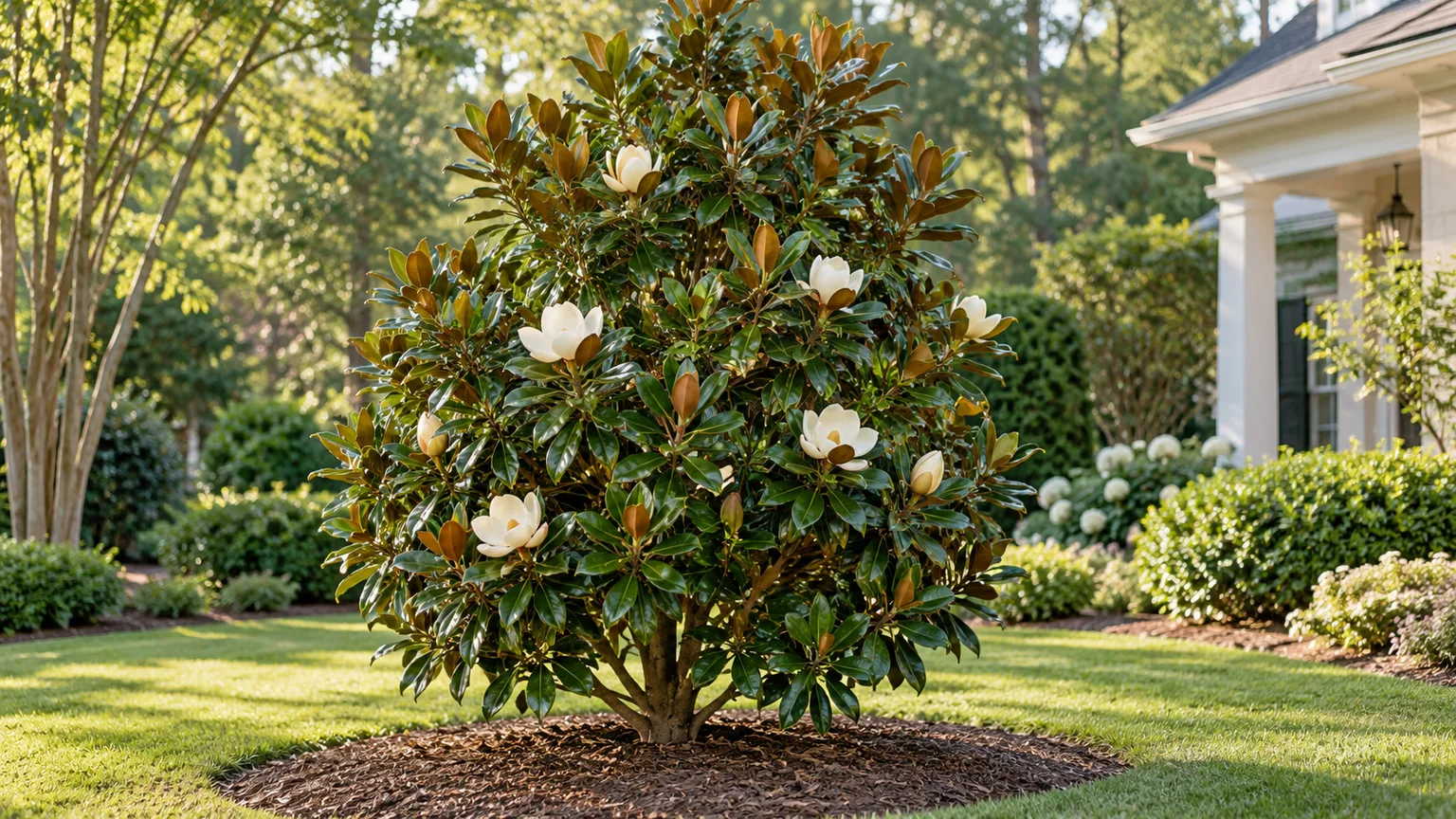
Southern magnolia is an evergreen tree that makes a strong impression: glossy leaves with rusty-brown undersides, large fragrant white flowers, and a broad, dense crown. The trade-off is scale. A standard tree can eventually reach 60 to 80 feet tall and 20 to 40 feet wide, so the first care decision is not fertilizer or pruning—it is whether your site can carry the tree for decades. North Carolina State Extension describes it as a large specimen for spacious yards and warns that its shade, roots, and leaf debris limit what works beneath it. (NC State Extension)
Is a southern magnolia right for your yard?
Choose this tree when you want an evergreen focal point, shade, a privacy screen, or a windbreak and can give its crown and root zone room. It is a poor fit for a narrow strip between a house and sidewalk, a small courtyard where leaves will clog drains, or a lawn where you expect turf and shallow-rooted plants to thrive under the dense canopy. Think in terms of the tree’s mature silhouette, not the small ball of roots you see in a nursery pot.
The foliage stays year-round, but “evergreen” does not mean “no leaf litter.” Old leaves drop as new ones emerge, usually in waves rather than all at once, and the thick leaves take time to break down. Flowers can be spectacular, but the brown, cone-like fruit that follows also releases bright red seeds and adds seasonal debris. If you want a tidy, low-litter tree close to a patio, compare alternatives before buying; if the texture, shade, and wildlife value are worth a little cleanup, the magnolia can be a rewarding long-term specimen. (Virginia Cooperative Extension; UF/IFAS Extension)
Choose a cultivar for the space and climate
A seed-grown southern magnolia can vary in shape and density. Named cultivars provide more predictable traits, but nursery size labels such as “dwarf” are relative: even compact selections can become substantial trees. ‘Little Gem’ is commonly offered for tighter sites, while ‘Teddy Bear’ (also sold as ‘Southern Charm’) grows more upright and compact; ‘Bracken’s Brown Beauty’ is valued for its dense foliage and pronounced brown underside. UF/IFAS Extension’s cultivar notes give approximate mature dimensions that make clear why shoppers should ask for the specific cultivar rather than assume all southern magnolias are interchangeable. (UF/IFAS Extension Escambia County)
Before you buy, ask the nursery for the cultivar’s local mature height and width, cold hardiness, and whether the tree was grown from seed, cutting, or grafting. Compare the actual spread to the space you can reserve, then leave extra clearance for branches, maintenance access, and the broad root system. ‘Little Gem’ is still a tree, not a compact foundation shrub; Virginia Tech lists it at about 20 feet tall and notes that winter damage can be significant in colder conditions. A cultivar that survives a zone rating may still be exposed to drying wind, late freezes, or a colder pocket in your yard. (Virginia Cooperative Extension)
Pick a sheltered site with room to mature
Southern magnolia is native to the southeastern coastal plain, including moist bottomlands and wooded areas, but garden sites differ sharply from those habitats. Choose a position with good drainage, dependable moisture, and protection from persistent wind, especially in the cold edge of the tree’s range. Its large evergreen leaves lose water during winter weather and can be battered by exposed winds; a sheltered microclimate may matter as much as a headline hardiness zone. The Royal Horticultural Society notes that cold or exposed sites can damage evergreen magnolia foliage and that M. grandiflora may need protection where temperatures fall below about 23°F. (RHS Growing Guide)
Walk the site before planting. Note overhead wires, the future shade footprint, driveways, sidewalks, septic components, utility lines, and places where fallen leaves will collect. Magnolia roots are wide-spreading and mostly near the surface; they are not automatically destructive, but a root zone squeezed by paving or repeated excavation is a poor match. Keep the planting well away from infrastructure where possible, and do not plan to relocate a mature tree later. UF/IFAS describes the root system as unusually broad and warns that field-grown trees can recover slowly after transplanting. (UF/IFAS Extension)
How to plant a southern magnolia
Plant a container-grown tree in a cool, mild part of the year when the soil is workable and you can keep it watered. Spring or fall is usually practical; avoid the heat of midsummer, frozen ground, and a period when you cannot monitor moisture. A smaller nursery tree is often easier to establish than a large specimen because less of its root system is disturbed during planting and transport. Water the root ball before removing the container, and handle the trunk and root ball rather than pulling on branches.
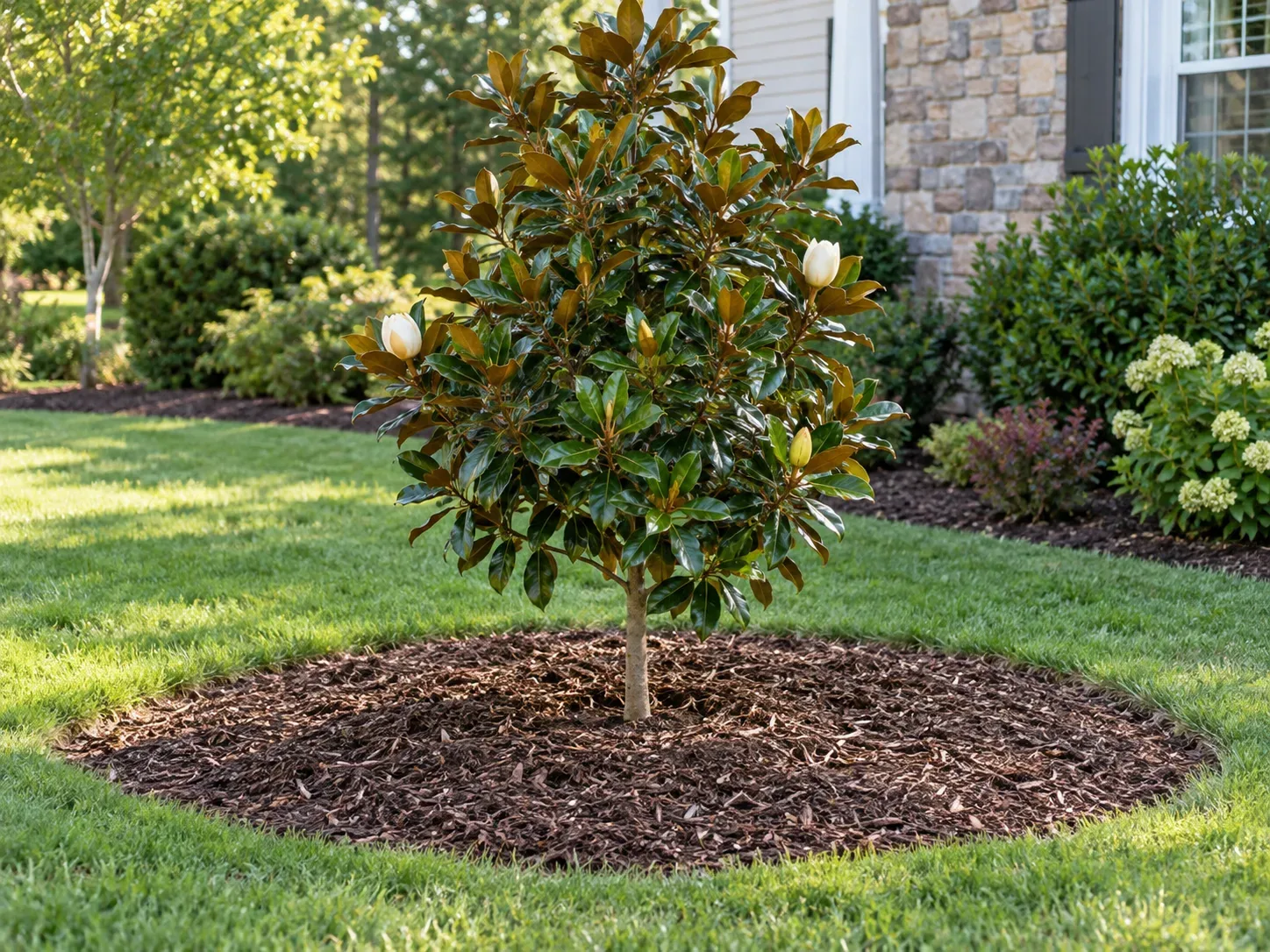
Dig a broad hole but no deeper than needed to set the root flare at or slightly above the surrounding grade. Loosen circling roots around the outer root ball; if the root system is tightly matted, use clean pruners to correct only the circling roots you can identify rather than shredding the whole ball. Backfill with the soil you removed, water slowly to settle it, and avoid creating a basin that traps water around the trunk. BBC Gardeners’ World recommends preserving magnolia’s fleshy roots during planting, while USDA NRCS guidance for southern magnolia emphasizes planting high enough to avoid burying roots and encouraging poor root direction. (BBC Gardeners’ World Magazine; USDA NRCS Plant Guide)
Keep the root flare visible
The root flare is where the trunk widens into the first major roots. If it disappears below soil or mulch, remove excess material until you can see that transition; do not bury the trunk to make the tree look neatly “set” in the bed. A small, visible rise above grade can be appropriate in slower-draining soil, but do not leave fine roots exposed to air. In heavy clay or a site that stays wet, planting slightly high and shaping a gentle, wide mound is safer than digging a deep bowl that holds water.
Light: balance sun, heat, and establishment
Full sun to partial shade suits southern magnolia. More sun generally supports a fuller crown and stronger flowering, but a newly planted tree in a hot, dry landscape may establish better with some afternoon protection until its roots extend into the surrounding soil. In deep shade, the tree may become open or lean toward light and can produce fewer flowers; in reflected heat beside paving, the young root ball can dry faster than the larger yard soil.
Use the tree’s age and site to decide whether to add protection. If leaves are scorched on the exposed side during the first summer, check soil moisture and root-ball dryness before blaming sunlight alone. A temporary shade cloth or a carefully chosen site can reduce stress during establishment, but do not wrap the canopy tightly or keep a mature tree in heavy shade as a substitute for water. UF/IFAS describes the species as suitable for full sun to partial shade and as more drought tolerant where roots have plenty of soil to explore. (UF/IFAS Extension)
Soil and drainage: moist is not waterlogged
The tree adapts to sand, loam, and clay, but its best growth comes from soil that holds some moisture without staying saturated. A slightly acidic soil is preferred; that preference is not a reason to add sulfur, peat, or acidifying fertilizer without a soil test. If a test shows high pH or a nutrient imbalance, use the local extension lab’s recommendations rather than trying to force the reading with a generic “acid-loving plant” product. Virginia Tech lists a broad soil pH range while still recommending good drainage and acidic conditions. (Virginia Cooperative Extension)
Check drainage before planting by watching the site after a heavy rain. If water remains pooled for a long time, choose a higher location or improve the broad planting area rather than putting gravel in the bottom of the hole; a gravel layer does not fix a poorly drained profile and can leave the roots sitting in a water-filled pocket. Southern magnolia tolerates occasional wetness better than many trees, but prolonged waterlogging starves roots of oxygen and can contribute to decline. Conversely, very fast-draining sand may need more frequent attention while the tree establishes.
Watering through establishment and drought
For the first growing season, water deeply enough to wet the original root ball and the soil immediately around it. Check the moisture with a finger or narrow trowel several inches down; if it is dry there, water slowly, then let excess drain before watering again. A fixed weekly schedule fails when a cool week turns into a heat wave, or when clay remains wet after rain. Rainfall, soil texture, root-ball size, and exposure should determine the interval.
Continue checking regularly for the first few years, especially through hot, dry weather. Roots do not instantly occupy the whole future canopy area, so a newly planted tree can wilt even when nearby lawn looks green. Expand the watered area as the tree grows; do not keep pouring water only against the trunk. Once established in a moisture-retentive site, a southern magnolia may need little supplemental irrigation except during prolonged drought. In restricted, hot, or sandy sites, expect to water more often. (UF/IFAS Extension; Gardeners’ Path)
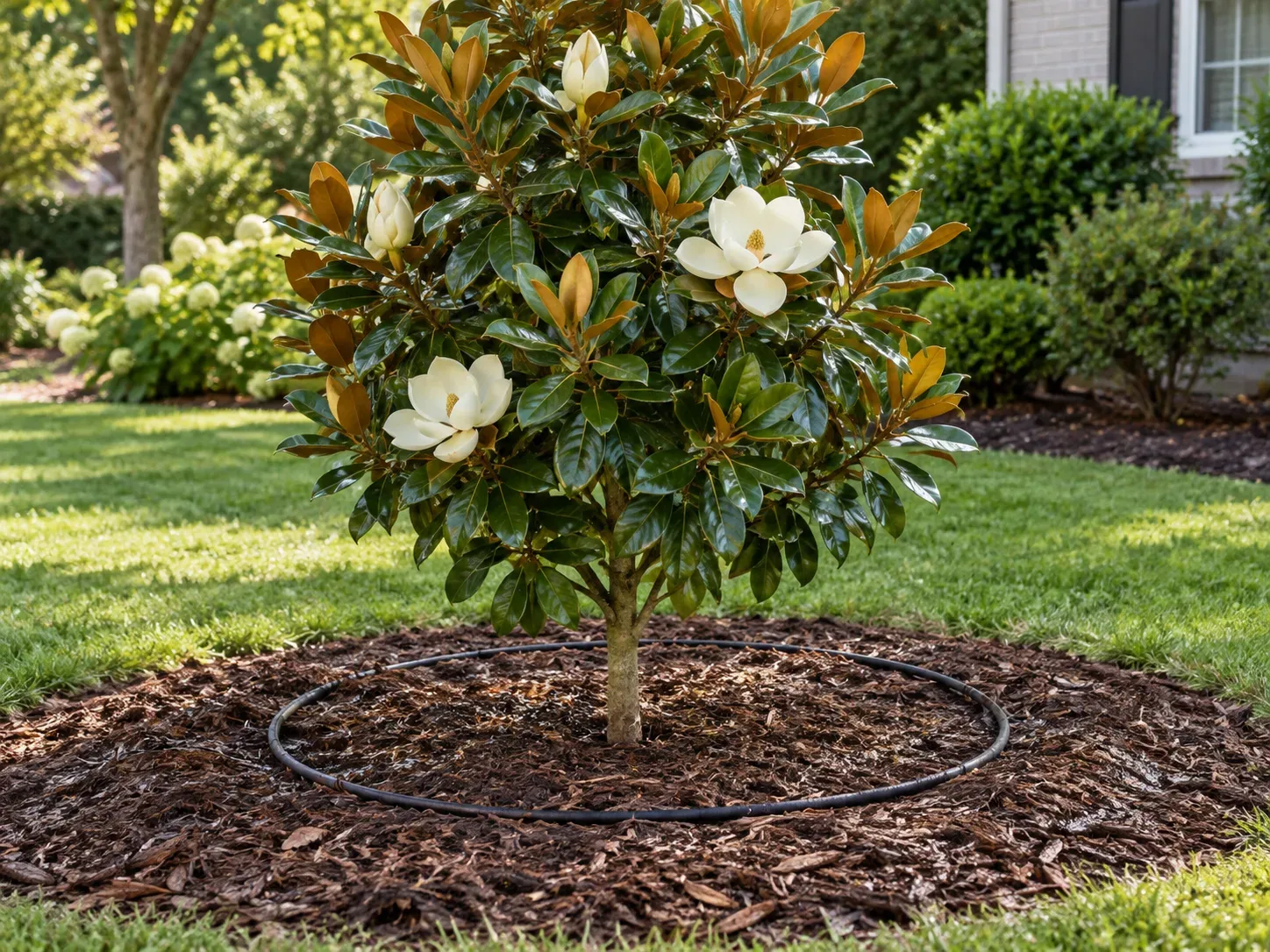
If leaves begin to brown, check both extremes before changing the watering routine. Dry soil around the root ball suggests drought stress; soil that stays wet for days, a sour smell, or progressive branch dieback points toward drainage or root problems. Water at the root zone in the morning when practical, and avoid frequent shallow sprinkling that wets only the surface. A slow hose trickle or drip line is more useful than blasting the trunk with a sprinkler.
Mulch and root-zone care
Spread a two- to three-inch layer of organic mulch over a broad ring, extending at least to the edge of the root ball and farther as space allows. Keep mulch several inches away from the trunk so the bark stays dry and the root flare remains visible. A wide ring reduces competition from turf and helps soil hold moisture; a tall mulch volcano against the trunk traps moisture, hides problems, and encourages roots to grow in the wrong place.
Avoid digging, trenching, or frequently cultivating beneath the canopy. Southern magnolia roots can be shallow, and cutting them to install edging, new paving, or a garden bed can reduce water uptake and destabilize the tree. The dense shade and leaf residue also make lawn and many understory plants unreliable there. If you want a planted look, choose a few shade-tolerant groundcovers at the outer edge, plant them with small holes, and leave most of the root zone mulched rather than turning it into a conventional border. (NC State Extension; USDA NRCS Plant Guide)
Fertilizer: test before you feed
Do not make three annual fertilizer applications part of the routine simply because the tree is evergreen. Fertilizer will not correct drought, poor drainage, deep planting, root damage, or the normal slow growth of a young magnolia. If the tree is growing normally and foliage color is consistent with the cultivar, leave it alone; excessive nitrogen can push tender growth and does not guarantee more flowers.
If growth is weak or leaves are unusually pale, inspect water, drainage, root flare, mulch depth, and nearby construction first. A soil test can identify pH or nutrient issues and tell you whether fertilizer is justified. Follow the product label and local extension advice for rate and timing, and apply it across the root zone rather than against the trunk. For a tree newly planted into reasonably fertile soil, the most important inputs are good placement and steady establishment moisture, not a bag of fertilizer.
Flowers, fruit, and normal leaf turnover
Southern magnolia’s large white flowers usually open from late spring into summer, though timing and abundance vary with cultivar, climate, age, and conditions. The blooms are fragrant and short-lived; individual petals brown and drop after flowering. A cone-like fruit develops after pollination and eventually exposes bright red seeds that birds and other wildlife eat. The fruit and the old leaves can be messy around lawns, sidewalks, and patios, so account for the cleanup before selecting a high-traffic planting site. (UF/IFAS Extension)
Expect some old leaves to fall as the new flush appears. A handful or a seasonal carpet of older leaves is not, by itself, evidence of a disease. Look at the pattern: normal turnover is spread through the canopy and accompanied by healthy new growth, while sudden defoliation, widespread yellowing, or dead branch tips deserve a closer check of moisture, roots, frost, and pests. Thick leaves decompose slowly; chop them with a mower or use them as a coarse mulch where they will not smother small plants.
Prune lightly and preserve the natural crown
Southern magnolia generally needs little pruning. Remove dead, broken, rubbing, or poorly attached branches, and make structural corrections while branches are still small enough to handle cleanly. If you need to raise the canopy for a path or vehicle, remove a few lower branches gradually instead of stripping the trunk in one season; the lower limbs are part of the tree’s characteristic dense form and removing them changes screening and shade.
Prune after the main flowering period if you need to shape the tree, while avoiding the removal of developing flower buds. Make cuts just outside the branch collar and do not top the tree or shear it into a formal shape. Heavy pruning can leave large wounds, expose bark to sun, and trigger unattractive regrowth; if a mature tree has a major structural defect or limbs over a roof, consult a qualified arborist. BBC Gardeners’ World and the RHS both advise against routine hard pruning and recommend spreading renovation over multiple years when it is unavoidable. (BBC Gardeners’ World Magazine; RHS Growing Guide)
Small yards and container growing
A standard southern magnolia is rarely a true small-yard tree. If your available planting width is substantially less than the cultivar’s expected mature spread, choose a smaller species or tree rather than planning to keep a large magnolia permanently clipped. ‘Little Gem’ and ‘Teddy Bear’ are more compact than the species form, but still need clearance from buildings, utilities, pavement, and the next tree. Ask for local mature dimensions and allow for variation; retail tags may describe nursery growth rather than the final crown.
Container growing can work for a genuinely compact cultivar while it is young, but it adds watering and winter-protection chores and does not erase the tree’s eventual size. Use a large, stable pot with drainage holes, quality potting mix, and a spot with enough sun; check moisture more often than you would in the ground because containers dry quickly. Pot-bound roots, poor drainage, or repeated freeze-thaw exposure can make a potted evergreen magnolia struggle. Treat a container as a temporary or deliberately managed setup, not a way to turn a full-size tree into a permanent patio bonsai.
Propagating from seed or cuttings
Seed is the simplest route when you want to raise a tree and do not need an exact copy of the parent. Collect mature seed cones as they begin to split, remove the red fleshy coating, and sow or cold-stratify cleaned seed according to your local season. Seedlings can vary in mature form, growth rate, flower timing, and foliage; they may take years to bloom, so use seed for experimentation rather than cultivar replication. The Royal Horticultural Society describes cleaning the seed and chilling it in moist medium before sowing. (RHS Growing Guide)
Cuttings can preserve a named cultivar, but rooting success depends on timing, humidity, maturity of the shoot, and skill. Gardeners’ Path describes taking young cuttings, using a free-draining propagation medium, and maintaining even moisture while roots develop; this is a more involved project than planting a nursery-grown cultivar. Layering a low branch is another option where a branch can be bent and kept in contact with moist soil. If you need a predictable tree for a specific spot, buy a properly labeled cultivar from a reputable nursery and ask how it was propagated. (Gardeners’ Path; RHS Growing Guide)
Troubleshooting a stressed magnolia
Before treating a symptom, record where it starts, whether it affects old or new foliage, and how quickly it is spreading. Photograph one affected branch and the whole crown, then check soil moisture and look for recent transplanting, root disturbance, mower or string-trimmer injury, frost, or scale. A single spot or old leaf is not enough to diagnose a disease, and a pesticide is not a substitute for correcting the growing condition.
Brown or yellow leaves
Brown leaf edges or tips can reflect dry soil, winter wind, cold injury, salt exposure, root damage, or over-wet soil that has harmed roots. First check the moisture several inches down around the original root ball and farther out, then check whether water drains after irrigation. If the tree was planted recently, check that the root flare is not buried and that mulch is not piled against the trunk. Do not respond to brown leaves by watering every day until you know the soil is actually dry.
If browning appears after a cold or windy spell and is limited to the exposed side, protect young trees from future desiccating wind and wait for new growth before pruning live branches. If new leaves and branch tips are progressively dying, or the soil remains saturated, contact a local extension office or certified arborist with photographs and site history. Evergreen magnolias naturally shed older leaves, but shedding should not be used to dismiss widespread decline. (RHS Growing Guide; UF/IFAS Extension)
Few or no flowers
A young tree may need time before it flowers, and cultivar differences affect when blooms begin. If an established tree is not blooming, check in this order: Is it receiving enough light? Was it pruned heavily or at the wrong time? Is it being stressed by drought, root disturbance, or waterlogged soil? Is it a seedling with variable flowering habits? Correct the condition you can verify, then give the tree a full growing season to respond rather than adding fertilizer as a first guess.
Scale, leaf spots, and dying branches
Southern magnolia is generally resilient, but scale insects may colonize twigs and leaf undersides. Look for stationary bumps, sticky honeydew, ants, or a black sooty coating; identify the insect before choosing a control, and consult your local extension service for timing and locally appropriate treatment. A leaf spot that remains limited may be cosmetic, while expanding lesions with dieback call for a closer diagnosis. Remove and dispose of heavily affected fallen leaves, and avoid wetting the canopy late in the day.
Dead branches can result from physical injury, drought, saturated roots, canker, or other decline; cutting off symptoms without finding the cause can leave the problem in place. Prune only clearly dead or damaged wood with clean tools, and seek an arborist if dieback is rapid, the trunk is cracked, or large limbs are involved. UF/IFAS notes susceptibility to Verticillium wilt, so do not assume every branch problem has the same fix. (UF/IFAS Extension; NC State Extension)
Conclusion
Southern magnolia is easiest to care for when its mature size, root zone, and seasonal litter are accepted before planting. Choose a cultivar suited to your climate, set the root flare at or just above grade, keep the soil evenly moist while roots establish, and use a wide mulch ring without burying the trunk. Once settled, it usually asks for light corrective pruning rather than routine shaping or heavy feeding.
If your tree is already planted, begin with the basics: verify that water reaches the root ball, make sure it drains, expose a buried root flare, and protect the broad root zone from digging and compaction. With the right site and a little patience, Magnolia grandiflora can provide year-round structure, fragrant flowers, and a dependable canopy for many years.



