Northern Bush Honeysuckle: Care, Growing, and Pruning
Grow Diervilla lonicera in sun or part shade. See how to plant, water, prune, manage suckers, and tell native bush honeysuckle from invasive Lonicera.
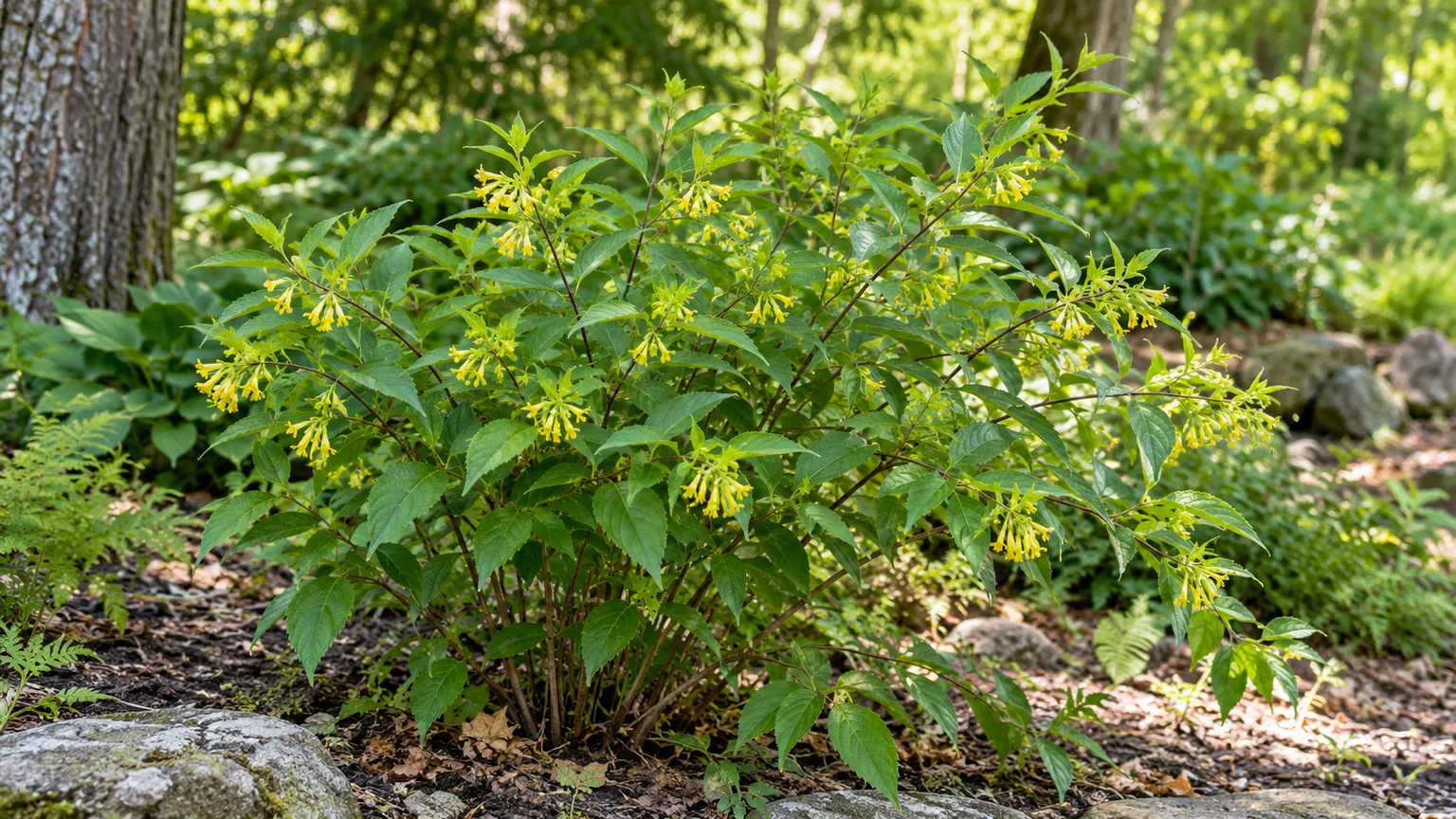
Northern bush honeysuckle (Diervilla lonicera) is a compact, deciduous shrub for gardeners who want summer flowers and a plant that can knit together a woodland edge, rocky bank, or informal border. It tolerates more than one soil texture and light level, but its suckering habit means you should choose a site where gradual expansion is useful.
The common name creates a real identification trap: Diervilla lonicera is not one of the invasive shrub honeysuckles in the genus Lonicera. Confirm the botanical name before buying, planting, or removing a plant. Once you have the right species, the practical routine is straightforward: plant it in sun or light shade, water while it establishes, and decide whether to let the clump spread or trim its edges.
First, confirm this is native bush honeysuckle
The first step is to check the label for Diervilla lonicera. “Bush honeysuckle” is used loosely for more than one plant, and invasive shrub honeysuckles such as Amur (Lonicera maackii), Morrow’s (L. morrowii), and Tatarian (L. tatarica) are different species in a different genus. Japanese honeysuckle (L. japonica) is an invasive vine in many parts of North America. A common name alone is not a safe basis for identification.
Northern bush honeysuckle is a low, rounded, multi-stem shrub, usually about 2 to 4 feet tall. Its paired leaves have toothed edges; clusters of small yellow, tubular flowers appear in summer and can age toward orange or reddish tones. The flowers are followed by dry, pointed capsules rather than the showy red or orange berries typical of many invasive shrub Lonicera. Native Plant Trust’s Go Botany profile describes its small stature, opposite leaves, yellow-orange flowers, and capsule fruit.
| Clue | Northern bush honeysuckle (Diervilla lonicera) | Common invasive shrub honeysuckles (Lonicera spp.) |
|---|---|---|
| Growth form | Compact, usually 2–4 feet tall; spreads by suckers | Large arching shrub, often 6–20 feet tall |
| Leaf edge | Toothed | Usually smooth-edged |
| Flowers | Small yellow tubular flowers, often in pairs or small clusters | Fragrant four-petaled flowers, often white then yellow or pink |
| Fruit | Dry capsule | Shiny red, orange, or pinkish berries |
| Stem center (pith) | Solid | Hollow brown pith in the invasive shrub group |
| Leaf arrangement | Opposite pairs | Opposite pairs |
Opposite leaves occur in both groups, so that clue does not settle the question. Penn State Extension’s identification guide recommends looking at several traits together: invasive shrub honeysuckles tend to be much taller, have entire leaf margins, and have a hollow brown pith; the native bush honeysuckle has toothed leaves and solid pith. Virginia Tech’s invasive honeysuckle overview also cautions gardeners not to mistake Diervilla lonicera for exotic Lonicera species.
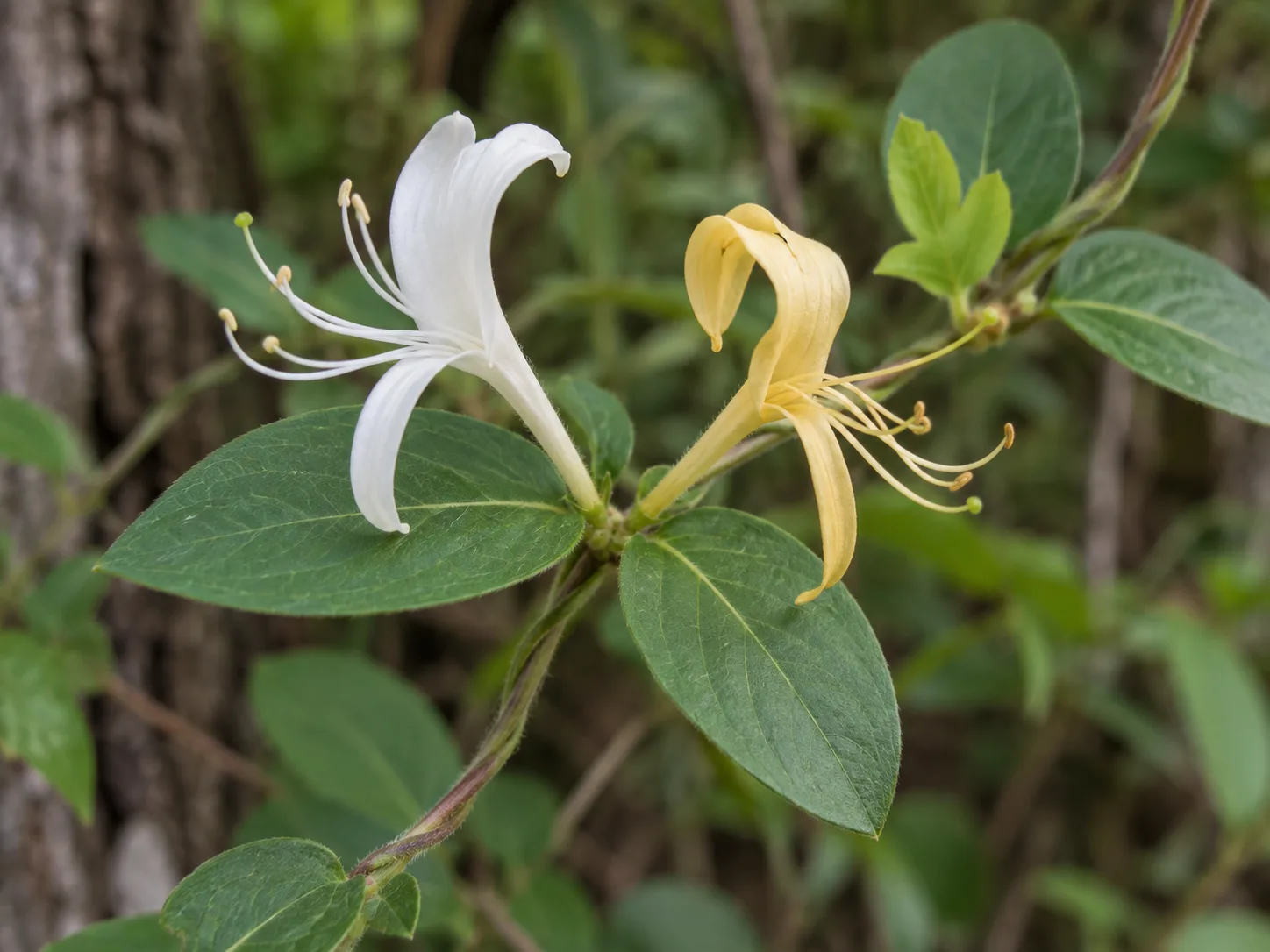
If a shrub is not flowering or you only have a few leaves, identification may be less certain. Do not cut a plant down because a label, neighbor, or search result called it “honeysuckle.” Photograph its leaves, flowers, fruit, whole growth form, and—if a stem is already broken—its pith, then compare those observations with a regional extension key or ask a county extension office or native-plant society.
“Native” also depends on place. D. lonicera is native across parts of eastern North America, but that does not mean it is locally native everywhere in the United States. Tennessee Smart Yards, for example, lists it as occurring in eight Tennessee counties and notes its threatened status there. Check a local flora or state native-plant database before using a broad national label to make an ecological decision.
Does northern bush honeysuckle fit your garden?
This shrub is most useful where a compact woody plant can spread slowly into a wider clump. It suits woodland edges, open shade, rocky slopes, informal low hedges, and naturalized borders. Its roots and suckers can help fill bare soil over time, but it is not a tight, evergreen screen or a plant that stays exactly within the outline of its original nursery pot.
Think about its mature footprint before planting. If the bed is narrow or crowded with small perennials, reserve room for a 3- to 5-foot-wide clump or plan to remove outer suckers every year. In a larger bed, on a bank, or at the edge of a woodland garden, the same spreading habit can reduce bare patches and make the planting look more established. University of Tennessee’s Tennessee Smart Yards profile notes that it spreads more aggressively in rich, moist soil and is better restrained in fairly dry conditions.
Use a local source when ecological fit matters more than a generic care label. In a region where D. lonicera is native, a locally sourced plant can support a planting designed around regional species. Outside its natural range, or near a sensitive natural area, confirm that it is appropriate for your county and ecoregion before planting; native status is not interchangeable across the continent.
Plant facts at a glance
| Feature | Typical description |
|---|---|
| Botanical name | Diervilla lonicera |
| Common names | Northern bush honeysuckle, dwarf bush honeysuckle, bush-honeysuckle |
| Plant type | Deciduous, suckering shrub |
| Mature size | Usually about 2–4 feet tall and 2–5 feet wide; site and cultivar affect size |
| Light | Full sun to partial shade; flowering is usually better with more light |
| Soil | Adaptable, but well-drained soil is the safer choice |
| Moisture | Medium to dry once established; water new plants regularly |
| Bloom | Yellow tubular flowers in summer; timing shifts with region and weather |
| Fruit | Dry capsules, not fleshy berries |
| Hardiness | Often listed for USDA Zones 3–7; verify the cultivar and local conditions |
Published dimensions and hardiness ranges vary. Gardenia’s horticultural profile lists a 2- to 3-foot height, 2- to 4-foot spread, and Zones 3–7, while university profiles give somewhat wider dimensions. Treat the numbers as planning estimates, not a guarantee that every plant will stop at the same height or spread.
Choose a site: light, soil, and drainage
For the fullest flowering and strongest fall color, choose a site with several hours of direct sun or bright dappled light. Northern bush honeysuckle can grow in partial shade, which makes it useful near a woodland edge or beneath open-canopy trees. In dense shade, it may remain alive and leafy but lose much of its ornamental effect and produce fewer flowers; Tennessee Smart Yards specifically cautions that deep shade reduces the plant’s display.
Soil texture is less important than drainage and establishment moisture. The shrub can grow in sandy, rocky, loamy, and some clay soils, but a spot that stays saturated after rain is a poor choice. If the ground is heavy, improve the whole planting area’s structure by loosening compacted soil and routing surface water away; do not create a small pocket of rich potting mix in dense clay, where water can collect around the roots.
The species is often described as preferring acidic to neutral soil, but routine pH correction is rarely the first move. A soil test is more useful when the plant repeatedly struggles or the site has a known soil problem. Avoid assuming that poor growth means it needs fertilizer: too much feeding can create lush, floppy growth without fixing shade, waterlogging, or poor establishment.
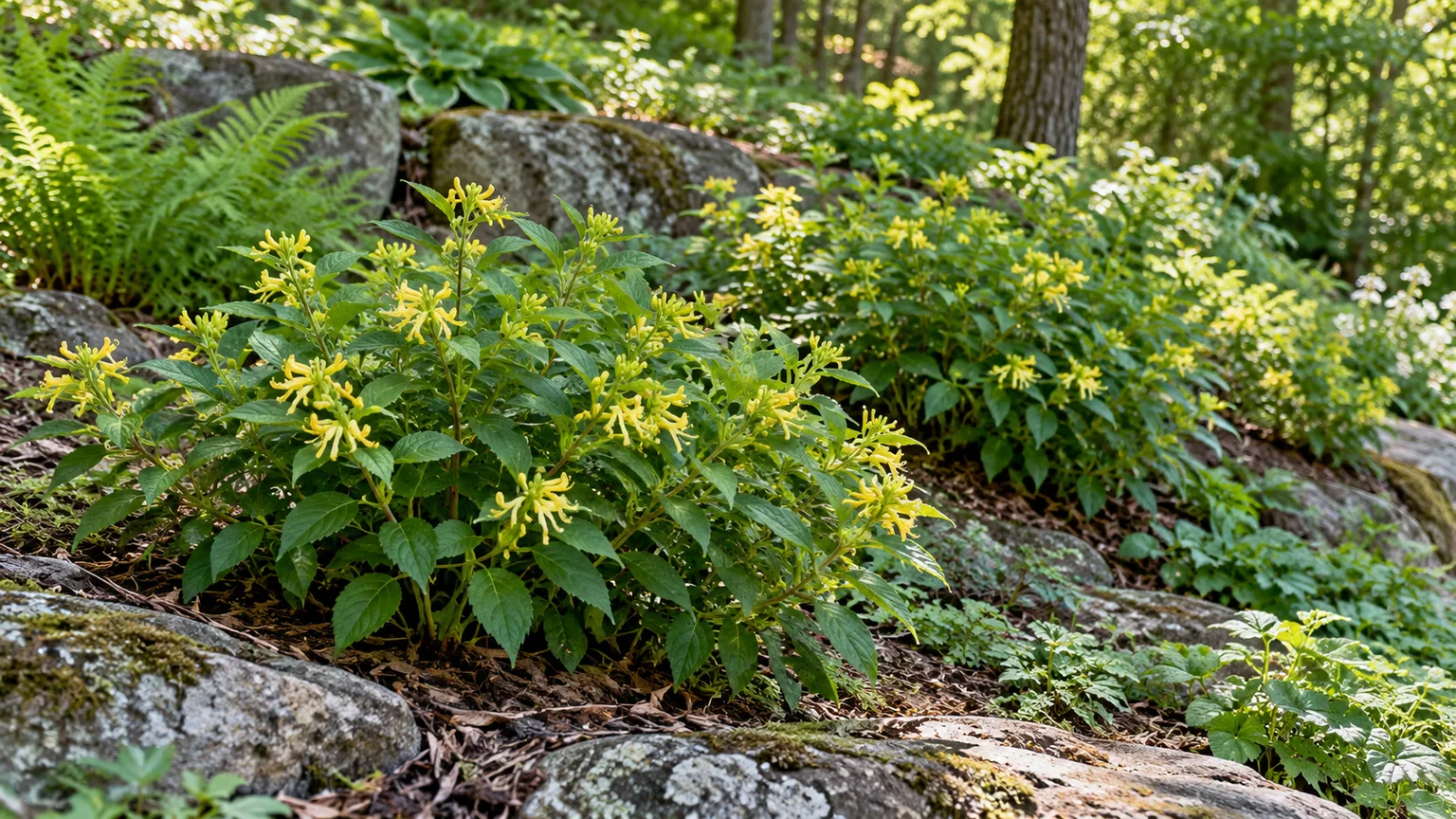
A rocky or sloping site can be a good match because the shrub tolerates leaner soils and its suckering growth gradually fills space. The University of Maine Cooperative Extension description documents the plant in rocky, open, and wooded habitats. Use it where a spreading colony is welcome, rather than as a precise accent that must hold a small, fixed shape.
Planting Diervilla lonicera
Plant a container-grown shrub in spring after the ground is workable or in early fall while the soil is still warm enough for root growth. Choose healthy stock labeled with the botanical name. If you are planting for a naturalized mass or low hedge, decide the intended boundary before you place the plants; it is easier to set a generous spacing now than to untangle a crowded bed later.
Dig a hole about twice as wide as the root ball and no deeper than the container’s soil line. Loosen circling roots gently, set the shrub so the crown is level with the surrounding soil, then backfill with the soil you removed. Water slowly to settle the root zone. A 2- to 3-inch mulch layer can moderate moisture and suppress weeds, but leave a small ring of open soil around the stems so the crown does not stay wet.
For a connected mass, start with about 3 to 4 feet between plants. Closer spacing closes gaps sooner but can create a dense patch that needs more thinning; wider spacing gives each shrub room to show its natural form and takes longer to fill. On a slope, stagger plants rather than lining them up directly downhill, and use other locally appropriate ground-layer plants between them if immediate soil cover is needed.
Do not heavily amend the planting hole with compost or fertilizer unless a soil test or a serious soil-structure issue gives you a reason. The goal is to help roots move into the surrounding soil, not to make a soft, nutrient-rich pocket that differs sharply from the rest of the bed. Water the new planting thoroughly and mark its edges so you can distinguish wanted suckers from weeds during the first season.
Watering, mulch, and fertilizer
Keep a new plant evenly moist while it establishes, especially during its first growing season and during hot, dry stretches. Water deeply at the root zone when the top few inches of soil begin to dry rather than giving frequent shallow sprinkles. The interval depends on rainfall, soil texture, wind, and sun; a newly planted shrub in sand may need checks more often than one in loam or partial shade.
After establishment, northern bush honeysuckle tolerates drier conditions and usually needs supplemental water only during prolonged drought. That does not mean it thrives in bone-dry soil everywhere. Watch the leaves and soil together: a short midday droop in heat is different from persistent wilting in dry soil, while wilting in saturated soil can point to root stress. Check moisture before watering so you do not worsen waterlogged roots.
Mulch is most useful during establishment and while the shrub is competing with weeds. Keep it a few inches away from stems and refresh it lightly as it breaks down. Mature plants do not need a scheduled fertilizer program. If growth is unusually weak, first check for deep shade, root competition, drought, waterlogging, or planting depth. Use a soil test before adding nutrients, and avoid high-nitrogen feeding that can push leaves and stems at the expense of a balanced shape.
Flowers, fall color, and wildlife
Northern bush honeysuckle offers a long stretch of summer interest rather than one brief flush. Its small, yellow tubular flowers appear in pairs or small clusters and may turn orange or reddish as they age. Flowering generally starts in early to midsummer, but local temperatures and exposure shift the calendar. A plant in more sun may bloom more generously than the same species in deep shade.
The flowers attract bees, butterflies, and hummingbirds, according to the Tennessee Smart Yards profile and Gardenia’s plant reference. That makes the shrub a useful midseason nectar source when placed among other regionally appropriate plants with staggered bloom times. Planting one shrub alone still provides flowers, but a small group can create a more visible patch in a larger pollinator garden.
The autumn display may include yellow, orange, red, or burgundy foliage, with color varying by exposure and weather. The dry capsules that follow flowering are botanically different from the fleshy berries of many invasive Lonicera species. Do not promise a specific fall color or a heavy wildlife display from every plant; age, light, water, and local conditions all affect the show.
Pruning: renewal versus shaping
Prune according to the job you want the shrub to do. For light shaping, remove broken, crossing, or wayward stems after flowering. That timing lets you enjoy the season’s flowers and makes it easier to see the plant’s outline. Use clean, sharp pruners and make cuts near the base of a stem or at a healthy branch junction instead of shearing the whole shrub into a hard-edged ball.
For renewal, remove a portion of the oldest, thickest stems near ground level in late winter or early spring, before new growth is underway. This opens the clump and encourages fresh stems from the base. Avoid removing all the old growth unless the shrub is badly overgrown and you are deliberately rebuilding its shape; a severe cut may leave a bare-looking spot until new shoots grow back.
Recommendations about timing differ because gardeners prune for different outcomes. Gardenia recommends pruning as needed immediately after flowering, while horticulturist Heidi-Hoe’s plant profile describes a hard early-spring trim to encourage fresh growth and a fuller display. The conservative default is to shape after flowering and reserve a stronger early-spring renovation for an established plant that needs rejuvenation. Do not prune late in fall just to make the shrub tidy; leave stems in place through winter unless they are damaged or obstructing a path.
Contain or encourage the suckering growth
The plant expands from its base by sending up new shoots. That makes it useful as a gradual groundcovering shrub, but it is still a plant that needs boundaries in a small garden. Check the edge once or twice during the growing season. Pull or dig young suckers that cross into a path, lawn, or neighboring planting, ideally when the soil is moist and the roots come free more easily.
If the shrub is filling a bank or woodland edge, let selected suckers remain and remove only those heading in the wrong direction. Keep a visible strip between the colony and plants that cannot compete with it. In a formal border, use a spade to sever unwanted shoots at the edge and remove the rooted section instead of repeatedly clipping foliage; clipping alone may leave the spreading root system in place to send up more stems.
Suckering does not make Diervilla lonicera the same kind of invasive plant as nonnative Lonicera. “Invasive” is an ecological status tied to species, place, and impacts; “spreading” describes growth. A native shrub can still outgrow a small bed, so manage it to suit your garden without treating the name as proof of invasiveness.
Propagating from suckers, cuttings, and seed
Rooted suckers are the simplest way to make another plant. In early spring or early fall, locate a young shoot at the edge of the clump and follow it down to a section with its own roots. Lift it with a spade, keeping as much root and attached soil as possible, then replant it promptly at the same depth. Water it well and keep the soil evenly moist until new growth shows that it has settled in.
Softwood or semi-hardwood cuttings are another option when you want to propagate a particular plant without digging up its root system. Take several healthy, nonflowering shoots, trim them below a node, and place them in a clean, moist propagation medium under bright indirect light. Keep humidity steady without leaving the medium waterlogged. Rooting success depends on shoot maturity and conditions, so take more cuttings than the final number of plants you need. Gardenia notes that both softwood and semi-hardwood cuttings can root readily.
Seed is slower and less predictable for a home gardener. The dry capsules are small, and germination may require a period of cold, moist conditions; use a current protocol from a native-seed supplier or extension source rather than assuming the seed will sprout in a warm windowsill pot. Seedlings also take longer to reach landscape size than a rooted sucker or nursery plant. If you collect seed, label it with the species and collection location and do not distribute it as a local ecotype unless you know its provenance.
Growing northern bush honeysuckle in a container
A container can work for a young plant or a patio planting, but it is not the easiest long-term setup. Choose a wide, heavy pot with drainage holes and room for the root system to expand. Use a well-drained container mix, set the crown at the same depth as in its nursery pot, and leave enough surface area to water thoroughly without runoff spilling over the edge.
Container soil dries and freezes faster than garden soil. Check moisture more often in hot weather, and water when the mix begins to dry rather than keeping it constantly wet. In winter, protect the pot from repeated freeze-thaw exposure by moving it to a sheltered, unheated place or insulating the outside, while allowing drainage to continue. Do not bring a dormant shrub into a warm room.
Because the plant naturally suckers and can reach several feet in width, a pot may need periodic root pruning, division, or a move into the ground. If you want a tidy accent plant that stays compact with little intervention, choose a naturally smaller cultivar or a different species; do not assume a container will permanently stop a determined shrub from expanding.
Troubleshoot common growing problems
Few flowers usually point to light or pruning. If the shrub gets only deep shade, move a young plant if possible or accept that it will function mainly as foliage and ground cover. A mature shrub that has been sheared repeatedly may also have lost much of its natural flowering structure; let it regrow, then thin selectively rather than cutting the whole plant every season.
A thin, open clump may need time or renewal. Newly planted shrubs often spend their first season establishing roots. Give them space, keep weeds down, and maintain moisture without waterlogging. If an older shrub has many tall, woody stems and few new shoots, remove some of the oldest stems at the base instead of topping the entire plant.
Wilting or collapse calls for a soil check before more water. If the root zone is dry, water slowly and deeply. If it is wet for days after rain, improve drainage or transplant a few healthy suckers to a better site; more water will not fix oxygen-starved roots. On sloping sites, check that runoff is not washing soil away from the root zone.
Leaf spots or powdery mildew are usually occasional foliage issues. Gardenia lists both among possible problems, though the shrub is generally described as low maintenance. Remove badly affected fallen leaves, avoid wetting foliage late in the day, and improve air circulation if a dense planting stays humid. Identify the cause before using a fungicide, and follow local extension guidance if symptoms recur or spread.
Broken stems after wet snow can be pruned out. The shrub may split or lose older stems under heavy snow, particularly if it has grown tall and dense. In late winter, cut damaged wood back to a healthy branch or the base. If snow damage happens repeatedly, thin some old stems and keep the shrub lower through gradual renewal pruning.
Seasonal care calendar
| Season | What to do |
|---|---|
| Early spring | Plant or move rooted suckers while the ground is workable; remove broken or oldest stems if renewal is needed; top up mulch without burying the crown. |
| Late spring | Check new plants for moisture and weeds; note where shoots are emerging so you can keep or remove them intentionally. |
| Summer | Enjoy flowers and pollinator activity; water new plants during dry spells; shape lightly after flowering if needed. |
| Fall | Plant nursery stock early enough for roots to settle; water during an extended dry spell before the ground freezes; remove suckers outside the planned footprint. |
| Winter | No special covering is needed for an in-ground plant in a suitable climate; leave the structure intact unless stems are broken or hazardous. |
Use that calendar as a regional guide, not a fixed date schedule. A cool northern site and a warmer southern garden will reach the same stage at different times. If your local plant source lists a different bloom or pruning window, follow the local timing.
Conclusion
Northern bush honeysuckle is a useful native shrub when its botanical identity and spreading habit fit the site. Plant Diervilla lonicera in sun or light shade, give it water as it establishes, and leave room for a low colony—or remove suckers to keep it within a border. Before you buy or remove any “bush honeysuckle,” verify the Latin name and compare several identification traits. That one check prevents a native shrub from being confused with invasive Lonicera species and lets you choose the right plant for your region and garden.



