How to Identify & Remove Oriental Bittersweet
Identify Oriental bittersweet by fruit along the stem, distinguish native American bittersweet, and choose a removal method with realistic follow-up steps.
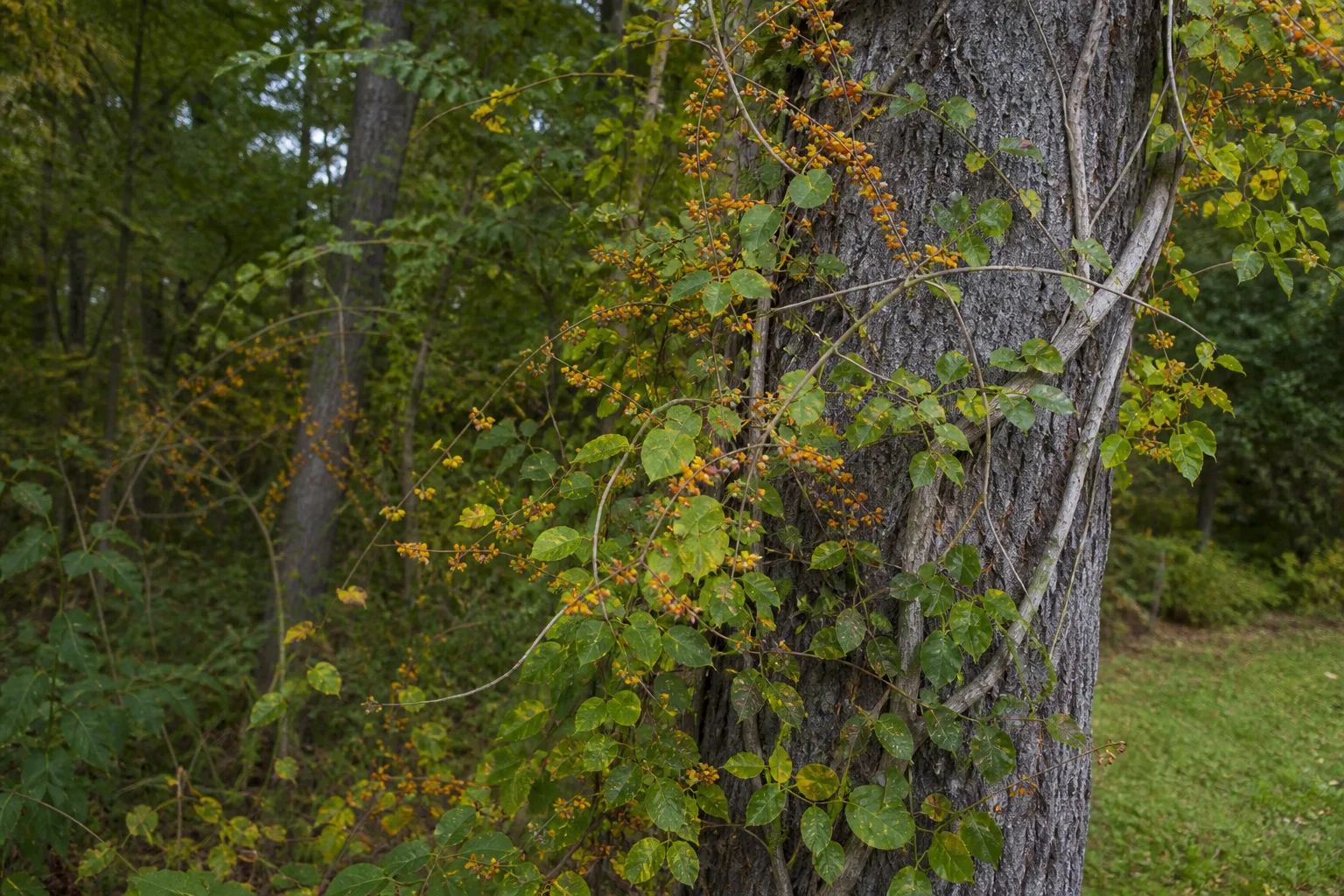
Oriental bittersweet (Celastrus orbiculatus) is a nonnative, woody vine that can wrap around shrubs and trees, spread across a canopy, and send up new shoots from an established root system. Dense foliage shades a host while tightening stems can constrict its trunk; the added weight can break limbs, and severe infestations can kill trees. Penn State Extension and Mount Grace Land Conservation Trust describe these risks. If you have found a few seedlings, act while they are easy to pull; if the vine is already climbing a tree, cut it free at a safe height and leave the upper growth where it is. Pulling a heavy vine out of a tree can break limbs, strip bark, or put you under falling wood.
The most useful identification clue is not simply “round leaves” or “orange berries.” Look for small flowers or fruit attached along the stems at leaf axils, then compare the whole plant with native American bittersweet before you remove it. The steps below help you confirm the vine, choose a control method for its size and setting, contain seed-bearing material, and plan for the regrowth that often follows.
First, Contain the Spread and Confirm the Plant
Before cutting, take a few clear photographs of the leaves, the way the stem climbs, and any flowers or fruit. If the plant is bearing fruit, avoid shaking or dragging it through the yard; Oriental bittersweet seed can be carried by birds, and fruiting material can also be moved by people. Do not make a wreath, compost a fruiting vine, or pass cuttings to someone else.
Next, note where the vine is growing and what it is attached to. A seedling in a mulched bed is a very different job from a mature stem woven through a tree crown, along a fence, or into a wetland edge. Mark the limits of the patch, look for a second stem or root sprout a few feet away, and decide whether you can work from the ground without disturbing desirable plants.
If the berries are still attached, keep the cut material contained while you learn the disposal rules for your town or county. Do not carry a load of fruiting vines to a compost pile or green-waste site unless that facility explicitly accepts invasive plant material. In Pennsylvania, for example, Penn State Extension identifies the species as a noxious weed that cannot be sold, propagated, or intentionally planted there; that state-specific rule is not proof that every jurisdiction follows the same policy.
Oriental Bittersweet Identification: Read the Whole Plant
Oriental bittersweet is a twining, deciduous vine. It does not climb with adhesive pads or tendrils; its stems wind around a support and can tighten as they thicken. The vine may begin as a low, easily overlooked plant, then climb a shrub or tree and spread through its branches, so inspect the ground as well as the canopy.
No single leaf shape is enough to confirm the species. A better field check combines the stem’s twining growth, alternate toothed leaves, inconspicuous flowers or fruit located in the leaf axils, and the distinctive yellow-orange capsule that opens to show red seed coverings in fall. Penn State Extension’s current identification guide describes these traits and notes that leaf shape can change along the vine, from rounded lower leaves to more elongated leaves higher up.
Leaves, Stems, and Roots
Leaves are arranged one at a time along the stem rather than opposite each other. They are usually rounded to oval, with small teeth along the edge; some leaves have a more pointed tip or a longer, football-like shape. That variation is why “round-leaved” is a clue, not a reliable test by itself.
Young stems are green and flexible. Older stems become woody and may develop textured, cracked bark; the vine can grow into a heavy, rope-like trunk as years pass. If a small seedling can be safely lifted, its roots may show orange coloring, but you do not need to excavate a large root system just to confirm an established vine. Digging around desirable tree roots or disturbing a large patch can create more work than the identification question requires.
Flowers and Fruit Give the Best Seasonal Clues
Small greenish flowers appear in late spring or early summer at the leaf axils—the points where leaves join the stem. Because Oriental bittersweet has separate male and female plants, a vine with no fruit may still be Oriental bittersweet; lack of berries is not a clean bill of health. The fruit is most conspicuous in fall, when the yellow to orange outer capsule opens and exposes red, fleshy seed coverings.
The axillary fruit pattern is especially valuable after leaves begin to drop: fruit clusters occur along the length of the stem rather than only at its ends. Penn State Extension notes that fruit can remain visible into winter, making a dormant vine easier to spot from a distance. If you see only a few leaves or a young nonfruiting shoot, wait for more evidence or ask a local extension office or invasive-plant program to review your photos before removing a plant that could be native.
Oriental vs. American Bittersweet: Check Where the Fruit Sits
American bittersweet (Celastrus scandens) is a native vine that can be mistaken for its invasive relative. It can be uncommon or protected in some places, so do not treat every vine called “bittersweet” as a target. The most useful comparison is where the flowers and fruits are arranged, not whether one leaf looks rounder than another.
| Field mark | Oriental bittersweet | American bittersweet |
|---|---|---|
| Flowers and fruit | Occur along the stem at leaf axils | Cluster mainly at the shoot tips |
| Typical leaves | Often round to oval, sometimes elongated; finely toothed | Often more elongated; finely toothed |
| Fruit display | Yellow-orange outer capsule opens to reveal red seed coverings | Fruit clusters are concentrated at branch ends |
| Confidence from leaves alone | Low to moderate | Low to moderate |
These are tendencies, not a substitute for a regional plant key. Leaf shape overlaps, both vines are deciduous and woody, and the two species can hybridize where they grow together. Penn State Extension recommends checking fruit or flower placement and notes that native American bittersweet is rare or vulnerable in some states.
When Leaf Photos or Seedlings Are Not Enough
If the plant is a small seedling with no flowers or fruit, do not make a high-impact decision from one blurry leaf photo. Photograph the entire plant, both sides of several leaves, the stem attachment points, and any climbing structures; record your state or region because local species and rules differ. Share the pictures with a county extension service, native-plant society, or state invasive-species program.
A nursery label is not infallible either. Penn State Extension warns that American bittersweet can be mislabeled as Oriental bittersweet, and Oriental bittersweet can be sold under the native name. When buying or protecting a vine, verify the botanical name and inspect the actual fruit arrangement rather than relying only on a common name. If a patch contains both types or shows mixed traits, get an expert ID before using herbicide or removing native vegetation.
Why Oriental Bittersweet Comes Back After Cutting
Cutting the visible stems removes the canopy load and stops that stem from producing more leaves, but the root system may stay alive. Oriental bittersweet sprouts from roots and cut stems, and one established root network can support multiple aboveground shoots. That is why a vine that looks gone after a single afternoon can reappear weeks or months later.
This is a control project, not a one-cut cleanup. A small seedling may be removed in one visit if the roots come out intact; a mature patch usually needs repeated checks and treatment over more than one growing season. Gardening Know How’s removal guide likewise frames eradication as a multi-season job, while local extension advice should determine the method for your site. The realistic success measure is a shrinking number of live stems and seedlings, no new fruit being produced, and fewer new shoots each year—not the promise that one method will permanently erase every root or seed.
Birds, Root Suckers, and Layering Make New Plants
Birds and other wildlife eat the colorful fruit and move seeds to new places in their droppings. Seeds can also be carried with decorative branches or discarded wreaths, so the vine can appear far from the original patch. North Carolina Cooperative Extension also describes spread by root suckers and stem layering, when a stem that lies along the ground can take root and establish another point of growth.
A new shoot is not always a separate seedling. It may be attached to a larger root system several feet away, or it may be one of several shoots emerging from a shared crown. Avoid assuming that pulling one visible stem has finished the job; inspect the surrounding ground, repeat the same route through the property, and look below trees where birds perch.
A practical containment order is: stop use of fruiting cuttings; remove accessible seedlings before they climb; sever established vines from host trees; then keep returning to cut or treat regrowth. Working first along the boundary between invaded and uninvaded ground protects the best remaining vegetation and gives you a more manageable edge to monitor. Penn State Extension recommends prioritizing less-invaded areas and maintaining spot removal because wildlife can introduce new seed even after a site has been treated.
Choose a Removal Method by Plant Size and Site
Choose by stem size, what the vine is touching, how close it is to water or desirable plants, and whether you can safely reach the work area. “Pull it all out” is appropriate for a young seedling in loose soil, but not for a woody vine tangled through a canopy. The least disruptive method is usually the one that removes or weakens the target while leaving the host tree and surrounding plants intact.
| Situation | First choice | What to expect |
|---|---|---|
| One or a few young seedlings in loose soil | Hand-pull or dig out the small crown | Recheck for missed roots and nearby seedlings |
| Slender vines on a fence or in an open bed | Pull if the root comes with the stem, or cut repeatedly | Any living root can send up new growth |
| Mature vine wrapped into a tree | Window-cut it from the ground where safely reachable; leave the canopy section | Top growth dies gradually; roots can resprout |
| Large patch or multiple vines at a woodland edge | Map the patch, work from less-invaded areas, and use repeated control | Plan for several seasons of follow-up |
| Near water, rare plants, power lines, or a roof | Pause and ask local extension, land manager, arborist, or utility for help | Method and permissions depend on site and jurisdiction |
If you are unsure which category fits, take photographs and ask for local advice before you apply anything. That pause matters around wetlands, drainage channels, conservation land, protected plants, and neighboring property lines; an otherwise ordinary yard treatment can become a non-target or legal problem in those settings. The field guide from UConn Extension likewise emphasizes early control and repeated monitoring over multiple years.
Pull Seedlings and Small Vines Before They Climb
Hand removal works best on seedlings and young shoots while roots are still small and the soil is moist. Grasp the stem close to the ground and pull slowly, following the root rather than yanking at the top; if the stem breaks, loosen the soil around the remaining crown and remove what you can without tearing through nearby desirable roots. A hand trowel can help with a small plant, but avoid chopping the root into several pieces.
If you find a group of shoots, look for the parent crown or a root connection. Pulling every shoot in a line may be easier after rain, when the soil releases roots without as much force, but stop when the work begins to disturb a tree or valuable planting. Do not rototill or aggressively cultivate an established patch: disturbance can damage surrounding plants and leave you with many more points to inspect.
Place pulled material on a tarp or in a bag while you work. If it has fruit, keep berries from falling onto soil and do not assume dry branches are harmless; the seeds may remain viable after the vine is cut. Ask your local waste authority whether bagged invasive plant waste belongs in regular trash or a designated disposal stream.
Make a quick return visit within a few weeks during the growing season. A root fragment or missed shoot can send up new growth after you leave, and a nearby seedling may have been hidden under another plant. Continue checking in spring and fall, when new seedlings and fruiting vines are easiest to notice.
Cut Large Vines Without Pulling Them From Trees
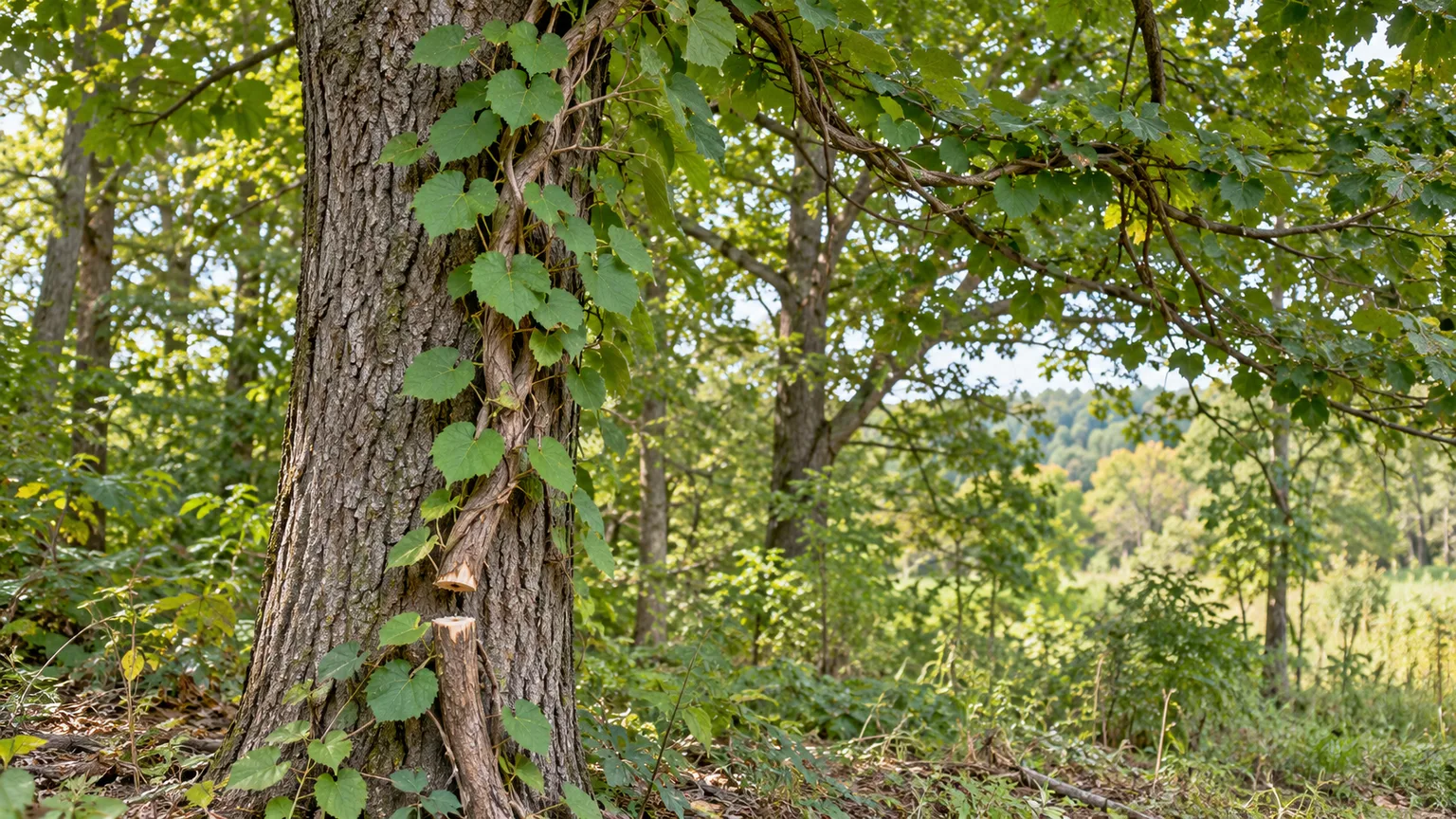
For a mature vine, the first job is to separate the canopy growth from its roots. Use sharp loppers for stems they can cut cleanly or a pruning saw for thicker wood, and cut only from stable ground at a height you can reach without a ladder or overhead swing. If the vine is close to power lines, a roof, a road, or a large dead limb, stop and call the relevant utility or a qualified arborist.
The window-cut approach makes the separation visible: cut the vine near ground level, then make another cut above it to remove a short section of stem. You can see the gap and know the upper vine no longer has a living connection to the roots. If multiple stems are wrapped around the trunk, identify each one and sever them individually; a single cut through the largest stem may leave smaller vines feeding the canopy.
Extension sources generally advise leaving the severed upper growth in the tree rather than dragging or pulling it down. A dead vine may be woven through branches; yanking can tear bark, snap limbs, or bring a heavy section down on the person working below. Once disconnected, its foliage dries and the vine gradually decays, although the time it takes to drop varies with the tree and the tangle.
Leave the Upper Vine to Dry and Fall
Do not climb the tree or try to strip the entire canopy in one session. The safest visible win is a clear gap near the base, not a perfectly bare trunk. If the upper vine is already dead, tangled high overhead, or heavy enough to pull down branches, leave it for a professional rather than using ropes or a vehicle to haul it.
After cutting, mark or photograph the stump so you can find it again. Check it for new shoots and inspect the root zone for sprouts; if the original stem is a thick woody trunk, the visible stump may be only one branch of a larger root system. University of Maine Cooperative Extension advises that nonchemical control can take several seasons of diligent removal of new shoots, while the upper vine can be left to wither and decompose rather than pulled from the tree.
Should You Use Herbicide? Match the Method to the Site
Herbicide can reduce the work of repeated cutting, but it is not automatically the best option for every yard. Consider it only if you can identify the vine confidently, protect neighboring plants, follow the product label, and comply with your state and local rules. If the vine is growing through a native planting or near water, a broadcast spray can injure desirable vegetation or create runoff concerns; ask a local extension specialist about an appropriate site-specific method.
Two approaches are commonly discussed for woody vines: a targeted cut-stump treatment on a freshly cut stem, and a foliar treatment on new foliage or regrowth. The right product and timing depend on its active ingredient, formulation, site, weather, and label directions. Do not copy a rate or calendar from another state, a different product, or a general online recipe.
Cut-Stump Treatment Is Targeted, but Not a One-Step Guarantee
A cut-stump application places a product labeled for that use onto the cut surface rather than spraying foliage across the site. This can reduce exposure of nearby leaves, but it still requires care: use an applicator that keeps liquid on the target stump, prevent runoff, and avoid contact with desirable stems or exposed roots. Follow the exact personal-protection, mixing, application, weather, and site instructions on the product label; the label and applicable state rules control what is allowed.
Timing instructions also vary by formulation. Penn State Extension lists certain cut-stump treatments as possible year-round when weather permits, while its foliar recommendations use a different seasonal window. These are not interchangeable instructions, and a “paint it immediately” rule for one water-based product may not apply to an oil-based product. If you cannot verify that the product label lists the site and treatment method, do not use it.
Even a correctly treated stump may not stop every root sucker. An established root system can send shoots up beyond the stump, so plan to monitor the surrounding area and treat or cut any regrowth using a locally appropriate method. If you prefer no herbicide, UConn Extension and Mount Grace Land Conservation Trust describe repeated cutting as a possible multi-season approach, provided new growth is not allowed to rebuild the vine’s canopy.
Foliar Timing Depends on Region and Regrowth
Extension guidance does not give one universal month for spraying. Penn State’s September 2025 guidance for Pennsylvania recommends waiting until cut vines have produced enough regrowth—about eight weeks in its guidance—and treating leaves later in the growing season. In contrast, a 2026 North Carolina Cooperative Extension post discusses foliar treatment in spring to early summer, when emerging leaves are more susceptible, and warns that a thicker cuticle later can reduce effectiveness.
Those schedules address different regions and may address different stages of growth, so do not turn either into a nationwide date. If you are considering a foliar application, ask your state extension office about the current recommendation for your plant stage and site, then follow the label for that exact product. Avoid windy weather, runoff, and spray drift onto any plant you want to keep; do not apply a product to a water-adjacent site unless its label and local authorities permit it.
For many homeowners, the most manageable plan is to cut the existing canopy safely, wait for accessible regrowth, and decide with local advice whether a targeted treatment is worth using. N.C. Cooperative Extension emphasizes that more than one treatment cycle is often needed, even when herbicide is part of an integrated plan. A single application is not a reason to stop checking the site.
Dispose of Fruit and Check Your Local Rules
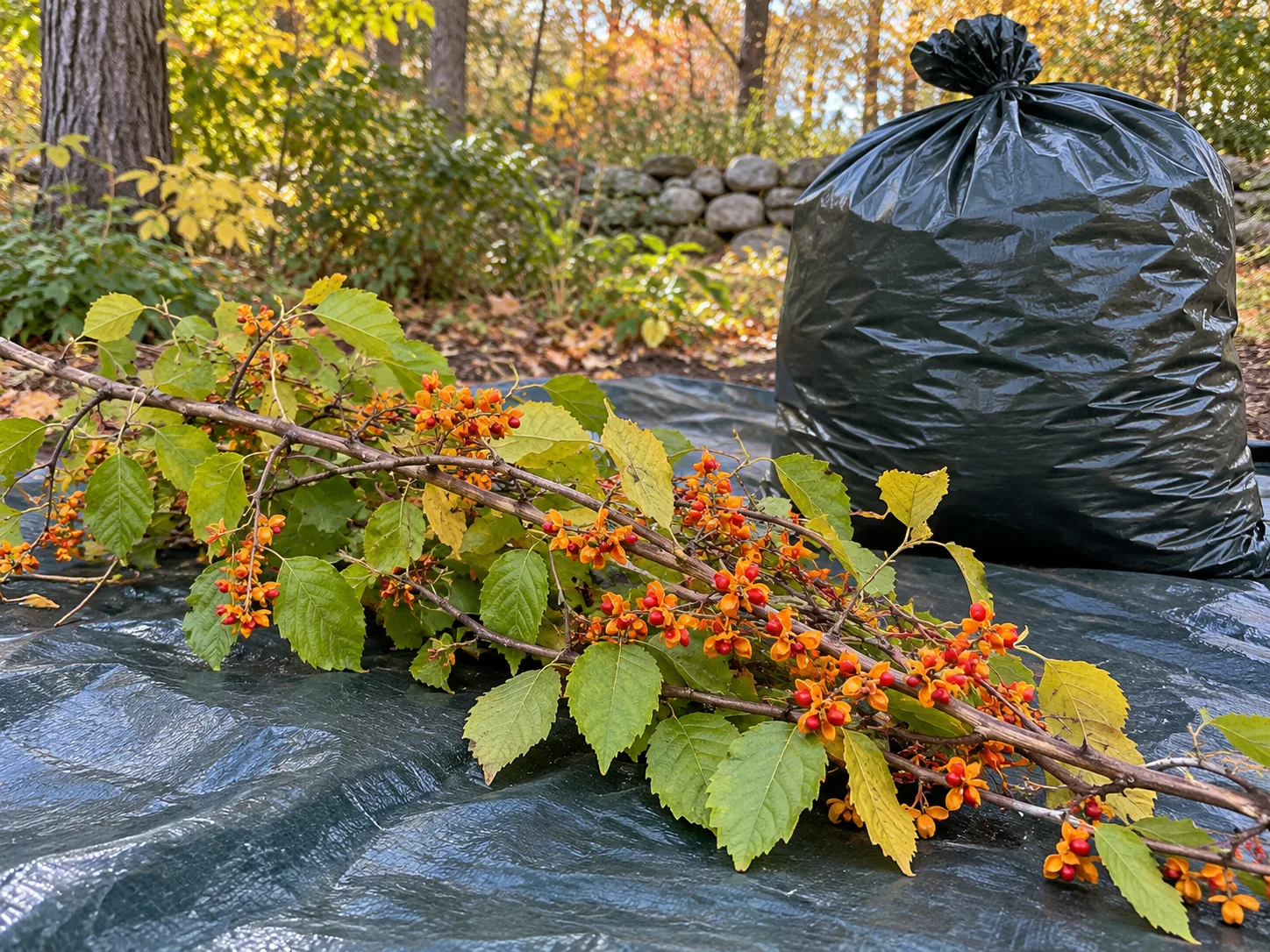
Oriental bittersweet fruit is attractive in autumn crafts, but moving the branches can move the seeds. Do not harvest fruiting vines for wreaths, dried arrangements, or decorations that may later be discarded in a garden or woodland. Penn State Extension notes that seeds can remain viable after drying, and both birds and people can carry them to new locations.
Keep cut or pulled fruiting material contained while you confirm disposal instructions. Municipal rules differ: some facilities accept bagged invasive plant waste only in trash, others require a special drop-off, and some restrict transfer from the property. Do not burn the vine unless local fire rules and invasive-plant guidance explicitly allow it, and do not compost or place it in yard-waste collection without confirmation that the facility can process the material safely.
The legal status also depends on where you live and how you handle the plant. One state may ban sale or intentional planting while another may list it as an invasive species without imposing the same private-land requirements. Check your state department of agriculture or natural-resources agency, county extension, and municipal waste service before you dig, transport, or dispose of a large volume; on public land, conservation easements, or a shared boundary, ask the land manager or property owner before treatment.
Monitor Regrowth and Restore the Site
Set a calendar reminder to revisit the patch during the growing season, after leaf drop, and the following spring. Look at the stump, nearby ground, fence lines, and the bases of trees where birds may perch; a new shoot several feet away may be more important than the old stem that you cut. Photograph the same spots each time so you can tell whether the patch is shrinking or spreading.
For a nonchemical approach, cut new shoots repeatedly before they regain the canopy, and keep doing it over several growing seasons. The exact number of visits depends on the amount of growth and local conditions, but one missed season can give the roots time to rebuild. If shoots keep appearing outside the original patch, widen your inspection area rather than simply repeating the same cut at the same stump.
Once the area is under control, reduce bare, disturbed ground and support plants suited to your region and site conditions. Do not replace one aggressive nonnative vine with another; use a locally appropriate native groundcover, shrub, or tree after you have confirmed it will fit the available light and moisture. Our guide to choosing plants that will not become invasive can help you screen options, but local native-plant lists should guide the final choice.
Conclusion
Identify Oriental bittersweet by checking the whole vine—especially whether its yellow-orange capsules open to red seed coverings along the leaf axils—and compare it with American bittersweet before you remove an uncertain plant. Pull small seedlings while their roots are manageable; for a vine in a tree, make a safe cut gap from the ground and leave the upper section to dry rather than hauling it down.
Then choose between repeated cutting and a label-compliant targeted treatment based on the site, local rules, and your tolerance for follow-up work. Keep fruiting material contained, check the patch several times a year, and expect to deal with root sprouts or bird-dispersed seedlings after the first removal. The first cut is a start; consistent monitoring is what keeps the vine from reclaiming the space.



