Feng Shui Plants in the Bedroom: A Guide
Understand feng shui plants in the bedroom, from Wood and Yin-Yang interpretations to practical placement, pet safety, and air-quality facts.
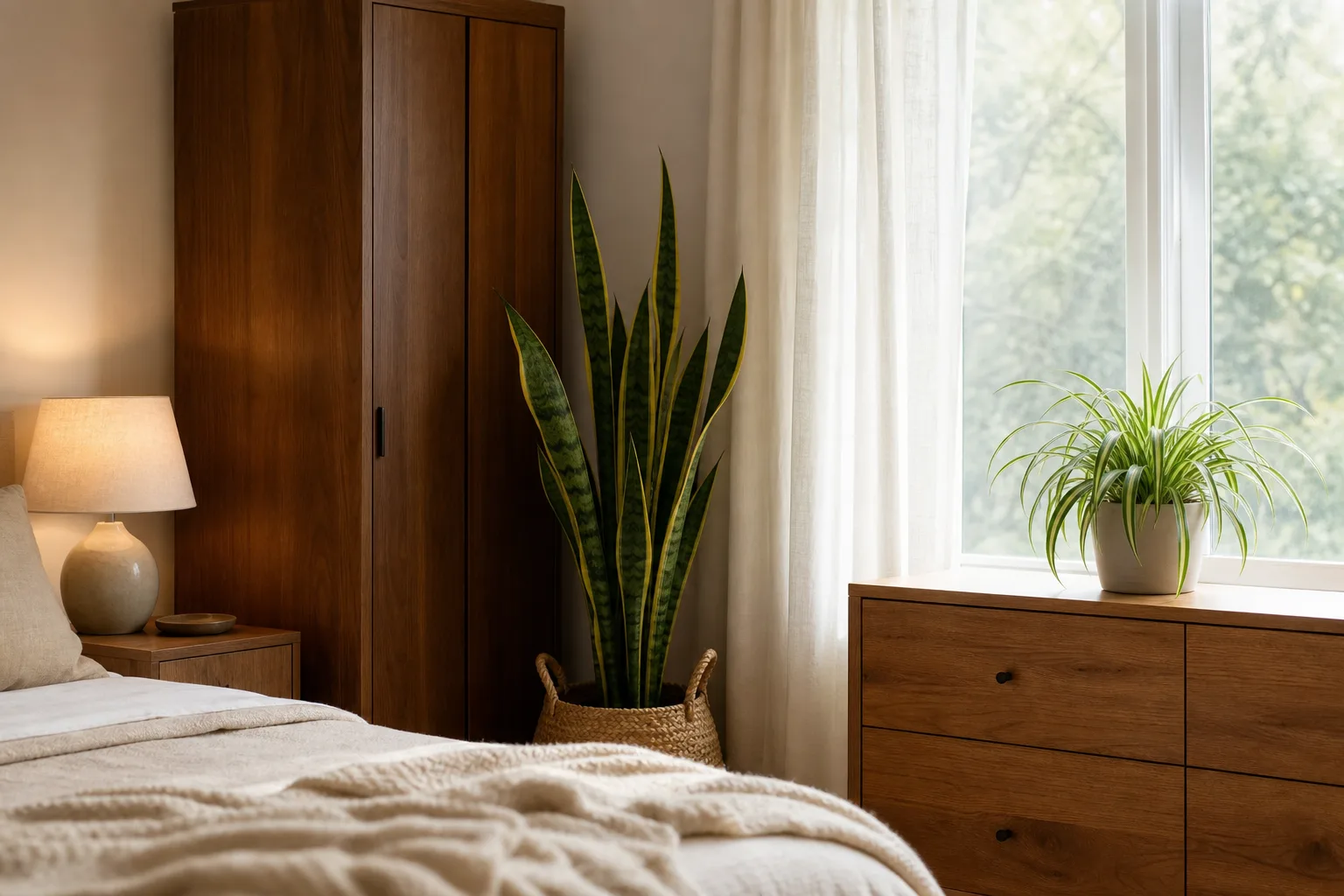
There is no single feng shui rule that says every bedroom must be plant-free. Many practitioners associate living greenery with the Wood element, growth, and vitality; others prefer to limit plants in a bedroom because its restful purpose calls for a quieter, less active feel. Both are interpretations within a varied design tradition, not universal laws. The practical answer is to choose a healthy plant, give it a suitable spot, and decide whether its presence helps the room feel restful to you.
If you are deciding what to do tonight, start with the plant’s actual conditions: light, temperature, pot stability, fragrance, and distance from pets. Then consider whether its shape and placement fit the feng shui approach you follow. A flourishing plant that does not obstruct a path is a better candidate than a struggling plant forced into a symbolic corner.
Short answer: plants are not automatically bad feng shui
The idea that plants are always unsuitable in bedrooms is too absolute. In many contemporary feng shui interpretations, living plants represent Wood and bring a sense of growth and renewal. Other practitioners point out that plants grow upward and outward, so a large or vigorous specimen may feel too stimulating in a room intended for rest. The difference is not a horticultural dispute; it reflects different schools, priorities, and ways of reading a space.
That means the answer depends on what “good feng shui” means to you. If you use a particular teacher’s method, follow that method rather than combining incompatible rules from social media. If you are using feng shui as a design lens rather than a formal system, one modest, healthy plant is a reasonable starting point. You do not need to remove it solely because someone says all bedroom plants bring bad energy.
The most useful test is concrete: does the plant fit the room, stay healthy, and feel calm rather than intrusive? If yes, it can remain. If the room feels crowded, the pot catches your eye at bedtime, or care has become another chore, moving it to a brighter living area may be the better choice—regardless of its symbolic label.
Why bedroom advice differs among feng shui approaches
Feng shui is often reduced online to a list of lucky and unlucky objects, but its roots are broader. A 1997 study in the Journal of Architecture and Planning describes feng shui as an ancient Chinese approach to residential environmental planning and examines its relationship to concepts such as Yin and Yang and qi. That historical context helps explain why the practice considers how a setting feels and functions, not just whether a particular object is present (Chang and Kitahara’s study).
Modern interior-design articles often translate that tradition into familiar plant advice. Homes & Gardens, for example, quotes feng shui practitioners who connect living plants with the Wood element and suggest softer foliage for a partnership space such as a bedroom (Homes & Gardens). Gardening Know How likewise presents plant choice, location, and plant health as parts of a deliberate home arrangement (Gardening Know How). Those are descriptions of contemporary practice, not controlled evidence that a plant changes a person’s fortune or relationship.
When two sources give opposite advice, ask which system each one is using. One may emphasize the symbolic benefit of living greenery; another may prioritize rest and reduced visual activity. A recommendation that says “always” or “never” without naming its school is usually less helpful than an explanation of its reasoning.
Living plants and the Wood element
In five-element interpretations of feng shui, living plants are commonly grouped with Wood. Practitioners may use them to represent growth, flexibility, vitality, or a connection to nature. A new leaf, a branching form, or a plant that visibly changes over time can become a reminder of a personal intention. That symbolic role can be meaningful even if you do not believe a plant produces a measurable energy effect.
This interpretation does not mean a bedroom needs many plants. A single small pot can provide a visible natural element; adding more is not automatically better. In a compact room, a row of crowded pots may make the space feel busy and increase watering, leaf cleaning, and pest checks. If your intention is renewal or nurturing, caring consistently for one plant may express it more clearly than collecting several plants you cannot maintain.
The living quality matters in many traditional interpretations, so a plastic plant may not represent Wood in the same way. Still, people use realistic artificial greenery as a visual design choice when a room has no usable daylight. Treat it as decoration, keep it clean and intact, and do not expect it to provide the biological benefits of a live plant. If a particular tradition matters to you, ask a practitioner how that school treats artificial plants.
The quieter bedroom and Yin-Yang interpretation
Some feng shui advice describes a bedroom as a space for rest and associates it with quieter, more Yin qualities. Because plants grow, reach toward light, and add a visible focal point, a large or sharply upright specimen may feel too active to some people. That is a design judgment, not evidence that a plant literally prevents sleep or creates harmful energy.
You can apply the idea without treating it as a ban. Choose a compact plant with soft-looking foliage, keep it to one side of the room, and avoid turning the bed into a display surrounded by pots. If a plant’s height, movement, or silhouette keeps drawing your attention when you want to wind down, move it farther from the bed or into another room. The goal is a restful composition, not obedience to a rigid plant quota.
The reverse can also be true. A room with hard surfaces, bare corners, and little connection to the outdoors may feel sterile to its occupant. A small leafy plant can soften that visual impression. Different people find different balances calming, so use these descriptions as prompts for observation rather than as claims that one arrangement is spiritually correct for everyone.
Separate symbolic guidance from plant science
Feng shui symbolism can guide your design choices, but it should not be mixed up with claims about oxygen, air purification, or sleep treatment. Ordinary houseplants do use oxygen and release carbon dioxide during respiration, including at night, but the amount is very small compared with the air volume and ventilation in a typical bedroom. The Royal Horticultural Society says nighttime carbon-dioxide emissions from houseplants are unlikely to be a problem for occupants (RHS). You do not need to move a plant away from the bed to prevent it from “stealing” your oxygen.
Plants also should not be treated as bedroom air purifiers. A peer-reviewed review and analysis indexed by PubMed found a median clean-air delivery rate of 0.023 cubic meters per hour per potted plant in chamber studies; it estimated that 10 to 1,000 plants per square meter would be needed to match ordinary building air exchange for VOC removal. Those sealed-chamber findings do not describe a normal bedroom, where air moves through doors, windows, and ventilation systems (Cummings and Waring, PubMed). The RHS similarly cautions that substantial air-quality gains may require impractical numbers of plants under specific conditions.
Research on indoor greenery can support modest statements about mood or wellbeing, but that is not the same as proof that a bedroom plant treats insomnia or improves a particular person’s sleep. If you enjoy seeing a plant, it may be part of a soothing environment or evening routine. Keep the claim proportionate: a plant can make a room more pleasant, but it cannot replace medical care, ventilation, or established sleep habits.
Start with the bedroom you actually have
Before placing a plant according to a map, take stock of the room. Notice where daylight falls in the morning and afternoon, whether the window gets direct sun, and how close the proposed spot is to a heater, air conditioner, or drafty door. Check whether the pot can sit securely and whether leaves will brush your face or knock into a lamp when you reach for it at night.
Then think about the people and animals who share the room. A cat that sleeps on a dresser can reach a small plant that looks safely elevated. A child may pull a lightweight pot down while learning to walk. Strong fragrance can bother someone who prefers a scent-free room, and wet potting mix that is watered too often can attract fungus gnats or develop surface mold. These are practical reasons to change placement; they are more immediate than speculation about invisible plant energy.
Finally, choose the purpose of the plant. Is it there as a quiet visual anchor, a symbol of growth, or because you like tending it? A clear purpose makes it easier to select the right scale and location. If the only available location is too dark, too hot, or in the way, the right decision may be to keep the plant somewhere else and use another calming object in the bedroom.
Light and plant health come first
“Low light” does not mean no light. A plant that tolerates a dimmer room still needs enough usable daylight or supplemental grow light to maintain healthy growth. A bedroom corner far from the window may look like the ideal symbolic location but leave a plant slowly stretching, thinning, and declining. That is not a good long-term design choice, and a plant cannot compensate for an unsuitable site with more frequent watering.
Match the exact species to the measured conditions at its proposed spot. North Carolina State Extension notes that peace lilies prefer partial to deep shade, should not be placed in direct sun, and do best in warm conditions; it also cautions against keeping the soil soggy. The same logic applies across houseplants: learn the needs of the plant you own rather than relying on a general “bedroom-friendly” label (NC State Extension, Spathiphyllum).
If the plant needs more light, first move it closer to a suitable window or use a grow light on an appropriate schedule. Do not keep it in a dark corner solely because a bagua map points there. You can often preserve the design intention by moving a thriving plant to a brighter side of the room, or by using a different species whose needs fit the intended location.
Keep paths, views, and surfaces usable
A plant should not interfere with the practical jobs a bedroom must do. Keep it out of the route between the bed, door, and closet; do not hide a light switch, cover a heater, or make someone sidestep a planter in the dark. A tall, top-heavy plant should not stand where a person might bump it while getting out of bed. Use a stable pot and saucer on a level surface, especially in a shared room or a home with children and pets.
Think about what you see from the bed, too. Some people find a leafy silhouette in a distant corner restful; others find a dark shape against a window distracting at night. A trailing vine that hangs into the line of sight can feel softer in daylight but visually busy when backlit. Stand or lie where you normally rest and check the plant from that angle instead of judging the placement only while standing in the doorway.
A calm arrangement leaves breathing room around the bed and keeps useful surfaces clear. If the room is already crowded, one plant is enough—or no plant at all. Good design should support comfortable movement and rest, not add another obstacle to manage.
Where a bedroom plant usually works best
There is no universal bedroom compass direction for a plant. A workable spot usually has adequate light, a stable surface, a clear route, and enough distance from the pillow that leaves, fragrance, and watering do not become nuisances. A simple comparison can help: use a bedside table only for a small and safe plant; use a side corner for a larger floor plant; use a windowsill only if temperature and direct sun suit the species; and skip any spot that blocks a door or creates a trip hazard.
The images below show examples of placement, not mandatory feng shui prescriptions. The important question is whether each location works in your actual room. You can move a plant seasonally if the sun angle changes, or rotate it between a brighter daytime location and a calmer display location if that is practical for its care.
Bedside tables need a small, calm plant
A nightstand is close to your face and hands, so it is a poor place for a large plant, a strong scent, sharp leaves, or a pot that can tip. If you want greenery beside the bed, keep the container small, stable, and easy to lift when you water. Leave enough surface for a lamp, glasses, medication, or the items you actually use. A tiny peperomia or another compact plant may be less intrusive than a floor-size specimen, but check its light needs before choosing it.
Distance is mainly a comfort and safety choice, not a rule that protects you from nighttime oxygen loss. If you wake to water the plant, knock leaves against it, or notice that it distracts you from winding down, move it to a dresser or side shelf. If you have pets, verify the botanical name against a reliable toxicity database before placing any plant within reach. ASPCA Poison Control notes that its plant list is not exhaustive and that eating plant material can cause gastrointestinal upset even when a plant is listed as non-toxic (ASPCA plant database).

A side corner can hold a larger plant
A corner away from the bed and door can anchor a room without competing with the sleeping area. It is a practical location for a medium floor plant if the corner receives enough light and the plant does not block a closet, curtain, or walkway. A smooth-leaved plant with a compact canopy may look quieter than a tall, rigid plant that rises directly behind the headboard, but the silhouette is a matter of taste rather than a hazard.
Some feng shui interpretations discourage thorny or very pointed forms near a bed because they read as visually sharp. If you follow that approach, move a cactus or spiny succulent to a desk or sunny living-room window instead of forcing it into the bedroom. If you do not use that rule, you can still avoid a literal bump risk by placing the pot where a person will not brush the leaves. Either way, keep the room’s movement and comfort in view.

Windowsills and dressers are practical only with the right conditions
A windowsill can offer the best light in a bedroom, but bright is not always suitable. Direct midday sun through glass can scorch foliage that needs indirect light; a cold windowpane, draft, or radiator beneath the sill can also stress a tropical plant. Measure the light and note temperature swings at that exact spot. If conditions are unsuitable, place the plant slightly back from the glass or choose a different room.
A dresser gives you height and visibility, but make sure the top is wide enough for the pot and saucer and that drawers can still open. Water the plant at a sink or on a waterproof tray, then empty standing water rather than leaving a damp ring on furniture. A dresser is a poor choice for a heavy plant above a bed or a spot a cat can reach by jumping. Keep electrical cords, lampshades, and fabric away from splashing water.

Choose a plant shape that feels right without treating it as a rule
If you want to follow common feng shui design advice, start with the plant’s form rather than a promise attached to its name. Rounded, heart-shaped, or gently arching leaves often read as softer; an upright plant may suggest growth; a vine can soften a shelf edge. Homes & Gardens attributes these kinds of interpretations to contemporary feng shui practitioners, including the idea that a partnership space might feel better with less prickly foliage. These meanings vary, and a leaf shape does not cause a relationship outcome.
Consider scale and maintenance as carefully as symbolism. A trailing plant can look graceful on a high shelf but may become a tangle if it is not trimmed. A large monstera may fill an empty corner but soon crowd a small bedroom. A peace lily may fit a softer visual palette yet need a brighter or warmer location than the dark corner you had in mind, and it is not a pet-safe choice. If you have cats or dogs, use the ASPCA database to check the exact plant name before buying; a decorative label such as “money plant” can refer to different species.
For a quick choice, shortlist two plants whose actual light and care needs match the room. Then compare leaf texture, fragrance, mature size, and pet safety. The plant that looks right and remains healthy is a better fit than the species that is supposed to be “luckiest.” For broader care choices, see the bedroom plant guide and the feng shui plant overview.
Use a bagua map consistently, not as a reason to force a bad spot
Some feng shui systems use a bagua map to relate areas of a home or room to themes such as partnership, family, or prosperity. Other systems use compass directions or a different method to orient the map. Those methods can produce different placements, so do not combine a front-door-aligned map with compass-based directions and expect one universal answer. If you follow a formal school, use the map and orientation that practitioner teaches.
It is also easy to confuse applying a map to the whole home with applying one to a bedroom. Decide whether you are mapping the whole floor plan or treating the bedroom as its own space, then stay consistent. A recommendation to put a plant in a particular corner only helps if you know which map is being used and why that corner matters to your chosen approach.
After you mark the desired zone, check it against the room’s real conditions. If the location is dark, blocks a door, sits above a heater, or is unsafe for a pet, move the plant to the nearest workable area or select another symbolic object. The symbolic map is a planning aid. It should not force a living plant into conditions where it cannot thrive or make the room harder to use.
Bedroom plant feng shui mistakes that are easy to fix
The first mistake is treating online rules as universal: “never keep a plant near your bed,” “every bedroom needs a money plant,” or “a plant in the southeast guarantees wealth.” These statements turn a flexible design practice into a rigid checklist. If a direction or meaning matters to you, identify the school behind it and whether it refers to the whole home or one room.
Another common mistake is choosing symbolism before horticulture. A plant may represent growth to you but still need more light than the bedroom provides. Keeping a sun-loving succulent in a dim corner, or leaving a moisture-loving plant next to a heating vent, will not make a peaceful display. Choose for the actual conditions and move the plant if it declines.
The third mistake is overloading the room. Several plants on every surface collect dust, compete with useful items, make watering less predictable, and can raise the chance of overwatering or pests. A plant that is dying, infested, or surrounded by standing water adds maintenance and visual noise. Remove dead leaves, check leaves and soil periodically, and address pests using species-appropriate advice rather than simply hiding the pot.
Finally, do not let a feng shui label override safety. Keep toxic plants away from cats, dogs, and children; secure heavy pots; and avoid a fragrance that irritates the person sleeping in the room. ASPCA guidance is a useful starting point for pet toxicity, but it warns that the list is not exhaustive. If an animal eats a plant and becomes unwell, contact a veterinarian or animal poison-control service.
A two-week test can settle the question for your room
If you are unsure whether a plant belongs in your bedroom, make the choice reversible. First take a quick baseline: note whether the room feels crowded, whether you notice the plant from bed, and how much daylight the intended spot receives. Check that the pot is stable, the route to the door is clear, and the species is safe for the people and animals who can reach it. Move the plant if any of these basics fail.
Then leave the plant in one suitable location for two weeks. Keep its care routine steady and observe three things: does it stay healthy, does it interfere with rest or movement, and do you like the way the room looks and feels? Do not treat this as a test of supernatural energy or a sleep experiment. It is a practical way to tell whether the arrangement works for you. If you are following a specific feng shui school, also assess the placement by that method’s criteria.
At the end of the trial, keep the plant if both the room and the plant are doing well. If it is leaning toward light or losing leaves, move it closer to a window or choose a better-matched species. If you find yourself focusing on it at night or navigating around it, move it to another room. A small change in location can preserve the plant and the intention while making the bedroom more comfortable.
Conclusion: keep the plant when the room and routine both work
Feng shui plants in the bedroom are not automatically good or bad. Living greenery is commonly associated with Wood, growth, and renewal, while some practitioners prefer a quieter, less active bedroom. Those interpretations vary, and none means a plant can guarantee luck or change a person’s health or relationships.
Choose your approach, then check the practical facts: adequate light, a stable and out-of-the-way location, suitable care, and safety for pets and children. Start with one plant if you are uncertain, keep it healthy, and give the arrangement time to feel familiar. If it supports the room you want, leave it there; if it distracts, crowds the bed, or struggles to grow, move it. The best placement is the one that respects your chosen symbolism and makes the actual bedroom work better.