Rake vs. Leaf Blower: Which Is Better for Your Yard?
Find out when a rake beats a leaf blower, when each falls short, and how to move leaves without harming turf or sending debris into the street.
The quick answer: choose by surface and leaf load
For a small yard, garden beds, tight corners, or a quiet neighborhood, a rake is usually the better choice: it is precise, inexpensive, and does not make motor noise or exhaust. A leaf blower earns its keep on a large property or broad hard surfaces where you need to move a light, dry layer quickly. But if the leaves are on the lawn, a mower set up to mulch them may beat both tools.
The useful question is not “Which tool wins everywhere?” It is “What do these leaves need to do next?” Move them off a lawn that is getting covered, guide them into a bed or compost pile, clear a path, or leave them as habitat? The answer changes by zone, so most yards benefit from using more than one approach.
Start with the destination, not the tool
A rake and a blower both move leaves; neither decides whether they belong in a bag, garden bed, compost, or lawn mulch. If you start by clearing every surface, you can create extra work: a blower pushes leaves from a patio onto the lawn, then you have to move them again, while a rake can gather a useful pile that still needs a destination.
Walk the property and sort it into three zones. On the lawn, decide whether the leaf cover is thin enough to mulch or thick enough to remove. On paths, driveways, and patios, gather only what creates a slip or drainage problem. Under trees, shrubs, and in quiet planting areas, consider leaving some leaf litter or moving leaves there as mulch.
This simple zoning step often matters more than whether your tool runs on gas or electricity. A rake is better for steering leaves to a precise place; a blower is better for pushing loose leaves across open ground; a mower is better for chopping a light layer already spread across turf.
When a rake is the better choice
Reach for a rake when control matters more than speed. It can gather leaves around young plants, along fence lines, under shrubs, beside a vegetable bed, or near decorative gravel without blasting mulch, topsoil, or light containers around. A rake also lets you lift leaves out of planted spaces gently instead of forcing them into the next zone.
A rake is the neighbor-friendly option when noise is a concern. It needs no battery, outlet, fuel, or engine maintenance, and it is easy to stop when someone walks past. On small patios and narrow garden paths, setting up a blower can take as long as gathering the leaves by hand.
The trade-off is physical effort. Pulling a rake through a deep, wet mat can be tiring, and a short-handled or heavy tool encourages hunching and twisting. If the pile is damp and compacted, break it into smaller sections or wait for it to dry rather than trying to drag the entire load in one pass.
Use a wide leaf rake for open lawns and a narrower shrub rake for careful work near plants. A flexible plastic or resin head tends to glide across turf; metal tines can be useful for stubborn debris but may snag groundcovers or scratch delicate surfaces. The right rake is light enough to lift repeatedly and long enough to let you stand upright.
When a leaf blower earns its place
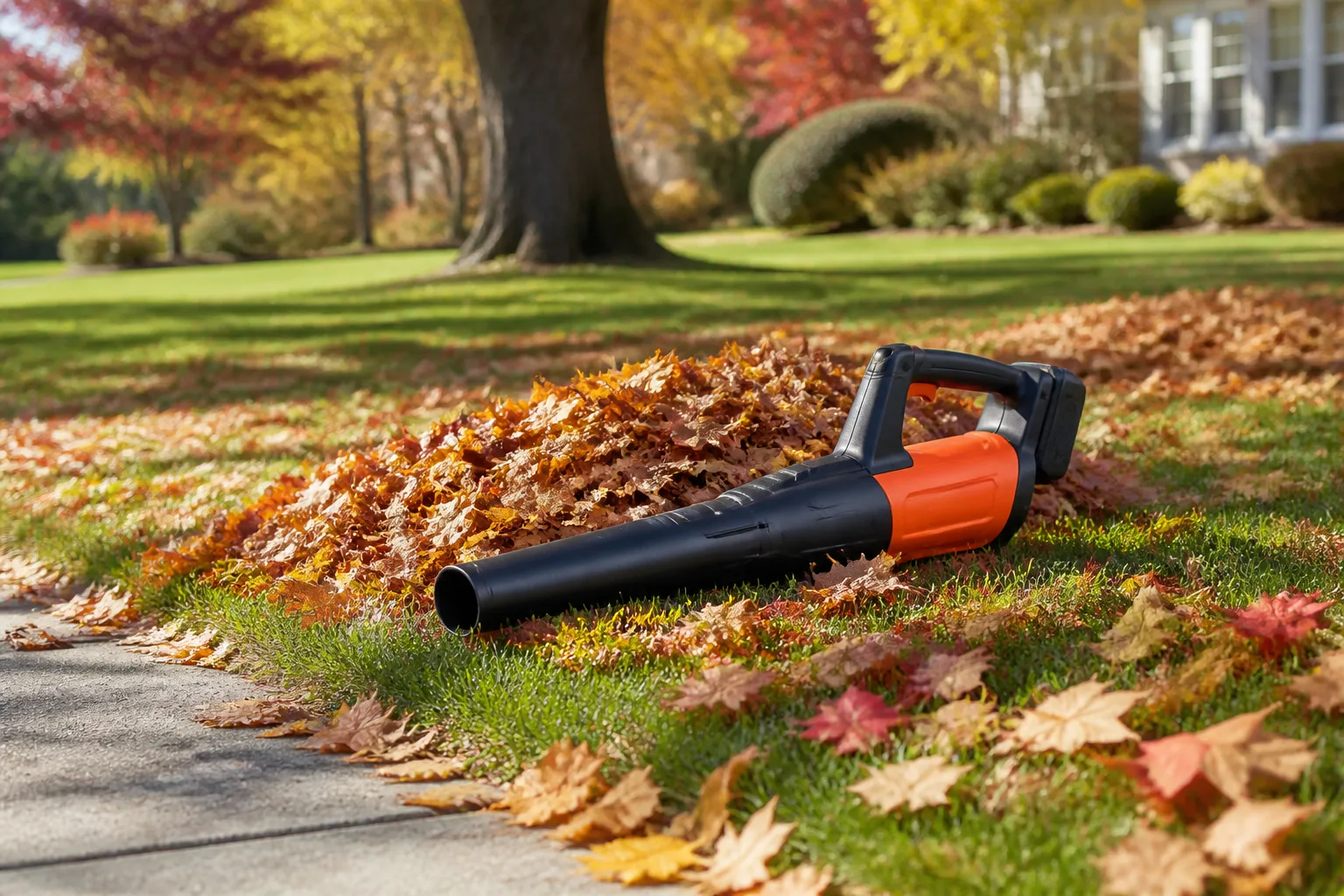
A blower can save time on large, open areas with a thin layer of dry leaves. It is especially useful for clearing a driveway, walkway, patio, or broad lawn edge into one collection zone, and it can push leaves from a hard surface without bending to gather every handful. On a property with many trees, that speed can be meaningful.
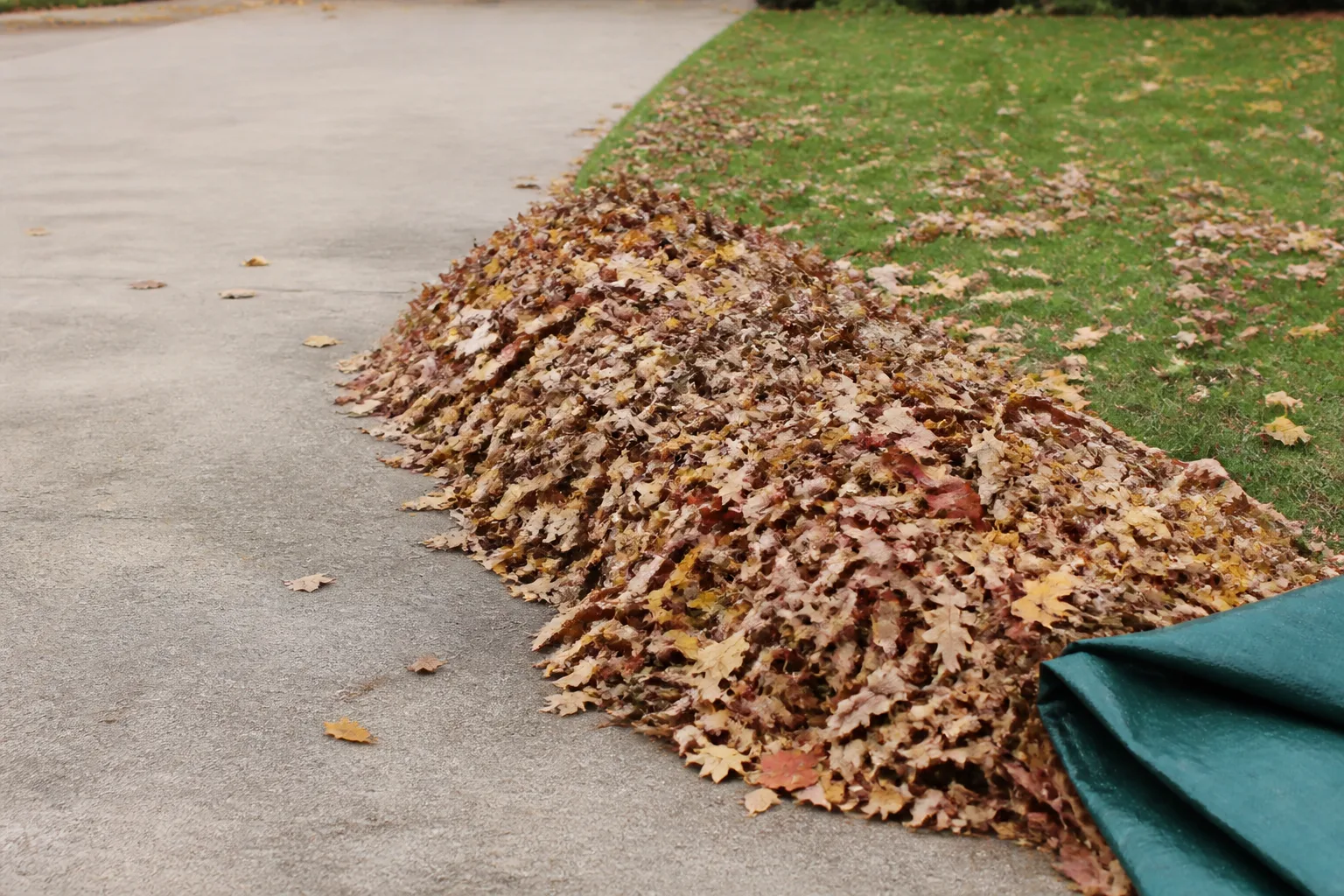
It works best when you have a plan for the leaves before you switch it on. Pick a sheltered staging spot—such as a tarp, compost area, or leaf corral—and work toward it in controlled passes. Blowing across the full yard with no collection point often scatters the same leaves into corners, beds, roads, or a neighbor’s lawn.
A blower also helps with leaves trapped against a fence or piled in a wide, shallow gutter, provided the manufacturer permits that use and you can work safely from the ground. It is not a reason to climb a ladder while holding powered equipment. For roof gutters or overhead work, use an appropriate ground-based attachment or hire a qualified service.
Know what a blower can and cannot do
A standard blower moves leaves; it does not remove them. You still need to collect the pile, bag it, compost it, or spread it somewhere useful. On grass, the blast can push leaves over the turf without actually picking them up, and repeated back-and-forth passes can turn one pile into several smaller ones.
A blower-vac model is different: it draws leaves into a collection bag and may shred them. That can reduce the volume of dry leaves and make them easier to use as mulch, but the bag fills quickly, wet leaves can clog the tube, and the machine is heavier when you carry the collection bag. Check whether a model is designed for small dry leaves before expecting it to process a dense layer of damp oak leaves.
The blower is also less selective than a rake. It may move bark mulch, seed, loose soil, small stones, and lightweight pots along with the leaves. On gravel, in flower beds, or around freshly seeded areas, lower airflow and short bursts may help, but a rake or hand cleanup is often simpler and safer.
Gas, corded, or battery: which blower type fits?
If a blower makes sense for your yard, match its power source to the area and your tolerance for upkeep. A corded electric blower avoids fuel and battery runtime limits, but the cord restricts reach and can snag around trees or beds. It is most practical for a small, fairly open lot where an outdoor-rated extension cord can reach the work area safely.
A battery blower is easier to start and maneuver than a corded model, and you can move around without fuel or an extension cord. Its useful runtime depends on the battery, setting, leaf load, and how continuously you work; heavy, wet leaves drain a pack faster than a light dusting. For a compact yard, swapping or recharging a battery may be a reasonable trade for lower setup effort.
A gas blower can be attractive on a large property where long runtime and strong airflow matter, but it adds fuel handling, engine maintenance, exhaust, and more noise. Washington University in St. Louis’s sustainability office explains that a two-stroke engine burns a fuel-and-oil mix, while electric equipment has no exhaust at the yard itself; electricity still has upstream impacts. Treat that as a practical trade-off rather than a claim that any tool has zero environmental cost.
For most homeowners, the choice comes down to scale. If you need a blower only a few times each fall, start with a rake and use a mower for lawn leaves before buying a powered tool. If repeated cleanup over a large hardscape is the bottleneck, compare the blower’s sound, weight, battery life, service needs, and local rules—not just its advertised air speed.
Rake vs. leaf blower: a practical comparison
| Job or constraint | Rake | Leaf blower |
|---|---|---|
| Small yard or garden bed | Precise and quiet | Often too forceful or cumbersome |
| Large, open lawn edge | Slower but controlled | Fast for dry, loose leaves |
| Patio, driveway, or sidewalk | Quiet; easy to gather into a pile | Quick for sweeping a broad surface |
| Wet or matted leaves | Can lift and gather them, but takes effort | Usually pushes the mat rather than collecting it |
| Around mulch, gravel, or seedlings | Easier to avoid moving other material | Can scatter mulch, soil, seed, and stones |
| Collection and composting | Easy to direct onto a tarp | Requires a collection area or vacuum bag |
| Noise and fuel | No motor or exhaust | Depends on power source; motorized models add noise |
| Ongoing cost | Low | Batteries, fuel, maintenance, or electricity |
The table describes typical jobs, not a universal speed test. A strong battery blower may work well for a person with mobility limits, while a lightweight rake may be the easiest choice for a large pile on a quiet morning. Your terrain, strength, time, and cleanup destination belong in the decision too.
The lawn question: how many leaves are too many?
You do not need to remove every leaf from a lawn. A thin layer that you can mulch into small pieces is usually manageable; a thick, continuous mat that hides the grass is a signal to act. Virginia Cooperative Extension’s reviewed lawn-management guidance explains that heavy leaf cover blocks light and holds moisture in the turf canopy, which can weaken turf and increase disease potential. It also describes chopping leaves into turf as a workable alternative to collecting them.
Use a simple visual check after mowing: if you can still see grass between the chopped pieces, the layer is not smothering the turf. If shredded leaves build into a blanket or continue to cover the blades, make another pass when conditions are suitable or collect part of the load. Do not wait for a deep pile and assume one mower pass will fix it.
Colorado State University Extension recommends mowing leaves when they are dry because they chop and filter into turf more easily than wet leaves. If the leaf fall is too heavy for your mower, rake or blow the bulk into a staging pile, then choose what to mulch and what to compost. K-State Extension’s practical approach is to mow frequently as leaves fall, because a series of light cleanups is easier on the lawn and mower than one late-season blanket.
Species and climate matter. Some warm-season lawns become dormant earlier, while cool-season turf may continue growing in fall; local extension guidance can refine the timing. But the basic decision remains useful in any region: keep enough leaf cover off the grass to preserve light and airflow, and recycle the material elsewhere where it can benefit soil.
Where to put leaves after you move them
Leaves are a resource, not automatically yard waste. If your property has a low-traffic corner, a shrub border, or a bed that can use organic cover, moving leaves there can save bagging and hauling. Fine Gardening’s practical guide to fallen leaves describes them as useful mulch, leaf mold, and compost material; it also cautions against piling whole leaves too thickly, since packed sheets can impede water movement.
For garden beds, use a light, loose layer and keep it from forming a wet collar against plant crowns or woody stems. Shredded leaves break down faster and are less likely to mat than whole leaves, but some whole leaf litter in an undisturbed area can provide winter cover for insects. Savvy Gardening’s leaf-mulch guide covers how chopped leaves can serve as garden mulch, while Joe Gardener’s explanation of leaving leaf litter describes its value as overwintering habitat. A small naturalized corner can hold those leaves without covering the lawn.
If you compost, whole leaves can act as carbon-rich “browns” alongside nitrogen-rich kitchen scraps or fresh clippings. Colorado State Extension notes that finely chopped leaves can compact in a compost pile, so unshredded leaves may be a better fit when your goal is an airy pile; shred some if your goal is a faster-decomposing mulch. Keep the pile damp, not waterlogged, and turn it if it stops breaking down.
Do not blow or rake leaves into the street, gutter, storm drain, or someone else’s property. K-State Extension explains that leaves washed into waterways can contribute excess nutrients and water-quality problems. Check local yard-waste rules before setting bags at the curb, since accepted materials, pickup dates, and compost options differ by municipality.
A hybrid cleanup routine for most yards
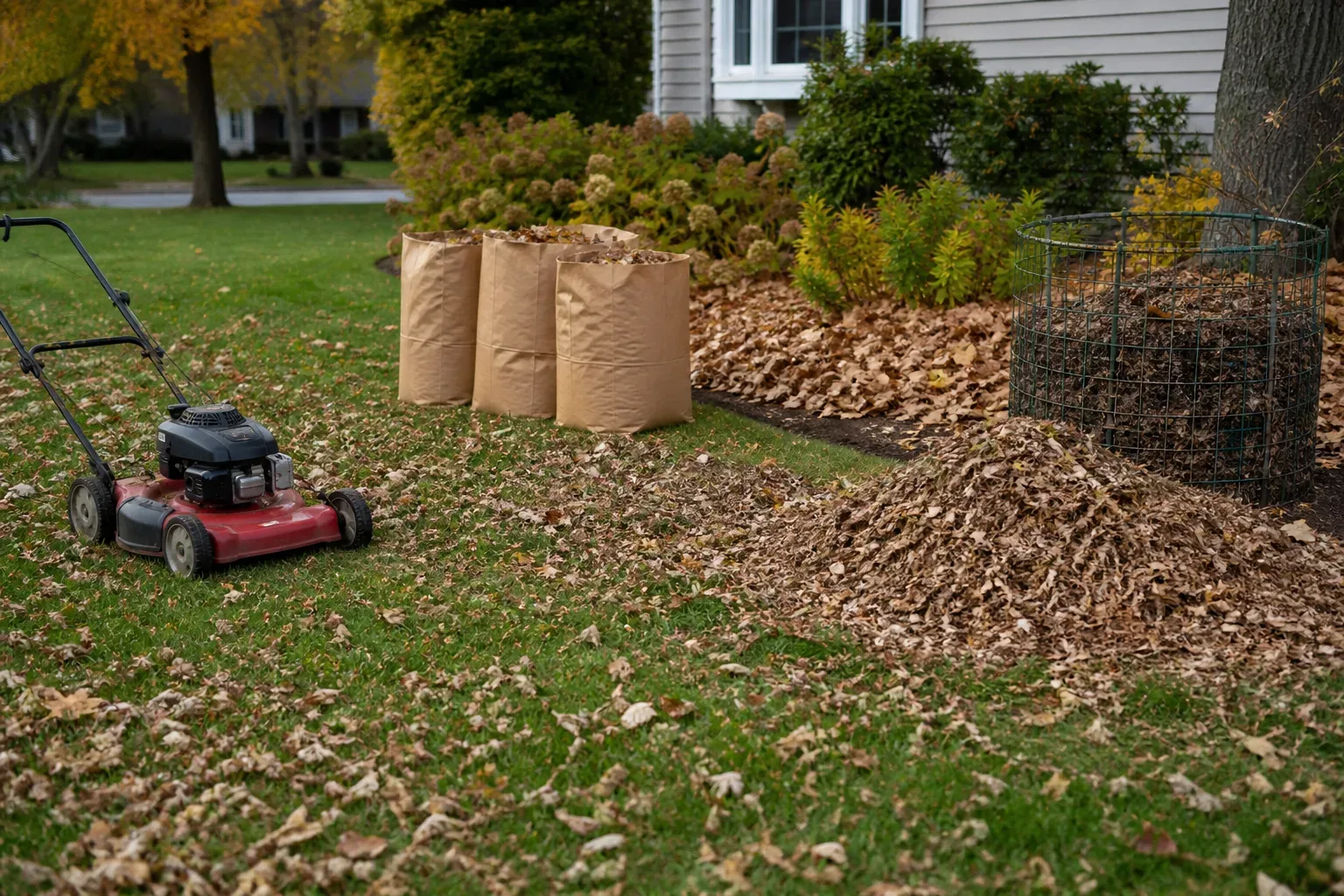
For a typical home, the best answer is a hybrid routine, not choosing a single tool for every surface:
- Leave some leaves where they help. Keep a modest amount in quiet garden areas or beneath suitable shrubs, away from lawn and drainage routes.
- Mulch a light lawn layer. Run the mower over scattered dry leaves and check that grass remains visible through the fragments.
- Move excess lawn leaves. Use a rake for small or tight zones; use a blower only for large, open areas where you can steer leaves to a nearby pile.
- Clear hard surfaces selectively. Rake or blow leaves off walkways where they could become slippery and away from drains, then gather them rather than scattering them.
- Reuse the pile. Shred some for bed mulch, store whole leaves for compost browns, or use municipal collection if there is no suitable place on site.
This sequence limits duplicate work because each tool has a defined job. It also makes the yard less dependent on perfect timing: if another wave of leaves falls, you can mulch the lawn again and move only the material that has accumulated on paths or in the wrong places.
How to rake with less effort
Raking is easier when leaves are dry and you work before they form a heavy mat. Divide a large lawn into manageable sections, make short, smooth strokes, and pull leaves toward a tarp rather than repeatedly lifting them into bags. If wind is moving leaves around, work with the breeze instead of fighting it.
Stand upright, keep the rake close enough that you are not reaching far to either side, and switch which side you rake from so one shoulder does not do every pull. Take breaks before your grip and posture start to slip. If a pile is heavy, split it or slide it on a tarp instead of lifting it against your back.
K-State Extension’s discussion of leaf management captures the practical reason many gardeners seek alternatives: a broad lawn can make hand raking feel endless. The answer is not to abandon the rake, but to save it for places where its control is valuable and let a mower or powered tool cover the jobs they handle more efficiently.
How to blow leaves without creating a bigger mess
Use the lowest airflow that moves the leaves, especially near beds, gravel, mulch, and decorative containers. Hold the nozzle at a shallow angle and sweep leaves into a low windrow rather than aiming straight down; then move the windrow onto a tarp or into a compost zone before the wind scatters it again.
Work from the far edge of a surface toward your collection point, not toward a road or neighbor’s driveway. Keep the nozzle pointed away from people, pets, open doors, and loose gravel, and pause if dust starts to rise. If you cannot collect the leaves where they land, stop and choose a destination before doing another pass.
A blower is not a lawn dethatcher or a general-purpose cleanup tool. It can move light debris off the surface, but it will not remove embedded thatch, repair turf, or solve a wet leaf mat. Use a rake or a mower for those jobs, and consult the tool’s manual before using attachments or aiming it into gutters.
Noise, exhaust, dust, and safety trade-offs
A rake is the clear winner when quiet matters: it has no motor and creates little airborne debris. Leaf blowers can be loud enough to disturb neighbors, especially in a small yard where sound reflects off houses; Joe Gardener’s discussion of leaving leaves also flags blower noise and dust as neighborhood and air-quality costs. Use powered equipment at considerate times and check local operating-hour rules before relying on it.
Gas equipment adds exhaust and fuel handling. Electric models avoid exhaust at the point of use, but battery manufacture and electricity generation still have environmental costs; the more useful comparison is the impact you can control on your property and how often you need to run the machine. For occasional cleanup on a small yard, a rake or mower-based leaf strategy avoids buying and maintaining a second motorized tool.
Protect yourself whichever powered equipment you use. Wear closed shoes and eye protection, keep other people and pets out of the work zone, and use hearing protection if the manufacturer recommends it or the sound is uncomfortable. Virginia Cooperative Extension at Virginia Tech specifically advises eye protection and a dust mask when mulching leaves with a mower; the same debris-control mindset is sensible when a blower kicks dry material into the air.
How weather and timing change the job
Dry, calm weather is easiest for both tools, but it especially improves blowing and mowing. Dry leaves lift and move in controllable sheets; wet leaves cling to grass, stick together, and feel heavier to pull. After rain, let the surface dry if you can, or use short raking passes to lift a troublesome mat instead of expecting the blower to clear it.
Wind changes the route, not just the schedule. If leaves are blowing across the yard, rake with the wind toward a sheltered pile or postpone the work until calmer conditions. A blower used against a crosswind can scatter debris farther than it moves it, while gusts can send leaves back onto a path you just cleared.
Do not wait until every tree is bare if leaves are accumulating faster than the lawn can handle. Repeated light passes—mowing when a thin layer appears, clearing paths as needed, and leaving selected bed litter—reduce the volume and effort of one large cleanup. If you need curb collection, check dates early so bags do not sit through rain and freeze into a dense block.
Common leaf-cleanup mistakes to avoid
The first mistake is treating every leaf as a problem. A light scattering on turf can often be mulched, and leaf litter in an appropriate bed can protect soil and provide habitat; a thick lawn mat is the case that needs attention. Joe Gardener’s “leave the leaves” approach and Colorado State Extension’s practical guidance both support keeping useful leaves on site, with the important qualification that turf should not stay buried.
The second mistake is letting the blower make decisions for you. Blasting leaves off grass into a storm drain may look fast for a moment, but it shifts the cleanup downstream and can create drainage problems. Choose the pile location first and work backward from it.
The third mistake is using the wrong tool on wet or delicate surfaces. A blower can spread mulch and stones; a metal rake can pull up shallow-rooted groundcover; a mower can clog or leave large fragments when leaves are soggy. Change tools or wait for better conditions rather than increasing force.
The fourth mistake is over-clearing planted areas in the name of neatness. Leaves do not need to be stripped from every bed, but diseased or pest-ridden debris deserves a different plan from healthy autumn litter. When you are unsure whether a specific plant disease survives in leaf litter, ask your local extension office how to dispose of that material safely.
Conclusion
For small yards, tight beds, wet piles, and quiet neighborhoods, use a rake. For broad, open hardscape covered in dry leaves, a leaf blower can save time—provided you guide leaves to a real collection spot and account for noise, dust, and exhaust. On the lawn itself, a mower may be the better tool when the leaf layer is thin enough to chop without hiding the grass.
The most reliable plan is to match the method to each zone: mulch light leaf fall into turf, rake or blow excess leaves off paths and heavily covered lawn, and leave or reuse suitable leaves in beds and compost. That approach protects the lawn without treating every leaf as trash, and it avoids making a fast cleanup into a second cleanup.