Scale on Houseplants: How to Identify, Treat, and Remove It
Scale on houseplants looks like harmless brown bumps but it's a sap-sucking pest that weakens plants fast. Learn to identify soft vs. armored scale, treat it with rubbing alcohol and horticultural oil, and stop it from coming back.
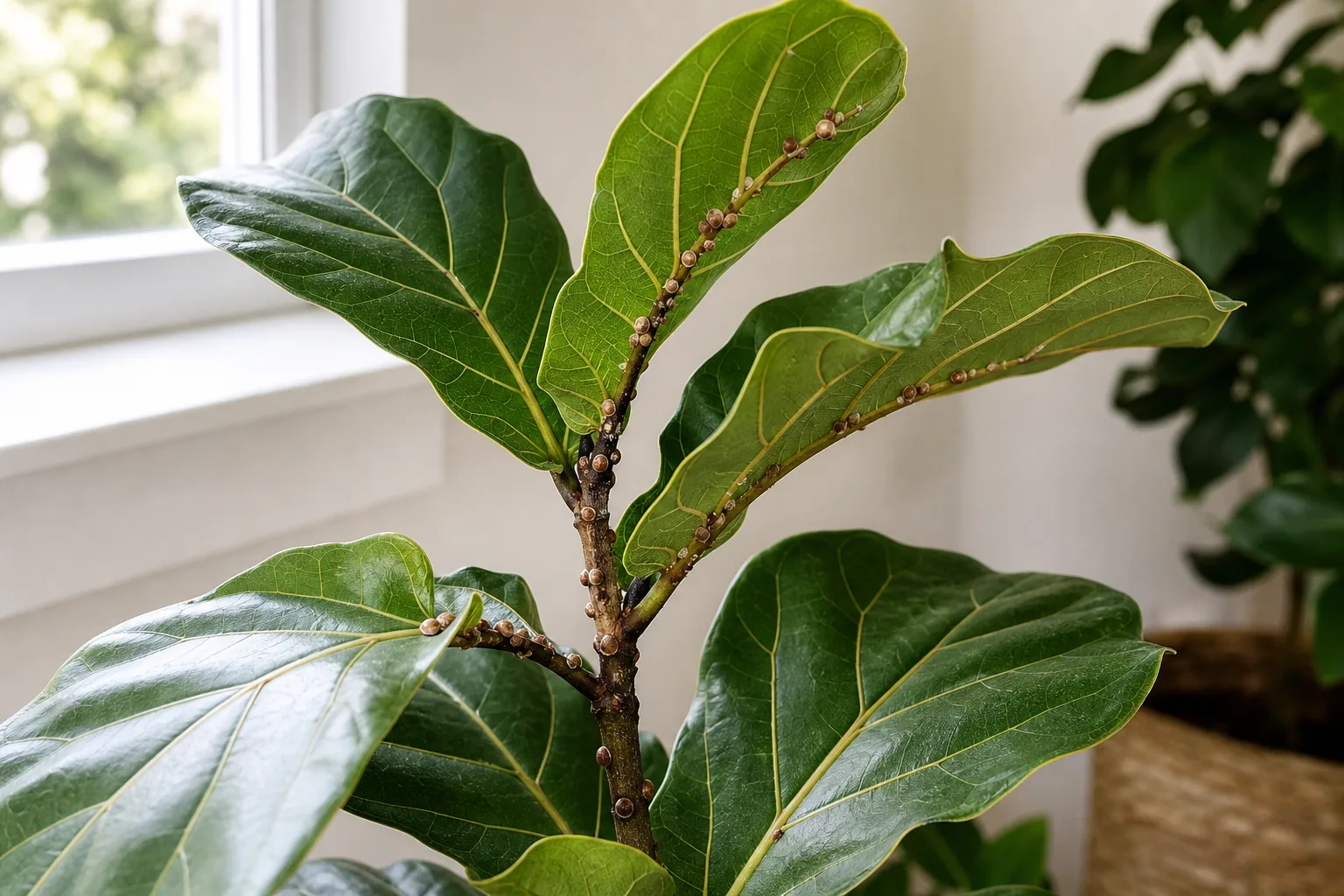
If you have found small brown bumps on your plant stems or the undersides of leaves — bumps that do not move, do not rub off easily, and look almost like they belong there — you are probably dealing with scale on houseplants. Scale insects are among the most overlooked indoor plant pests because they do not look like insects at first glance. They look like part of the plant. That is exactly the problem.
Scale insects are sap-sucking pests that latch onto stems, leaf veins, and petioles, then stay there. They drain your plant’s fluids, excrete sticky honeydew that attracts sooty mold, and multiply quietly until the damage is impossible to ignore. This guide covers everything you need to know: how to identify scale correctly, how to tell soft scale from armored scale (because your treatment options depend on it), how to remove scale step by step, and how to keep it from coming back. It also tells you honestly when you should just throw the plant away and start over.
What Scale on Houseplants Actually Looks Like
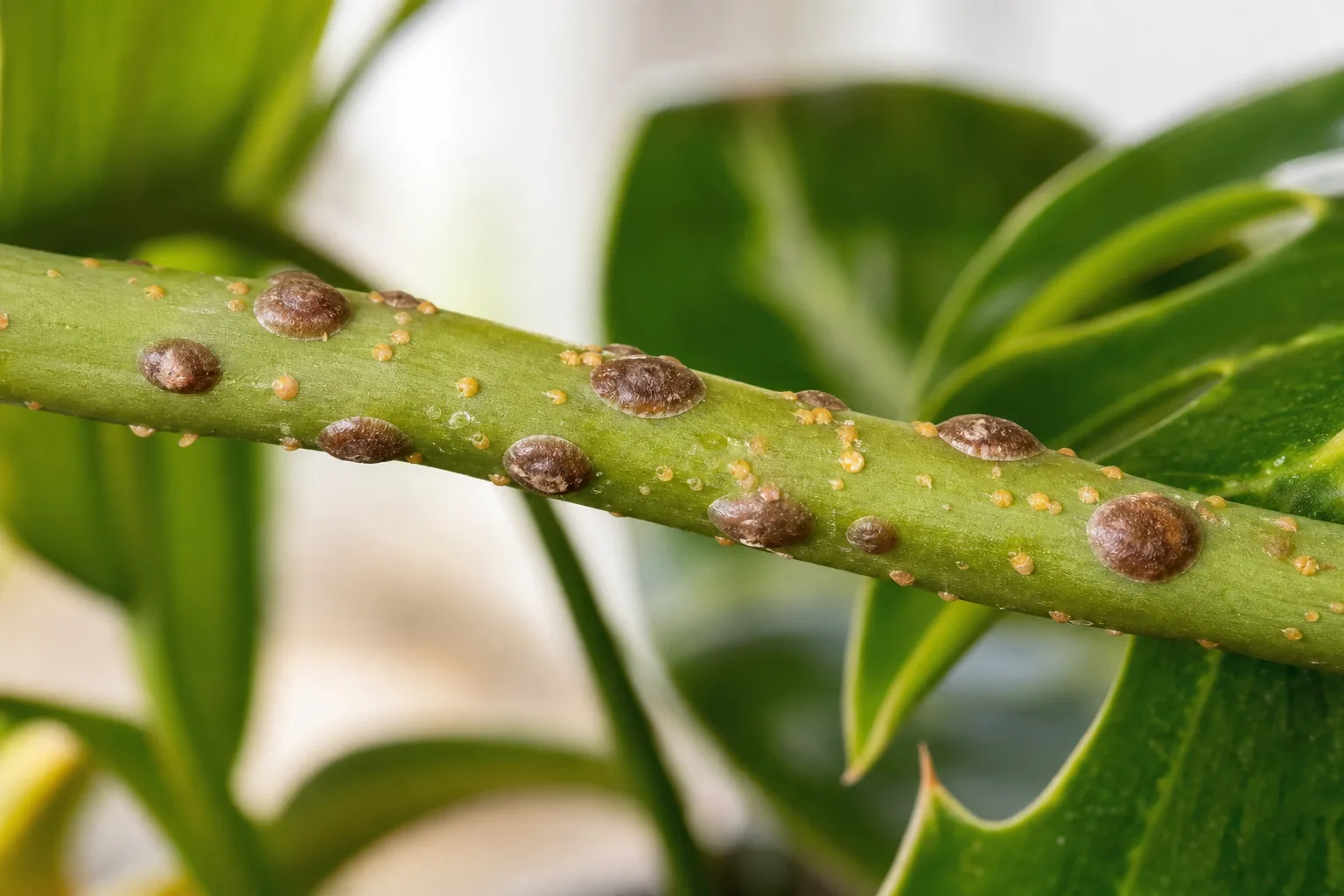
Scale insects are small — most adults measure between 1/16 and 1/8 inch across. You will almost never see just one. They cluster along stems, leaf veins, and the undersides of leaves in groups that can look like bumps, blisters, or irregular scabs on the plant surface. Colors range from tan and light brown to dark brown, gray, or almost black depending on the species and age. Some are flat and almost flush with the stem. Others are domed, round, or oyster-shaped.
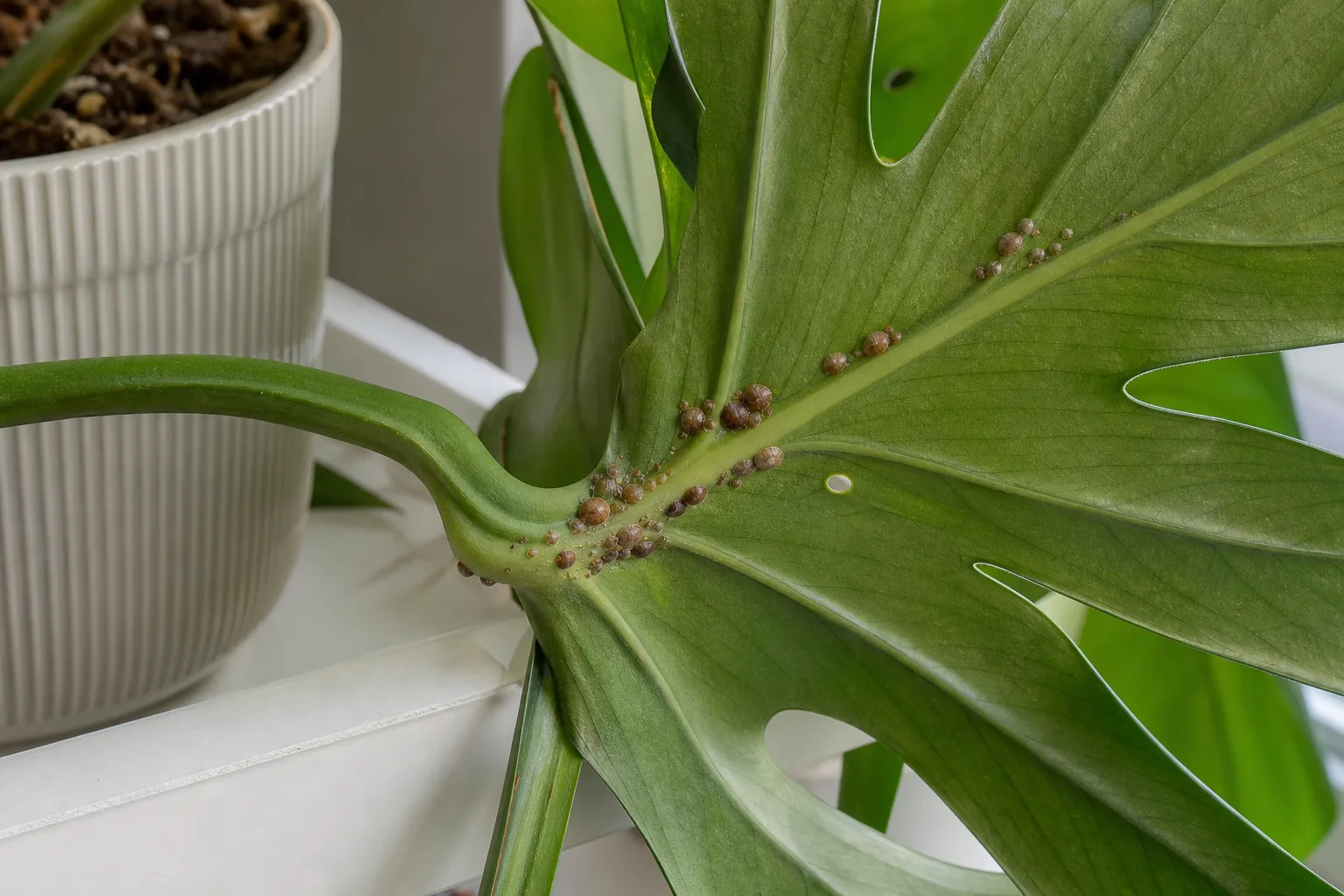
The fastest field test is to scrape one with your fingernail. If it pops off cleanly and feels shell-like, it is scale. If it squishes and leaves behind wet residue, it is still scale — just a live soft scale rather than a dried-out cover. Either way, it is not part of the plant.
Early infestations tend to appear on stems and along the central leaf vein, especially on the underside. Later, scale spreads to leaf petioles and newer growth. By the time you notice yellowing leaves or sticky residue on the floor beneath the plant, the infestation has usually been building for weeks.
Scale is frequently confused with other problems. Brown bumps from edema, mineral deposits from hard water, or fungal leaf spots can all look vaguely similar. The difference: scale can be picked off with a fingernail. Edema and mineral deposits cannot. If you are unsure, take a close-up photo with your phone and zoom in. If you see what looks like a tiny turtle shell with no visible legs or head, it is scale.
Soft Scale vs. Armored Scale — Why the Difference Matters
Not all scale is the same, and mistaking one type for the other leads to failed treatments. Scale insects fall into two main families: soft scales (Coccidae) and armored scales (Diaspididae). The distinction determines which pesticides will actually work.
Soft scale is the more common indoor pest. The brown soft scale (Coccus hesperidum) is found worldwide on an enormous range of houseplants, from Ficus and Monstera to citrus, orchids, and ferns (University of Maryland Extension). Mature females are oval, slightly domed, and range from yellow-green to dark mottled brown. Their waxy coating is part of their body wall — you cannot lift off a separate shell. Soft scale feeds on phloem sap and excretes large quantities of honeydew, the sticky sugar-rich waste that drips onto leaves and surfaces below. That honeydew is often the first sign you notice. On indoor plants, brown soft scale can produce three to seven overlapping generations per year.
Armored scale is less common indoors but more difficult to treat. Fern scale (Pinnaspis aspidistrae) is one of the most frequently encountered armored species on houseplants — it favors ferns, orchids, aroids, palms, and snake plants (UMD Extension). Armored scales secrete a hard, detachable shell that is separate from the insect body underneath. If you pry off the cover, the actual insect remains stuck to the plant. Armored scales do not produce honeydew — no sticky residue, no sooty mold. This makes them easier to overlook until plant damage is obvious. They feed on individual plant cell contents rather than phloem sap, and their hard shell blocks most contact insecticides from reaching the insect inside (UC IPM). Armored scale has at least two generations per year indoors, with reproduction and development continuing year-round.
Here is the practical takeaway: soft scale responds to a broader range of treatments, including systemic insecticides like imidacloprid. Armored scale does not. If you mistake armored scale for soft scale and reach for a systemic, you will waste time and product while the infestation worsens. UC IPM confirms that imidacloprid “controls soft scales and certain other scales but does not control armored scales” (UC IPM Publication 7408). Horticultural oil and thorough manual removal are your best tools against both types, but they are your only reliable tools against armored scale indoors.
| Feature | Soft Scale | Armored Scale |
|---|---|---|
| Cover type | Waxy, part of body; cannot be lifted off | Hard, detachable shell separate from body |
| Honeydew | Yes — sticky residue on leaves and surfaces | No |
| Sooty mold | Common | Absent |
| Size | Up to 1/4 inch, often domed | Smaller, flatter, often under 1/8 inch |
| Indoor common species | Brown soft scale (C. hesperidum) | Fern scale (P. aspidistrae) |
| Systemic insecticide effective? | Yes (imidacloprid) | No |
| Generations per year indoors | 3–7 | 2+ |
The Plants Scale Attacks Most Often
Scale is not equally interested in every houseplant. Some plants seem to attract it, while others rarely see an infestation. Brown soft scale alone has been recorded on plants from over 400 genera across 133 plant families (UMD Extension).
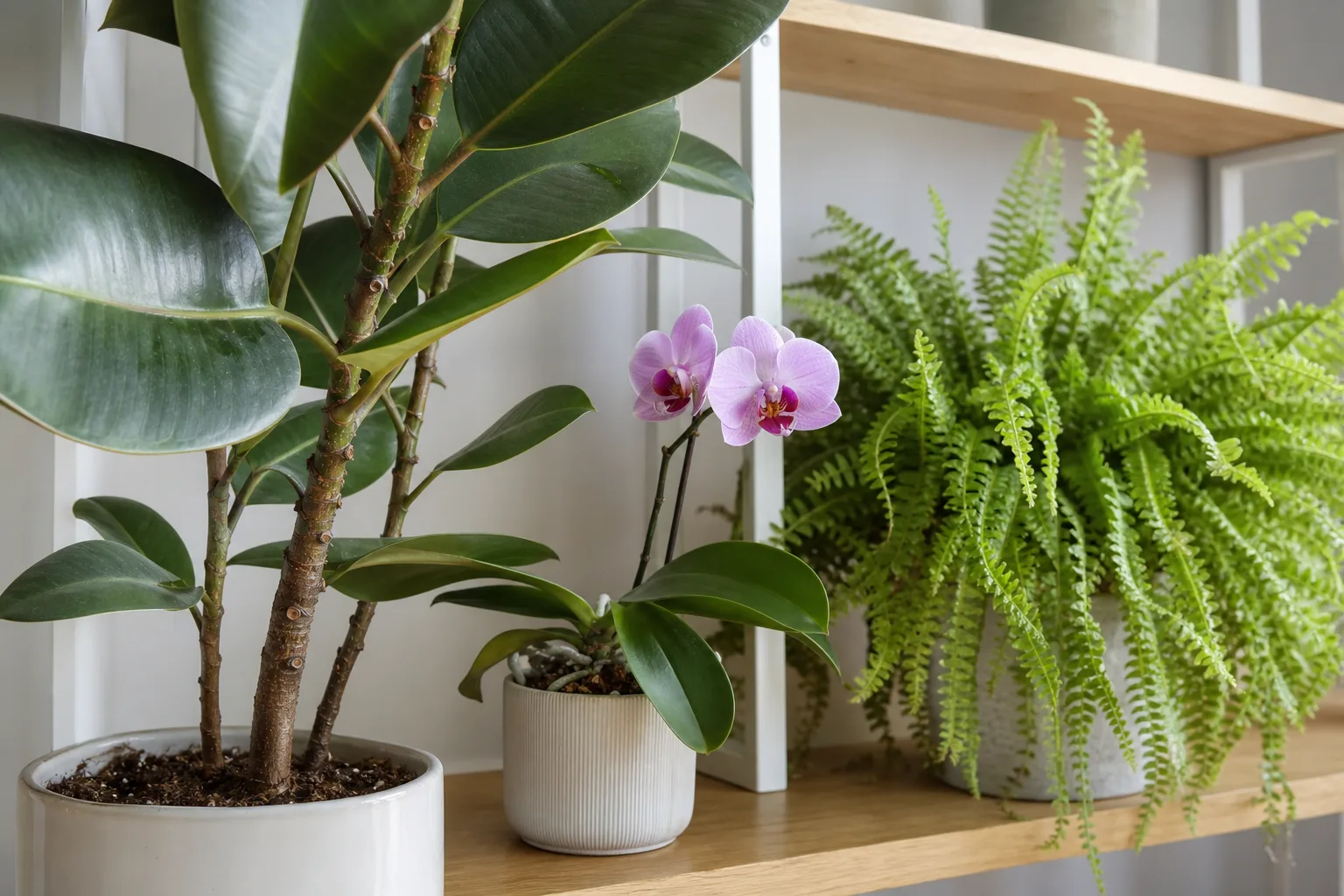
The highest-risk indoor plants include Ficus species (fiddle leaf fig, rubber plant, weeping fig), citrus trees grown indoors, orchids (scale hides under leaf sheaths where you cannot easily see it), ferns, palms, Schefflera, ivy (Hedera), croton, peace lily, Monstera, Philodendron, pothos, Dracaena, and gardenia. Succulents like aloe, haworthia, and agave are also susceptible. In edible indoor plants, scale appears on rosemary, bay laurel, olive, coffee, and pomegranate.
Certain plant characteristics make infestations harder to spot. Plants with overlapping leaf sheaths — orchids, palms, and some aroids — give scale a sheltered place to start a colony before it becomes visible. Plants with dense foliage hide early infestations deep in the canopy. Thick-stemmed plants like Ficus and Schefflera provide more surface area for clusters to establish.
If you grow any of these plants, make a habit of checking stems and leaf undersides during your regular watering routine. Early detection is everything.
How Scale Damages Your Houseplants
Scale feeds by inserting a needle-like mouthpart (stylet) into plant tissue and withdrawing fluids. Soft scale taps into the phloem — the plant’s sugar-transport system. Armored scale punctures individual cells. In both cases, the plant loses nutrients, water, and energy it would otherwise use for growth.
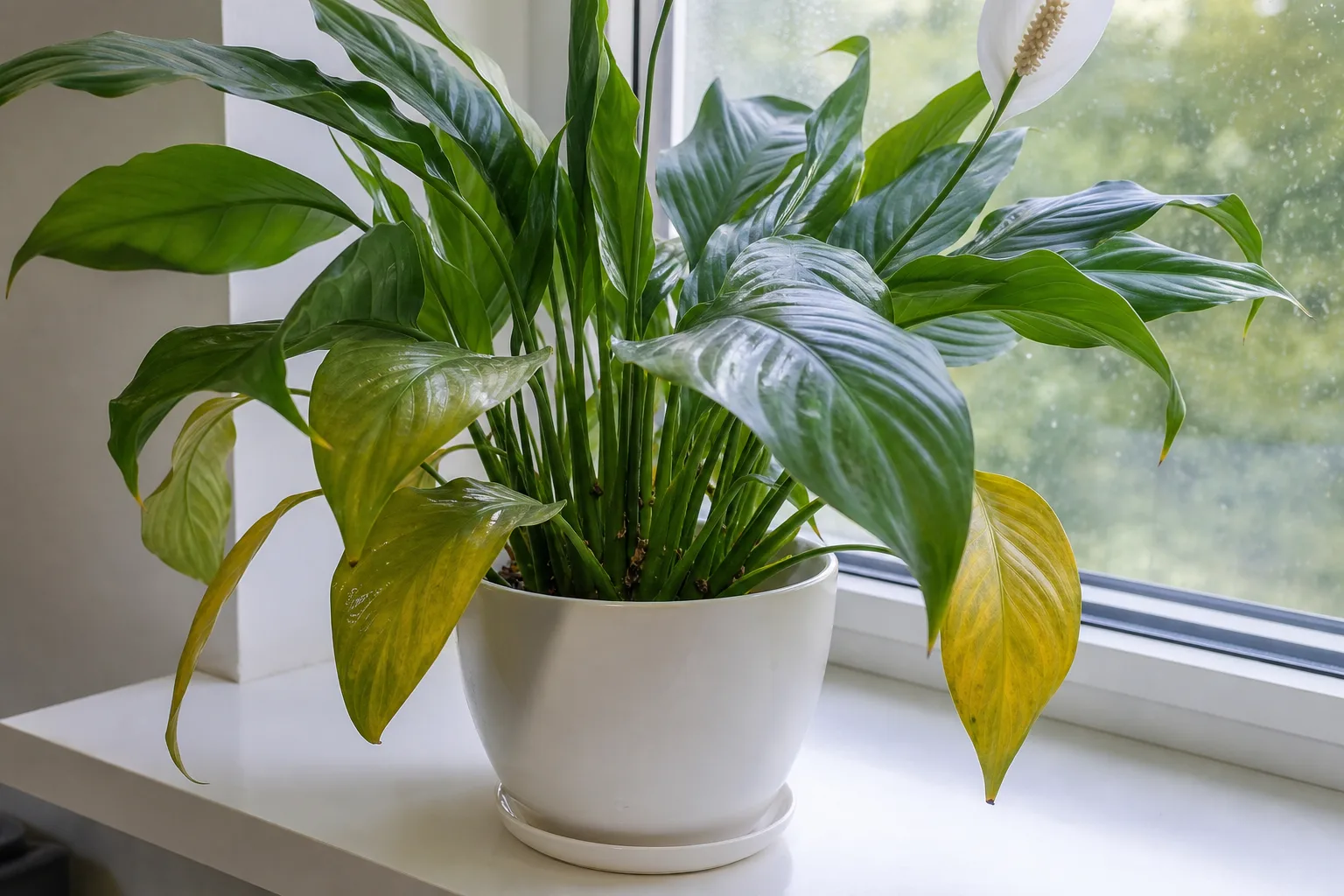
The damage follows a predictable progression. First, leaves near the infestation begin to yellow. This is often mistaken for a watering problem or nutrient deficiency. Then older leaves drop prematurely. New growth slows or comes in distorted. Over weeks to months, the plant looks increasingly thin, weak, and stalled. In heavy infestations, whole stems or branches may die back. The dead leaves often stay attached, giving the plant a scorched appearance (UC IPM).
With soft scale, you get the added problem of honeydew. This sticky coating attracts sooty mold, a black fungal growth that covers leaves and blocks photosynthesis. Sooty mold does not infect the plant itself — it grows on the honeydew — but a thick enough layer shades leaves and further weakens an already struggling plant (UMD Extension). The honeydew can also drip onto floors, furniture, and nearby surfaces, leaving a difficult-to-clean sticky film.
A plant with a light scale population may show no symptoms at all. But scale does not self-resolve. A small population indoors — without natural predators, wind, or rain to disrupt it — inevitably grows. The question is whether you catch it before the plant is too weak to recover.
Where Scale Comes From (and Why It Keeps Coming Back)
Indoors, scale does not appear out of nowhere. It arrives on something.
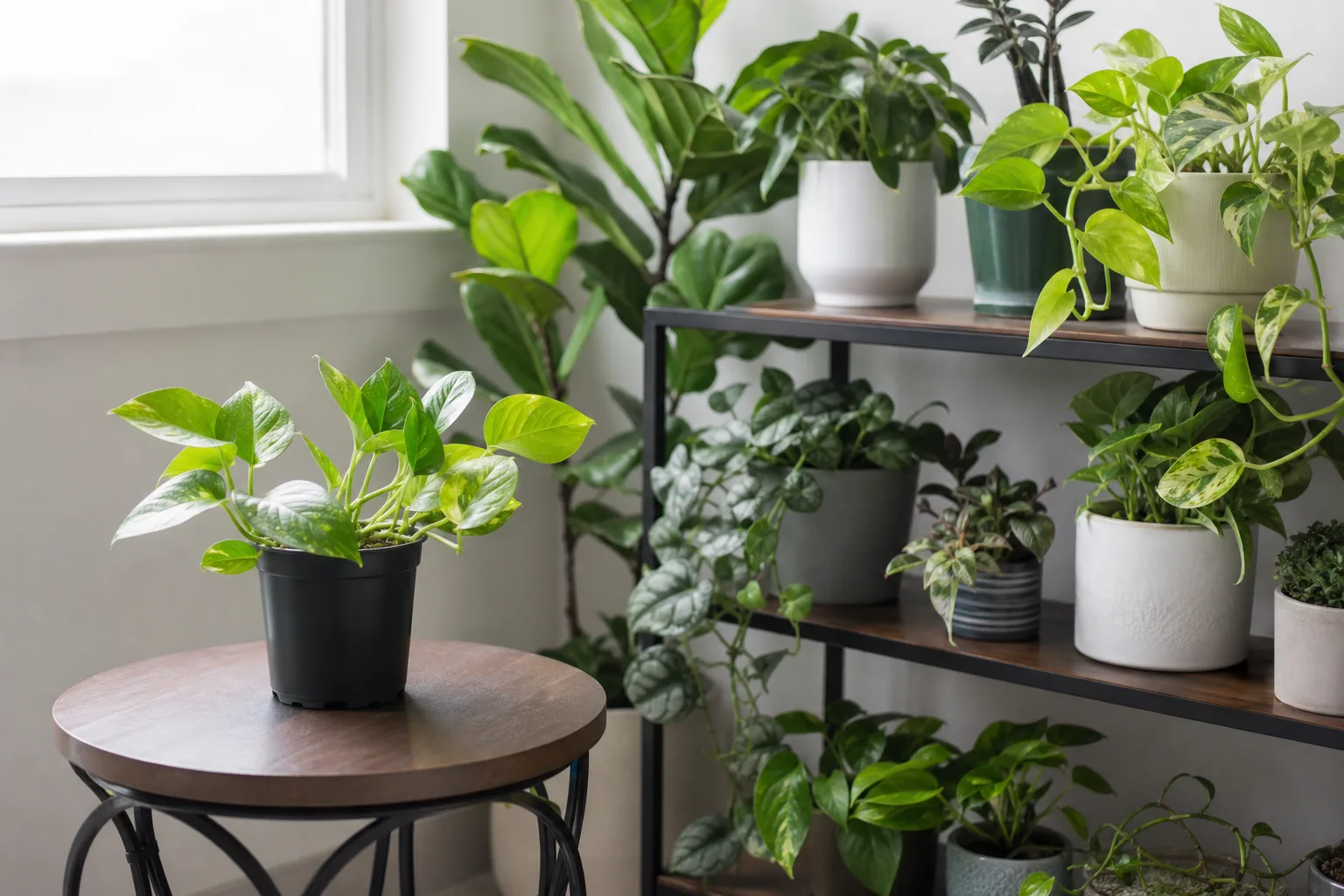
The most common source is a new plant that was already infested when you bought it. Scale eggs, crawlers, or settled nymphs can arrive hidden under leaves, along stems, or tucked into leaf sheaths. This is why experienced growers quarantine every new plant for at least two to three weeks before placing it near their existing collection.
Scale can also arrive on cut flowers or produce brought indoors. Fresh greenery from a garden center or florist may carry crawlers. Outdoor plants brought inside for winter are another major vector — a plant that spent summer on a patio or balcony can pick up scale from the outdoor environment, and once indoors, the pests have no predators to keep them in check.
Ants are an underappreciated accomplice. Outdoors, ants actively farm soft scale for honeydew, protecting them from predators and physically moving crawlers to uninfested plants. Indoors, ants can carry crawlers from plant to plant if they have access. If you see ants trailing to a houseplant, check the plant for scale — the ants are probably not the primary problem but a sign of one (UC IPM).
Re-infestation after treatment usually means either you missed some scale (a few hidden crawlers or eggs under a leaf sheath), or the plant was re-exposed to an untreated nearby plant. Scale crawlers are tiny — yellow to orange and about the size of a dust speck — and can move across leaves or be transferred by your hands, pruning tools, or watering can.
The Scale Life Cycle — Why Timing Changes Everything
Understanding the scale life cycle is not academic. It determines when your treatment will work and why a single application almost never does.
Scale begins as an egg, laid under the female’s protective cover or in a cottony egg sac. Eggs hatch into crawlers — the only mobile life stage. Crawlers are tiny (often yellow to orange), have functional legs, and wander the plant surface for a day or two looking for a feeding site. Once they insert their mouthparts and begin feeding, they settle. Legs are lost or become non-functional. The insect secretes its waxy covering and remains in place for the rest of its life, molting through two or three nymphal instars before becoming a reproductive adult (UC IPM).
The crawler stage is the critical vulnerability. Crawlers have no protective shell. Contact insecticides — horticultural oil, insecticidal soap, neem oil — can kill them on contact. Once the scale settles and builds its waxy cover, those same products become far less effective because the spray cannot reach the insect underneath.
Indoors, the life cycle never stops. Brown soft scale completes a generation in about 60 days and can produce three to seven overlapping generations per year. Fern scale takes about 95 days per generation with at least two generations annually (UMD Extension). Because generations overlap — eggs, crawlers, nymphs, and adults all present simultaneously — any treatment you apply needs to be repeated. Weekly applications for three to four weeks is a realistic minimum.
How to Inspect Your Plants for Scale
You find scale by looking, not by waiting for symptoms. By the time leaves turn yellow or you notice honeydew on the floor, the infestation is weeks old.
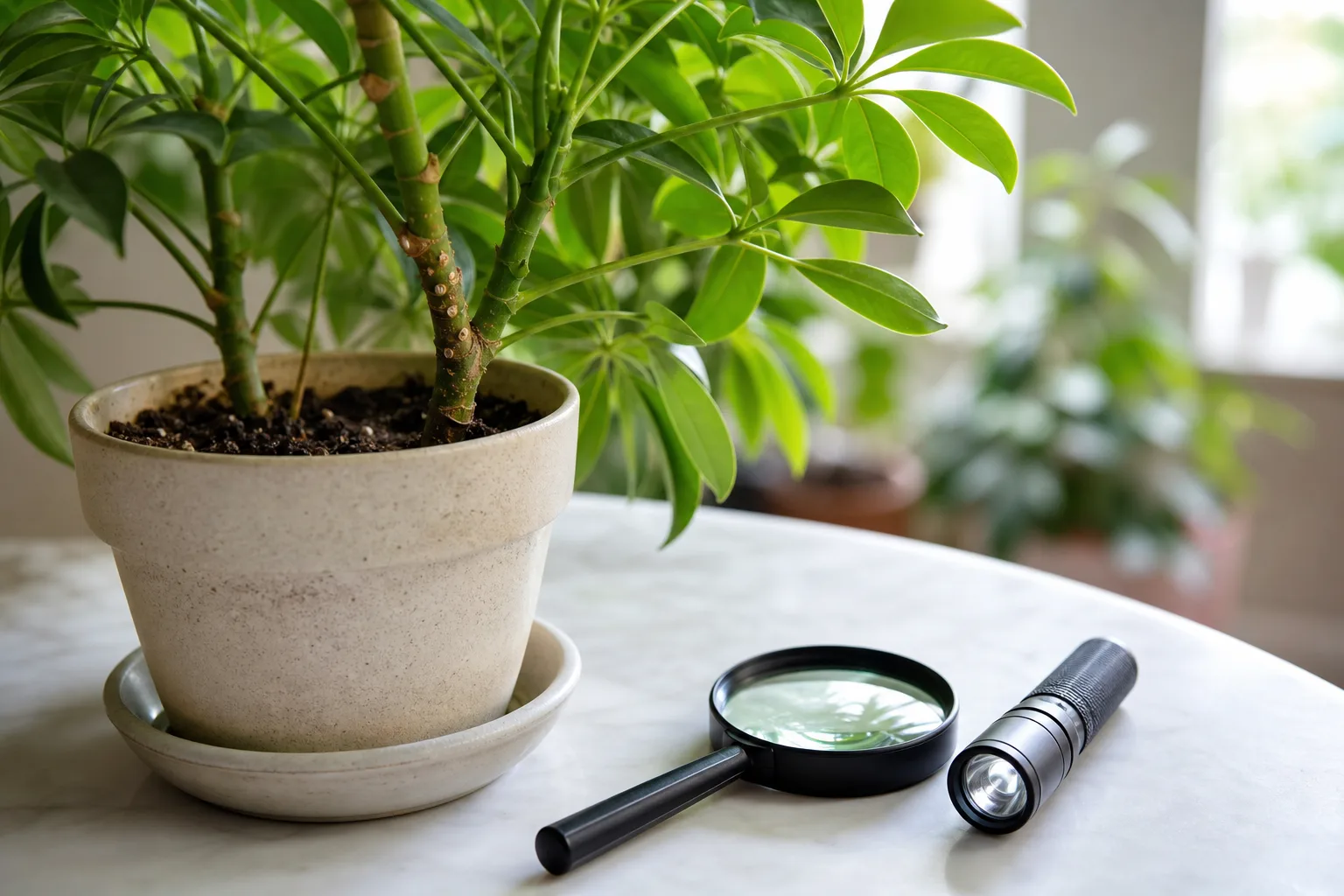
Inspect methodically. Start with the stems — scale prefers the junction where leaf meets stem and the woody lower portions of the plant. Run your finger along the stem. Scale bumps feel rough or slightly raised compared to smooth stem tissue. Next, check leaf undersides, especially along the central vein. Scale often lines up along veins where sap flow is most accessible. For plants with leaf sheaths — orchids, peace lilies, some palms — gently peel back the sheath and look inside. This is a favorite hiding spot.
Use a magnifying glass or your phone’s macro lens if you are unsure. Live scale may appear slightly glossy. Dead scale — which can remain attached for months after the insect dies — looks dull, dry, and sometimes cracked. The difference matters because dead scale does not require treatment, but it can fool you into thinking an infestation is ongoing.
Sticky tape monitoring is a technique adapted from outdoor IPM that works indoors too. Wrap double-sided transparent tape around a few stems or petioles and check it weekly. Crawlers get stuck and appear as tiny yellow or orange specks. This tells you whether the population is actively reproducing and helps you time treatments (UC IPM).
Also check for ants. If ants are trailing to your plant, look closely. They are likely feeding on honeydew from soft scale — and they may be protecting the scale from whatever natural enemies exist indoors.
Step 1 — Isolate the Plant Immediately
The moment you confirm scale, move the plant away from all other plants. Scale crawlers can travel short distances across leaves, drip onto plants below, or hitch a ride on your hands and tools. A separation of at least three feet is a reasonable minimum, but a separate room is better.
While the plant is isolated, check every plant that was nearby. Scale spreads slowly compared to pests like spider mites or thrips, but if plants were in direct leaf-to-leaf contact, assume the neighboring plants may have been exposed. Inspect them and monitor for several weeks.
Isolation also makes treatment more effective. You can apply sprays more thoroughly without worrying about drift onto other plants. You can be more aggressive with pruning and manual removal. And you reduce the risk of treating one plant while an untreated plant re-seeds the infestation.
Step 2 — Manual Removal (Your First and Most Underrated Weapon)
Before you reach for any spray, physically remove as much scale as possible. This step does more to reduce the population than most people realize, and it costs nothing.
Use a soft toothbrush, a fingernail, or a damp cloth and gently scrape or rub the scale off the stems and leaves. Scale that has already died or dried out will flake off easily. Live scale requires slightly more pressure but should still dislodge. The goal is not to kill every insect during this pass — it is to remove the protective covers, expose the insects underneath, and reduce the total number you need to treat chemically.
For plants with many small leaves or inaccessible crevices, manual removal alone will not get everything. That is fine. Do what you can, then move to the next step. Any scale you remove mechanically is scale you do not need to kill chemically.
Prune heavily infested stems or leaves and dispose of them in the trash — not in compost. Do not try to save a leaf that is 50% covered in scale. The plant will recover faster from losing that leaf than from carrying the infestation. For plants like pothos, Monstera, or Philodendron that can be propagated from cuttings, consider whether taking a few clean cuttings from uninfested portions and starting over is more practical than treating an extensively infested mother plant.
Step 3 — Rubbing Alcohol Treatment
Rubbing alcohol (70% isopropyl) is the single most effective spot-treatment for scale on indoor plants. It works by dissolving the waxy protective coating and killing the insect underneath on contact. It is inexpensive, available everywhere, and leaves no toxic residue — it simply evaporates.
The technique matters. Dip a cotton swab or small makeup sponge in alcohol and apply it directly to each scale you can see. Press and hold for a second or two to ensure the alcohol penetrates the covering. Do not just wipe it across the surface. For clusters on stems, you can wrap an alcohol-soaked cotton pad around the stem and hold it in place for 30 seconds. The alcohol will reach scale hidden in crevices that a swab might miss.
Do not spray the entire plant with alcohol. Alcohol can damage sensitive foliage — ferns, orchids with thin leaves, and plants with fine hairs are especially vulnerable. Always test on a single leaf first and wait 24 hours. If the leaf shows no damage, proceed. If it burns or discolors, stick to targeted swab application and avoid the leaf blades entirely.
Repeat every two to three days for at least two weeks. The alcohol kills adults and exposed nymphs on contact, but it does not penetrate eggs and may not reach crawlers hidden in tight spaces. Repeated applications catch new crawlers as they emerge and before they settle and armor up.
Step 4 — Horticultural Oil and Insecticidal Soap
Once you have removed what you can manually and spot-treated with alcohol, a broader application of horticultural oil or insecticidal soap catches the crawlers and young nymphs that you missed.
Horticultural oil works by smothering. It coats the insect’s body and blocks its breathing pores. It is effective against both soft scale and armored scale because it does not need to penetrate the shell — it just needs to contact the insect. Thorough coverage is essential. Spray every stem, both sides of every leaf, every petiole, and the soil surface where crawlers may be present. A plant should be dripping after a proper application (UMD Extension).
Insecticidal soap works differently — it disrupts cell membranes and causes dehydration. It is most effective on crawlers and young nymphs before they develop thick waxy coverings. Once scale is mature and armored, soap has limited effect. Use insecticidal soap as a crawler-stage follow-up, not as a primary treatment for established infestations.
Important precautions: Do not apply horticultural oil when temperatures exceed 85°F or when the plant is in direct sun — you risk leaf burn. Do not apply to drought-stressed plants; water thoroughly the day before treatment. Ferns can generally tolerate horticultural oil if kept shaded while the spray dries. Some plants have specific sensitivities — always check the product label. Repeat applications weekly for at least three to four weeks to catch successive waves of crawlers.
Step 5 — Neem Oil and Plant-Based Treatments
Neem oil occupies a useful middle ground. It works partly as a smothering oil (like horticultural oil) and partly as a growth regulator — azadirachtin, the active compound in neem, disrupts insect molting and reproduction. This dual action makes neem more effective than plain oil against established scale, not just crawlers.
Neem oil does not mix easily with water. Combine 1 to 2 tablespoons of neem oil with 1 to 2 teaspoons of mild dish soap as an emulsifier, then add to a gallon of water. Shake well and spray to full coverage. Apply in the evening or on an overcast day — neem, like any oil, can cause phototoxicity in direct sun.
The limitation is coverage. Scale tucked into leaf sheaths, stem crevices, or the tightly furled new leaves of plants like Ficus and Philodendron may escape the spray entirely. Neem is a valuable tool in the rotation, but it is not a one-and-done solution.
Other plant-derived oils — canola oil, cottonseed oil, soybean oil — work similarly as suffocants. They are less studied than neem for scale specifically but are generally safe and can be used as alternatives if neem is unavailable.
Step 6 — Systemic Insecticides (When Nothing Else Works)
Systemic insecticides are absorbed by the plant and distributed through its vascular system. When a scale insect feeds on treated tissue, it ingests the insecticide and dies. This approach bypasses the protective shell entirely — which is why systemics are appealing.
The most common systemic for indoor plants is imidacloprid, available in granular and liquid formulations labeled for houseplants. It is effective against soft scale only. It does not control armored scale (UC IPM). If you are unsure which type of scale you have, do not use a systemic until you confirm it is soft scale. Using imidacloprid against armored scale achieves nothing while exposing you and your home to an insecticide.
Systemics labeled for indoor use are applied as a soil drench. The plant takes up the chemical through its roots and moves it into stems and leaves over the following days to weeks. This means systemics are slow to act — you will not see immediate results. Combine a systemic application with manual removal and horticultural oil for faster knockdown of the existing population.
There are meaningful trade-offs. Imidacloprid is a neonicotinoid, a class of insecticides linked to pollinator harm. For indoor plants that never go outside, the risk to bees is minimal. But if you summer your plants outdoors, avoid systemics entirely or keep treated plants indoors permanently. Do not use systemic insecticides on edible plants — the labels explicitly prohibit this for fruits, herbs, and vegetables grown indoors.
Systemics are a last resort for indoor plants that are difficult to treat manually — large Ficus trees, sprawling Hoya vines, heavily foliated Schefflera — where complete spray coverage is impractical. For most houseplants, mechanical removal plus oil and alcohol will do the job without systemic chemicals.
How to Prevent Scale From Returning
Scale prevention is simpler than scale treatment, but it requires consistency.
Quarantine every new plant for two to three weeks. This is the single highest-impact habit you can adopt. Inspect new plants when you buy them, then isolate them away from your collection and check weekly. Scale eggs take about one to two weeks to hatch and crawlers take a few more days to become visible. A three-week quarantine catches most introductions before they spread.
Inspect weekly during watering. It takes 30 seconds to check stems and leaf undersides while you are already at the plant. Scale caught at the first few bumps is a five-minute job with a cotton swab. Scale caught after three months is a multi-week treatment campaign.
Shower your plants monthly. A lukewarm shower in the bathroom or a spray-down in the sink knocks off dust, dislodges early-stage crawlers, and lets you see the plant clearly. It also raises humidity briefly, which most tropical houseplants appreciate. Just let the foliage dry before returning the plant to direct sun.
Do not overfertilize. High-nitrogen fertilizers push soft, succulent new growth that is particularly attractive to sap-sucking pests including scale (UMD Extension). Fertilize at half the recommended strength during the growing season and stop entirely during winter when growth slows.
Control ants if they appear. Ants farming honeydew on your houseplants will actively protect scale from your treatment efforts. Bait traps near (not on) the plant are more effective than sprays, which only kill foraging workers while the colony survives.
Check plants coming back indoors. If you move plants outside for summer, inspect them thoroughly before bringing them back inside in the fall. Scale picked up outdoors can explode indoors without natural predators to suppress it.
When to Throw the Plant Away
Not every plant is worth saving. If you have been treating for four to six weeks without visible improvement — scale keeps reappearing, the plant continues to decline, new growth is stunted or deformed — you are in diminishing returns territory. The cost of continued treatment in time, products, and risk to your other plants starts to exceed the value of the plant itself.
Throw the plant away — bag it and put it in the trash, not compost — if:
- More than half the stems or leaves are infested
- The plant has stopped producing new growth entirely
- You have applied horticultural oil three or more times at weekly intervals without reduction
- The plant is small, inexpensive, or easy to replace (pothos, Peperomia, small ferns)
- You have other high-value or sentimental plants nearby that you cannot risk
If the plant has sentimental value — a large Monstera you have grown for years, a Ficus inherited from someone — it is worth persisting. Treat aggressively with the full sequence: manual removal, alcohol, oil, and repeat. It may take two months or more to fully clear a heavy infestation from a large plant.
A useful rule of thumb: if you dread treating the plant, and replacing it costs less than $20, replace it. The risk of scale spreading to your other plants while you delay or under-treat is not worth the savings.
Conclusion
Scale on houseplants is common, slow-moving, and completely manageable if you catch it early and treat it methodically. The problem is rarely the pest itself — it is the delay between when scale arrives and when you notice it.
Start with identification. Know whether you are dealing with soft scale or armored scale, because your treatment approach depends on it. Soft scale makes sticky honeydew and responds to systemics. Armored scale hides under a hard removable shell and does not. Both respond to manual removal and horticultural oil.
Start treatment with the least aggressive method that fits the infestation. Manual removal with a toothbrush or cotton swab. Alcohol spot-treatment. Horticultural oil spray for full coverage. Neem oil for its dual smothering and growth-regulating action. Systemic insecticides only when nothing else has worked, and only for confirmed soft scale.
Isolate the plant. Inspect everything nearby. Treat weekly for at least three to four weeks — overlapping generations mean a single application always leaves survivors. And if the plant is small, inexpensive, heavily infested, and draining your motivation, throw it away without guilt. There is always another plant.