Mealybugs on Houseplants: Identification, Treatment, and Prevention
White cottony clumps on your plant? Learn to identify mealybugs on houseplants, treat infestations with rubbing alcohol, insecticidal soap, or systemic options, and prevent them from returning.
Mealybugs on Houseplants: Identification and Treatment
You spot a cluster of white fuzz tucked into the joint where a leaf meets the stem. At first it looks like mold or maybe a bit of dust. Then you look closer and realize it’s moving — tiny, cotton-covered insects packed together like a miniature flock of sheep. That sinking feeling means you have just met your first mealybug infestation. They are among the most persistent pests you will encounter on indoor plants, but they are also manageable with the right approach. The goal is not panic. The goal is a calm, methodical response that matches the severity of the problem.
What Are Mealybugs?
Mealybugs are small, soft-bodied, sap-sucking insects in the family Pseudococcidae, closely related to scale insects but lacking the hard protective shell that makes scale so difficult to treat [Source]. Their bodies are covered in a powdery white wax that gives them their characteristic cottony appearance. Adult females — the ones you will almost always see — are wingless, oval, and segmented, typically measuring 2 to 4 millimeters in length, with waxy filaments extending from the margins of their bodies [Source]. Males exist but are tiny, winged, short-lived, and so rarely spotted that they are irrelevant to identification and control.
In their natural outdoor habitat, mealybugs are kept in check by predators and weather. Indoors, where temperatures stay warm year-round and natural enemies are absent, they can breed without interruption and build populations dense enough to seriously weaken a plant [Source]. That combination of year-round reproductive potential and the absence of biological controls is what makes indoor mealybug infestations so persistent compared to outdoor ones.
How Mealybugs Damage Houseplants
Mealybugs feed by inserting their piercing-sucking mouthparts into the plant’s phloem tissue and drawing out the carbohydrate-rich sap that the plant uses for growth and energy storage. This direct sap loss is what weakens the plant over time. Heavy feeding can cause yellowing leaves, stunted new growth, leaf drop, and in severe cases, branch dieback or death of the entire plant [Source]. Healthy, well-established plants can tolerate low populations without obvious damage, but the threshold for visible decline drops quickly as numbers increase.
The secondary damage is often what catches your eye first. Mealybugs excrete a sugary waste product called honeydew that drips onto leaves and stems below the feeding sites. That sticky coating then becomes a growing medium for sooty mold, a black fungal growth that, while not directly infecting the plant tissue, can cover enough leaf surface to reduce photosynthesis [Source][3]. If your plant’s leaves look glossy-sticky or have patches of dark soot-like film, look upward for the mealybug colony producing it. Some mealybug species can also transmit plant viruses, though this is more of a concern in agricultural settings than in a typical houseplant collection [Source].
How to Identify Mealybugs on Houseplants
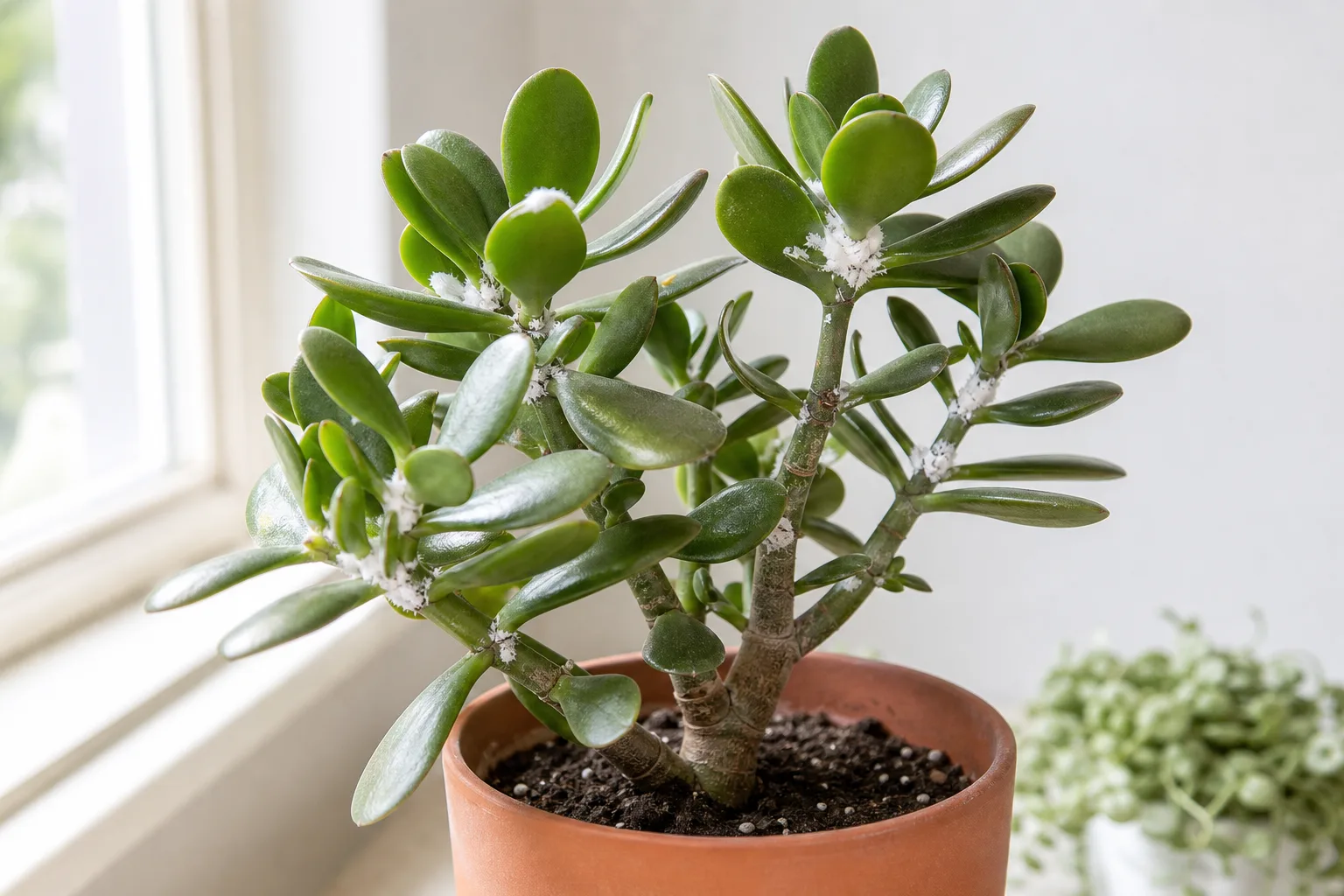
The most reliable visual cue is the white cottony wax. You will find it in clusters at leaf axils — those V-shaped junctions where a leaf or petiole meets the stem — along stem nodes, on the undersides of leaves, and sometimes at the base of the plant near the soil line [Source][3]. The wax serves as both camouflage and armor, repelling water-based sprays and hiding the insects from casual inspection.
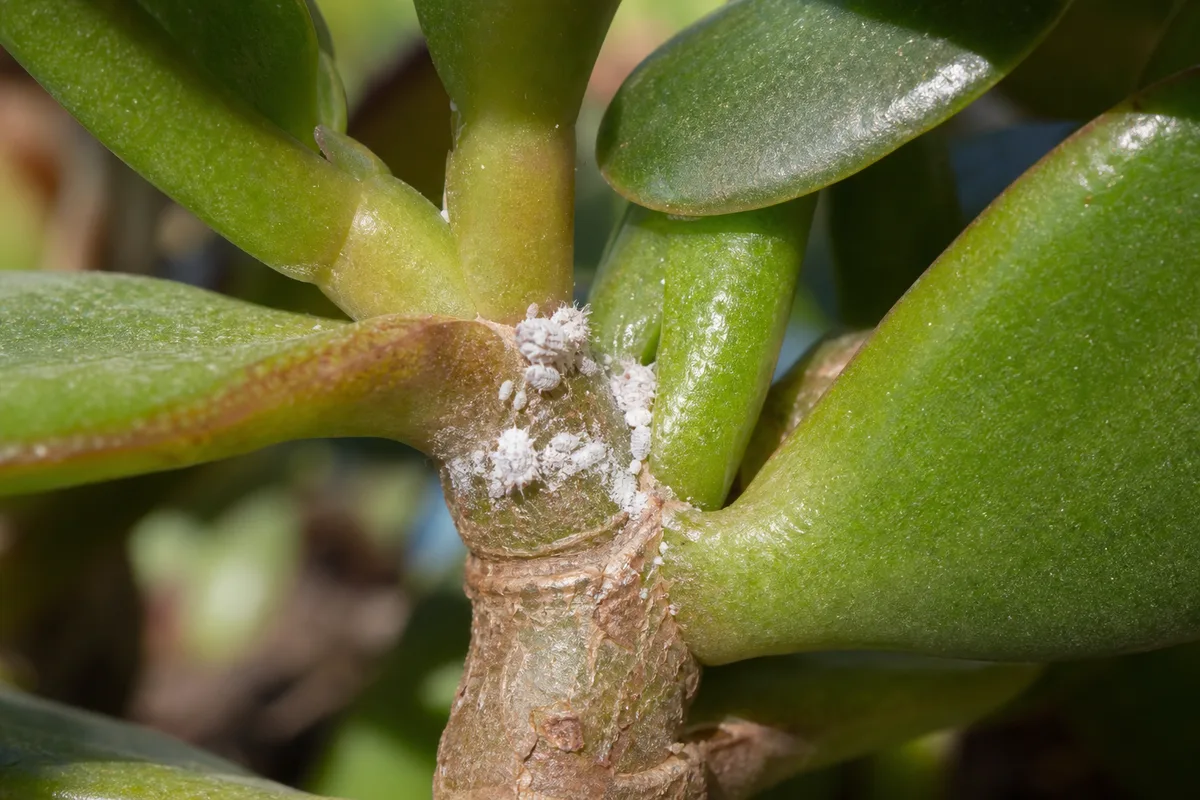 If you disturb the wax with a toothpick or cotton swab, you will expose the soft-bodied insect underneath: oval, segmented, and usually pale pink, yellowish, or light gray. You may also find tiny orange-pink eggs nestled within the cottony masses [Source]. Mealybugs are slow-moving. You will not see them scurry away when disturbed the way aphids or thrips do. They may shift slightly, but mostly they stay put, which makes manual removal straightforward once you have located them.
Common Mealybug Species Found Indoors
Not all mealybugs you encounter on houseplants behave the same way, and knowing which species you are dealing with can affect your treatment strategy.
The citrus mealybug (Planococcus citri) is the most common species on indoor ornamentals [Source]. It has short, equal-length waxy filaments around its body margin and sometimes a faint dark stripe running down its back. It lays eggs in dense cottony sacs and can produce hundreds of offspring per female over a reproductive period of 10 to 20 days [Source].
The longtailed mealybug (Pseudococcus longispinus) is easily distinguished by its two tail filaments, which can be as long as or longer than its body [Source]. Unlike the citrus mealybug, the longtailed mealybug gives birth to live young rather than laying eggs, which means you will not find egg sacs in its colonies. It can also reproduce without mating, so a single female can start an infestation on her own [Source].
Root mealybugs (Rhizoecus species) live entirely below the soil surface and feed on plant roots. They lack the prominent body filaments of their above-ground relatives and are often paler — white to yellowish — and smaller. You will not see them unless you unpot the plant and examine the root ball. Signs of root mealybug damage include unexplained wilting, slow decline, and white waxy residue clinging to roots and the inside of the pot [Source][3].
Look-Alike Pests You Might Confuse With Mealybugs
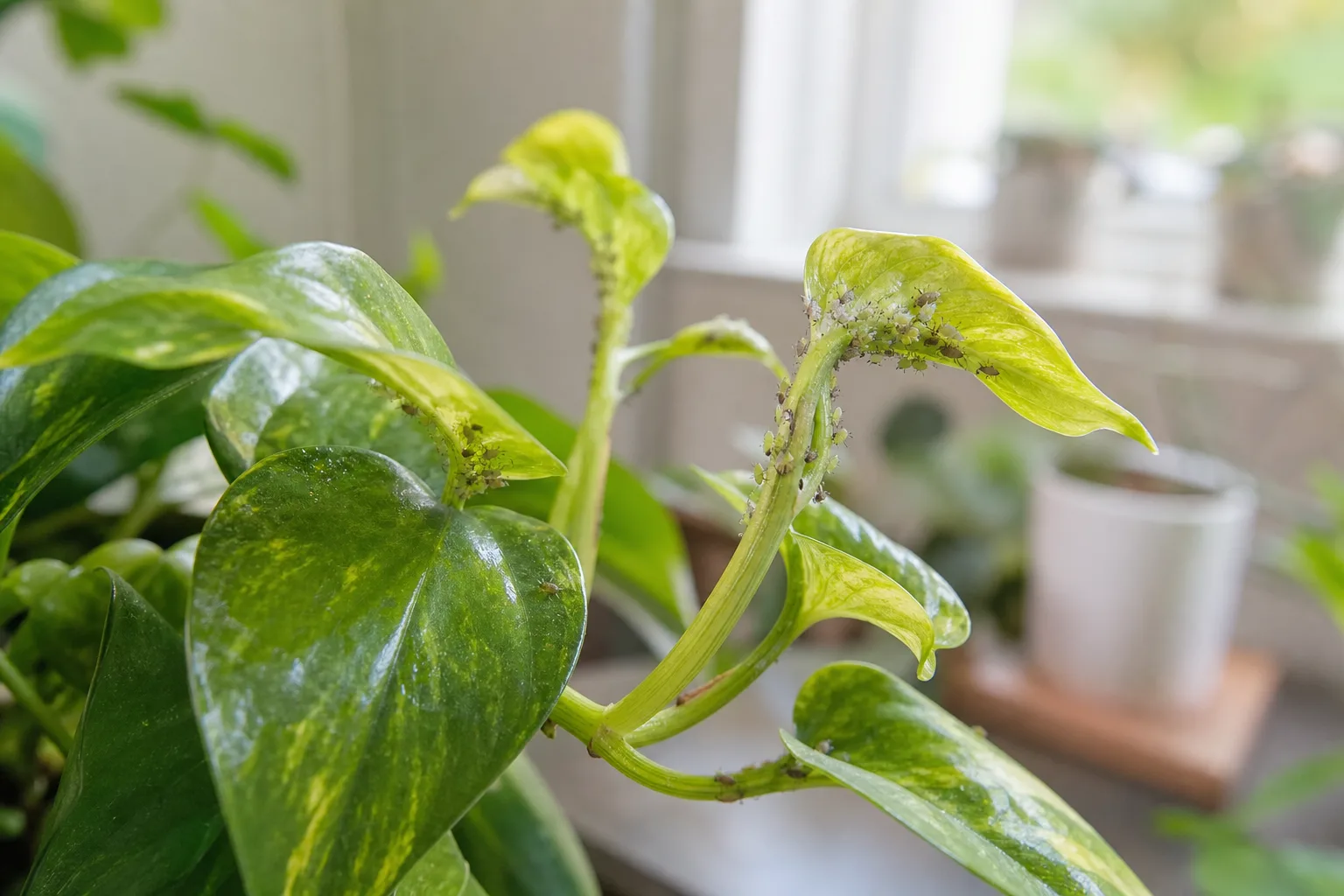
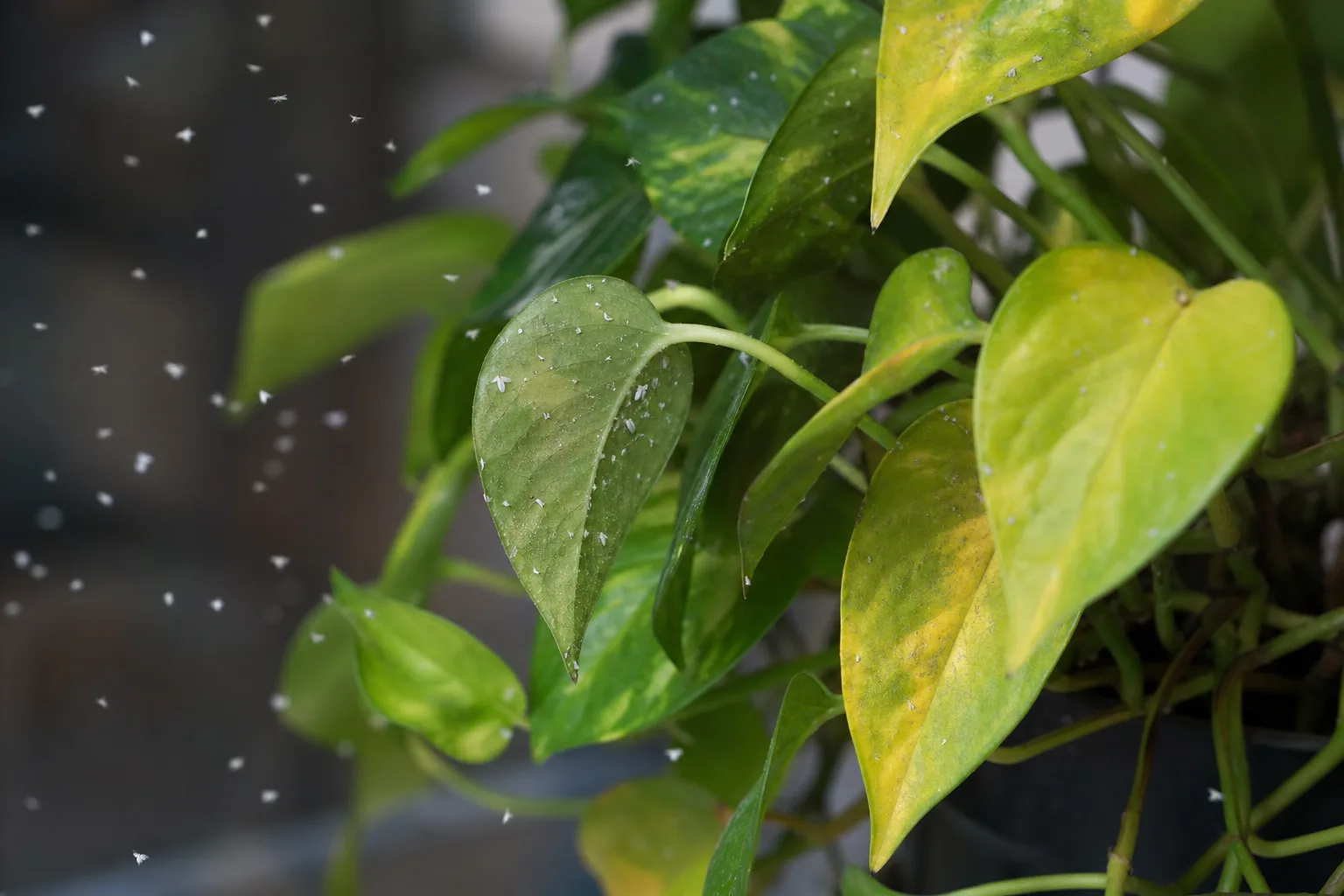
White fuzzy material on a plant does not always mean mealybugs. Woolly aphids produce similar white waxy filaments but are more mobile and tend to scatter when disturbed. Scale insects, especially soft scale, also produce honeydew, but scale remains fixed in place under a shell-like cover rather than moving around on legs. Whiteflies are winged and will flutter up in a small cloud when the plant is disturbed — something mealybugs never do. Cottony cushion scale produces large, ribbed egg sacs that can be mistaken for mealybug colonies, but the insect beneath looks markedly different [Source]. If you are unsure, take a close-up photo and compare it against reference images from a university extension site. Getting the identification right matters because treatment approaches differ across these pests.
Where Mealybugs Hide on Your Plants
Mealybugs prefer sheltered, tight spaces that protect them from air movement, light, and whatever predators might exist. Their favorite locations are leaf axils, where the petiole joins the stem — these are the cramped V-shaped crevices that a casual glance misses entirely. They also cluster under leaf sheaths on plants like dracaena, between twining stems on vining plants like hoya and philodendron, inside unfurled new leaves, and at the crown of the plant where stems emerge from the soil [Source][3].
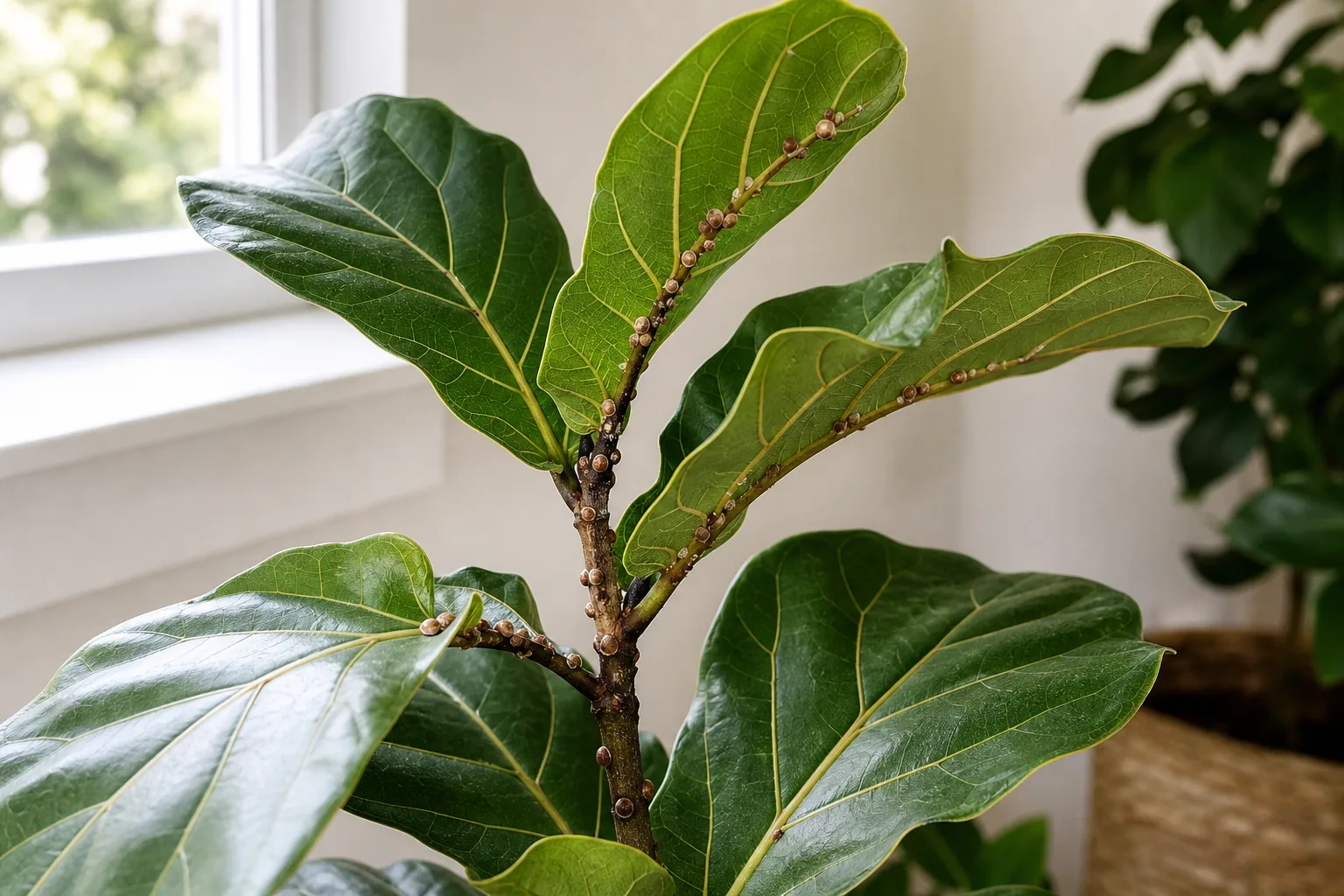
On succulents and cacti, mealybugs wedge themselves into the tight spaces between ribs, areoles, and spines where they are nearly impossible to reach with a spray. On orchids, they hide under the papery sheaths covering the pseudobulbs and at the junction where leaves attach. On ficus and schefflera, they congregate along the midrib of the leaf underside. If you are checking for mealybugs, you need to look at all of these places, not just the obvious leaf surfaces. The infestation you can see is often a fraction of the total population.
Signs You’re Dealing With Root Mealybugs
Root mealybugs are the stealth operators of the mealybug world. Since they live in the potting mix, you will typically notice the plant declining — yellowing, wilting despite adequate watering, stunted growth — before you ever see the pest [Source]. When you slide the plant out of its pot, look for white, waxy deposits clinging to the root ball and the inner walls of the container. The insects themselves are small, pale, and easily mistaken for bits of perlite or slow-release fertilizer unless you look closely. A hand lens or macro photo can help confirm. Root mealybugs tend to affect African violets and gardenias more than other houseplants, though they have been reported on a wide range of potted plants [Source].
How Mealybugs Get Into Your Home
Mealybugs do not appear out of thin air. Adult females cannot fly, and even the mobile nymphs cannot travel more than a short distance on their own [Source]. Nearly every indoor infestation starts with an infested plant that was brought into the home — a new purchase from a nursery, a gifted cutting, a plant that spent the summer outdoors and came back in, or even a plant that had been in the collection for months before the population grew large enough to notice [Source][3].
Less commonly, mealybugs can hitchhike on clothing, gardening tools, or reused pots that still carry egg sacs or crawlers. They can also move between plants in a collection when leaves of adjacent plants touch, creating a bridge for the slow-moving nymphs to cross [Source]. Ants, if present, can actively transport mealybugs from plant to plant in order to farm them for their honeydew — this is more of a greenhouse or outdoor scenario, but it is worth keeping in mind if you have ant activity near your plants [Source].
The Mealybug Life Cycle and Why It Matters for Treatment
Understanding the mealybug life cycle is not academic trivia. It is the difference between treatment that works and treatment that feels like it works, only for the infestation to resurge two weeks later. The life cycle explains why.
An adult female mealybug lays between 100 and 200 or more eggs in a cottony egg sac over a period of 10 to 20 days [Source]. The eggs hatch into first-instar nymphs called crawlers — yellow to orange-pink, tiny, and temporarily wax-free. Crawlers are the only highly mobile stage and the stage most vulnerable to contact insecticides because they lack the protective wax coating [Source]. After settling down to feed, usually within a day or two, they begin producing their own wax and become increasingly resistant to sprays as they molt through several nymphal instars on their way to adulthood.
Depending on the species and indoor temperature, a generation can complete in roughly a month during warm weather [Source]. Indoors, where temperatures stay consistently warm, mealybugs can produce multiple overlapping generations per year with all life stages present simultaneously [Source]. This is the crux of the treatment problem: you can kill every adult and older nymph you see with a single application, but the eggs in their protective sacs will survive, and the freshly hatched crawlers will be too small to notice. If you stop treating after the visible insects are gone, you are handing the next generation an uncontested plant.
The longtailed mealybug complicates this further: because it gives live birth rather than laying eggs, there is no egg sac to target, and a single surviving female can restart the population immediately [Source].
How to Treat a Mealybug Infestation: A Step-by-Step Approach
The treatment approach should escalate with the severity of the infestation. A few isolated mealybugs on a single leaf junction do not warrant the same response as a heavily colonized plant with sooty mold and leaf drop. What follows is a ladder of interventions, from least to most aggressive.
Step 1: Isolate the Plant Immediately
The moment you confirm mealybugs, move that plant away from every other plant in your collection. Mealybugs spread slowly on their own, but leaf-to-leaf contact between neighboring plants gives crawlers a direct path [Source]. Put the infested plant in a separate room if possible, or at least several feet away from anything else. Check every plant that was adjacent to the infested one — look in the leaf axils and stem joints specifically. Do this even if those plants look clean. An early infestation on a neighboring plant is small enough to miss but large enough to become a problem within weeks.
Step 2: Manual Removal With Rubbing Alcohol
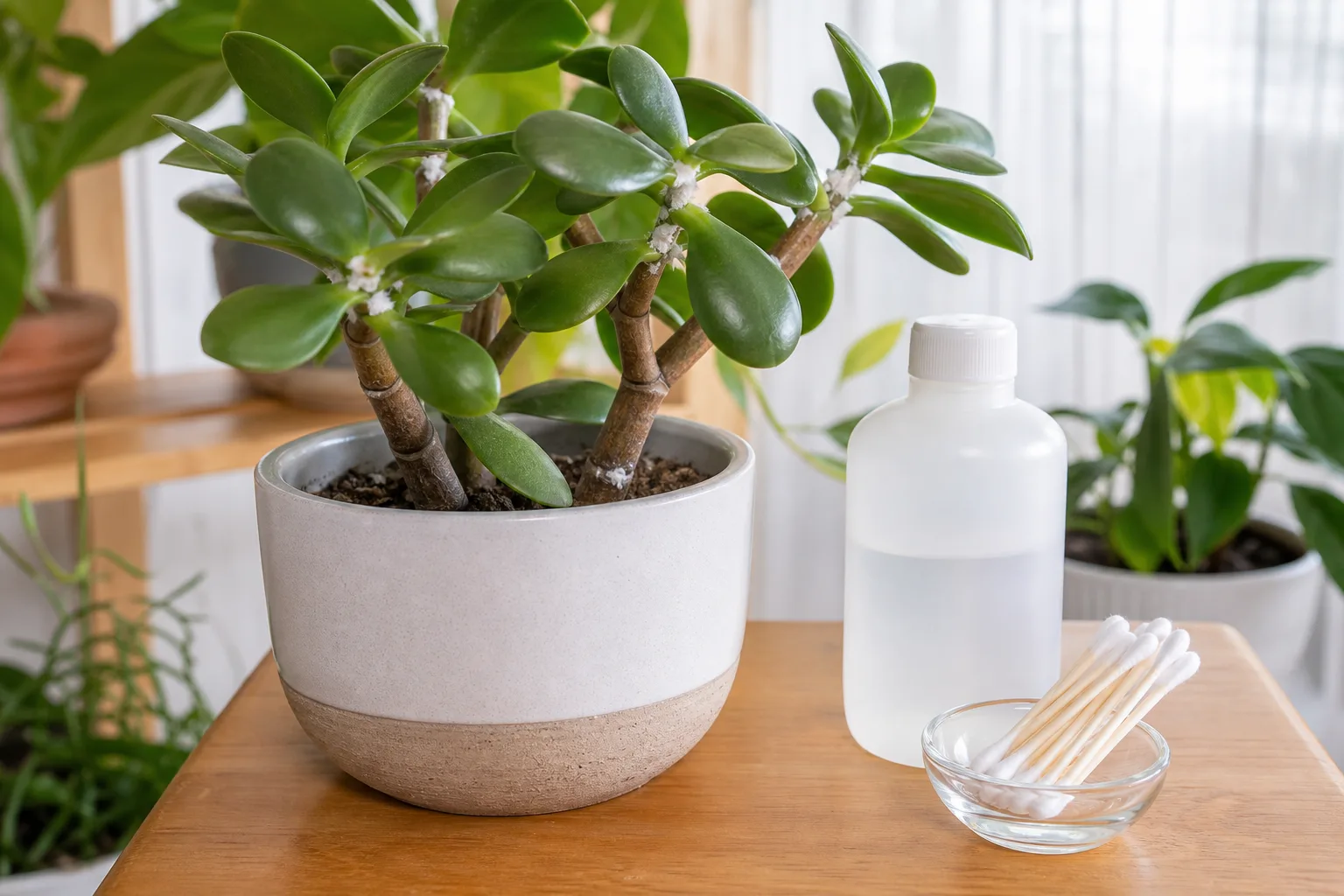
For light to moderate infestations — scattered colonies rather than a plant that is visibly coated — 70% isopropyl alcohol (or a slightly lower concentration; do not use 90% or higher, which evaporates too quickly to work effectively and increases the risk of leaf burn) is the first-line treatment recommended by university extension programs [Source][2].
Dip a cotton swab in the alcohol and dab it directly onto each visible mealybug and egg mass. The alcohol dissolves the waxy cuticle on contact, killing the insect almost immediately — treated mealybugs turn light brown as the wax dissolves [Source]. Work through every leaf joint, stem crevice, leaf underside, and crown area systematically. Do not rush this step. Missing a single egg sac or gravid female can restart the problem.
Before you commit to alcohol on the entire plant, test it on a single leaf and wait 24 to 48 hours to check for phytotoxicity — leaf burn, browning, or tissue collapse [Source][2]. Some plants, particularly those with thin or tender foliage like certain ferns, African violets, and some orchids, can react badly. If you see damage, dilute the alcohol further — a 10 to 25% solution in water can be applied as a spray for more extensive infestations — or switch to insecticidal soap instead [Source].
Repeat the alcohol treatment every 3 to 5 days for at least two weeks, checking all hiding spots each time. Consistency matters more than intensity. A single thorough session is better than none, but repeat sessions are what break the life cycle.
Step 3: Insecticidal Soaps and Horticultural Oils
For heavier infestations or plants where alcohol treatment is impractical due to size or density, insecticidal soap or horticultural oil sprays are the next step up [Source][6]. These work by suffocation — they coat the insect’s body and clog its breathing pores (spiracles). They are most effective against crawlers and young nymphs that have not yet accumulated a thick wax coating [Source].
Insecticidal soap is not the same thing as dish soap diluted in water. Commercial insecticidal soaps are formulated with potassium salts of fatty acids specifically designed to kill insects while minimizing plant damage. Dish soap contains detergents and degreasers that can strip the plant’s cuticle and cause phytotoxicity. Buy a product labeled for indoor plants and mealybugs, and follow the label instructions exactly [Source].
Neem oil — specifically cold-pressed neem oil containing azadirachtin, not clarified hydrophobic extract — can suppress mealybug populations through a combination of suffocation and disruption of feeding and development. It is less immediately lethal than alcohol or insecticidal soap on contact with adults, but its residual activity can reduce egg viability and disrupt the molting process of nymphs over repeat applications [Source][8].
The critical factor with any spray is coverage. Mealybugs in leaf axils, under sheaths, and in crown crevices will survive a spray that only hits the exposed leaf surfaces. You need to angle the spray nozzle into every joint and crevice, including leaf undersides. Wear gloves, work in a well-ventilated area, and protect surfaces from overspray. Repeat applications every 7 to 10 days for a minimum of 4 to 6 weeks, or until you have gone through at least three complete inspection cycles with no mealybugs found [Source].
Step 4: Systemic Insecticides as a Last Resort
Systemic insecticides — products containing imidacloprid or dinotefuran that are absorbed by the roots and distributed through the plant’s vascular system — are sometimes recommended for mealybugs on houseplants. However, university extension guidance is notably cautious about their use. UC IPM states that neonicotinoid products “are less reliable against mealybugs than against other piercing-sucking insects” [Source]. Research in greenhouse settings has found that systemic insecticides are often not sufficiently effective against citrus mealybugs [Source].
The reasons are straightforward. Mealybugs feed on phloem sap, and the concentration of systemic insecticide that reaches the phloem can be variable depending on the plant species, product formulation, application rate, and growth stage. Additionally, systemics work slowly — the insect must feed on treated tissue to receive a lethal dose, which means weeks of continued feeding and damage before the population crashes.
If you decide to use a systemic, reserve it for valuable plants that cannot easily be replaced, as UNH Extension advises, and for situations where repeated contact treatments have demonstrably failed [Source]. Avoid using systemics on flowering plants where bees or other pollinators might access the blooms, even indoors — the residue can persist in nectar and pollen. Always read and follow the label, and be aware that imidacloprid and dinotefuran are not available in all regions for home use.
Step 5: When to Throw the Plant Away
There is no shame in discarding a heavily infested plant. In fact, university extensions explicitly recommend it. The University of Maryland Extension advises that “heavily infested plants should be discarded” [Source]. UC IPM notes that when infestations become severe, “consider discarding houseplants rather than repeatedly treating them with insecticides” [Source]. The RHS similarly states that “it can be simpler to dispose of heavily affected plants rather than try to eliminate mealybugs” [Source].
The decision comes down to a few factors. How valuable is the plant to you — sentimentally, financially, or as part of a collection? How much time and effort have you already invested in treatment without progress? How many other plants are at risk if the infestation continues to spread? If the plant is heavily colonized across multiple stems and leaves, showing significant decline, and you have treated consistently for over a month without meaningful reduction, the rational choice is to bag it, seal it, and throw it away. Do not compost infested plants — that simply moves the problem elsewhere.
Plants Most Vulnerable to Mealybugs
Mealybugs are not equally interested in every houseplant. Some plants seem to attract them, and knowing which ones lets you direct your inspection efforts where they matter most. UC IPM identifies the following indoor plants as particularly susceptible: aglaonema, coleus, cactus, dracaena, ferns, ficus, hoya, jade, orchids, palms, philodendron, schefflera, poinsettia, African violet, gardenia, rosemary, and sage [Source]. The RHS adds cacti, succulents, bougainvillea, citrus plants, fuchsia, grape vines, oleander, and passion flower to the list [Source].
UCONN’s greenhouse IPM guide specifically flags begonia, citrus, coleus, croton, dracaena, hoya, English ivy, ficus, fuchsia, stephanotis, schefflera, hibiscus, mandevilla, and strawberry plant as “mealybug-prone” [Source]. If your collection includes several of these, you should be inspecting them regularly — not obsessively, but as a routine part of watering, when you are already up close with the plant.
How to Prevent Mealybugs From Coming Back
Prevention is not a single action. It is a set of habits that, cumulatively, make your indoor growing environment less hospitable to mealybugs and more likely to catch an infestation before it spreads.
Inspect every new plant thoroughly before it enters your home. Turn the pot around, lift the leaves, check the axils, look at the soil surface. If you see anything suspicious — white fuzz, sticky residue, ants — do not bring it in. This is the single highest-impact prevention measure because most infestations start with an introduced plant [Source][3].
Quarantine new plants for two to four weeks in a separate room or at least several feet away from your main collection. This gives any hidden eggs or crawlers time to mature to a visible size before the plant joins your other plants. It is tedious but far less tedious than treating an entire collection.
Avoid excess nitrogen fertilization. UC IPM notes that high rates of nitrogen combined with regular irrigation stimulate tender new growth where mealybugs prefer to lay eggs [Source]. Feed your plants appropriately for their species and growth stage, but do not overfeed in an attempt to push growth.
Remove dead leaves and spent flowers from the pot surface and from around the plant. These can harbor mealybugs, eggs, or crawlers [Source].
Inspect regularly. When you water, take 30 seconds to check the leaf axils and stem joints of a few plants. Rotate which plants you inspect each time. The goal is to catch an infestation when it is a colony of five mealybugs, not when it is a colony of five hundred.
Isolate plants that spent time outdoors before reintegrating them into your indoor collection. Outdoor time can expose plants to beneficial conditions, but it also exposes them to pests that would never otherwise find their way inside.
Conclusion
Mealybugs succeed indoors for one reason: they reproduce faster than most plant owners realize, and they hide better than most people look. The combination of a year-round breeding season, overlapping generations, and a waxy armor that shrugs off casual treatment makes them feel invincible. They are not.
Effective control comes down to three principles that apply regardless of which specific product you use. Find them all — check every leaf axil, stem joint, crown, and leaf underside, because missing even a small cluster resets the clock. Treat on the pest’s schedule, not yours — repeat applications every 7 to 10 days for at least a month, timed to intercept each wave of crawlers before they mature and reproduce. Know when to walk away — a plant that has not responded to consistent treatment over several weeks is a reservoir of infestation for everything else in your collection, and discarding it is not failure; it is triage.
The plants most likely to survive a mealybug infestation are not the ones treated with the most aggressive chemical. They are the ones caught earliest and treated most consistently. Build inspection into your watering routine, quarantine new arrivals, and treat at the first sign of white fuzz. The mealybugs will lose their head start, and that is usually enough.
Frequently Asked Questions
FAQ 1: Does rubbing alcohol kill mealybugs instantly?
Yes, 70% isopropyl alcohol kills mealybugs on contact by dissolving the waxy cuticle that protects their body. When dabbed directly with a cotton swab, treated mealybugs turn light brown within seconds as the wax dissolves and they desiccate. However, alcohol only works on the insects it physically touches. It has no residual activity, meaning it does nothing to eggs, crawlers that hatch later, or mealybugs you missed. That is why repeat applications every 3 to 5 days are essential — you are intercepting each new wave of crawlers as they emerge from egg sacs. Always test alcohol on a small leaf area first and wait a day to confirm the plant tolerates it. Do not use concentrations above 70%, which evaporate too quickly and increase the risk of leaf burn.
FAQ 2: How long does it take to completely get rid of mealybugs?
Expect to treat consistently for at least four to six weeks before you can confidently declare the infestation eliminated. The reason is the overlapping-generation life cycle: you can kill every adult and nymph you see in one session, but eggs in protective cottony sacs will keep hatching for up to two to three weeks, and freshly emerged crawlers are nearly invisible. You need to apply treatment every 7 to 10 days (or every 3 to 5 days for alcohol spot-treatment) until you have gone through at least three full inspection cycles — typically three to four weeks after the last visible mealybug — without finding any new insects. Stop treatment too early, and the few survivors will rebuild the population within a month.
FAQ 3: Can mealybugs spread from plant to plant in my home?
Yes, but slowly. Adult female mealybugs are wingless and move only short distances. The main vectors for spread are direct leaf-to-leaf contact between adjacent plants, which gives mobile crawlers a bridge to cross, and human-mediated transfer — brushing against an infested plant and then handling a clean one, or using the same tools, stakes, or pots without cleaning them. Ants, if present indoors, can also transport mealybugs between plants to farm them for honeydew, though this is uncommon inside homes. Isolating an infested plant the moment you spot mealybugs and washing your hands and tools afterward are the most effective barriers to spread.
FAQ 4: Are mealybugs harmful to humans or pets?
Mealybugs do not bite, sting, or transmit diseases to humans or pets. They are exclusively plant pests. The sticky honeydew they produce can be mildly irritating if it gets on skin and attracts dust, but it washes off with soap and water. The treatment products are the larger concern. Isopropyl alcohol is flammable and should be used in a ventilated area away from open flames. Insecticidal soaps and neem oil are generally low-toxicity but should still be kept out of reach of children and pets. Systemic insecticides containing imidacloprid or dinotefuran are more toxic and should be used with strict adherence to label safety instructions, including keeping treated plants away from pets that might chew on leaves or dig in the soil.
FAQ 5: When should I throw away a plant with mealybugs instead of treating it?
Discard the plant if it is heavily colonized — mealybugs visible across multiple stems and leaf junctions, significant leaf yellowing or drop, or sooty mold covering large portions of the foliage — and you have treated consistently for over a month without meaningful reduction in the population. Also discard if the plant is inexpensive and easily replaced, or if keeping it puts a larger, valuable collection at risk. The University of Maryland Extension, UC IPM, and RHS all explicitly recommend discarding heavily infested plants rather than pursuing indefinite treatment. Bag and seal the plant before disposal; do not compost it. The goal is to protect the rest of your collection, not to save every individual plant at any cost.