Whiteflies on Houseplants: ID, Treatment, Prevention
Identify whiteflies vs fungus gnats, clear sticky honeydew, and run a 5–7 day soap cycle until traps stay clean.
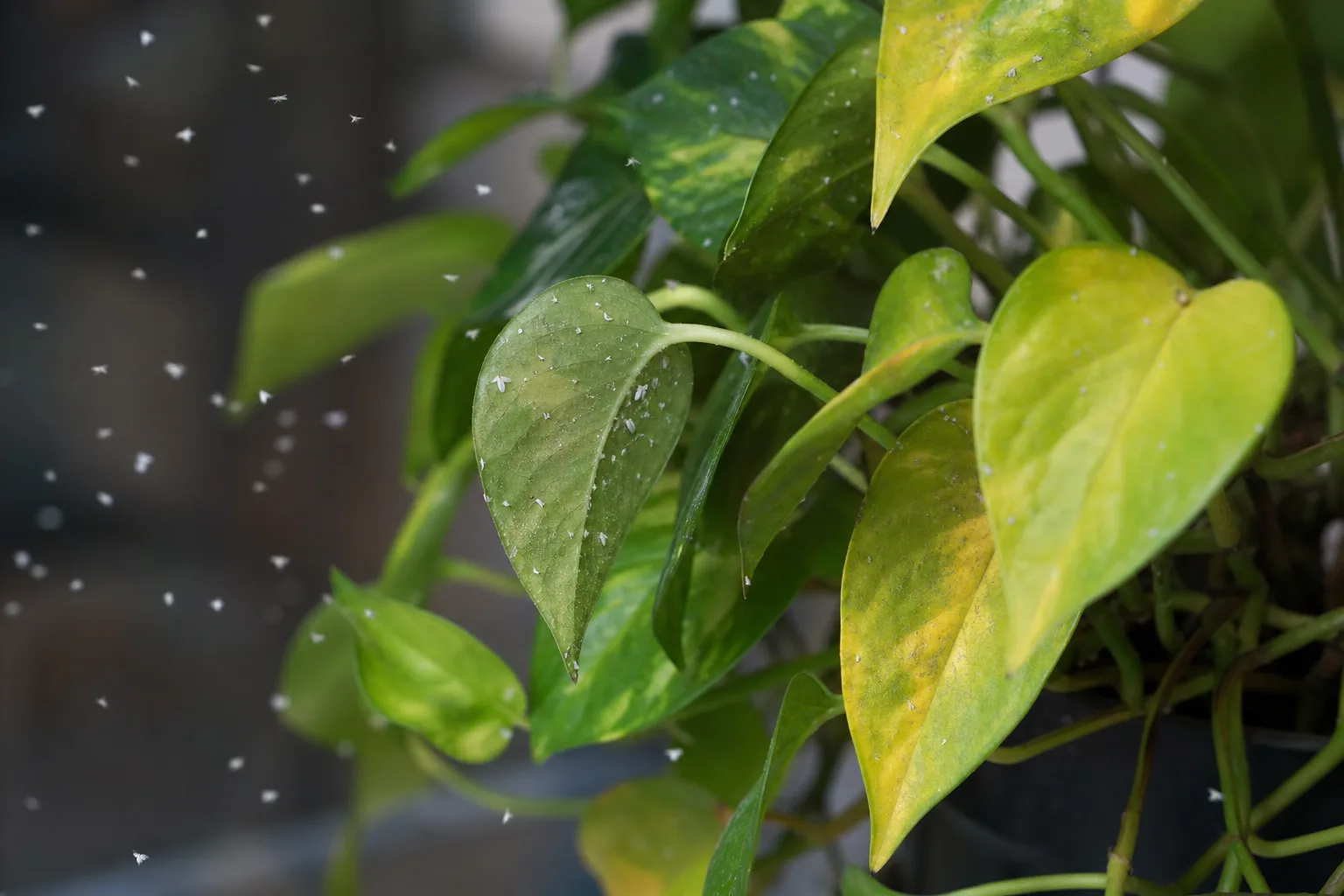
You tip a hibiscus or poinsettia and a brief cloud of tiny white insects lifts off the leaf undersides, then resettles like snow. That pattern is the classic signature of whiteflies on houseplants — not fungus gnats rising from wet soil, not dust on the foliage, and not a problem you solve with one emergency spray.
Lifecycle callout (why one spray fails): Whiteflies keep all stages on the plant at once. Missouri Botanical Garden notes one female can lay roughly 200 to 400 eggs, the life cycle can finish in about 18 days in warm rooms, and eggs plus non-feeding pupae are generally less susceptible than adults and nymphs. Eradication usually needs four to five applications at five- to seven-day intervals. Contact soaps and oils kill what they wet that day, then leave little residual—so plan repeat underside coverage every 5–7 days for at least three to five cycles, not a single “emergency” spray.
Whiteflies are sap-feeding insects that live on leaf undersides, excrete sticky honeydew, and breed year-round in warm rooms. Adults are what you notice. Immobile nymphs are what keep the infestation alive. This guide is the houseplant-wide whiteflies hub: confirm the pest, separate it from fungus gnats and other lookalikes, run a least-toxic multi-cycle treatment plan, then prevent rebound. For collection-wide pest triage, use the indoor plant pest guide. For sticky residue without a clear insect, open the sticky leaves symptom hub.
Quick Visual Checklist: White Cloud, Honeydew, Flat Disks
Confirm whiteflies when several of these line up under good light:
- A white cloud of winged insects rising when you water, mist, tip, or shake the plant
- Flat, pale, scale-like nymphs stuck to leaf undersides, especially along midribs and newest growth
- Sticky honeydew on leaves below the colony, pot rims, shelves, or nearby furniture
- Black sooty mold growing on that sticky film
- Yellowing, dull, or dropping leaves when nymph numbers are high
- Adults that resettle on foliage, not on the soil surface
White objects only on the upper leaf surface are more often cast aphid skins than whiteflies. The Royal Horticultural Society notes that white objects on top surfaces are more likely aphid skins, while true whitefly adults fly up from the plant when disturbed.
What Whiteflies Are (and Why Warm Rooms Favor Them)
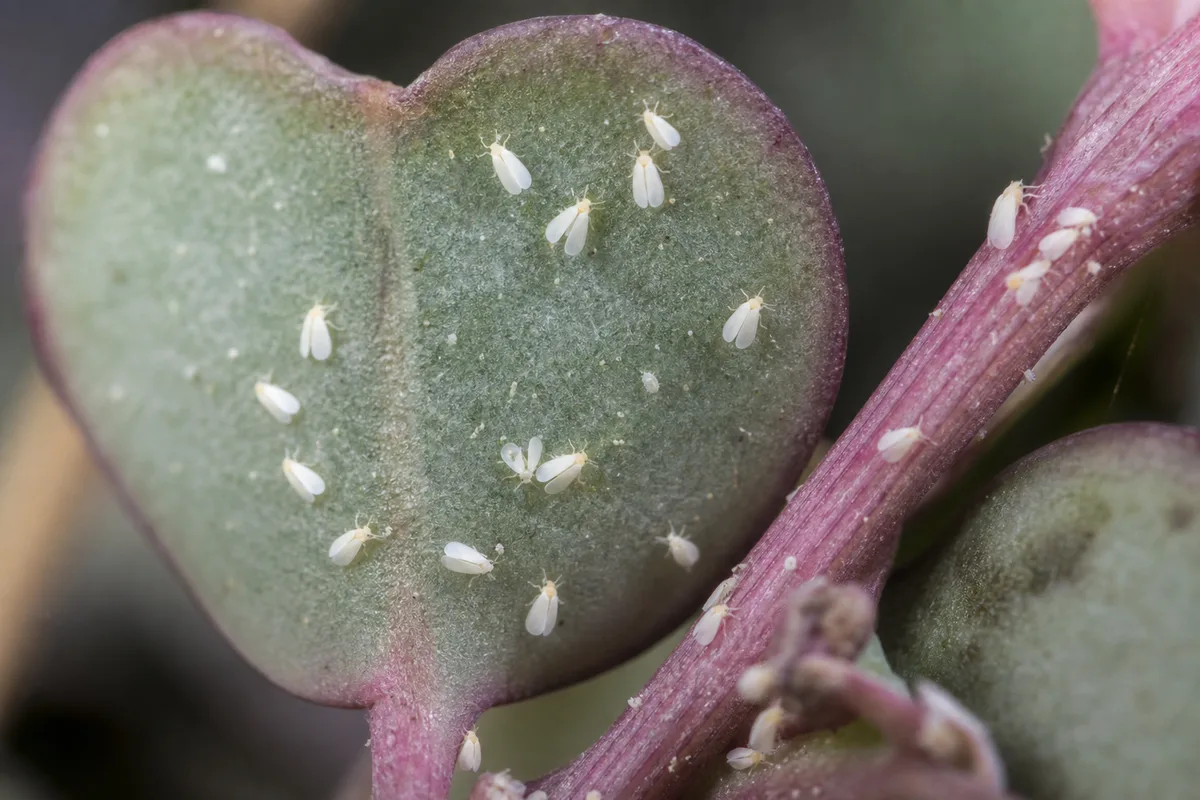
Despite the name, whiteflies are not true flies. They belong to the order Hemiptera with aphids, scales, and mealybugs. University of California IPM notes that adults have yellowish bodies and four whitish wings coated in mealy wax, while nymphs are oval, flattened, and largely immobile after the first crawler stage. The species you meet most often indoors is the greenhouse (glasshouse) whitefly (Trialeurodes vaporariorum). Sweetpotato / silverleaf whitefly (Bemisia tabaci) appears on some collections too. Both look similar without magnification and need the same repeat-contact protocol.
Homes and greenhouses stay warm enough for continuous breeding. Missouri Botanical Garden’s indoor whitefly guidance notes that because rooms stay warm, whiteflies can reproduce throughout the year. The Royal Horticultural Society likewise describes glasshouse whitefly as active all year on houseplants, with a life cycle that can finish in about three weeks near 70°F (21°C) and stretch to months in cool rooms.
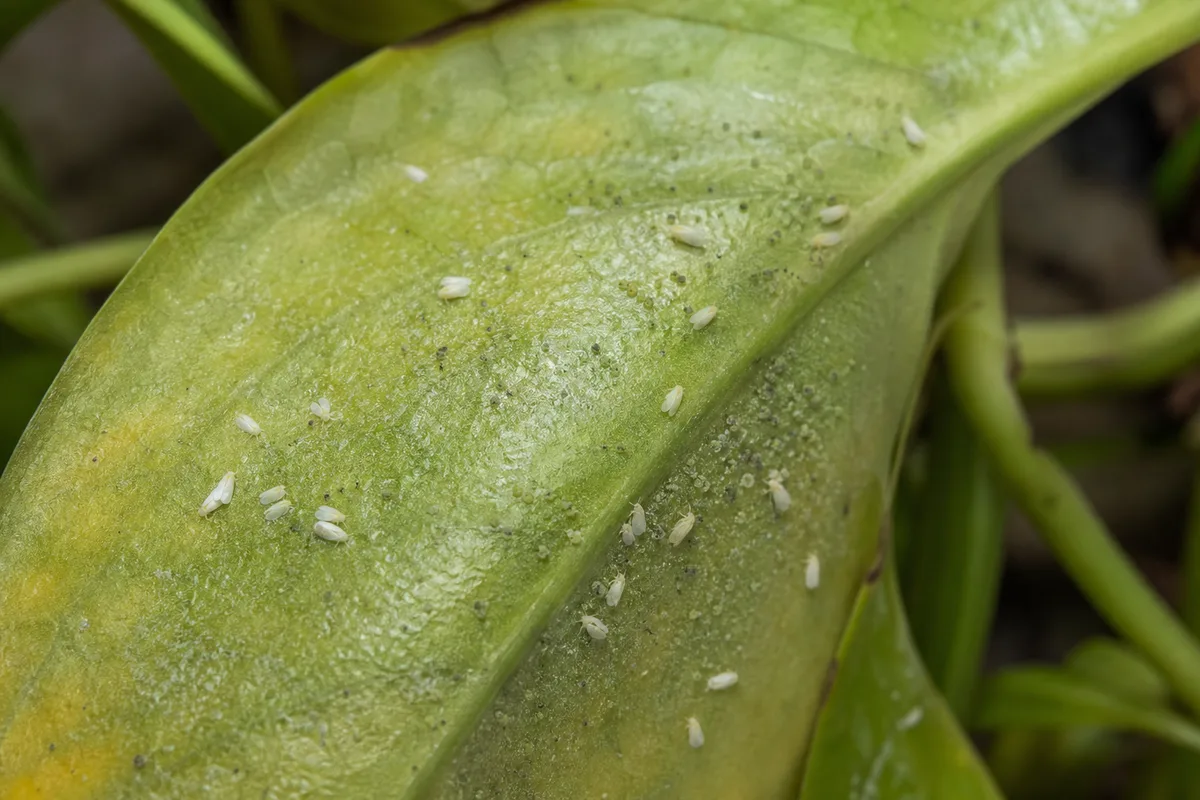
Adults, Nymphs, and Eggs on Leaf Undersides
Adults are roughly 1/16 to 1/10 inch long, wedge-shaped, and moth-like with powdery white wings. Disturb the plant and they flutter up briefly before returning to the undersides. Missouri Botanical Garden and Clemson Extension both describe that “white cloud” response as the easiest field ID.
Eggs are tiny oblong or cylindrical deposits on leaf undersides, sometimes in arcs or circles. They hatch into crawlers that walk a short distance, then settle and become scale-like nymphs. Colorado State University Extension notes that greenhouse whitefly eggs often hatch in three to seven days, nymphs feed for about two to four weeks, then pass through an inactive “pupal” stage of roughly one to two weeks before adults emerge. Wisconsin Horticulture adds that at about 82°F, egg-to-adult development can finish in roughly 18 days, while cooler rooms stretch each generation.
Nymphs do most of the feeding damage and are easy to miss: flat, pale, translucent disks glued to the leaf back. If you only spray adults you see in the air, you leave the next wave on the leaf.
Whiteflies vs Fungus Gnats, Aphids, and Mealybugs
Wrong ID wastes weeks. Use where the insects live and what they leave behind.
| What you see | Likely pest | Why |
|---|---|---|
| Tiny white/moth-like adults lift from leaf undersides; flat disks on leaf backs; sticky honeydew | Whiteflies | Foliar sap feeders; cloud + nymphs + honeydew |
| Dark, mosquito-like flies rise from wet soil when you water; no leaf honeydew | Fungus gnats | Soil breeders; larvae in media, not on leaves |
| Pear-shaped soft bugs with cornicles; slower to flee; sticky tips | Aphids | Cluster on soft tips; rarely form a white flight cloud |
| Cottony white clumps that stay put when touched | Mealybugs | Wax masses in axils; do not flutter |
| Fine webbing + stippling | Spider mites | Arachnids; no white winged cloud |
Honeydew, Sticky Leaves, and Sooty Mold
Adults and nymphs excrete sugary honeydew as they feed. Leaves feel tacky or look glossy, residue drips onto lower foliage, and black sooty mold can colonize the film. UC IPM and RHS both tie honeydew and sooty mold to whitefly feeding. Sooty mold does not infect the leaf like a leaf-spot fungus, but heavy cover blocks light. Wipe residue after you knock down the insects — cleaning alone does not stop new honeydew if nymphs remain.
If sticky leaves are the loudest symptom and insects are still hard to find, use that sticky-leaves hub to route between whiteflies, aphids, scale, and mealybugs.
The Disturbance Test vs Soil-Rising Flies
Disturbance test: Gently shake a stem or tip a leaf. Whiteflies lift in a brief white cloud from foliage, then resettle on undersides. Fungus gnats rise from damp potting mix when you water or bump the pot, and they hover near soil and windows rather than coating leaf backs with honeydew. If the only flies appear after watering and traps near the soil fill with dark gnats, treat moisture and larvae — not whitefly soap cycles on dry foliage.
Why Indoor Colonies Explode So Fast
Outdoors, weather and natural enemies often blunt whitefly spikes. Indoors those checks disappear. Warmth speeds the life cycle, soft fertilized growth offers rich feeding sites, and adults disperse the moment you disturb a shared shelf. Colorado State University Extension notes that most houseplant whitefly problems start from purchased or moved infested plants, then spread during warm months. Clemson likewise flags new plants and gifts as the usual source for whiteflies, scale, and mealybugs.
Overlapping Generations and Why One Spray Fails
All stages can be present at once. Missouri Botanical Garden’s 200–400 eggs / ~18-day cycle / four-to-five sprays guidance is the practical math for home rooms. Wisconsin Horticulture’s greenhouse guidance is similar: treat every five to seven days for about three treatments to cover overlapping stages. Contact soaps and oils kill what they wet that day, then leave little residual — so a single spray is almost guaranteed to fail.
Commercial greenhouses sometimes release parasitic wasps such as Encarsia formosa. That tool rarely fits a typical living-room collection: releases need sustained warm greenhouse conditions, host plants concentrated enough to support the wasp, and patience measured in weeks. For home shelves, assume mechanical removal plus labeled contact sprays—not mail-order biocontrol—unless you are running a sealed grow tent with documented greenhouse protocol.
Confirm With Underside Checks and Yellow Sticky Traps
Work through these checks before you buy a new product:
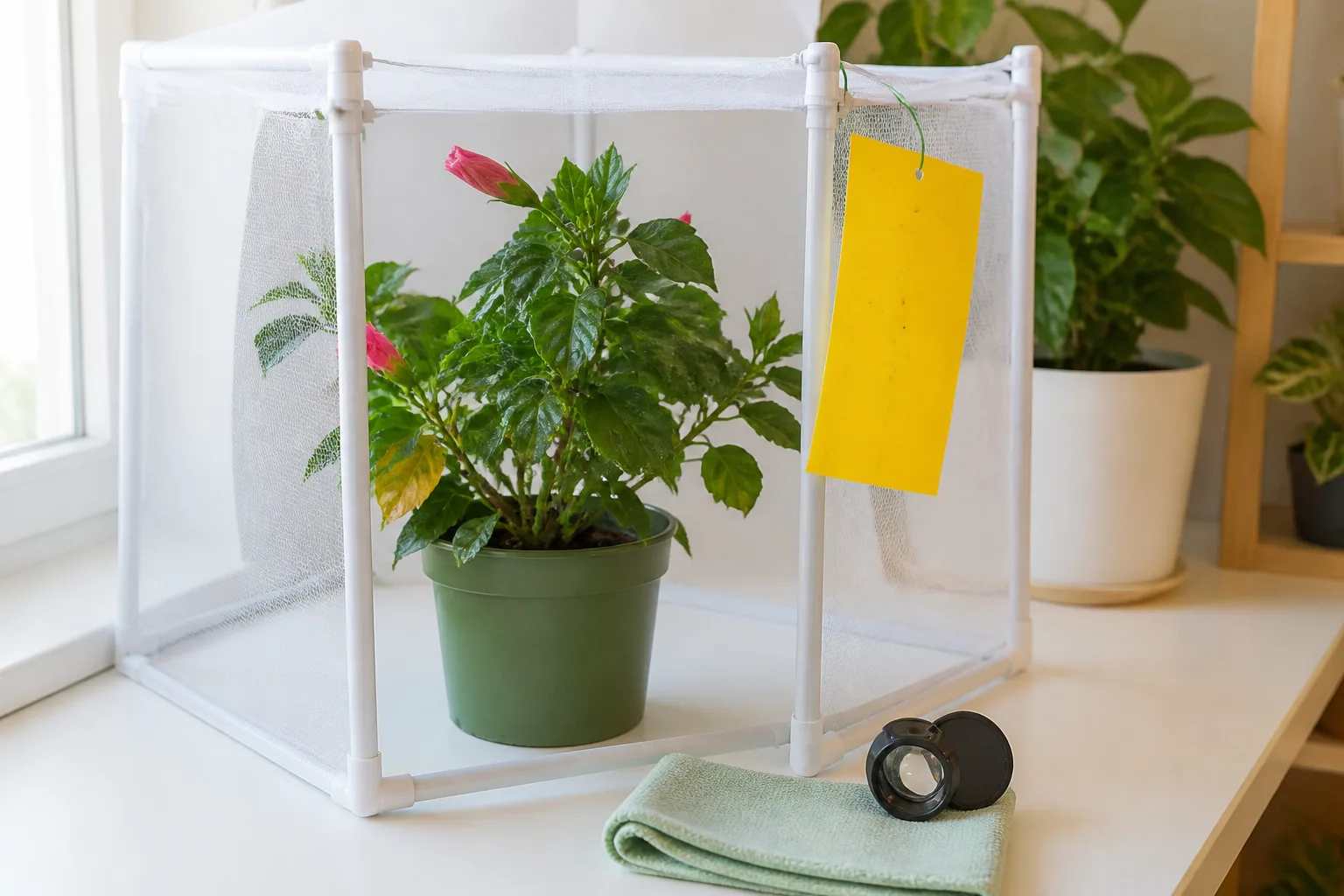
- Run the disturbance test on foliage, not just the soil.
- Inspect every leaf underside with bright light or a hand lens for flat nymphs and eggs.
- Wipe a sticky leaf — honeydew comes off as a tacky film; hard-water spots do not.
- Hang a yellow sticky trap near the canopy (sticky face toward foliage, out of harsh direct sun). Adults are strongly attracted to yellow; rising catches confirm active flight even when you miss nymphs.
- Scan neighbors on the same shelf — poinsettia, hibiscus, fuchsia, lantana, and soft-leaved herbs often seed the outbreak.
- Note recent nursery purchases, patio returns, or open windows.
Yellow traps are excellent for monitoring and adult knockdown, not solo eradication. UC IPM and RHS both emphasize that sticky traps reduce adults somewhat but leave eggs and nymphs on leaves. Colorado State University Extension adds that traps and careful vacuuming of adults help on small plants, while nymphs still need leaf-surface treatment. Replace cards when they fill with dust or insects so the sticky surface keeps working. Keep the card in the same position each week so your count trend is honest.
Simple trap log (editorial): date hung, position, adult count, next spray due. Print or use a notes app—trap trend is the fastest “is coverage working?” signal.
Treatment Campaign: Isolate, Rinse, Vacuum, Trap
Day 0 — isolate first. Move the plant away from every other houseplant before you rinse or spray. Adults disperse the moment you disturb them. Quarantine is the single highest-leverage step.
Mechanical knockdown. For manageable plants, wash leaf undersides in a sink or shower with lukewarm water, or wipe with a damp cloth. Hold the pot at an angle so runoff does not soak the mix for days. On small plants, Colorado State University Extension notes that vacuuming can remove adult whiteflies — empty the vacuum outdoors so survivors do not escape indoors. Prune the worst honeydew-coated or nymph-packed older leaves into a sealed bag for trash, not compost.
Trap while you treat. Hang yellow sticky cards at canopy height near the isolated plant. Use trap counts as your trend line: falling catches after honest underside sprays mean the plan is working; flat or rising catches mean coverage is incomplete or a neighbor is reseeding the plant.
Do not fertilize a heavily infested plant to “push it through.” Soft, nitrogen-rich flush is exactly what whiteflies prefer. Resume light feeding only after new growth stays clean.
Insecticidal Soap Coverage and 5–7 Day Repeats
After the rinse, spray a labeled insecticidal soap thoroughly on all leaf surfaces, especially undersides where nymphs sit. Clemson Extension recommends washing the plant, then spraying thoroughly with insecticidal soap with emphasis on lower leaf surfaces. UC IPM stresses that soaps and oils control only insects they contact directly, so undersides of lower leaves need real coverage, and repeats are required. Spray when plants are not drought-stressed and temperatures are under about 90°F to reduce burn risk.
Cadence: Plan contact sprays every 5–7 days for at least three to five cycles, matching MOBOT and Wisconsin guidance on overlapping stages. Prefer commercial insecticidal soap (potassium salts of fatty acids) over homemade dish-soap mixes — Colorado State University Extension advises against household dish detergents as pesticides because they are inconsistently formulated, can injure plants, and lack reliable efficacy evidence.
Pet/kids wait-until-dry (do this every spray day): move pets and children out of the spray zone, keep them off wet foliage until leaves are fully dry, and prefer treating in a bathroom, balcony, or garage when you can.
Soft-Leaf Sensitivity, Soap vs Oil, and Stronger Options
| Tool | Best when | Limitation |
|---|---|---|
| Rinse / wipe / vacuum | Day 0 knockdown; small plants; soft leaves you do not want to soak | Misses eggs and many nymphs; adults return if neighbors are infested |
| Insecticidal soap (labeled) | Early–moderate colonies on sturdy foliage; first-line contact kill | Must wet insects; little residual; may mark sensitive leaves |
| Horticultural / neem oil (labeled) | Heavy wax/honeydew; soap rebound after honest coverage | Same contact rules; avoid heat/drought stress; spot-test |
| Systemic neonics (label-only) | Severe, spreading infestations after contact cycles fail | Indoor exposure + pollinator risks; outdoor-only when label requires |
Start with rinse + labeled insecticidal soap for early to moderate colonies on soap-tolerant plants. Switch to or alternate with a labeled horticultural oil or neem oil product if heavy wax/honeydew blocks soap contact, soap failed after honest underside coverage, or the label better matches your plant. UC IPM lists insecticidal soaps and oils (including neem) as least-toxic options that reduce but may not eliminate populations without thorough coverage and repeats. For a product-choice deep dive, see neem oil vs insecticidal soap.
Soft/fuzzy-leaf caution: Spot-test fuzzy, thin, or variegated leaves first. Treat with extra caution (lighter coverage, rinse-only first pass, or a different labeled product after another spot-test) on African violets, maidenhair fern, thin tropical foliage that marks easily, and any plant already drought-stressed or sitting in hot direct sun after spraying. If a leaf shows spotting or edge burn within a few days, stop that product, rinse the plant, and switch tools.
Reserve systemic neonics (for example imidacloprid) and stronger adulticides for severe, spreading infestations when you accept label indoor-use limits and non-target risks. Colorado State University Extension notes imidacloprid can be highly effective on greenhouse whitefly but can harm bees and other non-targets — follow the label, and prefer outdoor treatment only when the product and plant allow it. Rotate modes of action if you escalate; whiteflies have documented resistance in some populations. Always confirm the plant and indoor use are on the label.
Plants Whiteflies Hit Most Often Indoors
Whiteflies are broad feeders. Expect higher risk on soft, sap-rich hosts brought from greenhouses or summer patios:
- Poinsettia, hibiscus, fuchsia, lantana, gerbera, and flowering maple (Abutilon)
- Herbs and edibles kept indoors — mint, tomato, pepper, cucumber starts
- Trailing foliage plants that brush neighbors — pothos, philodendron, string of hearts
- Flowering or fragrant houseplants — jasmine, lavender, petunia
- Soft tropicals and gifts — African violet, maidenhair fern
Secondary hosts can look fine for weeks while a poinsettia or hibiscus on the same shelf fuels the flight. Treat the source plant and inspect every touching neighbor the same day.
Prevention, Quarantine, and Rebound Mistakes
Prevention beats a month of spray days. Inspect leaf undersides of every new plant before it joins the collection. Colorado State University Extension recommends quarantining new plants for at least three weeks and rechecking before they share a shelf. RHS similarly advises quarantine so eggs and nymphs have time to show. Keep patio plants isolated for two weeks after you bring them indoors in fall.
Common rebound mistakes: stopping sprays when adults disappear but nymphs remain; skipping undersides; re-shelving beside an untreated hibiscus; using dish soap that burns leaves and then abandoning treatment; relying on sticky traps alone; and overfeeding soft flush during an active outbreak. Hang a monitoring card near high-risk plants after any nursery haul so the first adults show up on yellow plastic instead of on your whole shelf.
Recovery, Re-Shelving, and When to Discard
Expect two to four weeks of consistent action for a typical indoor outbreak, longer if rooms are cool or coverage was patchy. Judge success by live insects and clean new growth, not by old sticky leaves that still look dull. Wipe honeydew and sooty mold after populations drop so leaves can photosynthesize again.
Re-shelving rule (LeafyPixels practice, not a sourced quarantine window): finish at least three honest contact cycles on a 5–7 day schedule, then keep the plant isolated until new leaves stay free of nymphs and yellow-trap catches near that plant stay near zero for about two weeks. Sticky old foliage alone is not a fail if undersides and traps are clean. The sourced three-week quarantine remains the rule for new plants entering the home.
Keep treating when the plant still has healthy growing tips, you can reach most leaf undersides, and trap catches are falling after honest spray coverage.
Discard (bag for trash, not compost) when foliage is mostly yellow or dropped, nymphs carpet leaves you cannot practically rinse, several consistent 5–7 day cycles have failed, or the plant keeps reseeding a healthier shelf mate despite isolation. A cheap, heavily infested gift poinsettia is rarely worth risking a whole collection.
First-Hand Notes From Clearing Whiteflies Indoors
These are LeafyPixels grow-room notes from multi-cycle campaigns—not lab trials. Conditions and outcomes vary by plant, light, and product label.
Case 1 — Patio hibiscus returned indoors (cleared): Late summer, an east-window hibiscus brought back from a balcony showed a white cloud on tip and a yellow card hung at canopy height caught 40+ adults on Day 0. Day 0: isolated to the bathroom, rinsed undersides in the shower, pruned two honeydew-blackened lower leaves into a sealed bag, sprayed labeled insecticidal soap until undersides were wet. Day 6 and Day 12: repeated soap after finding flat nymphs on inner leaves the first rinse missed. Trap catches fell to ~12 adults by Day 6 and to 1–2 by Day 14. Outcome: cleared after five contact cycles; card stayed near zero for 14 more days before re-shelving. An earlier hibiscus outbreak rebounded within a week when we re-shelved after one quiet day—finishing the full cycle prevented that this time.
Case 2 — Gift poinsettia (discard economics): December gift plant with dense nymphs on nearly every bract underside and honeydew dripping onto wrapping paper. Day 0 rinse + soap dropped the visible cloud, but Day 5 trap still caught 20+ adults and undersides stayed coated. After three consistent cycles with no meaningful trap decline—and two neighboring herbs starting to show adults—we bagged the poinsettia for trash. Outcome: herbs cleared in two more soap cycles once the source plant was gone. Lesson: a disposable host can be the cheapest quarantine tool.
Case 3 — Soft-leaf African violet (product swap): A fuzzy-leaved African violet near the hibiscus picked up a light underside colony. Full soap mist after a warm afternoon left faint spotting on one leaf. We switched to rinse + damp-cloth underside wipes and a gentler labeled product on a spot-tested leaf for the next two cycles, with a mini yellow card at the pot rim. Outcome: adults gone; no further burn; card empty for 10 days before the plant rejoined a spaced shelf. Soft/fuzzy foliage deserves a smaller first pass.
Keep your own log: plant, date found, product, cycle number, trap count, next due date, and whether new growth is clean. That notebook is what turns lifecycle math into a finished campaign.
Pet and Indoor Spray Safety
Homes are less ventilated than outdoor air, so pesticide vapors and residues linger longer. National Pesticide Information Center’s houseplant IPM framing emphasizes least-toxic steps first and careful indoor exposure control.
Scannable rules after any spray:
- Prefer spraying outdoors, on a balcony, or in a garage; return the plant after leaves dry
- Keep children and pets away from wet foliage; do not let pets lick or chew treated leaves
- Protect floors, aquariums, and furniture from overspray
- Use only products labeled for houseplants/whiteflies at the labeled rate—never “a little more”
- Wash hands and tools after treatment; bag pruned leaves in trash
- Never apply unlabeled homemade mixes; store products as the label requires
- If a plant must be treated with a product not labeled for indoor use, move it outdoors for application only when weather and the label allow, then bring it back after residues dry
Least-toxic contact products still deserve label discipline. Escalation chemistry (imidacloprid and other neonics) raises the bar further—outdoor application when the label requires it, and no improvising with unlabeled concentrates.
Related Pest and Species Guides
- Fungus gnats on houseplants — dark soil flies vs white foliar clouds
- Aphids on houseplants — pear-shaped tip clusters and cast skins
- Spider mites on houseplants — stippling and webbing lookalikes
- Sticky leaves symptom hub — honeydew routing across sap feeders
- Neem oil vs insecticidal soap — when to choose oil vs soap
- Integrated pest management indoors — collection-wide IPM order of operations
- How to tackle indoor plant pests at home — collection-wide pest triage
- Species pages when the host is clear: pothos whiteflies, jasmine whiteflies, mint whiteflies, string of hearts whiteflies
Conclusion: Day 0–14 Whitefly Clearance Checklist
Use this one-screen campaign instead of re-reading the whole guide mid-outbreak:
| Day | Action | Pass criteria |
|---|---|---|
| 0 | Isolate; rinse/wipe undersides; prune worst leaves into sealed trash; hang yellow card at canopy; apply labeled soap/oil to all surfaces (esp. undersides) | Live adults sharply reduced; plant away from the shelf; trap hung |
| 5–7 | Inspect undersides for nymphs/eggs; spray again with full underside coverage; log trap count | Any survivors get wet; trap trend falling or flat-not-rising |
| 12–14 | Third cycle (continue to cycles 4–5 if needed); confirm nymphs declining and new leaves cleaner | No “tops only” passes; trap catches trending down |
| After last clean checks | Wipe residual honeydew/sooty mold; keep isolated until new leaves stay nymph-free and trap catches stay near zero ~2 weeks (editorial re-shelving) | Clean new growth + quiet traps, not perfect old sticky leaves |
Confirm the white cloud from leaf undersides—not soil flies—before you spray. Match contact products to soft vs fuzzy foliage. Escalate only with labeled chemistry and outdoor/exposure caution. With early ID and repeat underside coverage that respects overlapping generations, most indoor collections clear whiteflies without harsh indoor bombs.