Houseplant Fungus Gnats: Causes, Diagnosis and Fixes
Tiny flies around your pots? Confirm fungus gnats, dry wet topsoil, use sticky traps and BTI, and track progress for 2–6 weeks.
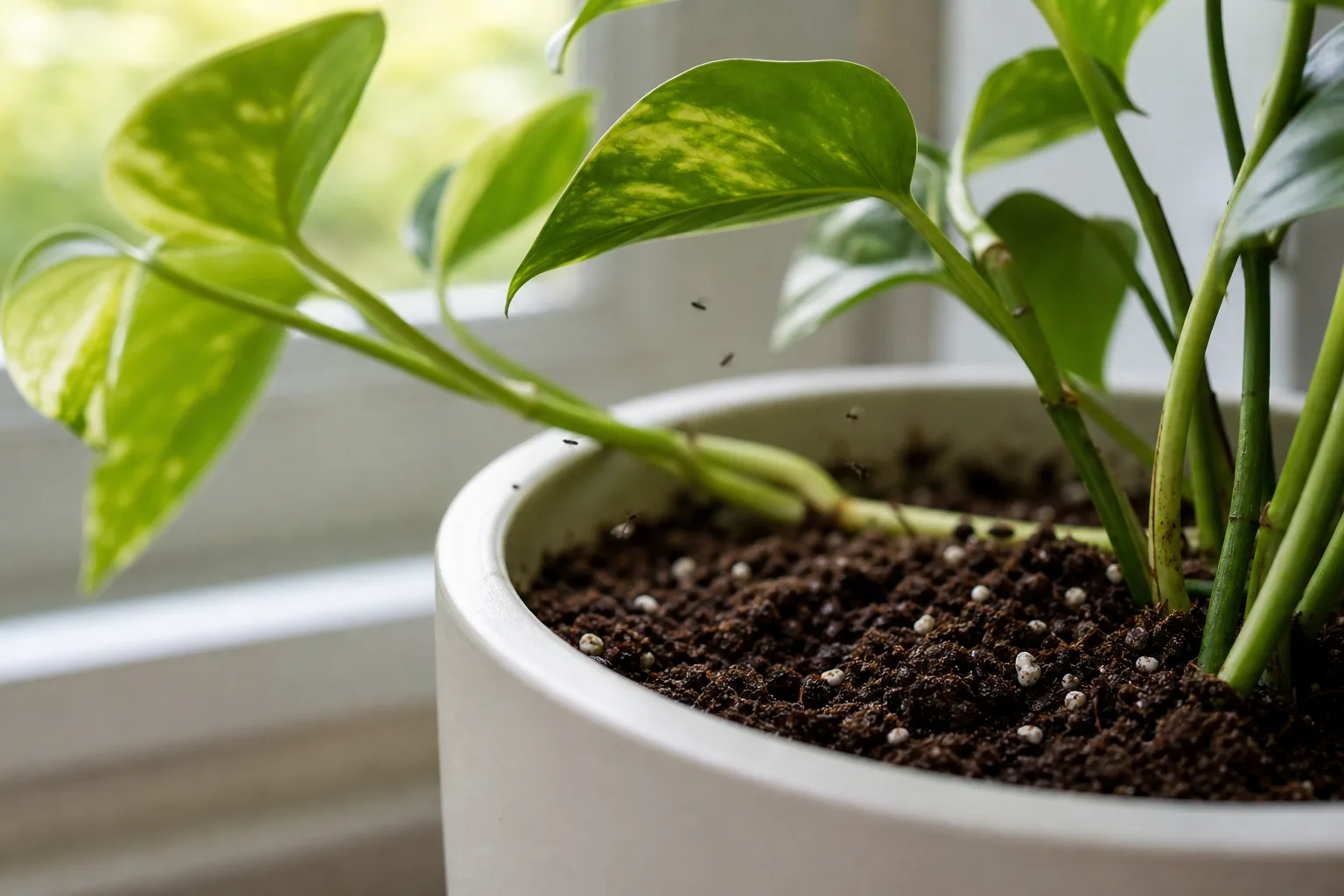
You water a plant and a cloud of tiny dark flies lifts off the soil. They settle on the pot rim, zigzag toward the nearest window, then return the moment the surface is disturbed again. That pattern is the classic signature of fungus gnats on houseplants — not a leaf disease, not fruit flies from the kitchen, and not a problem you solve by spraying foliage alone.
Fungus gnats are soil-breeding flies. Adults are mostly a nuisance. The real population lives as larvae in damp potting mix, feeding on fungi, algae, and organic debris — and chewing tender roots when numbers climb. The durable fix is habitat disruption: dry the top layer, trap adults, treat larvae in the media, then change the watering and mix habits that invited them. For a shorter symptom checklist, see our fungus gnats symptom hub.
What Fungus Gnats Are (and What They Are Not)
Fungus gnats are small flies in the family Sciaridae, often called dark-winged fungus gnats or sciarid flies. Common indoor genera include Bradysia and Orfelia. Adults are dark, delicate, and mosquito-like, usually about 1/16 to 1/8 inch long, with slender legs and antennae longer than the head. Many common Bradysia species show a Y-shaped vein in the wing (UC IPM).
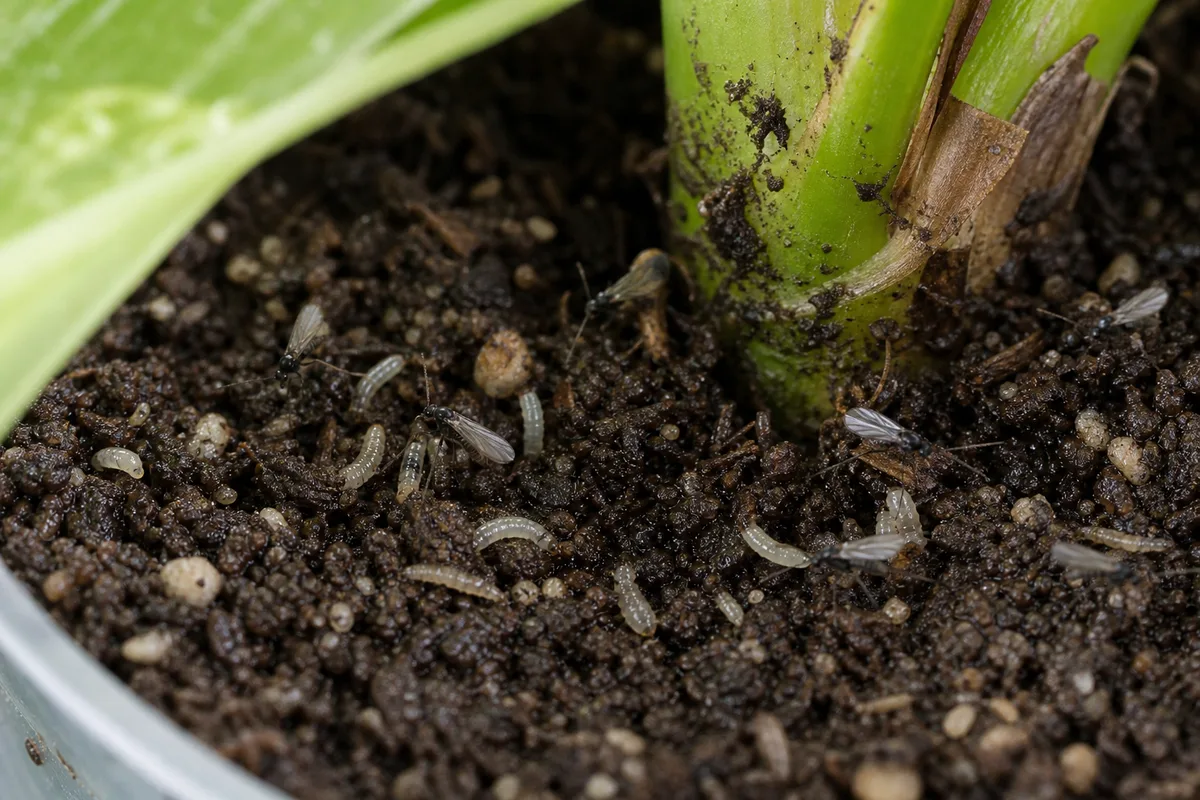
They are weak fliers. Unlike houseflies, they do not patrol a whole room for long. You usually find them resting on soil, foliage, cachepots, or nearby glass. They do not bite people or pets, and they are not known to transmit human pathogens (Missouri Botanical Garden; Colorado State Extension).
Adult Flies vs Larvae in the Pot
Adults are what you notice. Larvae are what keep the infestation alive. Fungus gnat larvae are slender, translucent to whitish maggots with a shiny black head capsule. They live in moist media — typically the top 1 to 3 inches (about 5–8 cm) — and feed on fungi, algae, decaying plant matter, and root hairs (CSU AgBio; UC IPM).
In heavy infestations on very wet media, larvae can leave shiny slime trails on the soil surface that look a little like tiny slug tracks. That detail helps when you scrape the top crust and see movement underneath. Adult sprays alone fail because most of the life cycle is spent in the media as eggs, larvae, and pupae.
How to Confirm: Sticky Traps and Potato Slice Tests
Confirmation is usually straightforward. Look for small dark flies that rise when you water, bump the pot, or lift the plant. Adults often rest on the soil surface and accumulate near windows because they are attracted to light (UC IPM). Pair that with a persistently damp top layer, especially on peat-heavy mix, and fungus gnats are the default explanation.
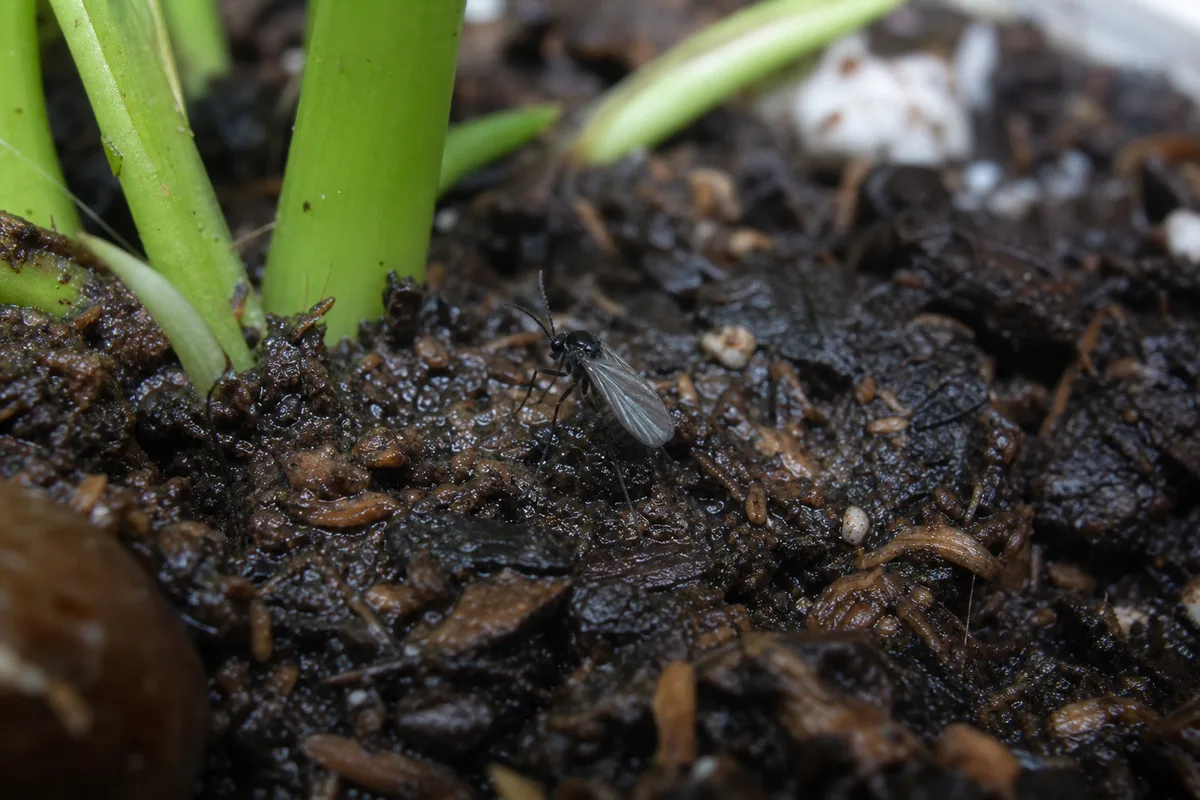
Also check plant context. A few flies around a mature Monstera or pothos with firm roots are mostly a moisture signal. The same flies around seedlings, soft cuttings, or a chronically soggy peace lily deserve faster action because larval feeding and wet-soil stress stack together.
Yellow sticky traps catch adults and give you a trend line. Place small cards near the pot rim or just above the soil, under the canopy if foliage is dense. Rising counts mean breeding is still active; falling counts after you dry the media and treat larvae mean the plan is working (Wisconsin Horticulture; CSU AgBio).
Potato slices detect larvae. Push a 1/4-inch raw potato wedge into the moist surface, cut side down, and check the underside after one to three days. Translucent larvae with black heads gathering on the potato confirm soil breeding (Colorado State Extension; UC IPM). Dispose of infested wedges and replace them while you monitor treatment. In propagation pots, roughly three to five larvae per slice is already a concerning density; production pots tolerate higher counts before root injury becomes likely (CSU AgBio).
Fungus Gnats vs Shore Flies and Fruit Flies
Wrong ID wastes weeks. Shore flies are more robust, stronger fliers, and often have five light spots on dark wings. Their larvae lack the distinct black head of fungus gnat larvae and are associated with algae and standing water rather than potting-mix organic matter (Wisconsin Horticulture). Fruit flies cluster around ripe fruit, drains, and kitchen waste, not pot soil. If flies appear only when you open the compost bin or fruit bowl, check the kitchen before blaming every houseplant.
Fungus gnats stay plant-adjacent, run across damp media, and surge when you disturb wet pots. That behavioral pattern matters more than memorizing wing veins when you are standing in a living room with a watering can. Do not confuse them with outdoor biting midges either — fungus gnat adults indoors are a nuisance, not a biting pest.
Why Houseplants Get Fungus Gnats
Fungus gnats are not random. Females seek moist organic media for egg laying. Indoors, that usually means potting mix that stays wet at the surface, especially mixes rich in peat or unfinished organic matter (Colorado State Extension; RHS).
They arrive with nursery plants, hitchhike in bagged mix that was stored damp, or explode when summer patio plants come indoors into warm rooms. Once one pot is breeding, weak-flying adults still reach neighboring containers that share the same wet-surface habit.
Overwatering and Constantly Wet Topsoil
The core cause is persistently wet topsoil. Eggs and larvae need moisture. Letting the upper inch or two dry between waterings reduces egg survival, larval survival, and the attractiveness of the pot to egg-laying females (UC IPM; CSU AgBio).
Saucers, decorative sleeves, and cachepots that hold drainage water extend the wet window even further. If your collection also shows wilt on wet soil, review overwatering symptoms alongside gnat control, and tighten habits with how to water indoor plants the right way.
Peat-Heavy Mix and Winter Watering Schedules
Moist media with high peat content are especially attractive to females (Colorado State Extension). As mix ages and breaks down, it holds more water and dries more slowly, which improves fungus gnat habitat without any change in your watering routine. Incomplete compost, heavy organic fertilizers, leaf mold, and debris on the surface add food for larvae (UC IPM).
Calendar watering makes this worse in winter. Shorter days and cooler rooms slow growth and water use, so the same Tuesday-and-Friday schedule that worked in June keeps media soggy in January — exactly when indoor fungus gnat complaints peak (Colorado State Extension). Drought-tolerant plants like snake plant and ZZ plant often get gnats when owners water them on a tropical schedule. For mix strategy beyond pest control, see best soil for indoor plants.
How Larvae Damage Plants (Seedlings vs Mature Specimens)
Adult fungus gnats do not damage plants. Larvae do, and severity depends on plant stage and larval density. Larvae primarily eat fungi and organic matter. At high populations they chew root hairs and tender roots, which can stunt growth, yellow foliage, and stress seedlings, cuttings, and young plants hardest (UC IPM; RHS).
Established houseplants with deep root systems often tolerate low numbers with little visible harm. That is why a mature rubber plant can host flies for weeks while still looking fine — and why people underestimate the pest until a propagation tray collapses. Larval wounds can also open doors to root pathogens in greenhouse and nursery settings; outdoors and in most home collections, moisture mismanagement remains the bigger plant killer (Missouri Botanical Garden; Wisconsin Horticulture).
Urgency callout: treat seedling trays and soft cuttings immediately; run a measured multi-week plan on mature specimens that still look firm. A wilted plant in wet soil is not automatically “thirsty.” It may have root damage from larvae, root rot from chronic saturation, or both.
Life Cycle: Why One Clean Week Is Not Enough
Understanding the life cycle explains why one clean-looking week does not mean you won. Fungus gnats develop through egg, four larval instars, pupa, and adult. At about 75°F, eggs can hatch in roughly three days, larvae develop for about ten days, and adults emerge after a short pupal period — roughly a 17-day generation under warm conditions (UC IPM). At typical room temperatures, egg-to-adult often lands closer to three to four weeks (Colorado State Extension).
Females live about a week to ten days and may lay up to around 200 eggs in moist media crevices (CSU AgBio; Colorado State Extension). Indoors, generations overlap year-round. Kill every adult you see on Monday and eggs already in the mix can still produce the next wave. That is why sticky traps, drying cycles, and larval treatments must run together for several weeks, not as a one-afternoon purge.
Step-by-Step IPM Fix for Houseplant Fungus Gnats
Use an integrated sequence. Cultural control first, monitoring always, biologicals for larvae, and adult trapping for nuisance reduction. Broad insecticide fogging indoors is rarely the best home answer (UC IPM). Expect two to six weeks for full suppression because eggs and larvae continue emerging in stages.
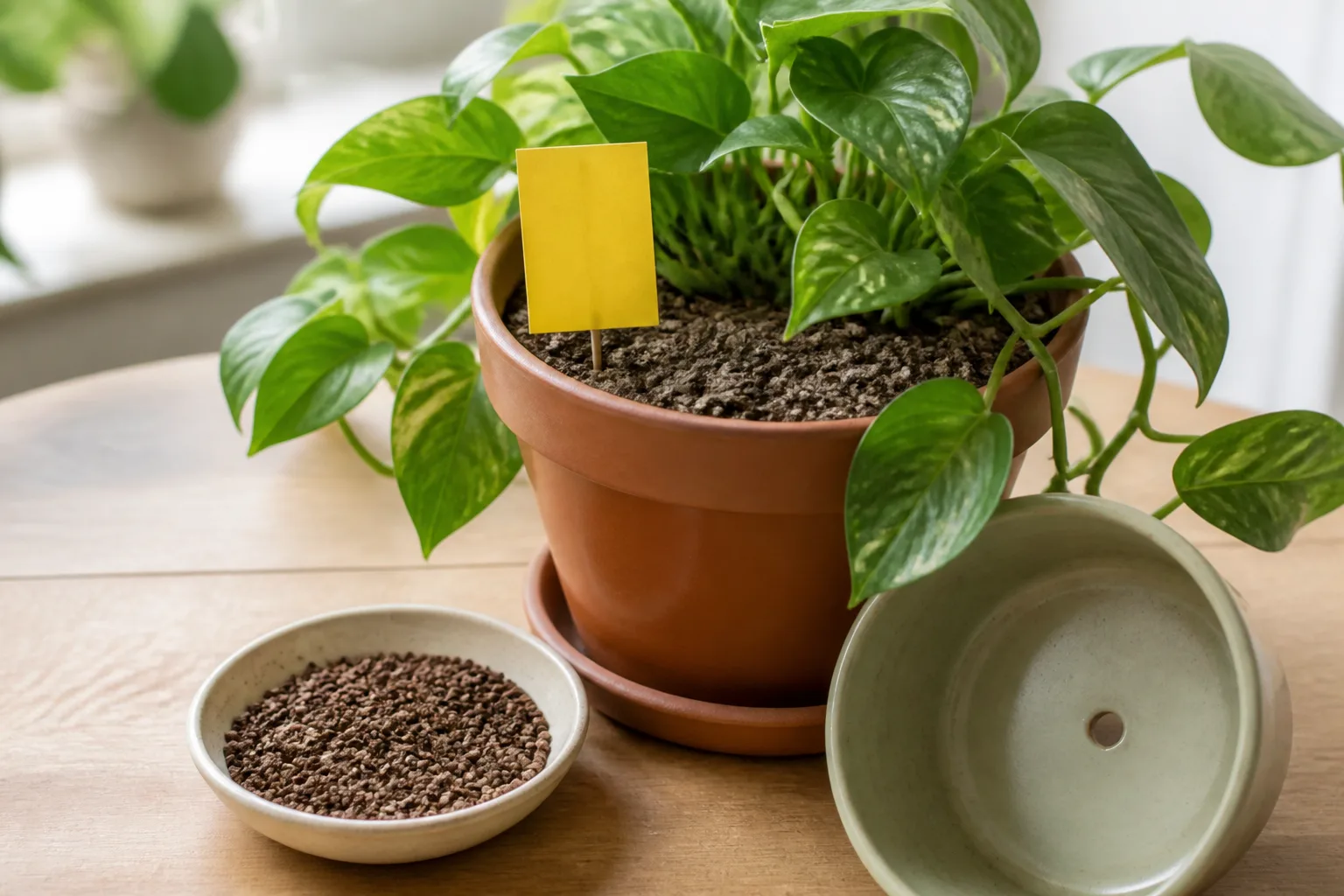
Dry the Surface, Empty Saucers, and Deploy Sticky Traps
Allow the top 1 to 2 inches of mix to dry before watering again. That single change reduces egg viability, larval survival, and the moisture cues that draw females (UC IPM; Colorado State Extension). Empty saucers and cachepots after watering. Fix leaks. Stop watering on a fixed calendar if pots still feel heavy.
Bottom watering can help keep the surface drier for some plants, but only if you still allow a real dry interval and do not leave pots sitting in water. Moisture-loving plants still need a dry surface crust between drinks; “always moist” at the rim is fungus gnat habitat even when the plant looks happy.
Deploy yellow sticky traps at every infested pot and any neighboring wet pots. Adults are attracted to yellow and get stuck, which lowers the next egg load and shows whether soil treatments are working (Colorado State Extension; RHS). Replace cards when they fill up. Traps alone will not finish the job if larvae still have wet organic media, but they are excellent partners to drying and BTI.
BTI Application Notes and Beneficial Nematodes
BTI (Bacillus thuringiensis subspecies israelensis) is a microbial insecticide that targets fly larvae such as mosquitoes and fungus gnats when applied as a soil drench. It is not the same Bt product sold for caterpillars — caterpillar Bt will not control fungus gnats (UC IPM; CSU AgBio). Home gardeners often use products sold as Mosquito Bits or similar BTI formulations; commercial Gnatrol is widely used in greenhouses (UC IPM; Missouri Botanical Garden).
How to apply (label first): Read the rate and method on your specific package — labels differ by product and strength. UC IPM recommends mixing BTI with water and applying it as a thorough soil drench so the active ingredient reaches the moist zone where larvae feed. Many Mosquito Bits labels use a soak-then-drench method: measure Bits per the label, soak them in water for the stated time, then water that liquid through the pot until the top few inches are wet. Do not stop at a light surface sprinkle if your label calls for a drench. Because BTI does not reproduce or persist well indoors, infestations often need repeat applications about every five days until monitoring shows larvae are gone (UC IPM). Missouri Botanical Garden notes BTI activity is short-lived (on the order of a couple of days) and does not kill egg-laying adults, which is why repeats matter (Missouri Botanical Garden).
Steinernema feltiae nematodes are another strong larval option as a moist-media drench. They seek hosts and can provide longer suppression under the right temperature and moisture conditions (roughly 60–90°F and moist media), though they are live products that need prompt use after arrival (UC IPM; RHS). Prefer nematodes when you want longer residual larval search and can keep media lightly moist without recreating a wet-surface gnat spa. Predatory mites such as Stratiolaelaps (Hypoaspis) are more practical in greenhouses than in a few houseplant pots (UConn IPM).
If biologicals are unavailable and adults are intolerable, short-contact pyrethrin sprays aimed at resting adults on media and foliage can knock numbers down temporarily, but they do not replace drying and larval control (UC IPM). Follow label directions, avoid indoor fogging, and prefer outdoor treatment when possible before returning plants indoors. Keep broad-spectrum broadcast sprays as a last resort around children and pets.
When to Repot or Top-Dress the Mix
Repot when the mix has collapsed into a water-holding sponge, smells sour, or never dries in your light level even after you cut watering (Colorado State Extension). Discard heavily infested old media rather than reusing it in open bags near clean plants (RHS). For milder cases, scraping and replacing the top inch with fresh, faster-draining mix or a dry inorganic top-dress can remove a slice of egg and larva habitat while you correct watering.
Quarantine new purchases for two to three weeks with a sticky trap in the pot. Do not move a heavily flying plant into a clean shelf of dry-loving plants until monitoring is quiet.
Home Remedies That Rarely Finish the Job
Apple cider vinegar bowls catch a few flying adults that wander into the kitchen — they do almost nothing to larvae in peat mix, so the next generation still emerges. Surface cinnamon dust may mildly discourage fungi on the crust, but it does not replace drying cycles or a larval biological that reaches the top few inches of media.
Dilute hydrogen peroxide drenches sometimes kill some soft-bodied larvae on contact, yet they do not provide the multi-week residual coverage overlapping generations need, and careless strength can stress roots. If you try any home remedy, treat it as a temporary assist only — keep sticky traps up, dry the surface, and finish with BTI or nematodes on a repeat schedule. Adult-only surface sprays fail for the same biological reason: eggs and larvae stay protected in moist media.
First-Hand Notes From Monitoring Infested Pots
In our indoor collection (bright north/east rooms, ~68–74°F), we tracked a January outbreak that started after a nursery peace lily arrived with wet peat mix. We monitored six pots: three plastic peat-heavy containers, two glazed ceramic, and one terracotta. At week 0, potato wedges on the worst plastic pots showed 8–14 black-headed larvae after 48 hours; terracotta showed 0–2. Yellow sticky cards above the worst pot rim caught 12–18 adults in seven days.
We let the top 1–2 inches dry between waterings, emptied every saucer, and applied a Mosquito Bits soak-drench on days 0, 5, 10, and 15 per the product label. Week 2 potato tests fell to 0–2 larvae on plastic pots and stayed clear on terracotta. Sticky cards still caught 4–7 adults per week — expected, because BTI does not kill adults already emerging from pupae. By week 4, cards were down to 0–2 adults per week, and potato tests stayed negative for two consecutive weeks.
Dry-down differed by pot type. Terracotta lost surface moisture in roughly two to three days under our light; the plastic peat pots needed four to six days and were the last to clear. A separate quarantine catch on a new Monstera cutting tray showed positive potato tests within five days of purchase — we isolated it, dried the surface, and ran two BTI drenches before it joined the shelf. Your numbers will vary with mix and room climate, but the pattern is consistent: larvae drop first, adult trap counts lag by one to two weeks, and plastic peat pots need the longest dry intervals.
Prevention That Actually Sticks
Prevention is the same biology, applied early. Water based on pot weight and finger checks, not habit. Keep the surface from staying wet. Use well-aerated mixes matched to each plant. Avoid unfinished compost and excess organic surface debris in indoor pots (UC IPM).
Store bagged potting mix sealed and off damp floors. Screen and caulk obvious entry points if outdoor adults are pouring in, though most indoor outbreaks are already breeding in pots. Keep a few yellow traps as early-warning sensors in winter, when watering mistakes show up as flies before they show up as root rot. For a broader indoor pest workflow that includes mites, mealybugs, and scale, see how to tackle indoor plant pests at home and integrated pest management indoors.
When Gnats Signal Root Rot or Drainage Failure
Fungus gnats are a moisture dashboard. Chronic wetness that supports larvae also supports root decline. If flies persist after drying cycles, check drainage holes, compacted mix, and cachepot water. If plants yellow, wilt while wet, or smell foul, inspect roots and treat the plant-stress problem in parallel — gnats are the smoke, not always the whole fire. For disease look-alikes after wet-soil stress, see houseplant diseases identification and treatment.
Seedling trays and soft cuttings deserve zero patience: larval feeding hits them hardest (RHS; Wisconsin Horticulture). Mature specimens can wait for a measured IPM plan. Discard cheap, collapsing plants that reseed every neighboring pot if treatment time costs more than replacement — bag them for trash, not open compost next to clean media (UC IPM).
Related Guides
Next steps depending on what you found:
- Short symptom checklist: fungus gnats symptom hub
- Moisture and recovery: overwatered plant
- Mix and drainage: best soil for indoor plants
- Broader pest workflow: how to tackle indoor plant pests at home
- Plant-specific moisture context: peace lily fungus gnats, Monstera fungus gnats, pothos fungus gnats
Conclusion
Success looks measurable, not magical. Use this 2–6 week checklist:
- Week 0: Confirm with sticky cards + potato wedges; note counts; start dry-surface cycles; empty standing water.
- Weeks 1–2: Keep traps up; apply BTI (or nematodes) on a ~5-day label-aligned cadence; expect adult catches to lag after larval decline.
- Weeks 3–4: Potato tests near zero; sticky cards trending down week over week.
- Weeks 4–6: Two consecutive weeks of near-zero trap catches and negative potato tests before you declare the shelf clear.
- Ongoing: Water by weight/finger check, airy mix, quarantine new plants with a trap for 2–3 weeks.
Houseplant fungus gnats are a wet-organic-soil pest with a noisy adult stage and a quieter larval stage that keeps the cycle going. Confirm the flies, attack the habitat, treat larvae on a repeat schedule, and keep prevention boring — dry surface cycles, airy mix, quarantine — so the tiny black cloud stops being a weekly event.