15 Non-Toxic Plants for Cats: Safe Indoor Options for Pet Owners
Compare 15 verified cat-safe indoor plants with care realities, placement tips, and safety caveats. Every toxicity claim checked against ASPCA data. Pick the right plant for your pet-friendly home.
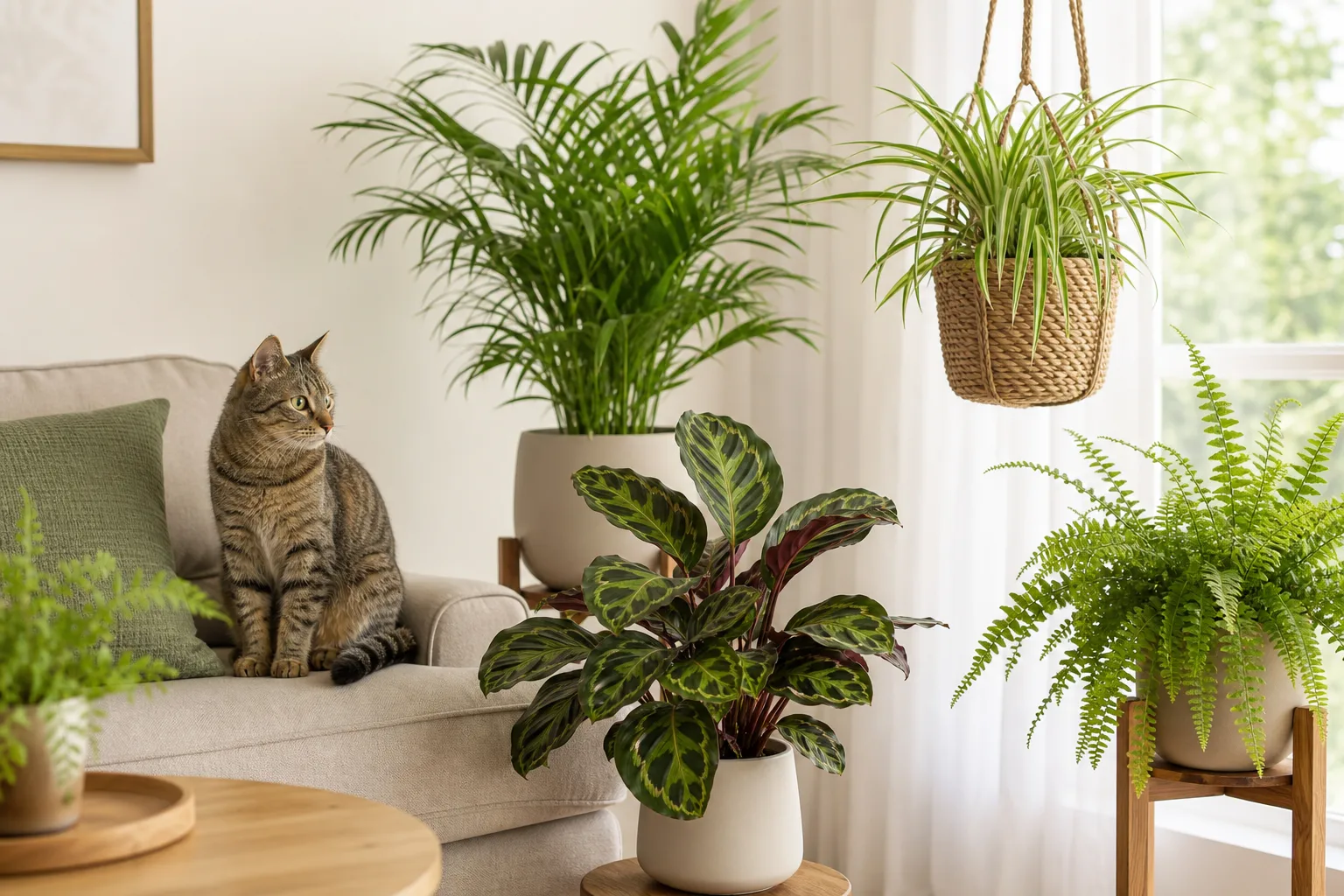
A cat and a houseplant collection can coexist. You do not have to choose one or the other, and you do not have to resign yourself to a home full of plastic greenery. What you need is a working knowledge of which plants are actually dangerous, which ones are safe enough to live with a curious cat, and a few practical strategies that keep both parties out of each other’s way.
The internet is full of lists claiming spider plants are non-toxic while omitting that the ASPCA’s own newsletter classifies them as mildly toxic with documented GI effects. Peace lily shows up on “pet-safe” Pinterest boards despite being a genuine oral irritant. And “non-toxic” gets treated like a synonym for “edible,” which it absolutely is not. A cat who eats an entire Boston fern will still vomit. It just will not develop kidney failure or liver damage.
This guide covers 15 indoor plants verified as non-toxic to cats by the ASPCA Animal Poison Control Center database, with real caveats about what non-toxic actually means, how to place plants to reduce chewing risk, and which popular species you should skip entirely if your cat is a determined leaf-eater. Every toxicity claim is backed by ASPCA data current as of mid-2026.
For plants sorted by room type, use the Best Bathroom Plants or Best Large Indoor Plants quick lists. This guide focuses specifically on verified cat safety with detailed care guidance for each plant.
Quick Pick: Best Cat-Safe Plant for Your Situation
For the most unkillable cat-safe plant, choose cast iron plant or parlor palm. Cast iron plant tolerates low light, irregular watering, and neglect better than almost any other non-toxic option. Parlor palm stays compact, thrives in medium indirect light, and has been a reliable houseplant since the Victorian era—long before Instagram made plants competitive.
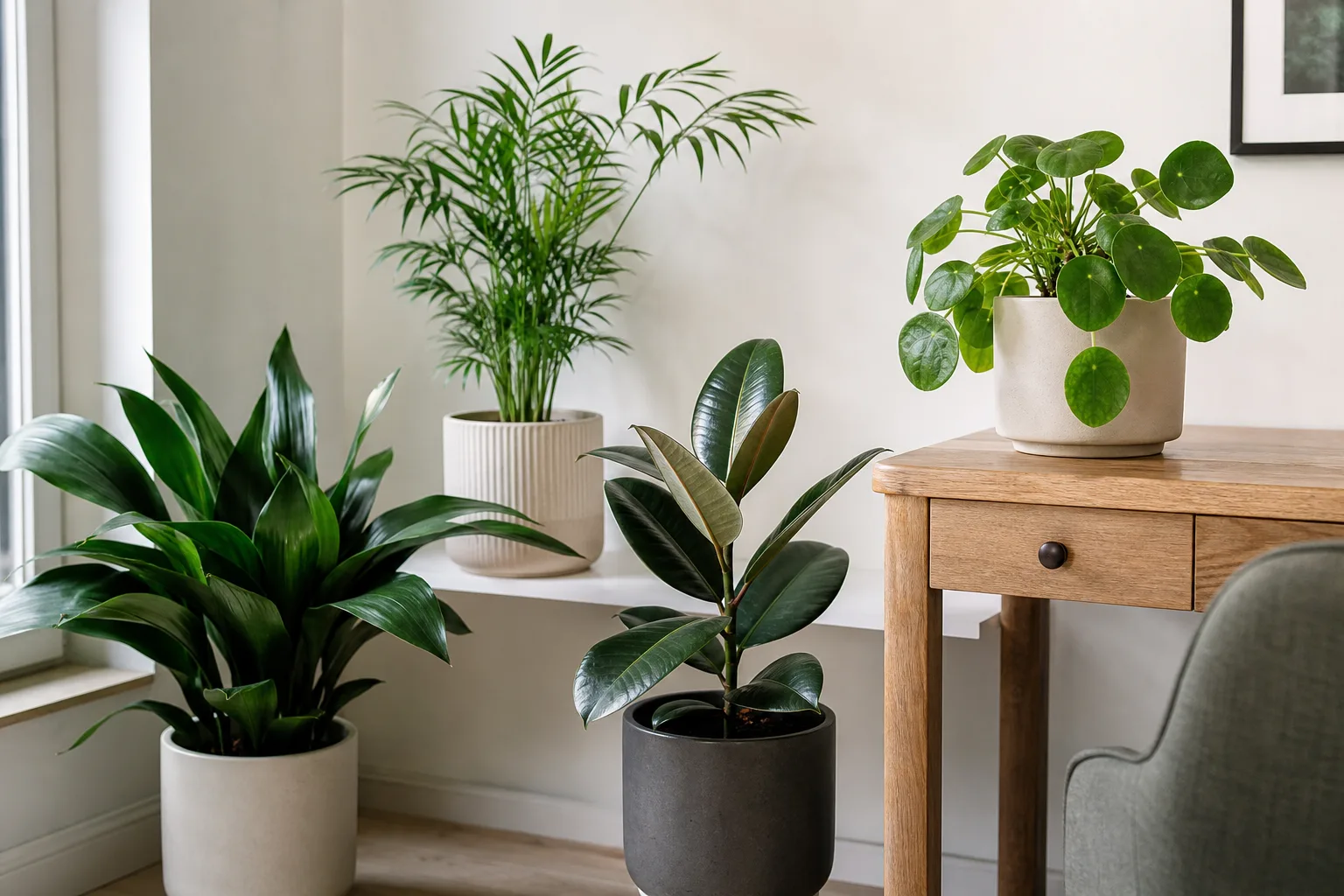
For a desk or shelf plant with zero drama, choose baby rubber plant, African violet, or pilea. All three stay compact, need medium indirect light, and are verified non-toxic. Baby rubber plant has thick, succulent-like leaves that hold water, so it forgives a missed watering. African violet blooms repeatedly under consistent light. Pilea peperomioides produces offsets you can share with friends.
For a statement plant with height and presence, choose areca palm or money tree. Areca palm can reach several feet tall with graceful, arching fronds that cats find less tempting to chew than grass-like leaves. Money tree has a braided trunk and umbrella-shaped canopy that fills a corner without demanding south-facing sun.
For a trailing or hanging plant that stays safely above paws, choose hoya, string of hearts, or peperomia hope. All three trail beautifully from hanging baskets and are safe if a leaf occasionally drops. Hoyas produce fragrant flower clusters when mature. String of hearts has delicate, silver-veined leaves on thin vines that look more expensive than they are.
For a colorful foliage plant that is still cat-safe, choose calathea or maranta (prayer plant). Calatheas have some of the most striking leaf patterns in the houseplant world—pinstripes, peacock feathers, painterly splashes of pink and cream—and the entire genus is non-toxic to cats. Prayer plants fold their leaves upward at night, a genuinely fascinating behavior (nyctinasty) that happens daily.
What “Non-Toxic” Actually Means
Non-toxic does not mean your cat should eat the plant. It means the plant does not contain known toxins at concentrations that cause systemic poisoning—organ damage, neurological effects, or life-threatening reactions—in cats.
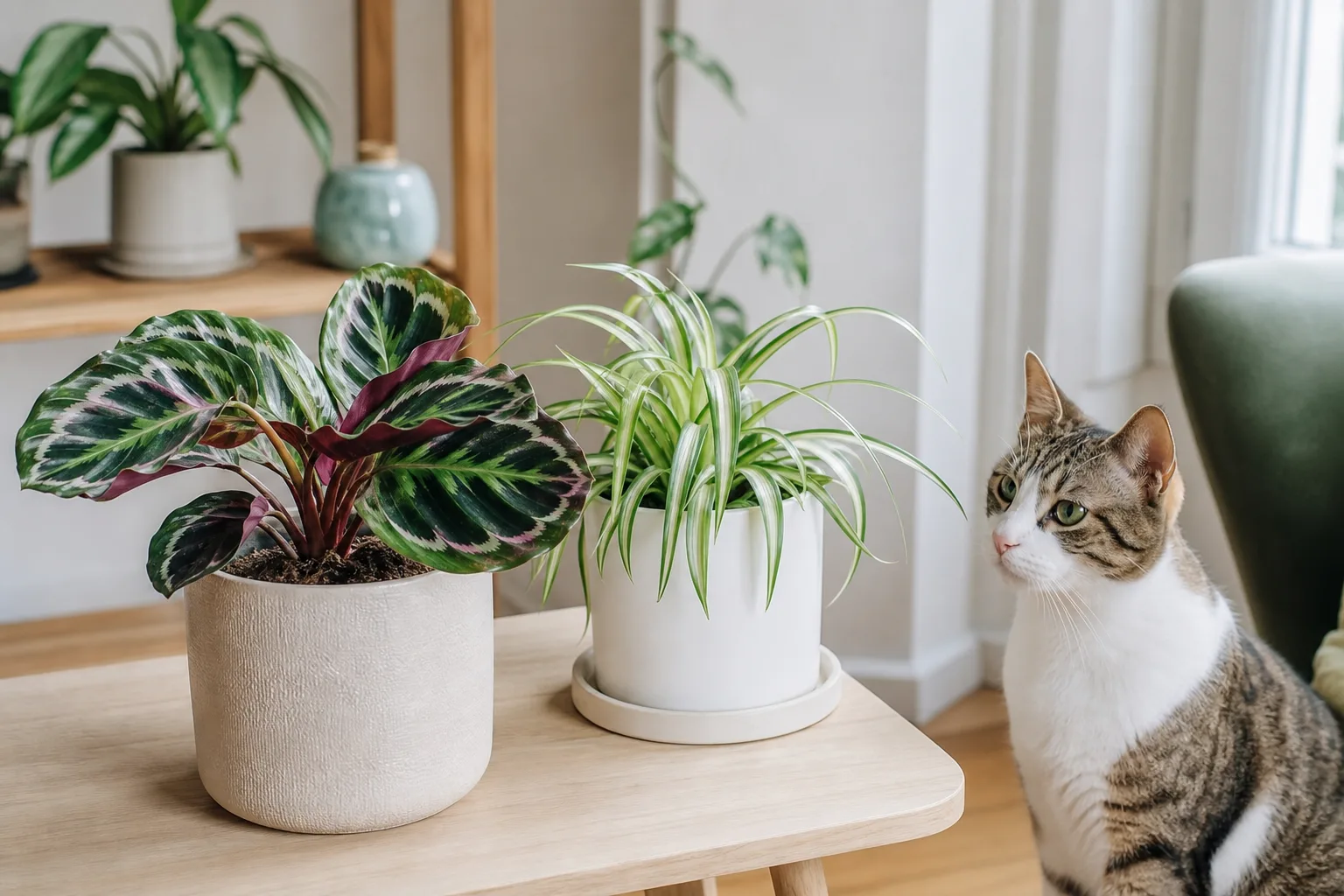
The ASPCA Toxic and Non-Toxic Plants database, maintained by the Animal Poison Control Center, is the most comprehensive publicly available reference for plant toxicity in pets. It classifies plants as either toxic or non-toxic based on reported veterinary cases, toxicological data, and known chemical constituents. But the ASPCA also explicitly states that consumption of any plant material may cause vomiting and gastrointestinal upset in dogs and cats. Non-toxic is a specific toxicological claim, not a free pass.
A cat who chews a calathea leaf may vomit from the physical irritation or fiber content. A cat who eats an entire spider plant may experience mild vomiting and lethargy from opium-like compounds the plant contains—the ASPCA confirms Chlorophytum comosum is non-toxic but reports mild GI effects. A cat who knocks over and shreds a parlor palm will probably be fine. None of these scenarios are emergencies. None require a panicked call to poison control. But they are all reasons to place plants thoughtfully and watch how your specific cat interacts with greenery before filling every surface with it.
The ASPCA classifies spider plant (Chlorophytum comosum) as non-toxic in its main database. However, the ASPCA’s own pet-safety newsletter separately lists spider plant under “Mildly Toxic Plants” alongside fiddle leaf fig, noting risk of “mild gastrointestinal irritation” with vomiting and diarrhea as the most common signs. Both sources are from ASPCA. We take the conservative position: spider plant is not systemically toxic but can cause stomach upset, especially in cats who eat it repeatedly. It is included in this guide with that caveat clearly stated. (ASPCA Houseplant Safety for Pets)
These are the genuinely dangerous plants every cat owner should know. True lilies (Lilium and Hemerocallis species) cause acute kidney failure in cats from ingestion of any plant part, including pollen. Sago palm causes potentially fatal liver damage. Pothos, philodendron, peace lily, dieffenbachia, snake plant, aloe vera, jade plant, dracaena, and ZZ plant are all listed as toxic by ASPCA, with pothos causing oral irritation, drooling, and vomiting from insoluble calcium oxalate crystals. If you have these plants and a cat, place them completely out of reach or replace them. (ASPCA Toxic and Non-Toxic Plants)
How We Verified These 15 Plants
Every plant on this list was checked against the ASPCA Toxic and Non-Toxic Plants database. We searched the database by scientific name and common name, confirmed the non-toxic classification, and cross-referenced with Pet Poison Helpline data where available. Plants listed as non-toxic in the ASPCA database but flagged with cautionary notes in other ASPCA publications—like spider plant—are included with those caveats clearly disclosed.
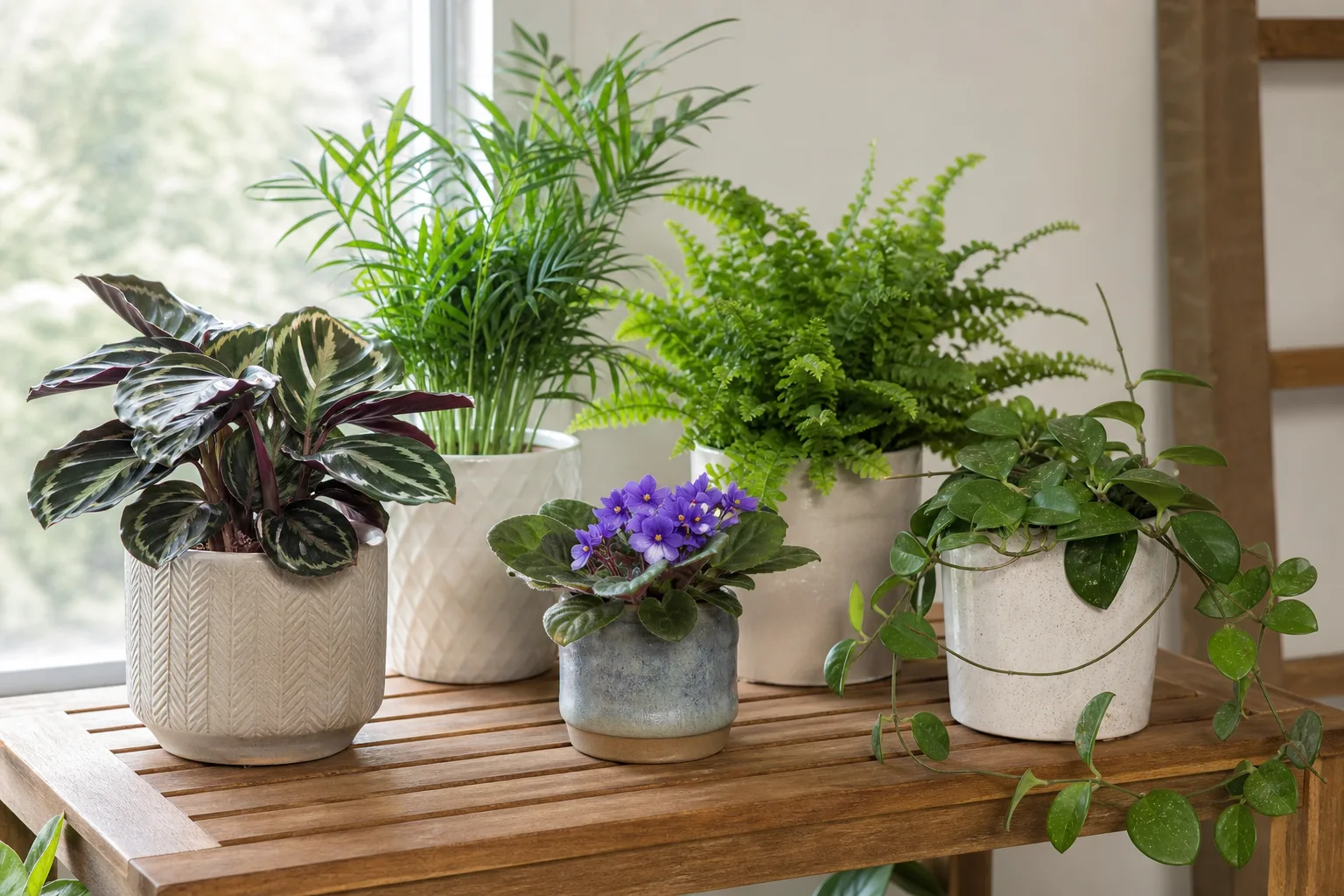
Only plants from the LeafyPixels inventory with full care guide coverage appear on this list. Each plant has a dedicated species hub with watering, light, soil, propagation, and problems guides so you can go deeper once you pick your plant. Links are provided throughout each entry.
We prioritized plants that are widely available at nurseries and garden centers, work in typical indoor conditions without specialized setups, and represent different growth habits—trailing, upright, compact, bushy—so you can find something that fits your specific space rather than settling for whatever is listed as safe.
The 15 Best Cat-Safe Indoor Plants
1. Calathea (Prayer Plant Family)
Safety status: Non-toxic to cats (ASPCA verified) Best for: colorful foliage, medium-light rooms, plant collectors, east-facing windowsills Difficulty: Medium Light: Bright indirect; direct sun scorches leaves Water: Keep soil consistently moist but not soggy; sensitive to tap water chemicals
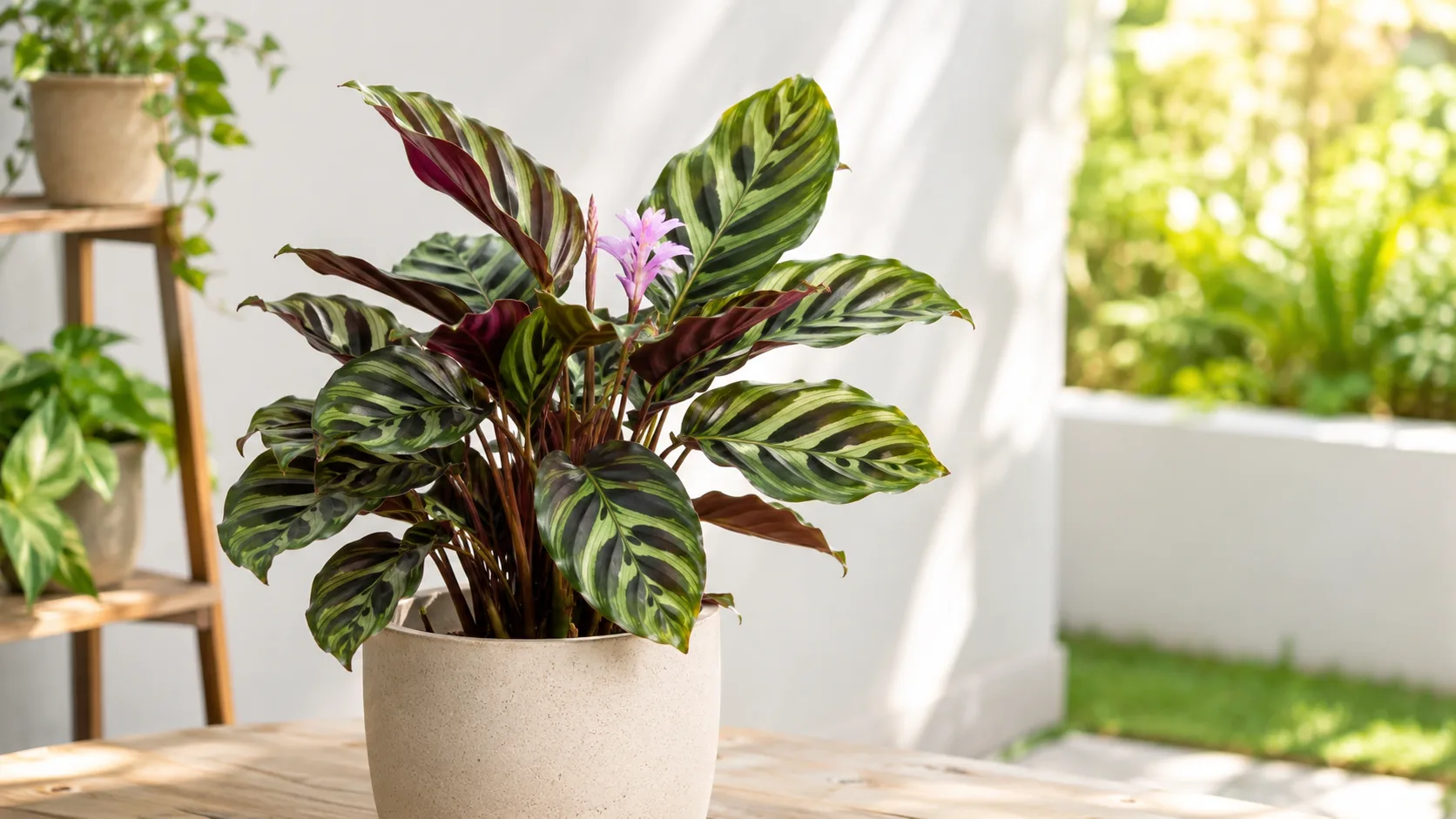
The entire Calathea genus—including orbifolia, medallion, rattlesnake, peacock plant, dottie, roseopicta, vittata, white fusion, zebrina, and musaica—is non-toxic to cats. For a plant family this visually striking, that is genuinely rare. No other genus gives you this level of painterly foliage detail—pinstripes, feathered brushstrokes, concentric rings, neon-pink markings—without a toxicity trade-off.
Calatheas earned a reputation as divas, and the reputation is partly earned. They need consistent moisture, hate drying out completely, and will show you brown leaf edges if your tap water has high mineral content or your humidity drops below 40 percent. But the difficulty is overstated in listicles that treat every calathea as equivalent. Rattlesnake calathea and freddie are noticeably more forgiving than white fusion or orbifolia, which are genuinely demanding. If you can keep the soil lightly moist and provide medium to bright indirect light, a rattlesnake calathea will thrive without the drama.
Safety note: Cats rarely chew calathea leaves—the texture is broad and papery, not grass-like. But the leaves are low to the ground on many varieties, so a curious cat can easily reach them. Place varieties with long stems in pots on plant stands rather than directly on the floor. Care reality: Calatheas are sensitive to chlorine and fluoride in tap water. Use filtered, distilled, or rainwater if you see brown leaf tips. They also prefer consistent temperatures above 60°F and dislike cold drafts from windows or air conditioning vents. Common mistake: Watering on a fixed schedule instead of checking soil moisture. Calatheas need consistently damp soil, but “damp” is not “wet.” Let the top half-inch dry between waterings in lower light, and never let the pot sit in standing water.
Useful care guides:
- Calathea care guide
- Calathea watering guide
- Calathea light guide
- Calathea soil guide
- Calathea problems guide
2. Spider Plant
Safety status: Non-toxic in ASPCA database; ASPCA newsletter notes mild GI irritation potential Best for: hanging baskets, shelves, beginners, fast growers, cat grass alternative Difficulty: Easy Light: Bright indirect to medium; tolerates some direct morning sun Water: Water when top inch of soil dries out; forgiving of occasional missed watering
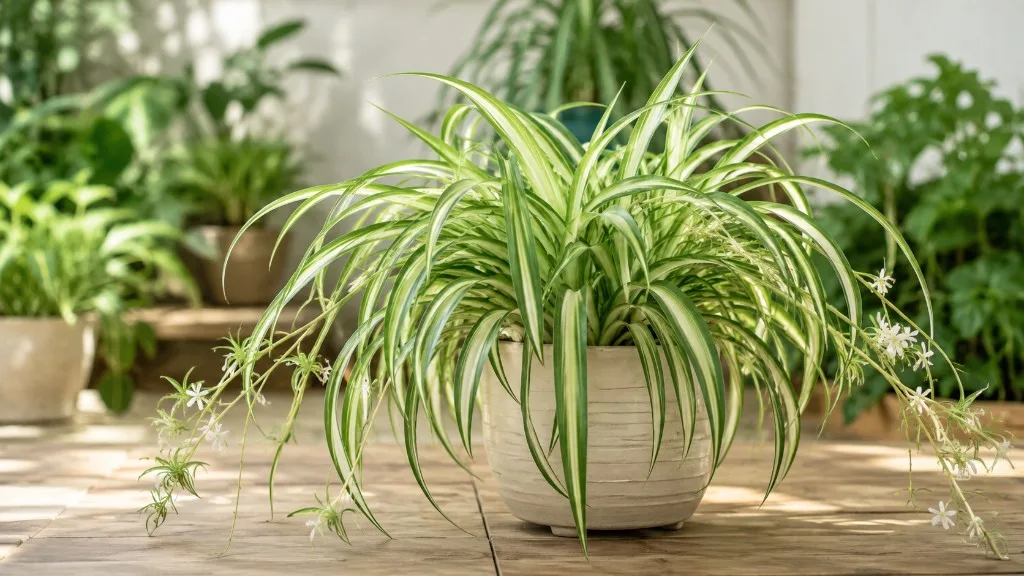
Spider plant is the most confusing entry on any cat-safety list. ASPCA’s main database says non-toxic. ASPCA’s own newsletter says mildly toxic. Both are technically correct in different ways: the plant does not contain compounds that cause organ damage or systemic poisoning (database classification), but it does contain opium-related compounds that can trigger vomiting and mild hallucinogenic effects in cats who eat enough of it (newsletter classification).
Here is what matters for a cat owner: spider plant will not kill your cat or damage its organs. But many cats are drawn to spider plant the way they are drawn to cat grass—the long, slender, arching leaves look and move like grass blades, which triggers a chewing instinct. Some cats will nibble once and lose interest. Others will treat the plant like a personal salad bar and vomit on your rug once a week. If your cat falls into the second category, hang the spider plant in a basket unreachable from furniture, or grow actual cat grass as a decoy.
For the human in the household, spider plant is one of the easiest indoor plants in existence. It tolerates a wide range of light, bounces back from severe underwatering, and produces offsets (spiderettes) that you can snip off and root in water or soil. A single healthy spider plant becomes a gift factory within six months.
Safety note: If your cat repeatedly eats spider plant and vomits, move it out of reach. The GI irritation is self-limiting but unpleasant for the cat and messy for you. Contact a veterinarian if vomiting persists or the cat shows lethargy beyond normal post-vomit recovery. Care reality: Brown leaf tips on spider plants are almost always caused by fluoride, chlorine, or soluble salts in tap water—not by underwatering or low humidity. Switch to filtered or distilled water and the new growth will come in clean. Common mistake: Putting spider plant in direct afternoon sun, which bleaches the leaves to a pale yellow-green and causes crispy edges. Bright indirect light gives you the deepest green color and fastest growth.
Useful care guides:
- Spider Plant care guide
- Spider Plant watering guide
- Spider Plant light guide
- Spider Plant propagation guide
- Spider Plant problems guide
3. Parlor Palm
Safety status: Non-toxic to cats (ASPCA verified) Best for: low to medium light, corners, living rooms, beginners, Victorian-era reliability Difficulty: Easy Light: Low to medium indirect; tolerates north-facing rooms better than most palms Water: Water when top inch or two of soil dries out; do not let sit in standing water
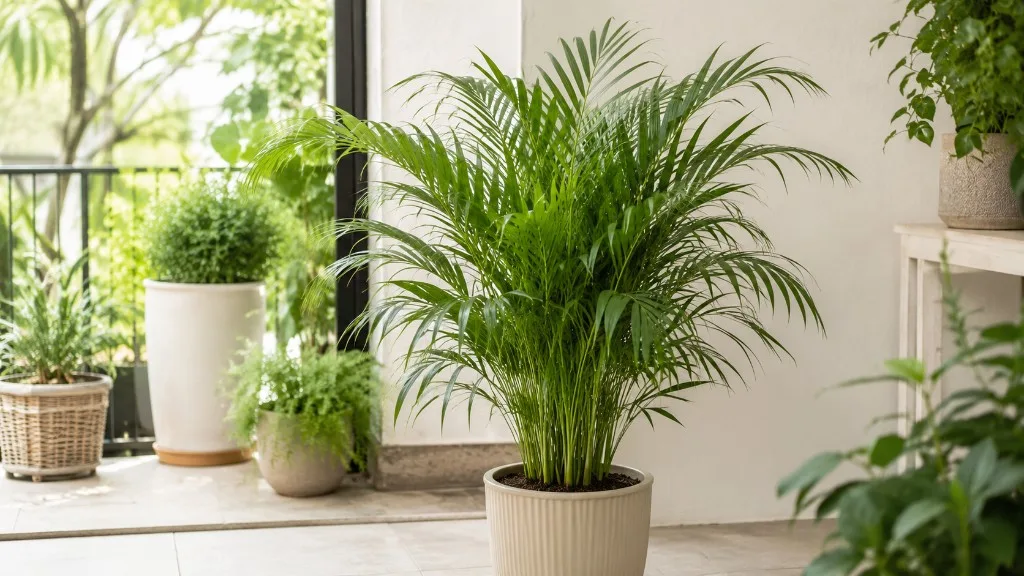
Parlor palm (Chamaedorea elegans) has been an indoor plant since the Victorian era, and its longevity as a houseplant tells you everything you need to know. It is not flashy. It does not flower indoors. It does not trail dramatically or unfurl leaves the size of dinner plates. What it does is stay green, stay compact, and adapt to conditions that would kill most other palms in a month.
For a cat household, parlor palm offers a specific advantage: the fronds are fine-textured but dense, which makes them less interesting to chew than spider plant’s grass-like blades or ponytail palm’s curly ribbons. A cat might bat at a dangling frond, but it is unlikely to sit and methodically eat it the way some cats attack dracaena or spider plant.
Parlor palm maxes out around four feet tall indoors and grows slowly, so you will not need to repot or prune frequently. It is one of the few genuinely low-light-tolerant palms—it will survive in a north-facing room with no direct sun, though it grows faster in bright indirect light.
Safety note: Like all palms, parlor palm fronds can accumulate dust. Wipe leaves monthly with a damp cloth to keep them photosynthesizing efficiently. Cats sometimes groom dusty leaves out of curiosity, so keeping them clean reduces temptation. Care reality: Parlor palm’s main weakness is spider mites in dry indoor air. If you see fine webbing between fronds or stippled yellow speckling on leaves, increase humidity with a pebble tray or humidifier and rinse the fronds with lukewarm water. Common mistake: Overwatering. Parlor palm likes consistent moisture but rots quickly in soggy soil. If the pot has no drainage hole, repot it into one that does before even thinking about a watering schedule.
Useful care guides:
- Parlor Palm care guide
- Parlor Palm watering guide
- Parlor Palm light guide
- Parlor Palm soil guide
- Parlor Palm problems guide
4. Boston Fern
Safety status: Non-toxic to cats (ASPCA verified) Best for: bathrooms, kitchens, hanging baskets, humidity-rich rooms, lush foliage Difficulty: Medium Light: Bright indirect; tolerates medium light with slower growth Water: Keep soil consistently moist; high humidity needs
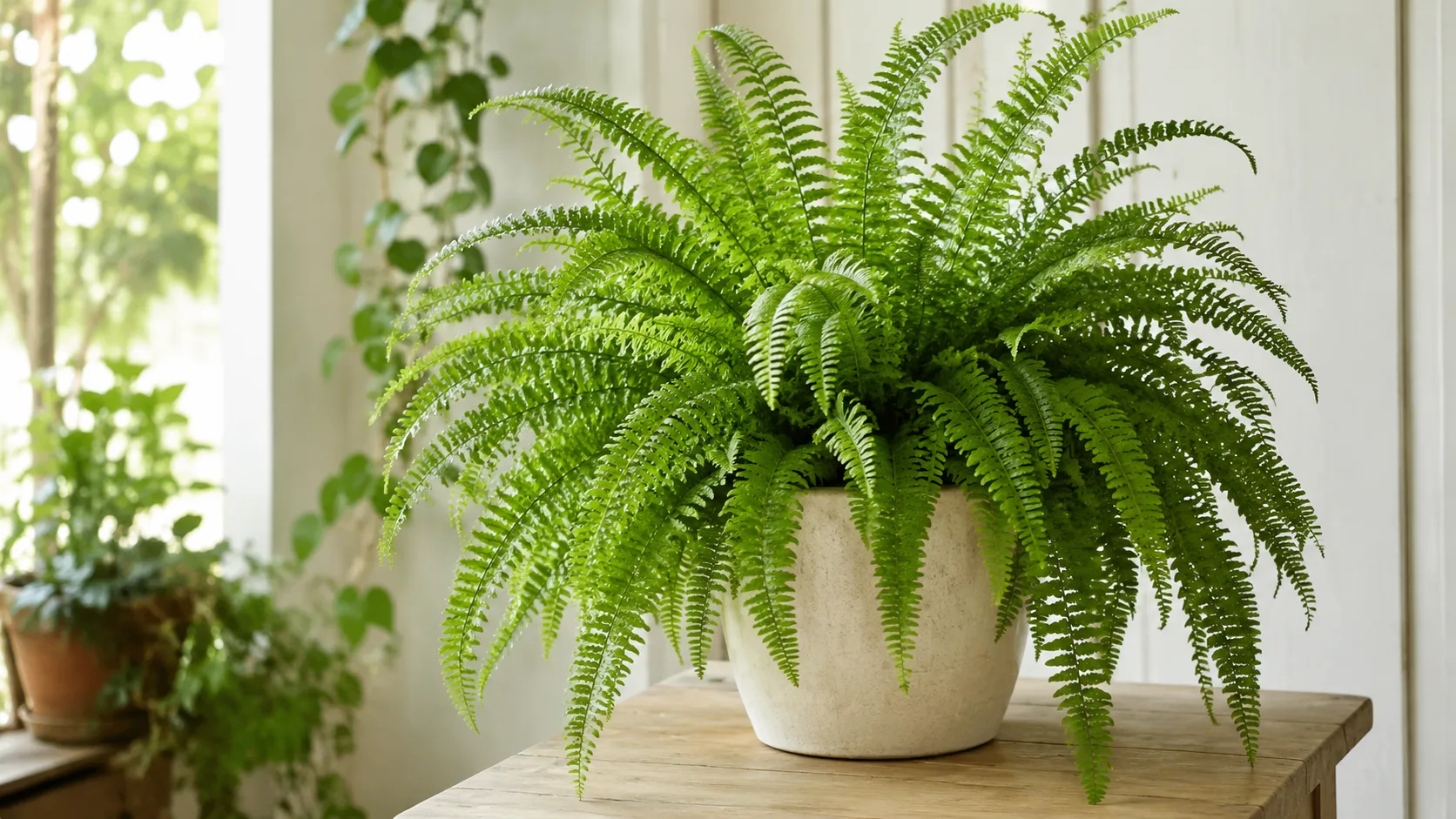
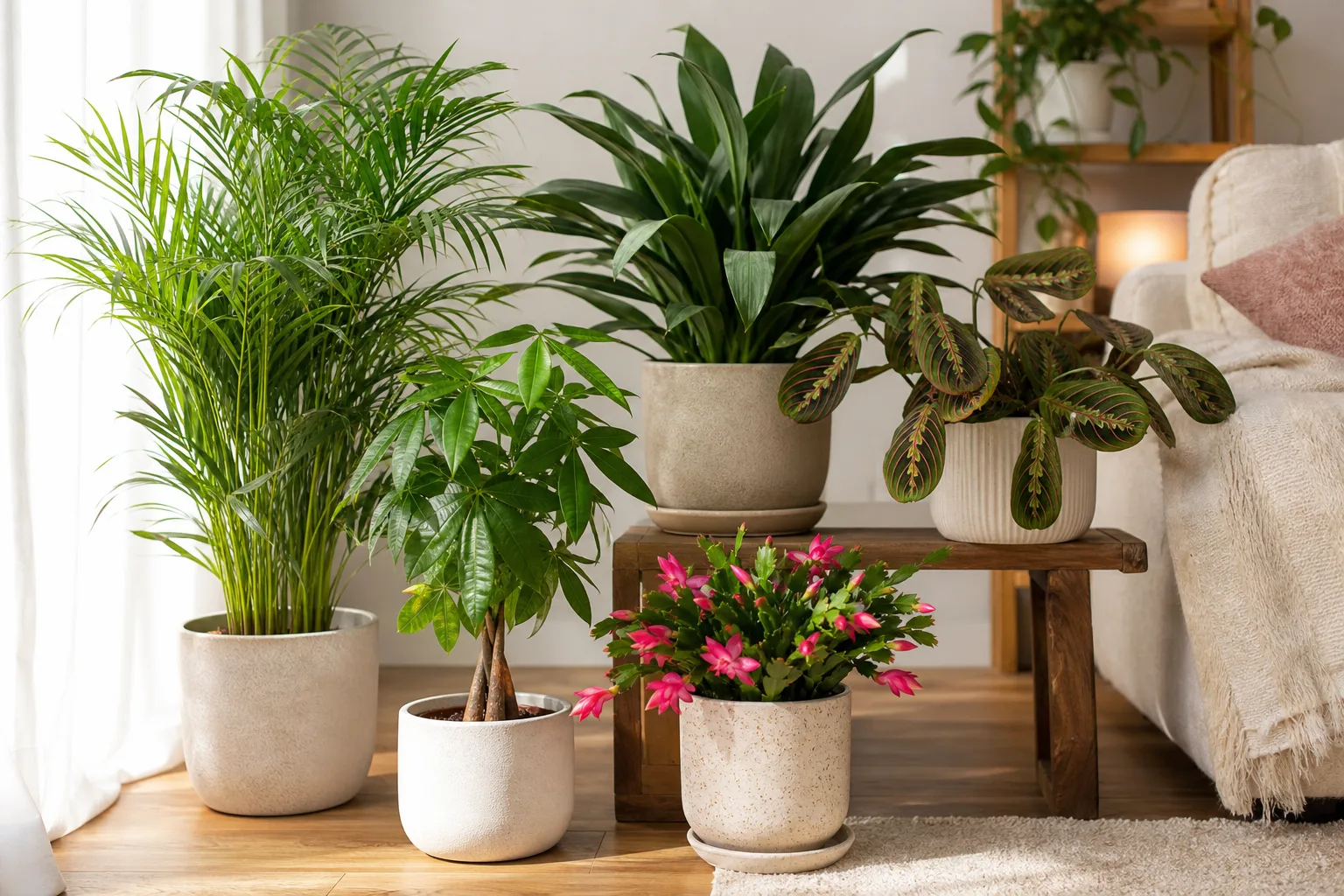
Boston fern and its relatives—bird’s nest fern, blue star fern, staghorn fern—are all non-toxic to cats. The entire fern category is as safe as houseplants get, though not all plants with “fern” in their common name are true ferns. Asparagus fern, for example, is a lily relative and toxic. Stick with genuine ferns (Nephrolepis, Asplenium, Phlebodium, Platycerium) and the safety concern disappears.
The trade-off is that true ferns need more consistent moisture and humidity than most of the other plants on this list. Boston fern in particular will drop leaflets on your floor if it dries out or sits in dry heated air. This is not dangerous for the cat—the dried leaflets are non-toxic—but it is annoying to clean. In a bathroom with a shower or above a kitchen sink where ambient humidity stays above 50 percent, Boston fern thrives with almost no extra effort. In a dry living room with forced-air heating, it will require daily misting or a humidifier to stay lush.
Safety note: Ferns shed small leaflets as part of normal growth. These dry leaflets are non-toxic but could be batted around and chewed by a cat. Sweep or vacuum around the plant regularly if your cat is the type to eat anything that hits the floor. Care reality: Boston fern needs consistently moist soil—not wet, but never bone dry. Check soil every two to three days. If the fronds start to look pale or thin, it is probably underwatered. Deep-water thoroughly at the sink and let it drain before returning to its spot. Common mistake: Treating all “ferns” as non-toxic. Asparagus fern is toxic; foxtail fern is toxic; most plants with “fern” in a misleading common name are not true ferns. Verify with the ASPCA database before buying anything with fern-like foliage.
Useful care guides:
- Boston Fern care guide
- Boston Fern watering guide
- Boston Fern light guide
- Boston Fern soil guide
- Boston Fern propagation guide
5. Areca Palm
Safety status: Non-toxic to cats (ASPCA verified) Best for: bright rooms, statement corners, living rooms, airy tropical look Difficulty: Easy to medium Light: Bright indirect; tolerates some direct morning or late-afternoon sun Water: Water when top inch or two of soil dries out; sensitive to overwatering
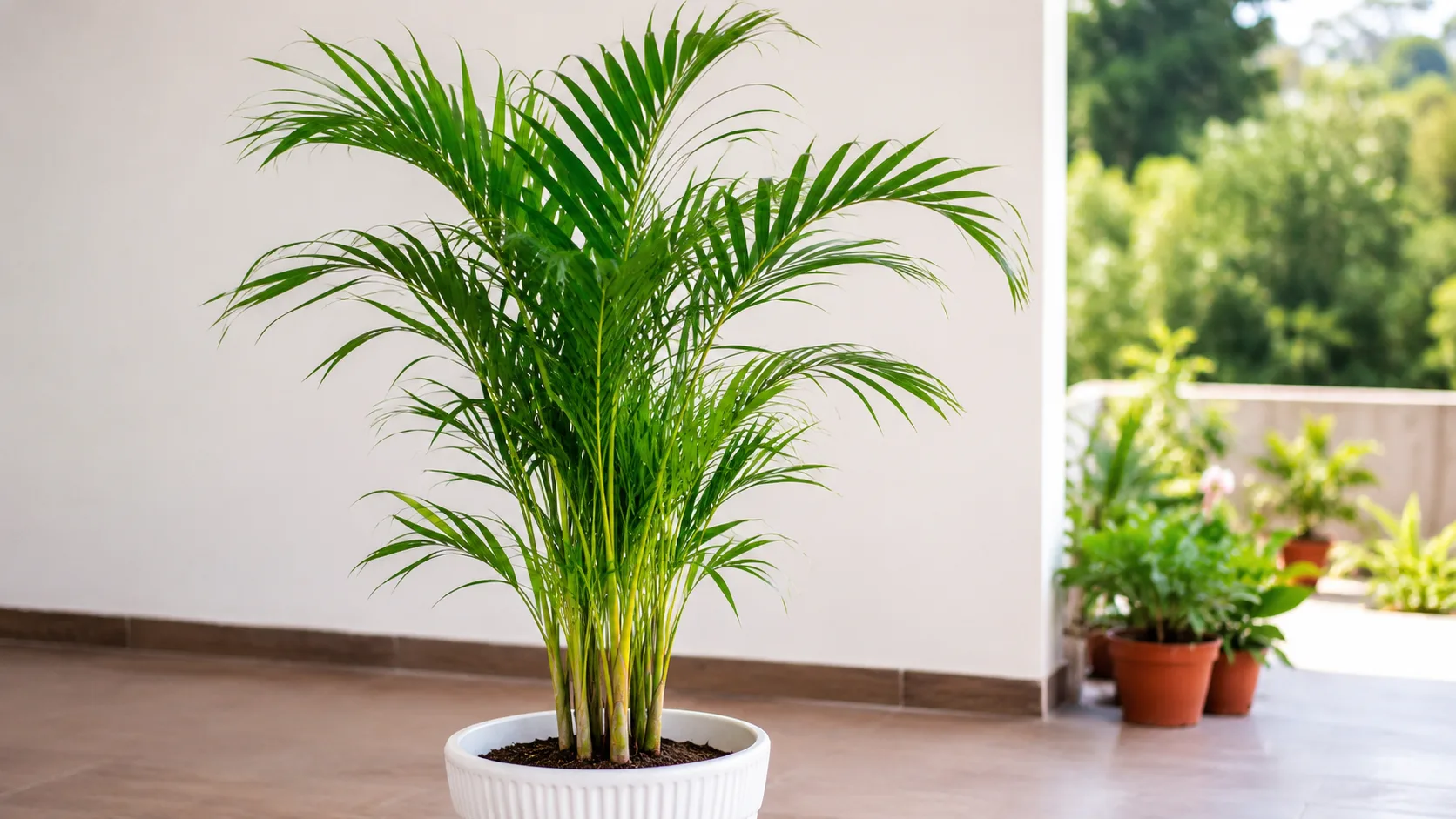
Areca palm (Dypsis lutescens) is the plant you buy when you want a palm that actually looks like a palm. Parlor palm is subtle. Areca palm is a statement piece—multiple bamboo-like stems shoot up from the base with long, feathery, arching fronds that spread outward and upward. A mature areca palm in a room corner reads as intentional decor, not just a houseplant.
It is also legitimately cat-safe. The ASPCA lists areca palm as non-toxic to both cats and dogs. The fronds are numerous and fine-textured, so a determined chewer can still do cosmetic damage, but the plant itself poses no toxicity risk.
Areca palm needs brighter light than parlor palm to look its best. In a north-facing room or a dark corner, it will survive for a while but eventually thin out, drop lower fronds, and look sparse. Give it a spot near an east or west-facing window where it gets several hours of bright indirect light, and it will push new growth steadily through spring and summer.
Safety note: Areca palm stems are thin and bamboo-like—a running cat can knock over an unsecured pot. Place in a heavy ceramic or terracotta pot, not a lightweight plastic nursery pot, and position it where zoomies are unlikely to collide with it. Care reality: Areca palm is sensitive to overwatering and cold drafts. Water only when the topsoil feels dry, and keep it away from air conditioning vents and exterior doors that open frequently in winter. Browning frond tips often mean the air is too dry or the plant is getting too much fertilizer. Common mistake: Buying a large areca palm without checking your light levels first. It needs more light than parlor palm or cast iron plant. If your room is dim, choose one of those instead.
Useful care guides:
- Areca Palm care guide
- Areca Palm watering guide
- Areca Palm light guide
- Areca Palm soil guide
- Areca Palm problems guide
6. Baby Rubber Plant
Safety status: Non-toxic to cats (ASPCA verified) Best for: desks, shelves, small spaces, forgetful waterers, beginners Difficulty: Easy Light: Medium to bright indirect; tolerates lower light with slower growth Water: Water when top inch or two of soil dries out; succulent-like leaves store water
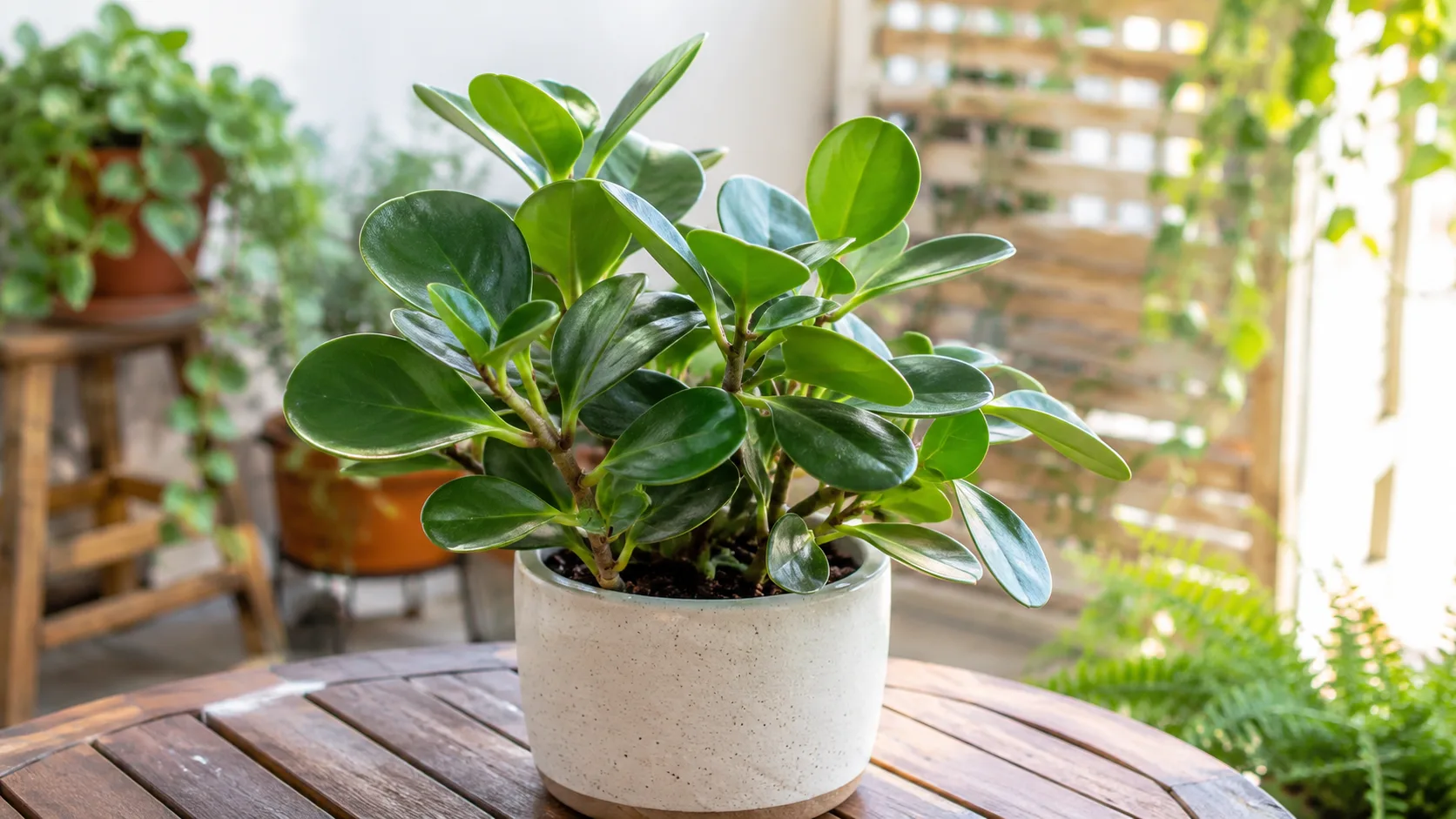
Baby rubber plant (Peperomia obtusifolia) is one of the most underrated houseplants in the entire non-toxic category. It has thick, glossy, spoon-shaped leaves that look almost like a miniature rubber plant—hence the name—but it is actually a peperomia, not a ficus. It maxes out around 12 inches tall, fits on a desk or bookshelf, and forgives the kind of inconsistent watering that kills calatheas.
The thick leaves store water the way succulent leaves do, which means a baby rubber plant can go an extra week between waterings without any visible stress. Leaves stay glossy and dark green in medium indirect light; variegated cultivars with cream or yellow margins need slightly brighter light to maintain their pattern. It is an ideal plant for a home office, nightstand, or any small surface that needs something green without demanding daily attention.
Safety note: Baby rubber plant’s leaves are thick and not grass-like, which makes them less appealing for cats to chew. The plant stays compact and can easily be placed on a shelf or plant stand where it is out of direct paw range. Care reality: The most common cause of baby rubber plant death is overwatering in low light. Those thick leaves store water efficiently, so in a dim room the plant may only need water every two to three weeks. Err on the side of too dry rather than too wet, and always use a pot with drainage. Common mistake: Misting the leaves. Baby rubber plant does not need high humidity, and wet leaves in still air can develop fungal spots. Just water the soil when it is dry.
Useful care guides:
- Baby Rubber Plant care guide
- Baby Rubber Plant watering guide
- Baby Rubber Plant light guide
- Baby Rubber Plant soil guide
- Baby Rubber Plant propagation guide
7. African Violet
Safety status: Non-toxic to cats (ASPCA verified) Best for: east-facing windowsills, desks, flowering plants, small spaces Difficulty: Medium Light: Bright indirect; east or north-facing window is ideal Water: Water from the bottom or avoid wetting leaves; keep soil lightly moist
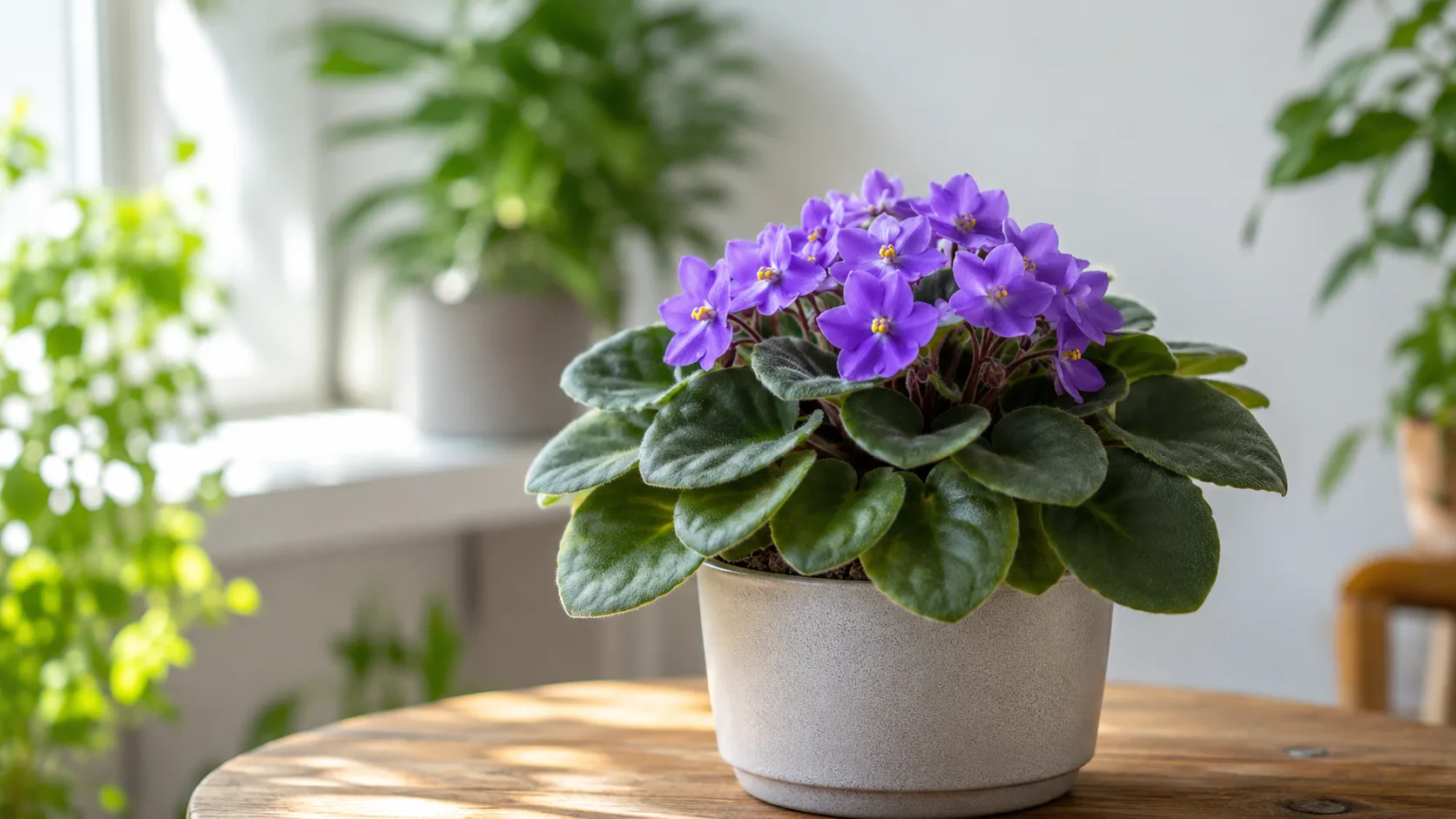
African violet is one of the few flowering houseplants that is non-toxic to cats and will bloom repeatedly indoors. The ASPCA database confirms Saintpaulia species are non-toxic, which puts African violet in a small club of colorful bloomers alongside phalaenopsis orchids and Christmas cactus that do not carry toxicity warnings.
The care requirements are specific but simple once you understand them: bright indirect light (an east-facing windowsill is perfect), consistently moist soil that never goes fully dry, and water that never touches the leaves. Leaf spots from cold water droplets are a cosmetic issue, not a health crisis, but the plant looks better when you bottom-water or use a narrow-spout watering can aimed at the soil.
African violets stay compact—rarely exceeding eight inches across—which makes them easy to place on a high windowsill or shelf where a cat cannot reach. They bloom in cycles year-round when light is adequate, producing clusters of purple, pink, or white flowers that last for weeks.
Safety note: The fuzzy leaves of African violet collect dust and cat hair in a pet household. Gently brush leaves with a soft, dry paintbrush or makeup brush to clean them without damaging the delicate leaf surface. Never mist African violet leaves—water droplets cause permanent spotting. Care reality: African violets stop blooming when light is insufficient. If the leaves are dark green and the plant has not flowered in months, move it closer to a window or supplement with a small grow light. They also bloom better when slightly root-bound, so do not rush to repot. Common mistake: Watering the leaves instead of the soil. Cold water on African violet leaves creates brown spots that never heal. Bottom-water by placing the pot in a saucer of room-temperature water for 20 to 30 minutes, then discard any remaining water.
Useful care guides:
- African Violet care guide
- African Violet watering guide
- African Violet light guide
- African Violet soil guide
- African Violet propagation guide
8. Money Tree
Safety status: Non-toxic to cats (ASPCA verified) Best for: living rooms, offices, feng shui placements, statement plants, beginners Difficulty: Easy Light: Medium to bright indirect; tolerates some direct morning sun Water: Water when top inch or two of soil dries out
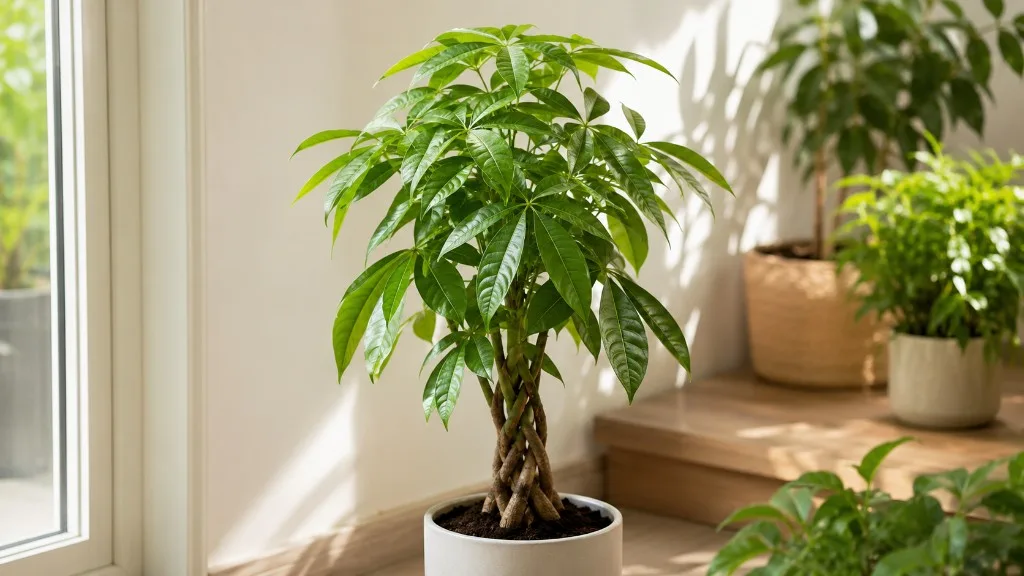
Money tree (Pachira aquatica) manages to be simultaneously trendy and genuinely easy. The braided trunk and umbrella-like canopy of five-lobed leaves give it a sculptural presence that works in modern and traditional spaces, and the ASPCA lists it as non-toxic to cats and dogs.
Money tree’s care tolerance is broader than its appearance suggests. It handles medium indirect light without complaint, bounces back from occasional underwatering, and does not need supplemental humidity to stay healthy. The main thing that kills money trees is overwatering—the braided trunk can trap moisture between stems, creating conditions for rot. Water thoroughly but infrequently, and always use a pot with drainage.
The leaves grow on long stems that rise above the trunk, which naturally keeps most foliage out of a cat’s immediate reach. A determined jumper can still get to them, but the plant’s architecture makes casual snacking less likely than with a bushy floor plant.
Safety note: Money tree leaves are arranged in groups of five and are fairly large. A cat that jumps onto the pot might knock leaves loose, but the foliage itself is not toxic. Secure the plant in a heavy pot to prevent tipping. Care reality: Money tree leaves turn yellow from overwatering or insufficient light. If lower leaves yellow and drop, check that the soil is drying properly between waterings and that the plant is getting enough indirect light. Trim yellow leaves with clean scissors—they will not recover. Common mistake: Keeping the braided trunk tied with nursery ribbon or wire. As the plant grows, these ties can girdle the stems and restrict water and nutrient flow. Remove all nursery ties when you bring the plant home.
Useful care guides:
- Money Tree care guide
- Money Tree watering guide
- Money Tree light guide
- Money Tree soil guide
- Money Tree propagation guide
9. Ponytail Palm
Safety status: Non-toxic to cats (ASPCA verified) Best for: forgetful waterers, bright windows, quirky decor, beginners Difficulty: Easy Light: Bright indirect to direct; tolerates direct sun on south or west-facing windows Water: Water thoroughly when soil is completely dry; bulbous trunk stores water
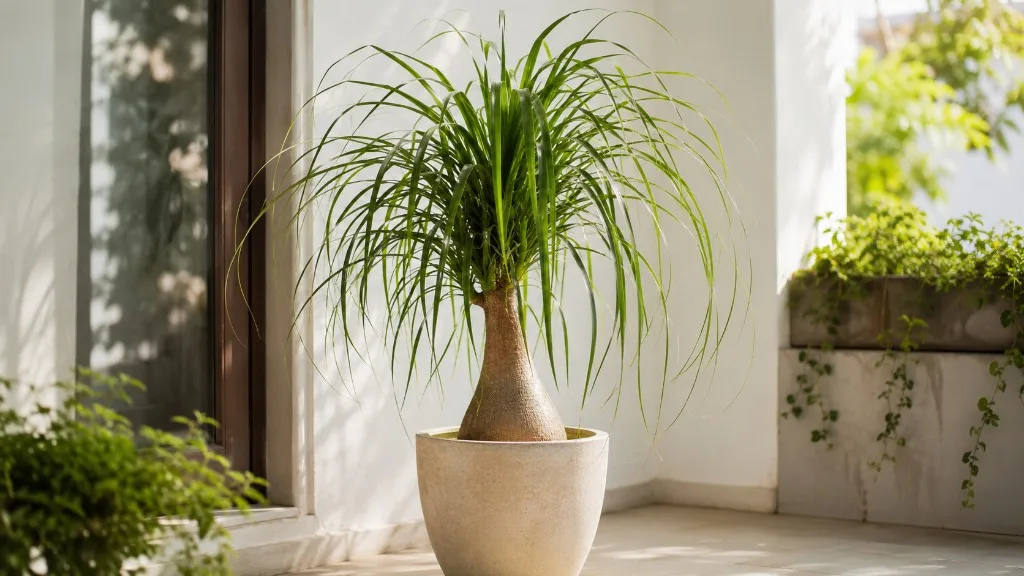
Ponytail palm (Beaucarnea recurvata) is not actually a palm—it is a succulent in the asparagus family—but the common name stuck because its long, curly, hair-like leaves cascade from a bulbous trunk that looks like an elephant’s foot. It is one of the most forgiving plants on this list and one of the most visually distinctive.
The swollen trunk base is a water storage organ. In a pot with drainage, a ponytail palm can go three to four weeks without water in moderate conditions and even longer in winter or low light. It thrives in bright light and can handle direct sun on a windowsill, which is uncommon for non-toxic plants—most of the others on this list need some protection from harsh rays.
The curly leaves are the one drawback in a cat household. They look like toys. A cat will bat at them, and a determined chewer may treat them like string. The leaves are non-toxic, but repeated chewing will leave the plant looking ragged and may cause mild stomach upset in the cat.
Safety note: Ponytail palm leaves are thin, curly, and highly appealing to cats as a play object. Place the plant where leaves do not dangle at paw level—on a tall plant stand, a high shelf, or a windowsill too narrow for a cat to sit on comfortably. Care reality: The fastest way to kill a ponytail palm is frequent watering. Let the soil dry out completely between waterings—the trunk shrivels slightly when the plant needs water, which is a more reliable signal than a calendar. In winter, you might water once a month. Common mistake: Treating the curly leaves like hair that needs trimming. Browning leaf tips are normal on older leaves. Trim only the brown portion, not into the green tissue, and do not give the plant a “haircut”—it needs photosynthesis to support the trunk.
Useful care guides:
- Ponytail Palm care guide
- Ponytail Palm watering guide
- Ponytail Palm light guide
- Ponytail Palm soil guide
- Ponytail Palm propagation guide
10. Hoya
Safety status: Non-toxic to cats (ASPCA verified) Best for: bright windows, hanging baskets, trailing displays, patient growers Difficulty: Easy to medium Light: Bright indirect; some direct morning or late afternoon sun Water: Water when soil dries out; succulent-like leaves store water
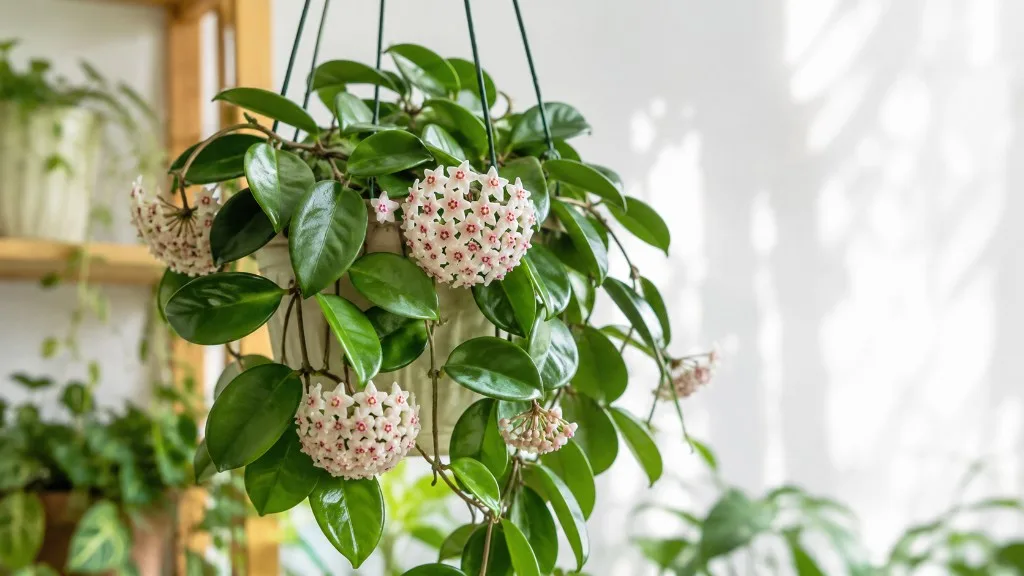
Hoyas are the plant equivalent of a slow-burn friendship. Nothing much happens for six months, and then suddenly you notice four feet of vine with waxy, perfect leaves and a cluster of tiny star-shaped flowers that smell like chocolate or honey. The entire Hoya genus is ASPCA-verified non-toxic to cats—carnosa, kerrii, pubicalyx, and the dozens of other species and cultivars.
Hoyas are epiphytic in the wild, growing on trees rather than in soil, which means they need excellent drainage and hate sitting in wet potting mix. A chunky aroid mix with orchid bark and perlite works better than standard potting soil. Water thoroughly when the soil dries out, which might be every two to three weeks depending on light and pot size. The thick, waxy leaves store water efficiently, so underwatering is far safer than overwatering.
The trailing vines look stunning in a hanging basket well above cat level. Hoya leaves are thick and not grass-like, so cats tend to ignore them. The flowers produce nectar that can drip, so place a saucer or tray underneath during bloom season to catch any sticky droplets.
Safety note: Hoya flowers produce sweet nectar that drips during bloom. While the plant itself is non-toxic, nectar on surfaces can attract ants. A saucer under hanging baskets catches drips and keeps things clean. Care reality: Hoyas bloom best when slightly pot-bound and receiving bright light. If your hoya grows long vines but never flowers, it probably needs more light. Do not cut the long, leafless vines (peduncles)—flower clusters emerge from these structures repeatedly. Common mistake: Repotting too often or into too large a pot. Hoyas bloom better when root-bound and hate having excess wet soil around their roots. Repot only when roots are visibly circling the drainage holes.
Useful care guides:
11. Cast Iron Plant
Safety status: Non-toxic to cats (ASPCA verified) Best for: low light, forgetful waterers, dark corners, offices, beginners Difficulty: Very easy Light: Low to medium indirect; tolerates deep shade where other plants die Water: Water when top inch or two of soil dries out; very drought-tolerant
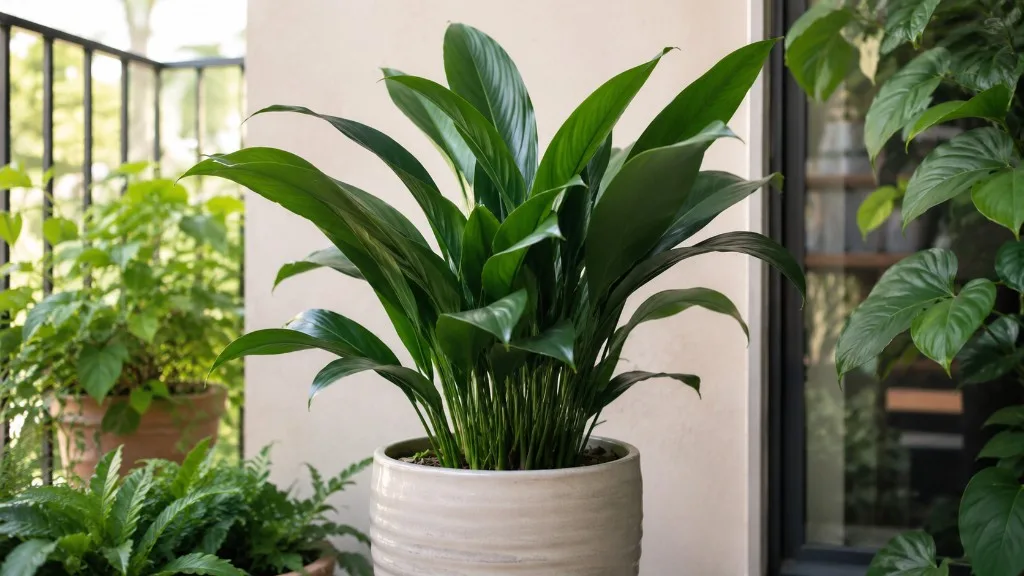
Cast iron plant (Aspidistra elatior) earned its common name honestly. It survived Victorian parlors heated by coal fires and lit by gas lamps, and modern indoor conditions barely register as a challenge. This is the plant you put in a windowless office bathroom with fluorescent lights and water once a month. It will grow slowly. It will look exactly the same in January as it did in July. It will not complain.
For a cat household, cast iron plant offers a unique advantage: the leaves are long, broad, and leathery with zero grass-like appeal. A cat might investigate once and never touch it again. The plant sits low to the ground with leaves arising directly from the soil, so it works as a floor plant without presenting dangling, tempting foliage.
The trade-off is growth speed. Cast iron plant puts out maybe two to four new leaves per year. It will never fill out dramatically or produce flowers or cascade over a pot edge. What you buy is roughly what you will have for years. If you want the excitement of visible growth and seasonal change, pair it with a faster plant like spider plant or a trailing hoya.
Safety note: Cast iron plant leaves collect dust in still indoor air. Wipe them with a damp cloth every month or two. Dusty leaves photosynthesize less efficiently and may attract a curious cat to investigate the texture. Care reality: The only things that reliably kill a cast iron plant are overwatering, standing water in the pot, and direct sun. In low light, soil stays wet for a long time—water sparingly, maybe every three to four weeks in winter. If leaves develop brown streaks or tips, the plant is getting too much direct light or too much fertilizer. Common mistake: Expecting fast growth. Cast iron plant is slow. A lack of visible change is normal, not a sign that the plant is dying. Fertilize lightly once in spring and once in summer, and otherwise leave it alone.
Useful care guides:
- Cast Iron Plant care guide
- Cast Iron Plant watering guide
- Cast Iron Plant light guide
- Cast Iron Plant propagation guide
- Cast Iron Plant problems guide
12. Pilea Peperomioides
Safety status: Non-toxic to cats (ASPCA verified) Best for: desks, windowsills, shelves, sharing with friends, modern decor Difficulty: Easy Light: Bright indirect; tolerates medium light Water: Water when top inch of soil dries out
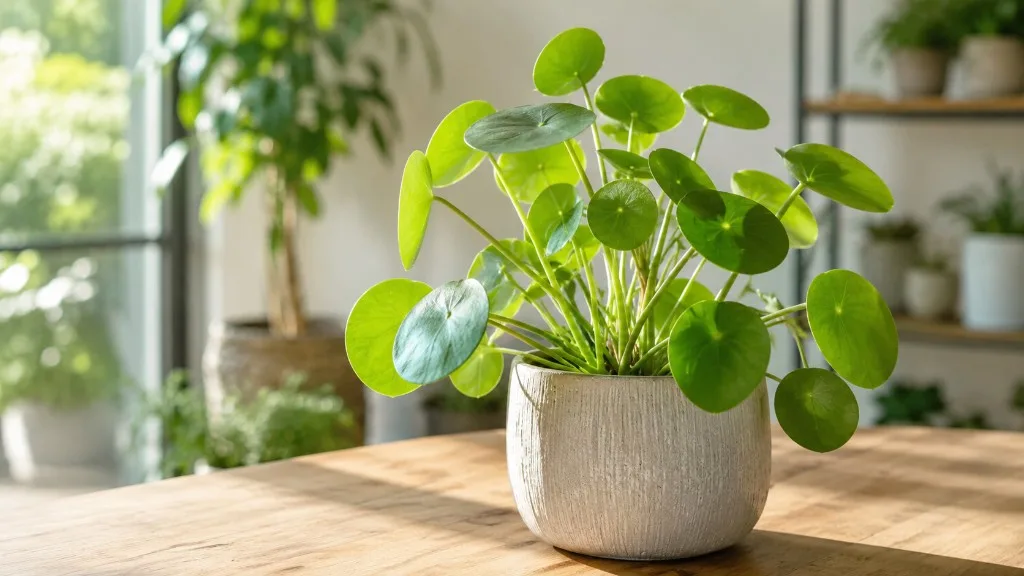
Pilea peperomioides—the Chinese money plant, the pancake plant, the UFO plant, the plant everybody on Instagram had by 2020—is genuinely deserving of its popularity. Round, coin-like leaves on long, delicate stems give it a distinct silhouette that does not look like any other plant on this list. It stays compact, produces offsets (pups) you can separate and share, and is verified non-toxic by ASPCA.
Pilea is a better choice for cat households than most small plants because the leaves sit on top of long petioles that lift them well above the soil line. A cat walking past might brush against a leaf, but the plant does not trail, dangle, or create tempting movement at floor level. On a shelf, desk, or windowsill, the leaves are at human eye level and mostly out of cat reach.
The plant signals its needs clearly. Leaves cup inward when thirsty and flatten back out within hours of watering. Lower leaves yellow and drop naturally as the plant grows taller—this is normal, not a crisis. Turn the pot a quarter turn every week so the plant grows evenly rather than leaning toward the light.
Safety note: Pilea leaves are round and coin-like, roughly the size of a ping-pong ball. A cat who bats at dangling toys might swat at the leaves if the plant is at paw level, but the plant is sturdy enough to handle casual contact without damage. Care reality: Pilea needs consistent bright indirect light to maintain its compact, rounded shape. In lower light, the stems elongate, the leaves get smaller, and the plant looks leggy. A north-facing windowsill is usually fine; a dark interior shelf is not. Common mistake: Panicking when lower leaves yellow and drop. Pilea naturally sheds older bottom leaves as it grows taller and develops a trunk-like stem. This is a normal growth pattern, not a disease. Only worry if multiple leaves across the plant turn yellow at once.
Useful care guides:
- Pilea Peperomioides care guide
- Pilea Peperomioides watering guide
- Pilea Peperomioides light guide
- Pilea Peperomioides propagation guide
- Pilea Peperomioides problems guide
13. Maranta (Prayer Plant)
Safety status: Non-toxic to cats (ASPCA verified) Best for: medium-light rooms, colorful foliage, shelves, east-facing windows Difficulty: Medium Light: Medium to bright indirect; tolerates lower light than calathea Water: Keep soil consistently moist; sensitive to drying out completely
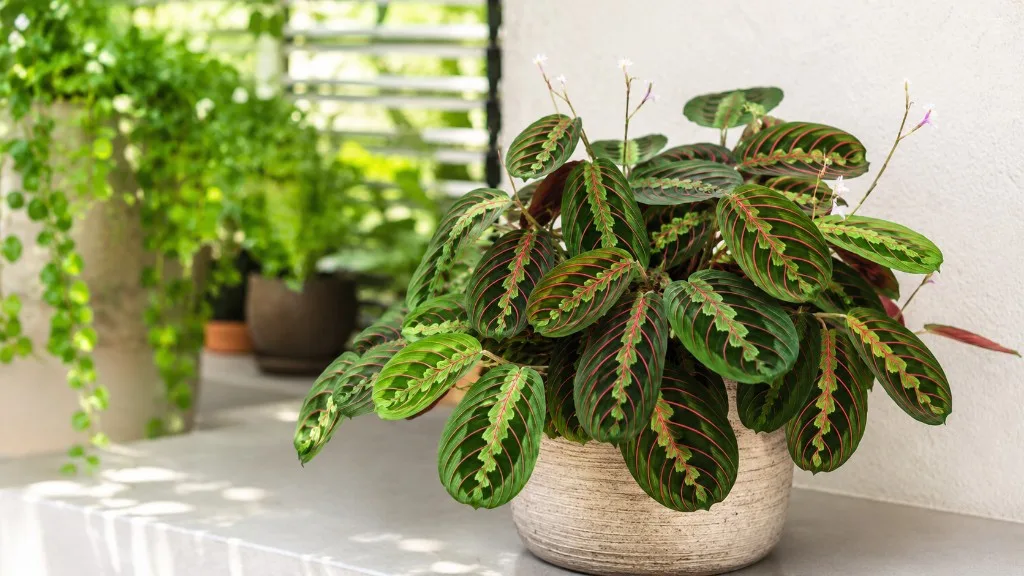
Prayer plant (Maranta leuconeura) is calathea’s slightly more forgiving cousin. Same family, same non-toxic status, same striking leaf patterns—herringbone veins of red and lime green on a dark background in the classic variety, softer lemon-lime tones with muted red veins in the lemon-lime cultivar. The difference is that prayer plants are generally more tolerant of lower light and inconsistent humidity than calatheas.
The name comes from nyctinasty—a daily leaf movement where the leaves fold upward at night like hands in prayer and flatten back out in the morning. You can literally watch it happen around dusk and dawn. It is one of the few houseplant behaviors visible in real time, and it never gets old.
Prayer plants grow horizontally rather than vertically, spreading outward as a low ground cover rather than reaching upward. This makes them ideal for wide, shallow pots on shelves or plant stands where the foliage pattern can be appreciated from above.
Safety note: Prayer plant leaves are colorful and textured, which may attract a curious cat. The plant is non-toxic, but repeated nibbling will damage the leaf patterns. Place on a shelf where the foliage is visible but out of direct paw range. Care reality: Prayer plants need consistent soil moisture but good drainage. Let the top half-inch dry between waterings, then water thoroughly. Tap water chemicals cause brown leaf tips—use filtered or distilled water if you see edge browning. Common mistake: Confusing prayer plant with calathea and assuming identical care. Marantas tolerate lower light and slightly drier soil than calatheas. If you killed a calathea, try a maranta before giving up on the family entirely.
Useful care guides:
- Prayer Plant care guide
- Prayer Plant watering guide
- Prayer Plant light guide
- Prayer Plant soil guide
- Prayer Plant problems guide
14. Peperomia (Multiple Varieties)
Safety status: Non-toxic to cats (ASPCA verified—entire Peperomia genus) Best for: desks, shelves, small spaces, variety collectors, beginners Difficulty: Easy Light: Medium to bright indirect; tolerates lower light with slower growth Water: Water when top inch or two of soil dries out; succulent-like leaves store water
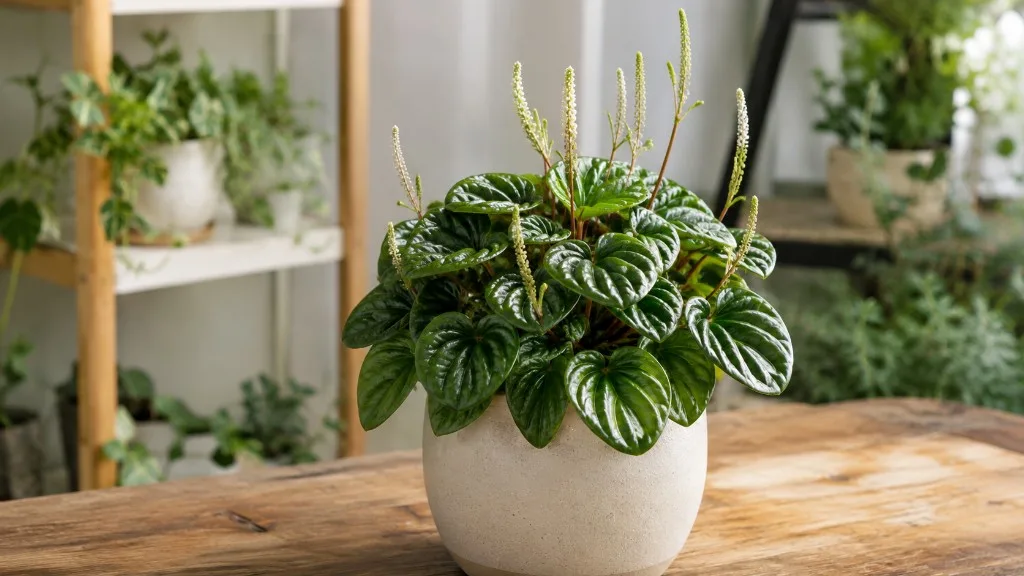
The Peperomia genus is a gift to cat owners who want variety without toxicity risk. The entire genus—over a thousand species, though a few dozen are common in cultivation—is ASPCA-verified non-toxic. You can collect peperomias the way some people collect pothos varieties, building a diverse display without ever introducing a toxic plant into your home.
The range of shapes and textures is remarkable. Watermelon peperomia has round, silver-striped leaves that genuinely look like tiny watermelons. Raindrop peperomia has glossy, teardrop-shaped leaves on upright red stems. Peperomia hope has small, round, succulent leaves on trailing stems that work beautifully in hanging baskets. String of turtles has tiny, round leaves with intricate shell-like vein patterns that trail down the sides of a pot.
All peperomias share the same forgiving care framework: medium to bright indirect light, water when the soil dries out, and standard indoor humidity. Their semi-succulent leaves store water, so they handle missed waterings better than calatheas or ferns. Compact size means they fit on any shelf, desk, or windowsill where a cat is unlikely to bother them.
Safety note: Trailing peperomias like hope and string of turtles should go in hanging baskets or high shelves where dangling vines are not at cat level. Upright varieties like watermelon and raindrop peperomia can sit on desks or windowsills with minimal temptation. Care reality: Peperomias rot quickly in soggy soil. The number one cause of death is overwatering in low light. Let the soil dry out between waterings—the leaves will feel slightly softer when the plant is thirsty, which is a better signal than a calendar. Common mistake: Using a pot without drainage. Peperomias have shallow, fine root systems that suffocate in standing water. Always use a pot with a drainage hole and a well-draining potting mix.
Useful care guides:
- Peperomia care guide
- Watermelon Peperomia care guide
- Raindrop Peperomia care guide
- Peperomia Hope care guide
- Peperomia watering guide
15. Christmas Cactus
Safety status: Non-toxic to cats (ASPCA verified) Best for: flowering color in fall/winter, bright indirect light, shelves, hanging baskets Difficulty: Easy Light: Bright indirect; tolerates some direct morning sun Water: Water when top inch of soil dries out; avoid soggy soil
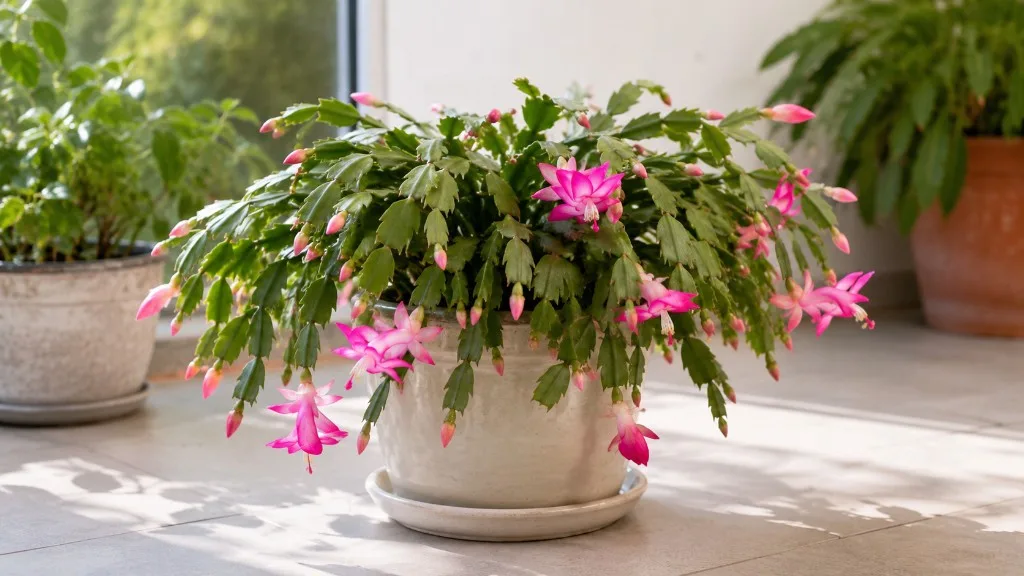
Christmas cactus (Schlumbergera) and its relatives—Thanksgiving cactus and Easter cactus, collectively the holiday cacti—are non-toxic to cats and bloom reliably once a year with minimal effort. The segmented, flat stems are not true leaves and do not have the grass-like texture that triggers chewing behavior in most cats.
The blooming cycle is triggered by shorter day length and cooler night temperatures in the fall. If you leave a Christmas cactus near a window that gets natural light (no artificial light after sunset) through September and October, it will set buds and bloom in November or December without any special intervention. The flowers last for weeks and come in shades of pink, red, white, orange, and coral.
Fishbone cactus and rhipsalis are close relatives in the same non-toxic cactus family. Fishbone cactus has zigzag, flattened stems that look nothing like a traditional cactus. Rhipsalis is a trailing, mistletoe-like cactus that grows as a cascade of thin green stems. Both are safe for cat households.
Safety note: Christmas cactus stems are segmented and can break off if a cat grabs or pulls them. The broken segments are non-toxic but could be a choking hazard for a cat who tries to swallow one whole. Pick up fallen segments promptly. Care reality: Christmas cactus is a tropical forest cactus, not a desert cactus. It needs more water and less direct sun than you would give a barrel cactus or echeveria. Water when the top inch of soil dries out, and never let it sit in standing water. If the stems wrinkle, it is underwatered. Common mistake: Treating it like a desert succulent. Direct afternoon sun burns the stems and causes reddish-purple stress coloring. Bright indirect light is ideal. Overwatering is more dangerous than underwatering, but do not let it dry out for weeks the way you would a true desert cactus.
Useful care guides:
- Christmas Cactus care guide
- Christmas Cactus watering guide
- Christmas Cactus light guide
- Christmas Cactus propagation guide
- Christmas Cactus problems guide
How to Choose the Right Plant for Your Cat Household
Start with the room where the plant will live, not with the plant itself. Light, temperature, humidity, and access routes for your cat determine which plants will thrive without becoming a problem.
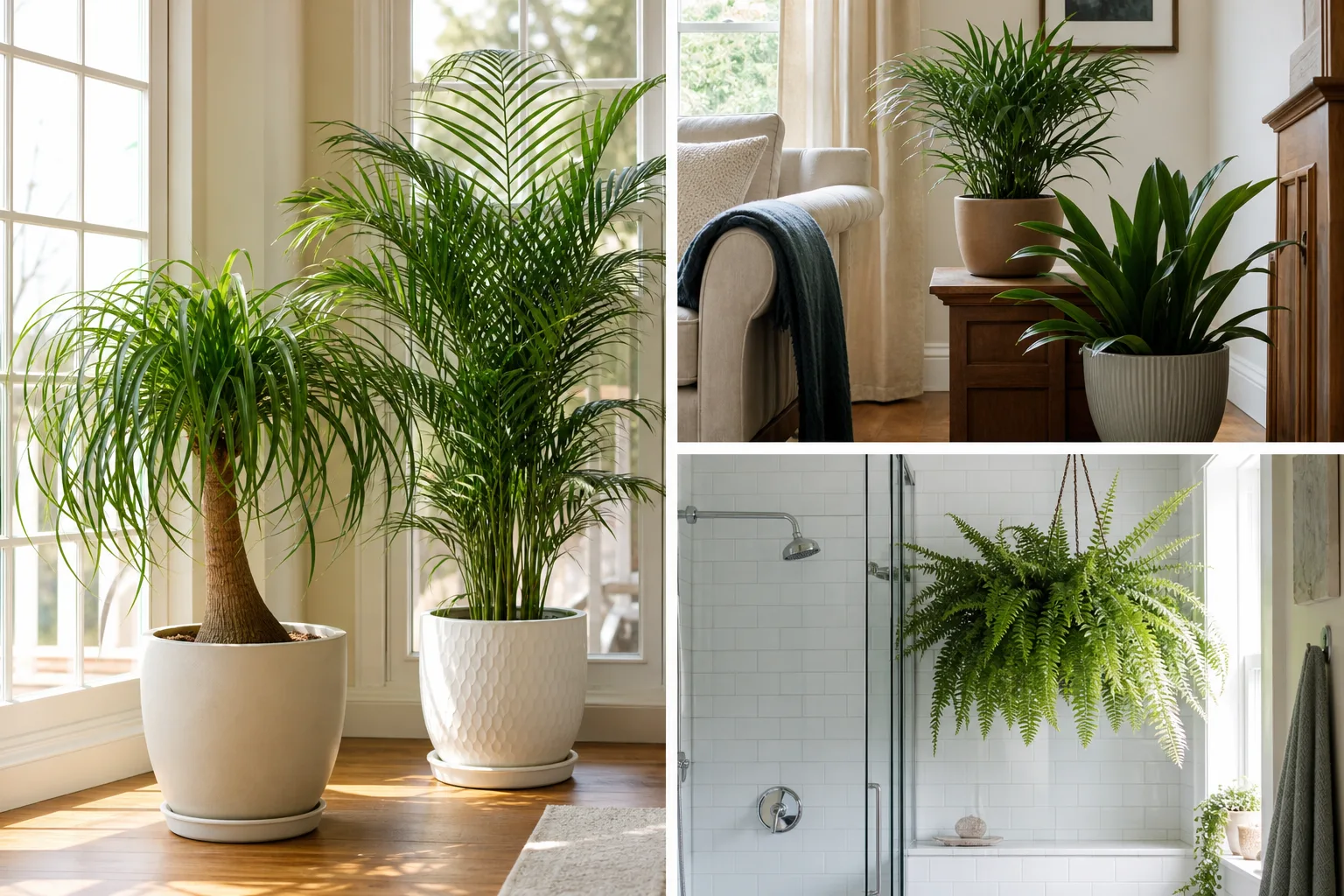
For bright, sunny rooms where your cat spends a lot of time, choose ponytail palm, areca palm, or hoya. All three need more light than the others on this list and have structures that cats find less interesting to chew. Place them on plant stands or in heavy pots that will not tip if a cat rubs against them.
For medium-light living rooms and offices where your cat has full access, choose parlor palm, cast iron plant, money tree, or pilea. These four tolerate the widest range of conditions and have leaves that are physically unappealing to most cats. They can sit on the floor or on low furniture without becoming constant targets.
For bathrooms, kitchens, and humid rooms with decent light, choose Boston fern, calathea, or prayer plant. These need more ambient moisture than the rest of the house provides, but a bathroom with a shower delivers it passively. Cats tend to spend less time in bathrooms and kitchens unsupervised, which reduces casual chewing opportunities.
For shelves, desks, and surfaces above cat level, choose African violet, baby rubber plant, peperomia, or Christmas cactus. All four stay compact and can live happily on a high windowsill or shelf where they are completely inaccessible. Trailing plants like string of hearts and peperomia hope also work from elevated hanging baskets.
For hanging baskets and trailing displays, choose hoya, string of hearts, peperomia hope, or fishbone cactus. These plants grow downward from a basket and naturally stay out of reach if the basket is hung high enough. Ensure no furniture gives your cat a launching point to reach the basket.
6 Popular Plants to Keep Away From Cats
These are widely sold houseplants that are toxic to cats. If you own them, move them to a room your cat cannot access, hang them completely out of reach, or replace them with a non-toxic alternative from the list above.
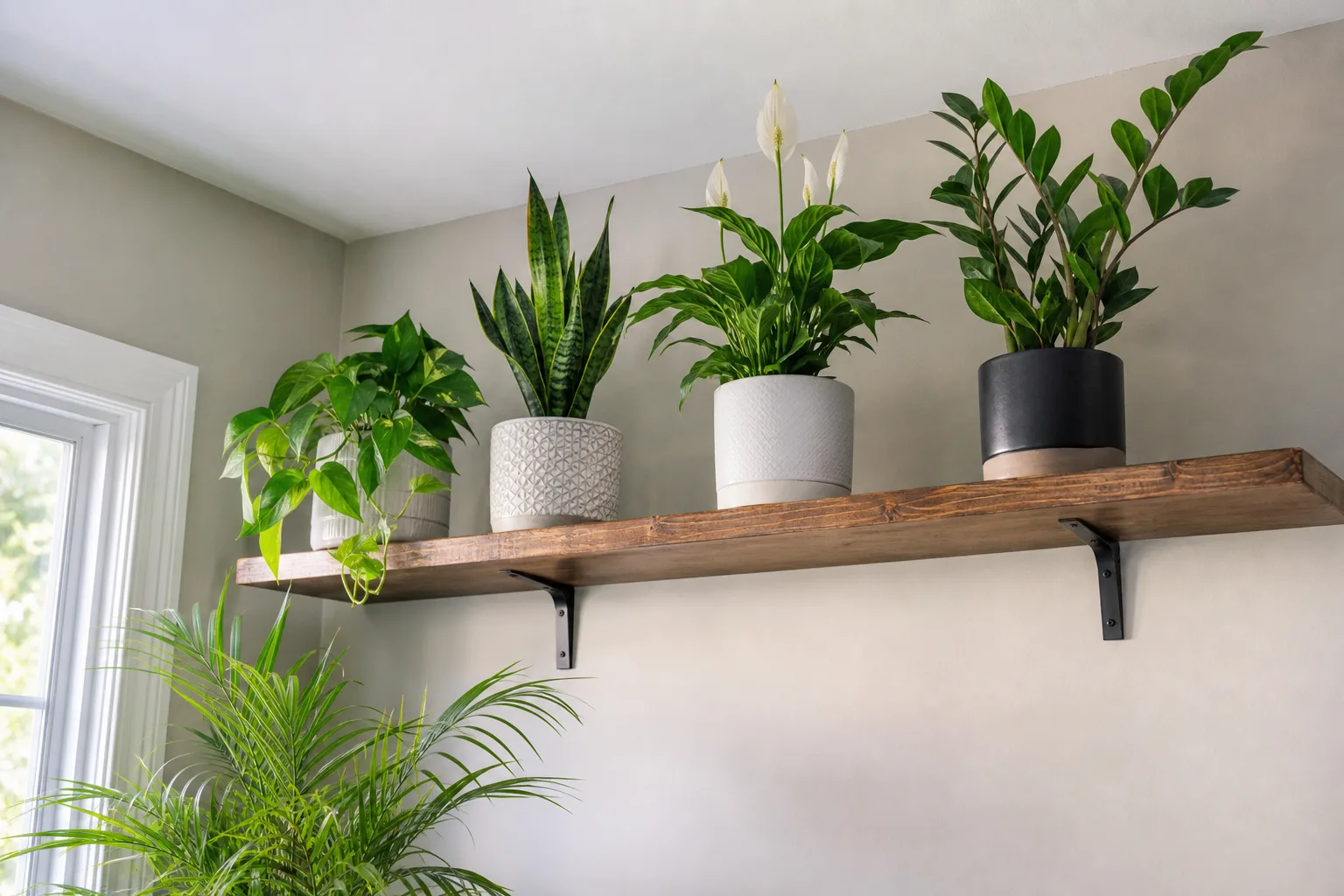
True lilies (Lilium and Hemerocallis species). All parts, including pollen and vase water, can cause acute kidney failure in cats within 24 to 72 hours of ingestion. Even a tiny amount of pollen licked off fur is a medical emergency. Do not bring cut lilies into a cat household at all—the risk is too high for a decorative flower.
Sago palm (Cycas revoluta). One of the most dangerous ornamental plants for cats. All parts are toxic, with seeds containing the highest toxin concentration. Causes vomiting, diarrhea, seizures, and potentially fatal liver failure. Veterinary treatment must start immediately after ingestion.
Pothos and philodendron. These contain insoluble calcium oxalate crystals that cause severe oral burning, drooling, difficulty swallowing, and vomiting. They are everywhere—grocery stores, big-box nurseries, and almost every “easy plant” list—so check the label or ASPCA database before buying anything with heart-shaped or vining leaves.
Snake plant and ZZ plant. Both contain saponins that cause nausea, vomiting, and diarrhea. They show up on every beginner-plant list and in every office and Airbnb. If your cat is a known plant-chewer, swap them for cast iron plant, which tolerates the same low-light and neglect conditions without the toxicity.
Aloe vera. The gel is soothing for human skin, but the plant contains saponins and anthraquinones that are toxic to cats, causing vomiting, lethargy, and diarrhea. Replace with haworthia—a small, spiky succulent that looks similar and is non-toxic.
Dracaena (including corn plant, dragon tree, and lucky bamboo). Moderately toxic, causing vomiting, drooling, dilated pupils, and abdominal discomfort in cats. Replace with parlor palm, which has a similar upright silhouette without the toxicity risk.
How to Make Plants Safer at Home
Having cat-safe plants is the first step. How you place and maintain them determines whether they stay safe in practice.
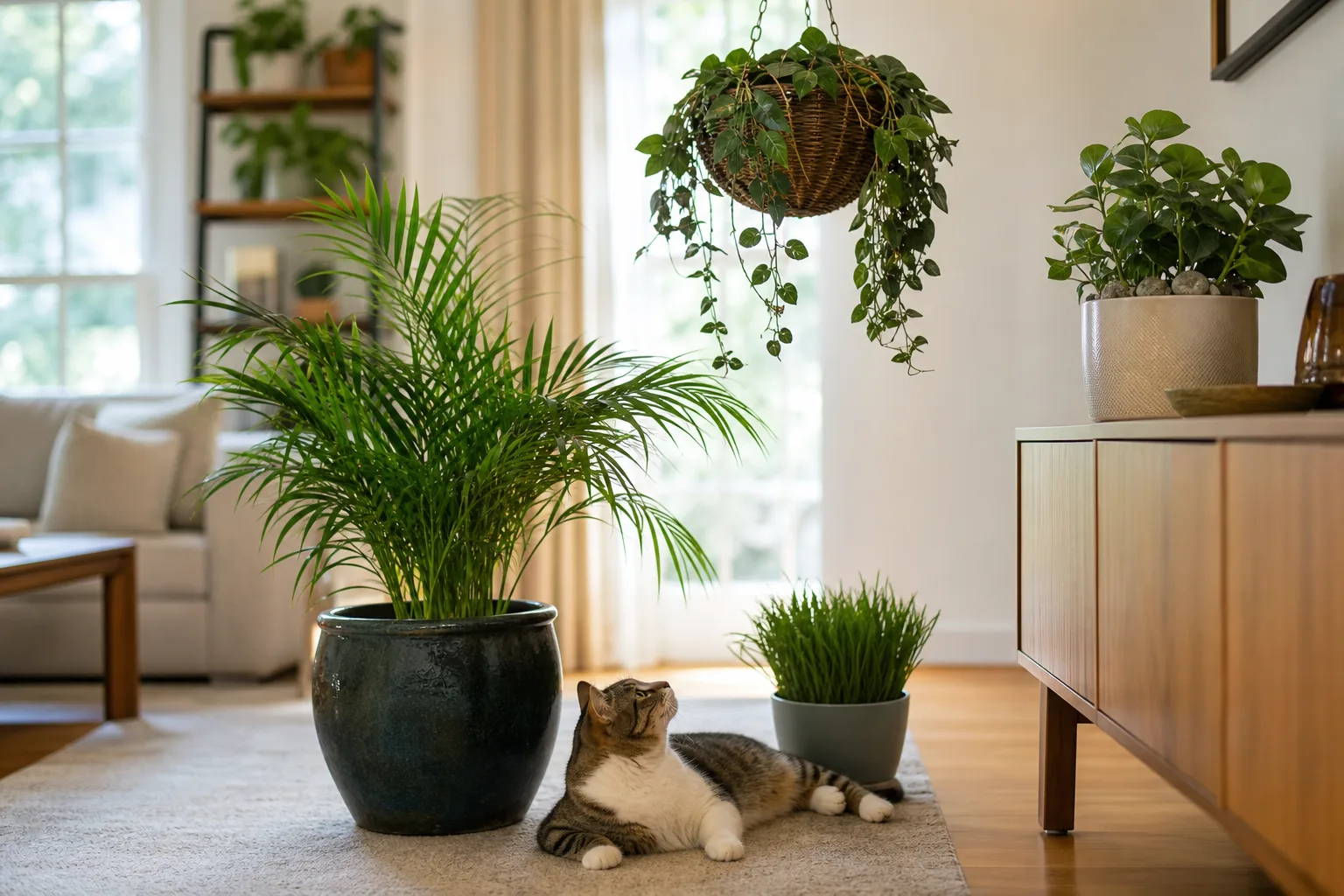
Use hanging baskets and high shelves. Trailing plants like hoya, string of hearts, and peperomia hope thrive in hanging planters well above cat height. Secure hooks into ceiling joists or wall studs rather than drywall, and use lightweight plastic or fiberglass pots to reduce the damage if the basket does fall.
Choose heavy, stable pots for floor plants. A running cat can knock over a lightweight nursery pot. Use ceramic or terracotta pots with a wide base for floor plants like parlor palm, areca palm, and cast iron plant. Add a layer of stones at the bottom for extra weight if the pot is still tippable.
Cover the soil surface. Some cats dig in potting soil as an alternative to a litter box. Prevent this by covering the soil with a layer of decorative river stones, pine cones, or plastic mesh cut to fit the pot opening. Avoid cocoa shell mulch—it smells like chocolate and is toxic if eaten.
Grow cat grass as a decoy. A small pot of wheatgrass or oat grass gives your cat something safe and intended to chew. Place it near the cat’s food and water, away from your houseplants. Refresh the grass every couple of weeks as it gets chewed down or turns yellow.
Wipe leaves and sweep fallen debris. Dusty leaves attract curious cats. Fallen leaves, dried fronds, and shed calathea leaflets look like toys on the floor. Regular cleanup removes both the temptation and the minor GI irritation risk of eating non-toxic but fibrous plant material.
Keep plant labels and know what you own. Save the nursery tag or take a photo of the plant with its name visible. If your cat does ingest something and shows symptoms, being able to tell your veterinarian or poison control exactly what the plant is—common name and scientific name—saves critical time.
Have emergency numbers saved. ASPCA Animal Poison Control: (888) 426-4435. Pet Poison Helpline: (855) 764-7661. Your regular veterinarian’s emergency number. Put all three in your phone contacts now, not when you are panicking and searching.
Conclusion
A cat and a houseplant collection can absolutely coexist. The key is knowing which plants are actually dangerous rather than trusting folklore or Pinterest lists, and placing plants thoughtfully rather than expecting your cat to ignore interesting greenery at nose level.
Best overall cat-safe plant: Parlor palm. Non-toxic, tolerates low to medium light, compact enough for any room, and the fine-textured fronds do not trigger chewing behavior the way grass-like leaves do. It has survived in homes for over a century because it simply works.
Easiest cat-safe plant: Cast iron plant. If you have killed plants before, start here. It handles low light, irregular watering, and general neglect without complaint. The leathery leaves hold zero appeal for cats.
Best decorative cat-safe plant: Calathea (any variety). The entire genus is non-toxic and delivers the most striking foliage patterns in the houseplant world. Rattlesnake calathea and freddie are the most forgiving starting points.
Best flowering cat-safe plant: African violet or Christmas cactus. Both bloom reliably indoors and are verified non-toxic. African violet flowers year-round in good light. Christmas cactus delivers a reliable annual show with minimal effort.
Best cat-safe plant for hanging baskets: Hoya or string of hearts. Both trail beautifully, are completely non-toxic, and naturally stay out of cat reach when hung correctly.
If your cat persistently chews any plant—even non-toxic ones—talk to your veterinarian. Persistent pica can indicate a dietary deficiency, dental pain, or anxiety that needs addressing rather than just plant-proofing around. In the meantime, the 15 plants on this list give you a starting garden that is beautiful, varied, and safe.