14 Scandinavian Christmas Tree Decorating Ideas
Explore 14 Scandinavian Christmas tree ideas with paper, straw, warm LED lights, natural garlands, small-space options, and practical safety tips.

A Scandinavian-inspired Christmas tree is less about buying a matching set than making a few deliberate choices: let the evergreen show, use materials with visible texture, and keep the light warm. Paper, straw, wood, wool, and dried citrus can make a tree feel personal without covering every branch. A restrained palette can be quiet, but it does not have to be colorless or formal.
There is no single decorating rule shared by every home in Sweden, Norway, Denmark, or Finland. Treat the ideas below as a flexible design language, not a test of cultural authenticity. Choose one or two details that feel right in your room, then adapt them for your tree, household, and traditions.
14 Scandinavian Christmas tree ideas
1. Let an airy evergreen silhouette do some of the decorating
Start with the shape of the tree rather than the ornaments. A naturally open Fraser fir or another locally available evergreen with visible branch layers gives handmade decorations room to read; a dense artificial tree can work too if you pull apart and shape its branches before adding anything. Step back from the tree while you fluff it. You want an even outline, not a solid green wall.
Open space is part of the finished look. Instead of placing an ornament on every outer tip, hang a few pieces slightly inward and leave some branch ends clear. This makes each ornament easier to see and keeps the silhouette from becoming cluttered. If your tree is lopsided, turn its best face toward the room and use a bare side toward a wall rather than trying to hide every irregularity with more decor.
2. Add the candlelit look with warm LED lights
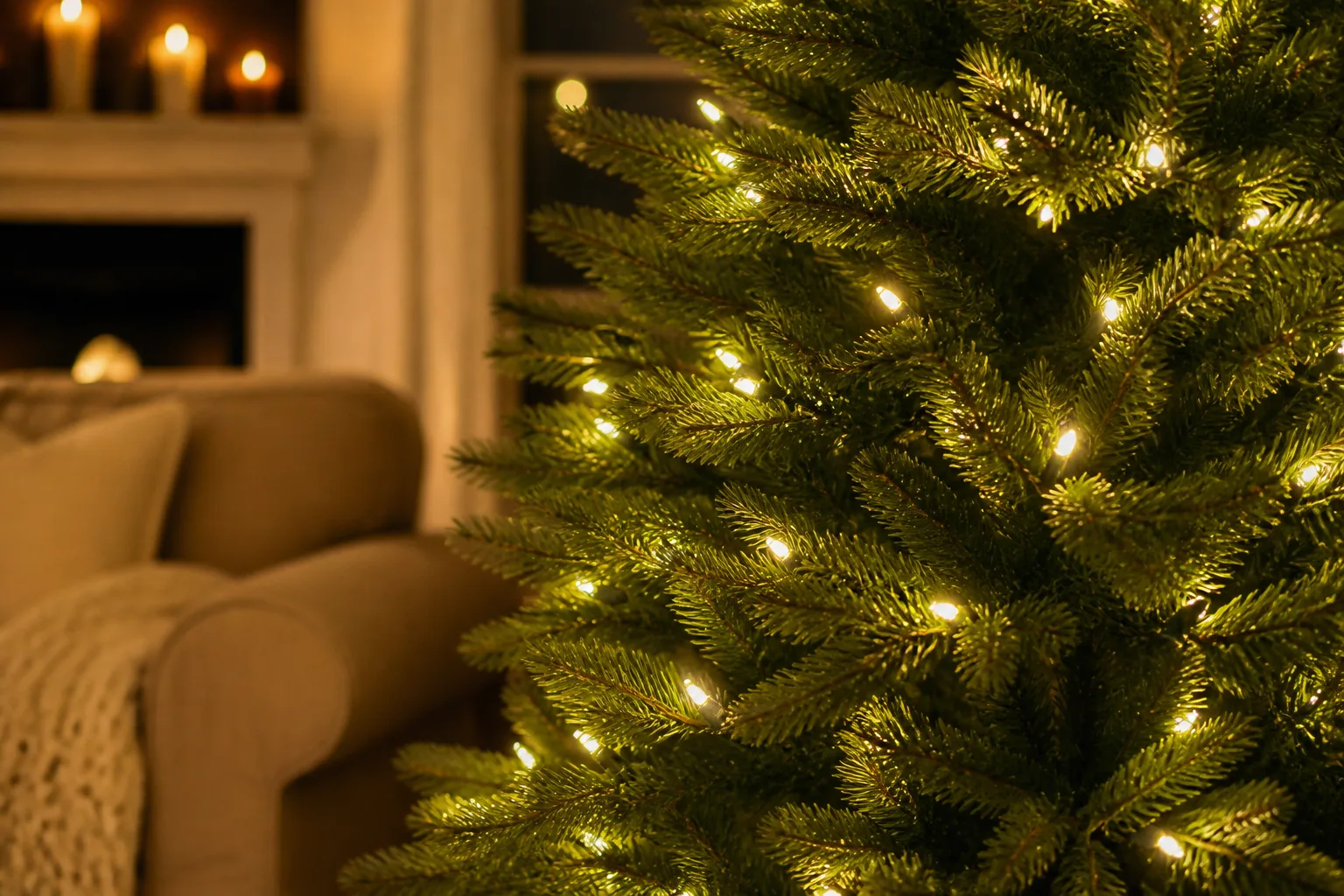
Slim candle-shaped lights bring a gentle vertical rhythm to evergreen branches. Choose warm-white battery-operated LED clips or a listed light set designed for indoor trees, and distribute them from the inner branches outward so light is visible at more than one depth. If you use clip-on candles, attach each clip securely to a sturdy branch and follow the manufacturer’s instructions for batteries, indoor use, and spacing.
The candle shape is an aesthetic reference, not a reason to use an open flame. A real candle clipped to dry foliage can ignite nearby branches, ornaments, or furnishings; keep flames away from a Christmas tree. LED versions give you the upright glow without the flame, hot wax, or need to supervise a burning candle. Switch the lights off when you leave or go to sleep, and replace a string with damaged insulation or loose connections instead of trying to disguise the fault. The U.S. Fire Administration’s holiday fire-safety guidance also recommends keeping trees away from heat and turning lights off when you leave or go to bed.
3. Hang folded paper stars and hearts
Paper ornaments add a handmade quality while keeping the branches visually light. Try a few folded stars, woven paper hearts, small rosettes, or simple cut-paper shapes in white, kraft, or pale colors. Hang them with thin thread or narrow ribbon so the fastener does not compete with the shape. Larger pieces suit a taller tree; on a small tabletop tree, reduce both ornament size and quantity so the branches do not sag.
Make or buy paper pieces in a short session and test one before filling the tree. If the paper curls or looks too flat, use a heavier stock, fold the shape into shallow dimension, or hang it where a branch supports it from behind. Paper is light and easy to store, but it can crease or absorb moisture. Keep it away from water spills and do not put it near a candle flame, hot bulb, fireplace, or other heat source.
4. Bring in straw stars and woven ornaments
Straw stars, small woven figures, and other plant-fiber ornaments add texture without a reflective finish. Their pale gold color sits comfortably beside green needles and wood, while their handmade irregularity helps a carefully styled tree feel lived in. Space them through the branches instead of grouping all of them at eye level; vary their height and allow a few to sit against darker foliage for contrast. The Scandinavian-inspired paper, weaving, and natural-material projects in Pillar Box Blue’s decoration roundup are useful starting points if you want to make a few pieces yourself.
Natural fibers are not indestructible. Avoid hanging a brittle ornament where a door, child, or pet can knock it down, and store pieces in a dry box with tissue or paper dividers so the points do not snag. If an ornament has loose strands, a sharp wire, or a fragile loop, retire it from the tree or secure it only where it cannot fall into a busy path. A small number of sturdy pieces usually looks more intentional than a fragile collection packed tightly together.
5. Make a light garland from dried citrus and wood beads
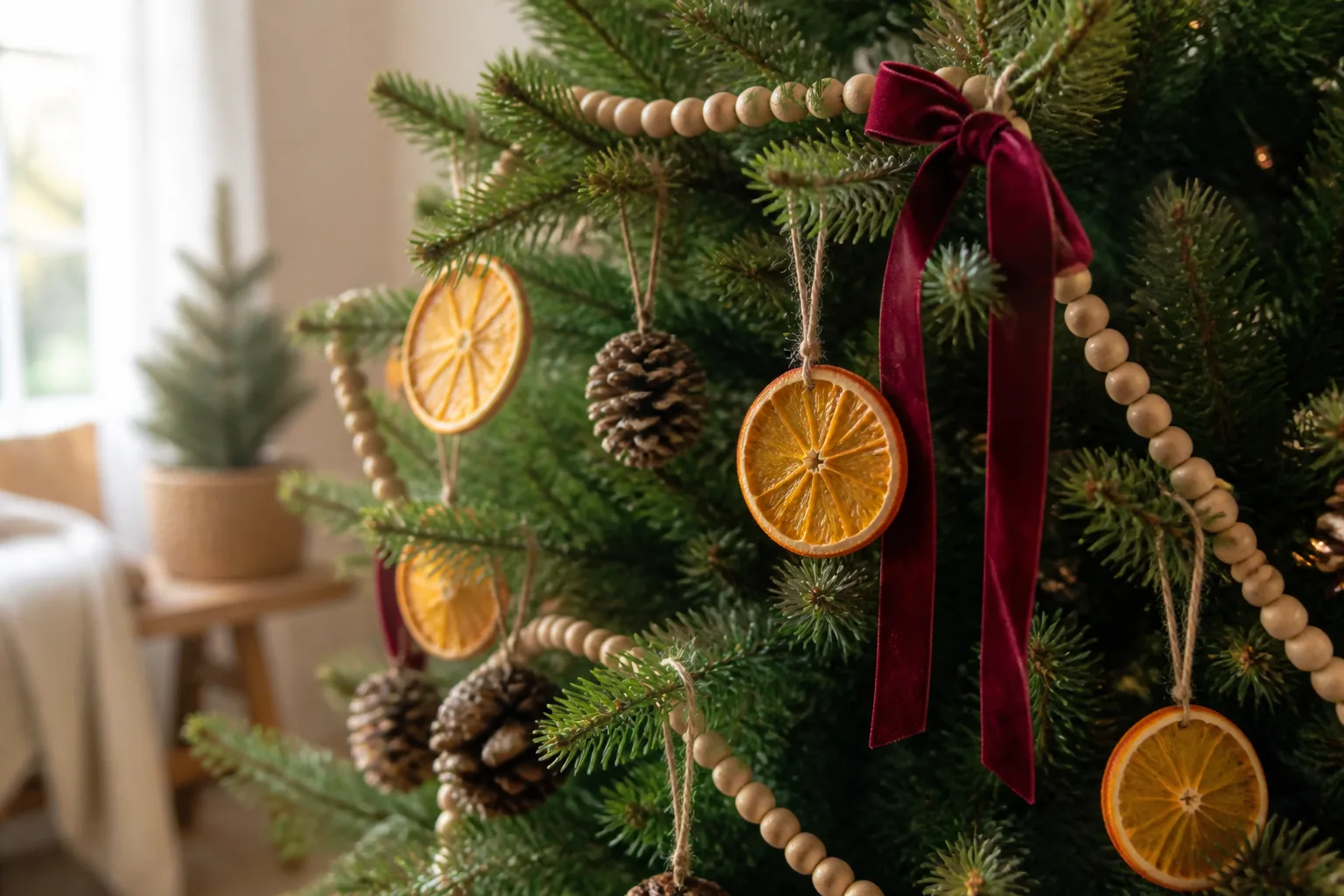
Dried orange slices and plain wood beads make a simple strand with color, translucence, and texture. Slice citrus evenly, dry it until the pieces are no longer tacky, and let them cool fully before stringing; pieces that retain moisture can soften or develop an off smell in storage. Alternate orange with beads or small pinecones rather than adding several materials at once. A few well-spaced strands are easier to hang and less likely to pull down delicate branch tips.
Keep the garland light and short enough that it rests on branches instead of dragging across the tree. Dried fruit can become brittle, so handle it gently when decorating and take it down before it crumbles. Do not treat the fruit as edible once it has hung on the tree, and keep small pieces out of reach if a child or pet might mouth them. When the season ends, compost only clean, untreated natural pieces where local rules allow; otherwise discard them and reuse the beads.
6. Build a quiet palette around cream, wood, and evergreen
Choose a small palette before you start, such as evergreen, cream, and pale wood. The green already comes from the tree, so the other two tones can come from paper, woven ornaments, linen ribbon, wood beads, or a simple tree-base cover. This is a useful way to make mismatched ornaments feel related: put the pieces that fit the palette on the most visible branches and keep the rest for another room or another year.
Restraint does not mean every object must match. Vary finish and shape within the palette: matte beside a little shine, round beside angular, smooth wood beside folded paper. If the tree looks too plain, add one darker or reflective detail near the middle to give the eye a stopping point. If it feels busy, remove a few pieces first rather than buying a new set. You can make a large visual change by editing what is already there.
7. Add one thoughtful red accent
Red can warm a pale, natural scheme without turning the tree into a fully red-and-green display. Try a narrow ribbon, a handful of small red ornaments, or one handmade heart repeated at a few points. Repetition makes the color feel intentional; a single isolated red object can look accidental, while dozens of red pieces may take over the gentle palette you started with.
The accent need not be a literal ribbon. Red berries on a small ornament, a family keepsake, or a fabric tie can do the same job. Use a scale that fits the tree: broad ribbon can overwhelm a small evergreen, while tiny dots of color may disappear on a tall one. If your household’s holiday tradition uses more color, keep it. Scandinavian-inspired styling is adaptable; it should support the room and the people in it, not erase a meaningful family decoration.
8. Mix handmade ornaments with a few heirlooms
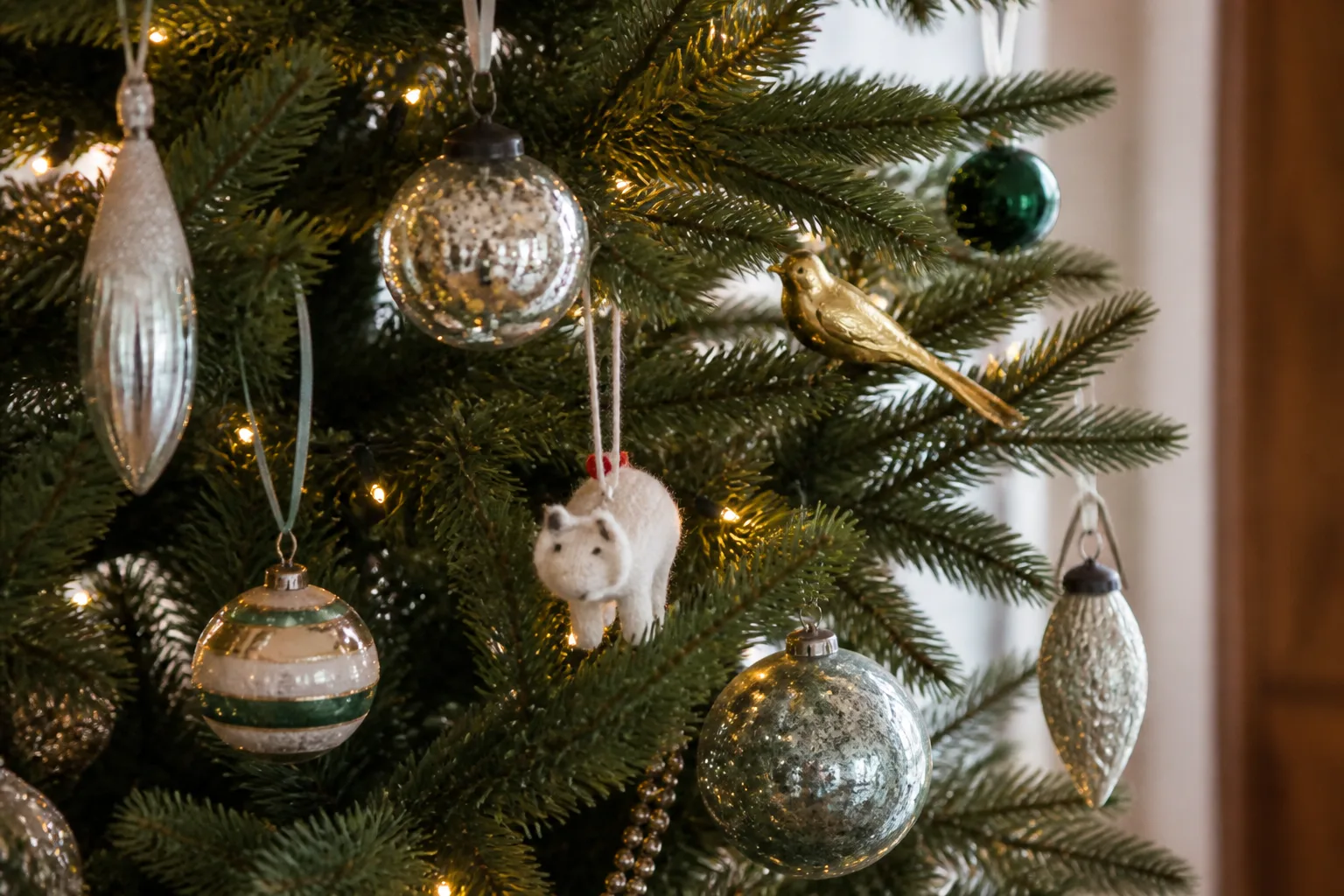
An all-new matching set can look polished, but a tree often feels more welcoming when it carries a little history. Pair a few inherited or collected ornaments with handmade paper and natural textures, then give the meaningful pieces space instead of hiding them in a dense cluster. A useful editing rule is to choose the ornaments you most want to see first, place those at eye level, and let the simpler shapes fill gaps around them. That mix of old, new, and handmade details also appears in HGTV’s Scandinavian holiday styling feature, which draws on a Danish stylist’s approach.
This approach also keeps the budget under control. Make a small batch of ornaments from materials you already have, repair a loose thread or hook, and buy only the missing size or color that would solve a real visual problem. Check older pieces for cracked glass, flaking paint, or brittle hooks before hanging them. Put breakable ornaments higher on the tree if children or pets share the room, and do not place a treasured keepsake over a hard surface where it could shatter if it falls.
9. Use a woven basket as a tree-base cover
A woven basket can soften the transition between the trunk and the floor and add the tactile material that often makes a spare tree feel warm. Choose one wide enough to hide the stand without squeezing it, tipping the tree, or blocking access to the stand’s water reservoir. The basket is a cover, not a substitute for a stable stand. For a cut tree, assemble and fill the stand first, confirm the trunk is upright, and only then fit the basket around it.
Water access matters more than a seamless base. If you cannot easily see or refill the reservoir, use a shallow removable cover, a stand with an accessible fill tube, or a different base treatment. Keep woven material away from standing water so it does not become damp or stain the floor. A basket that is too small can press branches outward or conceal an unstable tree; in that case, use a collar, a fabric wrap designed for the stand, or leave the stand visible.
10. Leave the stand visible or use a simple collar
You do not have to conceal the stand at all. A clean, sturdy stand can feel deliberately utilitarian, especially when the tree itself is lightly decorated. If you want a finished edge, a simple wood, metal, or woven collar can cover the stand’s legs without spreading loose fabric across a walkway. Choose a collar that fits the stand dimensions and can be removed quickly for watering or inspection.
Think through the base before the tree is dressed. A tree skirt can catch fallen needles and create a soft landing for gifts, while a collar uses less floor space and can keep paws or toys out of the stand. Neither solves stability or water access by itself. Make sure the tree cannot be pulled over by a child or pet, keep electrical cords out of walking routes, and avoid placing presents against a hot light adapter or other electrical equipment.
11. Give a miniature tree a proper place to shine
A tabletop or petite tree can deliver the same simple holiday atmosphere as a full-size evergreen. Put it where its shape has room around it: on a stable side table, a shelf with enough depth, or a sturdy stool away from a door and a heating vent. A small tree looks intentional when the vessel and the surface are scaled to it. A light jute basket or plain ceramic pot cover can work, but the tree still needs a secure stand or pot that supports its weight.
Scale the decorations down too. Use a short light string, small paper ornaments, a few wood beads, and one restrained topper rather than miniaturizing every full-size decoration you own. A sparse tree can look elegant, but a tabletop tree that carries several heavy ornaments may bend or topple. If it sits in a high-traffic area, choose shatter-resistant pieces and secure the vessel so a passing sleeve or wagging tail cannot knock it off the table.
12. Choose a tall, narrow tree for a compact room
If the room has ceiling height but little floor width, look for a slender evergreen or a narrow artificial profile. Measure the space before buying, including the stand and topper; also allow room for a star to clear the ceiling and for people to pass the tree without brushing branches. A tall tree can fill a vertical corner without taking over the center of a small living room, but only if its base stays out of the main route through the room.
Open branching is useful here. It lets light travel through the tree and makes a narrow outline feel less like a green column. Keep the ornament plan simple—perhaps paper, wood, and a single accent color—so decoration does not widen the visual footprint. If a slim tree still crowds the room, a half tree against a wall or a cluster of evergreen branches in a sturdy floor vase can give you seasonal greenery while preserving more usable space.
13. Place the tree where winter daylight can reach it
Set the tree where it can be seen from the room’s natural gathering point and, if the layout allows, where daylight outlines its branches. A window can give a simple tree a lovely daytime silhouette and make a small room feel brighter. Before choosing that location, open and close the curtains, check the path to the window, and make sure the tree does not block a door, a radiator, a return vent, or the route people use after dark.
Window placement has a practical trade-off: direct sun and nearby heat can dry a cut tree faster, while a tree pushed too close to the glass may be difficult to water or may interfere with blinds. Keep enough space to reach the stand and avoid heat sources. If the best spot is darker, warm LED lights can create the same evening focus; the tree does not need to sit in the brightest window to feel composed. The National Christmas Tree Association’s care tips advise keeping a live tree away from heat sources, including direct sunlight; Homes & Gardens’ placement guide discusses the same layout trade-offs.
14. Echo the tree with a small branch arrangement
Extend the tree’s materials around the room rather than adding more ornaments to it. A few evergreen sprigs in a sturdy vase, a short strand of wood beads on a shelf, or one paper star in the window can make the tree feel connected to the rest of the space. Repeat one or two colors and textures, not every ornament shape. The result is a holiday room with a clear focal point instead of a tree surrounded by competing decorations.
Use only branches and vessels that are stable and safe for the location. Secure cut greenery in a heavy vase, keep it away from candles and hot surfaces, and remove it when it dries or drops heavily. If you are gathering branches outdoors, take only from your own property or with permission and follow local rules. Artificial sprigs or saved clippings can provide the same visual echo without bringing fresh material indoors.
Choose a tree and layout that fit your home
The tree that suits this style is the one whose proportions work in your room. A naturally open tree makes ornament spacing easier, while a full artificial tree can be shaped to leave visible gaps. Compare the tree’s width at its broadest point with the clear floor area, then check the height with the stand and topper included. A little extra clearance above the tip and beside the branches makes setup easier and prevents the finished tree from feeling wedged into the corner.
If you buy a live cut tree, inspect it before taking it home. Look for flexible, firmly attached needles and a trunk that can fit the stand you own. Species, freshness, and indoor conditions affect needle retention, so ask the seller what they carry and how the tree was stored rather than relying on a universal “best tree” label. A locally available fir with good branch structure may be a better choice than a species chosen only for its name.
Plan the base, lights, and ornaments as one setup. Confirm that the stand supports the tree’s height, that you can reach its reservoir, that lights are rated for their intended use, and that cords can run without crossing a walkway. Then decorate in layers: lights first, the largest ornaments next, and small handmade details last. Step back after each layer. That pause helps you see where the tree needs one more point of light—and where it needs nothing at all.
Keep the tree stable, fresh, and safely lit
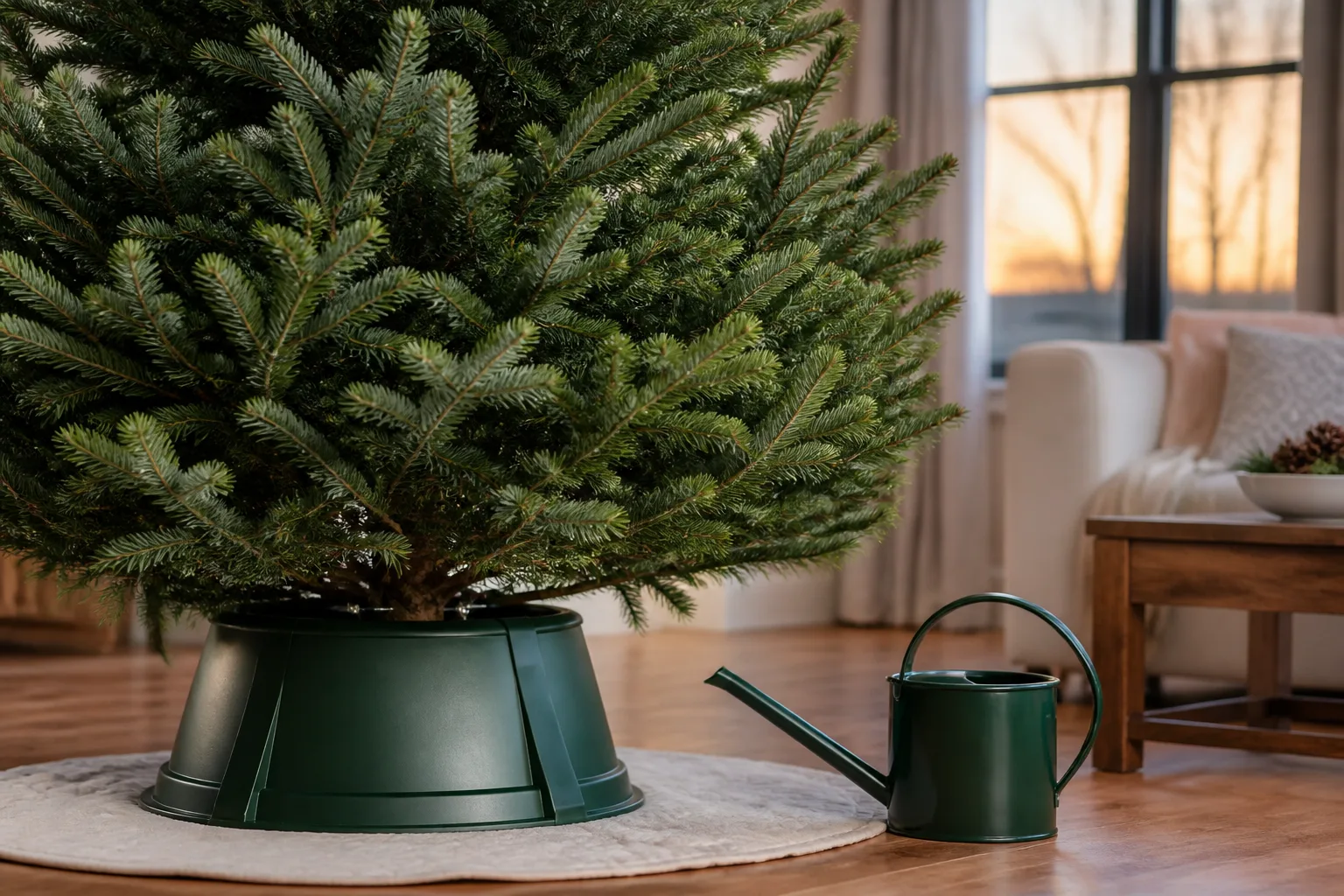
The most important styling decision is a safe location. Keep a live tree away from fireplaces, radiators, candles, and other heat sources; do not let it narrow an exit or sit where a door can strike it. Secure the stand on a level surface and anchor the tree if the room includes toddlers, climbers, or pets. Use lights in good condition, follow their labels, and switch them off when no one is home or everyone is asleep. Do not put real candles on or close to tree branches. These precautions align with the U.S. Fire Administration’s Christmas tree safety guidance.
A cut tree also needs a stand that holds water and regular checks. Keep the trunk base supplied with plain water according to the stand maker’s instructions, and check the level daily because uptake can change. Do not let the cut surface sit dry; if it does, ask the tree seller or a local fire service how to handle it rather than assuming a small top-up restores its original condition. Additives are not a substitute for water access or a fresh tree, and a basket should never make the reservoir hard to reach. Both the U.S. Fire Administration and the National Christmas Tree Association advise regular water checks for cut trees.
Keep fragile glass and small loose ornaments where children and pets cannot easily reach them. Avoid tinsel or edible-looking decorations if a pet tends to chew tree items, and tidy fallen needles before they are tracked through the home. As the tree dries, increases in needle drop are a prompt to reassess whether it should stay indoors, especially if you notice brittle branches or a reservoir that no longer seems to take up water. A beautiful tree should not demand that you ignore changing conditions.
Conclusion
A Scandinavian Christmas tree can be airy and handmade, but it does not need a strict uniform or a cart full of new decorations. Begin with a tree shape that fits, choose a short palette, add warm LED light, and let paper, straw, wood, or dried citrus provide texture. A basket, collar, visible stand, miniature tree, or window placement can adapt the look to the room you actually have.
The best version is the one that feels personal and still works day to day. Keep the stand stable and reachable, keep real flames away, and edit the ornaments until the branches have breathing room. If one heirloom, bright ribbon, or family-made decoration brings more joy than a perfectly restrained palette, give it a place on the tree.


