5 Signs You Have Carpenter Ants in Your House
Carpenter ant signs can hide in walls. Use this practical guide to identify frass, swarmers, rustling, and damp wood before damage spreads.
Finding one large ant indoors is not proof that a colony is living in your walls. Finding a repeatable trail at night, coarse frass under a sill, or winged ants emerging from a room is a different matter: those clues justify a closer inspection for a parent or satellite nest.
Carpenter ants excavate wood to make smooth nesting galleries; they do not eat the wood as termites do. That distinction matters because the most useful response is not to kill every ant you can see. It is to identify the route, find the moisture or wood condition that supports the nest, and determine whether the colony is indoors, outdoors, or connected to both.
What carpenter ants are—and what they are not
“Carpenter ant” describes several species in the genus Camponotus, so their color and size vary by region. Workers are often black or black-and-red and commonly measure about 1/4 to 1/2 inch, but size alone is a poor identification test. The Illinois Department of Public Health’s carpenter-ant guidance recommends looking at the smoothly rounded thorax and the single waist node, along with bent antennae, rather than relying only on color.
These ants need food and water, but wood is primarily their construction material. They feed on insects, honeydew, plant juices, and household foods such as sweets and grease, then chew galleries in suitable wood or insulation. A nest may begin in damp, softened timber and later extend into drier structural wood, so “the wood looks dry now” does not rule out a carpenter-ant problem.
Carpenter ants vs. termites at a glance
Large dark insects with wings are easy to misidentify in a hurry. Use the table as a screening aid, not as a substitute for a professional identification when the evidence is unclear.
| Feature | Carpenter ant | Termite |
|---|---|---|
| Waist | Narrow waist with one visible node | No pinched waist |
| Antennae | Bent or elbowed | Straight |
| Wings | Front pair longer than back pair | Four wings are about the same length |
| Body | Dark, brown, or red-and-black depending on species | Usually pale or light-colored |
| Wood evidence | Smooth galleries and coarse frass | May include mud-lined shelter tubes or packed soil-like material |
The Missouri Botanical Garden’s carpenter-ant reference also cautions that workers can range widely in size and color. If you can do so without touching the insect, take a sharp photo from above and from the side; a pest professional can use those views to narrow the identification.
Sign 1: Large ants follow a repeatable trail, especially after dark
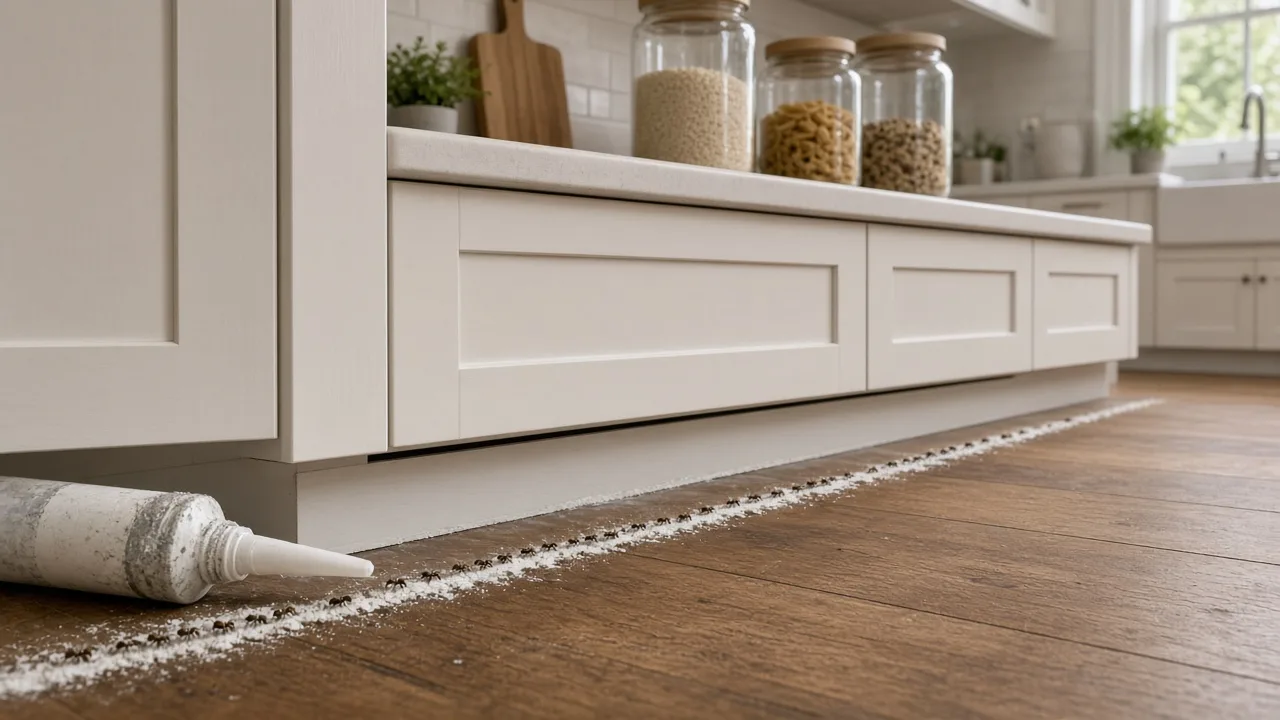
Carpenter ants are most active from dusk through the night, when workers leave the nest to look for food and water. A single ant wandering across a counter could be a forager from an outdoor nest. Repeated activity along the same baseboard, pipe chase, window edge, or door threshold is more informative because ants maintain scent trails between food sources and their nest.
Do not let the word “trail” make you expect a solid line of insects. The route may be a few feet apart, hidden under siding, or visible only for several minutes. Indoor trails often follow electrical lines, plumbing, trim joints, and other protected edges before disappearing into a wall void. The Northeastern IPM Center’s inspection guidance specifically recommends mapping possible entrances and nest sites instead of treating every visible ant as a separate problem.
How to check an ant trail without losing the clue
Watch the route for a few minutes after the room is quiet. Use a flashlight at a low angle so you can see movement along the edge of trim, then note where ants vanish rather than immediately sealing the opening or saturating it with spray.
If the ants are in a safe, accessible area, photograph one beside a familiar object for scale. Avoid crushing the workers you are trying to track: a dead worker cannot reveal the route back to the nest, and indiscriminate contact spray can scatter activity into less visible spaces. If the route disappears behind a wall, ceiling, or electrical fitting, stop at observation and call for help rather than opening the void yourself.
Sign 2: Coarse frass collects beneath a wooden surface
Carpenter-ant frass is the debris workers remove as they excavate. It often looks like coarse sawdust or wood shavings, but a fresh pile may also contain bits of insulation, insect parts, pupal cases, or other colony debris. Look directly below a crack, joint, sill, baseboard, doorframe, porch support, or other wooden surface where material could fall from a gallery.
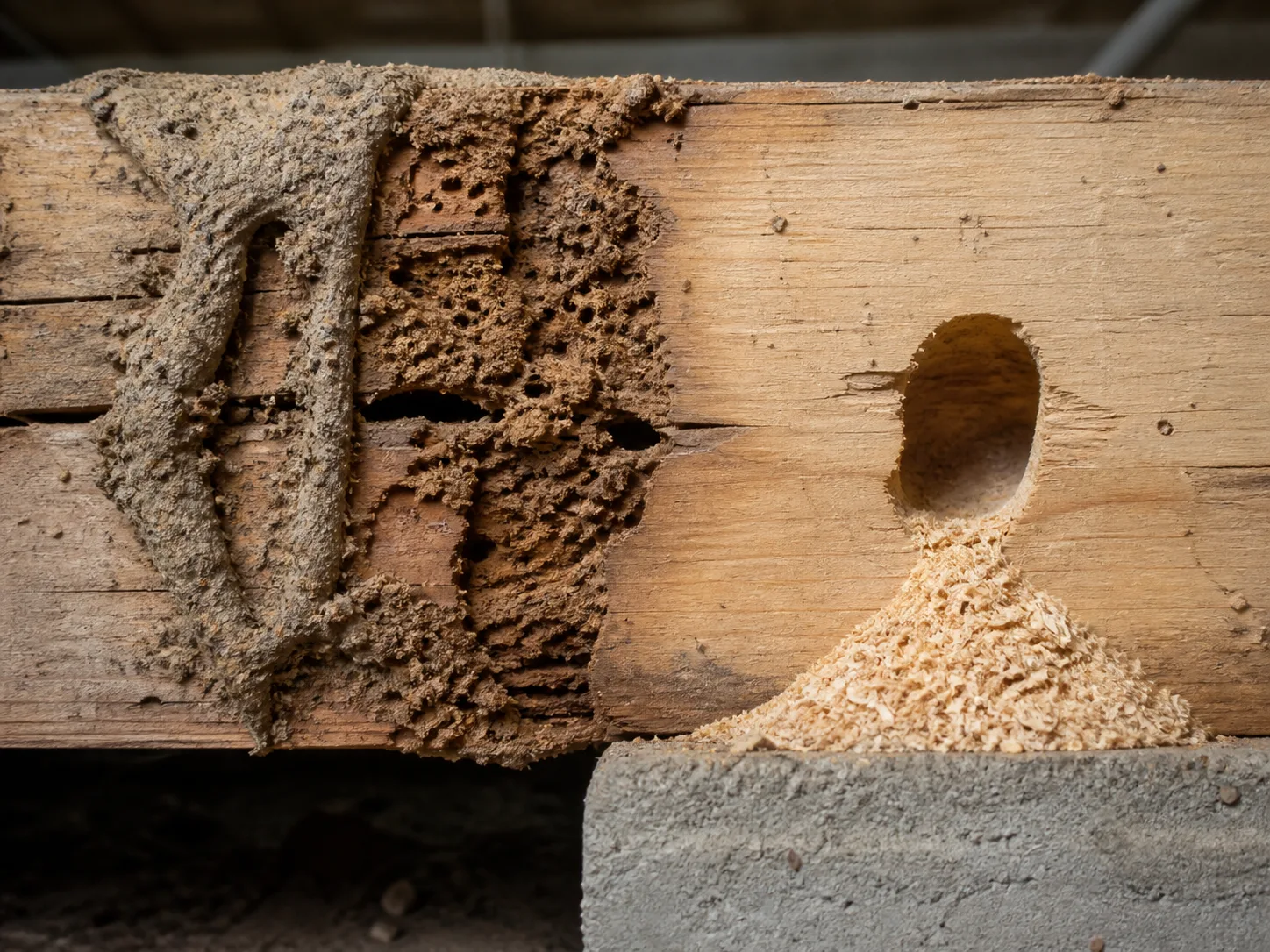
The pile is a stronger clue when it is paired with live ants or a small opening. A clean pile beside a quiet, old piece of furniture may be leftover debris from a past issue, ordinary drilling, or another wood-boring insect. Place a sheet of plain paper below the suspected area, clean the surface around it, and check again later; new debris gives you useful evidence without requiring you to dismantle the wall.
Frass does not tell you where the queen is. A satellite nest can be several feet away, and the parent colony may be outdoors in a stump, log, tree, or woodpile. The Pacific Northwest Pest Management Handbooks’ structural-pest guidance notes that sawdust piles show where excavation is happening, not necessarily the location of the main colony.
Sign 3: Winged ants emerge inside the house
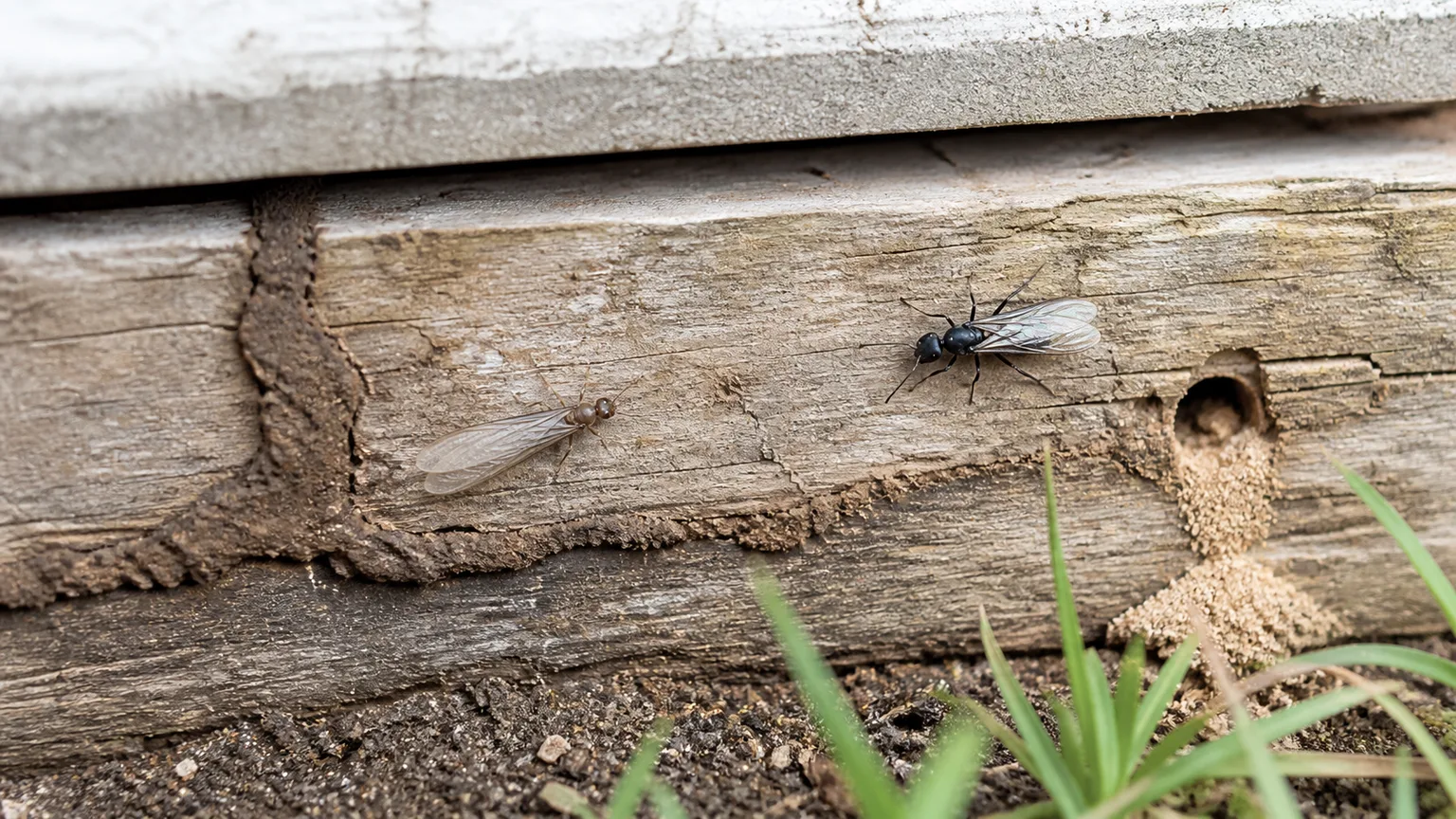
Winged carpenter ants are reproductive males and females released during a mating flight. They are usually seen in spring or during the local swarming season, although the exact timing varies by species and region. A few winged ants outside near a tree are not automatically a house infestation; winged ants appearing from a window frame, wall, attic, or ceiling fixture are much more concerning because the emergence point is indoors.
Do not assume every indoor winged ant is a termite. Check the waist, antennae, and wing lengths in the comparison above, then save a clear photo or an intact specimen if you can do so safely. Swarmers can be the first obvious sign of a mature nest, but they are also a reason to inspect rather than panic: the visible insects tell you that reproduction is occurring somewhere, not exactly how much structural damage exists.
If you plan to use bait, avoid spraying the swarmers or the workers that are carrying food. Bait depends on workers staying alive long enough to carry it back and share it. If there are many winged ants indoors, or if they are emerging from more than one location, skip improvised treatment and arrange a professional inspection.
Winged carpenter ants vs. winged termites
The easiest field clue is the wing arrangement. Carpenter ants have a larger front pair and a smaller back pair; termites have four wings that are about equal in length. Carpenter ants also have a pinched waist and bent antennae, while termites look more straight-bodied and have straight antennae.
Shed wings around a sill or light source can remain after the insects leave. Clean them up, but record where you found them first. A pile of wings without live insects is worth documenting, especially if it is near frass or damp wood, because the location may identify the exit point.
Sign 4: You hear faint rustling in a quiet wall
A light scraping, crackling, or rustling sound from a wall can occur when carpenter ants move through or enlarge a gallery. It is most noticeable late at night when heating, plumbing, appliances, and traffic are quiet. The Pacific Northwest Pest Management Handbooks describe this as a possible detection clue, but sound alone is not a diagnosis.
Before blaming ants, check for pipes expanding, ductwork, rodents, insects near a vent, or branches rubbing against the exterior. If the sound repeats in the same place and you also see ants, frass, or moisture damage, treat it as a reason to inspect that area more closely. Do not cut into drywall to “listen better”; hidden wiring and plumbing create a bigger safety problem than the original clue.
Sign 5: Damp or damaged wood sits near the activity
Moisture is often the bridge between a house and a carpenter-ant nest. Check around leaking plumbing, window and door seals, roof or chimney flashing, gutters, downspouts, crawl spaces, attics, decks, porches, and wood siding near the ground. Water-damaged wood is easier to excavate and can provide the humid conditions that support developing ants.
The Illinois Department of Public Health lists common indoor satellite-nest areas such as windowsills, doorframes, soffits, siding, skylights, and spaces near plumbing. Outside, inspect stumps, logs, dead limbs, and firewood. The Hunker garden guide on locating carpenter-ant nests makes the useful distinction that a nest in the yard may be harmless if it is well away from the home and there is no indoor activity, but it deserves attention when trails point toward the house.
Damaged wood can be a cause, a consequence, or both. Carpenter ants may move into wood that was already softened by a leak, and their galleries may then worsen the damage. Repairing the leak without checking for ants can leave a colony in place; killing visible ants without fixing the leak leaves the habitat inviting.
Are the ants nesting inside the house or only foraging?
A carpenter-ant colony can use a parent nest and one or more satellite nests. The parent nest usually contains the queen and is often outdoors in a tree, stump, log, or woodpile. Satellite nests contain workers and developing ants and are commonly found indoors in moisture-damaged wood, wall voids, insulation, or other protected spaces.
That arrangement explains why a few ants do not always mean the house is full of insects—and why removing a few dozen ants does not prove the problem is gone. Workers can travel a long way for food. The Illinois guidance says a parent nest may be up to 100 yards away, while the Northeastern IPM Center gives a foraging range of up to 300 feet; the practical takeaway is that the nearest ant is not necessarily beside the nest.
What multiple clues mean together
Think in terms of evidence clusters, not a single dramatic sign:
- One large ant, no repeat activity: monitor and photograph it; check food and moisture sources.
- Repeated night trail, no frass: look for the route and inspect nearby entry points, but the nest may still be outside.
- Frass plus live ants at a sill or baseboard: treat the area as a likely active satellite-nest location and arrange a thorough inspection.
- Winged ants indoors: assume an indoor emergence point is possible and move quickly to identify where they came from.
- Any clue plus soft wood, a leak, or structural movement: address the water or building issue as well as the ants.
These are decision rules, not a home test with a guaranteed result. Species, season, weather, construction, and the age of the evidence can all change what you see.
How to inspect for carpenter ants safely
Start with a flashlight, your phone camera, a sheet of paper, and a simple map of the rooms where activity appears. Do not climb onto a roof, probe live electrical equipment, remove insulation, drill into a wall, or handle a large nest. Your goal is to document patterns that make a professional inspection faster and more accurate.
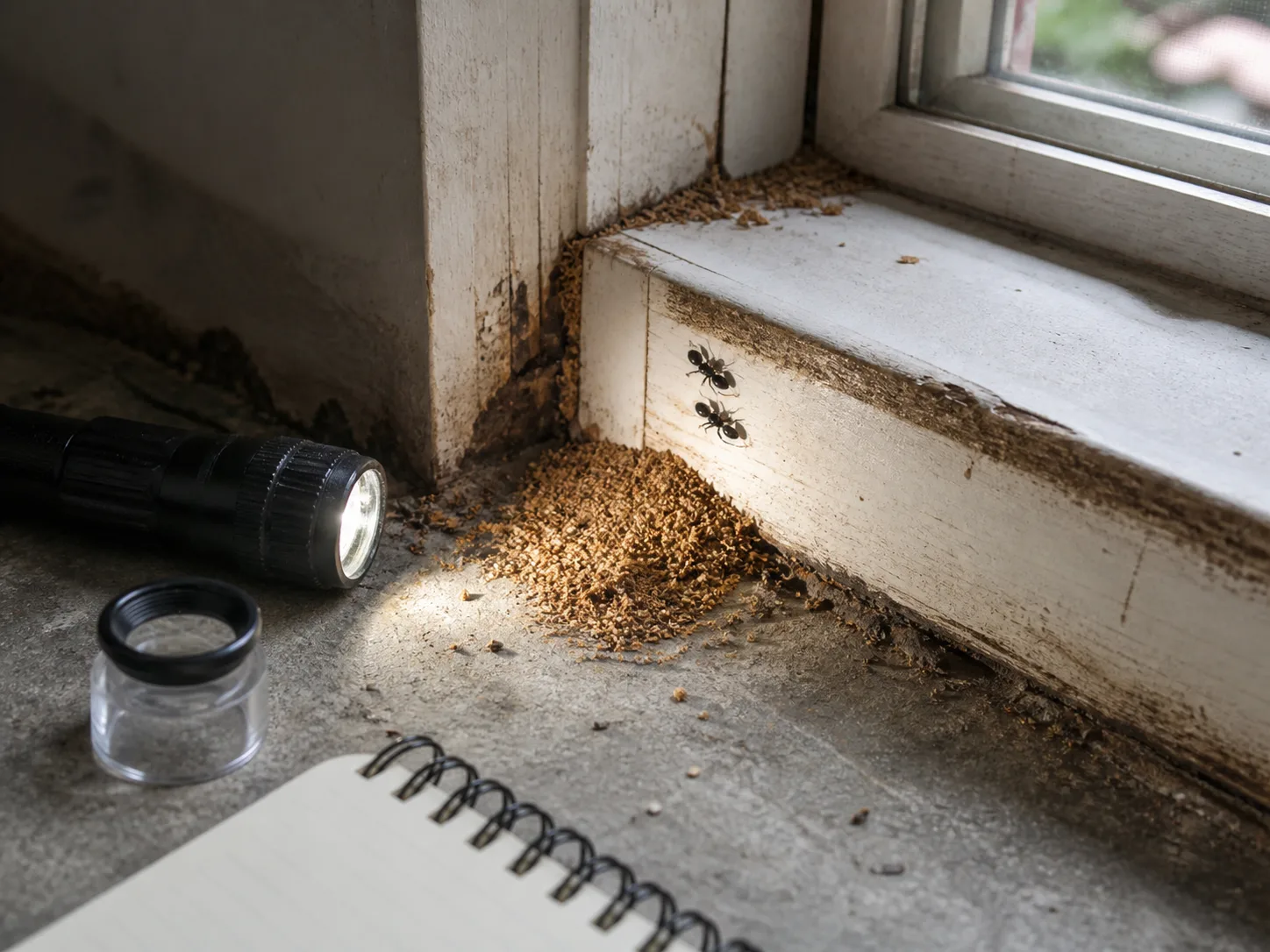
Indoor inspection map
Inspect the room where you see ants, then the rooms on the other side of the same wall or ceiling. Work outward from the route and check:
- Window and door sills, trim joints, baseboards, and gaps under thresholds.
- Areas behind or below sinks, tubs, dishwashers, refrigerators, and washing machines.
- Attic, crawl-space, chimney, skylight, and roofline areas that show staining or poor ventilation.
- Wall penetrations around pipes, cables, vents, and utility lines.
- Wood furniture, beams, porch supports, and foam or fiberglass insulation near a damp surface.
Use the paper test under a suspected frass drop, photograph any new debris, and record the time of activity. If you vacuum visible workers, empty the canister or bag into a sealed waste bag outdoors; cleanup helps you see new activity but does not remove the nest.
Outdoor inspection map
Walk the perimeter in daylight first, then follow any safe-to-observe trail near dusk. Look at firewood, stumps, fallen logs, dead branches, fence posts, porch framing, tree cavities, and siding near the ground. Check whether branches or vines touch the roof or walls and whether a downspout deposits water beside the foundation.
Do not tear apart a suspected nest or pour a household chemical into a stump. If the trail leads into a mature tree, roofline, crawl space, or inaccessible structure, mark the location from the ground and leave the treatment to a qualified professional. A photo of the nest area, the trail direction, and any damp wood is more useful than a risky attempt to reach it.
How to get rid of carpenter ants
The first response is to preserve information and reduce conditions that keep the ants comfortable. Clean up exposed food and grease, correct obvious leaks, move water away from the foundation, and vacuum accessible workers after you have photographed the route. Those steps reduce foraging but do not replace locating and treating the nest.
The most reliable control plan is nest-focused. The Missouri Botanical Garden explains that successful control depends on finding and destroying the parent nest, while the Pacific Northwest Pest Management Handbooks note that a professional may choose a direct nest treatment or an exterior non-repellent approach depending on where the colonies and trails are found. A blanket foundation spray is not automatically the right answer.
When bait makes sense—and when it does not
Bait can help when workers are actively foraging and the nest is hidden or difficult to reach. Choose only a product whose current label allows the intended indoor or outdoor use and lists the target pest. Put it in a tamper-resistant station or inaccessible placement when children or pets could reach the area.
Bait works differently from a contact spray. Workers need to feed and carry it back, so do not spray, crush, or wash away the active trail while bait is being accepted. You may see more ants around the bait at first; that increase can mean workers are collecting it, not that the product has failed. Keep competing sweets, grease, pet food, and food waste sealed or removed, and follow the label’s placement, replacement, storage, and disposal directions.
Bait is not a universal fix. Carpenter ants can be selective about food, and a bait that attracts one colony may be ignored by another. If activity continues, frass keeps appearing, winged ants emerge, or ants are coming from a wall void, stop experimenting with household remedies and have the nest located.
Prevent carpenter ants from coming back
Prevention begins with water management, not fragrance or a one-time spray. Repair leaks, improve ventilation in attics and crawl spaces, keep gutters and downspouts moving water away from the foundation, and replace wood that is no longer structurally sound. If the water source is a roof, plumbing line, window, chimney, or grading problem, the building repair is part of pest control.
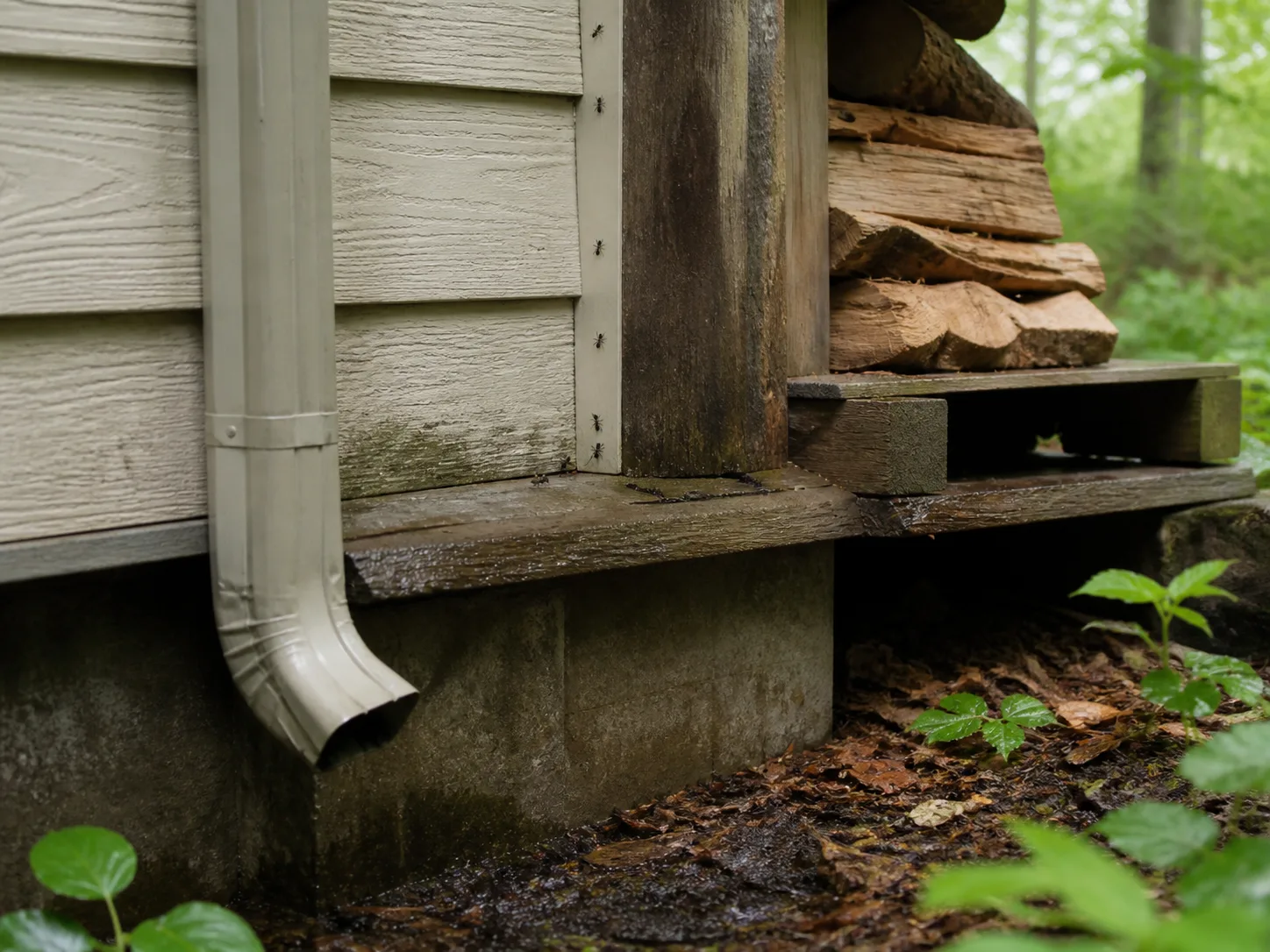
Reduce the outdoor connections that make the house easy to reach. Move firewood, logs, stumps, and landscape timbers as far from the structure as practical and keep firewood off wet soil. Remove dead branches and prune limbs that touch the roof or siding. Seal cracks around doors, windows, foundations, pipes, cables, and vents after you have documented any active route and dealt with the nest.
Keep food in closed containers, clean grease and crumbs from hard-to-reach areas, and empty garbage regularly. Then recheck the original trail and moisture area during the next warm season. A quiet week is encouraging, but it is not proof of colony elimination if the wood remains wet or a parent nest was never found.
When to call a professional
Call a licensed pest professional promptly if you see winged ants indoors, repeated frass, ants emerging from a wall or ceiling, activity in more than one room, or a trail that disappears into an inaccessible area. Also call when the house has soft or visibly damaged framing, stuck doors or windows, sloping floors, or a known leak near the activity. Pest treatment and structural repair may require different specialists.
Professional help is especially important when you cannot tell carpenter ants from termites, when children or pets are exposed to a proposed treatment area, or when bait and exclusion have not changed activity. A competent inspector can trace trails, use a moisture meter or other inspection tools, distinguish a parent nest from a satellite nest, and recommend a targeted treatment that matches the label and the construction of the home.
You do not need to wait for dramatic damage before asking for an inspection. At the same time, you do not need to panic over one outdoor ant near a stump. The useful threshold is a pattern: recurring indoor activity, evidence of excavation, winged ants emerging inside, or ants paired with moisture-damaged wood.
Conclusion
The five most useful carpenter-ant signs are a repeatable trail of large ants, coarse frass, winged ants emerging indoors, faint rustling in a quiet wall, and damp or damaged wood nearby. No single clue proves the nest is inside your house, but two or more clues together deserve action.
Photograph the evidence, follow the route safely, fix the moisture source, and avoid turning a bait plan into a contact-spray plan. If the nest is hidden, the activity is recurring, or the wood may be structural, a professional inspection is the shortest path to knowing what is actually happening.