How to Grow and Care for Star Magnolia
Grow star magnolia successfully: choose a protected site, plant at the right depth, protect early blooms, prune after flowering, and troubleshoot scale.
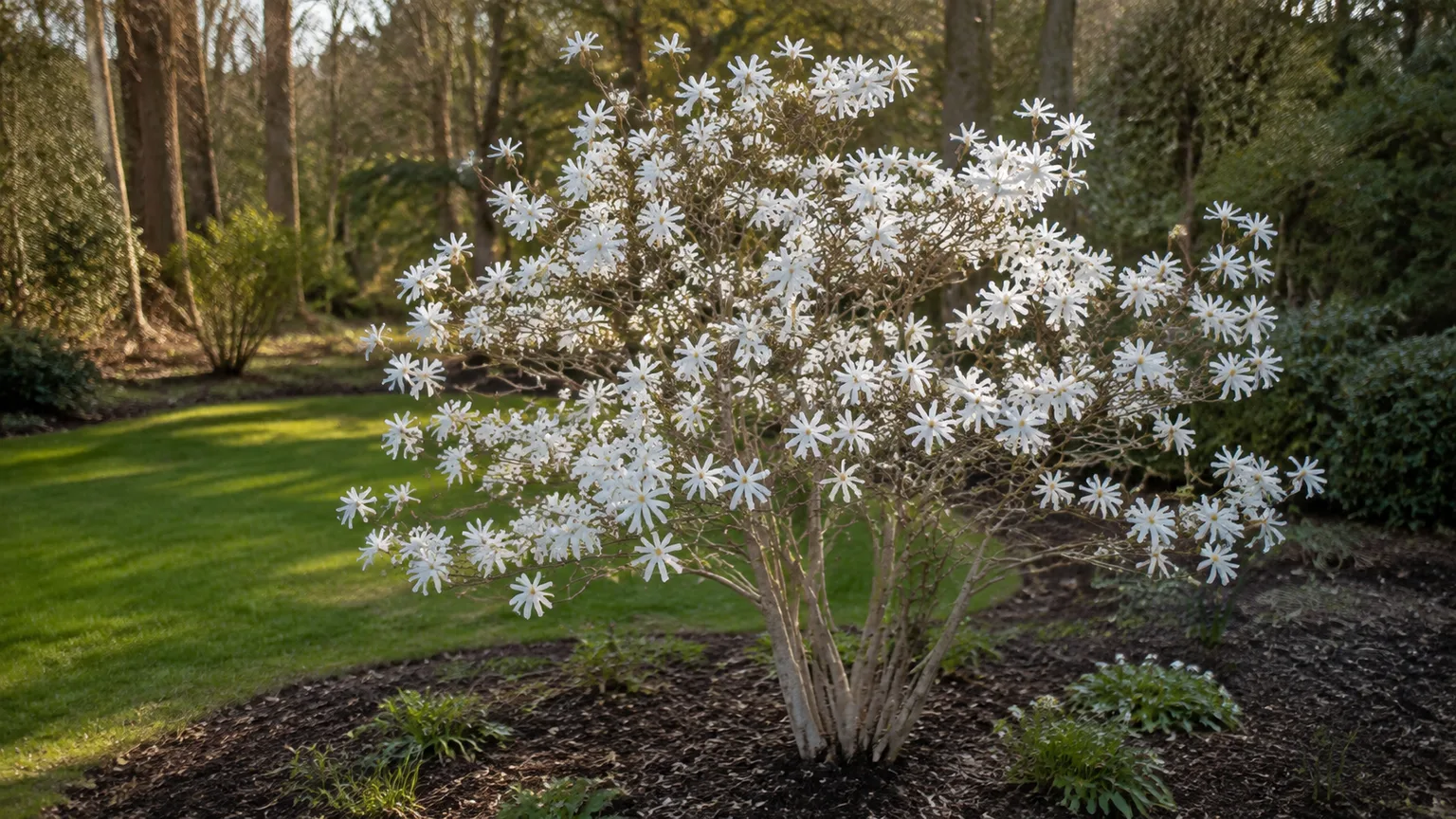
Star magnolia (Magnolia stellata) is a small deciduous tree that can also be grown as a large, rounded shrub. Its best moment arrives before most of the garden wakes up: silky buds open into white, narrow-petaled flowers on bare branches in late winter or early spring. That timing is also its main weakness, because a late freeze can damage the display even when the plant itself is perfectly healthy.
The care is straightforward once you plan around that trade-off. Give star magnolia a protected site, keep the root zone evenly moist without leaving it waterlogged, prune only after flowering, and treat size and frost exposure as part of plant selection—not as problems to solve later.
Star magnolia at a glance
Star magnolia is native to Japan, including the highlands of Honshu, and is commonly listed under the botanical name Magnolia stellata or the synonym Magnolia kobus var. stellata. It grows slowly into a rounded, spreading form, often with several trunks, and usually reaches about 15 to 20 feet tall and 10 to 15 feet wide. The NC State Extension Plant Toolbox profile and Missouri Botanical Garden Plant Finder both describe it as a compact flowering tree or shrub for specimen, foundation, border, and woodland-edge planting.
The flowers typically have 12 to 18 narrow tepals and may be white, blush, pink, or creamy yellow depending on the cultivar. Leaves emerge after bloom, mature from bronze-tinged green to medium or dark green, and often turn yellow or copper in fall. Cone-like seed pods may split later in the season to reveal bright orange seeds; those pods are a normal part of the plant’s cycle, not a disease.
Star magnolia is generally suited to cool-to-mild climates often described around USDA Zones 4 through 8, although local exposure matters as much as the number on a zone map. A sheltered garden can protect buds in a marginal climate, while a windy or frost-pocket site can lose flowers even when the tree survives winter without injury.
Choose a site that protects spring buds
Site selection is the most important star magnolia care decision because you cannot easily correct a tree that is too close to a foundation, too exposed to wind, or planted where its roots compete with thirsty lawn and large trees. Walk the proposed spot in late winter if possible. Notice where cold air settles, where wind funnels between buildings, and whether a south-facing wall warms the plant early enough to push the buds before the last frost.
Light, soil, exposure, and wind
Star magnolia flowers best in full sun, but it tolerates part shade. Aim for at least several hours of direct light, preferably gentle morning or midday sun, with enough open sky for the rounded crown to develop. In hotter climates, a little afternoon protection can reduce heat and drought stress, but dense shade will usually mean fewer flowers and a thinner form.
Avoid placing it in a wind tunnel or at the exposed top of a hill. High wind can break slender branches, dry the buds, and make an already cold night more damaging. The UF/IFAS Gardening Solutions guide also cautions against salt and root competition, so a spot beside a heavily salted drive or under a large, aggressive tree is a poor long-term match.
The ideal soil is organically rich, moist, and well drained, with a slightly acidic to neutral reaction. Star magnolia can tolerate some clay, but it should not sit in a basin that stays saturated after rain. It is also not a dry-soil tree: repeated drought can reduce growth and stress the plant during hot summers even if an established specimen survives.
Before planting, dig a broad test hole and fill it with water. If water remains for many hours, solve drainage before buying the tree or choose a different location. Do not try to turn heavy clay into good soil by dumping in a small amount of sand; improve structure with finished organic matter and reduce compaction, or use a raised, well-drained planting area. Our guide to what loam soil actually means explains why texture and structure are different questions.
Keep the magnolia away from turf that needs frequent irrigation and fertilizer. Grass roots can outcompete a young tree for water, and mowing equipment can damage thin bark at the base. A broad mulch ring is usually more useful than a tight lawn edge.
Plant star magnolia correctly
When and how to plant
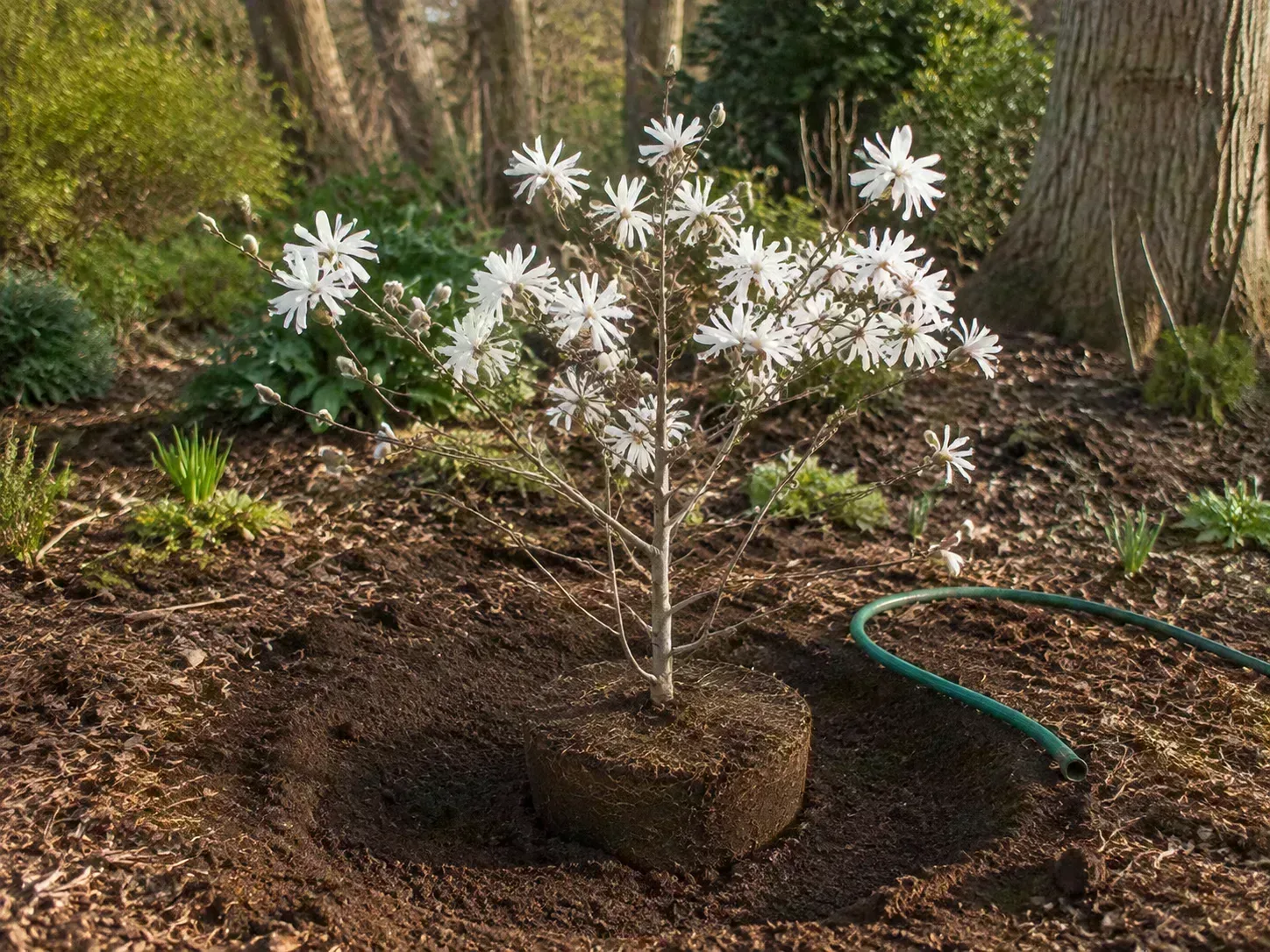
Planting during dormancy, before the spring flush, is a good choice for bare-root or field-dug plants because the roots have time to settle before hot weather. Container-grown magnolias are more flexible and can be planted outside the hottest or driest periods, provided you can keep the root zone consistently moist while it establishes.
Do not plant into frozen ground, waterlogged soil, or a forecast of extreme heat. If the tree arrives while conditions are poor, keep the root ball evenly damp and sheltered from drying wind until the site is workable. Never let a container-grown tree sit with its pot submerged in a bucket or saucer of water.
Dig a hole at least twice as wide as the root ball and no deeper than the root ball’s soil level. The finished root flare should be at or just above the surrounding grade; planting too deeply can keep the trunk base wet and restrict oxygen to the roots. If the root ball is tightly circling, loosen only the outermost roots enough to encourage outward growth without tearing the whole root system apart.
Backfill with the soil you removed unless a soil test or drainage correction calls for a specific amendment. Water slowly until the entire root ball and surrounding soil are moist, then apply about 2 to 3 inches of mulch over the root zone. Keep mulch several inches away from the trunk so the bark stays dry and visible.
Stake only if wind or a loose root ball makes the tree unstable. A permanently rigid stake can prevent the trunk from developing normal movement and strength. Check ties after the first growing season and remove support when the plant can stand on its own.
Water for establishment, then water by need
For the first two growing seasons, inspect the soil regularly rather than relying on a fixed calendar. Water deeply and slowly when the upper root zone begins to dry, allowing moisture to reach beyond the original container shape. A soaker hose or a hose set to a slow trickle is better than a quick splash that runs off compacted ground.
The correct frequency depends on soil, rainfall, tree size, temperature, and wind. Sandy soil may need checking more often than loam; clay may stay wet longer but still dry around the root ball if the planting hole becomes a hard pocket. During a dry spell, water before leaves wilt, and then allow excess water to drain away. The goal is even moisture, not constantly wet soil.
Once established, star magnolia is more forgiving, but “drought tolerant” should not be interpreted as “never water.” Give it a slow soak during prolonged heat or drought, especially if it is surrounded by pavement, lawn, or competing tree roots. Maintain the mulch ring as a moisture buffer, refreshing it when it thins rather than piling new material against the trunk.
Fertilize only when the soil calls for it
Star magnolia usually needs little fertilizer when planted in decent soil and mulched with finished organic matter. If the tree is making healthy new growth and the leaves have normal color, extra feeding is unlikely to create better flowers. Excess nitrogen can push soft leafy growth instead of solving a light, frost, root, or pruning problem.
Use a soil test when growth is weak, leaves are unusually pale, or the site has a history of construction fill or repeated fertilizer use. Alkaline soil can cause chlorosis, in which leaves look yellow while veins remain greener, because some nutrients become less available. Correct the underlying pH and root-zone issue according to the test rather than repeatedly applying an all-purpose product.
If fertilizer is genuinely needed, apply a slow-release, balanced product in spring as new growth begins and follow its label. Do not fertilize late in the season just to force growth before winter. A young tree with weak roots benefits more from correct watering and weed control than from a heavy dose of food.
Prune after flowering, not before
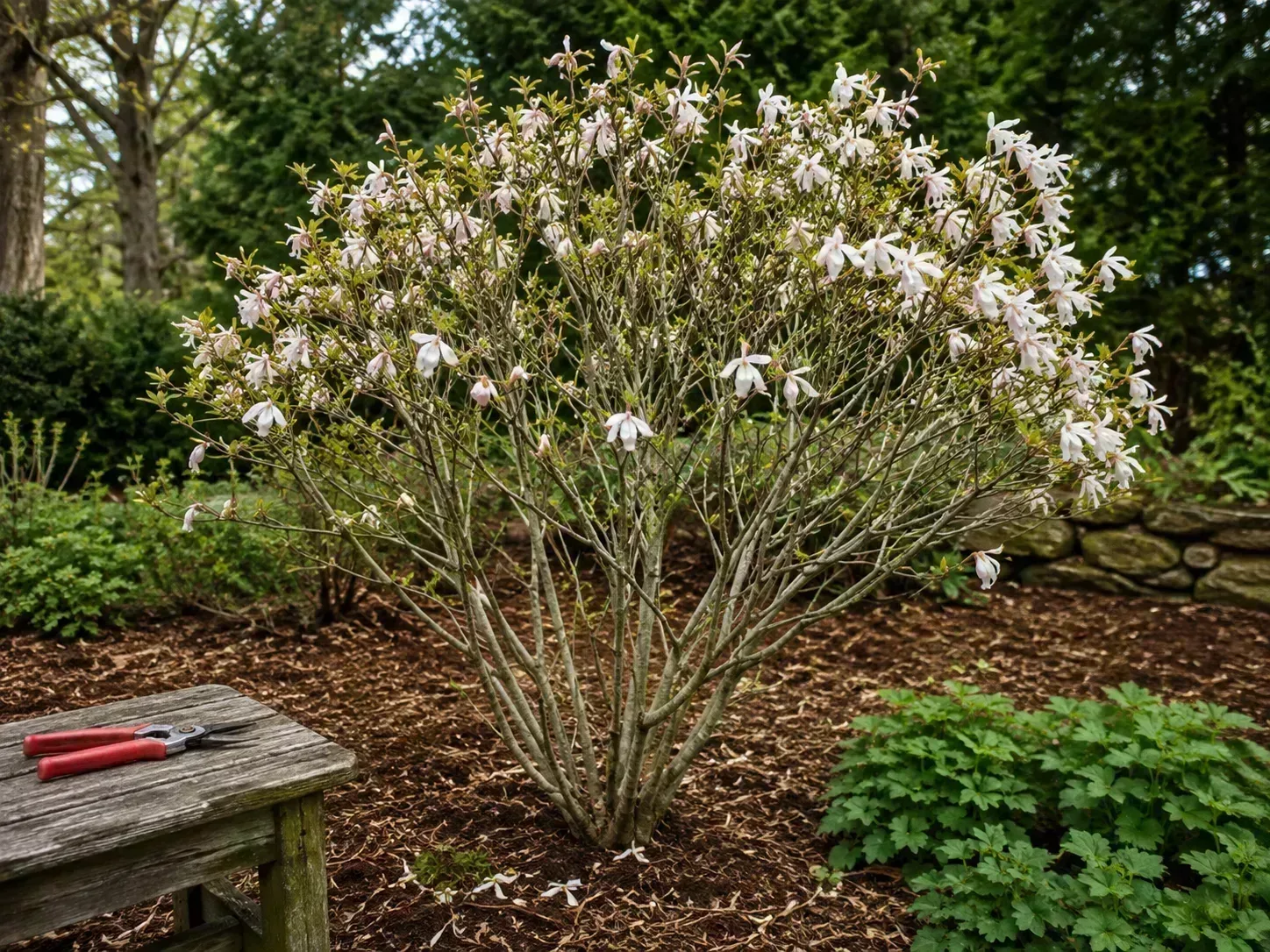
Star magnolia flowers on older wood formed during the previous growing season. The safest pruning window is immediately after flowering, before the plant spends the rest of spring and summer building next year’s flower buds. Prune later only for a clear safety or health reason, and accept that you may remove some of the next display.
Begin with the smallest useful intervention: remove dead, broken, diseased, rubbing, or badly crossing branches. Cut just outside the branch collar rather than leaving a long stub or cutting flush into the trunk. Clean, sharp bypass pruners handle young stems; a pruning saw is safer for larger branches.
Do not top the tree, shear the crown into a ball, or remove large limbs simply because the plant looks untidy in winter. Magnolias heal slowly from large wounds, and a severe haircut can destroy the natural silhouette while stimulating awkward shoots. If a branch is threatening a roof, path, or utility line, use a staged reduction or consult an arborist rather than making one oversized cut.
Keep the natural shrub or train a small tree
Multi-stemmed shrub form is not a failure. It gives the plant a fuller outline and suits woodland borders, foundation beds, and informal screens. Keep that habit by removing only damaged growth and a few congested stems, preserving the plant’s balanced, rounded crown.
To train a small tree, start while the plant is young. Select one central trunk or a small group of well-spaced trunks, then gradually remove low suckers and competing shoots over several seasons. The NC State Extension profile recommends a restrained rejuvenation approach: when an older shrub is crowded, remove only one or two older stems per year rather than cutting everything at once.
Choose a cultivar by size, color, and bloom timing
Species size is only a starting point. Check the mature dimensions of the named cultivar on the nursery tag and leave room for the canopy to spread. A star magnolia marketed as a “small tree” can still become too wide for a narrow foundation strip.
| Cultivar | What makes it useful | Decision note |
|---|---|---|
| ’Royal Star’ | Double white flowers opening from pink buds | A classic choice, but double flowers can hold more moisture in wet weather |
| ’Rosea’ | Light pink flowers that fade toward white | Choose it for color; it is generally described as non-fragrant |
| ’Jane Platt’ | Double, pale pink, scented flowers | A good choice when fragrance and pink color matter more than a pure-white display |
| ’Pink Stardust’ | Large, fragrant flowers and a more pyramidal habit | Useful when you want a narrower-looking young plant, but allow for mature width |
| ’Waterlily’ | Large narrow petals, strong fragrance, and often later flowering | Later bloom may help in some frost-prone gardens, but local weather still controls the result |
| ’Centennial’ | Large white flowers with a pink blush and a larger eventual size | Give it more room; some references list it approaching 25 feet |
Cultivar names and size descriptions can vary among nurseries, so treat the label as a starting point and verify the mature dimensions. The Wisconsin Horticulture Extension account and Gardenia’s star magnolia profile are useful cross-checks for the range of forms and flower colors.
Get more dependable flowers without forcing the plant
Star magnolia often blooms before its leaves, and that bare-branch display is normal. Flowering may begin when a nursery plant is still young; NC State notes that plants can start flowering at roughly two to three years, but the timing depends on plant size, age, propagation method, cultivar, and establishment after planting.
If an established tree is not blooming, check the causes in this order:
- Look at the buds. If they formed but turned brown after a cold night, frost injury is more likely than a fertilizer problem.
- Check light. Dense shade can support foliage while reducing flower production.
- Review pruning dates. Late summer, fall, or winter pruning may have removed flower-bearing wood.
- Check the root zone. Drought, standing water, turf competition, or recent transplanting can delay flowering.
- Confirm plant identity and maturity. A seed-grown plant may not flower for many years and may not resemble the parent cultivar exactly.
Do not deadhead star magnolia to make it rebloom. Flowers drop naturally, and removing every spent bloom will not replace the buds already set for the next season. After bloom, keep the plant watered, mulched, and free of damaging competition so it can build healthy wood for the following year.
Propagate star magnolia with realistic expectations
Propagation is possible, but buying a healthy nursery plant is usually the fastest and most predictable route to a flowering specimen. A cutting or seedling needs time to form a strong root system, survive transplanting, and acclimate to the landscape. Propagation is most rewarding when you want to preserve a plant you already own or enjoy the process itself.
Cuttings, layering, and seed
Take softwood or semi-hardwood cuttings in late spring or early summer, when the current season’s growth is firm enough to handle but not fully woody. Choose a healthy shoot, cut a roughly 6- to 8-inch section with several nodes, remove the lower leaves, and insert the base into a clean, airy medium such as a perlite-rich propagation mix. Keep the medium lightly and evenly moist, the cutting in bright indirect light, and the humidity high without trapping stagnant, soaking air.
Rooting hormone may help in some situations, but it is not a guarantee. Magnolia cuttings can be inconsistent, and a cutting that stays green for weeks has not necessarily rooted. Tug very gently only after a reasonable rooting period, or wait for new growth and visible roots before potting on. Gardening Know How’s star magnolia care guide and Plantura’s propagation overview both reinforce the need for suitable conditions and patience.
Layering is a useful alternative when a low, flexible branch can be bent to the ground. Score a small section of bark, pin that section under moist soil while leaving the tip exposed, and keep it watered. Leave the branch attached to the parent plant until it has formed a substantial root system; separating it too soon turns a promising layer into a wilted stem.
Collect mature seed from a ripe cone-like pod after the orange seeds are exposed. Remove the fleshy outer coating, which can inhibit handling and attract mold, then provide a moist cold period of about three months in a refrigerator-safe medium. The purpose is stratification: a cool, moist rest that helps break dormancy.
After chilling, sow the seed shallowly in a clean medium and keep it evenly moist in a bright, protected place. Transplant only after the seedling has made a strong root system, and protect it from competition and drying. Seed propagation is a poor choice if you want an exact named cultivar, because seedlings can vary from the parent and may take many years to flower. That long timeline is why a grafted or established nursery plant is usually better for a designed landscape.
Scout pests and diseases before treating
Star magnolia is generally trouble-free when planted in a suitable site, but “low maintenance” does not mean “ignore it.” Walk around the tree during the growing season and inspect the undersides of leaves, twigs, branch unions, and the soil line. Diagnose the pattern before reaching for a spray; drought, root damage, frost, and pests can produce overlapping symptoms.
Magnolia scale and sooty mold
Magnolia scale appears as brown, white, or gray bumps clustered along twigs and branches. Heavy infestations may leave the foliage sticky with honeydew, which encourages black sooty mold. The mold is often the visible aftermath; the scale insects are the underlying problem.
Start by checking whether the bumps are stationary scale covers or harmless bits of bark, and look for crawlers during the season when your local extension office says they are active. Prune out a badly infested twig if that is practical, wash away light deposits where appropriate, and use horticultural oil or insecticidal soap only according to the product label and local timing guidance. Do not spray a stressed, drought-dry tree in hot sun, and do not assume an organic product is automatically harmless to beneficial insects.
If the infestation is large, recurring, or high in the canopy, contact your county extension office or a qualified arborist. A single treatment aimed at the wrong life stage often fails, and broad spraying can create more problems than the original scale.
Leaf spots, canker, and wilt
Brown, black, tan, or reddish leaf spots can appear during wet weather and may stop progressing when foliage dries. Remove badly affected fallen leaves, thin only congested growth, water at the soil line, and improve air movement. Avoid wetting the canopy late in the day, but do not strip every spotted leaf from an otherwise vigorous mature tree.
Cankers and dying branches deserve closer attention. If a single branch fades, trace it back and look for a distinct lesion, cracking, or discolored wood; remove dead material during dry weather, cutting back to healthy tissue. If several branches decline, leaves drop prematurely, or the tree weakens despite correct watering, seek an extension diagnosis rather than applying a generic fungicide. Verticillium wilt and other vascular problems can have poor prognoses, and repeated spraying cannot reverse infected wood.
Protect flowers from frost and storm damage
The tree can tolerate cold, but its early flowers and swelling buds are much more vulnerable. A forecast below freezing during bloom may turn open petals brown overnight, especially when wind is also strong. This is cosmetic damage to the current display, not proof that the entire plant is dying.
Choose protection before planting by avoiding a low frost pocket and, where possible, a warm south-facing wall that advances bud break. When a freeze is forecast, water the root zone if the soil is dry, then cover a small young tree with breathable frost fabric supported above the branches. Remove the cover after the freeze passes and the day begins to warm; do not leave a wet, sealed covering against foliage for days.
For a mature tree, covering the entire crown may be unrealistic. Protect the root zone with mulch, avoid late-season nitrogen that encourages tender growth, and accept that no cover can guarantee flowers through a hard freeze. Broken limbs from ice or wind should be removed with clean cuts; large storm damage near structures is a job for an arborist.
Use star magnolia where its seasons can be appreciated
Star magnolia works best as a specimen where you can see the early flowers from a window, path, or patio. Its bare winter outline, bronze-tinged spring leaves, summer green canopy, and fall color give it more than one season of interest, even though spring bloom is the main reason to plant it. A lawn edge, woodland margin, or large foundation bed can show off the rounded form without forcing it into a narrow strip.
Use the shrub form in an informal border or as a soft screen, and reserve tree training for a location where the trunks will remain visible. Underplant with shallow-rooted companions only after the magnolia is established, and keep the immediate mulch ring open so you can monitor moisture and the trunk base. The RHS magnolia growing guide includes star magnolia among the compact choices for smaller gardens and notes that some compact magnolias can grow in large containers. If you are still comparing site choices, pair its slightly acidic soil preference with other suitable plants through our guide to acid-loving plants, but do not assume every plant listed there wants the same moisture or light.
Conclusion
Growing star magnolia well is mostly a matter of protecting its timing. Plant it in full sun to part shade with moist, well-drained, organically rich soil; keep a new tree watered while roots spread; feed only when a soil test supports it; and prune immediately after bloom if pruning is necessary. Choose the cultivar for its mature width and frost exposure, not just the flower color on the tag.
When flowers brown, check the weather before adding fertilizer. When leaves spot, check moisture and airflow before spraying. When branches die or scale returns, diagnose early and ask for local extension help. That measured routine lets the magnolia keep its natural shape and gives you the best chance of enjoying those starry flowers every spring.