How to Grow a Pistachio Tree: From Planting to Harvest
Learn how to grow pistachio trees, check winter chill, choose compatible male and female cultivars, plant correctly, prevent common failures, and harvest nuts.
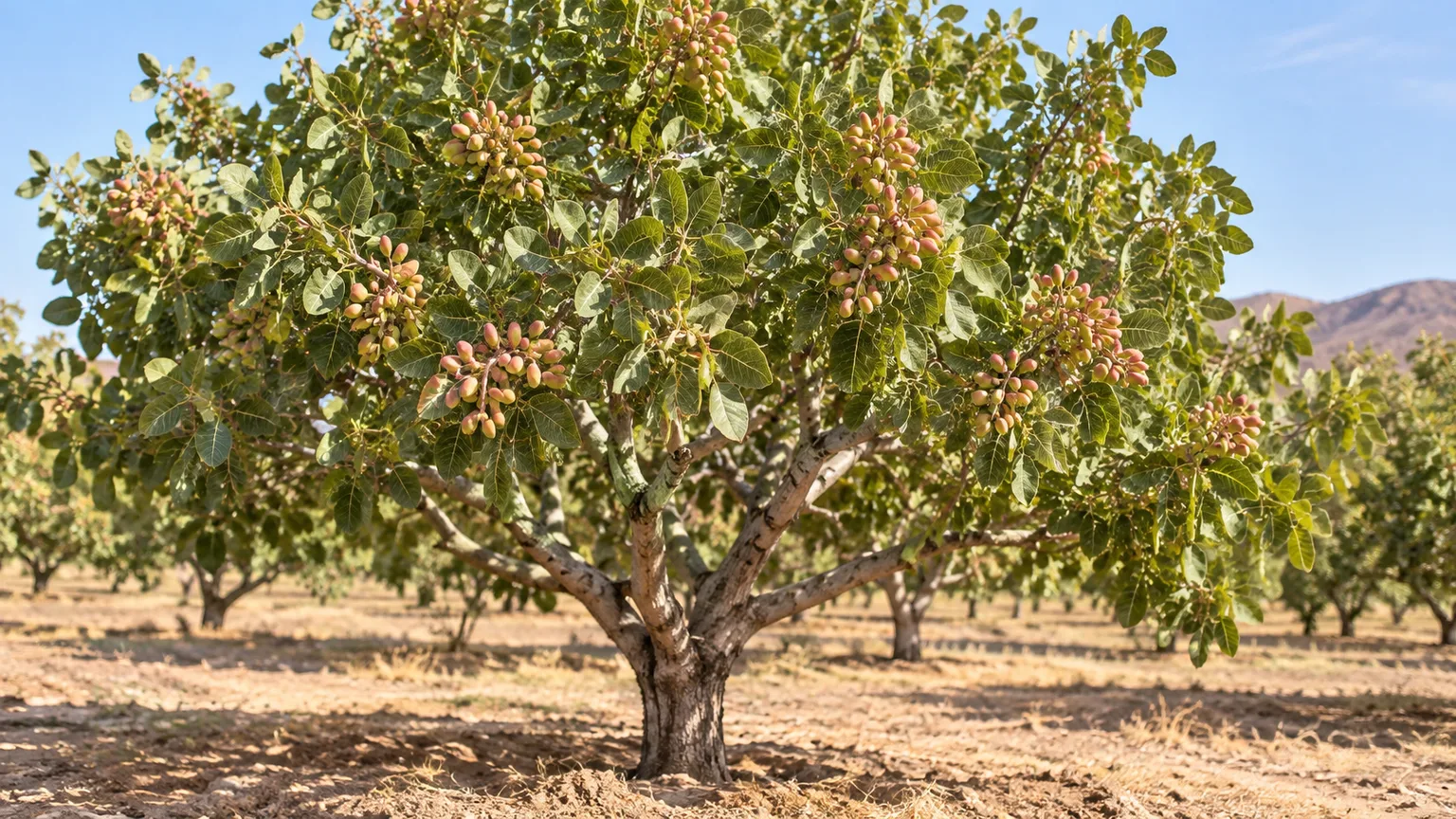
A pistachio tree can look healthy for years without producing a useful crop if its site lacks winter chill, summer heat, or a compatible pollinator. Before buying one, check those conditions and find out whether the nursery is selling a grafted female tree, a male pollinator, or an unidentified seedling.
Pistachios are long-lived, deep-rooted fruit trees rather than patio plants. Give them a sunny, dry-climate site with excellent drainage, then manage water and pruning around the tree’s growth stages instead of following a generic calendar.
Quick answer: climate and pollination decide whether a tree will fruit
For a pistachio tree to bear nuts, it generally needs long, hot summers, a cool winter dormancy, and a male tree whose pollen is available while a female tree is receptive. Pistachios are wind-pollinated, so both the cultivar pairing and the position of the trees matter; bees cannot make up for a missing male tree or a bloom window that does not overlap.
The tree also needs deep, well-drained soil and enough space for a broad canopy and roots. A grafted tree is the practical choice when the goal is nuts because its sex and cultivar are known, while a seedling can take years to reveal whether it is male or female. A hardiness zone by itself is not a reliable “yes” or “no” test for fruiting.
Check whether your climate can support a crop
Pistachios evolved for climates with hot, relatively dry summers and cool winters. Summer warmth supports kernel development, while winter chill helps the tree leave dormancy and flower normally. Warm, humid summers can make the tree more vulnerable to foliar and fruit diseases; a mild winter can leave it with too little chill even if it never suffers a freeze.
An older New Mexico State University Extension circular, printed in 1997, uses about 1,000 accumulated hours at or below 45°F as a regional chill benchmark. A practical pistachio-growing guide gives a similar approximate figure, but neither number should be treated as a universal threshold: chill models, cultivar requirements, and the timing of warm spells differ. Use the number as a reason to investigate, then ask a local nursery or extension office for cultivar-specific performance in your area.
Do not confuse a tree’s need for winter chill with its tolerance of damaging freezes. Rootstock, cultivar, age, and the timing of a freeze influence injury, and a young tree may be less resilient than an established one. If your winters are very mild, your summers are short or humid, or your site regularly experiences severe freezes, expect fruiting to be uncertain even if a map labels the area suitable.
Choose a sunny site and check drainage
Choose the sunniest open part of the garden, away from buildings, evergreen shade, and dense windbreaks. Pistachios need enough light for vigorous growth and flower development, and a fully enclosed corner can also interrupt the airflow that carries pollen. A gentle breeze during bloom is useful; strong, hot, drying winds can damage flowers or interfere with pollen transfer.
Plan for a full-size tree, not the dimensions of the small nursery plant. Pistachios commonly grow roughly 20 to 30 feet tall, and their crowns spread widely when unconfined. A practical growing guide gives a broad 15-to-30-foot spacing range; use the cultivar’s expected vigor, your pruning plan, nearby structures, and local nursery advice to set the actual distance. Avoid squeezing a tree beside a wall or another mature tree where shade and poor airflow will increase over time.
Soil depth matters more than a hardiness-zone label
Pistachio roots need oxygen as well as moisture. Deep sandy loam is a favorable soil, but the essential feature is free drainage: persistent puddles, a shallow water table, or a dense layer that traps water can cause slow growth and root disease. If water stands in the planting area after rain or irrigation, correct the drainage problem or choose another site instead of trying to solve it with a richer planting-hole mix.
The tree can tolerate some soil conditions that would trouble less-adapted fruit trees, including certain saline soils, but “tolerant” does not mean that every poor site is suitable. Do not deliberately add salt, lime, sulfur, or fertilizer without a soil test. Have the soil checked for pH, salinity, and major nutrient issues, and ask whether a hardpan or compacted layer will restrict deep rooting.
Buy a grafted female tree and plan its pollinator
Pistachio trees are dioecious: individual trees are male or female. Only female trees make the fruit, and the pollen must come from a male tree that sheds at the right time. New Mexico State’s regional circular recommends about one male for every eight to ten females in orchard blocks, but that commercial ratio is not a guarantee for a backyard planting. For a home garden, one well-matched male may serve several females if the pollen reaches them and bloom overlaps.
Buy from a nursery that identifies the cultivar, sex, rootstock, and compatible pollinizer. ‘Kerman’ is a familiar female cultivar and ‘Peters’ a traditional male partner in some western U.S. production, but they are examples, not universal choices. Ask what pairing is recommended locally and whether the male sheds pollen throughout the female’s receptive period. Plant the male upwind when the prevailing spring wind is predictable, while avoiding a location where the male shades the female.
For more than one tree, draw the layout before planting. Include the expected mature crowns, access for pruning and harvest, and the route pollen will travel. Don’t rely on a neighbor’s male tree unless you know its identity, distance, and bloom timing; it may be too far away or flower before or after your female.
When to plant a pistachio tree
Plant a container-grown tree in early spring while it is dormant or just before active growth begins, after the soil is workable and not saturated. This gives roots time to establish before hot weather. New Mexico State’s extension circular notes that pistachios form and regenerate roots slowly and are difficult to handle bare-root; when buying, favor a healthy, correctly labeled container-grown or nursery-grafted tree and follow the seller’s local planting window.
Planting steps that protect the root system
First, water the nursery root ball so it is evenly moist, then dig a hole two to three times as wide as the root ball but no deeper than its height, a planting approach also used in a practical planting guide. Set the tree so the root flare—the point where the trunk begins widening into roots—rests at or slightly above finished soil level. A hole that is too deep can settle and bury the crown, especially in recently loosened soil.
Slide the tree out carefully and loosen only roots that are tightly circling the outside; avoid tearing or washing away the root ball. Backfill with the excavated soil, firm it gently to remove large air gaps, and water slowly to settle the soil. Do not place fertilizer, fresh manure, or a concentrated compost layer against the roots, and do not bury the graft union.
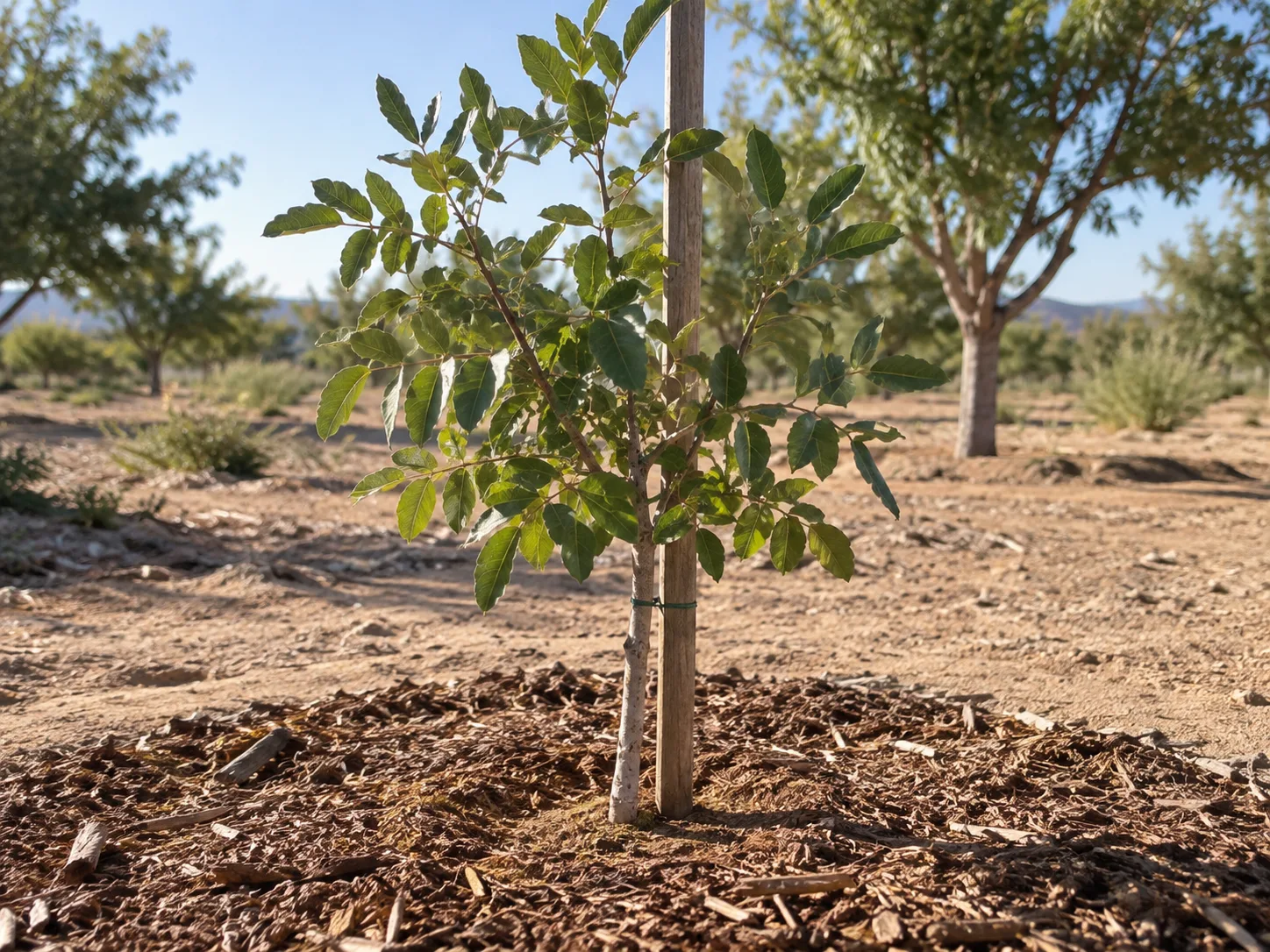
Use a stake only if the young trunk cannot stay upright in wind, and keep ties loose enough for slight movement. Spread a modest mulch ring to reduce weeds and rapid surface drying, leaving a clear gap around the trunk so bark stays dry. Check the planting depth after the first deep watering; add or remove soil before it hardens if the root flare has become covered.
Care for a young tree while it establishes
During the first growing season, the priority is steady root establishment, not forcing fast top growth or an early crop. Water the root zone when it begins to dry, keep competing weeds and turf away from the young tree, and protect the trunk from mower or string-trimmer damage. A small tree can be stressed by hot wind even in a climate that suits mature pistachios, so inspect it during heat waves rather than assuming drought tolerance means no care.
Check the stake and ties every few weeks, especially after windy weather. Remove the stake once the trunk can stand on its own; a permanent tight tie can girdle it. If the tree wilts, first feel the soil below the mulch and inspect drainage. Wilting in dry soil calls for water, while wilting in saturated soil points toward root stress or disease, and adding more water to the second situation can make the damage worse.
Let the tree build its framework before expecting nuts. Remove suckers from below the graft union because they belong to the rootstock, not the named fruiting cultivar. Keep a brief annual record of shoot growth, bloom, irrigation, and any crop; those notes make it easier to tell normal alternate bearing from a persistent site or pollination problem.
Water for growth without keeping roots wet
Pistachios tolerate dry conditions once established, but drought tolerance describes survival better than reliable nut production. Young trees need enough water to root into surrounding soil, and bearing trees need moisture during spring growth and kernel development. UC IPM advises avoiding severe water stress during the early shell-growth stage because it can increase early shell split and contribute to pest and mold problems later.
Water slowly and deeply enough to wet the active root zone, then allow the soil to drain before watering again. The interval will be shorter in hot weather and sandy soil than in cool weather or heavier soil, so a fixed weekly schedule can either drown roots or leave them dry. Check below the surface near the edge of the root ball or canopy rather than judging by the dusty top inch; adjust for rain, soil texture, tree age, and the actual depth reached by irrigation.
Drip irrigation or a low-flow soaker line can deliver water to soil without repeatedly wetting the foliage. Avoid directing water at the trunk or leaving it pooled around the root collar. In a humid region, keeping leaves and fruit dry and preserving airflow may reduce disease pressure, but do not withhold water so severely that the tree enters shell development under stress. The goal is a moist root zone with oxygen, not a permanently wet basin or deliberate drought.
Prune for structure and preserve future fruitwood
Train a young tree gradually so it can carry a crop and remain accessible for maintenance. A practical pruning guide and a pistachio cultivation guide describe selecting a few scaffold branches and keeping a workable canopy, while the exact form depends on cultivar, climate, sunlight, and whether a grower uses mechanical harvest. New Mexico State’s circular notes that an open center can expose branches to sunburn in the intense New Mexico sun; that is a useful reminder not to copy a commercial pruning diagram without considering local conditions.
Make structural decisions while branches are small: retain a strong trunk and a few evenly distributed limbs, remove branches that rub or grow inward, and shorten competing leaders only when you understand how the cut will redirect growth. Pistachio flower buds form on shoots that developed earlier, and a pistachio cultivation guide cautions that fruit develops on one-year-old growth. Heavy heading can remove future fruiting wood or trigger unwanted shoots, so do not top the tree just to keep it small.
Prune in the dormant season for major structure, removing dead, broken, or diseased wood with clean cuts. Use light corrective cuts during the growing season only when needed, and avoid removing a large share of the canopy at once. If a mature tree is too tall for safe hand harvest, pruning cannot turn a full-size pistachio into a dwarf patio tree; consult an arborist or local fruit-tree specialist before making large cuts.
Fertilize only when a test or growth pattern supports it
A pale leaf or weak shoot does not automatically mean the tree needs nitrogen. Poor drainage, root damage, insufficient chill, shade, drought, and a heavy crop can all reduce growth or change leaf color. Begin with a soil test and check irrigation and roots before applying fertilizer, especially if the tree is in sandy soil where nutrients can leach.
Avoid adding a strong fertilizer to the planting hole or feeding a newly planted tree to “make it grow.” New Mexico State’s circular notes that pistachio nutrient needs were not fully established in its region and warns that late nitrogen can prolong growth and delay dormancy. Because those recommendations are old and regional, use them as a reason to avoid a one-size schedule—not as a current fertilizer recipe. If a test or leaf analysis identifies a deficiency, follow local extension rates for the soil and tree age, split applications if advised, and stop well before the season’s end when late growth could be vulnerable to cold.
Diagnose poor flowering, fruit set, and nut fill
Separate “no flowers” from “flowers but no nuts.” A tree may be too young, lack winter chill, receive too much shade, or have been pruned at the wrong time. If it flowers but sets little fruit, pollinator sex, cultivar compatibility, bloom overlap, and wind exposure move to the top of the checklist. If fruit forms and then fails, inspect water stress during shell growth, crop load, pests, and disease before reaching for fertilizer.
| What you see | First checks |
|---|---|
| No bloom | Tree age, winter chill, sunlight, and heavy pruning of mature shoots |
| Female flowers but few nuts | Confirm a nearby male, matching bloom dates, and open airflow during pollen shed |
| Small nuts drop or split early | Review spring soil moisture, heat stress, and early insect damage |
| One heavy crop followed by a light one | Consider normal alternate bearing before changing fertilizer or irrigation |
Flowers appear but no nuts develop
Confirm that the flowering tree is female and that a male is flowering at the same time. The male’s pollen is carried by wind, so a compatible tree can still fail to pollinate if it is downwind behind a solid barrier or if strong dry winds disrupt bloom. Record the bloom dates on both trees for a couple of seasons; this is more useful than buying a second female when the actual problem may be a missing or mistimed pollinizer.
If the tree is a seedling, its sex may not be known yet. If flowers occur but the fruitlets remain empty, consider incomplete pollination or seed abortion, but avoid diagnosing from a single year: pistachios can bear heavily one year and lightly the next. A grafted, correctly identified tree plus a compatible pollinizer removes much of this uncertainty, though it cannot compensate for a climate that does not support normal flowering.
Young nuts drop, stay blank, or split early
Some blanks and seasonal crop variation occur even in managed pistachio plantings. A tree that carries a heavy crop may produce fewer flower buds or a smaller crop the following year, so record the pattern over several seasons rather than treating every low year as a care failure; a pistachio cultivation guide describes this alternate-bearing pattern. A single application of more fertilizer will not fix alternate bearing, missed pollination, or inadequate winter chill.
Premature shell split is different from a naturally mature shell opening near harvest. UC IPM connects severe water stress during early shell expansion with increased early split; early openings can expose developing nuts to navel orangeworm and fruit molds. Check whether irrigation wets the root zone consistently during this stage, and inspect a sample of nuts for pinholes, webbing, or frass. For commercial-scale pest thresholds or pesticide decisions, use current local extension guidance rather than applying orchard rates to a backyard tree.
Limit disease and pest problems with prevention
Pistachios are not immune to disease simply because they tolerate dry climates. Alternaria late blight is more troublesome when humidity, leaf wetness, and poor airflow persist. UC IPM’s disease notes describe black angular or round leaf lesions, sometimes with black spores that rub off, and dark lesions on hulls; similar-looking damage can have another cause, so use the pattern and season as clues rather than a definitive diagnosis.
Keep irrigation on the soil where practical, avoid crowding the canopy, and remove fallen or diseased material when local guidance recommends it. Persistently wet soil can favor root and crown problems such as Phytophthora, while Verticillium wilt is soil-borne and can cause branch or whole-tree decline. If a branch suddenly wilts or a tree declines despite adequate soil moisture, photograph the symptoms and ask a local extension office or diagnostic lab before replanting in the same spot.
Navel orangeworm is an important pistachio pest in production areas. Its larvae can enter nuts around hull split, and feeding may leave pinholes, webbing, and frass; the insect can also create conditions for mold contamination. UC IPM’s navel orangeworm guidance emphasizes removing unharvested “mummy” nuts after harvest and harvesting promptly. A backyard grower can use those sanitation and timing steps without adopting a commercial spray program. If a pesticide is being considered, verify that it is currently labeled for the crop and location, follow the full label, and ask local extension for an appropriate home-garden option.
Harvest, hull, and dry pistachios promptly
Harvest season varies with cultivar and climate, so watch the fruit rather than copying a calendar date from another region. As pistachios mature, the hull changes from green toward yellow, pink, or red tones and loosens from the hard shell; the shell may split naturally. New Mexico State’s regional description identifies easy hull separation as a maturity sign, while a pistachio cultivation guide notes the color change and split. Check several clusters across the tree because fruit does not always mature uniformly.
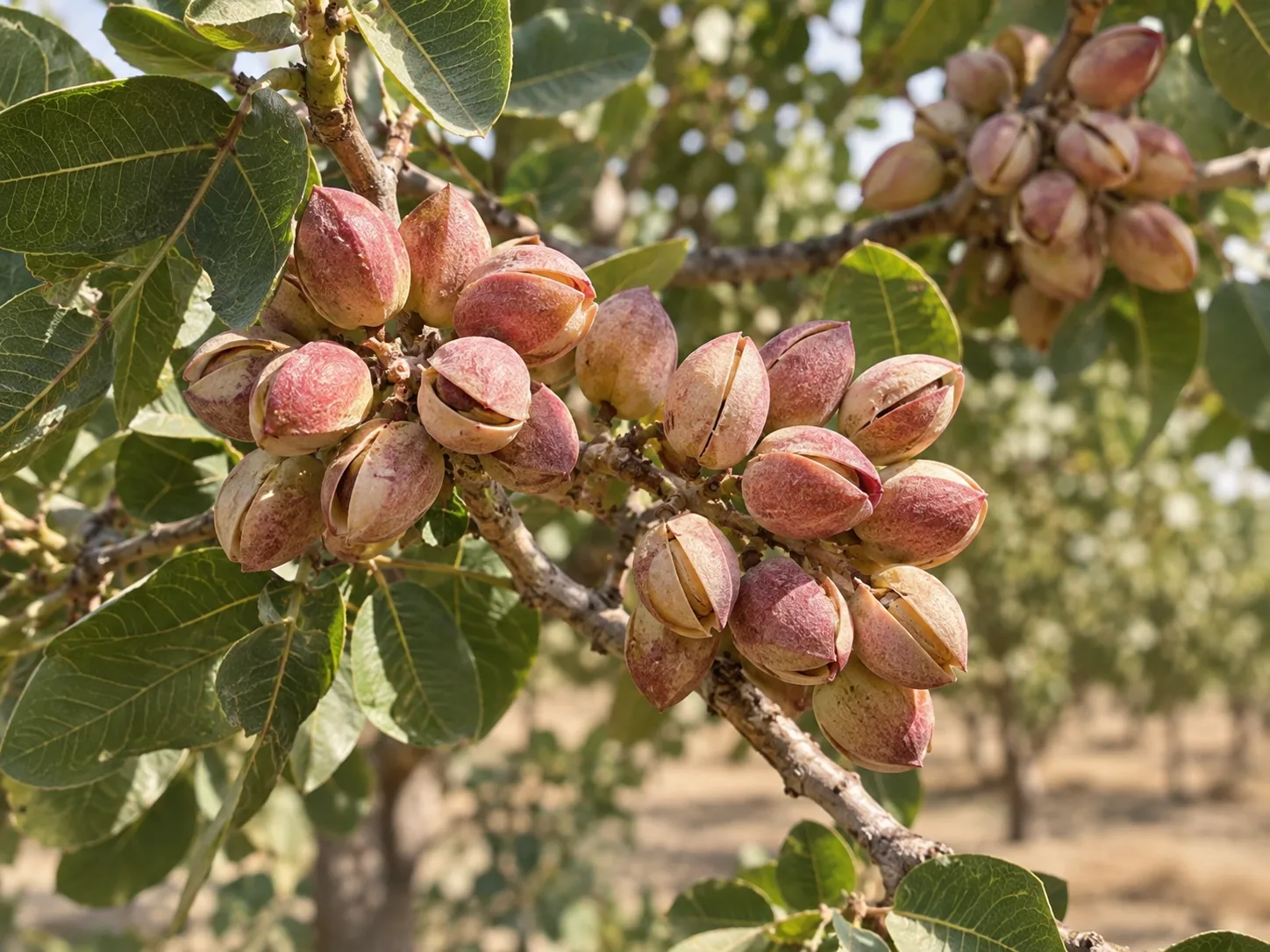
Spread a clean tarp under a small tree and gently shake or tap branches so ripe clusters land on a clean surface, not bare soil. Do not leave split nuts on the tree for an extended period, and collect any that fall promptly. Separate the soft outer hull from the shell soon after harvest; UC IPM’s harvest guidance recommends hulling and drying within 24 hours to reduce postharvest disease. Discard nuts with visible mold, insect webbing, or serious damage rather than mixing them into the clean crop.
Dry the hulled nuts thoroughly in a clean, airy place using a food-safe method suitable for your humidity and equipment. Do not seal warm or damp nuts in a jar, because trapped moisture encourages spoilage. If you are unsure whether a small home harvest is dry enough to store safely, use current university or food-preservation guidance rather than guessing from the outside of the shell.
The first crop is a long-term prospect. A grafted tree may begin bearing a small crop several years after planting, but the older New Mexico State guide distinguishes early bearing from significant production and places fuller production later; actual timing depends on climate, cultivar, pollination, rootstock, and how “first crop” is defined. Plan for the tree’s space and care needs even if the first harvest is modest.
Container and seed options have narrow uses
A nursery may sell a young pistachio in a container, and a pot can be a temporary holding place before planting. Long-term container culture is a poor fit for a tree with a deep root system, a broad mature canopy, and a need for winter dormancy and outdoor pollination. It is not a suitable indoor fruit tree, and repeated potting up does not remove the climate requirements.
You can experiment with a viable, unroasted seed, but seed-grown plants are genetically variable and their sex is unknown until they flower, which may take years. A seedling also will not reliably reproduce the cultivar and traits of its parent. New Mexico State describes seed propagation as a route to rootstock followed by budding, while a pistachio cultivation guide likewise points to grafting for named fruiting trees. If the purpose is a harvest, buy a grafted female and a compatible male instead of planting a handful of seeds and hoping for the right mix.
Conclusion
The best first step in growing a pistachio tree is not digging a hole; it is checking whether your climate can provide winter chill, hot dry summers, and a workable pollination window. If those conditions fit, choose a labeled grafted tree, confirm its male partner, and plant it in deep, well-drained soil with room to mature.
After planting, keep the root zone watered but never waterlogged, build the framework gradually, and investigate poor crops by checking flowering, pollination, water stress, and alternate bearing in that order. A pistachio can reward a patient gardener, but the quality of the site and tree pairing will matter more than a complicated fertilizer or pruning routine.