Why Are My New Leaves Small? Indoor Plant Growth Problems
Diagnose why new leaves come in smaller than old ones. Fix light, nutrients, watering, root binding, salt buildup, and other indoor plant growth problems.
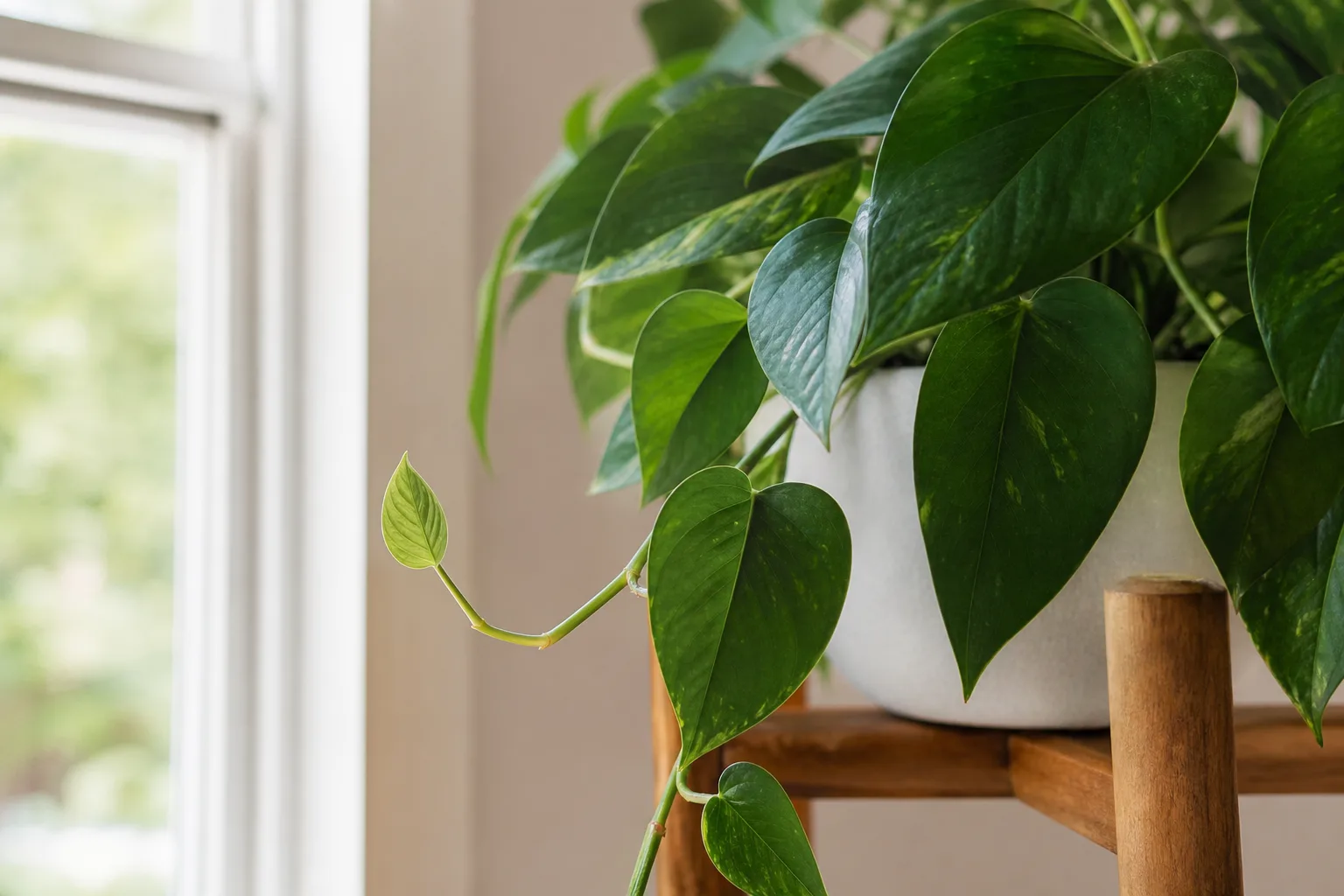
Your plant is pushing out new growth, but each new leaf is smaller than the last. That is one of the most frustrating patterns in indoor plant care because the plant is clearly alive, clearly trying, and still somehow shrinking. The good news is that this pattern almost always has a fixable cause. Small new leaves are not a mysterious plant mood. They are a signal that one or more inputs (light, water, nutrients, root space, or soil condition) have fallen below the threshold needed for full-sized growth.
This guide covers the most common causes across a wide range of indoor plants and walks you through a diagnosis sequence that catches the biggest bottleneck first. Fix that, and the next new leaf will usually tell you if you are on the right track.
Quick Answer: The Five Most Common Reasons
If your indoor plant is producing progressively smaller new leaves, one of these five bottlenecks is usually responsible:
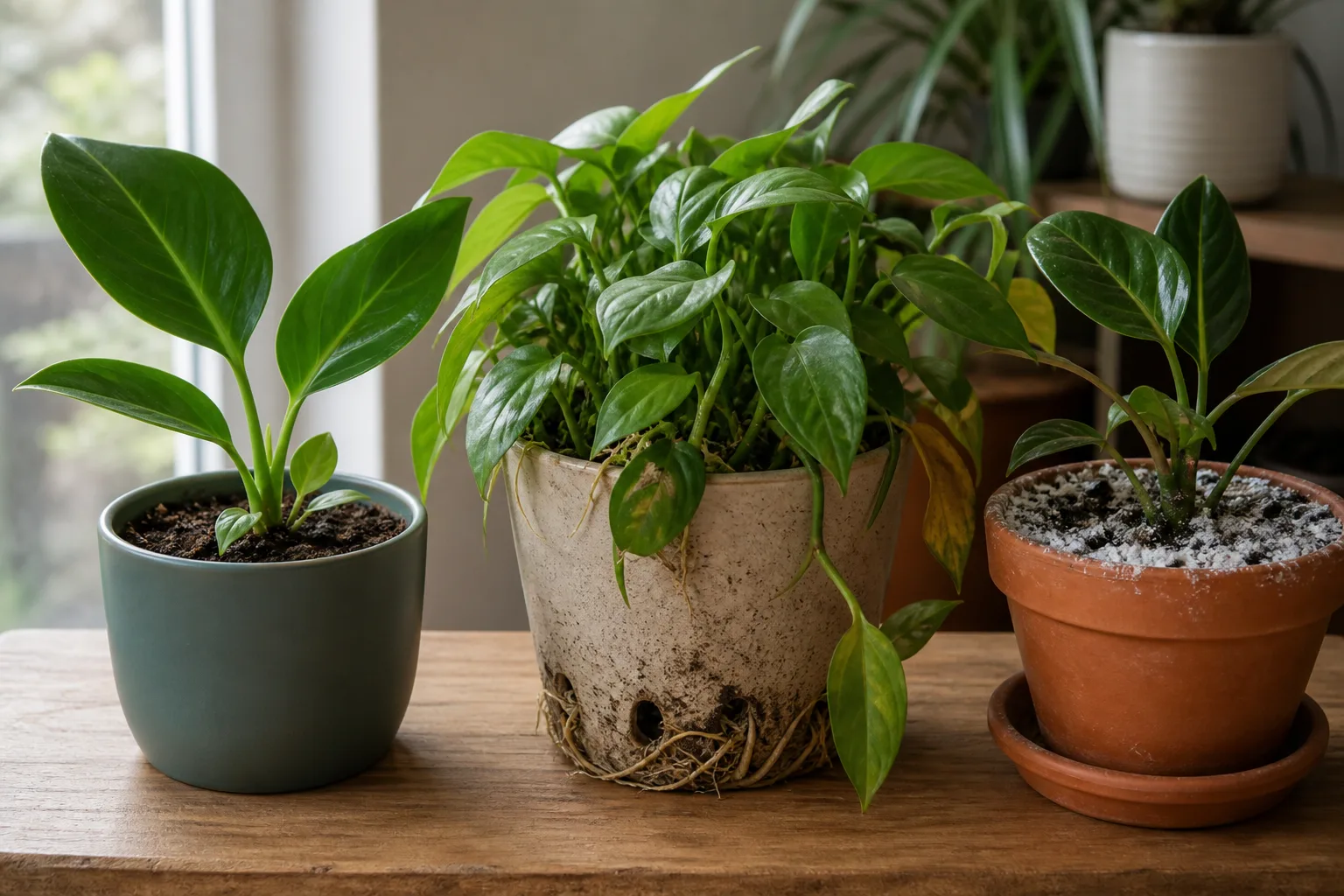
- Not enough usable light. The plant cannot generate enough energy to build full-sized leaves. This is the most common cause, and unlike many problems, it often produces no other visible symptoms besides smaller growth.
- Nutrients are depleted. Old potting mix has run out of available nutrients, especially nitrogen, which drives leaf development.
- The pot is root bound. Roots have filled the container so densely that water and nutrient uptake is restricted, and the plant cannot support larger foliage.
- Mineral salts have built up in the soil. Tap water and fertilizer leave behind dissolved salts that accumulate over time, stressing roots and reducing growth.
- Watering is inconsistent or excessive. Overwatering damages roots and limits nutrient uptake. Underwatering causes drought stress that shrinks new growth.
Work through them in that order. Light is the highest-leverage fix in most homes, followed by nutrients and root space. Salt buildup is the one most people never check.
Diagnose the Problem in 5 Minutes
Before you change anything, run these four checks. They will surface the most likely bottleneck without expensive tools.
Check 1: Light at the Leaf Canopy
Stand where the plant sits and look up at your light source. Can the leaves see the sky, or at least a large patch of bright window? Or is the plant tucked deep in a room where the brightest thing is a lamp across the hall? University of Maryland Extension notes that insufficient light causes spindly, weak growth and that light intensity drops rapidly with distance from a window (University of Maryland Extension).
A plant that was purchased from a greenhouse with optimal light and placed in a dim corner will often produce increasingly smaller leaves as it adjusts to the lower energy budget. If your plant has been in the same spot for months and new leaves are shrinking, light is the first variable to test. Move the plant closer to a bright window or add a grow light, then watch the next two or three leaves for improvement.
Check 2: When Did You Last Repot or Replace Soil?
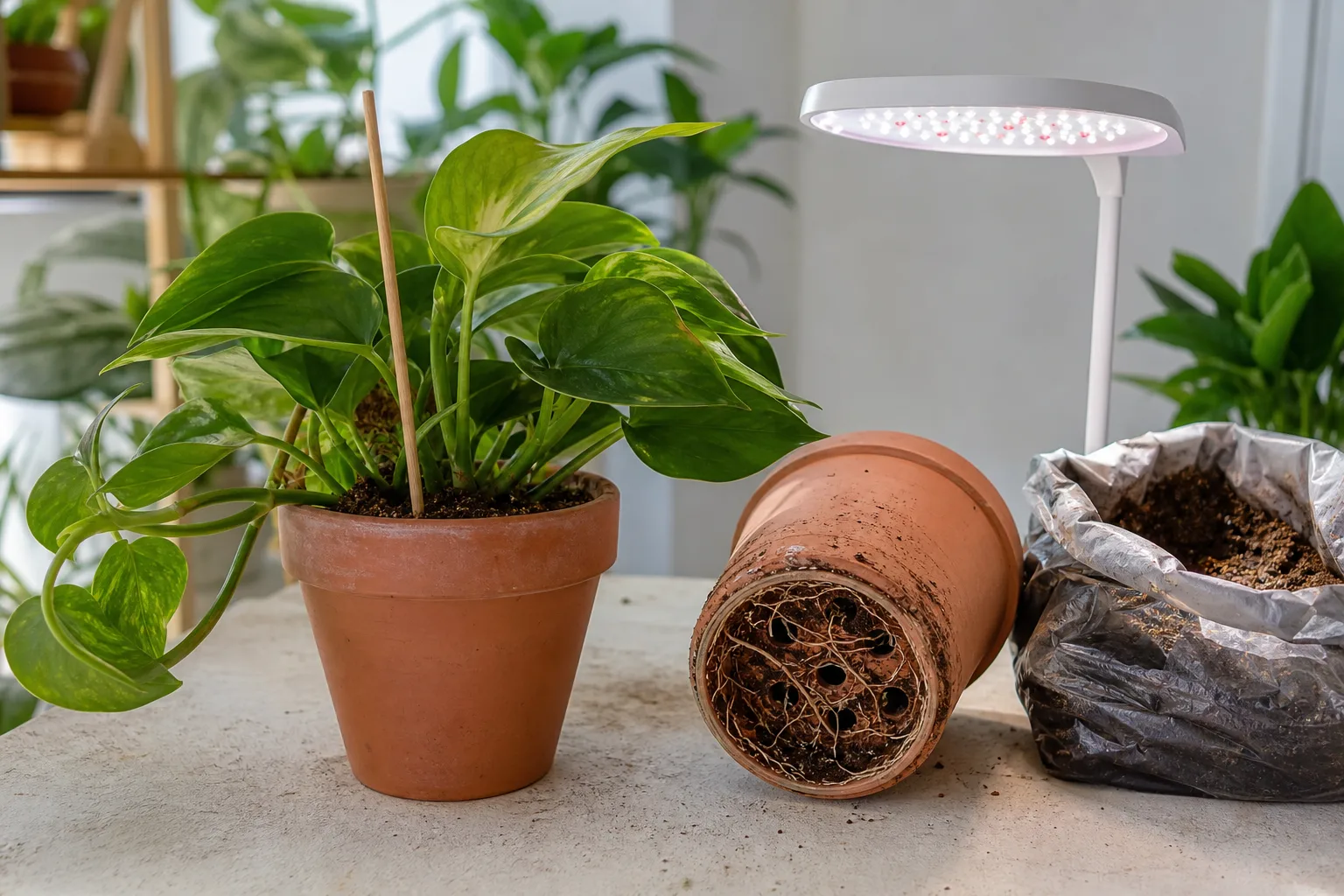
Lift the pot and look underneath. Are roots poking through drainage holes? Does water run straight through without soaking in? Slide the root ball out gently. If roots are circling the inside wall in a tight mat, the plant is root bound. University of Arkansas Extension states directly: when plants start producing small leaves and almost no new growth, repotting is needed (University of Arkansas Extension).
Also check for a white or yellowish crust on the soil surface or around the rim of the pot. That is accumulated mineral salts from tap water and fertilizer. These salts draw water out of roots through osmosis and can damage root tips, reducing the plant’s ability to take up both water and nutrients. University of Arkansas Extension advises that if a salty crust is visible, repot and replace as much of the soil as possible (University of Arkansas Extension).
Check 3: How Old Is the Potting Mix?
Potting mix is not permanent. Over six to eighteen months, organic components break down, the mix compacts, and available nutrients are either used up by the plant or washed out through repeated watering. University of Missouri Extension lists small new leaves as a documented symptom of poorly drained or compacted soil, and recommends a blend of sphagnum peat, vermiculite, and perlite for healthy root growth (University of Missouri Extension). If you have not refreshed the soil in over a year and new leaves are shrinking, nutrient depletion or compaction is a strong suspect.
Check 4: Watering Pattern and Root Health
Push a finger or a wooden skewer about five centimetres into the soil. Is it consistently wet several days after watering? Does the pot feel heavy? Overwatering is the most common houseplant mistake, and University of Maryland Extension identifies yellowing of lower leaves and poor growth as primary symptoms (University of Maryland Extension). Roots sitting in saturated media cannot absorb nutrients efficiently, even if nutrients are present in the soil.
If the soil is bone dry, pulls away from the pot sides, and repels water when you try to wet it, the plant may be chronically underwatered or the mix may have become hydrophobic. Either way, the root zone is not getting consistent moisture, and new leaves will reflect that stress.
Cause 1: Not Enough Usable Light
This is by far the most common reason new leaves come in small, and it is easy to miss because the plant often looks otherwise fine. Light is the primary energy input for photosynthesis. When light is insufficient, the plant cannot produce enough carbohydrates to build full-sized leaves. It prioritizes survival over size.
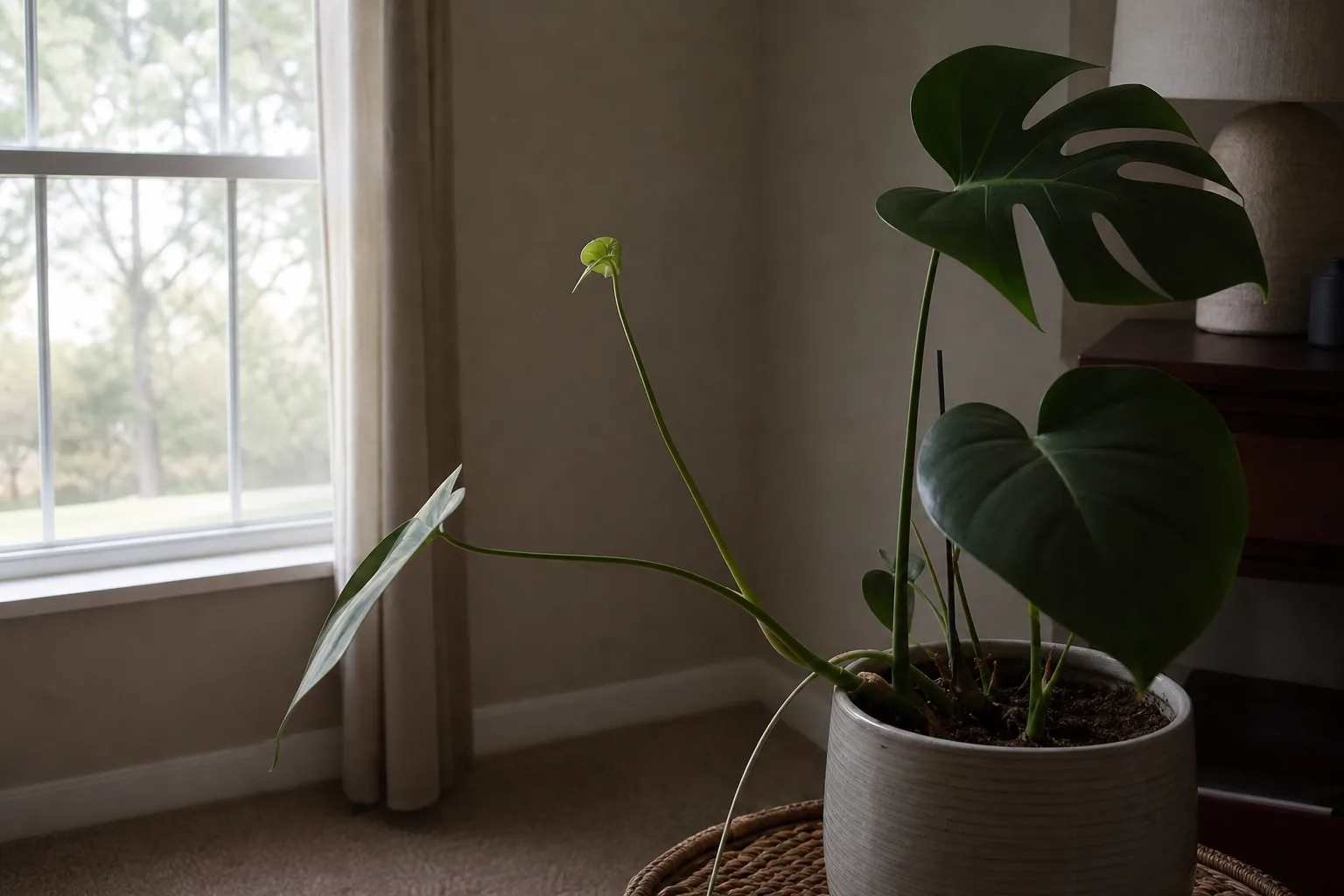
The signs are subtle. Unlike overwatering, there is no yellowing. Unlike pests, there is no visible damage. The plant simply produces progressively smaller leaves, often with longer spaces between them on the stem. Montana State University Extension notes that many growth issues including stunting can mimic nutrient deficiencies when the real cause is environmental stress (Montana State University Extension). Before you reach for fertilizer, test light.
The fix is straightforward: move the plant closer to a bright window or add a full-spectrum grow light. Acclimate gradually over a week or two to avoid sunburn. South- and east-facing windows typically provide the most usable light indoors. If your only option is a north-facing window or a dim room, a grow light run for ten to twelve hours a day can make the difference. Judge the result on the next two or three new leaves.
Cause 2: Nutrient Depletion
Potting mix is not soil. It is a soilless blend of peat, coir, perlite, bark, and other ingredients designed for drainage and structure. It contains very limited nutrient reserves, and those are typically exhausted within a few months of planting. If you have not fertilized or refreshed the mix in six months or more, your plant may simply be running out of food.
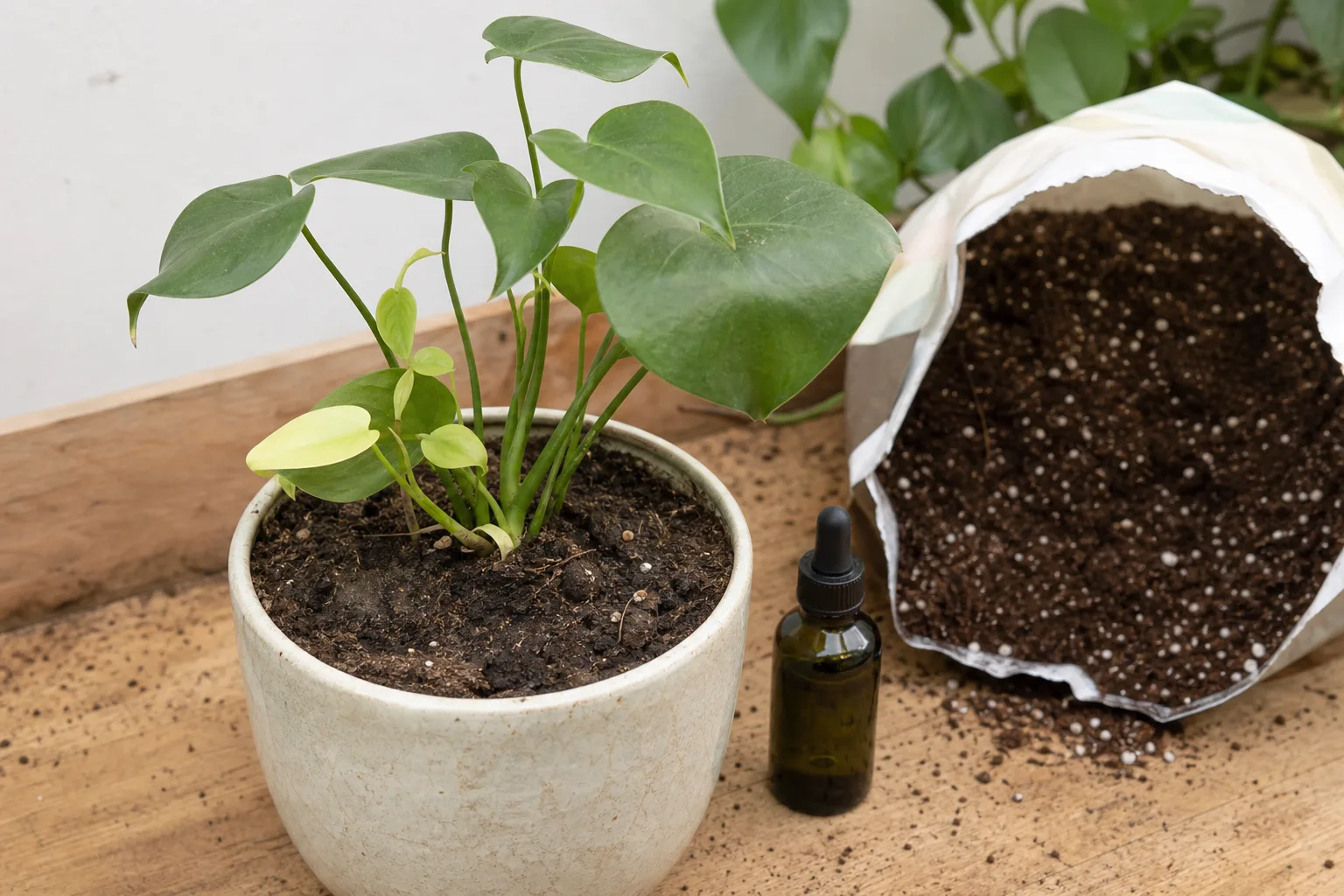
Nitrogen is the nutrient most directly tied to leaf size and green color. West Virginia University Extension explains that nitrogen deficiency typically causes overall stunting and yellowing of older leaves first, because nitrogen is mobile within the plant and is pulled from old growth to support new growth (West Virginia University Extension). If old leaves are fading while new leaves stay small, nitrogen is a likely gap.
Use a balanced houseplant fertilizer at half to quarter strength during the active growing season. Do not fertilize a stressed, overwatered, or recently repotted plant. The goal is to restore a steady nutrient supply, not to force growth with a heavy dose. If you suspect salt buildup from previous fertilizing, leach the pot first (see Cause 4) before resuming a moderate feeding program.
Cause 3: Root-Bound Pot
A root-bound plant has outgrown its container. The roots form a dense, circling mass that cannot expand into fresh media. Water channels through the gaps rather than soaking the root ball. Nutrient uptake becomes inefficient because there is little fresh mix left to hold nutrients or moisture.
University of Arkansas Extension lists small leaves and stalled growth as clear signs that repotting is overdue (University of Arkansas Extension). The fix is to move the plant to a pot that is roughly five centimetres larger in diameter, using fresh potting mix. Gently loosen the outer roots if they are tightly circling. Do not jump to a dramatically larger pot; excess wet media around a modest root system can cause new overwatering problems.
The best time to repot is late winter or early spring as natural light levels increase and plants enter their active growth phase. However, a severely root-bound plant that is visibly suffering should be repotted regardless of season.
Cause 4: Salt Buildup in the Soil
This is the stealth cause that most indoor gardeners never check. Every time you water with tap water, dissolved minerals (calcium, magnesium, sodium, and others) enter the potting mix. When water evaporates or is taken up by the plant, those minerals stay behind and accumulate. Fertilizer salts add to the load. Over months, the concentration can reach levels that damage roots, reduce water uptake, and stunt new growth.
The visible clue is a white, yellow, or crusty deposit on the soil surface, pot rim, or drainage holes. But salt buildup can also be present without visible signs. If small new leaves are accompanied by brown leaf tips or edges, especially on sensitive plants like spider plants, dracaena, and calathea, accumulated salts are a strong possibility.
The fix is leaching: slowly pour a large volume of water through the pot (roughly twice the pot’s volume), allowing it to drain completely. Do this over a sink or outdoors, and never let the pot sit in the drained water. Repeat every four to six months as preventive maintenance. If the crust is heavy, scrape off the top layer of soil first, then leach, or repot entirely with fresh mix. University of Arkansas Extension recommends replacing as much soil as possible when a salt crust is present (University of Arkansas Extension).
Cause 5: Watering Problems
Both overwatering and underwatering can produce smaller new leaves, but the mechanism and the fix are different.
Overwatering damages roots by depriving them of oxygen. Damaged roots cannot absorb water or nutrients effectively, even when both are present in the soil. The plant becomes functionally starved. Signs include persistently wet soil, yellowing lower leaves, wilting despite moist media, and a heavy pot. University of Maryland Extension identifies overwatering as a primary cause of poor growth, yellowing, and root rot in indoor plants (University of Maryland Extension). Let the top several centimetres of soil dry out before watering again. If the problem has been ongoing, inspect roots for rot and remove any dark, mushy sections.
Underwatering causes drought stress. The plant conserves water by reducing new growth, and leaves that do emerge are often smaller, sometimes with brown, crispy edges. The pot feels light, soil pulls away from the sides, and water may bead up and run off without penetrating. Rehydrate slowly by bottom-watering or by watering in several small passes so the mix can absorb moisture throughout. Do not compensate for one dry spell by keeping the plant constantly wet.
What About Climbing Plants?
Some vining and climbing plants (Monstera, Philodendron, Pothos, Syngonium, Hoyas) naturally produce smaller leaves when they trail downward or lack support. This is not a health problem in the same category as the five causes above; it is a growth habit. These plants evolved to climb, and when they cannot, the unsupported vine often produces smaller, more juvenile-looking leaves.
If you have a climbing species that is otherwise healthy but producing small new leaves on long, unsupported vines, the fix is structural rather than nutritional. Add a moss pole, trellis, or other support and train the vine upward. This often triggers a return to larger, more mature foliage on subsequent growth. If the plant is a Monstera, the Monstera not splitting leaves guide covers the light-plus-support dynamic in detail.
Temperature and Humidity
Extreme temperature or very low humidity can contribute to smaller new growth, but these are rarely the primary cause in typical indoor environments. University of Missouri Extension notes that flowering plants do best at 65 to 75 degrees F during the day and 55 to 60 degrees F at night, and that foliage plants thrive between 65 and 70 degrees F (University of Missouri Extension). If your plant sits beside a drafty winter window or directly in the path of an air conditioning vent, temperature stress may be compounding other issues.
Low humidity is more likely to show as brown leaf tips, curling, or crispy edges than as dramatically smaller leaves. However, in very dry indoor air, especially during winter heating months, new leaves on humidity-sensitive plants may unfurl smaller or with damaged margins. A nearby humidifier or pebble tray can help, but humidity should be addressed after light, nutrients, and root-zone conditions are sorted.
The Fix Sequence
Follow this order. Each step builds on the previous one, and skipping ahead can create new problems.
- Move the plant into better light. Closer to a bright window or under a grow light. Acclimate gradually. Judge the next two or three new leaves.
- Check the roots and pot. If root bound, repot one size up with fresh mix. If salt crust is visible, leach the pot or repot with fresh soil.
- Evaluate the potting mix. If the mix is over a year old, compacted, or depleted, repot with fresh, well-draining houseplant media.
- Correct the watering routine. Water thoroughly when the top several centimetres are dry, not on a fixed schedule. Let excess drain completely. Never let the pot sit in runoff.
- Resume moderate fertilizing. Only after the plant is in adequate light, has healthy roots, and is in fresh or refreshed soil. Use a balanced houseplant fertilizer at half to quarter strength during the growing season.
Improvement shows up on new leaves, not on the undersized ones already on the plant. Expect the first new leaf after corrections to be slightly larger, the second noticeably so, and the third or fourth to approach the plant’s potential for your conditions. If you see no improvement after two or three new leaves, revisit light and root health. Those are the two variables that matter most.
When to Consider Pests
Pests are not usually the primary cause of progressively smaller leaves, but a heavy infestation can weaken a plant enough to reduce new growth size. Check leaf undersides for spider mite webbing, stippling, or moving specks. Look for scale insects on stems and leaf veins. Examine new growth tips for aphids or thrips. If you find pests, treat them before addressing other variables, because a plant under active pest pressure will not respond normally to care improvements. The indoor plant pest guide covers identification and treatment.
Related Guides
- How to water indoor plants the right way — moisture checking, drainage, and avoiding the over/under cycle.
- Repotting houseplants — when, how, and what size pot to use.
- Fertilizing indoor plants — complete feeding guide across seasons and plant types.
- Best potting mix for indoor plants — soil ingredients that support healthy root zones.
- Save a dying houseplant — when small leaves are part of a broader decline.
- Signs your houseplants need more humidity — when dry air is compounding the problem.
Conclusion
Small new leaves are a signal, not a personality trait. The plant is telling you that its current conditions cannot support the leaf size you expect. Start with light because it is the easiest variable to misjudge indoors and the one that costs nothing to test. Then check the pot, the roots, and the soil. Fix the biggest bottleneck first, judge the next few leaves, and adjust from there.
The pattern you want to see is not instant giant leaves. It is a trend: each new leaf slightly larger than the last. That trend means your diagnosis was correct and the plant is responding. If the trend stalls or reverses, run the diagnosis again. The bottleneck may have shifted.