10 Elm Tree Species to Know for Your Yard
Compare 10 elm tree species by size, range, disease risk, and landscape fit, then learn how to identify elms and choose a tree suited to your site.
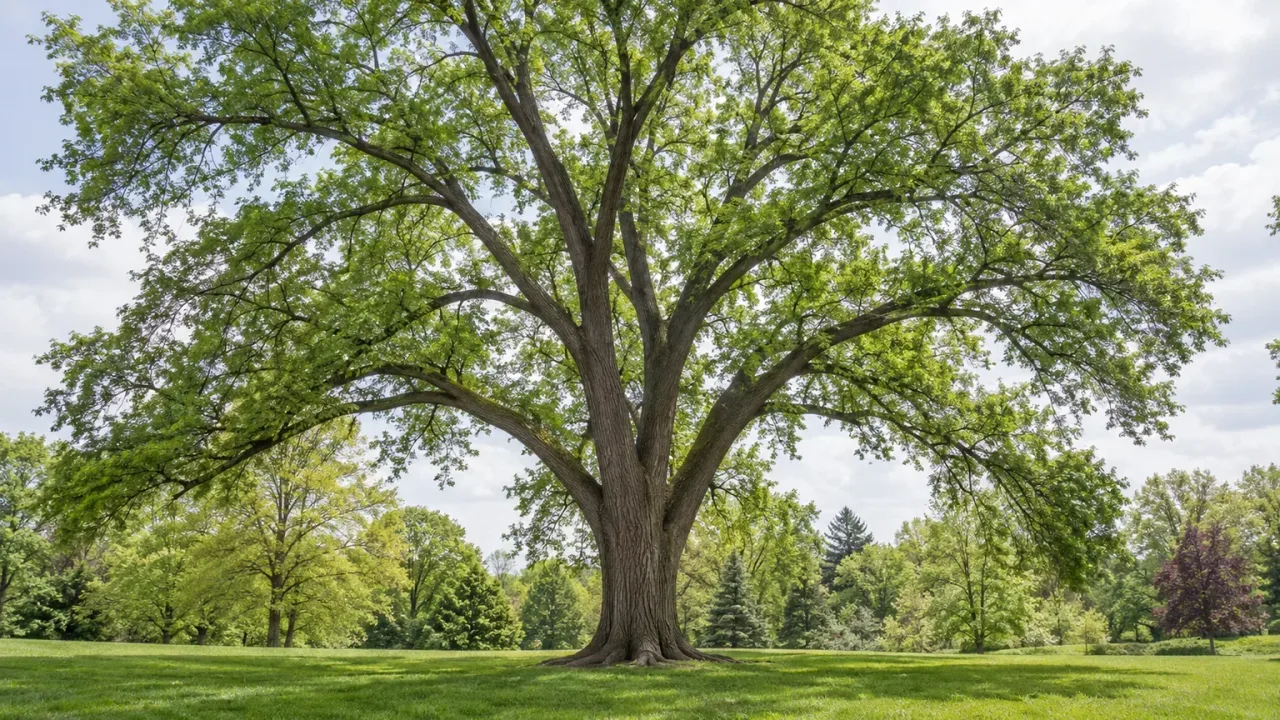
Elm trees belong to the genus Ulmus, a group of deciduous trees whose familiar features include alternating leaves, toothed edges, and small, flat, often roundish seeds called samaras. Those traits make an elm recognizable as a group, but they do not tell you which species you have: leaf size, bark, crown shape, habitat, and even the samara’s stalk can differ considerably. Common names also overlap, so a botanical name is the safest way to compare a nursery label with a reference.
This guide compares 10 elms by the details that matter in a yard: how to recognize them, where they grow naturally, their likely size or habit, and the trade-offs that can make one a poor fit. It also clarifies a frequent listicle wrinkle: Camperdown elm is a cultivated, grafted form of wych elm, not a separate wild species.
A quick way to recognize an elm
Look at several mature leaves on a twig, not just one leaf that may be damaged or unusually small. Elm leaves are usually arranged alternately rather than in opposite pairs; many are oval with a pointed tip and conspicuously uneven halves at the base, where one side of the leaf blade begins lower than the other. The margins are toothed, and in many species the teeth are doubled, with smaller teeth along the larger ones. These are useful clues, but they are not a stand-alone species key.
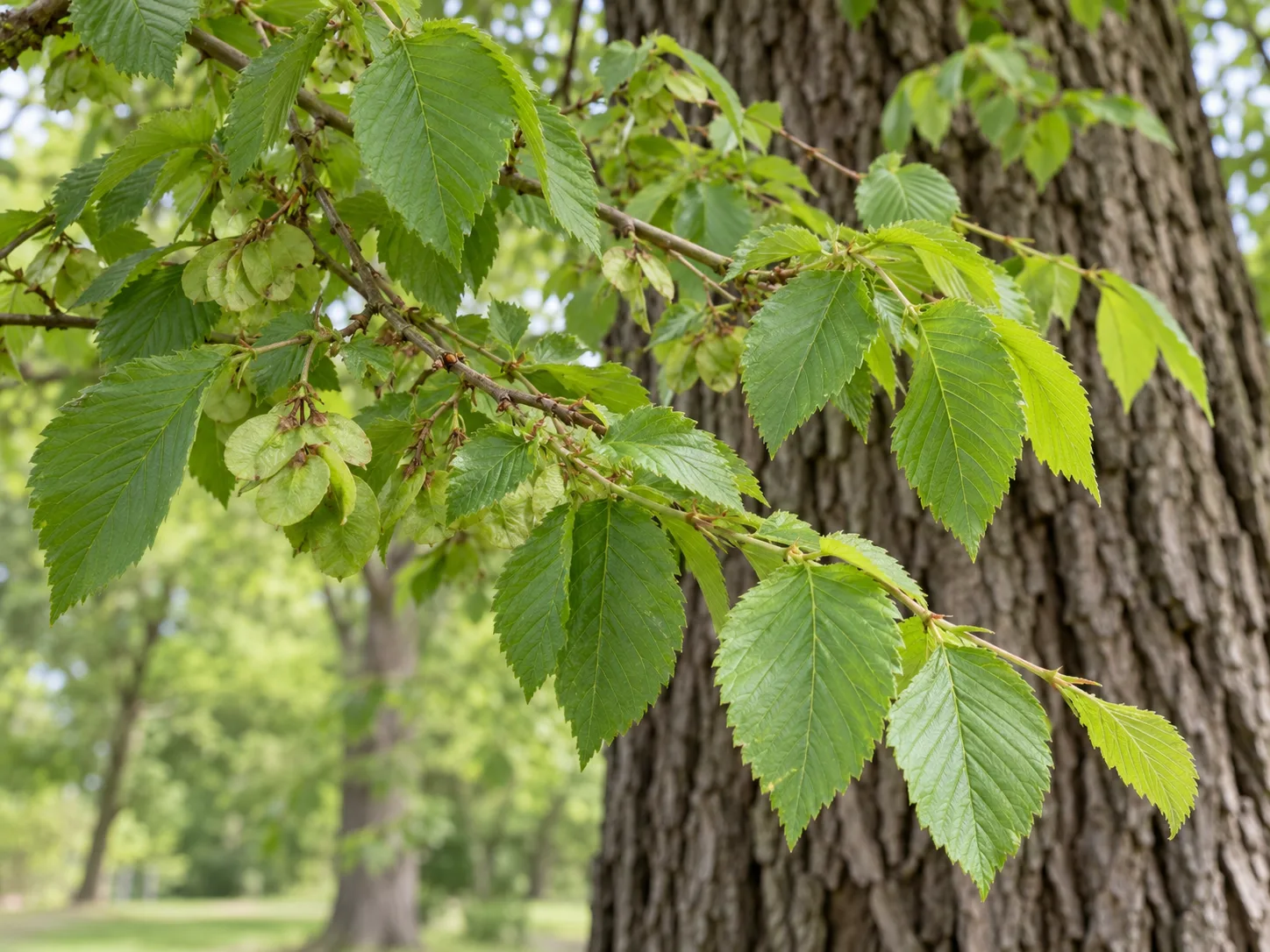
Check the bark and fruit as well. Most elms form ridged or furrowed bark with maturity, while Chinese elm is known for peeling, mottled patches; young bark can look quite different from old bark. Elm samaras are small, flat, papery discs or ovals with a seed near the center or toward one end, unlike the winged helicopter fruits of maples. In European white elm, the samaras hang on stalks and have a fringed, hairy edge, a more distinctive clue than leaf shape alone. Trees and Shrubs Online’s account of European white elm notes these conspicuously stalked fruits.
For a dependable identification, record where the tree grows, its approximate mature size, whether the leaves feel smooth or rough, and what the fruit looks like. Take clear photos of a whole branch, both leaf surfaces, bark, and seeds, then compare them with a regional flora or ask a local extension office. A seedling in a vacant lot may be a naturalized elm, not a locally native species, and common names such as “Russian elm” can refer to different trees in different references.
How to use this guide to pick a tree
Start with the place you have, rather than with a favorite species name. Measure the available canopy space, note overhead wires and nearby structures, and check whether the soil stays saturated or dries quickly. Then narrow the choices by local disease pressure and whether the tree is native or prone to unwanted seedlings in your area.
The profiles below are not a universal ranking. A tree that tolerates drought or urban pollution can still have weak branches or spread beyond a garden; a wet-site species may not thrive in a small dry planting strip. Regional extension recommendations and local invasive-plant guidance should outweigh a broad national list when the choice is close.
1. American Elm (Ulmus americana)
American elm is the classic large North American shade tree: its trunk rises into arching limbs that form a high, vase-shaped crown. Mature trees commonly reach roughly 60 to 80 feet, though space, climate, and growing conditions change the result. Look for a large, rough-textured leaf with a distinctly uneven base and doubly toothed edge; mature bark develops deep, interlacing ridges. NC State Extension describes the species’ vase-like form and those leaf characteristics in its American elm profile.
Choose American elm when a broad shade canopy and a locally native tree are priorities and the site can hold a large tree over its full life. Dutch elm disease devastated many mature elms, but selected cultivars have improved resistance and are used in restoration and landscape planting. Ask which cultivar is available, what resistance evidence applies to it, and whether it performs locally; “resistant” does not mean immune, and a new tree does not recreate the mature canopy lost to disease overnight.
2. Camperdown Elm (Ulmus glabra ‘Camperdownii’)
Camperdown elm is a compact, weeping cultivar of wych elm, typically formed by grafting its cascading branches onto a trunk. Its umbrella-like canopy can be wider than the tree is tall, creating a dramatic focal point in a lawn or garden where there is room for branches to sweep outward. It is a useful choice when you want elm foliage and sculptural form at a smaller scale than a full-size wych elm, rather than a substitute for a tall shade tree.
The graft is a practical care consideration: inspect the union for damage, keep the graft above the soil, and maintain the support stake only as long as the nursery or local arborist advises. Branches may droop close to the ground, so avoid paths where they will obstruct access or be repeatedly clipped. Like other wych elms, it can be vulnerable to Dutch elm disease; buy from a reputable nursery and ask about the health of the cultivar and rootstock. Trees and Shrubs Online describes ‘Camperdownii’ as a grafted, distinctive weeping form.
3. Cedar Elm (Ulmus crassifolia)
Cedar elm is a strong candidate for parts of the South and central United States, especially Texas and Oklahoma, where it is valued for handling heat, periodic drought, and challenging urban conditions once established. Its small leaves are among the most compact in the genus, and its rounded crown can work well as a street, park, or lawn tree when planted with enough soil volume. The common name comes from its frequent association with junipers historically called cedars; it is not a true cedar.
This is still a substantial tree, not a small-yard solution, and tolerance is not a license to neglect establishment watering. Cedar elm can be affected by Dutch elm disease, so local risk matters even in regions where it is a dependable street tree. Oklahoma State University Extension’s cedar elm profile is especially useful for regional suitability; elsewhere, check with a local extension service before assuming its heat and drought performance will transfer to a different climate.
4. Cherry-bark Elm (Ulmus villosa)
Cherry-bark elm is a large Asian elm native to the western Himalaya, including parts of Kashmir. Its common name refers to the bark’s appearance: younger stems can be smooth with visible horizontal lenticels, while older bark becomes furrowed. Its leaves have a rougher texture, and its samaras are often noticeably hairy at the edges. These details make it an interesting tree for arboreta and collectors, but the species is much less familiar in ordinary North American landscapes than American or Chinese elm.
Do not select cherry-bark elm on the assumption that it is Dutch-elm-disease-proof. Older horticultural summaries sometimes describe it as less susceptible, but disease response varies, and specialist dendrology sources record susceptibility and infected specimens. Trees and Shrubs Online’s species account treats it as a rare tree with a disease risk, so source a plant only if a reputable nursery can identify the stock and explain its provenance. For a standard shade planting, a better-documented regional elm may be easier to evaluate and maintain.
5. Chinese Elm (Ulmus parvifolia)
Chinese elm, also sold as lacebark elm, is recognized by small, glossy leaves and exfoliating bark that reveals mottled gray, tan, orange, or greenish patches. It usually develops a rounded crown and can be trained or pruned for different landscape uses; bonsai growers also value its small foliage and ability to respond to pruning. NC State Extension describes Chinese elm as adaptable and relatively resistant to Dutch elm disease in its species profile, while this lacebark elm overview from Gardening Know How covers its ornamental bark and landscape use.
This is often a practical urban option where a medium-to-large canopy is wanted and American elm disease pressure is a concern. But it is not a miniature tree, and hard pruning should not be confused with a requirement for continual shearing: choose a cultivar and site that fit the intended mature shape, then prune selectively for structure. In warmer areas, seedlings may appear where samaras land; check local naturalization concerns and remove unwanted seedlings while small. “Lacebark” is more precise than “Chinese” in some nursery contexts, but verify the botanical name because common names are inconsistent.
6. David Elm (Ulmus davidiana complex)
David elm is best understood as a group of closely related Asian forms whose taxonomy and naming have shifted among horticultural references. This matters because nursery plants may be labeled with a variety, selection, or hybrid name rather than simply Ulmus davidiana. It is not always possible to compare one “David elm” listing directly with another without checking the full label and parentage.
The species complex is important to elm breeding because some selections show useful Dutch elm disease resistance and have contributed traits to cultivated elms. That does not make every tree sold under a David-elm name equally resistant; resistance belongs to particular genetic material, not to a loose common name. Trees and Shrubs Online’s U. davidiana account discusses the species complex and its horticultural varieties. For a landscape planting, ask the nursery for the exact selection, expected mature size, and documented disease performance in your region.
7. English Elm (Ulmus procera; often treated within U. minor)
English elm is a large European tree associated with historic hedgerows, parks, and landscapes. It can spread by root suckers, so a single tree may gradually form a colony or send shoots into a lawn; this is a defining management issue, not a minor quirk. Older trees may also develop heavy limbs that fail, which makes this a poor choice for a confined site above a heavily used patio, parking area, or narrow street.
Taxonomy complicates the label: some sources treat Ulmus procera as a distinct species, while other treatments include it within or closely associate it with field elm, U. minor. Trees and Shrubs Online explains the English elm’s history and sucker growth, while NC State’s field elm profile reflects the broader naming complexity. For most home landscapes, English elm is more of a heritage or specimen choice than a default recommendation; confirm identity and plan for sucker management before planting.
8. European White Elm (Ulmus laevis)
European white elm is a tall species of central and eastern Europe that naturally grows in floodplain and riverside settings. Its distinctive samaras hang on long stalks and have a fringed edge, making the fruit especially useful for identification. The canopy can become broad and open, so this is a tree for a large park, estate, or spacious naturalistic planting rather than a tight residential strip.
Its association with wet habitats should not be oversimplified into “it grows in standing water.” Floodplain trees experience periods of inundation alongside periods when soil drains and roots can function; a permanently waterlogged urban planting hole is a different stress. European white elm can still be susceptible to Dutch elm disease, so its floodplain habitat is not a disease-protection guarantee. Trees and Shrubs Online provides the distinguishing fruit details and habitat context.
9. Siberian Elm (Ulmus pumila)
Siberian elm is fast-growing, drought-tolerant, and capable of establishing in poor soils, qualities that helped it become common in harsh or neglected sites. Its small leaves and rapid growth may sound attractive when a homeowner wants quick shade, and it has better Dutch elm disease resistance than American elm. However, fast growth can come with weak branches, messy seed production, pest problems, and repeated volunteer seedlings.
In several parts of North America, Siberian elm is considered invasive or highly weedy, but its legal status and ecological impact are regional. Do not plant it just because it survives where little else grows; first check your state or provincial invasive-plant list and nearby natural areas. NC State Extension’s Siberian elm profile notes both its resistance and its drawbacks, including naturalization concerns. If a resilient elm is the goal, compare a locally recommended cultivar before choosing the most aggressive grower.
10. Slippery Elm (Ulmus rubra)
Slippery elm is a North American native named for the mucilaginous inner bark, which becomes slick when moistened. Its leaves are large, rough above, and often feel sandpapery; the tree forms a medium-to-large crown in forests, woodland edges, and other suitable native settings. It has ecological value as part of native habitat, but that does not automatically make it a low-risk specimen tree for every yard.
Slippery elm is susceptible to Dutch elm disease, and its seedlings may not be easy to find in mainstream nurseries. Consider it when restoring native woodland or supporting regional biodiversity, especially where local guidance recommends it and the site has enough room. Do not harvest inner bark from a living tree; bark removal can injure or kill it, and wild plants should be left intact. NC State Extension’s slippery elm profile describes its native status and disease susceptibility.
Compare these elms by planting purpose
The table is a first screen, not a final species prescription. Mature dimensions vary by cultivar and growing conditions, and “tolerates” does not mean a tree will thrive without adequate root space, water during establishment, and local disease management.
| If your priority is… | Start by comparing… | Main caveat |
|---|---|---|
| A native, high-arching shade canopy | American elm | Large mature spread; choose a locally tested resistant cultivar where DED occurs |
| A weeping ornamental for a lawn | Camperdown elm | Grafted form needs room for cascading branches and attention to the graft |
| A tough regional tree in Texas or Oklahoma | Cedar elm | Still grows large and can contract DED |
| Mottled, peeling bark and urban adaptability | Chinese elm | Confirm mature size and check local seedling or naturalization concerns |
| A research or arboretum planting | David elm selections or cherry-bark elm | Exact identity and disease performance may be difficult to verify |
| A wetland-edge planting in its native range | European white elm | Flood tolerance is not the same as permanent waterlogging; DED is still possible |
| A fast-growing tree for neglected ground | Siberian elm only where locally appropriate | Volunteer seedlings, weak limbs, and invasive behavior can outweigh hardiness |
| A native habitat or woodland planting | Slippery elm | DED susceptibility and availability matter |
For a small yard, none of the large upright species should be treated as automatically “small” because a young nursery tree looks compact. Camperdown elm is the clearest ornamental exception in this group, although its broad, low canopy still needs clearance. If no elm matches the space you have, choose a smaller tree that will fit without continual crown reduction.
Dutch elm disease: what “resistant” actually means
Dutch elm disease (DED) is caused by fungi in the Ophiostoma group. Bark beetles can carry the pathogen from infected elm material to healthy trees, and the disease can also move between nearby elms through naturally connected root grafts. The fungus disrupts water movement in the tree, so leaves wilt, yellow, or brown and branches may die back; those symptoms overlap with drought and other problems, so a diagnosis should not rely on leaf color alone. NC State Extension’s disease guide explains the beetle and root-graft routes.
Species and cultivars differ in susceptibility, but no broad statement such as “this elm is resistant” guarantees immunity in every location or under every disease pressure. A resistant cultivar can still be infected, and resistance claims should be tied to a named, documented selection. Ask a nursery which cultivar it is selling and whether local arborists or extension specialists recommend it where DED is active.
Prevention is partly a neighborhood problem: infected trees and fresh elm wood can support beetle populations, while root grafts connect some neighboring trees underground. If a mature elm shows rapid wilt or unexplained branch death, contact a certified arborist or extension office promptly rather than pruning randomly or moving firewood from a suspected infected tree. Follow local guidance for diagnosis, pruning windows, sanitation, and removal, because beetle timing and regulations vary by region. A homeowner can reduce stress with sound planting and watering, but cannot guarantee that a susceptible elm will escape infection.
Planting and siting: avoid a poor fit
Before buying, estimate the canopy at maturity, identify overhead wires and hardscape, and check whether the species is locally recommended or flagged as invasive. Then look at the actual site: does water drain after rain, how much sun does it receive, and can a large tree’s roots occupy unpaved soil beyond the planting hole? A tree labeled drought-tolerant still needs regular attention while its root system establishes.
Plant the root flare at or slightly above finished grade, spread or cut circling roots as recommended for the stock, and make the hole wider than the root ball without making it deeper. Backfill with the excavated soil unless a soil test or local expert gives a specific reason to amend it; rich amendments isolated in the hole can discourage roots from expanding into surrounding soil. Water thoroughly after planting, then monitor soil moisture near the root ball instead of relying on a fixed calendar that ignores rain, heat, and soil texture.
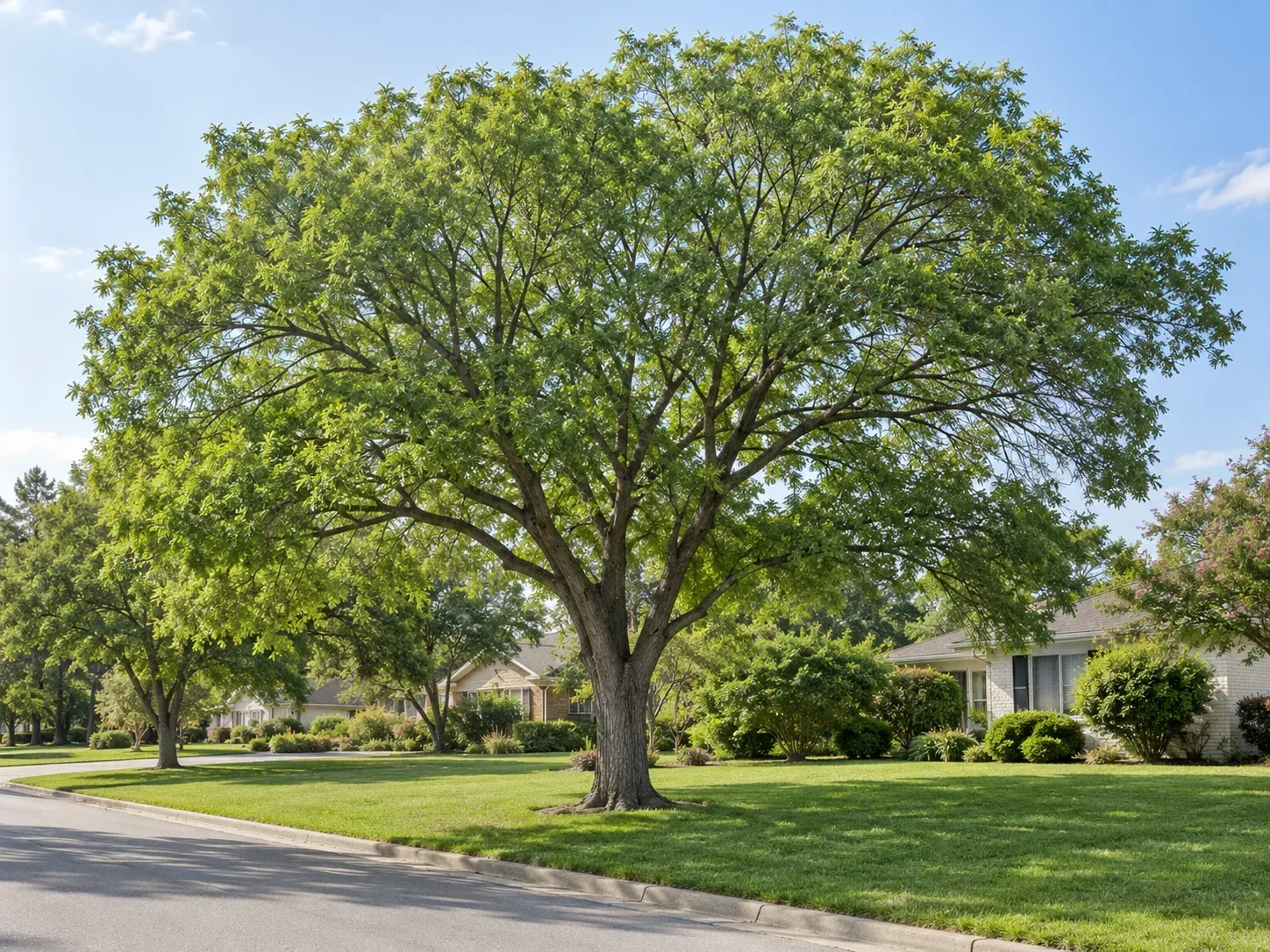
Spread a shallow layer of organic mulch over the root zone, keeping it several inches away from the trunk. Do not pile mulch against bark or bury the flare, because constant moisture at the trunk can create problems and conceal root defects. Avoid turf competition close to a young tree and do not trench or pave through the area where its future roots need to grow.
Prune for structure while branches are small, removing damaged, crossing, or poorly attached growth with clean cuts and a species-appropriate plan. Do not top an elm to keep it smaller; topping creates large wounds and weak regrowth while leaving the underlying space problem unsolved. For mature trees, disease diagnosis, major limb work, and work near utilities belong to a qualified arborist.
Conclusion
Elm trees share a recognizable leaf-and-samara pattern, but the 10 profiles here differ sharply in size, habitat, disease response, and landscape behavior. American elm offers the classic native shade-tree shape, Chinese elm combines mottled bark with urban adaptability, cedar elm suits some hot southern regions, and Camperdown elm brings a weeping form; Siberian elm’s toughness may be outweighed by weak limbs and invasive spread, while European white elm is better matched to spacious, moist landscapes.
Use botanical names to avoid common-name mix-ups, verify a cultivar’s disease claims, and check local extension or invasive-plant guidance before buying. The best elm is the one whose mature canopy, health risks, and growth habits fit the site you can actually provide.



