Decorating With Fake Plants: 5 Practical Design Tips
Learn how to decorate with fake plants, disguise the nursery pot, mix faux and live greenery, and avoid the shiny, crowded look that gives them away.
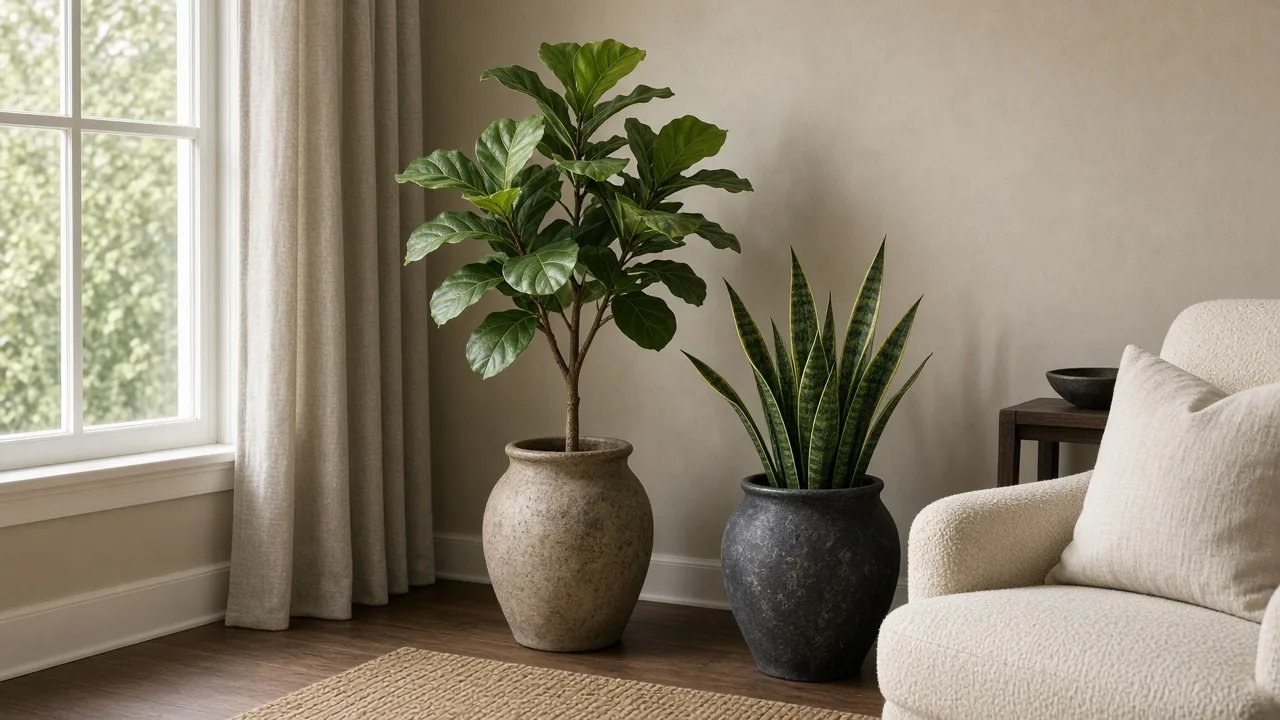
Fake plants look convincing when the whole setup makes sense: the plant’s shape fits the room, its leaves look believable at normal viewing distance, and the pot feels like part of the décor. A realistic-looking artificial plant in a tiny nursery pot can still read as a prop; a simpler faux stem in a well-chosen vessel can feel completely at home.
Use these five tips as a sequence. Decide what the greenery should do, choose foliage that suits the scale, finish the base, then place it where it belongs. The goal is not to fool someone examining a leaf from six inches away. It is to make a room feel considered rather than decorated with a random plastic object.
1. Choose a plant shape that fits the room and its scale
Start with the job you want the plant to do, not the species name or trend. A tall floor plant can soften a bare corner and balance a sofa; a trailing stem can break up a row of books; a compact plant can finish a console that already has room for it. That function tells you how much height, width, and visual weight the plant needs before you compare leaf details.
Start with the job the greenery needs to do
Stand at the room entrance and identify the spot that looks unfinished. If the room needs height, look for a plant with a distinct upright trunk or a narrow, vertical silhouette. If a shelf feels rigid, a trailing form adds movement; if a wide tabletop feels empty, a low, rounded plant may make more sense than a miniature tree.
The useful question is not “Which plant is most realistic?” but “Which outline belongs in this space?” A fiddle-leaf-fig shape needs enough ceiling clearance and visual breathing room. A small fern-like form disappears beside a large sectional, while a tall specimen jammed between a door and a chair becomes an obstacle instead of a focal point. Gardenista’s houseplant examples use height, depth, and airy placement to change how a room reads, a helpful reminder to consider the outline against the architecture, not just the plant itself Gardenista’s interior examples.
Check the silhouette from the doorway and the seat
Before buying, estimate the finished height, including the planter. Tape that height on the wall or temporarily place a box in the footprint. Check the view from the doorway, the main seat, and the side where people walk; an arrangement that looks balanced in a store can feel oversized at home if it blocks a lamp, narrows a path, or crowds the edge of a television.
Treat the pot and foliage as one composition. A wide, bushy plant usually needs a base with enough visual weight to hold it, while a thin, upright plant can look lost in a broad tub. In a compact apartment, one well-proportioned statement plant often does more than several little plants scattered across every surface. Leave some open space around it so the eye can read the shape.
2. Choose believable leaves, color, and finish
Look at artificial foliage at two distances: across the room, where color and silhouette dominate, and close up, where shine, repeated shapes, and exposed seams give it away. A good candidate has leaves with some variation in tone and angle rather than identical pieces placed in a perfect ring. It does not need to be flawless; a slightly irregular outline is often easier to style naturally than a rigid, symmetrical one.
Inspect the whole plant and one leaf up close
First check the silhouette. Are the branches spaced unevenly enough to look organic? Do leaves face different directions? Does the plant have a few gaps, or is it an impenetrable ball of green? Then inspect the details: leaf edges, veins, stem joints, visible wire, and the point where each branch joins the trunk. Turn it around, because the view from behind may be visible in a room even if the display is planned against a wall.
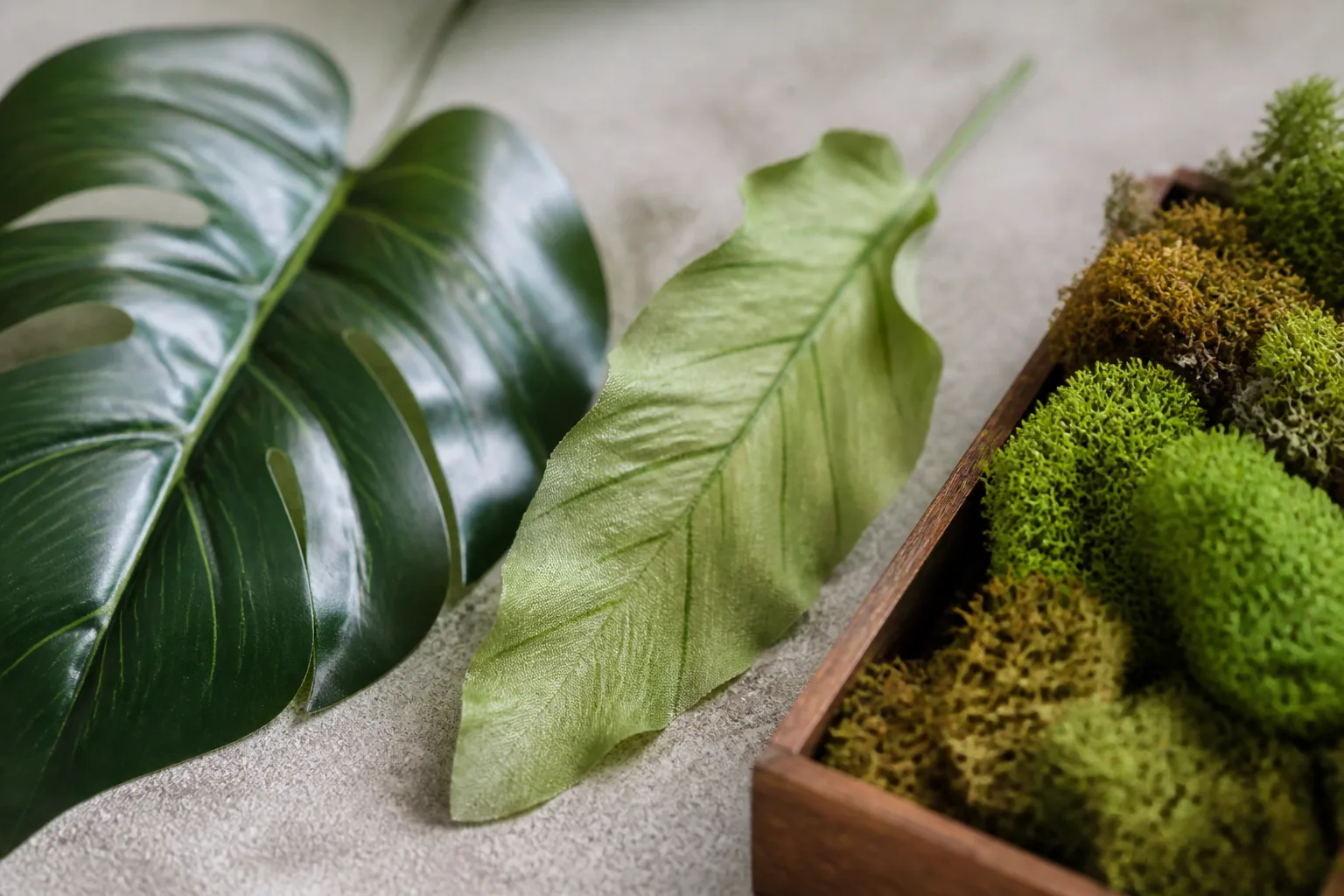
Finish matters most where light catches the surface. Highly glossy foliage can flash under a window or overhead lamp and reveal its material, while a matte finish tends to be easier to blend into a relaxed interior. That is a styling preference, not a hard rule: glossy leaves can suit a polished room if the plant is well made and the reflections are controlled. Check whether color changes across the leaf and whether the stem color matches the foliage; an all-one-shade plant can look flat against natural materials.
When shopping online, write down the plant’s full height and widest spread, then compare those measurements with a sketch or temporary placeholder in your room. A styled product photograph can hide the base or use furniture for scale that is different from yours, so check whether the measurements include the pot. If the listing does not show the plant from more than one angle or explain what the stems are made of, treat realism as uncertain rather than assuming the image tells the whole story.
The close-up in the existing faux-foliage collection is a useful example of what to inspect: surface, color shifts, veins, and how leaves sit beside one another. Do not judge by the product thumbnail alone. If shopping in person, compare the plant with a photo of a real specimen; if shopping online, look for clear close-ups and full-length views rather than a single heavily styled image.
3. Give the plant a convincing container
Many artificial plants come in a lightweight plastic nursery pot or a small weighted base. That piece is useful for transport and stability, but it rarely looks finished on its own. A separate cover pot adds scale, hides the insert, and lets the plant relate to the other materials in the room. Savvy Gardening notes that a container can either contribute to a composition or step back and let the planting lead; the same choice applies here Savvy Gardening’s planter ideas.
Hide the nursery pot with a stable cover pot
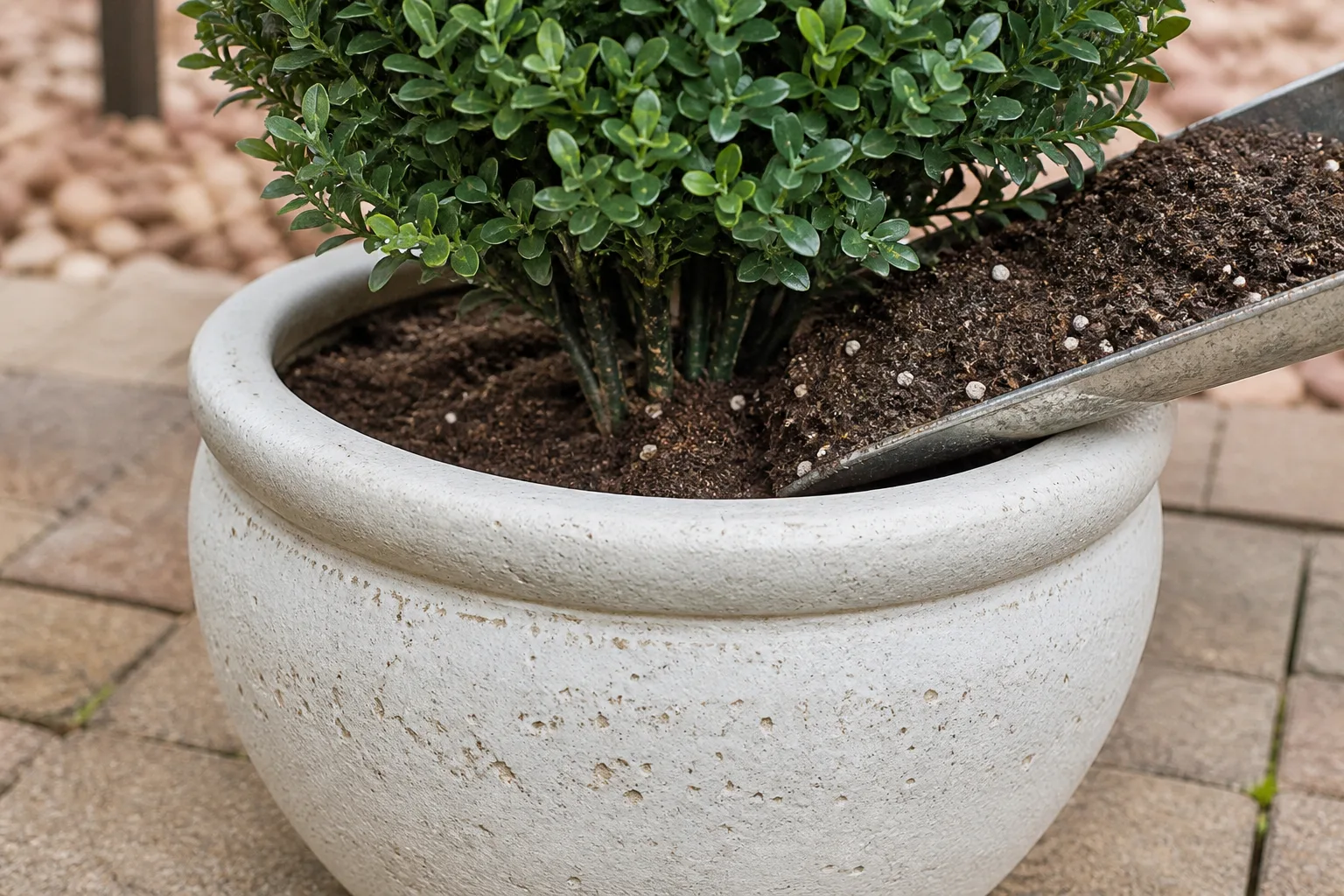
Use the “pot-in-pot” approach when the artificial plant is already assembled. Choose a decorative planter wide and deep enough to hold the original pot, then fill the empty space around it with crumpled kraft paper, packing material, or another clean, dry filler so the insert cannot wobble. Set the plant at a natural height: it should not look as though the trunk has been buried unusually deep or perched above the rim.
Cover the visible plastic with a restrained top dressing. Dry preserved moss, smooth stones, bark, or a small amount of clean potting mix can work, depending on the style and whether the plant is strictly faux. Keep filler dry and avoid adding water or wet soil to a faux arrangement; moisture has no benefit to the plant and can create a mess or affect materials. If you combine a faux insert with a living plant in the same container, keep the real plant’s root zone and watering access separate rather than trapping it behind a plastic base.
Finally, make the vessel proportionate. A slender faux tree often looks more believable in a substantial ceramic pot, basket, or textured planter than in a tiny shiny cup. A small tabletop plant can use a quieter vessel so the leaves remain the focus. The planter should feel chosen for the room—matching a nearby wood tone, repeating a metal finish, or adding contrast—rather than like an afterthought.
4. Put greenery where it makes visual sense
Faux plants do not need the window, but the room still tells a story about where a plant would plausibly live. A leafy tropical shape looks natural beside a bright window or in a layered plant corner; a dark bathroom shelf is a better fit for a compact, shade-tolerant-looking silhouette than a plant that suggests open sun. If you deliberately put a plant where a live one would struggle, make the styling quiet and believable so the convenience does not become the room’s main visual message.
Use light as a realism cue, not a growing requirement
This is one place where artificial and living plants differ. A faux plant can decorate a dark hall, interior bathroom, or shelf far from a window, but a real plant needs conditions suited to its species. The RHS recommends checking a houseplant’s growing needs before placing it and notes that light, temperature, humidity, and water all shape where a living plant will thrive RHS houseplant growing guidance. Even shade-tolerant plants need some light for photosynthesis RHS light guidance.
Use that distinction to make better choices: match a faux plant’s appearance to the visual conditions of its location, while remembering it does not have the biological requirements of its living counterpart. A sculptural cactus in a dark, windowless bath may look incongruous even though it will not suffer there. A trailing green plant on a dim shelf may feel more plausible. Near a bright window, inspect how the leaf finish reacts to glare; if the maker labels the piece indoor-only, do not assume it can handle direct sun or outdoor exposure.
Place the plant where it can be seen without looking staged. Empty corners, the end of a console, a shelf that needs a soft edge, or a space beside a reading chair are usually stronger choices than lining every windowsill. Turn the plant slightly off center and adjust a few stems so the silhouette relates to the room instead of facing the viewer like a showroom sample.
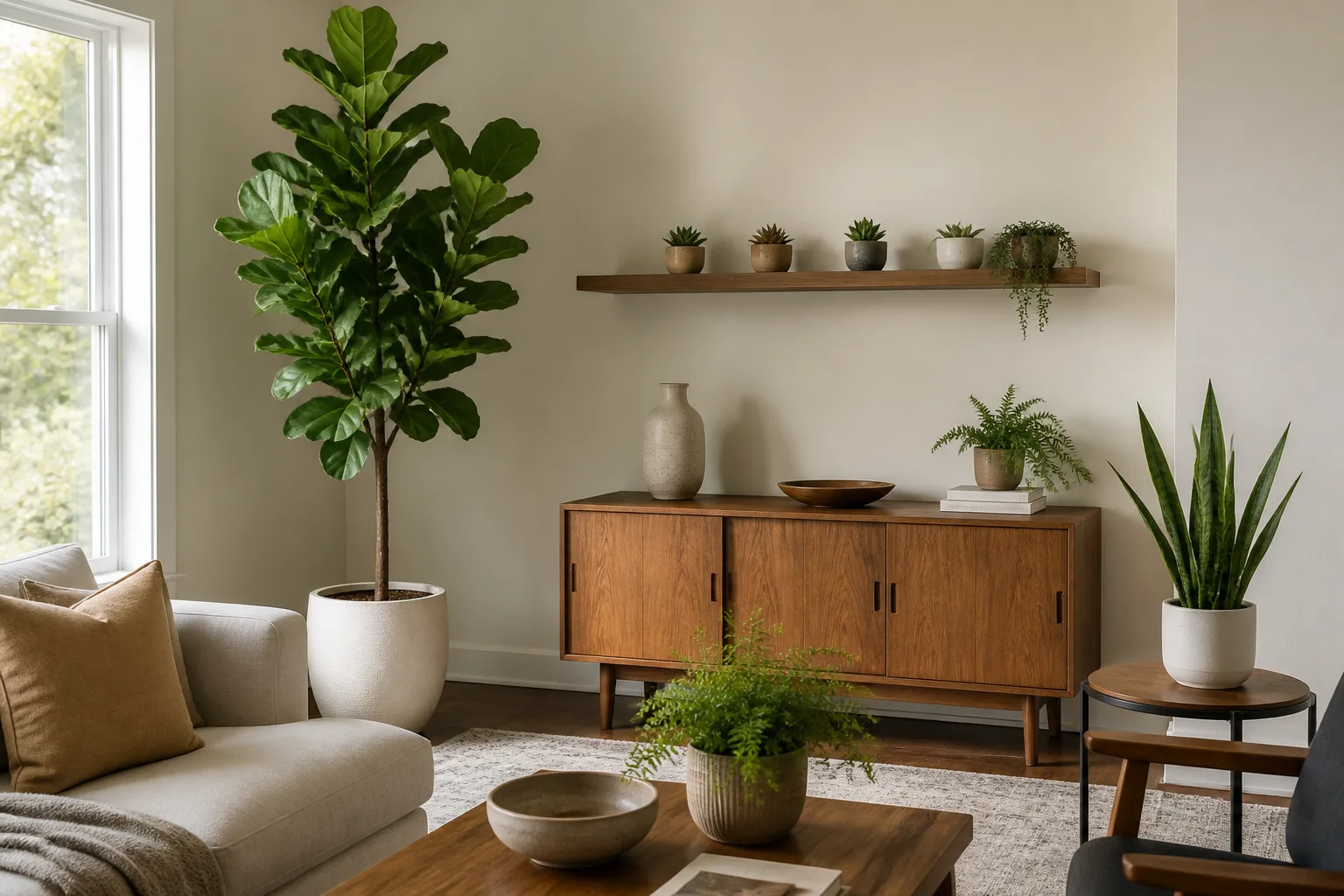
5. Mix faux plants with live greenery and natural materials
You do not need to choose between an all-real collection and an all-faux one. Use a real plant where its care needs fit the space, then use artificial greenery to fill a genuinely difficult spot or maintain a consistent shape where you travel often. The result feels more lived in when the plants do different visual jobs instead of pretending to be identical specimens.
Make the contrast intentional
Pair contrasting forms: a real upright plant with a faux trailing stem, or one living plant among a few low-maintenance artificial accents. Avoid buying multiples of the same faux plant and arranging them in a perfect line; repeated leaf shapes and identical growth patterns become obvious. A change in height, leaf size, or container material gives the eye a natural rhythm.
Natural materials help the arrangement feel connected to the room. A ceramic pot, wood stand, woven basket, stone, or linen nearby can keep artificial leaves from reading as a plastic product display. Use one or two materials already present in the space rather than adding a new texture to every pot. The design principle is simple: let the greenery repeat the room’s palette and scale, then give the arrangement a little variation.
When real and faux plants share a shelf, keep care practical. Leave enough room to lift and rotate the living pot, check its soil, and catch drips. Do not bury a fake base in the real plant’s soil or set it where regular watering will soak it. If you add cut branches or fresh flowers to a faux arrangement, make sure the vase and stems are safe for water; otherwise, use a dry vase with discreet filler.
Where fake plants work best, room by room
Use artificial greenery where it solves a real design problem: a spot that needs height, a shelf that feels hard-edged, or a room without enough usable daylight for the look you want. It should not become a reason to fill every bare surface. Gardenista’s room examples show how foliage can create height, depth, and a sense of openness; translate that idea by choosing a plant that supports the room’s existing focal point instead of competing with it Gardenista’s interior examples.
Living room, entry, and home office
In a living room, a floor plant can soften an unused corner or balance the height of a bookcase. Keep it clear of door swings, vents, and walkways, and avoid placing a tall plant directly in front of a television or art you want to see. A low plant on a console works when there is open surface around it; if the console is already busy, remove another object rather than wedging greenery into the remaining gap.
An entry benefits from one easy-to-read silhouette near a console or bench, where it can welcome people without narrowing the path. In a home office, place a small plant on a shelf behind the desk or beside a monitor, not in the area where your hands and tools need to move. If the plant will appear on video calls, check that its outline does not intersect awkwardly with your head or a lamp.
Bathroom, kitchen, and bedroom
Bathrooms are useful for faux greenery when there is little daylight or when the plant will sit on a high shelf. Keep it away from splash zones and allow space to dust it; steam and residue can collect on foliage even though it does not need humidity. A trailing form can soften tile and mirrors, while a single upright plant is better for a narrow vanity.
In a kitchen, choose a spot away from cooking splatter, grease, and open flames. A small plant on an open shelf can break up stacks of dishes, but a counter plant should not crowd meal prep. Bedrooms usually need less decoration, not more: one plant on a dresser or an open corner can be enough. Avoid setting a large plant where it blocks a window, closet access, or the path around the bed.
Style a faux plant in ten minutes
If you already own a plant that looks wrong, change its setup before replacing it. This short sequence helps separate a foliage problem from a placement problem:
- Choose one spot. Identify the empty corner, hard shelf, or height imbalance you want to soften.
- Check the silhouette. Step back to the doorway and make sure the plant fits the room and leaves a clear path.
- Upgrade the base. Place the original insert inside a stable cover pot and conceal the plastic rim with dry top dressing.
- Edit the stems. If branches are wired, gently bend them into varied directions; do not force a brittle stem or pull leaves from a construction that could loosen.
- Simplify nearby objects. Remove one small accessory if the plant is competing with clutter.
- Review the finish in daylight and lamplight. If a shiny surface catches glare, rotate the plant, move it a little, or reserve it for a less reflective location.
Take a photo from the main seat after each adjustment. A picture makes gaps, awkward symmetry, and crowded surfaces easier to spot than standing close to the planter. Stop when the plant supports the room’s existing arrangement; adding more filler, moss, or accessories will not rescue a wrong scale or an obviously artificial leaf.
Mistakes that make fake greenery look artificial
The most common mistake is treating every empty corner as a place for a plant. Too many small faux plants scattered across shelves can make a room feel staged, and multiple identical leaves repeat the same visual pattern. Start with one anchor plant, then add a second only when the room needs another height or a different texture.
The next problem is leaving the store pot visible. Even good foliage can look temporary when it sits in a bright plastic insert, has an exposed foam base, or wobbles in a vessel that is too large. Check the pot from seated eye level as well as standing height; the top is often more visible from a chair or stair landing.
Other common missteps include choosing a plant too wide for its corner, placing a glossy plant in harsh glare, and using a species shape that clashes with the room’s light cues. Perfectly paired plants can also look artificial if they are identical in height and angle. Break symmetry with a different container, a slight change in placement, or one real object nearby—not with extra clutter.
Finally, do not expect a faux plant to create the same effect as a living one. It adds color and form, but it does not grow, change with the seasons, or need the care that keeps a real collection healthy. If the look depends on those qualities, choose a living plant that fits your conditions instead.
Keep artificial plants clean without damaging them
Dust is one of the fastest ways to make artificial leaves look dull and neglected. Check the manufacturer’s instructions first, because materials vary. For routine cleaning, a soft microfiber cloth or a gentle brush can lift loose dust from sturdy leaves; support a delicate stem while you work instead of tugging at it.
If the maker allows damp cleaning, test a hidden leaf or stem before wiping the whole plant. Use a lightly damp cloth, then let the piece dry completely before returning it to a basket or a dark corner. Avoid soaking the base, using abrasive pads, or spraying polish and cleaning products onto the foliage unless the manufacturer explicitly approves them; coatings can change the finish or leave residue.
For an artificial plant near a kitchen, bathroom, or open window, check it more often because grease, moisture, and outdoor dust can settle on the surface. Do not put an indoor-only faux plant outdoors just because it looks weatherproof. Follow the product’s exposure rating and keep it away from heat sources that could damage plastic or fabric materials.
Conclusion
Decorating with fake plants works best when the plant is chosen for the room, not just for its product photo. A believable silhouette, a finished cover pot, a plausible location, and some breathing room can make even a modest artificial plant feel intentional.
Start with one spot that needs softness or height, make the pot stable and visually finished, then look at the arrangement from the doorway and the seat where you spend time. If the plant still feels out of place, adjust its scale or move it before you buy more greenery.