9 Ornamental Trees and Shrubs With Purple Leaves
Compare nine purple-leaf trees and shrubs by mature size, light, color, and maintenance. Find a cultivar for your yard and avoid invasive Japanese barberry.
Purple foliage can anchor a border long after spring flowers fade, but the color is only useful if the plant fits the site. A burgundy shrub that grows twice as wide as the bed becomes a pruning chore; a purple-leaf cultivar planted in deep shade may turn greener; a small tree placed under a wire can become an expensive mistake. Start with the plant’s mature size and light needs, then choose the shade of purple you want.
The nine choices below range from compact shrubs to a large canopy tree. Their foliage may read plum, wine, bronze, or nearly black rather than vivid violet. Cultivar, season, sun exposure, heat, and drought all affect the color, so use the botanical name and cultivar on the plant tag—not a generic label such as “purple tree”—to compare stock.
How to Choose a Purple-Leaf Ornamental
Before buying, answer three questions: how much room will the plant have at maturity, how many hours of direct light reach it, and what should it contribute besides color? A flowering plum offers a spring display but may be short-lived; ninebark adds flowers and exfoliating bark; an established beech can create a purple canopy but needs a genuinely large site. Match the plant to the job rather than expecting one ornamental to do everything.
| Plant | Approximate scale | Best fit | Main caution |
|---|---|---|---|
| Purple-leaf plum | 15–25 ft | Sunny small-yard tree | Short-lived; fruit and twig drop |
| Purple-leaf sand cherry | 7–10 ft | Sunny shrub border | Short-lived; disease and insect issues |
| Japanese maple | Cultivar-dependent; often a small tree | Sheltered specimen or understory | Leaf scorch in hot sun, wind, or drought |
| Smokebush | Often 10–15 ft; smaller cultivars exist | Sunny focal point | Purple can fade in shade; needs room |
| Ninebark | 3–8 ft by cultivar | Tough mixed border | Purple intensity varies by cultivar and exposure |
| Crabapple | Roughly 11–26 ft for many garden selections | Spring bloom plus fruit | Disease pressure and seasonal cleanup |
| Copper beech | About 50–60 ft tall, 35–50 ft wide | Large lawn or park-like garden | Too large for most compact yards |
| Elderberry | Cultivar-dependent; species can be much larger | Wildlife-friendly informal screen | Suckering and rapid growth |
| Japanese barberry | Commonly 3–6 ft | Avoid where invasive or restricted | Spiny, invasive in many areas |
These dimensions are guides, not guarantees. Nursery cultivars can differ substantially from the species, and local climate changes performance. Read the cultivar label, check your regional extension service, and leave enough room for the full spread instead of planning to keep a naturally large plant small through constant shearing.
Purple-Leaf Plum (Prunus cerasifera)
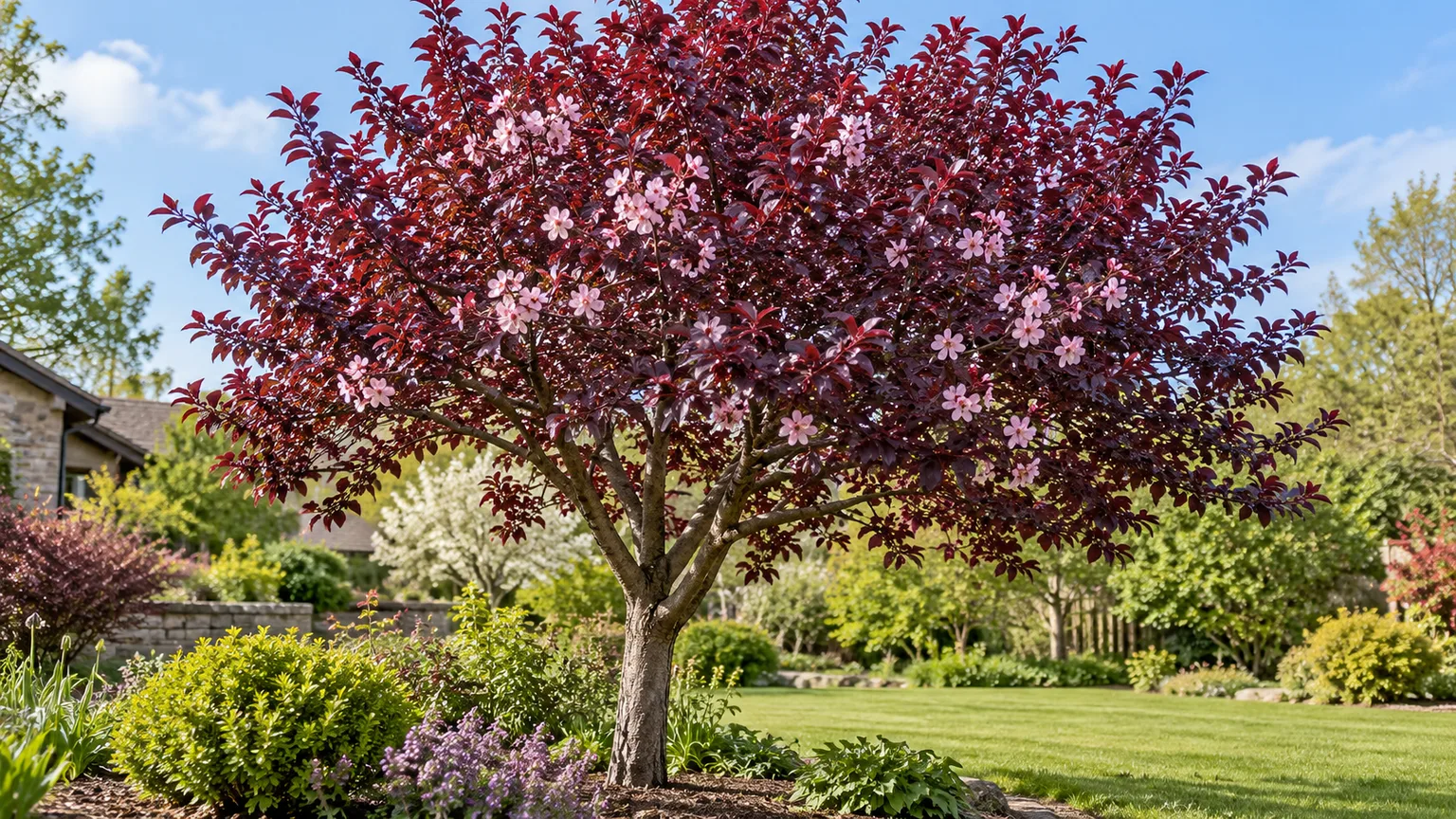
Purple-leaf plum is one of the most recognizable purple-foliage trees: reddish-purple leaves set off pale spring blossoms, followed in some selections by small fruit. It typically reaches about 15 to 25 feet in both height and spread, so treat it as a small tree with a broad canopy, not as a narrow column. ‘Atropurpurea,’ ‘Thundercloud,’ and ‘Newport’ are familiar names, but color, shape, and fruiting can differ among selections. NC State Extension notes that full sun gives the strongest leaf color and that established trees tolerate moderate drought.
This is a good choice when you want a strong spring transition from pale flowers to dark foliage and can accept some cleanup. It is not a long-term, low-risk specimen: purpleleaf plum is relatively short-lived and susceptible to multiple insect and disease problems, and twigs or fruit can fall where people walk. Avoid placing it directly over a patio, driveway, or children’s play area if fallen fruit would be a nuisance. NC State Extension’s profile summarizes the tree’s size, color, and pest liabilities.
Purple-Leaf Sand Cherry (Prunus × cistena)
Purple-leaf sand cherry is a shrub or small multi-stemmed accent, usually around 7 to 10 feet high and 5 to 8 feet wide. Its red-purple leaves contrast with pale pink or white spring flowers, and its scale suits a sunny foundation border or mixed shrub bed better than a tight foundation strip. Plant it in well-drained soil; full sun generally produces the best foliage color and flowering. NC State Extension describes the hybrid as tolerant of cold winters, hot humid summers, and urban conditions, while also flagging frequent disease and insect problems and a short life span.
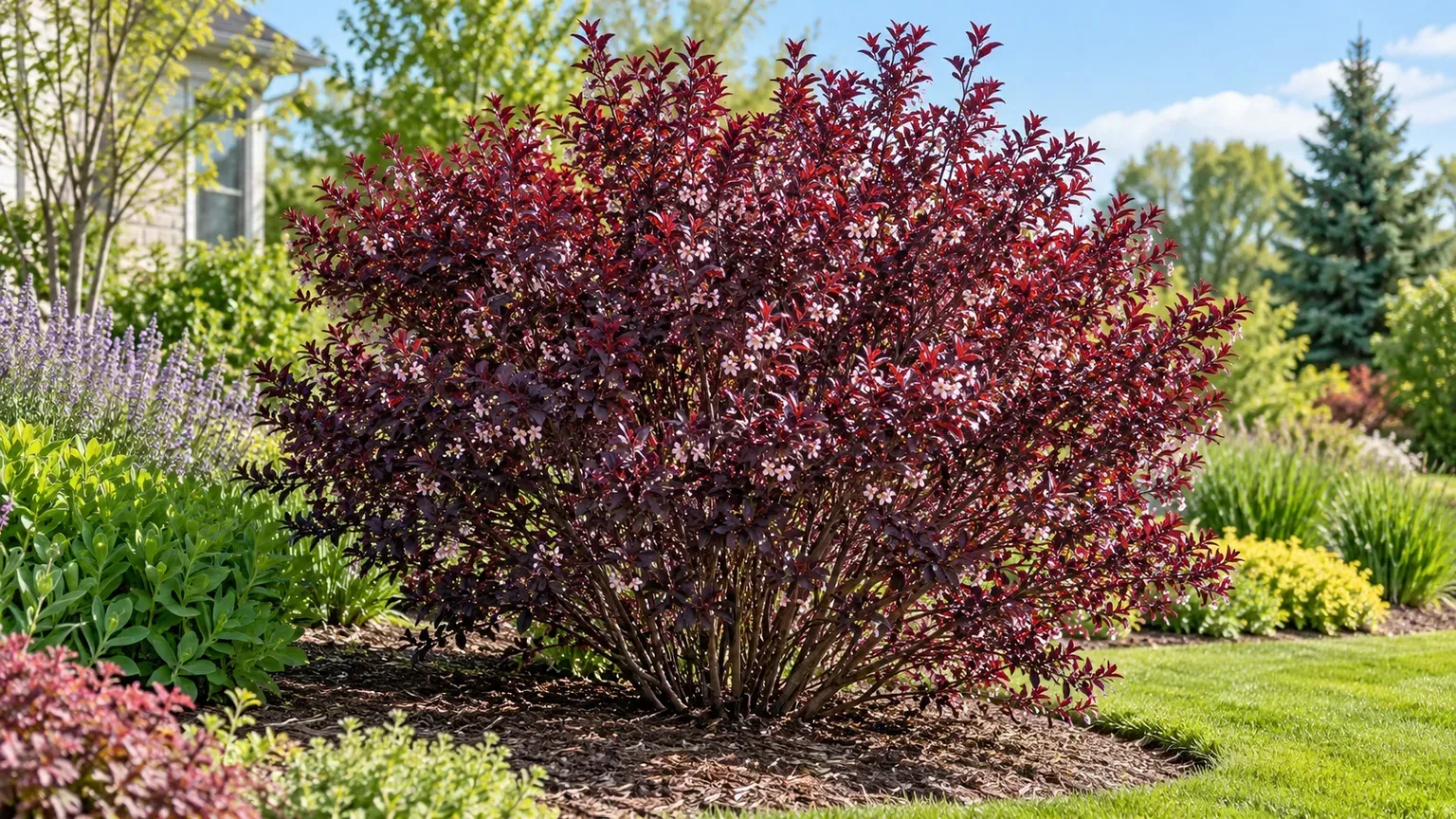
Think of sand cherry as an affordable, high-color accent rather than a permanent framework shrub. It can look excellent for years, but if the site stays wet or the plant repeatedly declines, replacing it may be more sensible than trying one treatment after another. Give it air around the branches, water it while establishing, and do not promise it a decades-long role in the design. The species profile and its site limits are detailed by NC State Extension.
Japanese Maple (Acer palmatum)
Japanese maples offer the broadest range of purple tones and shapes here, from upright small trees to low, cascading forms. Cultivars such as ‘Atropurpureum,’ ‘Bloodgood,’ ‘Garnet,’ and ‘Tamukeyama’ differ in leaf dissection, habit, mature dimensions, and the way their color changes through the year. Some stay deep red-purple in summer; others shift toward bronze or green and intensify again in fall. Buy by cultivar, not by the species name alone.
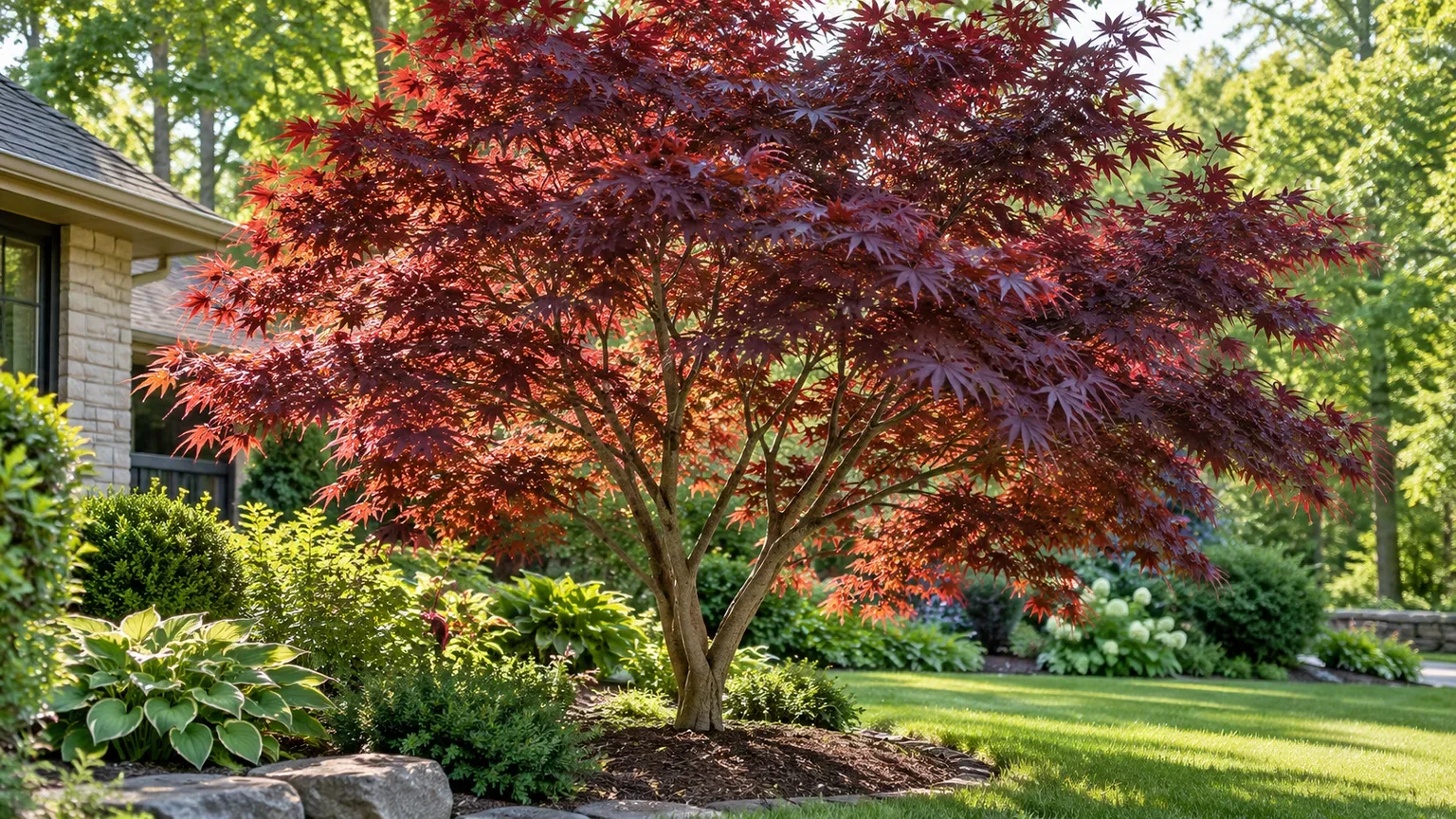
A Japanese maple is often the best candidate for a sheltered focal point in a smaller garden, but “purple” does not mean “bake it in afternoon sun.” Many perform best in dappled shade or morning sun with protection from drying winds; drought and excessive heat can scorch the leaf edges. Keep the root zone evenly moist but well drained while the tree establishes, and avoid crowding it against a hot wall. NC State Extension describes the species’ sensitivity to frost, drought, wind, and leaf scorch. Check the selected cultivar’s mature spread before using it near a path or under eaves.
Purple Smokebush (Cotinus coggygria)
Smokebush earns its place with two seasons of interest: dark foliage in summer and airy, smoke-like flower panicles that can become pink-purple clouds. ‘Royal Purple’ is a large, classic selection; ‘Winecraft Black’ and other compact cultivars are better when the available bed is modest. The species profile lists many smokebushes around 10 to 15 feet tall and wide, but that number should not be applied to every cultivar. Check the plant label for a named selection’s actual dimensions.
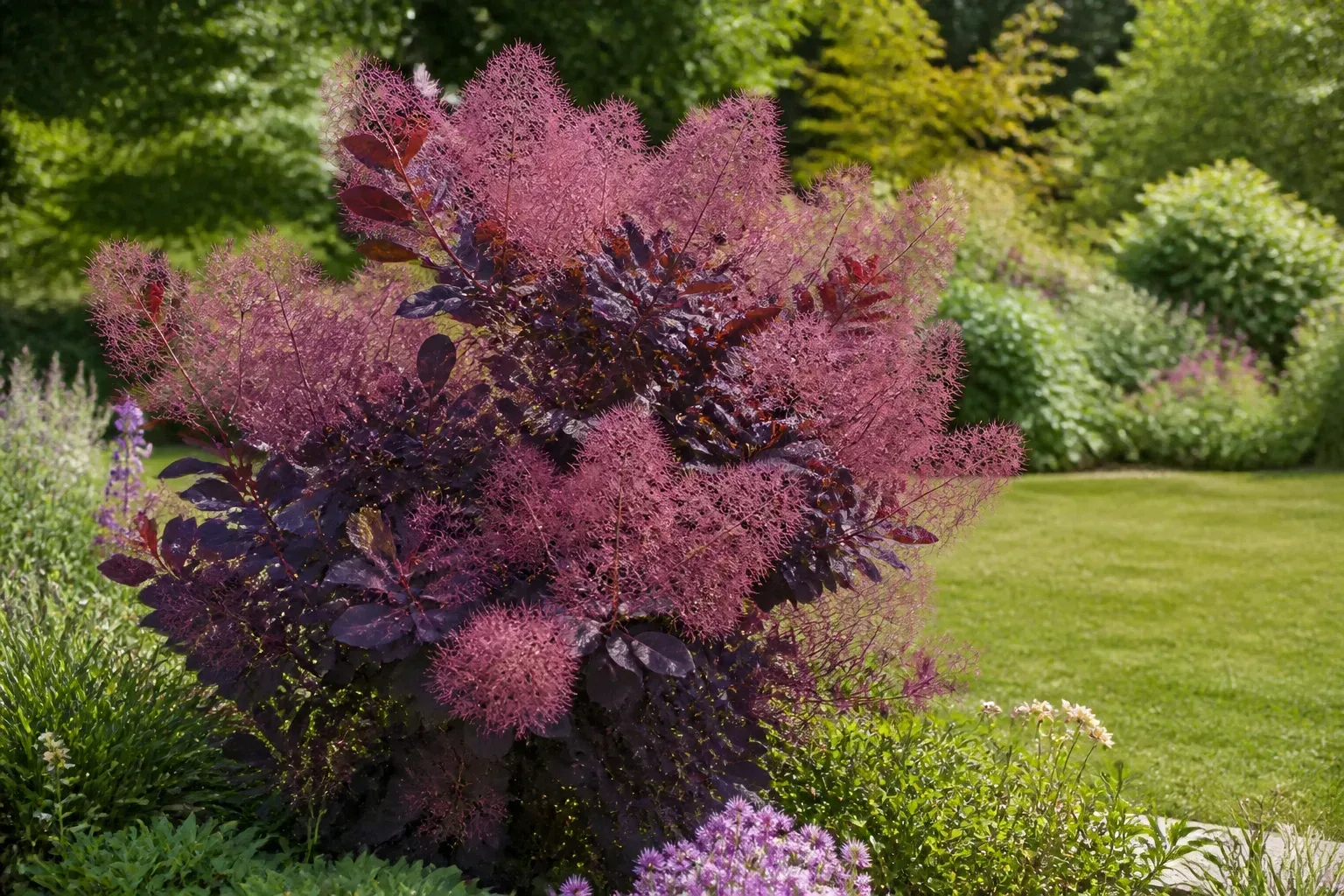
For the strongest purple color, give most purple-leaved smokebushes full sun and sharply drained soil. Shade can make foliage greener, while wet soil is a poor match. The main design decision is whether you want the smoky flowers or a dense, heavily renewed foliage shrub: hard late-winter pruning can rejuvenate its shape but removes the framework that carries that season’s display. NC State Extension explains this bloom-versus-pruning trade-off. A Fine Gardening cultivar report also describes ‘Winecraft Black’ as a 4- to 6-foot choice for full sun, illustrating why cultivar-level sizing matters.
Purple Ninebark (Physocarpus opulifolius)
Purple ninebark combines dark foliage with late-spring flowers and peeling bark that remains visible after the leaves drop. The native North American species is adaptable and tough, and named purple selections range from broad, large shrubs to compact plants such as ‘Little Devil.’ ‘Diabolo’ (‘Monlo’) and ‘Summer Wine’ are other familiar choices. The cultivar name matters: a species-level estimate of 5 to 8 feet is not a reliable forecast for every nursery selection.
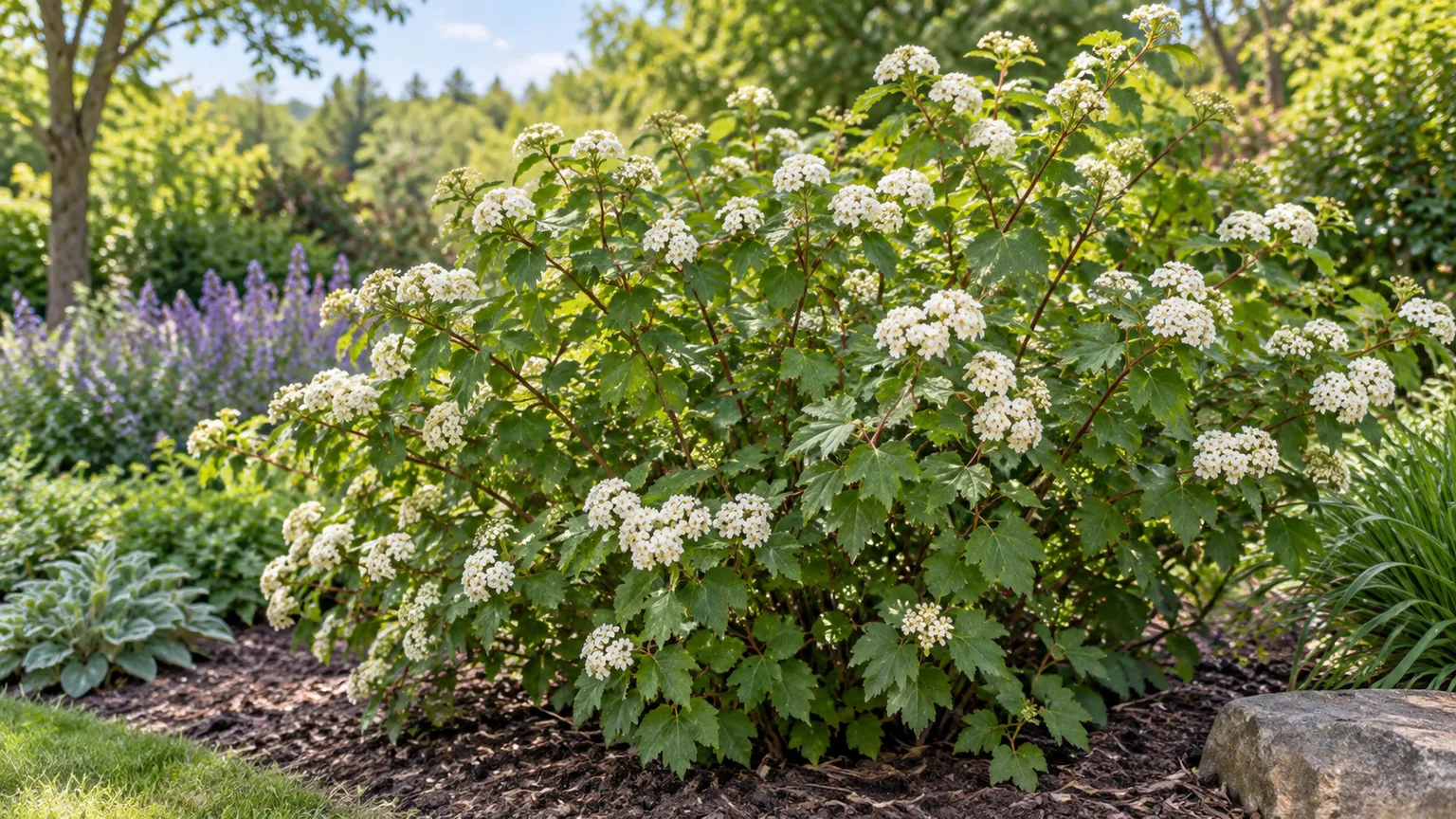
Ninebark is a practical option when you want a resilient shrub with more than one season of interest, but do not assume every cultivar keeps the same burgundy color in every exposure. NC State Extension notes that purple cultivars can lose color intensity in prolonged direct sun, while cultivar and regional guidance may recommend sunnier sites for other selections. Follow the named plant’s tag and local advice, and observe whether your site’s combination of heat and light fades or scorches the leaves. If pruning is needed, remove crossing or damaged stems after flowering; severe winter renewal can reduce the next flower display because blooms form on older growth. NC State Extension gives the species’ adaptation and pruning details, and Fine Gardening describes a compact purple cultivar for smaller mixed borders.
Purple-Leaf Crabapple (Malus cultivars)
Crabapples bring more than leaves: spring flowers, a branching silhouette, and small fruits that can persist into cooler weather or feed birds. Purple-foliaged selections include names such as ‘Royalty,’ ‘Purple Prince,’ ‘Profusion,’ and ‘Radiance,’ but check the nursery tag for the cultivar’s actual mature size, fruit color, and disease resistance. The genus ranges widely; many ornamental crabapples fit in the small-to-medium tree category, but some can outgrow a tight urban front garden.
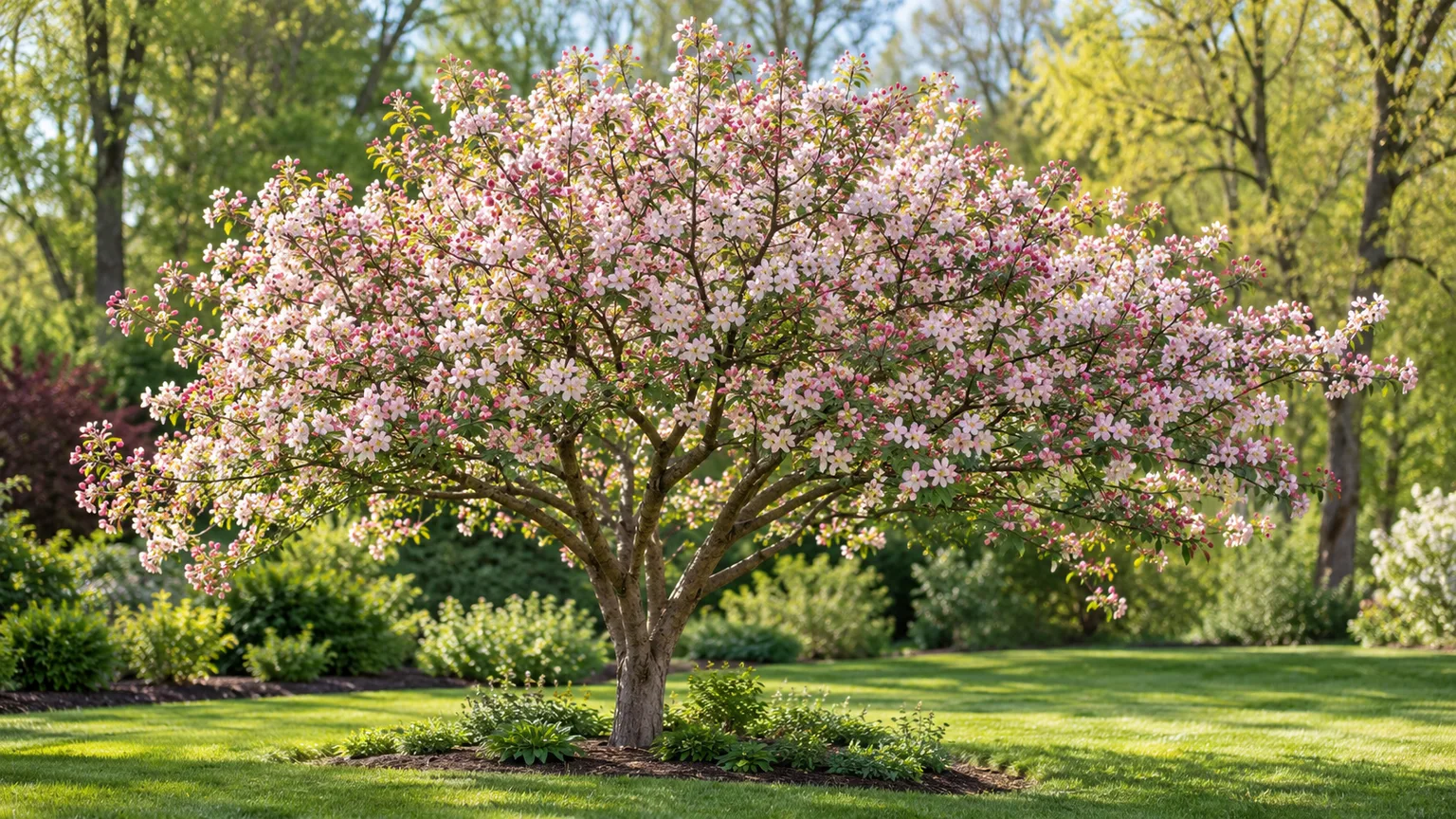
Choose a site with full sun and air movement through the canopy. Crabapples can suffer from apple scab, fire blight, rust, and powdery mildew, especially in humid summer climates, so local disease pressure should influence cultivar choice more than a photograph of perfect leaves. A resistant cultivar is a way to reduce routine problems, not a guarantee of a disease-free tree. Plan for the fruit: small apples are decorative and useful to wildlife, but may drop and need cleanup on a paved surface. NC State Extension’s Malus profile describes the range in size and the major disease concerns.
Copper Beech (Fagus sylvatica)
Copper beech is the dramatic, long-view option. Purple-leaf forms such as ‘Atropunicea,’ ‘Riversii,’ and ‘Purple Fountain’ can eventually create a broad, dark canopy, but a typical European beech can reach roughly 50 to 60 feet tall and 35 to 50 feet wide. Even a narrow or weeping cultivar needs a site chosen for its mature size, root zone, and overhead clearance; it is not a sensible “small yard” tree just because the young nursery specimen looks compact.
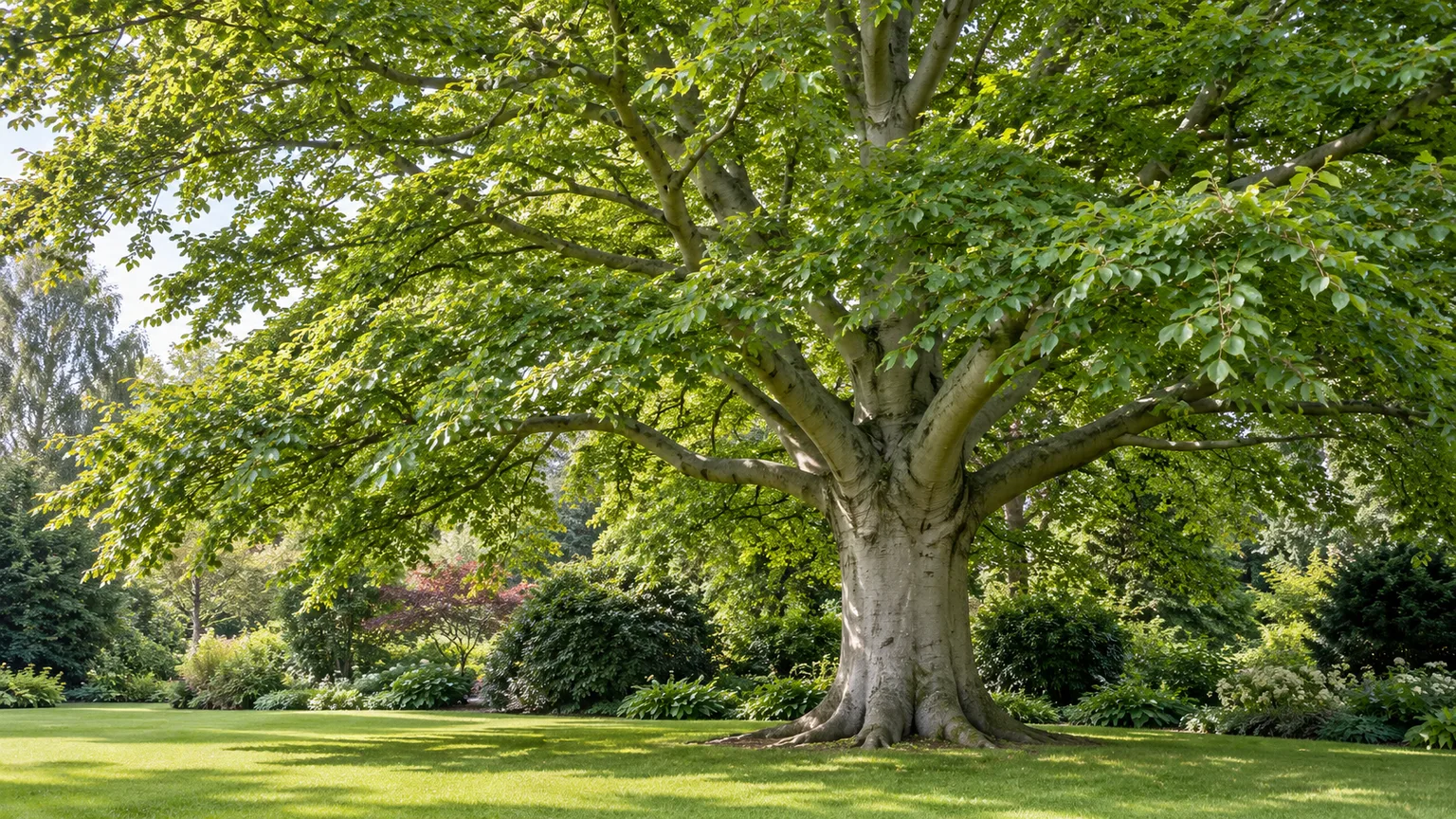
Beech prefers moist, well-drained soil and can struggle in hot summers, poor drainage, or difficult urban conditions. NC State Extension notes that some purple forms begin red-purple and become greener as leaves mature, so do not expect an unchanging, dark-purple canopy from spring through fall. This tree is best for a large lawn or park-like garden where it can become the main structural feature, not a narrow strip between pavement and a building. NC State Extension’s European beech profile lists the mature dimensions and cultivar differences.
Purple-Leaf Elderberry (Sambucus nigra)
For lacy foliage and a softer, more informal outline, look for ‘Black Lace’ or ‘Black Beauty.’ Their deeply cut, purple-black leaves give a different texture from the broad leaves of plum or ninebark, and pale pink flower clusters can brighten the shrub in early summer. A named compact selection may stay around 6 to 8 feet, but the species can grow much larger and spread by suckers; cultivar descriptions are essential if you have limited space.
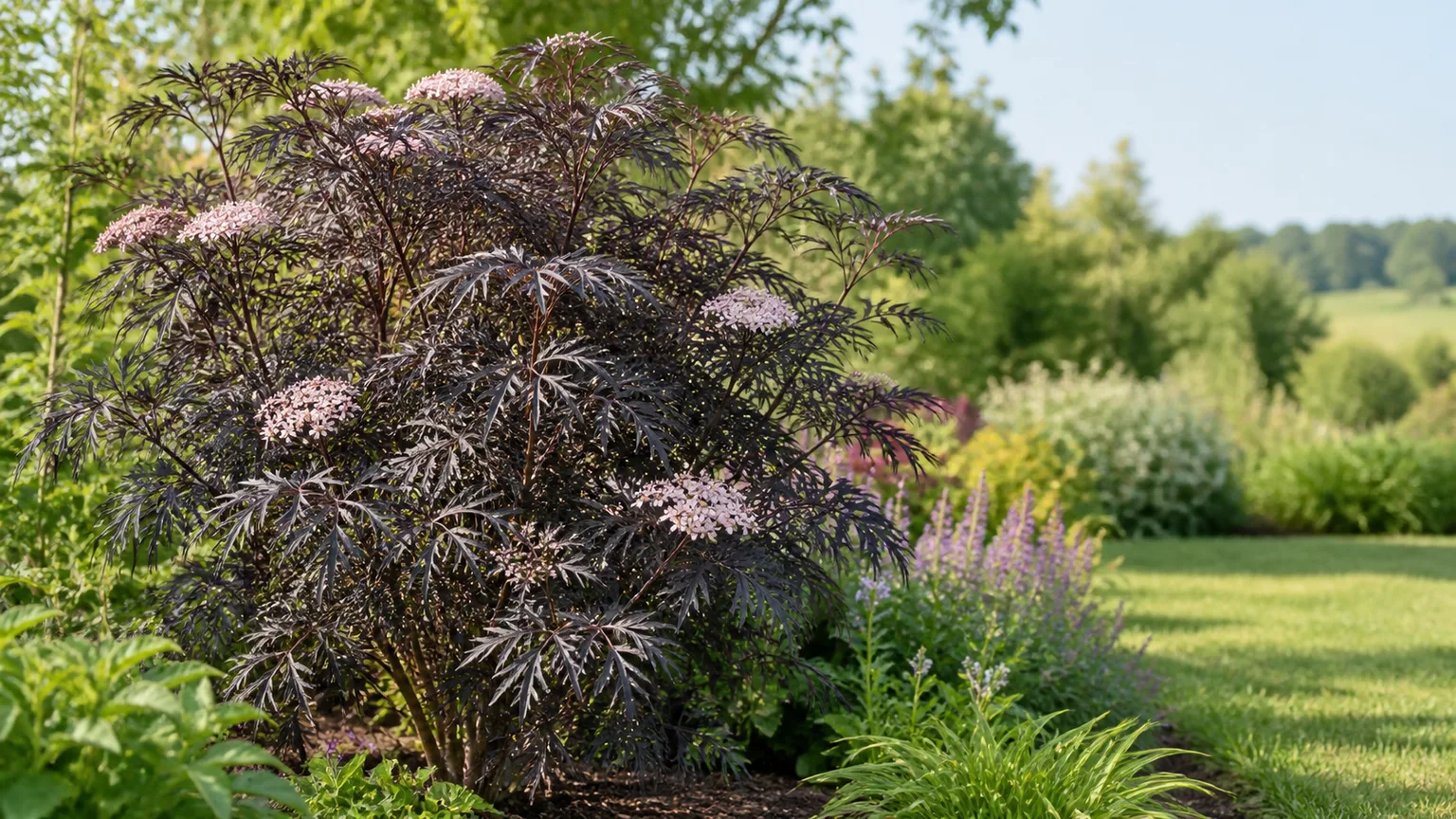
Elderberry suits an informal screen or wildlife planting better than a formal clipped hedge. Give it room for new shoots, remove suckers you do not want, and expect faster growth in rich, moist soil. Do not assume a purple ornamental cultivar will fruit heavily by itself: cultivar compatibility and cross-pollination can affect berry set. If fruit is a goal, confirm the particular cultivar’s pollination needs and learn correct identification and preparation before using berries. NC State Extension describes the species’ suckering habit and notes that multiple cultivars can improve fruit yield; Fine Gardening reports that ‘Black Lace’ may need another variety for fruit.
Japanese Barberry (Berberis thunbergii): A Cautionary Choice
Japanese barberry is included because purple-leaved cultivars remain common in landscaping, not because it is a good default recommendation. This thorny shrub can form dense growth and produce berries that birds disperse. In parts of North America it has escaped cultivation and become invasive, crowding out native plants; Pennsylvania State University Extension also describes an association between dense barberry stands and greater black-legged tick presence. Regional restrictions and ecological conditions vary, so check your state or provincial invasive-species list before buying or moving one.
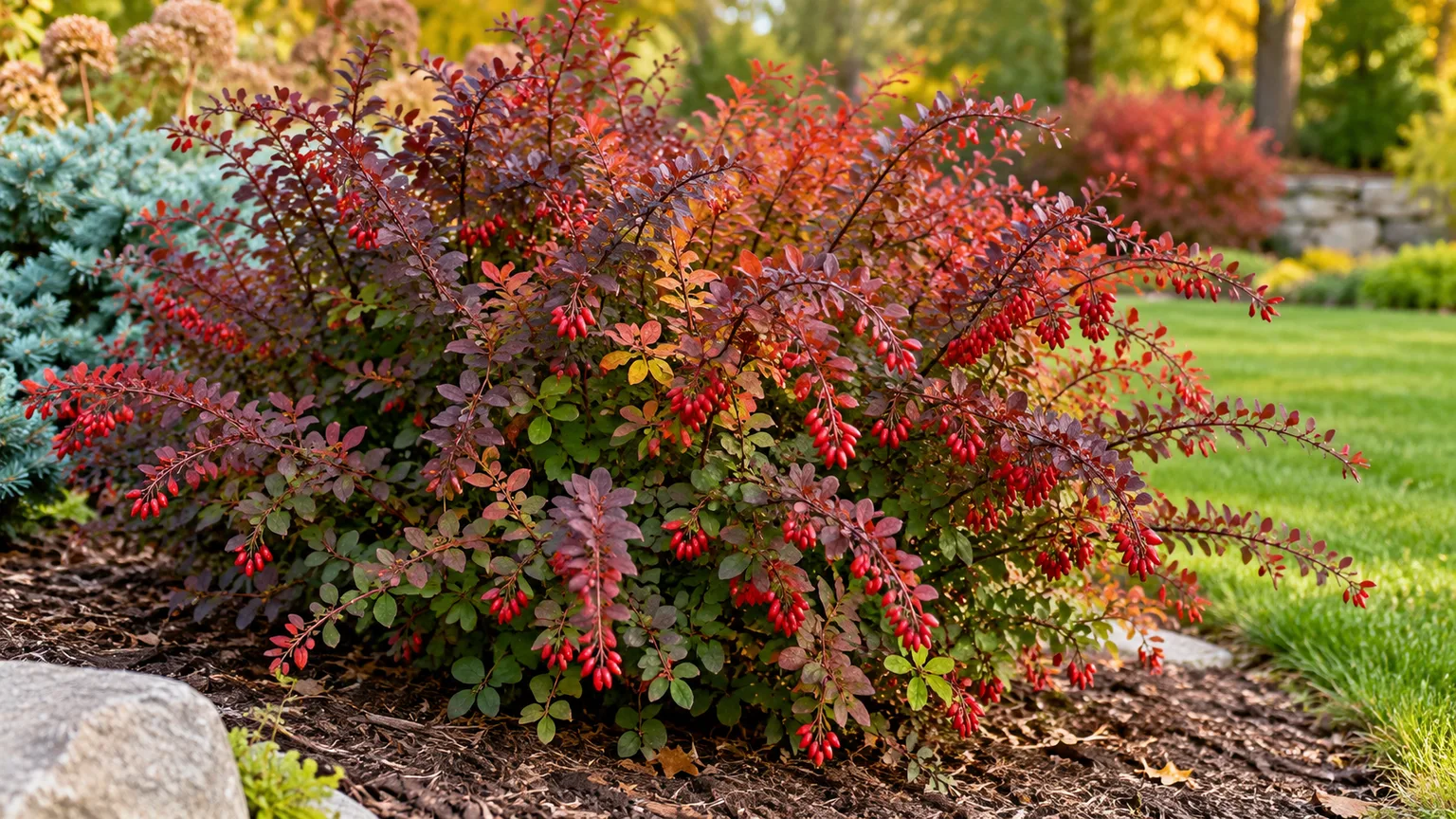
If barberry is invasive where you garden, do not plant a purple cultivar or give away suckers. For a similar dark accent, consider a locally suitable purple ninebark or elderberry, and verify the alternative’s native status and mature dimensions. If an established barberry is already on your property, treat removal as a management job: the thorns make hand work unpleasant, and missed pieces can resprout. Follow local extension guidance and product labels for any control method. Penn State Extension’s current Japanese barberry guidance explains its spread, habitat effects, and removal considerations.
Match the Plant to Your Climate, Space, and Job
A plant’s height in a catalog is only half the decision. Width, growth habit, roots, canopy shade, and leaf cleanup determine whether it fits the part of the yard you have. A round ninebark can occupy more ground than its height suggests; a weeping maple needs horizontal clearance; a copper beech shades a large area; and suckering elderberry can slowly claim space beyond its original planting hole. Mark the expected mature spread on the ground before you purchase.
Then match exposure. A sunny, well-drained bed suits smokebush, purpleleaf plum, and sand cherry; a sheltered understory is often more comfortable for Japanese maple. Purple foliage often looks strongest in brighter light, but the rule is not universal: cultivar response, summer heat, and reflected light can change the result. A south-facing wall may be bright enough to intensify color and hot enough to scorch leaves. When a cultivar’s performance is uncertain in your region, ask a local nursery or extension office for observations from nearby gardens.
Finally, choose a secondary job. Do you want spring blossom, a screen, edible fruit, wildlife value, winter bark, fall color, or a single focal point? Purple leaves do not make plants interchangeable. A plum and crabapple offer spring bloom and fruit; a smokebush gives summer foliage and haze; ninebark adds native habitat value and peeling bark; beech supplies long-term canopy. Picking the secondary feature makes the decision clearer than comparing leaf color alone.
Use Purple Foliage for Contrast, Not a Wall of Color
A single purple-leaved specimen can make surrounding greens look brighter. Repeating purple in several plant sizes can also tie a border together, but a whole row of nearly identical burgundy shrubs can become visually flat. Use the dark foliage as an anchor, then add contrast through leaf size, plant form, bloom timing, and lighter foliage. Garden Design’s purple-plant guidance recommends pairing dark leaves with gold or chartreuse foliage; the principle works because contrast keeps each plant legible rather than merging into one dark mass.
Place the darkest plant where it can be seen against a lighter backdrop: a plum in front of green evergreens, a smokebush beside silver foliage, or a small Japanese maple against a pale wall that does not overheat it. Repeat the color in smaller doses with perennials or containers rather than lining a property edge with large shrubs. Be aware that deep purple foliage can disappear into shadow at dusk or against dark fencing, so check the planting from the windows and paths you use most. Garden Design discusses using colored foliage as a long-season focal point and pairing purple with brighter colors.
Why Purple Foliage Changes Through the Season
Purple is a plant pigment expression, not a promise that every leaf stays one shade all year. Cultivars differ in how much red, bronze, or green shows, and new foliage can be a different color from mature leaves. Light exposure changes pigment intensity for some plants; in shade, certain purple smokebushes can turn greener, while too much heat, wind, or drought can make Japanese maple leaves brown at the edges. Normal fall color can add red or orange, while a cultivar such as European beech may move toward green as its leaves age.
Before treating a color shift as a disease, compare new and old growth, check whether the entire plant is affected, and review recent weather and watering. If leaves are simply greener but otherwise healthy, light or cultivar behavior may be the reason. If the shift comes with wilt, dead twigs, leaf spots, or one-sided dieback, diagnose that symptom separately rather than adding fertilizer in the hope of making the foliage purple again. More fertilizer does not correct a site mismatch and can push unwanted soft growth.
Mistakes That Make Purple-Leaved Plants Disappointing
The most expensive mistake is buying by the display pot’s color and size. A young copper beech fits on a nursery cart; its mature canopy may be wider than the front yard. A smokebush tagged only by species can also become a large shrub, so make the cultivar name and expected spread part of the purchase. If the seller cannot provide those details, postpone the decision rather than relying on pruning to keep a large plant permanently small.
Another common error is using hard pruning as a substitute for correct siting. It can temporarily reduce a plant’s footprint, but repeated severe cuts may remove flowers, expose stems, or leave the shrub with a shape that fights its natural habit. Check pruning guidance for the species and decide whether foliage, flowers, or a compact outline matters most before cutting. Smokebush is a clear example: renewal pruning can give a dense foliage effect but sacrifices some flowering.
Also avoid treating “purple” as one uniform landscape color, ignoring fruit cleanup, or planting Japanese barberry without checking local invasiveness. The plant that looks striking in a regional nursery display may not suit your climate, soil drainage, or ecological setting. Compare a cultivar’s mature dimensions and disease resistance with conditions in your own area, and favor a locally appropriate alternative when the risks outweigh the foliage effect.
A Practical Shortlist by Garden Situation
For a small, sheltered focal point, start by comparing named Japanese maples and their eventual spread. For a sunny border, a compact ninebark or a named small smokebush may provide purple leaves without the canopy of a full-size tree; compare specific cultivars rather than relying on the species name. For quick spring color, purpleleaf plum and sand cherry offer flowers and colored foliage but come with a shorter expected service life and more potential cleanup.
For a large open lawn, copper beech can become a lasting structural tree if climate and soil are suitable. For a wildlife-oriented informal screen, elderberry provides flowers, fruit, and dark foliage, but needs room for suckers. If your shortlist includes Japanese barberry, check regional invasive listings before purchase and choose a safer substitute where it is a concern. A good final check is simple: write down the botanical name, cultivar, mature height and width, light, drainage, and one known drawback. If any of those details do not fit your site, pick a different plant.
Conclusion
The best purple-leaf ornamental is the one whose size, light needs, and seasonal behavior match your yard. Japanese maples suit many sheltered small gardens; compact ninebark and smokebush cultivars work in sunny borders; purpleleaf plums and sand cherries make colorful but relatively short-lived accents; and copper beech belongs in a large landscape. Purple elderberry adds flowers and wildlife interest if you can manage its suckers.
Treat Japanese barberry as a regional ecological question, not a routine choice. Before you buy any of the other eight, verify the cultivar name and mature spread, then check how its foliage performs in your climate. That short bit of label-reading will do more for a successful planting than choosing the darkest leaves on the nursery bench.



