Identify Tree Fungus and Choose the Right Next Step
Compare common tree fungal diseases, understand what symptoms can and cannot tell you, and learn when to contact an arborist or diagnostic clinic for your tree.
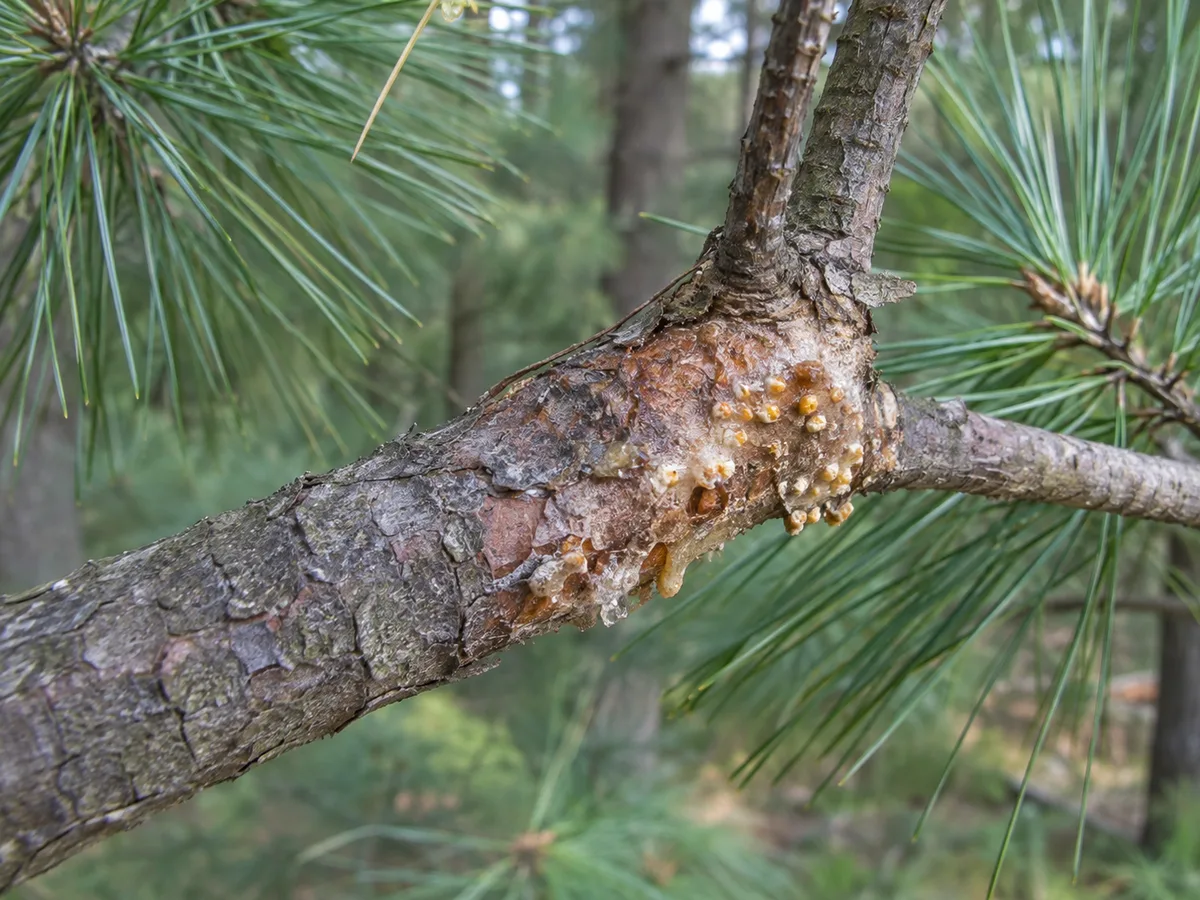
A pale patch on bark, orange spots under leaves, a wilted branch, and a shelf-shaped mushroom can all be described as “tree fungus.” They are not interchangeable clues. Some point to a disease that needs timely attention; some are surface growths that do little harm; others indicate decay that matters more for a tree’s stability than for its leaves.
The useful first question is not what spray kills this. Ask where the symptom appears, how quickly it is changing, what tree is affected, and whether a branch could reach a person or structure. Those observations prevent a wrong spray, unnecessary cuts, and delayed professional help.
Start With a Risk Check, Not a Disease Name
Many tree diseases are fungal, but drought, saturated soil, root damage, compaction, winter injury, salt, insects, and herbicide exposure can produce similar yellowing, browning, wilting, or dieback. A photo of one discolored leaf rarely proves a diagnosis.
Start with the tree’s identity and damage pattern. Note whether symptoms affect one twig, one branch, one side of the crown, or the whole tree; how quickly they appeared; and whether nearby trees of the same species are affected. Add recent weather, irrigation, construction, trenching, mulch, pruning, and chemical use. This context often narrows the possibilities more than a spot’s color.
Assess possible structural failure separately. A large bracket at the trunk base, a new crack, a partly detached limb, lifting soil, or a dead branch over a driveway does not prove a tree will fall, but it warrants an on-site risk assessment. Keep people clear and do not climb or make large cuts yourself.
Read Symptoms by Location and Pattern
The affected part of a tree gives you a starting point, not a laboratory result. A leaf pattern differs from a trunk lesion or thinning across the crown. Record symptoms before removing plant parts so a diagnostician can see their distribution.
| What you see | Possibilities to investigate | Sensible first move |
|---|---|---|
| Spots, powder, or holes on leaves | Foliar fungi, insects, spray injury, weather | Photograph both leaf surfaces and note when symptoms began |
| One branch wilts or dies back | Canker, wilt, root injury, borer, storm damage | Trace the branch to its attachment and inspect the trunk without cutting |
| Sunken or cracked bark | Canker, mechanical injury, sunscald, decay | Photograph the boundary and check whether the trunk is partly girdled |
| Brackets on trunk or root flare | Wood-decay fungus, sometimes a root or butt rot | Arrange an arborist assessment if people or property are within striking distance |
| Black film on leaves | Sooty mold growing on insect honeydew | Look beneath leaves and along twigs for scale, aphids, or other sap-feeders |
Leaf and Needle Symptoms
Leaf spots may be tan, brown, black, or yellow, sometimes with darker borders that merge into larger dead patches. Anthracnose often causes irregular blotches after cool, wet spring weather; powdery mildew looks like white surface growth; rusts can form orange or brown pustules under leaves. Insect feeding, hail, chemical drift, and drought can create similar marks, and signs vary by host.
Look at the whole canopy and leaf undersides. A few late-season spots on older leaves differ from widespread symptoms on new growth, repeated early defoliation, or years of declining vigor. Many foliage rusts do little damage to mature trees, while rust cankers on five-needle pines are more consequential, according to the RHS tree-rust guide. The host and affected tissue change what a symptom means.
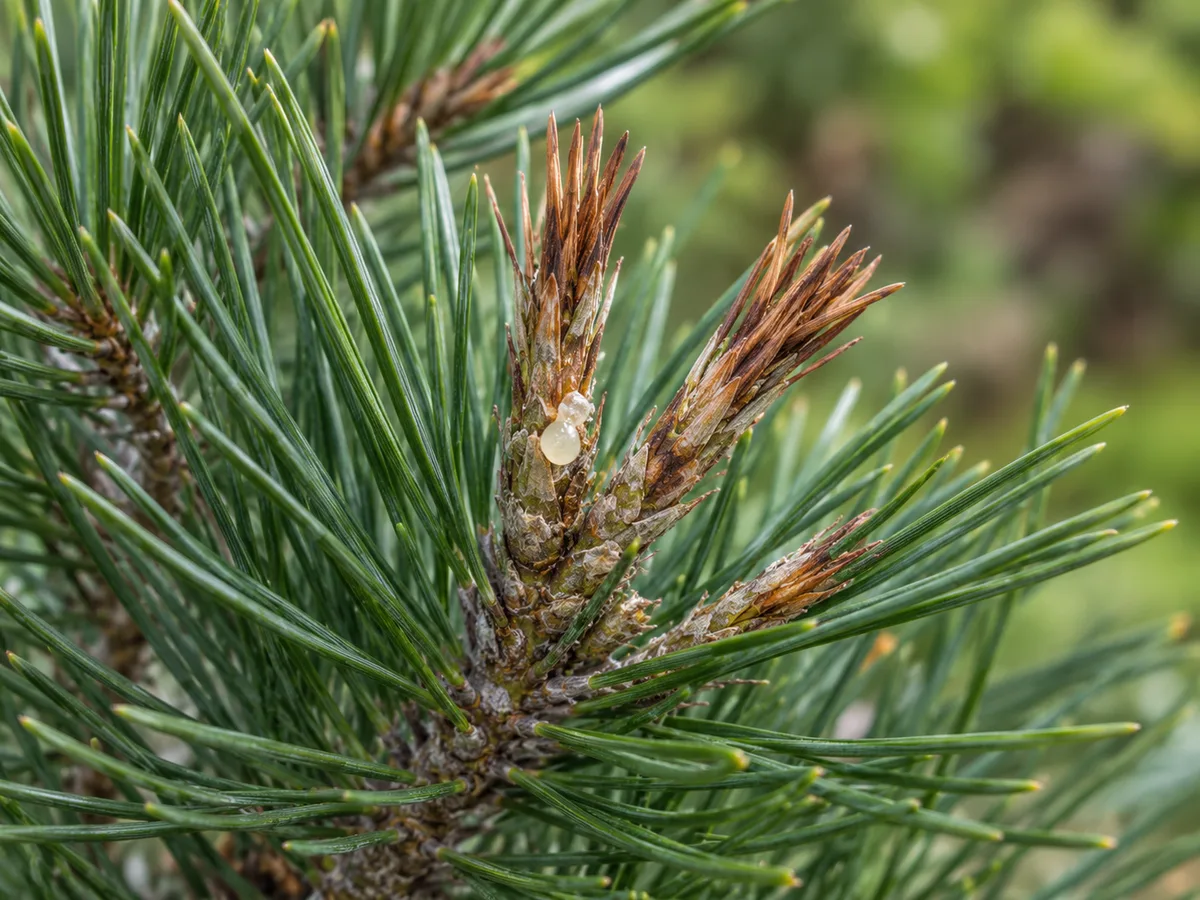
Holes are not automatically insect damage. In shot-hole diseases, spots form before damaged tissue drops out, leaving holes with discolored edges; insects can make holes too. On conifers, brown tips, needle loss, or flagging shoots may signal a fungal blight, but drought, salt, root damage, and insects can mimic it. Photograph both affected and healthy branches.
Cankers, Oozing Bark, and Dieback
A canker is a localized area of injured or dead bark and tissue. It may look sunken, cracked, discolored, swollen, or damp; some pathogens produce tiny raised fruiting structures, while others do not. A canker that encircles a twig can kill growth beyond it. A lesion on a trunk or major limb needs more caution than one on a small removable twig because it can affect tree function and strength.
Resin, sap, and dark staining can accompany cankers, borers, mechanical wounds, bacterial problems, or other stress. Note whether surrounding bark is firm and whether the lesion is expanding; do not peel bark back, which can enlarge the wound and erase useful evidence. A canker-like image is an example of a sign, not a visual test that identifies its cause.
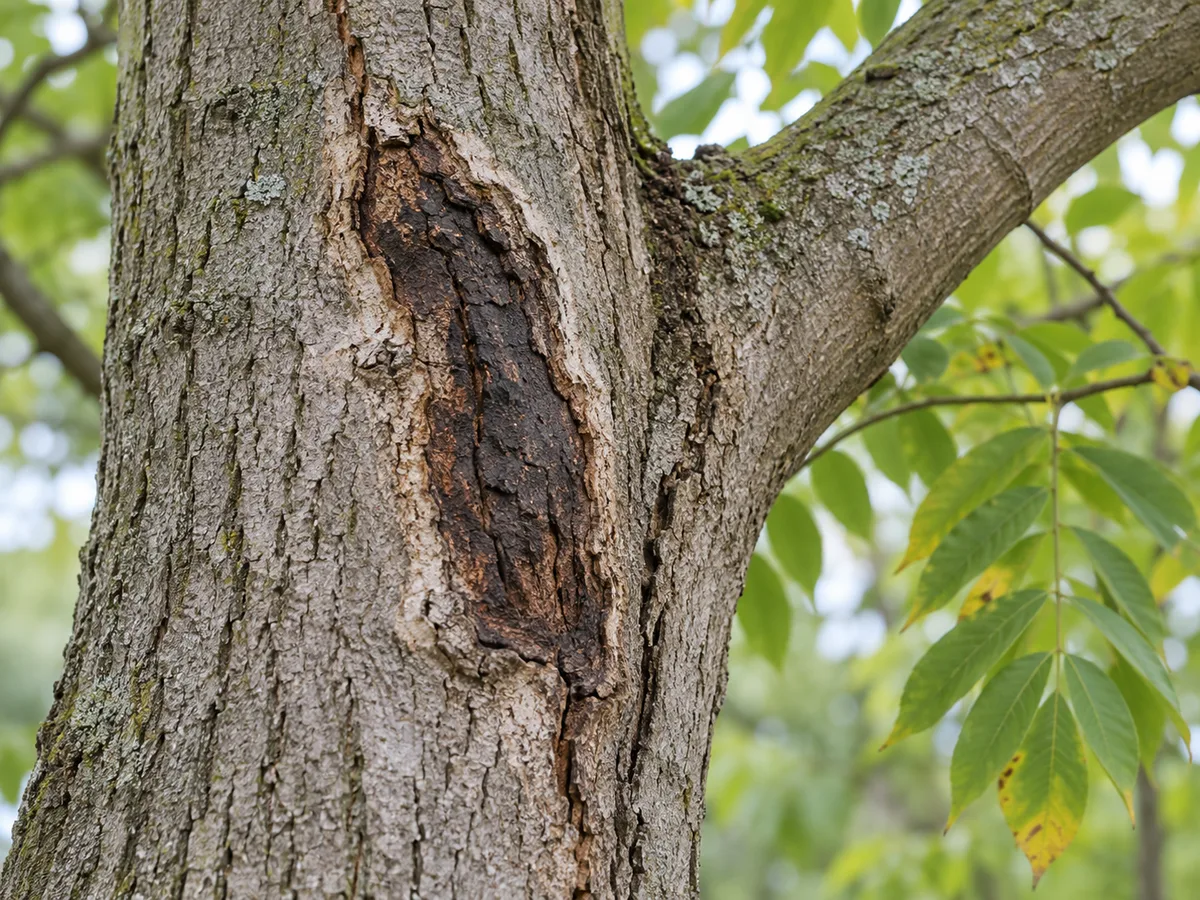
Fast crown wilt deserves attention when a susceptible host grows in a region where a vascular disease occurs. Oak wilt may start with wilt and bronzing at branch tips or leaf margins, but drought and root damage can look similar. Ohio State’s oak-wilt guidance notes that visual symptoms overlap and lab diagnosis may be needed. Do not cut, trench around, inject, or move wood from a suspected oak-wilt tree without local professional guidance.
Mushrooms, Brackets, Lichens, and Harmless Growth
A mushroom is a reproductive structure; most of the fungus may be hidden in wood or soil. Lawn mushrooms may feed on buried roots or decaying wood and do not prove that a living tree has root rot. Fruiting bodies on a trunk, root flare, or major branch deserve more attention when accompanied by dieback, cavities, cracks, or loose bark.
Bracket fungi, or conks, are fruiting bodies of wood-decay fungi. They can indicate heartwood decay, but species, location, host, and remaining sound wood determine risk. A tree can have internal decay without a visible bracket, and a bracket does not prove imminent failure. The RHS bracket-fungi guide explains that some fungi decay heartwood without killing living tissue, though weakened wood can still break; scraping off a bracket does not repair it.
Lichens look like crusty, leafy, or branching patches on bark, often gray-green, yellow, or pale. They are partnerships between fungi and photosynthetic organisms and use bark as a surface rather than drawing food from the tree. Mosses and algae also grow in damp shade. These are generally not the reason a tree is declining; do not scrape them off. UMN Extension lists lichens among non-harmful tree conditions.
Common Tree Diseases and What the Clues Mean
Think in groups rather than memorizing fungus names. Foliar diseases affect leaves, needles, or shoots; vascular wilts interfere with water-conducting tissue; cankers kill patches of bark or cambium; and root or heartwood diseases may undermine strength. A tree-care overview of fungal disease categories uses similar groupings, and a common-disease guide catalogs examples such as anthracnose, cankers, and powdery mildew. Each disease has its own host, spread pattern, and management; fungal spores may travel by air or splashing water, while insects, tools, soil, or plant material matter for only some pathogens.
A symptom does not name the pathogen. “Yellow leaves” describes what happened, not why. “Fungus on the tree” is equally broad: a pathogen may be a true fungus, a fungus-like organism, or growth on insect honeydew rather than tree tissue.
Vascular Wilts: Oak Wilt, Dutch Elm Disease, and Verticillium
Vascular wilt diseases affect the tissue that moves water through the tree. Oak wilt and Dutch elm disease are highly consequential because they can spread and kill susceptible hosts; Verticillium wilt affects many woody plants but has a different biology and management path. Wilting, branch flagging, leaf yellowing or browning, and premature leaf drop can occur in these diseases, but they can also result from drought, girdling roots, damaged roots, or other vascular problems.
Host and geography matter. In oak-wilt regions, susceptibility varies among oak groups, and disease can spread between neighboring oaks through root grafts and insects that carry spores to fresh wounds. Wisconsin Extension outlines local pruning precautions; timing varies by region, so use current local guidance, not a universal calendar. If oak wilt is plausible, seek advice before pruning, removing, injecting, or transporting wood.
Dutch elm disease affects elms and spreads through elm bark beetles; clusters of leaves can yellow and wilt before affected shoots die back. Forest Research’s disease profile describes these signs and the beetle route. Removal, timing, and disposal require care; a symptom alone cannot confirm the disease.
Verticillium wilt is soilborne and may cause one-sided dieback, yellowing, scorch, or slow decline. There is no general spray that restores vascular tissue once a pathogen is established. A diagnostician can separate it from drought or root injury and guide pruning, monitoring, or replacement; do not move suspect soil or replant a susceptible host without local advice.
Leaf Spots, Mildew, Rust, and Shoot Blights
Many foliar infections are seasonal and mainly affect appearance on established trees that still produce healthy growth. Anthracnose can cause blotches after cool, wet springs; powdery mildew creates white leaf growth; rusts form pustules on certain hosts. Repeated severe infection, early defoliation, or dieback on a young tree deserves attention, but a cosmetic symptom does not automatically justify treatment.
Rusts illustrate why host matters. Some alternate between two plants during their life cycle, so removing one nearby host may not stop airborne spores from elsewhere. The RHS guide says many foliage rusts do little damage in gardens, while white pine blister rust can form cankers on five-needle pines. Distinguish a leaf pustule from a stem canker before considering treatment.
With powdery white growth, check which surfaces are affected; mineral residue, dust, insects, and other organisms can look similar. For spots, inspect both leaf surfaces and note whether one or several species are affected and whether overhead watering or repeated rain preceded symptoms.
Root Disease and Wood Decay
Root and collar problems are difficult to identify because roots are hidden. Clues include progressive thinning, short shoots, dieback, early fall color, a loose root plate, soft bark, or mushrooms near the trunk. Drought, saturation, compaction, grade changes, buried root flares, and construction damage can look similar. Do not excavate major roots or treat root rot based on a lawn mushroom.
Armillaria and other pathogens can kill roots and colonize the lower trunk; Phytophthora can cause root, crown, or bleeding-canker problems in wet conditions. Phytophthora is an oomycete, or water mold, not a true fungus, so products that work on true fungi may not work on it. The Morton Arboretum’s disease profile explains why accurate pathogen identification matters before choosing a treatment.
Wood-decay fungi consume structural wood. A cavity, crack, dead upper crown, large wound, or fruiting body warrants an assessment of whether sound wood can support the crown, especially near a target. Do not drill or try to diagnose stability by tapping. An arborist can assess the tree, site, and likely failure consequences; cutting off a bracket does not repair internal decay.
Sooty Mold and Fungus-Like Pathogens
Sooty mold is a black growth on leaves, fruit, and sometimes twigs. It grows on honeydew left by sap-feeding insects such as scale, aphids, or whiteflies; it is not a fungus invading vascular tissue. Extensive coating can shade leaves, but the first step is to identify the insects. A fungicide misses the source, while an unnecessary insecticide may harm beneficial predators or pollinators.
Phytophthora root decline can resemble drought or other root disorders. Saturated soil and poor drainage favor some diseases, while dry compacted soil can cause similar decline. Improving drainage may prevent future infection in a suitable site, but it cannot revive roots already lost or cure every lookalike problem.
A Safe First-Response Plan
Preserve evidence, protect people, and avoid actions that might move a pathogen or worsen injury. Keep clear of a broken or hanging limb and call a tree professional; otherwise, record symptoms before major action.
Document the Tree Before Making Cuts
Photograph the whole crown, affected side and nearby trees, trunk base and branch unions, and close-ups of both sides of affected leaves or bark. Include healthy tissue for comparison. The UW–Madison Plant Disease Diagnostics Clinic recommends landscape, whole-plant, and close-up images because each view reveals different clues.
Record the species if known, approximate size, location, symptom start date, recent weather and irrigation, construction, pruning, and chemical use. Note whether symptoms followed a storm, heat wave, or excavation and whether they are spreading. If the tree is unidentified, photograph its leaves, bark, fruit, and overall shape instead of guessing.
Ask a local clinic what sample it needs before mailing material. Some accept digital submissions; physical samples often need fresh tissue from the boundary between healthy and affected areas. Follow collection and shipping instructions. The UW clinic asks out-of-state clients to contact it first, because services and rules vary by region.
Reduce Spread With Sanitation and Careful Pruning
Avoid pruning wet foliage when a suspected disease spreads by splashing, and do not move from a diseased tree to a healthy one with dirty tools. For a known tool-borne disease, use the extension service’s cleaning protocol; otherwise, clean, sharp tools may be sufficient. Disinfectants vary in contact time and can corrode metal, so follow directions rather than mixing chemicals.
Prune only when the cut is within your ability and guidance supports it. Cut just outside the branch collar, avoid flush cuts and stubs, and do not remove a large share of live canopy at once. A small dead twig may be manageable; trunk cankers, large limbs, utility conflicts, and overhead cuts belong to a trained professional. Follow local disposal rules, especially when a regulated disease may be present.
Pruning paint is not a universal remedy. Many references discourage sealing routine cuts, but oak-wilt guidance in some regions gives specific wound-protection advice during beetle-risk periods. Follow current local recommendations instead of dressing every cut or applying one region’s advice everywhere.
Match Treatment to the Confirmed Cause
Treat the cause, not the word “fungus.” For minor leaf spotting on a vigorous tree, local guidance may recommend collecting affected leaves, reducing repeated leaf wetness, and monitoring new growth. For sooty mold, identify the honeydew-producing insect. For wilt, root rot, or structural decay, diagnosis or risk assessment matters more than a home spray.
Water according to soil moisture and species needs; do not keep the root zone saturated. Newly planted trees need more frequent checks as roots establish. A broad, moderate mulch layer can conserve moisture, but keep it off the trunk and root flare. Drainage correction or grade changes can damage roots or utilities, so get advice before digging around a declining tree.
When Fungicides Help—and When They Do Not
Fungicides are not broad-spectrum tree medicine. Many protect healthy tissue at a specific growth stage; they do not reverse dead bark, restore a girdled trunk, rebuild decayed heartwood, or cure every systemic wilt. Timing matters: a protectant applied after infection may do little, and a product for one pathogen may not work on another. Some diseases are managed through sanitation, resistant plant selection, vector control, or stress reduction instead.
Before using any pesticide, confirm the tree, disease, site, and product label. Use only a product labeled for the intended host, disease, and site in your jurisdiction; follow its rate and safety, storage, and disposal directions. Do not increase a dose, mix products, or inject a tree based on a photo. A professional can weigh treatment benefits, costs, intervals, tree condition, and the chance that treatment may slow decline without curing it.
This matters for oak wilt. Ohio State Extension describes propiconazole injection as a professional, disease-specific option with more promise before infection in selected cases; it is not a cure for every oak and has little hope of saving infected red oaks once disease is established. A local pathologist or arborist should decide whether it is appropriate.
When to Call an Arborist or Diagnostic Clinic
Call an ISA-credentialed arborist for a risk assessment when a bracket or cavity is on the trunk or root flare, a major branch is dead or cracked, the root plate is lifting, or a tree could strike a home, road, or play area. The ISA directory helps locate and verify credentialed professionals. Ask what the inspection includes and whether a lab sample is also needed.
Contact an extension plant clinic when diagnosis will change treatment, a tree is declining quickly, several trees are affected, or a regulated disease is possible. A clinic may identify a pathogen or distinguish disease from environmental injury, but it does not replace an on-site structural inspection. A risk assessment may establish whether a tree is hazardous without naming the fungus; a serious case may need both.
Call promptly if oak wilt is plausible locally, the canopy is changing quickly, or fresh trunk cracks, root movement, loose limbs, or decay threaten a target. A few leaf spots on a vigorous tree usually allow time to document and ask extension before acting.
Prevent Future Problems by Reducing Tree Stress
Choose trees suited to the region, mature size, drainage, root space, and overhead clearance. A locally resistant species or cultivar may lower recurring disease risk, but resistance is not immunity and pathogen populations vary. Check before replanting a host in soil with a confirmed persistent pathogen.
Protect roots from compaction, trenching, traffic, and excess fill. Preserve the visible root flare and water according to soil moisture. During drought, soak the root zone rather than briefly wetting the surface; in wet sites, address standing water or choose a better-adapted tree instead of relying on routine fungicide.
Prune for structure when young and avoid topping or large unnecessary cuts. Clean up fallen leaves when a local disease overwinters there, but leave some litter where it benefits soil and wildlife. For oak wilt, follow county or state timing advice. Healthy-tree care cannot prevent every infection, but it can reduce stress and improve recovery.
Conclusion
Tree fungus identification starts with the host, symptom location, pattern, timing, and site history—not a spray bottle. Leaf spots, white powder, black coating, cankers, wilt, and mushrooms point to different possibilities, but one sign rarely proves the pathogen. Lichens and many lawn mushrooms do not prove a living tree is infected, while trunk decay can matter structurally even when the canopy is green.
Photograph the whole tree and affected tissue, note recent site changes, and ask extension or an arborist before consequential cuts or treatments. Use a labeled, disease-specific method only when it is appropriate; get professional help for rapid wilt, major cankers, suspected root decay, or a possible hazard.



