12 Types of Variegated Hosta to Plant in Your Yard
Find 12 variegated hosta varieties for yard borders and shade beds. See how their colors change, which fit small spaces, and what to check before buying.
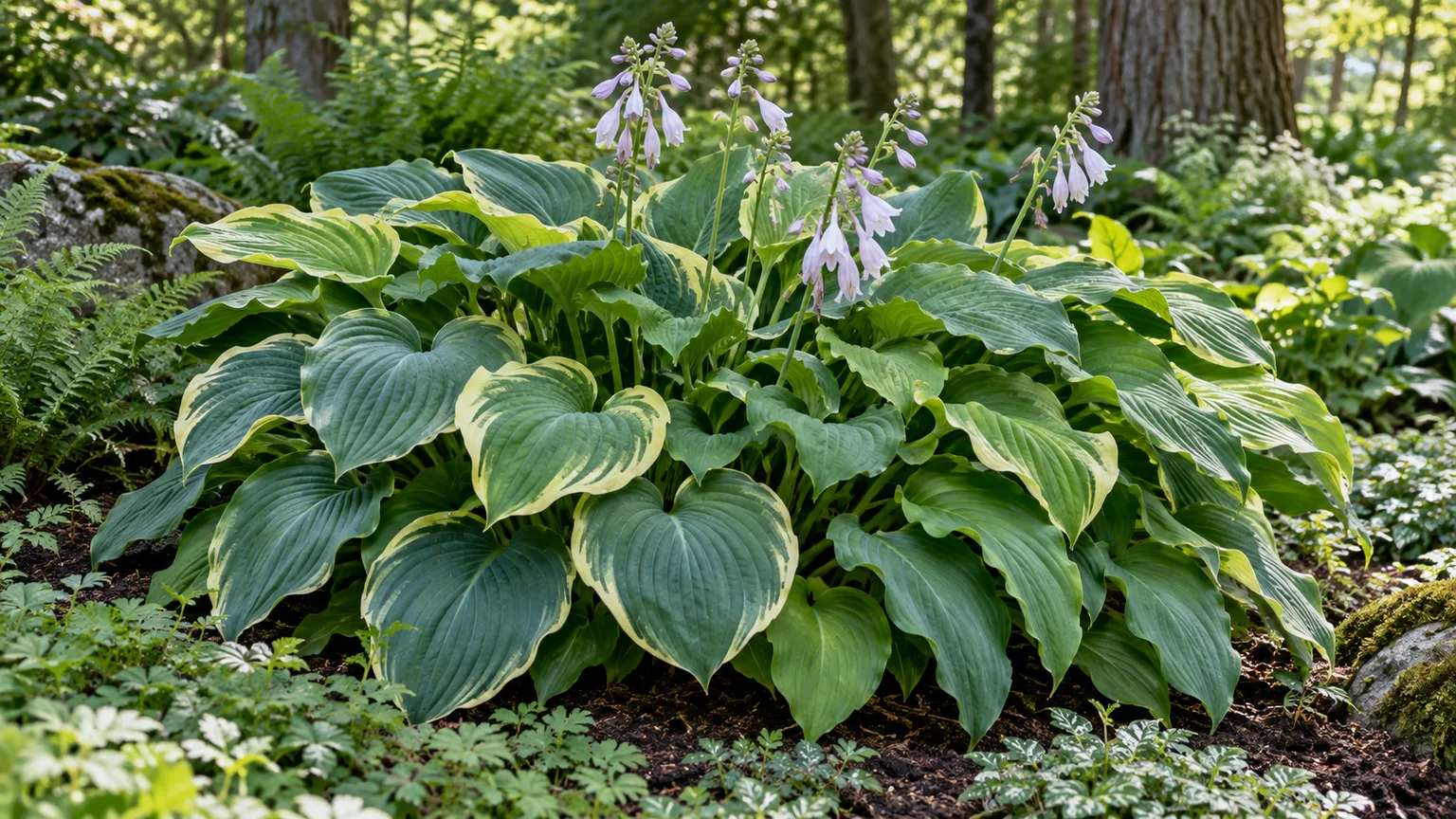
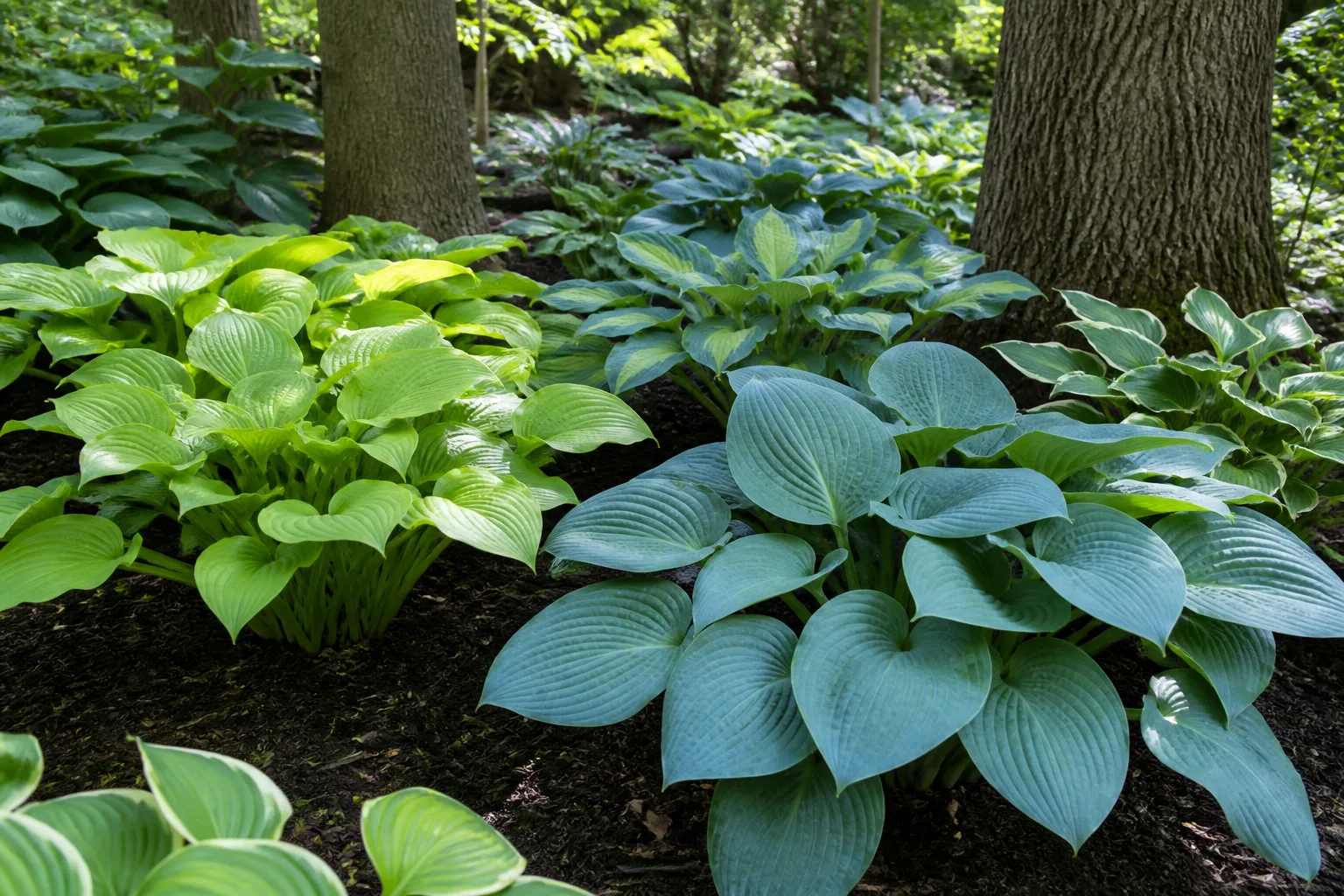
If a shady border looks flat, a variegated hosta can add contrast without relying on flowers that disappear after a few weeks. The right cultivar can light up a north-facing bed, give a path a crisp edge, or anchor a woodland planting with broad, patterned leaves. The useful choice depends on more than color: mature spread, leaf thickness, exposure, and the amount of summer moisture the site can supply all change how a hosta performs.
The 12 varieties below range from compact, gold-centered mounds to wide plants with blue-green leaves and bright margins. Treat nursery dimensions as a planning estimate, not a promise. Hosta size and color can vary with climate, age, light, and growing conditions, so use the plant tag alongside the site guidance here.
Choose by footprint, leaf pattern, and site
For a tight border or a pot, begin with ‘Magic Island’, ‘Rainbow’s End’, or ‘Remember Me’. Their compact mounds bring color near a path without asking for the four- or five-foot footprint that a mature ‘Frances Williams’ can occupy. If the bed has room for an intermediate clump, ‘June’, ‘Patriot’, ‘Revolution’, and ‘Captain’s Adventure’ give you more leaf area without immediately taking over the scene.
For a larger woodland bed, consider ‘Wide Brim’, ‘Francee’, ‘Liberty’, or ‘Frances Williams’. Their foliage can make a strong anchor, but it also needs enough clearance from paths, smaller perennials, and neighboring hostas. When your site gets some gentle morning sun, gold-centered forms such as ‘June’ and ‘Remember Me’ can show more color; for hot afternoon exposure, choose a cooler, filtered spot before relying on any cultivar’s “sun tolerant” label.
Here is a quick way to narrow the list:
| Garden need | Start with | Why it may fit |
|---|---|---|
| Small border or container | ’Magic Island’, ‘Rainbow’s End’, ‘Remember Me’ | Compact clumps with a vivid center or margin |
| White edge that reads clearly in shade | ’Francee’ or ‘Patriot’ | Green foliage framed by a contrasting pale margin |
| Gold center with a dark outline | ’June’ or ‘Remember Me’ | Strong center-to-edge contrast |
| A leaf pattern that changes through summer | ’Captain’s Adventure’ or ‘Revolution’ | Streaking and color shifts make the foliage more animated |
| A broad focal point | ’Liberty’ or ‘Frances Williams’ | Large leaves and a wide, spreading mound |
These are starting points, not rankings. If deer regularly browse the yard, hostas may be a poor choice for an unprotected bed regardless of the cultivar; if the soil dries quickly, a smaller hosta in a pot will need closer watering checks than the same plant in moisture-retentive ground.
What hosta variegation means—and what shifts during the season
Variegation describes a leaf with two or more colors arranged as a margin, center, stripe, streak, splash, or patch. A marginally variegated hosta has a different-colored edge around a greener center, as with ‘Patriot’ and ‘Francee’. A center-variegated hosta reverses that pattern: a pale or gold center is framed by a darker band, as in ‘June’ and ‘Remember Me’. Other cultivars mix the two through streaks or shifting bands. The Royal Horticultural Society defines variegation as contrasting streaks, blotches, or patches; it also notes that seedlings of variegated plants often grow up as a single color rather than repeating the parent pattern. The RHS hosta-growing guide
The colors in a catalog photo are not fixed paint. A gold center can emerge yellow and mature toward cream or a paler tone; shade may leave gold foliage more chartreuse, while extra light can bring out stronger yellow. Some cultivars also change in the line between center and edge as the leaves expand. The named pattern remains useful, but seasonal appearance is one reason to compare a plant through the growing season rather than judge it from one nursery photo.
Leaf texture matters as much as the color map. Smooth, thin leaves create a different impression from a deeply veined, puckered, cupped, or corrugated leaf. Texture can also matter practically: thick leaves are often less appealing to slugs than thin, soft leaves, though they are never immune. Before buying, look at the whole plant from above and from the side; the same color pattern can read very differently when the mound is upright, flat, cupped, or cascading.
12 variegated hostas for different garden jobs
Use the following descriptions to match a cultivar to a spot, not to chase a perfect color photo. Several measurements vary between horticultural references and nurseries, and a young hosta will be much smaller than its eventual clump. The Iowa State University Extension cultivar table is helpful for comparing leaf traits and mature dimensions, while the RHS and botanical-garden profiles add cultivar-specific notes for several selections. Iowa State’s hosta cultivar table
Compact hostas for borders and pots
‘Magic Island’ offers a compact mound of thick, slightly cupped leaves with a creamy-yellow center and a blue-green edge. The RHS places it in partial or full shade and notes that its thicker foliage may be less vulnerable to slugs than thinner-leaved hostas. That is a useful combination for a small border or a container near a sheltered entrance, but the leaves still need inspection if slugs are common. The RHS profile for ‘Magic Island’
‘Rainbow’s End’ is a small, high-contrast choice: yellow to creamy-white centers sit inside green margins that can vary in width. Iowa State Extension lists a mature footprint of about 11 inches tall by 21 inches wide. Use it near a path where people can notice the pattern, or at the front of a bed where a large hosta would hide smaller plants. Avoid placing it beside several other bright, streaked hostas; a little visual breathing room helps the variegation stand out.
‘Remember Me’ starts the season with bright yellow centers and dark green margins, then the middle of the leaf can turn nearly white as summer advances. The Chicago Botanic Garden describes it as a small-to-medium mound about 15 inches high and 20 inches wide, and identifies it as a sport of ‘June’. It grows more slowly than many common hostas, so give it time to establish before deciding that the plant is failing. This is a good specimen for a sheltered nook or a pot that can be protected from harsh afternoon sun. The Chicago Botanic Garden profile for ‘Remember Me’
Medium hostas with strong patterns
‘Frozen Margarita’ has glossy yellow-green leaves that mature greener, a narrow white margin, and deeply impressed veins. The RHS lists it at around 18 inches tall and up to about 3 feet wide, with partial shade as its preferred position. Its contrast is subtler than the bold white-edged types, so it works well where you want a bright but not oversized accent. Leave enough space for the mature width; a young division can look far smaller than the clump it eventually forms. The RHS profile for ‘Frozen Margarita’
‘Captain’s Adventure’ is a cultivar for gardeners who enjoy a changing, more intricate pattern. It is a sport of ‘Captain Kirk’; its leaves develop a chartreuse center and pale outer margin with a dark green line between them, creating a three-part or watermarked effect. A specialist hosta record places it in the medium class at roughly 15 inches tall by 24 inches wide. The seasonal variation can be appealing, but it makes this a less predictable pick if you want a simple, stable-looking border. The MyHostas cultivar record for ‘Captain’s Adventure’
‘Revolution’ puts a creamy-white center inside a dark green border, with green speckles or streaks interrupting the pale area. That central flecking gives it more visual movement than a clean two-color margin. Iowa State Extension lists it at about 18 inches high by 24 inches wide, a practical fit for the middle of a layered shade bed. Place it where the center marks can be seen up close; from far away, a more simply edged hosta may read more clearly.
‘June’ is a versatile choice when you want a blue-green edge around a gold center. Its center tends to look more gold with some gentle sun and more chartreuse in deeper shade, so the site influences the effect. Fine Gardening describes it as a sturdy hosta that can fare well in brighter conditions than many cultivars and notes that its thicker leaves are fairly resistant to slug damage. That makes ‘June’ a reasonable first trial for a bed with morning light, but not a guarantee for a hot, dry, west-facing strip. Fine Gardening’s notes on ‘June’
‘Patriot’ has dark green, puckered leaves with broad, irregular white margins. The pale edge makes it easy to use as a repeating line beside a path or under a tree canopy where white foliage can lift a dim corner. Iowa State Extension records it around 12 inches tall by 30 inches wide, although seller measurements can differ. Because the outer tissue is pale, place it in partial or dappled shade in hot-summer regions and water consistently during establishment rather than using it as a dry-site plant.
Broad clumps for a woodland bed
‘Wide Brim’ has medium-to-dark green leaves with a substantial yellow border that often fades toward creamy white. Iowa State Extension lists it at about 18 inches high by 45 inches wide, so it is a better fit for a roomy border than a narrow foundation strip. It bridges yellow and green foliage in a design: nearby solid green hostas can quiet the pattern, while a gold-leaved companion can echo its margin.
‘Francee’ is a dependable-looking green-and-white option, with dark foliage and a clean pale margin. The Chicago Botanic Garden groups it with good midsize hostas, while Iowa State’s cultivar table gives it a spread of roughly 36 inches. This cultivar is useful when you want a consistent white edge without a streaked or center-variegated effect. Treat the stated spread as a spacing cue and allow a little extra room if you want every clump visible instead of a continuous foliage mass.
‘Liberty’ makes a broad, architectural mound with blue-green leaves and a wide yellow margin that shifts creamier as the plant matures. Iowa State Extension lists an approximately 39-inch height and width; Fine Gardening describes it as an early-emerging large hosta that can serve as a focal point at the far end of a garden. It needs more room than its nursery pot suggests. Use it where its size can frame a view or terminate a path, not where its leaves will spill across a narrow walkway.
‘Frances Williams’ is a classic large hosta with broad, puckered blue-green leaves edged in irregular yellow-green. The Chicago Botanic Garden describes a mature plant about 2 feet tall and 4 feet wide; the Missouri Botanical Garden notes that some clumps spread wider with age. The large leaves give it weight in a woodland border, but the plant can overwhelm a small bed and can show damage from slugs or exposed weather. Site it as a specimen or use it as a backdrop for finer-textured ferns rather than squeezing it between small edging plants. The Chicago Botanic Garden profile for ‘Frances Williams’
Find a hosta for your light and climate
Most hostas perform best in moist soil and partial shade. “Shade plant” does not mean every cultivar wants the darkest corner, however. Yellow and gold forms often show stronger color with some gentle sun, and some green or fragrant cultivars tolerate brighter conditions. Blue-leaved hostas generally benefit from more shade, while intense late-day light can scorch leaves, especially when the soil is dry. The RHS hosta guide North Carolina State Extension’s hosta profile
Morning sun for gold; afternoon shade for foliage
Watch the exact bed for a full day before choosing. Two or three hours of early sun followed by open shade is not equivalent to the same number of hours beside a west-facing wall, where heat radiates after midday. In a cool-summer region, a hosta may handle more direct light; in a hot or humid climate, give even a gold-centered cultivar protection from the hottest afternoon hours.
If you want more brightness, start with a yellow or chartreuse selection such as ‘June’, ‘Remember Me’, or ‘Rainbow’s End’ and test it in morning light. If the leaf edges become papery, washed out, or brown on the sun-facing side, move the plant to filtered light or add afternoon shade rather than increasing fertilizer. A colorful margin is not evidence that a hosta can tolerate heat and dry soil.
Fit mature spread before planting
The width of a hosta is often more important than its height. A plant only a foot tall can still spread three or four feet and cover nearby spring perennials. The North Carolina State Extension profile describes hostas ranging from dwarf to giant and groups cultivar classes by mature height, while the Iowa State tables also report cultivar widths. Use both measurements, and remember that garden sites can change the final result.
For a single specimen or a crisp repeated rhythm, space plants so their centers are about one mature spread apart. That leaves a gap while young clumps grow, but preserves each plant’s outline and gives you room to weed. If you want a continuous groundcover, you can plant closer, but you are choosing a denser bed that will need more thinning and can be harder to keep clean around the crowns.
Check what lies above and below the planting spot. Tree roots may compete for water, roofs can dump runoff onto one crown, and a path edge can force broad leaves to flop into foot traffic. A wide hosta can be excellent under a tree with reliable soil moisture and enough room around it, but a young specimen beside a doorway is not automatically a compact plant just because it arrived in a small pot.
Plant in a cool, moist, well-drained root zone
Hostas like moisture-retentive soil enriched with organic matter, but they do not want to sit in winter water. The RHS recommends fertile soil and notes that hostas can grow in clay when improved with compost; North Carolina Extension likewise emphasizes good drainage and warns against soggy conditions. That distinction is more useful than a rigid claim that hostas need a particular soil texture or pH. The RHS guide North Carolina State Extension
Choose spring or fall planting where those seasons are mild, and avoid asking a fresh transplant to establish during a heat wave if you can wait. Dig a hole as deep as the root ball and wider than it, loosen compacted surrounding soil, and set the crown at the same level it grew in the nursery pot. Backfill with the site’s soil, water slowly to settle it around the roots, and spread a modest layer of organic mulch across the bed while keeping the crown itself uncovered.
Do not make a rich, soggy pocket around a hosta in otherwise compact soil. A hole amended heavily while the surrounding ground sheds water poorly can collect moisture like a basin. Improve the whole planting zone, add organic matter across the bed, and resolve drainage before adding several cultivars. Avoid piling mulch over emerging eyes in spring, because buried growth can be delayed or stressed.
Water the roots without keeping the crown soggy
During the first growing season, check the soil rather than following a fixed calendar. Water when the root zone is starting to dry, then soak deeply enough to reach the bottom of the root ball. Established hostas need supplemental water during dry spells, especially beneath large trees or near paving where roots and reflected heat increase stress.
A container needs closer attention because its limited soil volume can dry faster than a garden bed. Use a wide pot with drainage holes, keep it out of hot afternoon sun, and water when the top layer begins to dry rather than letting the whole root ball bake. Gardeners’ World recommends keeping hostas moist but well-drained and warns that waterlogged potting mix can kill a plant. BBC Gardeners’ World’s hosta guide
Keep leaves presentable around slugs, snails, deer, and pets
Slugs and snails are the most predictable foliage problem. They often damage the young leaves just as they unfurl, leaving ragged holes that remain visible through the season. Thicker leaves may be less vulnerable: Fine Gardening calls ‘June’ fairly resistant to slug damage, and the RHS says ‘Magic Island’ may be less susceptible than thin-leaved varieties. “Less susceptible” is not “slug-proof”; local pest pressure can overcome a cultivar advantage. Fine Gardening’s hosta design guidance The RHS ‘Magic Island’ profile
Make the bed less convenient for slugs by removing damp leaf litter and hiding places beside the crowns, checking at dusk or after rain, and hand-picking pests when practical. Keep air moving between mature clumps rather than packing foliage wall-to-wall. If you use any control product, follow its local label exactly and choose a method compatible with pets and wildlife; the safest practical first step is to identify whether slugs are actually causing the holes.
Deer and rabbits also browse hostas. No leaf pattern makes a hosta deer-proof, and a hungry animal may strip even an established clump. If browsing is severe, use a physical barrier or shift the hosta to a protected courtyard bed instead of buying more expensive cultivars in the hope that their color will deter wildlife. North Carolina State Extension’s hosta profile
Hostas are toxic to cats, dogs, and horses. The ASPCA lists saponins as the toxic principle and vomiting, diarrhea, and depression among possible signs. If a pet tends to chew foliage, site hostas where it cannot reach them or choose a confirmed non-toxic alternative; contact a veterinarian or animal poison-control service if ingestion is suspected. The ASPCA’s hosta listing
Use companions and repetition to make patterns work
One bold hosta can clarify a shady bed; a dozen unrelated bright patterns can make it feel busy. Repeat one or two cultivars at intervals, then use solid green or blue-green foliage as a quieter backdrop. Fine Gardening’s design advice highlights how gold foliage can be echoed with yellow flowers and how contrasting colors can strengthen a composition. Use that principle in small doses: a gold-centered hosta beside a dark green fern reads more clearly than several competing chartreuse leaves jammed together. Fine Gardening’s design guidance
Contrast shape as well as color. The broad, ribbed leaves of ‘Frances Williams’ pair well with fine fern fronds; a low ‘Rainbow’s End’ can sit at the front of a bed while a taller, wider clump anchors the back. Astilbe, brunnera, hellebores, and heuchera are common shade companions, but match moisture and mature size before planting. If the hosta will eventually cast deep shade, do not place a sun-loving companion where it will be crowded out.
For a long season of interest, tuck spring bulbs or early woodland flowers into the spaces between hosta crowns, then let the hosta foliage expand later. Hostas are deciduous and disappear after frost, so include plants with winter structure if the bed should look composed year-round. Keep companion plants far enough from the hosta crown that you can remove damaged leaves and check for slugs without wrestling through a thicket.
Shop, divide, and keep a cultivar true-to-type
Buy named cultivars from a nursery that labels plants clearly and can tell you whether the plant is grown by division or tissue culture. Inspect several leaves, not just the best-looking one in the display. A cultivar should show a fairly consistent pattern from leaf to leaf; the centers and margins may shift with season, but random distortion, uneven puckering, or unusual color bleeding deserves a closer look.
Named hostas are usually increased by dividing the crown or through tissue culture. Seedlings are not a dependable shortcut to more ‘Patriot’ or ‘June’: seed from a variegated cultivar can produce a green plant or an unpredictable combination. Divide a healthy mature clump in spring as the eyes emerge or in early fall when the weather is cool, making sure each division has healthy roots and at least one growing point. You do not need to divide a hosta on a strict schedule if the clump still has room and looks healthy. North Carolina State Extension The RHS hosta-growing guide
Normal variegation versus suspicious mottling
Stable cultivar patterns follow the plant’s normal layout: a clean outer edge, a repeated center, or a known set of streaks. Hosta Virus X and other problems can create irregular dark and light green mottling, vein “bleeding,” puckering, or distortion that does not match the cultivar’s usual pattern. Those symptoms can be subtle and are not enough to confirm a virus, so ask the seller and use an extension plant-diagnostic service if the plant looks suspicious.
Do not divide a questionable hosta or cut it with tools used on other hostas. Hosta viruses can move in infected sap on hands and tools; University of Wisconsin Extension recommends strict sanitation, and Minnesota Extension notes that abnormal mottling can require laboratory diagnosis to distinguish among viruses. If a newly purchased plant is suspicious, isolate it from the collection while you seek advice rather than placing it directly beside prized cultivars. University of Wisconsin Extension’s Hosta Virus X guidance University of Minnesota Extension’s hosta diagnostic guide
Common mistakes when choosing variegated hostas
- Buying by color alone: A photo cannot tell you whether a cultivar will become three or five feet wide. Check both height and spread before you pay.
- Assuming every hosta wants deep shade: Gold forms may need some gentle light to show their color, while blue-leaved types benefit from more shelter. Match cultivar to exposure.
- Treating “sun tolerant” as “heat proof”: Morning light, steady moisture, and cool roots differ from hot reflected light on dry soil.
- Calling a cultivar slug-proof: Thick leaves can reduce damage, but they do not remove the need to monitor a damp bed.
- Over-amending one planting hole: Improve the broader bed and keep drainage open instead of creating a water-holding pocket.
- Planting large cultivars too close: A hosta can outgrow its neighbors even when its first-season pot looked small.
- Growing named types from seed: Seedlings do not reliably repeat their parent’s leaf pattern. Use a healthy division when the cultivar identity matters.
- Ignoring household access: Hostas are toxic to pets that chew plants; choose a protected location before installing a bed.
Before buying, stand in the proposed spot at the warmest part of the day, measure the full mature spread, and decide whether you want the plant to stand alone or merge with neighbors. Those three checks rule out many disappointing choices before you dig.
Conclusion
Variegated hosta varieties differ in more than whether their leaves have a white edge or gold center. Choose a compact ‘Magic Island’, ‘Rainbow’s End’, or ‘Remember Me’ for a small border; use ‘June’, ‘Patriot’, or ‘Revolution’ for a medium focal point; and reserve ‘Wide Brim’, ‘Liberty’, or ‘Frances Williams’ for a bed with room to let the clump mature.
Match the leaf pattern to the light, the mature spread to the available space, and the plant to the moisture and pest conditions you can manage. A named hosta bought from a reliable source and grown in a suitable spot will give you the color the label promised—with the room, care, and patience the cultivar needs.