17 Weeds With Purple Flowers: How to Get Rid of Them
From wild violets to purple loosestrife, this guide helps you name purple-flowered weeds and choose hand-pulling, smothering, or herbicide control that actually works.
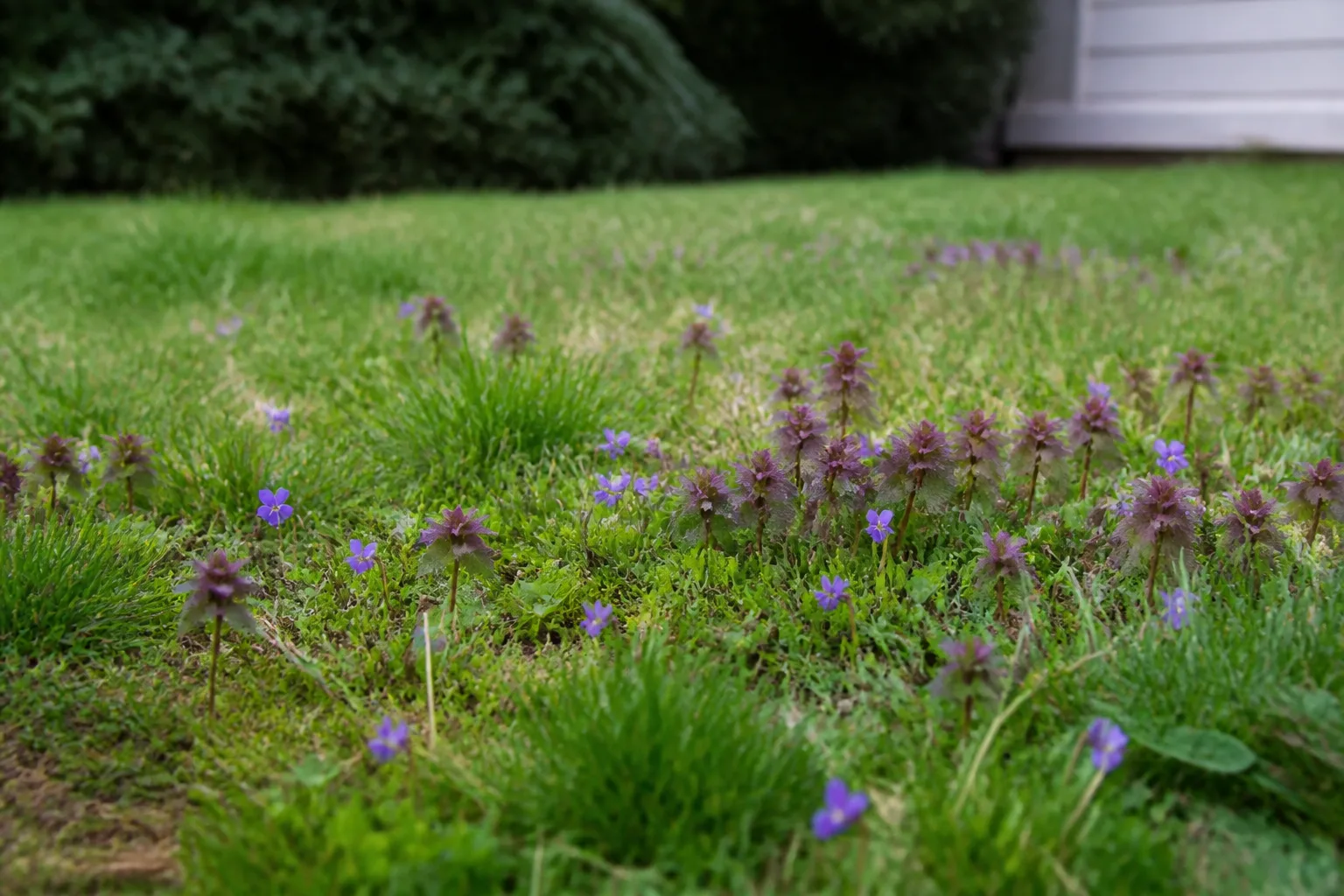
A flush of purple in the lawn can mean anything from a harmless spring native to a wetland invader that should be reported. Purple-flowered weeds share one visual trait and almost nothing else in biology, which is why blanket advice — spray everything purple — often fails. Some spread by rhizomes six inches deep. Others are annuals that vanish after one good pull. A few are federally problematic invasives; several are early-season bee plants gardeners deliberately leave during No Mow May.
The job is simple in theory and messy in practice: name the plant, decide whether it belongs, then use a control method that matches how it spreads. This guide walks through 17 common purple-blooming weeds, grouped by when they appear and how hard they are to kill, so you can stop guessing and start treating the right plant at the right time.
Quick answer: identify first, then match the control to the root system
Before you reach for herbicide, answer three questions: Where is it growing (lawn, bed, wetland edge, fence line)? How does it spread (seeds only, rhizomes, stolons, taproot)? Is it regulated (state noxious list, wetland invasive)? Annual seed weeds like henbit often surrender to early hand-pulling. Rhizome weeds like creeping bellflower laugh at a single pull. Canada thistle needs a multi-year plan because roots can run 10 feet or more horizontally and 15 feet deep, according to Colorado State University Extension.
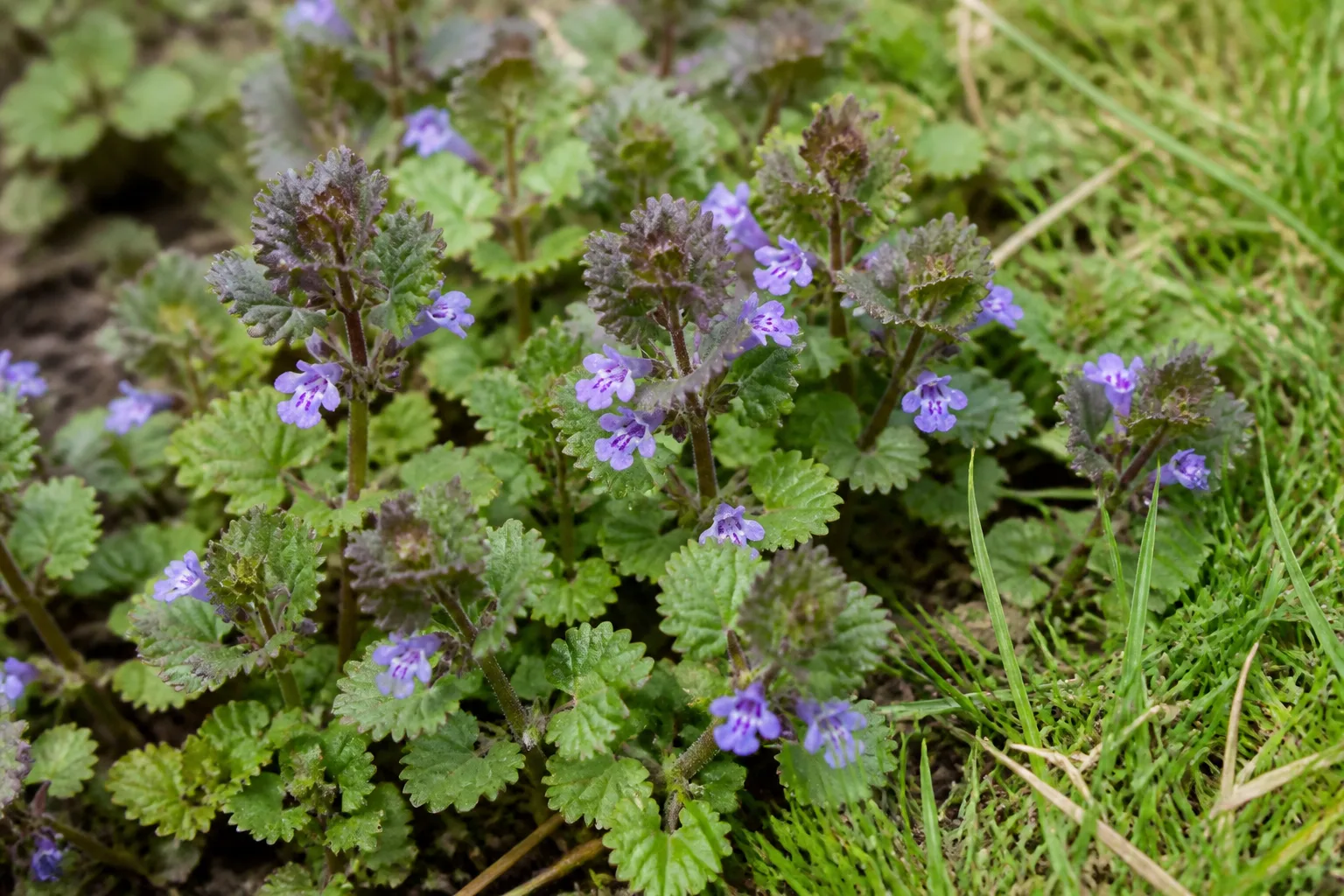
If you are staring at a mat of scalloped leaves with square stems and a minty smell when crushed, you are probably dealing with creeping Charlie (Glechoma hederacea). Our dedicated guide on how to get rid of creeping Charlie covers fall triclopyr timing in depth; the summary here fits it into the wider purple-weed lineup.
Keep the flower or remove the weed?
Not every purple flower is an enemy. Wild violets (Viola spp.) are native spring bloomers that feed mason bees and serve as host plants for fritillary butterflies. Henbit and purple deadnettle supply some of the earliest nectar in a thin spring lawn. Self-heal (Prunella vulgaris) is native, edible in small amounts, and popular with bumblebees. Tolerating a patch in an out-of-the-way corner costs little; letting those same plants colonize a formal lawn or vegetable bed costs plenty.
When purple blooms are worth tolerating
Consider keeping (or managing lightly rather than eradicating) when the plant is native, not on your state’s noxious list, confined to a low-traffic zone (orchard floor, meadow edge, rain-garden buffer), and providing documented pollinator value without crowding out diversity. Wild violets in a shady lawn strip under trees are a classic example: they indicate moist, shaded turf where grass struggles anyway. University of Minnesota Turfgrass research notes that creeping Charlie also feeds bees — a trade-off, not a free pass to let it run the entire yard.
When purple weeds need immediate action
Remove or report when the plant is listed as noxious or prohibited in your state (purple loosestrife and spotted knapweed are common examples), growing in wetlands, ditches, or natural areas where seed spread affects neighbors, allelopathic (spotted knapweed releases chemicals that suppress neighbors), toxic to children or pets (bittersweet nightshade), or forming monocultures that block grass, crops, or desired ornamentals. Creeping bellflower (Campanula rapunculoides) looks charming until rhizome fragments in every shovel of soil turn a border into a bellflower farm. Treat it as an emergency, not a curiosity.
Fast identification keys for purple-flowered weeds
Purple is the last clue you should use. Shape, stem, and timing narrow the field faster than flower color alone.
Leaf, stem, and smell clues
Square stems point to the mint family: creeping Charlie, henbit, purple deadnettle, and self-heal. Crush a leaf — a strong mint or sage odor confirms ground ivy. Opposite leaves with a purple wash on the upper surface suggest purple deadnettle; henbit’s upper leaves clasp the stem directly without a petiole. Heart-shaped, waxy basal leaves with flowers on short stalks above the foliage scream wild violet. Lobed, spiny leaves mean thistle — check whether the plant is a low rosette (bull thistle, biennial) or shoots from spreading white roots (Canada thistle, perennial). Pea-shaped flowers on one side of a stalk identify tufted vetch. Bell-shaped flowers on one side of an upright stem flag creeping bellflower.
Bloom timing cheat sheet
| Season | Likely purple weeds |
|---|---|
| Late winter–early spring | Henbit, purple deadnettle |
| Spring | Wild violets, creeping Charlie, bugleweed, slender speedwell, forget-me-not |
| Summer | Bittersweet nightshade, Canada and bull thistle, tufted vetch, purple loosestrife, tall verbena, self-heal, creeping bellflower, common burdock (year 2), spotted knapweed |
| Late summer–fall | Tall verbena, spotted knapweed, bull thistle |
Snap a photo of leaves and stems, not just flowers. Many of these plants look different before bloom.
Control toolbox: what works on rhizomes, taproots, and seed banks
Matching method to biology saves seasons of frustration.
Hand-pulling, digging, and smothering
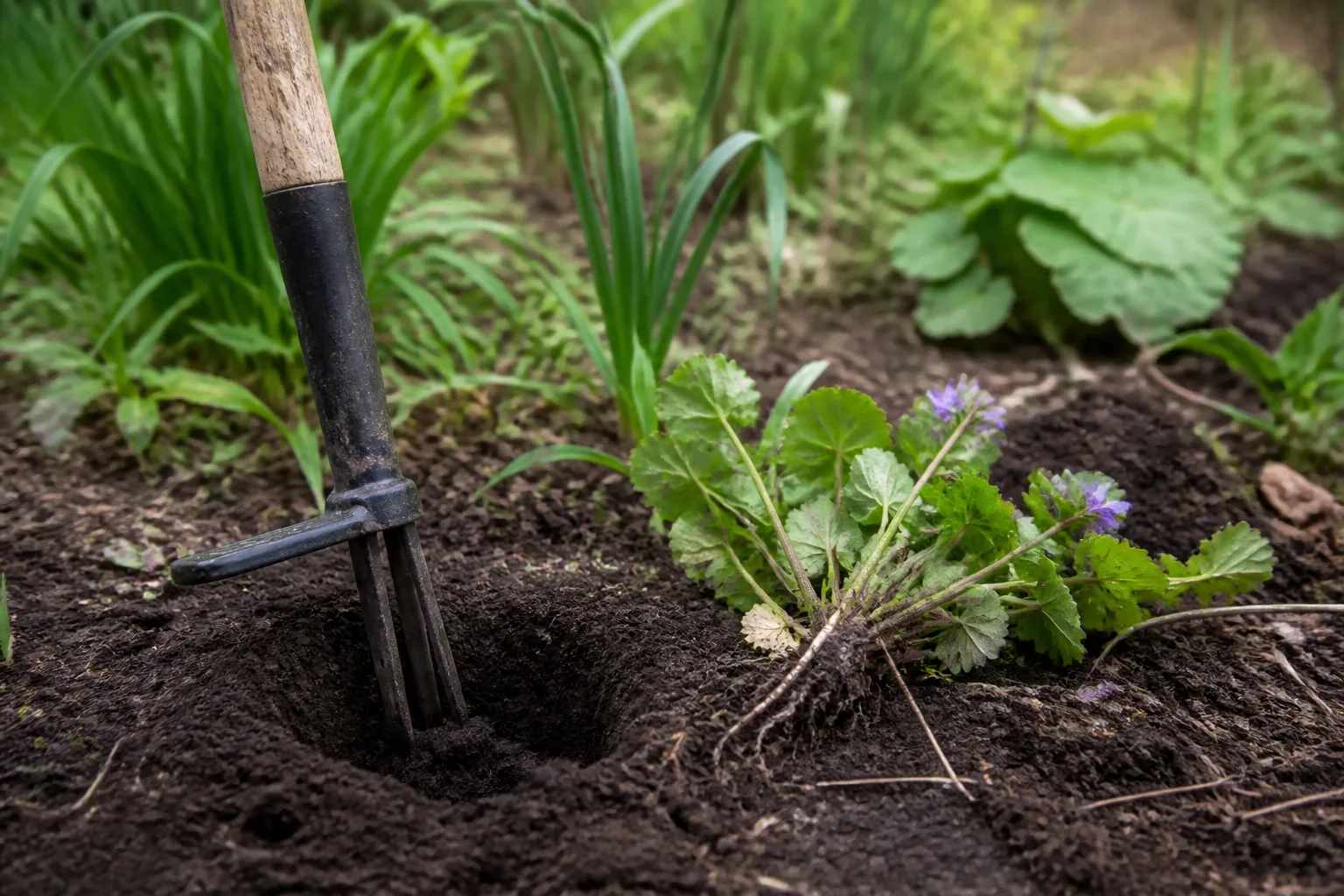
Hand-pulling works when plants are young, soil is moist, and you can remove the full root system. Bag flowering plants so seeds do not drop. For taproot weeds (burdock, young spotted knapweed), loosen soil with a fork and pull slowly so the root does not snap. For rhizome weeds (creeping bellflower, Canada thistle, wild violets), one pull is never enough — expect to revisit weekly and dig out white root fragments. Smothering with cardboard plus mulch helps in beds after a thorough dig; it is rarely practical across an entire lawn. Solarization can weaken patches in full-sun beds over a hot summer.
Selective herbicides and timing rules
In cool-season lawns, broadleaf selective herbicides (products containing 2,4-D, dicamba, MCPP, triclopyr, or sulfentrazone — always read the label for your grass type) target dicots without killing grass. Timing matters more than brand: fall is prime for perennial rhizome weeds like creeping Charlie and wild violets because the plant moves chemical into roots. Spring bloom is the second-best window for many broadleaf weeds. Pre-emergents (prodiamine, dithiopyr) stop annual purple weeds like henbit when applied before fall or late-winter germination, depending on product and region. Never spray near water without checking wetland buffer rules — especially for loosestrife. Non-selective glyphosate kills everything; use it only for spot treatment in beds, fence lines, or renovation areas where you accept bare soil temporarily.
Spring lawn weeds: violets, henbit, deadnettle, and creeping Charlie
Wild violets (Viola spp.) form 4–6 inch clumps with heart-shaped, often waxy leaves and lavender-purple flowers in spring. They spread by rhizomes and seed. In a manicured sunny lawn, fall broadleaf herbicide after the first light frost often works better than spring sprays. In shade where grass will never thrive, consider converting the strip to groundcover rather than fighting violets forever. Several native Viola species overlap in lawns; all respond similarly to control. Do not confuse them with African violets — those are unrelated houseplants.
Henbit (Lamium amplexicaule) and purple deadnettle (Lamium purpureum) are cool-season annuals (deadnettle can behave as a biennial) that germinate in fall, overwinter as rosettes, and bloom in late winter. Henbit has rounded, deeply lobed leaves that clasp the stem; deadnettle’s upper leaves are triangular with a prominent purple tint. Both have square stems. Pull or hoe in February and March before seed set, or use a labeled pre-emergent in fall if they return every year. They are excellent early bee plants — if you participate in No Mow May or similar programs, decide in advance which zones stay unmowed so you are not fighting policy with herbicide later. Neither survives heavy summer heat in southern lawns; they reappear from seed when cool weather returns.
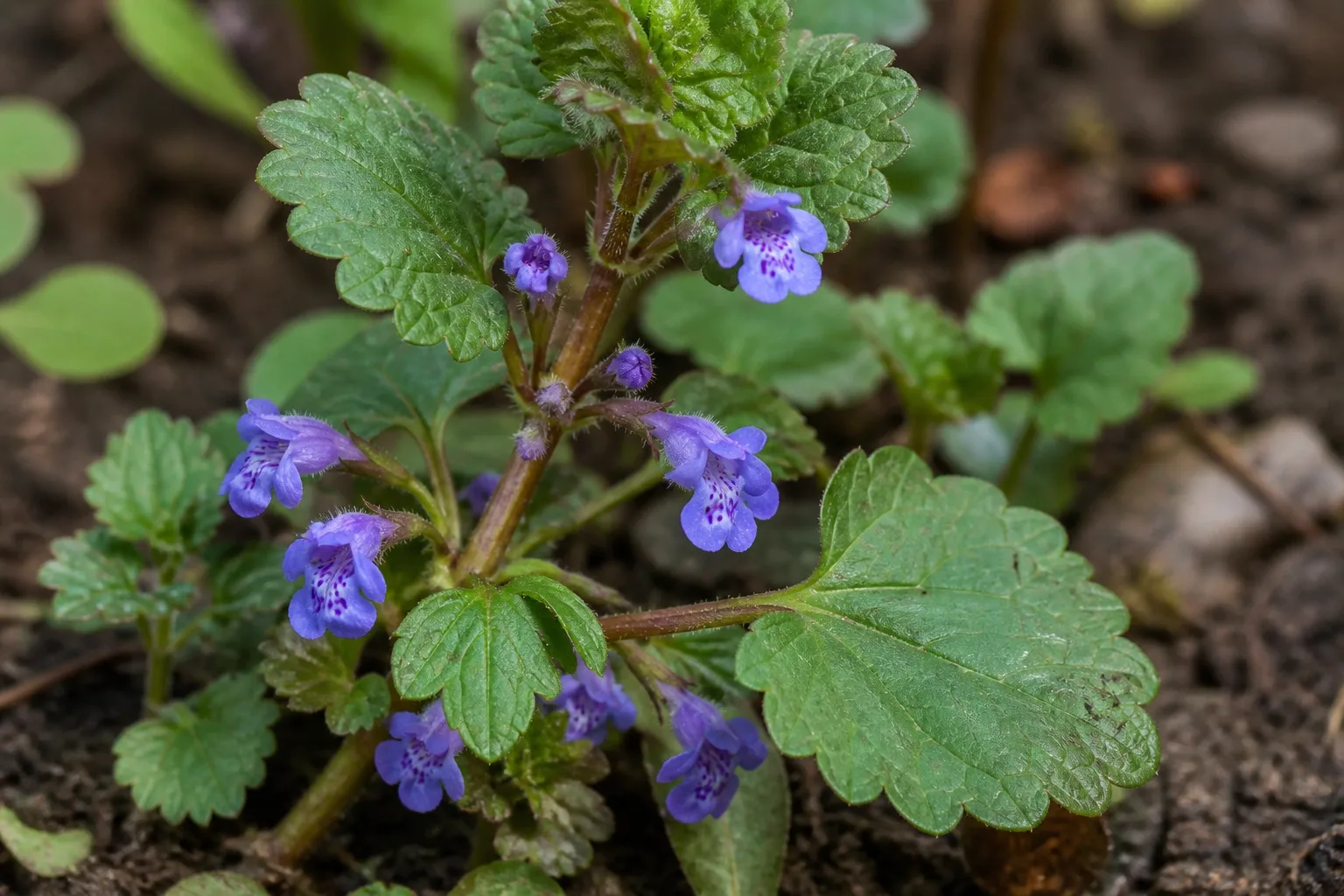
Creeping Charlie is a perennial ground ivy with scalloped kidney-shaped leaves, square stems, and funnel-shaped blue-purple flowers in mid-spring. It thrives in shade and moist soil. Hand-pull small patches after rain; for lawns, fall triclopyr-based products outperform 2,4-D alone, per UW–Madison Horticulture. See our full creeping Charlie removal guide for product examples and pollinator trade-offs. Creeping Charlie is allelopathic — it releases compounds that suppress neighboring plants — so patches expand faster than their size suggests.
Summer spreaders: bellflower, bugleweed, nightshade, and tall verbena
Bugleweed (Ajuga reptans) is sold as a shade groundcover but escapes into lawns, especially in warm climates where it stays evergreen. Glossy leaves and spring flower spikes on 6–9 inch mats spread by runners. Hand-pull borders; in lawns use broadleaf herbicide when actively growing. Cultivars like ‘Chocolate Chip’ are less aggressive but not risk-free. Once bugleweed crosses into turf, mowing spreads stem fragments that can root — treat bed edges before the mat reaches the grass line.
Creeping bellflower (Campanula rapunculoides) is the wolf in sheep’s clothing on this list. Upright stems carry one-sided rows of bell-shaped purple flowers. Underground rhizomes snap easily and resprout from fragments. Dig deeply, sieve soil in valuable beds if necessary, and bag every flower spike before seed forms. Extension services in the Upper Midwest report that repeat glyphosate or broadleaf treatments during active growth may be needed for two or more years. Do not compost rhizome pieces. A single overlooked rhizome can restart an infestation the following spring.
Bittersweet nightshade (Solanum dulcamara) is a climbing perennial with star-shaped purple flowers and red berries later in the season. NC State Extension lists all parts as toxic if ingested; keep children and pets away. Pull seedlings wearing gloves; cut and treat regrowth on fences. Crush a leaf — the unpleasant smell helps confirm ID. It is not the same plant as oriental bittersweet (Celastrus orbiculatus), a woody vine with yellow capsules — but both belong on a removal list if children use the yard.
Tall verbena (Verbena bonariensis) is a garden favorite that self-seeds aggressively in mild climates. Wiry 3–6 foot stems topped with flat purple clusters attract butterflies but can crowd vegetable beds. Pull volunteers before seed drop; in warm zones treat large patches like any unwanted perennial. In cold climates it often dies back in winter and is less weedy — know your USDA zone before assuming it will stay contained.
Wetland and pasture invaders: loosestrife, knapweed, thistles, and vetch
Purple loosestrife (Lythrum salicaria) is the purple-flowered weed most often cited as a top wetland invasive in the Northeast and Midwest. Plants reach 4–10 feet with magenta flower spikes and lance-shaped opposite leaves. Penn State Extension emphasizes that even supposedly sterile cultivars can cross with wild plants and produce seed. It is illegal to sell or propagate in many states. Control: hand-pull pioneers, cut and bag flower heads through summer, dig mature roots completely, and never plant it intentionally. Report large infestations to your state natural-resources agency — biological control beetles are established in some regions. A single mature plant can produce millions of tiny seeds that float on water, so drainage ditches and pond margins need priority monitoring.
Spotted knapweed (Centaurea stoebe) grows 2–3 feet tall with pink-purple thistle-like heads and gray-green foliage. It is allelopathic and forms monocultures in disturbed soil. Pull small plants including the taproot before bloom; for heavy infestations use labeled broadleaf herbicides in spring and reseed bare ground promptly so the weed does not return. Knapweed is a serious pasture and roadside problem west of the Mississippi but appears in eastern disturbed sites too — do not ignore a single plant because it looks ornamental.
Canada thistle (Cirsium arvense) is a perennial with small lavender flower heads and spiny lobed leaves; it spreads by deep creeping roots and windblown seed. Mowing alone spreads the problem. A multi-year plan combining fall herbicide, repeated mowing before bloom, and thick competitive plantings is standard extension advice. Bull thistle (Cirsium vulgare) is a biennial: rosette year one, tall flowering stalk year two. Mow or cut before seed set; first-year rosettes are easier to dig than mature Canada thistle patches. Tell them apart by roots — Canada thistle sends up many shoots from connected white rhizomes; bull thistle is a solitary taproot with spiny-winged stems.
Tufted vetch (Vicia cracca) climbs 1–3 feet with one-sided purple pea-flower clusters and compound leaves with many leaflets. Pull when soil is moist, removing the crown; do not leave stem pieces that can reroot against fences. Vetch fixes nitrogen, which can favor its own return in poor soil — improving fertility and competition from desired grasses helps after removal.
Biennial and carpet weeds: burdock, forget-me-not, speedwell, and self-heal
Common burdock (Arctium minus) spends year one as a huge fuzzy rosette, then sends up a branched 3–6 foot stalk with purple thistle-like flowers that become clingy burs. Dig first-year rosettes or cut second-year stalks before flowers open; one mature plant can produce tens of thousands of seeds. Persistent taproots may need a fork and repeat visits. Burdock burs stick to clothing and animal fur — check pets after walks along unkempt fence lines.
Forget-me-not (Myosotis sylvatica and relatives) carpets shady spring beds with tiny blue-purple flowers and yellow eyes. It self-seeds aggressively. Pull before seed drop in shade gardens; spot-treat large patches in renovation areas. Woodland forget-me-not is often confused with Chinese forget-me-not (Cynoglossum amabile), which has similar flowers but hairier foliage — both can become weedy in moist shade.
Slender speedwell (Veronica filiformis) forms low lawn mats with tiny pale violet flowers in spring. It spreads by stolons and resists many herbicides. Improve lawn density, hand-remove patches after rain, and use labeled post-emergent broadleaf products where permitted — expect repeat applications. Speedwell thrives in compacted, moist turf; aeration combined with overseeding reduces return pressure.
Self-heal (Prunella vulgaris), also called heal-all, is a native mint-family perennial with short purple flower spikes in late spring. Runners colonize thin turf. Dig out the full root system in beds; in lawns, broadleaf herbicide when actively growing. Some foragers use the young tops, but control it if it outcompetes desired plants. Its square stem and opposite leaves place it in the same family as henbit, but self-heal blooms later and forms tighter lawn patches.
Seasonal control calendar for purple weeds
Late winter: Identify overwintering henbit and deadnettle rosettes; hoe or pull on dry days. Early spring: Watch for violet and creeping Charlie bloom; decide keep-vs-kill zones. Late spring: Remove creeping bellflower and bugleweed flower spikes before seed. Summer: Cut loosestrife and knapweed flowers, treat thistles before seed ripens, pull burdock rosettes. Early fall: Best herbicide window for creeping Charlie, violets, and Canada thistle in northern lawns. Late fall: Apply pre-emergent for annual purple weeds where labels allow. Year-round: Clean tools and boots after working in infested wetlands so you do not carry loosestrife or knapweed seed to clean ground.
Conclusion
Purple flowers in the yard are a diagnostic test, not a diagnosis. Learn the stem shape, leaf arrangement, and season first, then decide whether the plant earns its place for pollinators or needs to go before rhizomes, taproots, or wetland seed rain make the decision for you. Group your targets — spring annuals, summer rhizome invaders, wetland noxious weeds — and schedule control when the plant is most vulnerable. When in doubt, photograph leaves and stems, check your state noxious-weed list, and ask your county extension office before treating unfamiliar purple blooms near water. The right ID beats the strongest bottle every time.