What Is a Weevil and How Did It Get in My Food?
Found tiny beetles in your rice or flour? Learn what pantry weevils are, how they got into your food, and the freezer-and-cleanout steps that stop them.

You pour rice into a pot and a tiny dark beetle crawls out. Or you open a bag of flour and see pinhead beetles with unmistakable long snouts clinging to the powder. That is almost certainly a pantry weevil — not a sign your kitchen is filthy, and not a reason to panic. It is a stored-grain beetle that probably arrived inside a dry good you bought, hatched from an egg laid in a kernel weeks ago, and is now spreading to anything nearby that is warm, dry, and unsealed.
Weevils are beetles in the family Curculionidae, distinguished by an elongated snout (rostrum) with chewing mouthparts at the tip. More than 90,000 weevil species exist worldwide, but only a handful routinely show up in home pantries. The three you need to know — rice, granary, and maize weevils — are small, reddish-brown to black, and feed inside whole grains and seeds rather than on the surface. Understanding that internal-feeding habit explains both how they hide in plain sight and why a single infested bag can seed your entire cupboard.
What a Weevil Actually Is
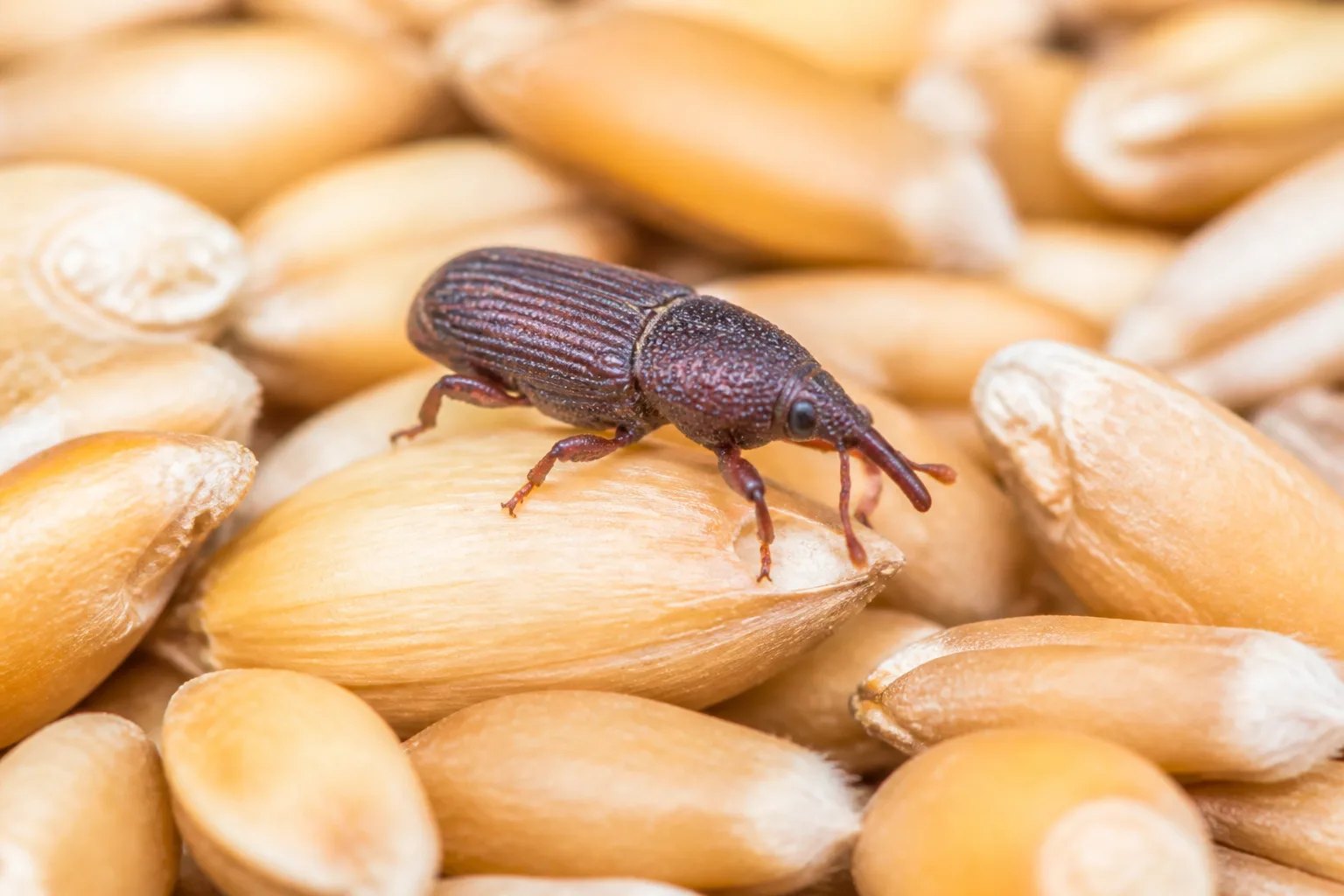
A weevil is a beetle with a snout, not a fly, not a moth, and not a worm — though you may see worm-like larvae before adults emerge. Adult pantry weevils are roughly 1/16 to 3/16 inch long (about 2 to 5 mm), hard-bodied, and slow-moving compared with flying pantry moths. Their antennae attach partway down the snout, giving the head a drill-bit profile that is easy to recognize once you have seen it.
The signature snout that separates weevils from other pantry beetles
The snout is the fastest field mark. Flour beetles and sawtoothed grain beetles — two other common pantry invaders — are flat, snoutless, and often reddish. Weevils look more cylindrical, and the rostrum extends forward from the head. Female grain weevils use that snout to chew a tiny hole into a kernel, turn around, lay a single egg, and seal the opening with a gelatin plug. The larva hatches inside and eats the grain from within, so you can have a serious infestation before you see a single adult (Oklahoma State Extension).
Pantry grain weevils are also different from outdoor nuisance weevils — root weevils, vine weevils, and billbugs — that chew ornamental plants and turf. Those species may wander indoors in fall seeking shelter (University of Minnesota Extension), but they are not the insects living in your oatmeal. If the bug has a snout and you found it in rice, flour, cornmeal, pasta, or birdseed, you are dealing with a stored-product weevil.
Three Stored-Grain Weevils You’re Most Likely to Find
Home pantries in North America are dominated by three closely related species in the genus Sitophilus. All develop inside kernels, all leave jagged-edged round exit holes when adults emerge, and all can contaminate adjacent packages if you leave food in torn bags or cardboard boxes.
Rice weevil vs granary weevil vs maize weevil
| Species | Size | Color / marks | Can fly? | Common hosts | Adult lifespan |
|---|---|---|---|---|---|
| Rice weevil (S. oryzae) | ~3/32 in. (2–3 mm) | Reddish brown to black; four pale spots on wing covers | Yes — functional wings | Rice, wheat, corn, barley, oats, pasta, seeds | ~4–5 months |
| Granary weevil (S. granarius) | ~3/16 in. (3–4 mm) | Uniform reddish brown to black; no spots | No — wingless | Wheat, rice, corn, cereals, whole grains | ~7–13 months |
| Maize weevil (S. zeamais) | ~1/8–3/16 in. | Darker than rice weevil; round thorax pits | Yes — strong flier | Corn, popcorn, rice, wheat | ~4–8 months |
Rice and maize weevils can fly to new food sources and enter through window screens or gaps around doors, which is why you sometimes find them in grains you swear were sealed. Granary weevils cannot fly; every granary weevil in your kitchen walked there from an infested product or crevice nearby. Under warm pantry conditions, the life cycle from egg to adult can complete in 25 to 35 days for rice weevils and slightly longer for maize weevils (Oklahoma State Extension).
Two other pantry pests are called “weevils” but are not true snout beetles: the cowpea weevil (Callosobruchus maculatus) and bean weevil (Acanthoscelides obtectus) attack dried beans and peas, lack a prominent snout, and leave a thin “window” on the seed surface rather than a deep kernel bore. If your infestation is in lentils or black-eyed peas, look for those spot-marked beetles instead of Sitophilus.
How Weevils Get Into Your Food
Weevils rarely appear because you left crumbs out. They get into food through three main routes, and most start at the supply chain — field, elevator, processing plant, or bulk bin — long before the bag reaches your cart.
Pre-infested packaged goods are the number-one source. Females lay eggs inside kernels at the farm or in storage. Larvae develop invisibly inside the grain; by the time adults chew out and you notice beetles, the product may have been in your pantry for weeks. Miller Pest Management notes that Midwest pantry weevil problems often originate at the grocery store or grain facility, not from poor home hygiene — which is why two households with equally clean kitchens can have wildly different weevil pressure based on what they buy and how long they store it.
Hitchhiking adults enter through torn packaging, bulk-bin scoops, or shared warehouse pallets. Rice and maize weevils can also fly in from outside when windows are open, especially in late summer and fall when outdoor populations peak. Granary weevils spread by crawling from bag to bag on the same shelf.
Eggs hidden inside whole kernels explain the “how did they get through a sealed box?” mystery. The egg and larva are inside the rice grain or wheat berry — not in the empty air space of the bag. Sealing a partially infested bag traps adults but does not kill larvae already developing inside kernels. Once several adults emerge, they mate and lay eggs in neighboring packages you assumed were safe.
Weevils need dry grain (roughly 12.5% moisture or higher for egg-laying) and warmth. A back-of-pantry shelf at 75–85°F is ideal. The longer flour, rice, or birdseed sits unused, the more generations can complete — which is why that 10-pound bag of oats bought on sale is higher risk than small bags rotated quickly.
Signs of Weevils in Flour, Rice, and Cereal
Live or dead snout-nosed beetles in the product are the obvious sign, but infestations often announce themselves earlier if you know what to look for.
Holes in kernels or pasta — Adults chew jagged circular exit holes when leaving the grain. In heavy infestations, rice looks shot-peppered. Fine powder or dust at the bottom of a bag is frass (insect waste) and chewed grain debris; the bag may feel lighter than it should. Clumping or heating in whole grains can mean many larvae feeding inside adjacent kernels.
White or cream-colored larvae may be visible in heavily infested flour or meal, though larvae of true grain weevils are usually hidden inside whole kernels until late instars. Musty, stale, or “off” odor and flavor develop as insects and moisture break down fats in grain — discard anything that smells wrong even if you only see a few beetles.
Do not confuse weevil damage with silken webbing from Indian meal moths. Moths produce visible webs and pale caterpillars with dark heads; weevils do not spin pantry webs. Yeasty secretions from some stored-product beetles can look web-like in extreme cases, but the presence of flying moths at dusk points to moths, not weevils. Our guide on tiny bugs in the house walks through room-by-room ID when you are not sure which pest you have.
Weevils vs Pantry Moths vs Flour Beetles
Misidentification leads to wrong treatment — freezing pasta when you needed to discard webbed nuts, or setting moth traps when the problem is beetles in whole rice. Use this triage before you empty the pantry.
| Pest | Body shape | Key mark | Movement | Typical products | Telltale sign |
|---|---|---|---|---|---|
| Grain weevils | Cylindrical beetle + snout | Long rostrum | Crawl; rice/maize species fly | Whole rice, wheat, corn, seeds, pasta | Exit holes in kernels |
| Indian meal moth | Moth | Copper bands on wings | Flies at night near lights | Flour, nuts, dried fruit, pet food, birdseed | Webbing + caterpillars |
| Flour beetles | Flat, oval beetle | No snout; reddish | Crawl | Flour, cake mix, processed cereals | Beetles in fine meal; no kernel holes |
| Sawtoothed grain beetle | Very flat | Saw-like teeth on thorax | Crawl | Oats, cereal, dried fruit, candy | Flat beetles in cracks of boxes |
If you see a snout, assume weevil until proven otherwise. If you see webbing, assume moth. If the product is finely milled flour with flat reddish beetles and no kernel holes, suspect flour beetles (Penn State Extension).
Are Weevils Dangerous? Is It Safe to Eat Them?
Pantry weevils are nuisance pests, not disease vectors. They do not bite people or pets, do not sting, and do not spread pathogens the way filth flies or cockroaches can. Finding one in your cereal is gross — not a medical emergency.
That does not mean you should scoop them out and keep cooking. Rutgers Cooperative Extension advises discarding any dry food with visible insects because you cannot know how long contamination has continued or what secondary spoilage has occurred (Rutgers NJAES). Heat-killed insects in an old box of crackers are unlikely to poison you, but the product has lost quality, may contain frass and shed skins, and can harbor mold in damp clumps. When in doubt, throw it out — especially for children, elderly household members, or anyone with food allergies where insect fragments matter.
Weevils damage food economically by reducing weight, ruining taste, and triggering discard of adjacent packages. In commercial grain storage, internal feeders can cause grading discounts when damaged kernels exceed thresholds (Oklahoma State Extension). At home, the cost is wasted groceries and time — another reason prevention beats salvage.
How to Get Rid of Pantry Weevils Step by Step
Weevils will not leave on their own while food and crevice shelter remain. A partial wipe-down often fails because one overlooked bag of cornmeal restarts the population in two months. Treat this as a full pantry reset, not a single-bag fix.
Step 1 — Inspect and discard. Pull everything off shelves. Open every bag, box, and jar of dry goods: grains, flour, baking mixes, pasta, beans, spices, breadcrumbs, pet food, and birdseed. If you see live insects, larvae, exit holes in kernels, rancid smell, or heavy powder at the bottom, discard the package — outdoor trash, not kitchen bin. When uncertain, discard; saving a $4 bag of rice is not worth reinfestation.

Step 2 — Empty and clean shelves. Vacuum cracks, shelf lips, hinge areas, and floor-wall corners with a hose attachment. Pay attention to corrugation flaps on shelf liner and under loose shelf paper. Wipe shelves with warm soapy water, then a 50/50 water and white vinegar rinse to cut residue odors that can attract other pantry pests. Let surfaces dry completely.
Step 3 — Do not spray pesticides on food-contact surfaces. Aerosol insecticides around open shelving risk contaminating dishes and future food. Sticky traps or pheromone traps for moths will not control weevils and give false confidence. Physical removal and discarding infested food are the core treatment.
Step 4 — Re-store only vetted or treated food. Anything unopened that shows no holes, webbing, or beetles can be frozen before return (see prevention below). Combine small partial bags of the same grain so fewer open packages sit on the shelf.
Step 5 — Monitor for two weeks. Check sealed containers every few days. A single stray adult may mean a missed package or a crevice population; repeat discard-and-vacuum if you see more than one or two individuals after day seven.
What not to use around food storage
Avoid mothballs, essential-oil bombs, and broad-spectrum sprays labeled for crawling insects in pantries. Bay leaves and garlic cloves are sometimes used as repellents; they are harmless but not reliable as sole control — airtight storage and discarding infested product matter far more. Diatomaceous earth in a food pantry creates dusty contamination and is hard to remove from shelf cracks; skip it indoors near open food.
How to Prevent Weevils From Returning
Prevention targets the two failure modes: bringing eggs home and giving larvae a place to spread.
Freezer quarantine and airtight containers

Freeze new dry goods before they join your pantry stock. Place sealed store packaging in the freezer for at least 72 hours (four days is safer for large dense bags) to kill eggs, larvae, and adults. This step alone stops most grocery-origin infestations. After freezing, transfer food to glass, thick plastic, or metal containers with tight gaskets — not the original paper or thin plastic bag with a twist tie.
Buy smaller quantities you will use within two to four months. Whole grains and brown rice spoil faster than white rice and also support longer pest development if insects are present. Practice first-in, first-out rotation: new purchases go behind older ones, or freeze new stock while finishing the old.
Keep the pantry cool and dry. Use a dehumidifier in damp basements used for food storage. Wipe honey, syrup, and crumb spills promptly — they do not feed weevils directly but attract other pests that complicate cleanup.
Inspect bulk-bin purchases carefully; avoid torn bags at the store. At home, bay leaves tucked in containers may add odor that discourages some beetles, but sealing and freezing are the evidence-backed habits extension programs emphasize for stored-product pests.
When the Problem Is Not Weevils—or Keeps Coming Back
If beetles lack a snout, revisit the comparison table — you may have flour beetles or sawtoothed grain beetles requiring the same discard-and-seal response but a different mental model. Flying moths mean Indian meal moth protocol: discard all webbed food, deep-clean, and use pheromone monitoring — not weevil-focused steps alone.
Reinfestation after a thorough cleanout usually means a missed food source (popcorn behind the microwave, dog treats in the garage, decorative dried corn) or new infested purchases brought home without freezing. Trace the timeline: if beetles appear within two weeks of a bulk rice purchase, freeze quarantine failed on that item.
Large numbers of outdoor weevils on walls and windows in fall are often root weevils seeking shelter — vacuum and seal exterior gaps; they are not breeding in your flour (University of Minnesota Extension). Persistent heavy infestations in multi-unit buildings may need a pest professional to inspect shared wall voids, but most single-family pantry cases resolve with discard, vacuum, freeze, and seal.
Conclusion
A weevil is a snout-nosed beetle that often enters your kitchen already inside rice, flour, corn, or seeds — not because you failed to clean. Rice, granary, and maize weevils develop hidden inside kernels, emerge through round exit holes, and spread to any unsealed dry goods nearby. They do not bite or carry disease, but extension food-safety guidance is clear: discard infested products rather than picking out bugs.
Fix the problem with a complete pantry reset — throw out affected food, vacuum every crevice, avoid pesticides near food storage, and reintroduce only frozen-and-sealed goods. Prevent the next infestation by freezing new grain purchases for at least 72 hours, storing dry goods in airtight containers, and buying amounts you will rotate within a few months. Catch the snout early, and weevils stay a one-time cleanup instead of a permanent pantry tax.



