How to Get Rid of Magnolia Scale at the Right Time
Magnolia scale is easiest to manage when crawlers are exposed. Learn how to scout, protect beneficial insects, and decide when a tree needs an arborist.
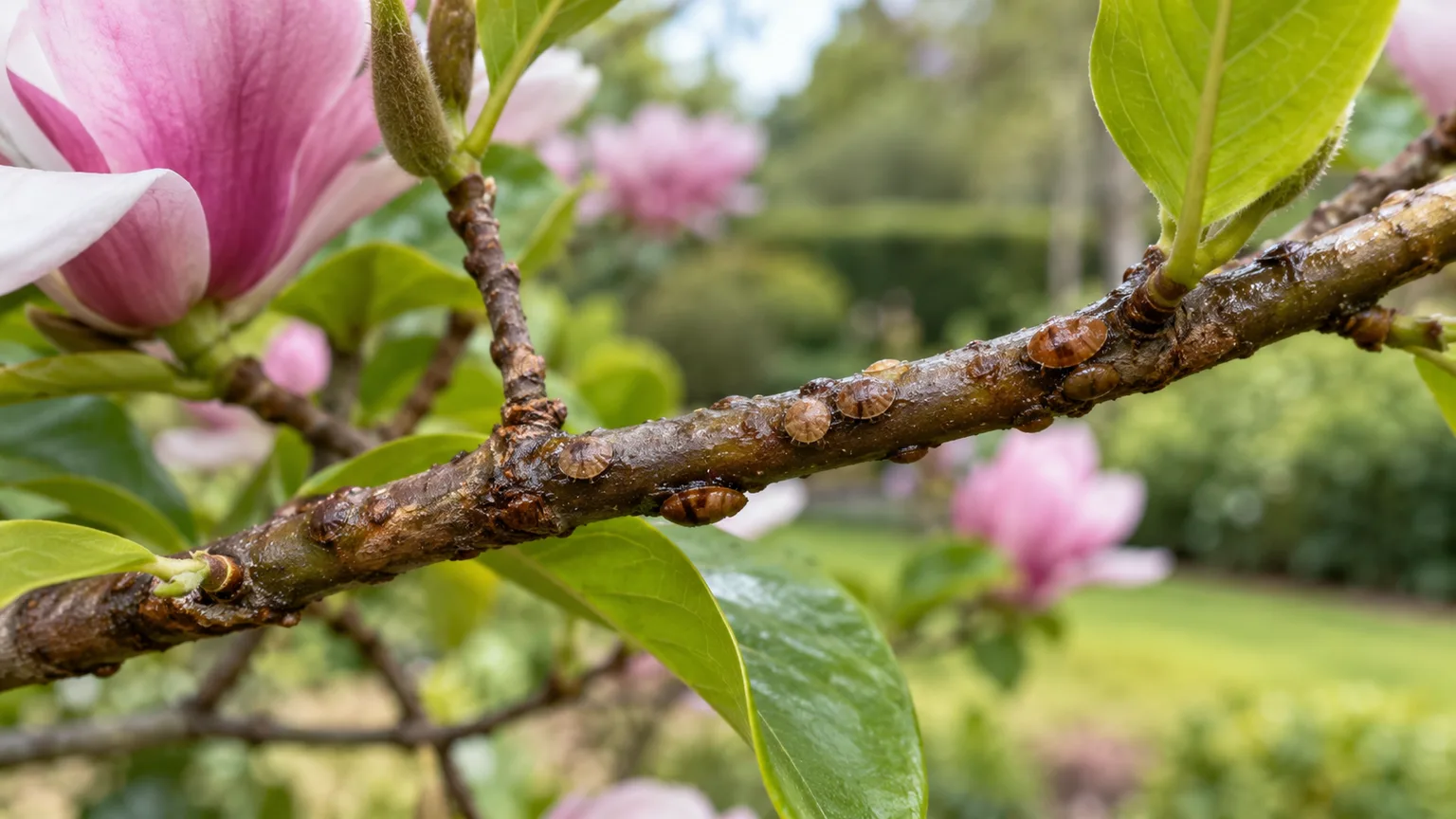
Magnolia scale can leave a tree’s leaves, branches, patio furniture, and anything underneath it sticky. The bumps on the twigs may look alarming, but they are not always a reason to spray: small populations often do limited harm, and treatments aimed at adults can miss the stage that is easiest to control.
The practical plan is to confirm the insect, estimate how much of the tree is affected, and watch for the mobile young called crawlers. Hand removal and selective pruning can be enough on a small, reachable infestation; horticultural oil or insecticidal soap is most useful when crawlers are present. A large tree, heavy dieback, or a treatment that requires spraying beyond safe reach is a job for a qualified arborist.
The short answer: match treatment to the scale’s stage
Magnolia scale (Neolecanium cornuparvum) is a soft scale insect that feeds on magnolia sap. Its mature females develop a waxy covering and remain attached to twigs, which makes them difficult to kill with contact sprays. The exposed crawler stage, usually in late summer into early fall in much of the northern United States, is the best time for a targeted spray; the exact window shifts with region and weather. University of Wisconsin–Madison Extension and The Morton Arboretum both emphasize timing treatments to crawler activity rather than spraying simply because you see old bumps (UW–Madison Extension’s magnolia scale guidance; The Morton Arboretum’s magnolia scale profile).
Start by checking several twigs throughout the canopy, not just the branch with the worst symptoms. If there are only a few insects on reachable branches and the tree is growing normally, wipe or prune only those areas and keep monitoring. If the infestation covers many branches, the canopy is thinning, or twigs are dying back, get a local diagnosis and treatment plan before using a broad pesticide.
Confirm that magnolia scale is the problem
Look along one- and two-year-old twigs for rounded, oval bumps that are tan, reddish brown, or purplish brown. A mature female can approach half an inch long, much larger than most scale insects, and may be mistaken for a bud or an irregularity in the bark. Star magnolia and saucer magnolia are among the commonly affected hosts, but magnolia scale can occur on other magnolias as well (Penn State Extension’s current profile).
The usual host is magnolia, although the host range is not described identically by every extension source: Penn State says it feeds only on magnolia, while NC State notes that it can also be damaging on tulip tree (NC State Extension). If bumps appear on a different tree, do not assume they are magnolia scale; many unrelated scale insects look similar and need different timing.
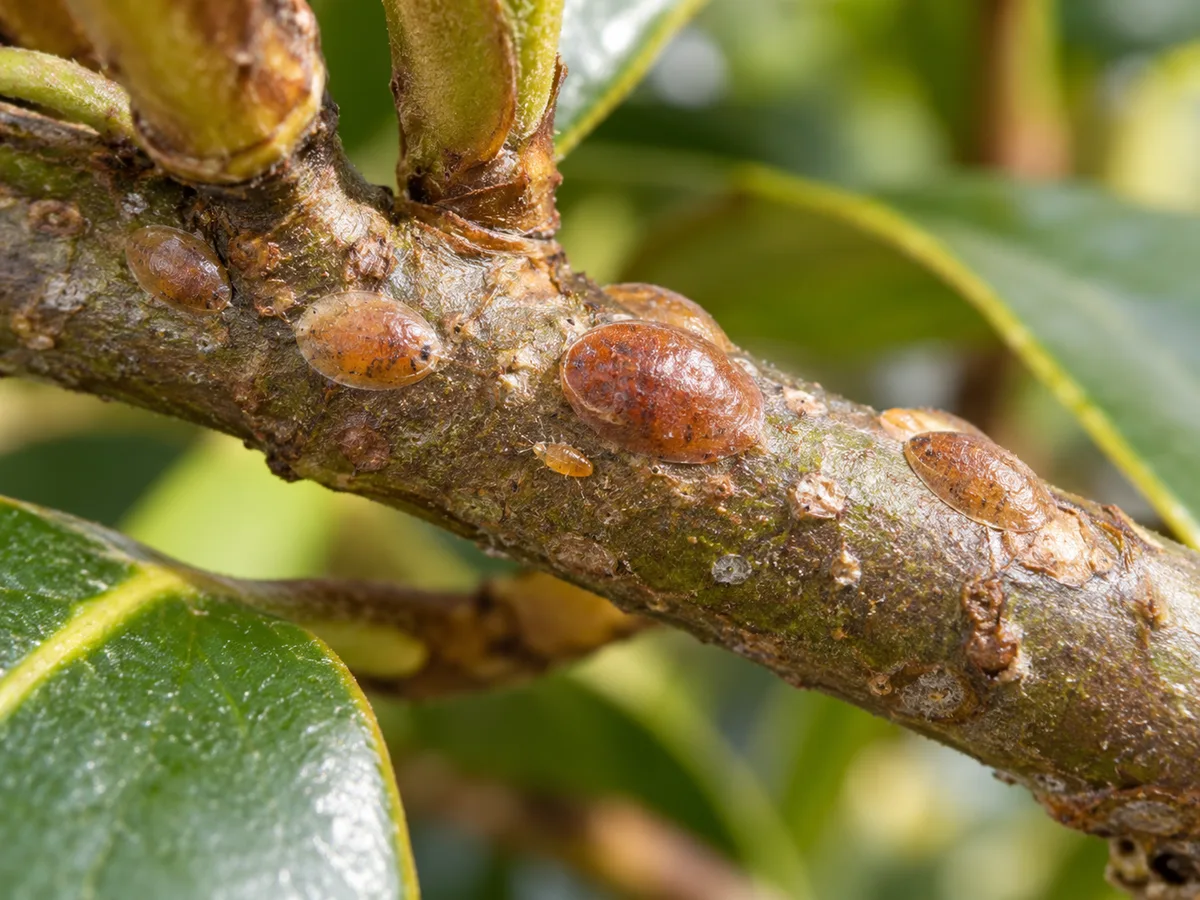
Tell live scales from old shells
An old female shell can stay stuck to a twig after the insect has died, so counting bumps alone can exaggerate an infestation. University of Wisconsin–Madison Extension notes that a living female is soft-bodied and leaves a reddish stain when crushed, while the crawler stage is much smaller, flatter, and mobile. If you can reach the twig safely, use a gloved fingernail or cotton swab to test one suspect scale; do not scrape repeatedly or gouge bark to remove every bump.
In spring and early summer, some insects may be easier to spot as adults than to identify as live or dead. If the tree is valuable or the diagnosis is uncertain, take a close, sharply focused photo of the twig and ask your Cooperative Extension office or an arborist to confirm the pest. This small check helps prevent a mistimed treatment for a different scale, a bark feature, or old shells that no longer need control.
Read the clues from honeydew and sooty mold
Magnolia scale pierces plant tissue and feeds on sap. The excess sugars it excretes form honeydew, a shiny, sticky residue that can drip onto leaves, branches, cars, decks, and furniture. A black, sootlike film on the honeydew is sooty mold. A light coating is often mostly cosmetic, but University of Georgia entomologists note that dense mold can shade leaves; either way, the scale’s sap feeding is the root problem (The Morton Arboretum; UGA Turf and Ornamental Pest Management). Fungicide will not remove the scale or stop new honeydew, so treat the insect only if the infestation and tree condition justify it.
Ants, flies, and wasps visiting the tree may be feeding on the honeydew. Their presence supports the diagnosis but is not proof by itself, and killing visiting insects does not solve the scale problem. Look for the rounded bumps on twigs as well as sticky residue. If black marks are part of the leaf tissue rather than a wipeable surface film, or if there are no scale bumps, ask for help identifying another cause.
Understand the yearly cycle before choosing a date
Magnolia scale generally produces one generation each year. Small nymphs overwinter on twigs, resume feeding as the weather warms, and mature through spring and summer. The adult females enlarge and later produce live young called crawlers. Those crawlers move across the branch briefly before settling to feed and overwinter, when they gain the protective covering that makes later contact treatment harder.
That cycle explains why the same product can appear to work one year and fail the next. A spray applied while most scales are protected adults may barely affect them; a product that kills by direct contact needs to land on exposed crawlers. Penn State Extension’s Pennsylvania calendar places crawler activity in August and September, while UW–Madison and The Morton Arboretum describe late-August or early-September activity in the upper Midwest; none of these dates should be copied uncritically to a warmer or cooler region (Penn State Extension; UW–Madison Extension; The Morton Arboretum).
Why treatment dates vary by region
“Spray in September” is a rough northern-U.S. shortcut, not a universal instruction. Crawler emergence follows accumulated heat and local weather, so it may begin earlier in a warm area or later after a cool spring. Even neighboring trees can differ in infestation intensity. The University of Wisconsin–Madison factsheet uses about 1,925 growing degree-days as a crawler-hatch reference for its region, but a degree-day total only helps when you use the same base temperature and accumulation method as the regional source that reports it.
University of Maine Cooperative Extension’s advice for a mature magnolia also centers on timing sprays to crawlers and warns that dormant-oil timing depends on flower-bud development (University of Maine Cooperative Extension). Use your local extension’s current calendar or monitoring guidance, then confirm activity on your own tree. The field check matters more than a date printed on a general article or a retailer’s treatment schedule.
Find crawlers before reaching for a spray
Inspect twigs every few days once your local extension expects crawler emergence. Use a hand lens if you have one, and examine both the scale-covered branches and nearby twigs where new crawlers may settle. Crawlers are tiny yellowish, reddish, or dark specks that move; they do not look like the large, immobile adult females. If you find none, hold off on a contact spray and check again rather than applying pesticide “just in case.”
A simple monitoring aid is a short strip of clear tape wrapped around a twig with its sticky side facing out. Check the tape frequently for tiny crawlers, replacing it if it becomes dirty, dusty, or full. UW–Madison Extension describes this method as a way to detect crawler activity. It is a practical clue rather than a precise population count, so compare it with direct twig inspection and local timing guidance.
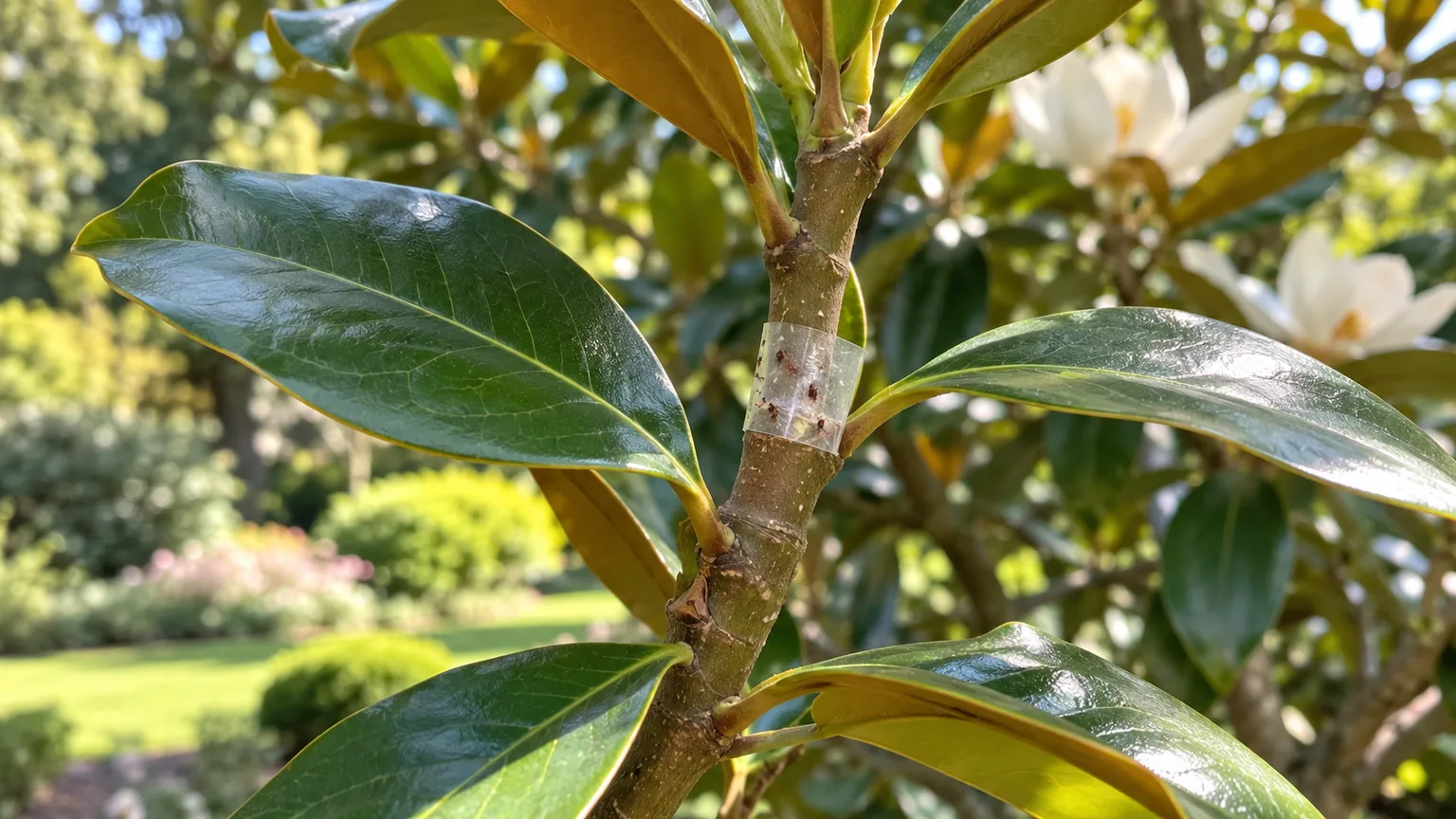
If the tape catches crawlers, mark the date and inspect again on nearby branches. This tells you whether emergence is just beginning or continuing, and gives you a better basis for following the product label’s repeat interval if you decide treatment is warranted. Do not let a tape strip remain indefinitely on a growing branch, where it could constrict the twig as it thickens.
Decide how much treatment the tree needs
Scale is not a binary problem where every bump demands eradication. A mature, vigorous tree may tolerate a small population, while a young, drought-stressed, recently transplanted, or heavily infested magnolia deserves closer attention. Consider the share of twigs affected, whether honeydew is increasing, whether foliage is yellowing, and whether there is active branch dieback. Your aim is to stop damaging pressure, not to make a tree completely free of every insect at any cost.
| What you find | A proportionate next step | Why |
|---|---|---|
| A few live scales on reachable twigs, with normal growth | Wipe or pick off the insects carefully and monitor | A small, contained infestation may not need a spray |
| Several affected tips or one badly infested branch | Prune only the affected branch if the cut is safe and appropriate | Removing a concentrated source can be simpler than spraying the whole tree |
| Many live scales but no crawlers | Continue scouting; ask local Extension about the next vulnerable stage | Contact products may miss protected adults |
| Crawlers are active and the infestation is causing meaningful stress | Consider a labeled contact treatment, with careful coverage and non-target safeguards | The crawlers are more exposed to contact products |
| Large mature tree, widespread dieback, or unsafe access | Consult a certified arborist | Professional diagnosis and application can reduce worker, drift, and coverage risks |
A heavy infestation does not mean the tree is doomed, and a sticky patio does not by itself indicate that the magnolia is dying. But repeated heavy feeding can yellow leaves, weaken twigs, and cause dieback. Take a few photos and note which branches are affected so that any professional can assess change over time instead of judging severity from honeydew alone.
Use hand removal on small, reachable infestations
When there are only a few scales on a shrub-sized magnolia or lower branch, gently rub or pick them off with a soft cloth, cotton swab, or gloved fingers. The University of Wisconsin–Madison Extension and The Morton Arboretum both list physical removal as an option for small populations. Work carefully: the goal is to dislodge the insect, not to scrape away bark or damage buds. Stop if the twig is thin, the scale is tightly attached, or reaching it would require a ladder.
Check the twig again after removal and monitor nearby branches for crawlers later in the season. Hand removal will not reach hidden insects throughout a large canopy, and it does not remove the honeydew already on leaves or hard surfaces. If the tree is tall or insects are widespread, repeating a labor-intensive wipe-down across every branch is unlikely to be a safe or complete plan.
Prune selectively instead of stripping the canopy
Pruning can help when the infestation is concentrated on a few branches or the affected wood is already declining. Make clean cuts at an appropriate branch junction, and remove only the portion needed to eliminate heavily infested or dead twigs. Bag or dispose of infested cuttings according to local rules; do not leave them under the tree where you will keep seeing the same insects and be tempted to treat the whole canopy.
Magnolias do not benefit from severe “scale pruning.” Removing many healthy branches reduces foliage, changes the tree’s structure, and may remove flower buds. If infestation is widespread, pruning alone is not a realistic whole-tree treatment. Have an arborist assess deadwood and branch structure before making major cuts, especially on an established tree whose shape or safety matters.
Use horticultural oil or insecticidal soap on active crawlers
Horticultural oil and labeled insecticidal soap can control crawlers when the spray contacts them directly. They have limited residual activity, so thorough coverage and timing matter: wet the infested twigs and the areas where crawlers are moving, following the product label for suitable plants, rates, weather limits, protective equipment, and reapplication. These products generally do not penetrate the waxy covering of mature females, and a light mist on the outer leaves may not reach insects on the inner branches.
Use a product labeled for the target site and pest; do not substitute dish detergent or an improvised neem mixture for a registered insecticidal soap or horticultural oil. “Organic” does not mean harmless to magnolias or to every insect in the spray path. Test a small area if the label recommends it, avoid spraying stressed foliage or conditions the label warns against, and keep the spray off open flowers and visiting pollinators. Recheck for live crawlers after treatment and repeat only if the label permits and monitoring shows a reason.
Consider dormant oil only before buds open
Dormant oil is aimed at overwintering nymphs while they are on twigs, before spring growth resumes. It is a possible option for a tree with a recurring problem, but it is not a substitute for crawler monitoring and it may not reach every insect in a large canopy. The timing window is narrow: apply only when the product label allows it and before buds open or flower buds swell. University of Maine Cooperative Extension specifically cautions that oil can damage magnolia flower buds once they have begun to swell.
Recommendations for dormant-oil dates differ across regions and fact sheets, which is another reason not to copy an October, November, or March schedule from a different climate. If you cannot confidently tell whether the buds are still dormant, skip the treatment and ask local Extension or an arborist. A missed application is better than damaging the next bloom or spraying a tree when the product is not appropriate.
Get professional help for large or severe infestations
A large magnolia canopy is difficult to cover evenly from the ground. Spraying high branches can create drift, expose the applicator, and miss the sheltered twigs where crawlers or adults remain. Do not climb an extension ladder while handling a sprayer, and do not borrow a neighbor’s product without confirming that its current label permits the use on magnolia and the target pest.
For a mature tree with repeated heavy infestation or branch decline, ask a certified arborist to inspect the tree and explain the treatment options, expected timing, and non-target precautions. University of Maine Cooperative Extension recommends a licensed professional for an exceptionally large tree because the size can make application impractical for a homeowner. A good plan may include monitoring and staged treatment across more than one season rather than promising a one-time cure.
Systemic insecticides have timing and pollinator tradeoffs
Systemic products move into plant tissues and can be considered for some severe infestations, but they are not a casual first step. Their timing must allow the active ingredient to move through the tree before the target scale feeds, and the application method depends on the product and tree. UW–Madison Extension advises that spring soil drenches be timed after bloom to reduce risk to bees and other pollinators; Morton Arboretum also notes that professional systemic applications need to be made well before crawler activity to allow uptake (UW–Madison Extension; The Morton Arboretum).
A systemic should not be chosen simply because the tree is tall or a spray feels inconvenient. Ask the arborist which active ingredient and application site are being considered, what evidence supports that timing locally, and what pollinator restrictions apply. Use only a product labeled for the tree, site, and pest, and follow all directions; local rules and product registrations can change.
Contact sprays can harm beneficial insects
Contact sprays reach more than the pest if they drift onto predators, pollinators, or other insects. UW–Madison Extension notes that pyrethrins can be hard on beneficial insects, while the Morton Arboretum describes horticultural oils and insecticidal soaps as options with a more limited impact on natural enemies such as lady beetles. That does not make oil or soap risk-free; it makes accurate timing, direct coverage, and treatment only when necessary important parts of the choice.
Protect flowering plants and active pollinators by avoiding open bloom and following label restrictions on temperature, wind, and nearby plants. Do not spray when wind can carry droplets into neighboring beds or onto a flowering lawn edge. Whenever practical, preserve lady beetles, lacewings, parasitoids, and other natural enemies; they may not eliminate a severe infestation, but they are part of the landscape’s pest control and should not be destroyed for a minor one.
Support recovery and reduce next year’s scale pressure
Keep the magnolia steadily watered during dry periods, especially if it is newly planted or growing in a confined root zone. A layer of organic mulch helps moderate soil moisture, but keep mulch away from the trunk flare. Avoid high-nitrogen fertilizer applications intended to “push” growth: excessive fertilization can encourage tender growth and is not a reliable scale treatment. The Morton Arboretum recommends good watering, mulching, and pruning of dead or infested branches while avoiding excess fertilizer.
If you are choosing a new magnolia, inspect woody twigs as well as the leaves before bringing it home. Denny McKeown’s regional garden-center guidance also calls out branch inspection as a way to avoid starting with scale already on the plant (Bloomin Garden Centre). Ask the nursery to identify any suspicious bumps rather than assuming that every old shell is a live pest.
After crawler activity ends, keep notes on which branches were affected and whether new twig growth looks healthy. Honeydew and sooty mold may remain after the insects are gone; their presence alone does not prove that a treatment failed. If a dark film is on the leaf surface, it can fade as the honeydew source stops and weather washes it away, while damaged leaves may remain marked until they drop. Judge success by live scale, new crawler activity, and the tree’s next flush of growth, not by whether every old shell disappears immediately.
A small infestation may decline over time as natural enemies act, but that can take more than one season. Wisconsin Extension notes that scale pressure can subside over several years, while the Morton Arboretum cautions that predators may not provide enough control when populations are high. UGA entomologists identify lady beetles, syrphid fly larvae, lacewings, and parasitoid wasps among the natural enemies associated with magnolia scale, and warn that broad-spectrum insecticides can disrupt them (UGA Turf and Ornamental Pest Management; Penn State Extension). In practice, tolerance is reasonable when the tree remains vigorous and the infestation is limited; repeated dieback, substantial yellowing, or expanding populations justify a more active plan.
When to call an arborist
Get a professional diagnosis if the magnolia is tall, the scale covers a large part of the canopy, the tree is declining, or you cannot tell whether the bumps are alive. Also call if a treatment would need equipment you do not own, if the tree is near a pond or flowering garden, or if the first properly timed approach has not reduced live crawlers. Ask whether the person is a certified arborist and, if pesticides are proposed, whether they hold the required applicator credentials for your area.
Before the visit, note when honeydew first appeared, which branches are sticky, whether you have found crawlers, and what product—if any—has already been applied. A short record can help the arborist separate a new infestation from old shells, choose a local monitoring window, and avoid repeating an ineffective treatment. Ask for the plan in writing, including what outcome to expect and when the tree should be checked again.
Conclusion
The best way to get rid of magnolia scale is to treat the vulnerable crawler stage when it is actually active, not to spray on a fixed date or attack every old bump. Confirm the insect, inspect several twigs, use hand removal or selective pruning for small accessible patches, and reserve labeled oil, soap, or professional treatment for a justified infestation. Keep the tree healthy, protect beneficial insects, and call an arborist when size or decline makes home treatment unsafe or incomplete.