What Do Hummingbirds Eat? Nectar, Insects, and More
Hummingbirds eat flower nectar, small insects, and spiders. See what feeder food is safe, what to avoid, and how to build a yard with dependable food.
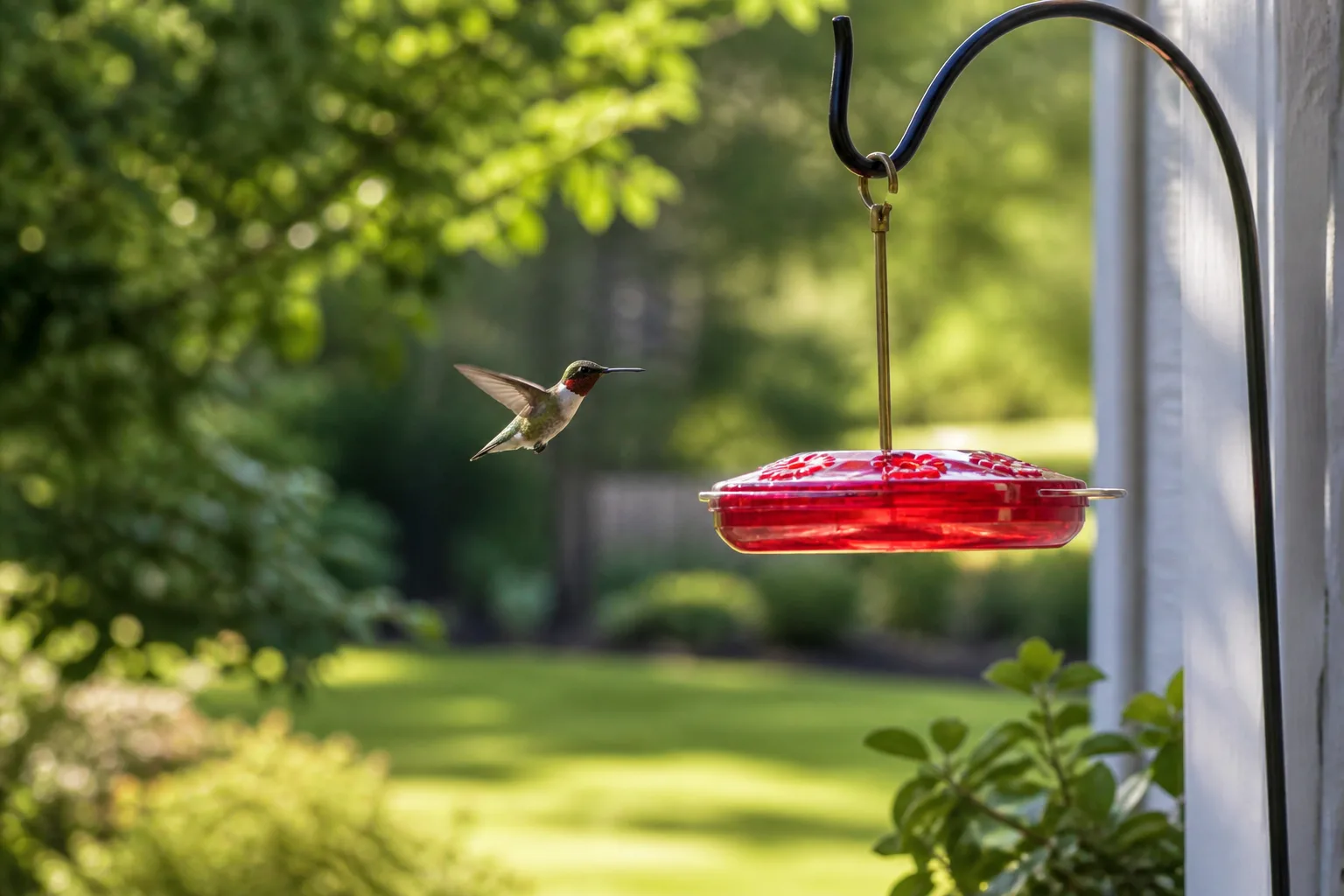
A hummingbird’s diet has two main parts: sugary flower nectar for fast energy and tiny insects and spiders for nutrients nectar cannot provide. A feeder filled with plain sugar water can supplement the first part, but it does not replace the food hummingbirds find while foraging.
That distinction is useful whether you are deciding what to put in a feeder or how to make a yard more attractive. Flowers provide natural nectar, insects provide important protein and other nutrients, and a clean feeder can help bridge a temporary gap in bloom. A garden that supports all three offers a more complete food supply than a feeder alone.
The short answer: nectar plus small prey
Most of the time, hummingbirds visit flowers for nectar and hunt small arthropods such as gnats, aphids, flies, beetles, insect eggs, larvae, and spiders. Nectar supplies carbohydrates that fuel hovering, rapid flight, and other high-energy activity; small prey supplies nutrients the sweet liquid lacks. The National Park Service describes nectar as the energy source and insects as a source of protein, while Kansas State University Extension lists the small insects and immature stages hummingbirds take. (National Park Service; Kansas State University Extension)
A hummingbird does not switch between two tidy meals. It makes many brief visits to flowers and takes prey opportunistically, sometimes catching insects in the air and sometimes picking them from leaves or webs. The mix changes with the bird’s species, location, breeding season, migration, and what is available, so a backyard visitor will not follow one fixed menu every day. (Audubon Rockies)
| Food | What it contributes | What to provide |
|---|---|---|
| Flower nectar | Sugars for energy | Locally suitable, nectar-rich blooms through the season |
| Feeder solution | A supplemental sugar source | Plain white granulated sugar and water in the recommended ratio |
| Small insects and spiders | Protein and other nutrients | A pesticide-conscious garden with living plants and some insect habitat |
| Sap or pollen | Occasional or incidental food | Do not try to serve these as feeder substitutes |
| Fruit | Not a dependable core food | Do not add fruit, juice, or jam to the feeder |
Nectar powers the flight
Nectar is the most visible part of a hummingbird’s diet because birds visit flowers in the open and feeders make their sipping easy to watch. The nectar’s dissolved sugars are a readily available source of energy. A hummingbird’s long bill and extensible tongue help it reach nectar inside flowers, and when it moves between blooms it can carry pollen from one flower to another. (National Park Service)
The natural food is not just “sugar water in a flower.” A living bloom is part of a wider feeding habitat: it offers nectar at a particular time, draws insects that may also become prey, and is often surrounded by perches and shelter. This is why a flowering garden and a feeder play different roles, even though both can provide sugar. A feeder cannot produce insect prey or create the staggered bloom that sustains foraging across a season.
Flower nectar is the natural baseline
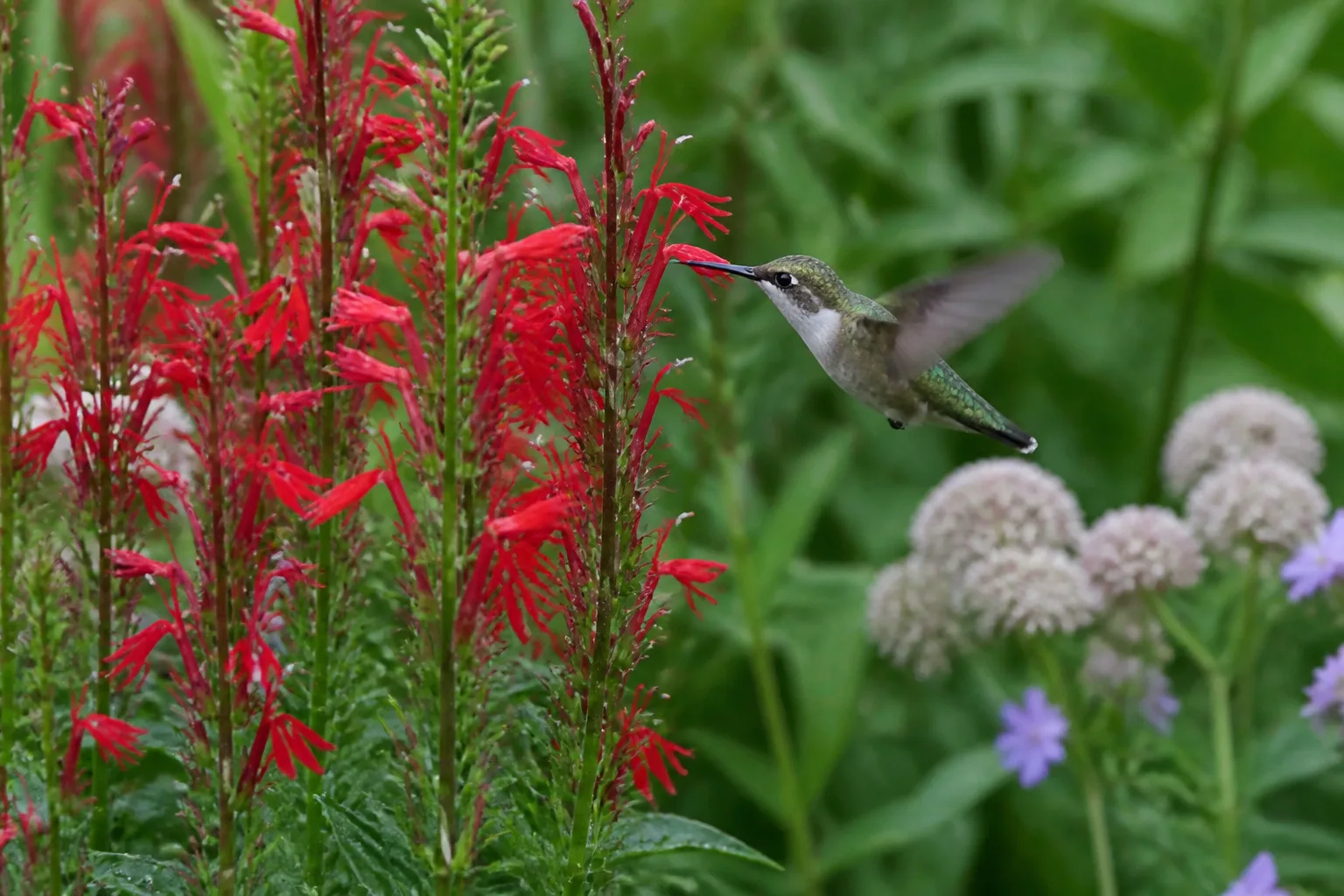
For most backyard hummingbirds, the best first food source is a succession of suitable flowers. Choose plants that are native or well adapted to your region and that bloom at different times, rather than filling a bed with one cultivar that flowers for a short window. NC State Extension recommends native trees, shrubs, vines, and perennials with staggered bloom times; Audubon’s regional guidance likewise puts native flowering plants first because they provide nectar within a broader habitat. (NC State Extension; Audubon Rockies)
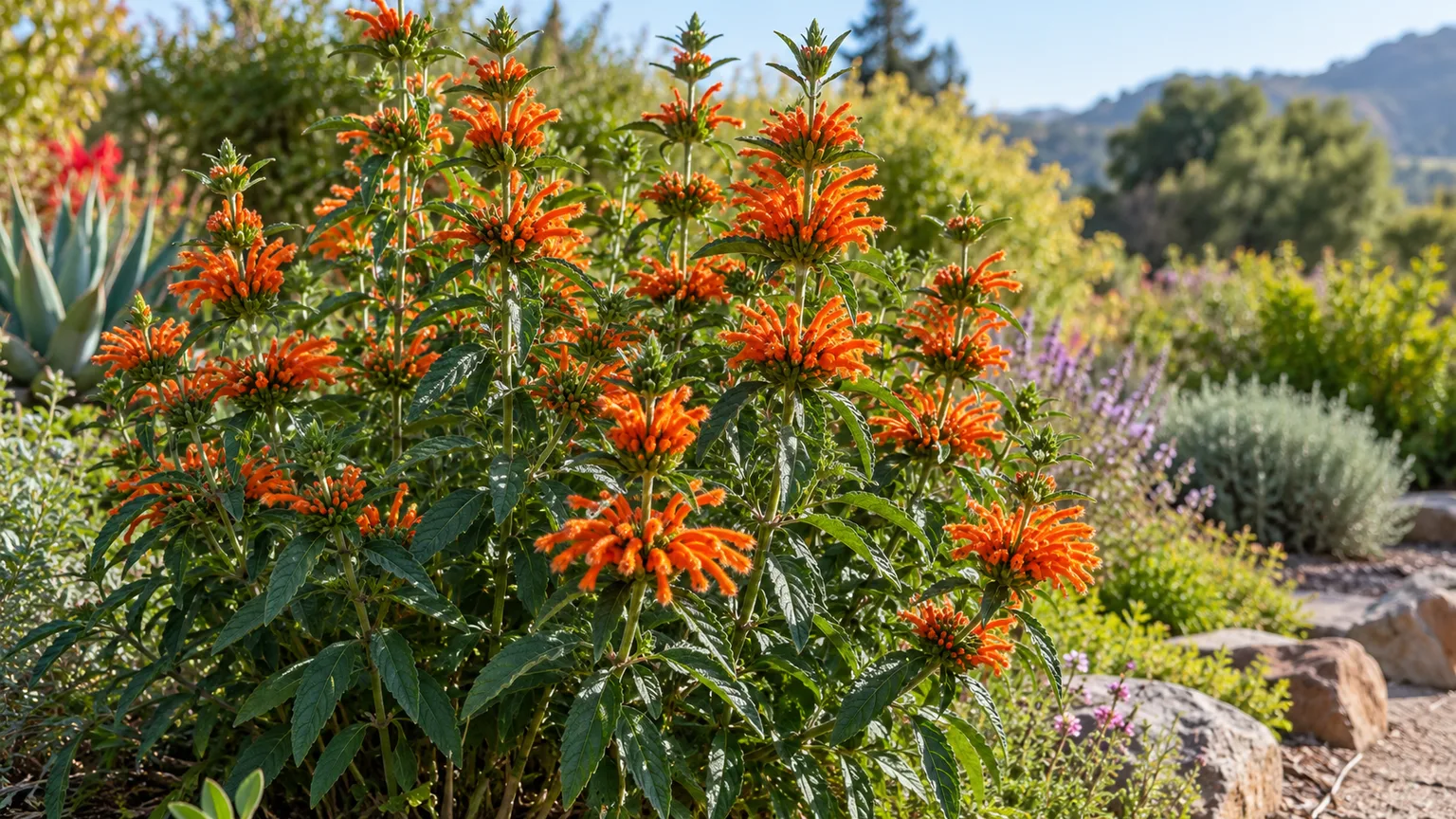
Red and tubular flowers are familiar hummingbird signals, but color alone is not a reliable planting plan. Species in different regions use different plants, and hummingbirds will visit a range of nectar-rich flowers when the nectar is accessible. Think of the flower shape and color as helpful clues, then check local plant lists and bloom periods. In eastern gardens, native bee balm, cardinal flower, and coral honeysuckle can be useful examples; western gardeners can look to regional penstemons and other local nectar plants. Avoid treating a list from another climate as a universal prescription. (National Park Service; Savvy Gardening)
A practical bed can mix shrubs and perennials with containers, a fence-line vine, or a few well-placed hanging baskets. The point is to keep fresh flowers coming, not to create a single bright patch that fades before the birds’ season ends. If you already have regular visitors, note which plants they use and when those plants stop blooming; that observation will show where the next food gap is.
Feeder sugar water is a supplement
A hummingbird feeder supplies a simple carbohydrate source, not a complete diet. The sugar solution has no insects or spiders, so it cannot replace the protein and other nutrients birds obtain while hunting. Audubon recommends native flowering plants as the best source of nectar and describes a well-maintained sugar-water feeder as supplemental; the bird can continue to forage for natural foods when a feeder is present. (Audubon Feeding FAQs; National Park Service)
This is not a reason to avoid feeders. They can be useful when flowers are scarce, during a dry spell, or when you want to observe birds closely. But a feeder should be one part of a yard with flowers and insect life, not the whole plan. If you cannot keep a feeder clean, it is better to pause it and focus on habitat than to leave old solution sitting in the sun.
Insects and spiders supply the rest
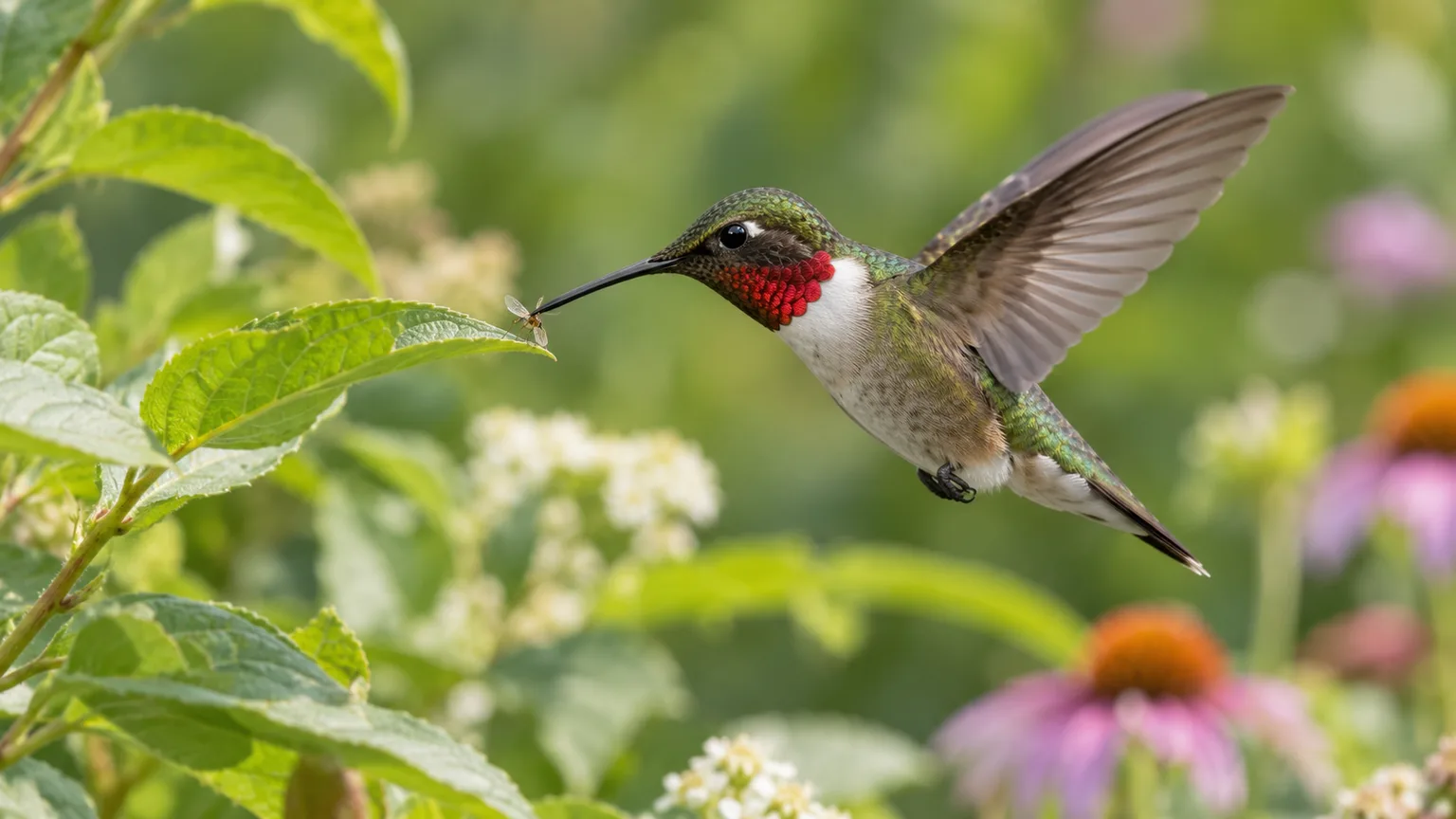
Small prey is not a novelty or a rare treat. Hummingbirds eat insects and spiders because their bodies need more than the sugars in nectar. Kansas State University Extension notes that prey can provide protein for muscle and feather development as well as amino acids, fats, fiber, and salts; it lists ants, aphids, beetles, gnats, mosquitoes, some wasps, insect eggs, and larvae among foods birds may take. The exact prey list and quantity vary with availability and the bird’s needs. (Kansas State University Extension)
A nestling’s need for growing tissue makes insect prey especially important during the breeding season, and adult birds also need it as they molt and maintain their bodies. Insects are easier to overlook than nectar because a bird may catch them in a split-second pass or pick them from the underside of a leaf. A feeder can make a yard appear well supplied while quietly removing the prey birds need if the surrounding garden is treated broadly for insects.
Hummingbirds also take spiders and may pull trapped insects from webs. A web is more than a nuisance to the bird: it can be a place to collect prey, and spider silk is used in nest construction. Audubon’s account of western hummingbirds describes aphids, gnats, spiders, ants, and fruit flies as prey and stresses the value of keeping insects and spiders in the landscape. (Audubon Rockies)
How hummingbirds catch tiny prey
Hummingbirds use several hunting methods. They can hawk small flying insects by darting from a perch, hover near foliage and pluck prey from a leaf, or pick insects from a flower, tree surface, or spider web. Ruby-throated hummingbirds, for example, catch small insects both in midair and from leaves and webs, according to Audubon’s field guide. (Audubon Ruby-throated Hummingbird Field Guide)
That varied approach explains why “planting flowers” and “supporting insects” belong in the same garden plan. Blooms attract nectar-seekers and small insects; shrubs, trees, and leaf litter give other insects places to shelter and develop. A tidy lawn with few blooms and frequent insect sprays may offer a feeder but leave little foraging habitat around it. You do not have to invite a serious pest problem; simply avoid trying to sterilize every leaf, web, or small patch of the garden.
Sap, pollen, and fruit: what roles do they play?
Some foods discussed in birding accounts are occasional, incidental, or difficult to interpret. That does not make them equal to nectar and insect prey. When planning a feeding station, build around the two reliable categories first and treat sap, pollen, or fruit as observations a bird may encounter naturally rather than items to add to a feeder.
Sap wells are an occasional shortcut
Some hummingbirds sip fresh sap from holes drilled by sapsuckers and other woodpeckers. Sap contains sugars, so it can provide energy when a bird encounters an active sap well; Audubon notes that tree sap is among the sugary liquids used by western hummingbirds. The availability of this food depends on region and the presence of a suitable sap well, so it is not a reason to drill a tree or offer syrup. (Audubon Rockies; Birds & Blooms)
A sap well also brings insects. Hummingbirds can take tiny prey visiting the sap, which makes the site more than a substitute feeder. If you see a hummingbird working at a tree, it may be collecting insects as well as drinking sap. That natural behavior still does not change the backyard advice: leave healthy trees undamaged and offer plants and safe feeder nectar instead of trying to recreate a sap well.
Pollen is incidental, not a meal
When a hummingbird probes a flower, pollen can stick to its bill or face and may be swallowed while the bird drinks. Pollen is part of the pollination exchange between bird and bloom, but it is not a practical replacement for either nectar or small prey. A gardener does not need to gather pollen or sprinkle it into a feeder.
A healthy flower garden provides the better solution: it lets birds feed on nectar while they pollinate, and it supports the insect life they hunt. Thinking of pollen as a bonus rather than a menu item keeps the diet simple and prevents a feeder from becoming a mixture of household ingredients that may spoil or attract the wrong visitors.
Fruit is not a dependable food
Fruit is not a regular substitute for flower nectar, insects, or a clean feeder solution. You may see a hummingbird around damaged fruit or a fruit fly swarm, but that does not mean sliced apples, berries, or juice should become part of the feeding station. Small insects gathered around overripe fruit may be the more relevant food, and sweet scraps can attract ants, wasps, and other visitors.
Do not put fruit juice, jam, or mashed fruit in a nectar feeder. The sugar and other compounds are not the same as the plain sucrose solution recommended for feeders, and organic material can spoil quickly in warm weather. If fruit is left out for other wildlife, keep it separate from the hummingbird feeder and remove it before it turns moldy or draws stinging insects.
What food should you put in a hummingbird feeder?
For a feeder, use a simple solution of refined white granulated sugar and clean water. Do not add dye, honey, brown sugar, molasses, artificial sweeteners, vitamins, fruit juice, or commercial flavoring. A feeder is a supplemental nectar source, so keep the recipe deliberately plain. The National Park Service and NC State Extension both advise against honey and dye; NC State also warns against brown sugar and fruit juice because they spoil easily and may harm birds. (National Park Service; NC State Extension)
The exact recipe and what not to add
The standard feeder mix is one part white granulated sugar to four parts water. For a small batch, dissolve ¼ cup of sugar in 1 cup of water; for a larger batch, use 1 cup of sugar in 4 cups of water. Measure the ingredients instead of estimating by eye. A more concentrated mixture is not a shortcut to better food, and adding extra ingredients does not make it nutritionally complete.
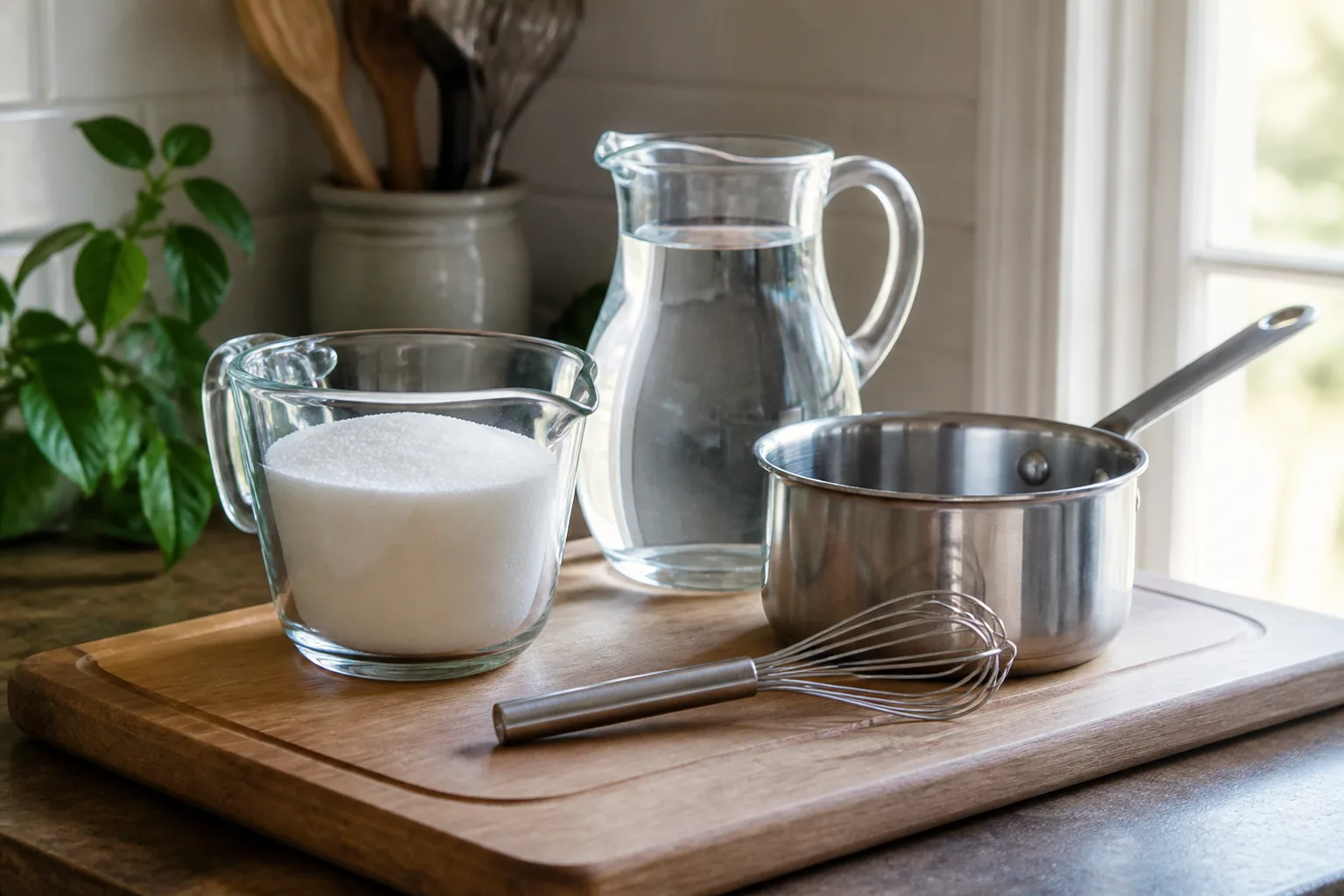
The sources differ slightly on heating: NC State Extension says to dissolve the sugar in hot tap water and let the solution cool, while Audubon recommends bringing the mixture to a boil and cooling it before filling the feeder. Both agree on refined white sugar, the 1:4 ratio, and cooling the solution before use. Follow a preparation method that fully dissolves the sugar, then refrigerate unused solution in a clean container and use it only while it remains fresh. (NC State Extension; Audubon Feeding FAQs)
Avoid honey even though it seems like a natural alternative. The feeder recipe is designed around plain sucrose, and honey or other sweeteners add ingredients that the cited bird-feeding guidance warns against. Artificial sweeteners are not suitable nectar substitutes because they do not provide the sugar energy the birds seek. Red food coloring is unnecessary: use a feeder with red parts if you want a visible color cue, but keep the liquid clear. (Audubon Feeding FAQs; National Park Service)
How often to change nectar and clean a feeder
Treat the feeder like fresh food, not a set-and-forget ornament. Empty it and clean it more frequently in hot weather, when the solution can spoil sooner. Audubon’s schedule is daily or every other day in hot weather, every three days in temperate weather, and twice a week in cooler weather; clean it sooner if the nectar is cloudy, if mold appears, or if insects have contaminated it. If birds empty the feeder before the next scheduled cleaning, wash it before refilling. (Audubon Feeding FAQs)
Take the feeder apart far enough to reach the ports, basin, and seams where residue collects. Wash with hot tap water and a dedicated brush; Audubon also recommends hot water with hydrogen peroxide or a weak vinegar solution and cautions against dish soap that could leave residue. Rinse thoroughly, let the feeder drain, and refill only with fresh, cooled solution. Do not top up old nectar, since that carries any contamination into the new batch.
Feeder placement matters to the food staying clean. Put it where it is easy to inspect and wash, close enough for viewing but not where pets can reach it. If bees or ants are visiting, try a feeder design with a moat or bee guards and clean up drips rather than spraying insects. University of Maine Cooperative Extension advises leaving harmless nectar-feeding insects alone and warns against using pesticide around feeders; a little competition is safer than contaminating the food source. (Audubon Feeding FAQs; University of Maine Cooperative Extension)
Build a yard that supplies nectar and protein
A hummingbird-friendly yard supplies a sequence of natural foods instead of just one convenient sugar source. Start with nectar plants, keep some shrubs or trees for shelter and perching, and tolerate the small insects that share the garden. NC State Extension recommends native plantings and staggered bloom times, while Audubon emphasizes that plants can support both nectar and the insects hummingbirds need. (NC State Extension; Audubon Rockies)
Choose local plants that bloom in sequence
Pick plants for your region, not just for their color in a catalog. Native plant databases and local extension lists can help you avoid species that are poorly adapted or invasive where you live. Bee balm, cardinal flower, coral honeysuckle, penstemon, salvia, and columbine are useful examples from various North American gardens, but the right choices depend on local hummingbird species, climate, and bloom period. (NC State Extension; Savvy Gardening)
Make a rough calendar: what blooms when the first hummingbirds arrive, what carries the middle of the season, and what remains available during late-season movement? A mix of trees, shrubs, perennials, vines, and container plants can spread bloom across more weeks than a single row of annuals. This also gives a practical way to notice a food gap: if your last flowers fade in midsummer, add plants that bloom later rather than simply making the feeder larger.
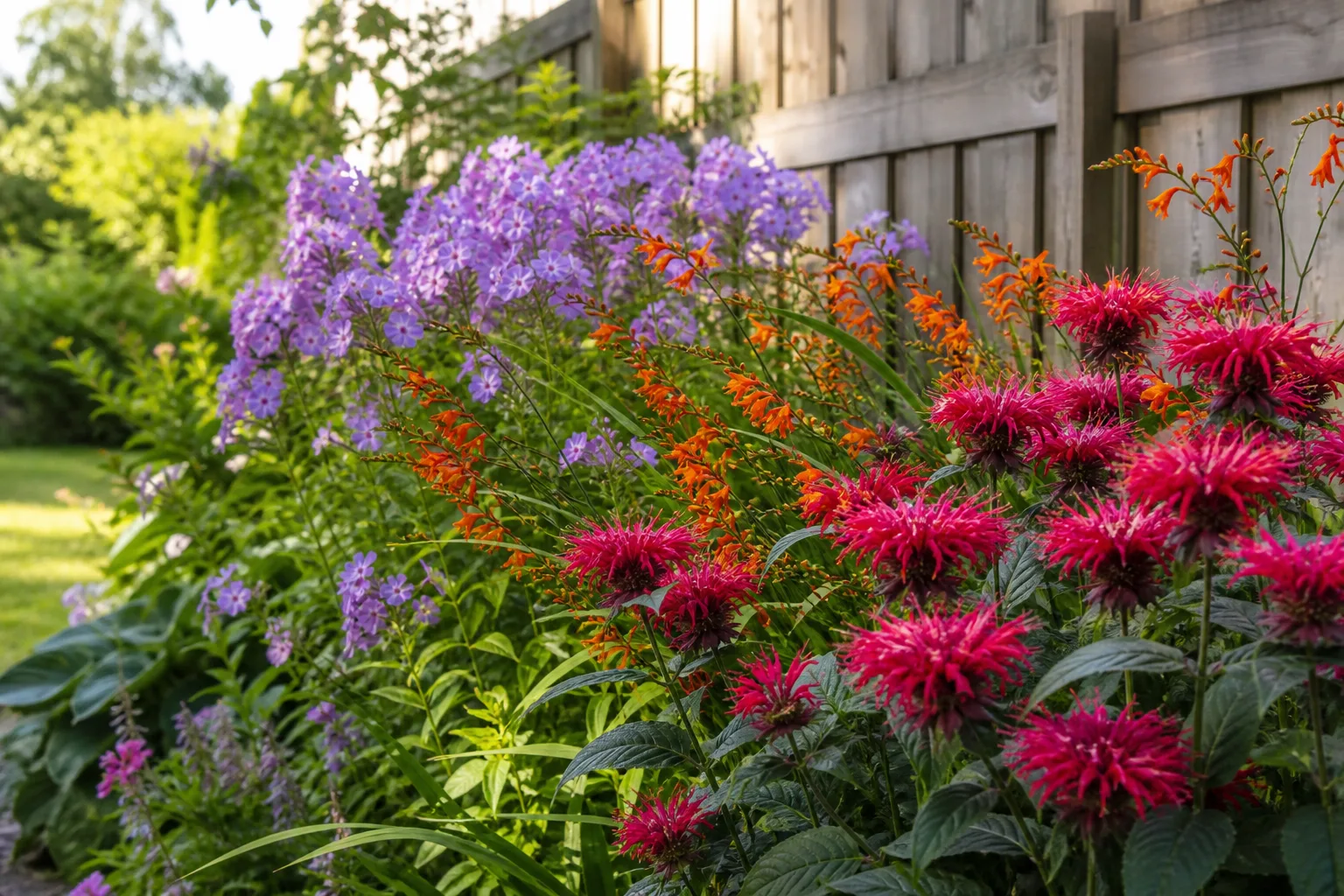
Do not judge a plant only by whether it has a red flower. Bright, tubular flowers can help hummingbirds find nectar, but local fit and sustained bloom matter more than a color rule. Savvy Gardening’s practical planting guidance recommends mixing hummingbird-friendly flowers and notes that birds use a broader range of nectar-rich blooms once they visit. Keep plant labels and local wildlife value in mind, since some garden cultivars may offer less accessible nectar than their wild relatives. (Savvy Gardening)
Keep insect prey available without pesticides
A garden with flowers but no prey is still missing half the diet. Avoid broad pesticide use where hummingbirds forage, and do not spray a feeder or a plant merely because a few aphids or spiders appear. Insects support birds and other wildlife, and pesticide residues or loss of prey can undermine the very habitat you are trying to create. Audubon specifically recommends avoiding pesticides and describes spiders and aphids as useful prey in hummingbird habitat; NC State and University of Maine Extension also caution against sprays around feeders. (Audubon Rockies; NC State Extension; University of Maine Cooperative Extension)
You can still manage a genuine garden pest problem, but start by identifying the insect and the damage. A few aphids on a plant that is otherwise thriving may be food for a bird; a rapidly spreading infestation that is weakening a valuable plant calls for a targeted, label-compliant response that accounts for pollinators and wildlife. Avoid treating flowering plants while birds and pollinating insects are visiting them. If you do need to use a product, follow its label and local extension guidance rather than assuming that a “natural” spray is harmless.
Leave a modest amount of leaf litter or stems where it is safe and practical, and include woody plants or hedges for perches and shelter. The goal is not to let every area become overgrown. A few layers—a flowering bed, a shrub, and a nearby tree—can support more insect life and give birds places to rest between feeding trips. Savvy Gardening’s habitat-garden advice similarly treats food and shelter as connected parts of a wildlife-friendly space. (Savvy Gardening)
Common feeding mistakes that create risk
The biggest mistake is thinking that one feeder solves the whole diet. Hummingbirds still need prey and natural flowers, so a sugar-water station should complement a garden rather than replace it. If there is no feeder available, the birds can forage from blossoms and insects; if the only food offered is a feeder, the yard may still be poor habitat.
Another mistake is making nectar “healthier” by adding honey, brown sugar, juice, vitamins, or dye. These ingredients do not improve the feeder food and may spoil more quickly or expose birds to unsuitable additives. Keep the mix simple and use a clean feeder. Audubon and extension guidance are consistent on avoiding additives, even though the sources describe slightly different ways to heat the water. (Audubon Feeding FAQs; NC State Extension)
A third problem is cleaning only when the feeder looks dirty. Microbial growth may be present before visible cloudiness or mold, especially in warmth, so use the weather-based schedule instead of waiting for a visual warning. A feeder that sits in strong sun or receives little traffic may still need regular cleaning; a small batch limits waste when birds are not drinking much.
Finally, do not try to increase insect availability by feeding birds store-bought bugs or by deliberately breeding pests. Protecting a living garden is enough: plant for local blooms, leave harmless insect life alone, and avoid pesticide exposure where birds feed. If bees or ants gather around a feeder, adjust the feeder design or clean drips rather than poisoning visitors that are also part of the garden ecosystem.
Conclusion
Hummingbirds eat flower nectar for energy and tiny insects and spiders for the nutrients a sugar solution cannot supply. Some birds also use fresh sap wells, and pollen may be swallowed while they drink, but neither should be treated as a main food to serve in a backyard. Fruit is not a reliable diet item or feeder ingredient.
If you want to help, plant nectar-rich flowers suited to your region, leave some insect prey available, and avoid pesticides where hummingbirds forage. Add a feeder only if you can keep it clean, and fill it with a measured 1:4 mixture of white sugar and water—nothing else. That combination supports the foods hummingbirds naturally seek without turning a simple feeding station into a risky recipe.