What to Know Before Buying White Oak Flooring
Compare white oak flooring cuts, grades, finishes, solid and engineered planks, moisture limits, installation needs, and the questions to ask before you buy.
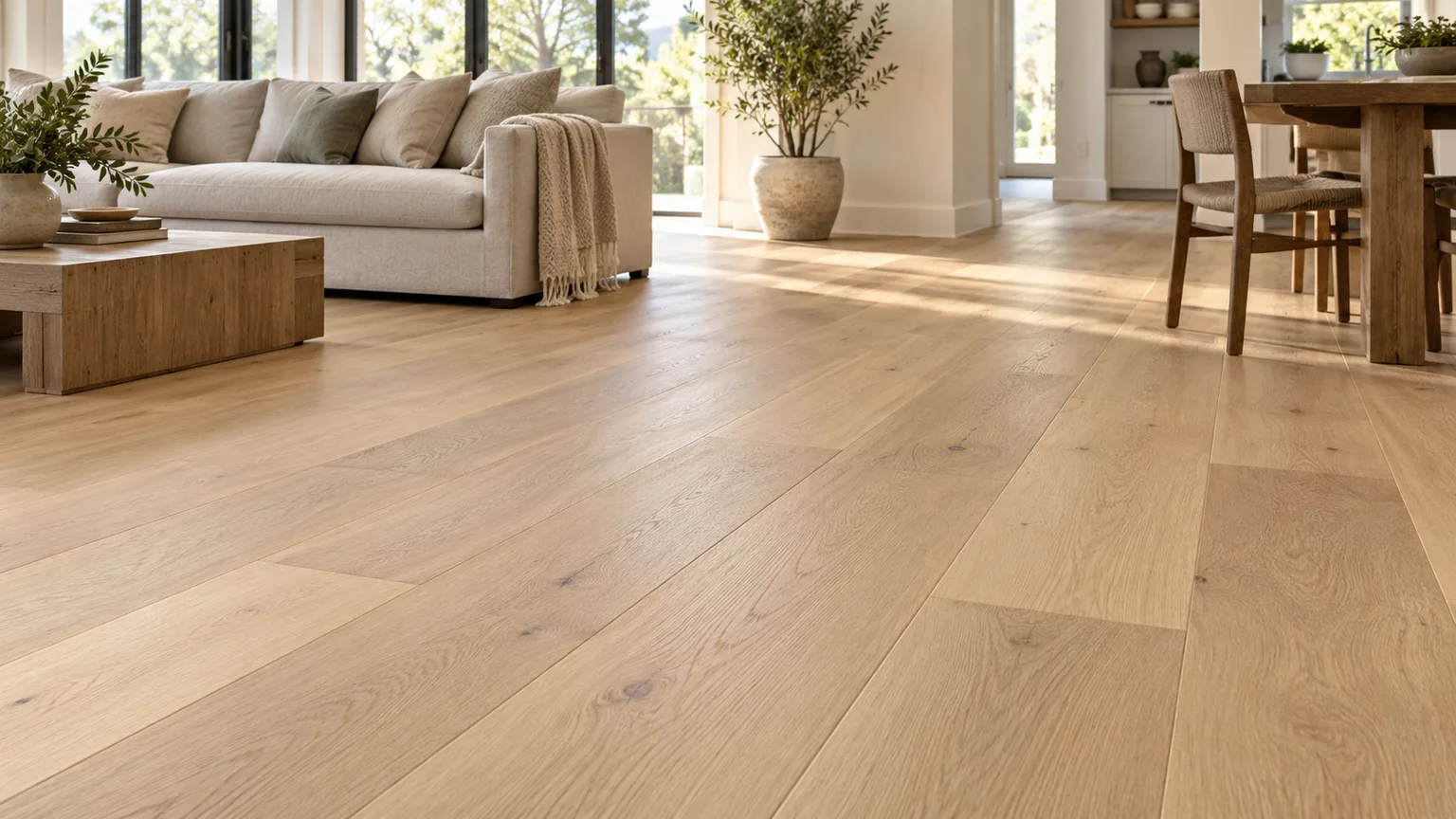
White oak is often sold as a safe, versatile hardwood choice, but “white oak” does not tell you everything you need to know about the floor. The color can range from pale beige to warm brown, the grain changes with the way a board is cut, and solid and engineered products behave differently over concrete, plywood, and changing humidity.
The most reliable way to buy well is to choose a product system, not just a species name: decide on the look, match the construction to the room and subfloor, inspect a sample under your lighting, and confirm the installation and maintenance requirements in writing. That approach helps you judge whether the premium is worth it for your home.
Quick verdict: who should choose white oak?
White oak is a strong candidate if you want real hardwood with a relatively calm grain, a broad range of natural and stained colors, and a surface that can often be renewed rather than replaced. It suits traditional and contemporary rooms, but it is not a waterproof floor, a no-maintenance floor, or always the lowest-cost option.
| White oak makes sense when you want… | Reconsider it when… |
|---|---|
| A neutral wood that can work with many cabinet and wall colors | You need a surface that can tolerate standing water or frequent wet cleaning |
| A hardwood floor that can be refinished if its construction allows | A tight budget matters more than a natural wood wear layer |
| A choice of solid and engineered products, cuts, widths, and finishes | You need every plank to have nearly identical color and grain |
| A material with good everyday hardness and recognizable oak character | The installer cannot verify subfloor moisture or follow product-specific instructions |
The deciding factor is often the room rather than the species. A properly specified engineered white oak may suit a concrete-supported room better than solid planks, while a dry room over a compatible wood subfloor may be a good fit for either construction.
What white oak flooring is—and what “white” means
Commercial white oak is hardwood milled from trees in the white oak group. It is not always a promise that every board came from one exact botanical species, so ask the seller how the product is specified if species identity, origin, or certification matters to you. The U.S. Forest Products Laboratory’s Wood Handbook explains why wood species differ in anatomy, moisture response, and mechanical properties; those material traits matter, but the mill’s grading, cut, and finish also shape the floor you see.
“White” is a species-group name, not a color guarantee. Boards may be light tan, beige, brown, or have subtle olive and gray notes, and natural variation can occur within one carton. A finish can warm, mute, or deepen that color, while exposure to light can gradually change the appearance of wood and some finishes.
White oak vs. red oak: color, grain, and pores
White oak often reads as more neutral or brown, while red oak commonly has pinker or warmer undertones and a more pronounced open-grain pattern. These are useful tendencies, not a substitute for samples: stains, cut, board selection, and lighting can make two products of the same species look quite different.
One structural difference is that white oak’s vessels are often blocked by tyloses, while red oak has more open vessels. That gives white oak a relative advantage in resisting liquid penetration through the wood itself, which helps explain its traditional use in tight cooperage. A finished floor still has seams, edges, and a coating that can be breached, so neither species is waterproof and neither should be left wet.
White oak is often the easier starting point when you want a lighter, less red floor or plan to compare a wider range of stain colors. Red oak can be the better choice when its warmer color and stronger grain suit the room, when matching existing red oak matters, or when local stock and price favor it. Judge both on a finished sample, not on species labels alone.
Choose the look: cut, grade, and plank width
The visual character you buy depends on more than color. A product description may name the grade and cut, but it may not show how much variation, sapwood, mineral streaking, knots, and board-length variation to expect in the installed floor. Ask for a sample or installed photo that represents the exact product and grade.
How sawing changes the grain
Plain-sawn boards often show sweeping cathedral patterns and more visible variation. Rift-sawn boards tend to have a straighter, quieter grain, while quarter-sawn boards can show distinctive ray fleck across the face. Rift- and quarter-sawn material may cost more because the cutting process yields less flooring from a log, but availability and pricing vary by mill and product.
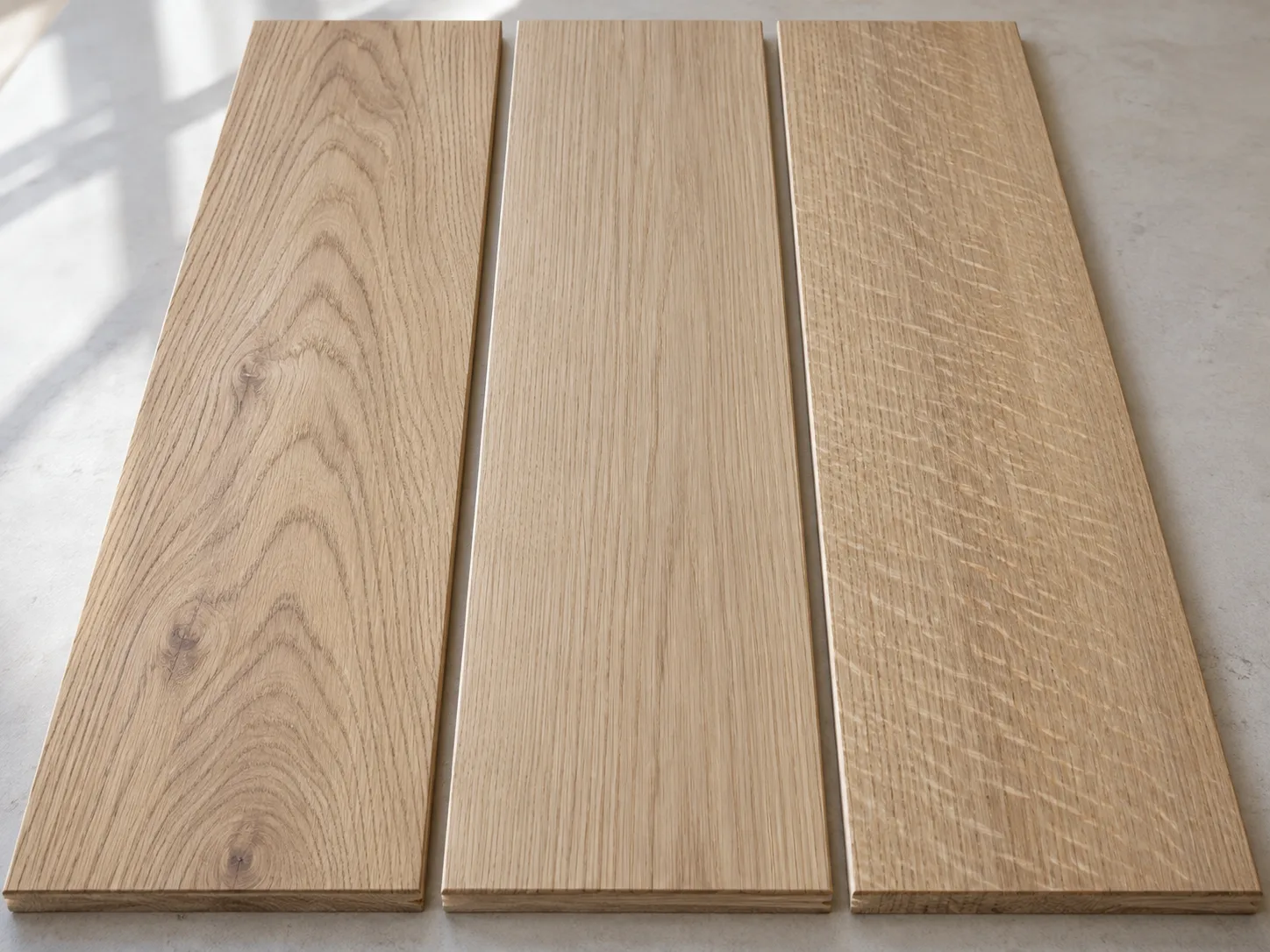
Do not assume that a “select” label means no color movement or that a “character” grade means poor quality. Grade terms and product groupings differ among manufacturers; request the maker’s grading definition and see several boards from the actual line. If you want a very uniform pale floor, a character-rich grade could feel busier than the single showroom sample suggested.
What grade and width change
Wider planks show more of each board’s color and grain, which can make a room look more expansive and the wood more prominent. They also make seasonal gaps or edge changes more noticeable, and they require an installation plan appropriate to the product’s width, subfloor, and indoor moisture conditions. A narrow or medium board is not automatically more stable, but it can make small seasonal changes less visually dominant.
Longer boards create fewer end joints and a more continuous look; cartons that contain many short lengths can produce a busier pattern. Compare the advertised length range and the actual carton mix. In a large room, ask how the installer will distribute boards to avoid clustering short pieces or repeating obvious grain patterns.
Solid vs. engineered white oak
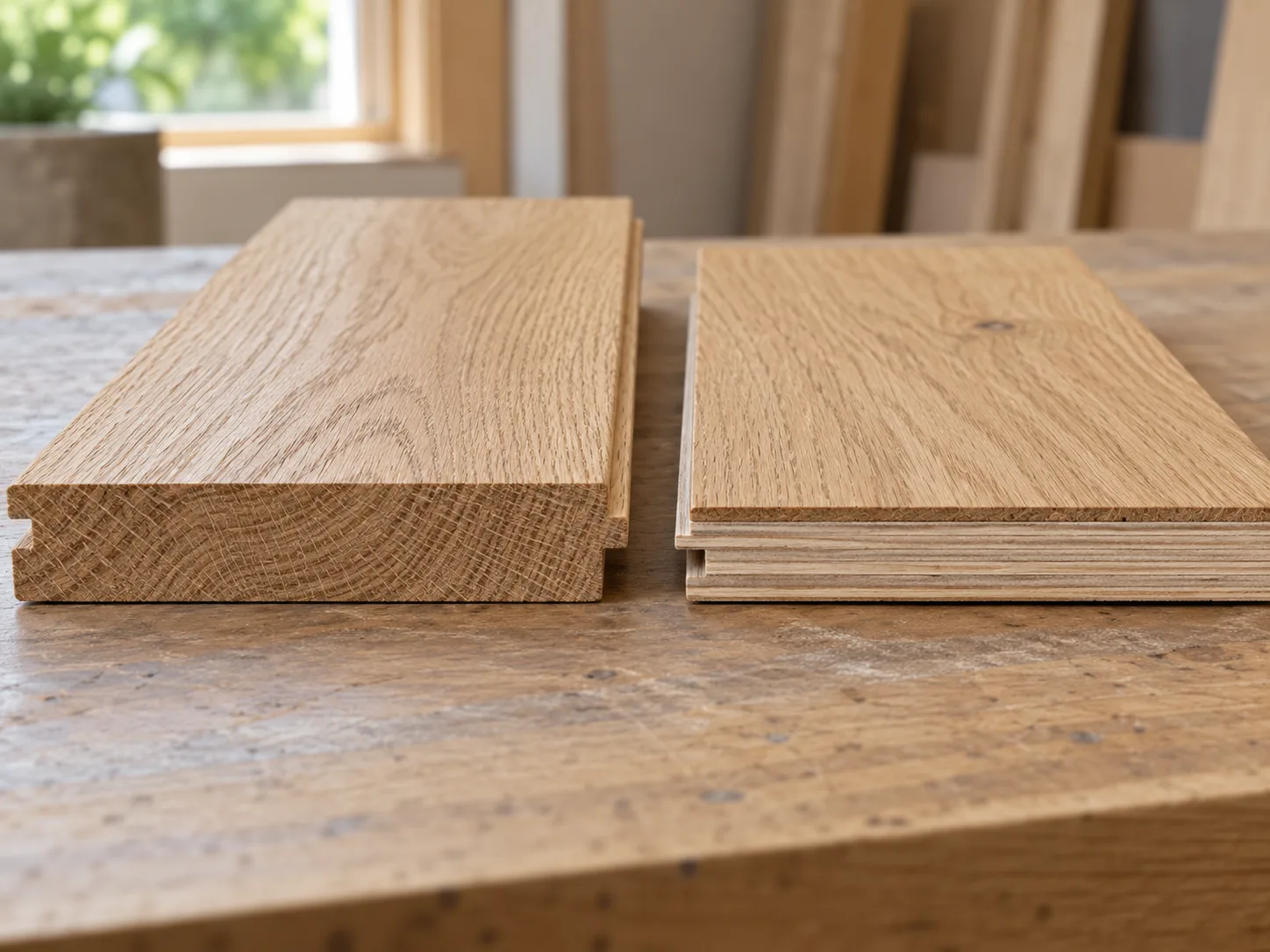
Solid white oak is milled from one piece of wood. Engineered white oak has a real oak surface layer bonded to a layered core, commonly plywood or another engineered substrate. Both can look like oak because the visible wear surface is oak; the difference is in construction, movement, installation choices, and how much future sanding the product can support.
| Construction | Often a good fit for | Ask before you buy |
|---|---|---|
| Solid white oak | Compatible wood subfloors and above-grade rooms where the product’s installation method is approved | Is the subfloor suitable for fastening, and how many times could this thickness realistically be sanded? |
| Engineered white oak | Some concrete-supported, radiant-heat, or wider-plank installations when the exact product is approved | What is the oak wear-layer thickness, core construction, allowed installation method, and moisture limit? |
Engineered flooring is not automatically immune to humidity, and solid flooring is not automatically unsuitable outside one floor level. Construction is only one part of the system: the product instructions, slab or subfloor, moisture control, room conditions, and installation method must agree. For below-grade or concrete locations, get written confirmation that the specific product is approved for that exact installation.
Check the wear layer before paying extra
Ask how thick the engineered board’s oak wear layer is, not just how thick the whole plank is. A thicker oak surface generally leaves more material available for future sanding, but the number of safe refinishings also depends on the profile, the depth to the tongue, prior sanding, and the skill and equipment used. “Refinishable” is not a universal count of how many times the floor can be sanded.
Look for a clear answer in millimeters or inches and a product-specific refinishing statement. If the salesperson cannot supply either, compare the product as a floor intended for a long service life with limited sanding, not as an equivalent to thick solid boards.
Choose a finish that fits the household
Prefinished boards arrive with a factory-applied coating, often with a slight bevel at the edges. They can shorten on-site finishing work and make the factory color and sheen easier to evaluate, although the bevels and board-to-board finish variation may be visible. Site-finished flooring is installed, sanded, stained if desired, and coated in the home; it can create a more continuous surface and offer custom color, but it involves more jobsite finishing and drying time.
The finish type affects the look and the maintenance plan. A clear water-based coating may preserve a lighter appearance better than some oil-modified products, which can warm or amber the wood; hardwax-oil systems have a different feel and maintenance routine from film-forming polyurethane. None is categorically best. Check the manufacturer’s cleaning instructions, repair method, cure time, sheen, and warranty conditions before choosing.
Matte and satin sheens tend to diffuse reflections and can make everyday dust and fine scuffs less conspicuous than a high-gloss surface. They do not prevent dents, and no finish makes dog claws or grit harmless. Ask for the same sheen and finish system on the sample you assess, because a raw board is a poor predictor of the finished color.
How durable is white oak flooring?
White oak is considered a hard domestic hardwood. Published Janka figures commonly place it around 1,360 pounds-force, but the Janka test measures the force needed to press a steel ball into a wood sample; it does not test a finished floor’s scratch resistance, coating quality, dent recovery, or resistance to damage from standing water. The USDA Forest Products Laboratory discusses wood’s mechanical properties as material data, not as a guarantee of how one finished product will perform in a particular home.
For practical durability, look at the full assembly: the oak surface, finish, board construction, subfloor support, installation quality, and how the room is used. Rolling office chairs, grit at an entry, narrow furniture feet, and pet nails can damage many hardwoods. A hard wood may resist some dents better than a softer one, yet still scratch or show wear if its finish is thin or poorly maintained.
Oak’s grain can help disguise small scratches because marks do not sit against a perfectly uniform surface. A low-sheen finish can soften their visibility further. This is a visual advantage, not a reason to skip entry mats, felt pads, or prompt cleanup.
Water resistance does not make it waterproof
White oak’s relative resistance to liquid absorption is a helpful feature, especially compared with more open-pored red oak, but water can still stain or deform the wood and damage a coating. Liquid can also reach the subfloor through joints, perimeter gaps, or an unsealed edge. A few wiped-up drops and a leaking appliance are not comparable exposure conditions.
Use a dry or manufacturer-approved barely damp cleaning method, and wipe spills promptly. Avoid steam mops, soaking wet mops, standing water, and strong cleaners unless the flooring maker explicitly approves them. If a kitchen is in scope, plan for sink and dishwasher leaks, use suitable mats where spills happen, and check the floor periodically around appliances.
Where white oak works—and where to pause
Living rooms, bedrooms, dining spaces, and many kitchens can work well when the product is properly specified and the indoor environment is reasonably stable. Entryways can also be practical if grit and wet shoes are managed. The trade-off is everyday care: a wood floor rewards quick cleanup and grit control, not neglect.
Bathrooms, laundry areas with leak risk, and below-grade rooms deserve more caution. White oak is still a moisture-sensitive wood floor, and an engineered product’s layered construction does not make it a waterproof surface. In a basement, confirm the flooring, moisture-control system, adhesive or underlayment, and warranty all allow the intended installation. If water exposure is likely to be frequent or uncontained, compare tile or another water-tolerant surface for that zone.
What a sound installation requires
Wood flooring moves as its moisture content responds to the surrounding temperature and relative humidity. The building should be enclosed and the heating or cooling system operating under normal living conditions before installation; drywall, paint, tile, and other wet work should be complete, and leaks or damp crawlspaces corrected. The National Wood Flooring Association’s technical guidelines provide industry guidance, and Hardwood Floors Magazine’s installation coverage describes why installers check the jobsite before bringing flooring in.
Acclimation does not mean every bundle must sit in every home for the same number of days. The goal is to install flooring whose moisture condition is appropriate for the building’s expected living environment, as directed by the manufacturer and installer. A fixed “three days” rule cannot account for product construction, delivery conditions, local climate, building readiness, or whether the room is still drying out.
Ask the installer to record moisture readings for the flooring and the wood subfloor, along with temperature and relative humidity. Hardwood Floors Magazine summarizes guidance that wood subfloor moisture should be within roughly 2 to 4 percentage points of the flooring’s expected equilibrium moisture content, with the allowable difference depending on board width. Concrete requires the specified test method and the limits for the selected adhesive or flooring system; a casual surface reading is not a substitute.
For concrete slabs, radiant heat, or unusually wide boards, do not rely on a retailer’s general statement that engineered flooring is “more stable.” Verify the exact product’s approved installation methods, required underlayment or vapor control, temperature limits for radiant heat, and warranty. A qualified installer should explain how the substrate will be checked and what would make the job pause before planks are laid.
Maintenance, scratches, and refinishing
Most routine damage starts with grit, dragging furniture, or moisture rather than the species choice. Sweep or vacuum with a hardwood-safe head, place entry mats that do not trap moisture, and use felt glides under chairs and furniture. Keep pet nails trimmed and lift furniture rather than dragging it over the floor.
Use the cleaner recommended for the finish, because a product suitable for one coating may leave residue or interfere with maintenance on another. Avoid wax, oil, vinegar, or abrasive cleaners unless the floor maker recommends them. A quick damp wipe is different from leaving water on the boards; follow the instructions for the exact product.
Small scratches may be addressed with a finish-specific repair product or professional screen-and-recoat service, while deep scratches, worn-through finish, and water damage can call for more extensive repair. Solid boards usually offer more sanding depth than thin-veneer engineered boards, but condition and installation matter. Before purchase, ask who handles repairs, whether matching boards and finish are available, and what a future recoat requires.
How to compare flooring quotes
Current quotes vary by region, product availability, species group, grade, cut, width, finish, and the condition of the existing floor. Compare itemized installed totals rather than a headline material price. One quote may include removal and disposal while another prices only the planks; a low per-square-foot figure can leave the expensive preparation work off the page.
Ask each bidder to list flooring, waste allowance, furniture moving, removal, subfloor repair or leveling, moisture testing and mitigation, underlayment or adhesive, transitions, baseboards or shoe molding, stair parts, installation method, finish coats, cleanup, and warranty. Confirm who will buy and deliver the wood, when the room needs to be vacant, and which conditions could create a change order. Then compare bids with the same product specifications and scope.
Do not pay a premium for a vague label such as “premium white oak.” The premium may be justified by a specific cut, grade, longer average board lengths, thicker wear layer, durable finish system, or better installation scope. Ask the seller to identify that difference in the product documentation.
When an alternative makes more sense
Engineered white oak may solve a construction or moisture-stability constraint while preserving a real oak wear surface, but it is still hardwood and still has limits. Red oak can be a practical alternative if its warmer tone works and matching material is easier to source. Maple is another domestic hardwood option for a cleaner, less oak-like grain, although it may take stain differently.
If water exposure or low maintenance is the priority, porcelain tile can be a better fit in a bathroom or laundry area. Laminate and luxury vinyl can offer a wood look at different price and repair trade-offs, but neither is a white oak floor and neither has a solid oak wear layer. Compare the material you actually want against the conditions of the room rather than treating a printed oak pattern as interchangeable with oak flooring.
A sample-first buying checklist
Before placing an order, bring home samples of the exact product, grade, cut, color, and finish you are considering. View them beside cabinets and trim in morning and evening light, and include both daylight and the room’s usual lamps. A tiny sample can hide color variation and the visual effect of plank width, so ask to see a full board or several planks if you are covering a large area.
Get the following details in writing: the species or species group; grade definition; sawn cut; plank width and length range; solid or engineered construction; total thickness and engineered wear-layer thickness; surface finish and sheen; approved installation method; subfloor and moisture requirements; radiant-heat compatibility; cleaning and repair instructions; warranty exclusions; and return terms. Ask whether the sample is from the same production line you will receive and how much color variation is expected between cartons.
If you are hiring an installer, ask how moisture will be measured, who decides whether the subfloor is ready, what acclimation criteria apply to the exact product, and what work is excluded from the bid. A confident answer should name a test, a manufacturer requirement, or a measurable condition—not only a number of days or a verbal promise that the floor is suitable.
Conclusion
White oak flooring can be a durable, adaptable hardwood choice, but its value depends on choosing the right product and installing it under the right conditions. A good buying decision matches the visible grain and finish to your room, the solid or engineered construction to the subfloor, and the maintenance expectations to how the household lives.
Compare actual samples, inspect the wear layer and grading details, confirm moisture and installation requirements, and ask for itemized quotes. If those answers are specific and the room is a suitable environment for wood, white oak can give you a floor whose appearance can evolve with the home and whose surface may be renewed when its construction allows.