When to Harvest Sweet Corn for Peak Flavor
Learn when to harvest corn by checking silk, husk, ear fill, and kernel juice. Use a simple test, pick each ear cleanly, and chill it promptly.
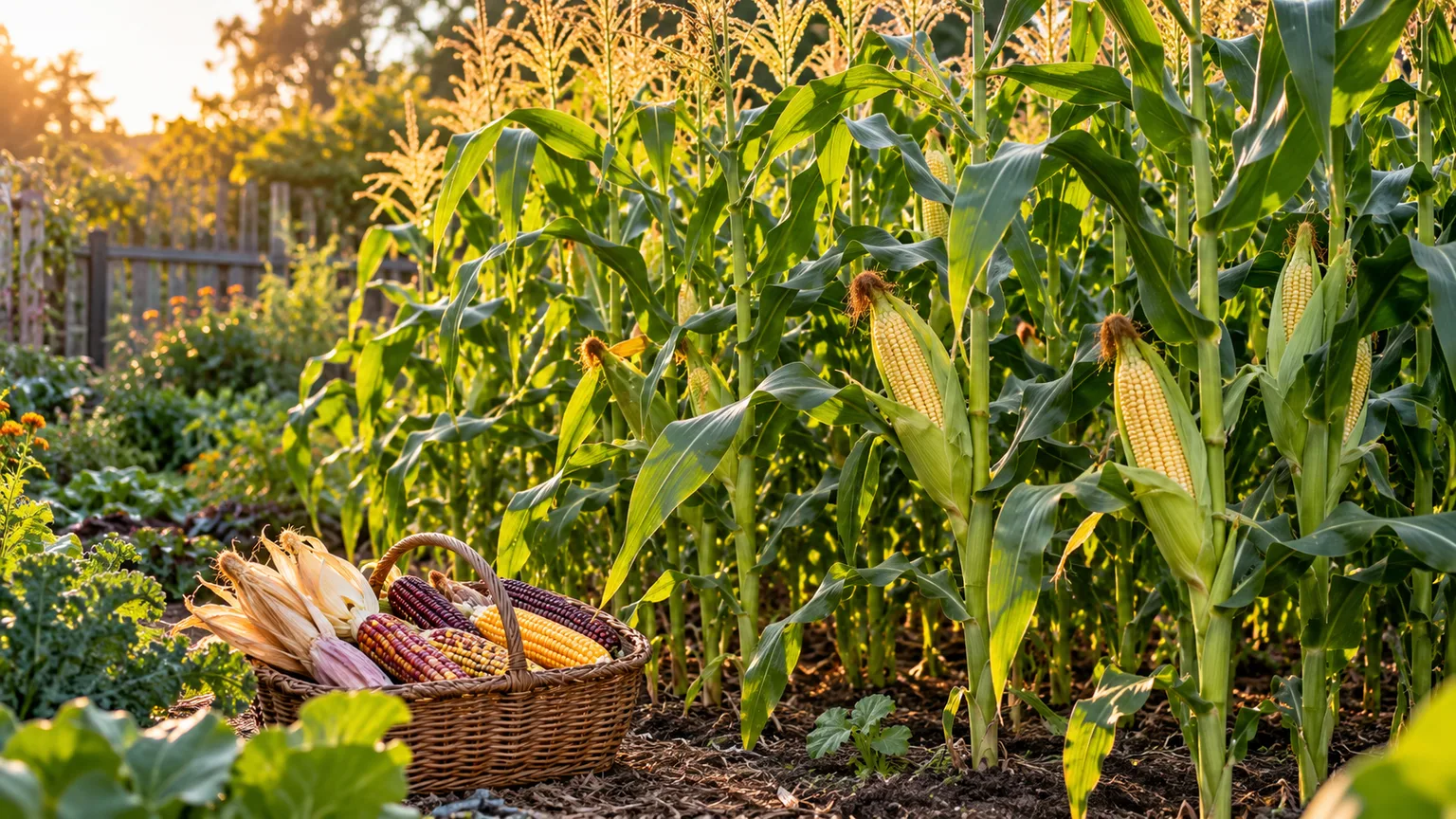
Pick sweet corn when its kernels are full-sized and release milky juice when punctured. That milk stage is the brief point when kernels are tender and sweet; clear, watery juice means the ear needs more time, while thick doughy juice or no sap means it has passed peak eating quality. Brown silk and a green husk help you choose which ear to check, but the kernel test makes the final call.
Most home-garden sweet corn reaches this stage around 17 to 24 days after silks first appear, often close to three weeks. That range shifts with cultivar and weather, and different ears on one stalk or in one bed can be ready on different days. Check each ear individually, then cool it as soon as you bring it in: flavor can fade quickly when harvested corn stays warm.
The short answer: harvest at the milk stage
The harvest target for sweet corn is the milk stage. At this point the kernels have filled out but are still soft; a puncture releases opaque, milky liquid. The kernels have not yet turned starchy and tough, which is what happens as they advance toward the dough stage.
An ear is most likely ready when the silks at its tip have dried and turned brown, the husk remains green, and the ear feels filled rather than narrow or pointed. Then check one kernel. Virginia Cooperative Extension describes the same three-way test: clear liquid means immature, milky liquid means ready, and no sap means too late for peak sweet-corn quality. Virginia Tech’s expert-reviewed sweet corn guide places the usual window at 17 to 24 days after the first silks appear, with faster development in hot weather and slower development in cool weather.
Read four clues together
No single outdoor clue is as reliable as the kernel test. Use the outside of the ear to decide whether it is worth testing, then confirm the stage before you break it from the stalk.
Silks dry while husks stay green
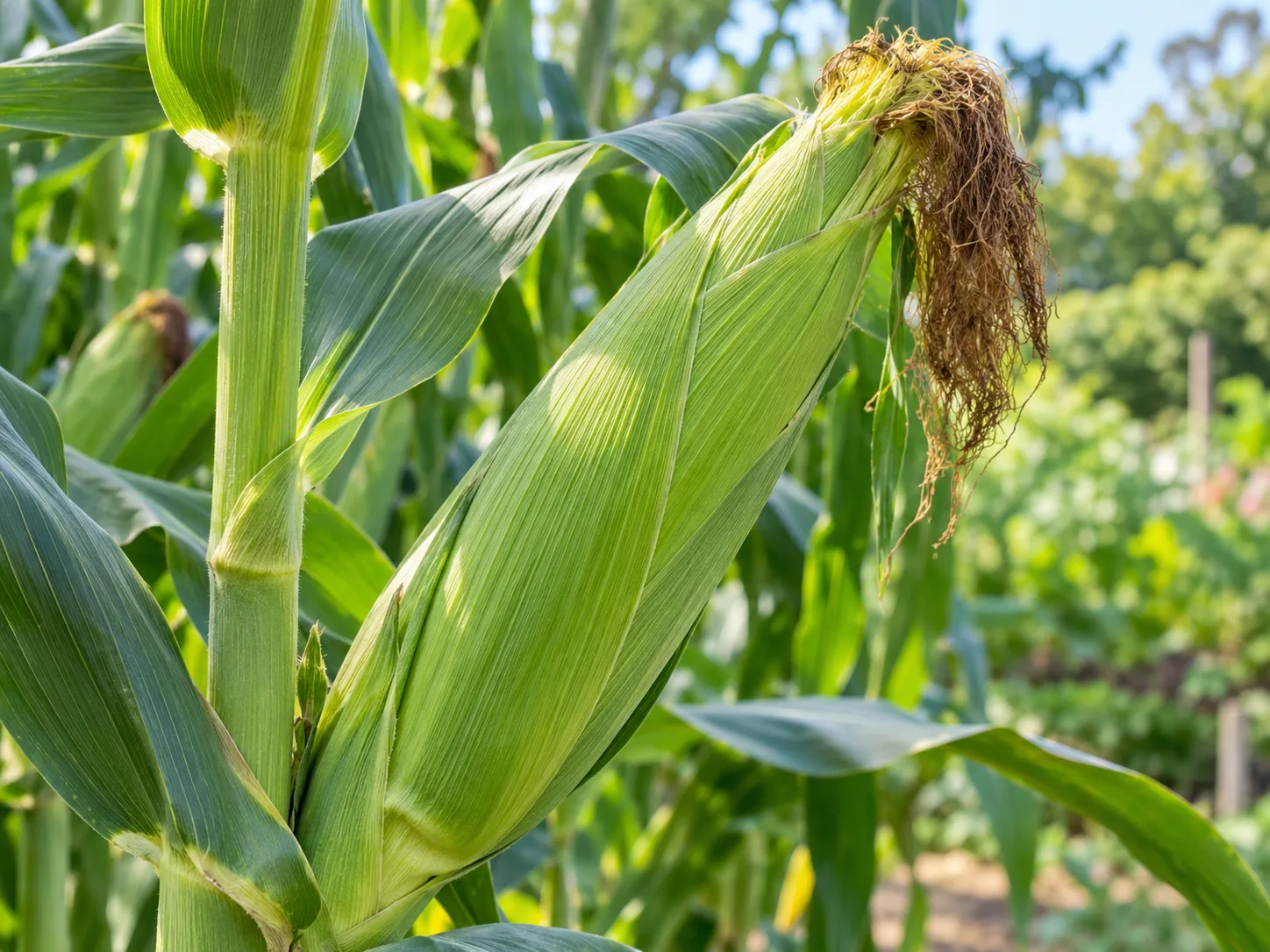
The threadlike silks emerging from an ear are part of the pollination process; each silk connects to a kernel. As the ear develops, most silks dry and turn brown. That is a useful signal that the ear is getting close, but it only tells you that pollination has progressed, not that every kernel has filled or reached the best eating stage.
Look at the silks at the ear, not just the tassel at the top of the stalk. Corn tassels release pollen; the silks at each ear receive it. A dry tassel is not a harvest cue. If one ear’s silks are brown while the husk is still lush green, move to the next clues rather than picking immediately.
A ripe ear feels full to the tip
Gently feel the length of the husked ear without squeezing hard. A well-filled ear feels firm and rounded from the base toward the tip, with no long, narrow section that suggests the kernels have not developed. The exposed end of the ear should feel blunt and filled rather than sharply pointed.
The husk should still be green and snug around the cob. It may feel less bright as harvest approaches, but a dry, yellowing, loose husk is not the goal for fresh sweet corn. A full feel is a useful cue, not a guarantee: incomplete pollination can leave gaps even when the rest of the ear is mature.
Kernels are plump, not hard
When the ear is ready, the kernels have nearly reached their full size and form orderly rows that press against the husk. The tip may be slightly less full than the base, but a broad, underfilled section often points to pollination trouble rather than a need to leave the ear on the stalk for another week.
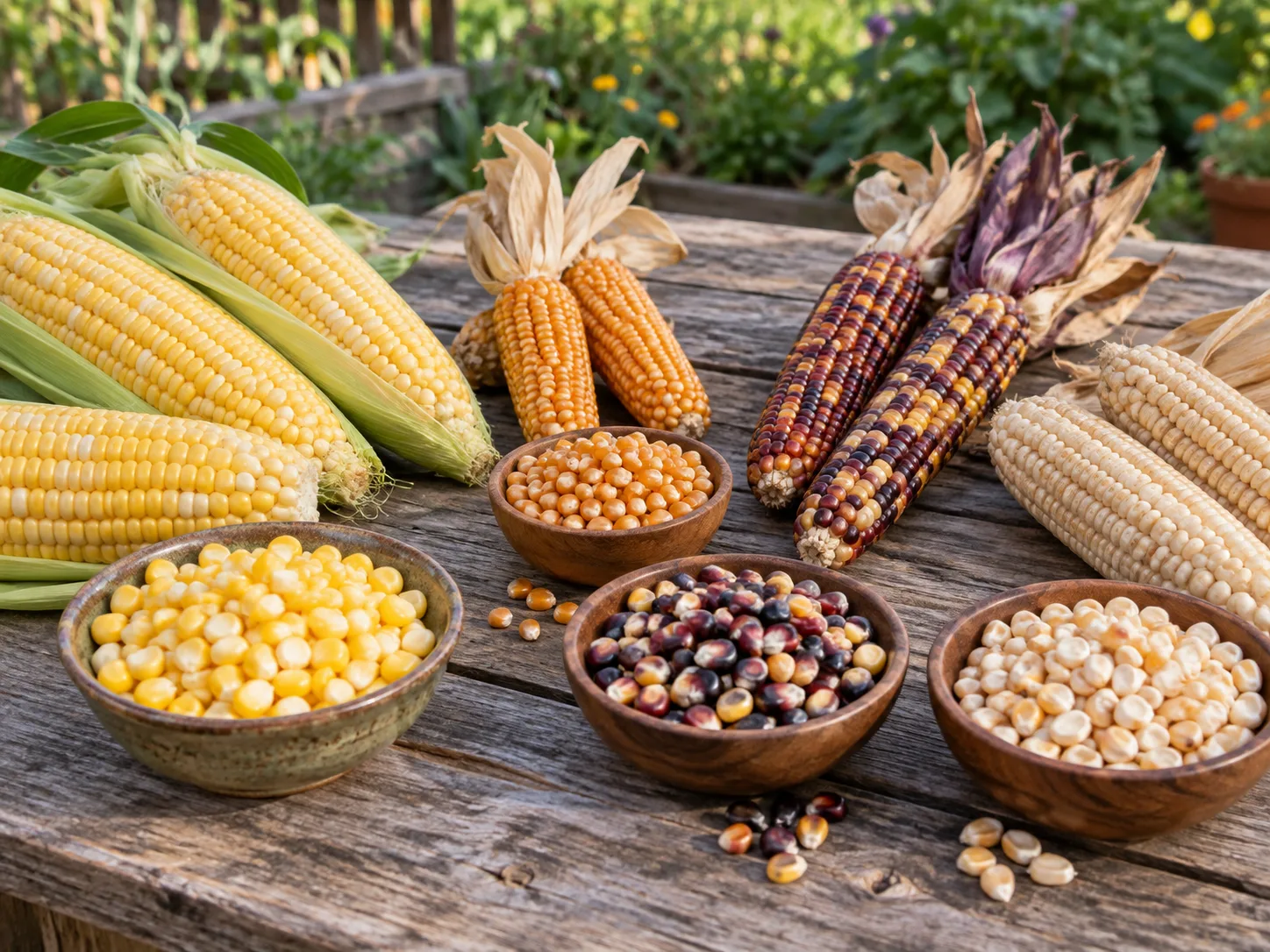
Kernel color depends on the variety. Yellow, white, and bicolor sweet corn can all be ripe, so color alone cannot tell you whether to pick. If the packet names a supersweet or sugary-enhanced type, that affects how well the kernels hold sweetness after harvest, not the need to check for milk-stage tenderness.
Milky juice confirms readiness
The fingernail test is the most direct check. Peel back just the top inch or two of husk on one likely-ready ear and press a plump kernel with a clean fingernail. Milky, opaque juice is the target; clear fluid means the kernel is still immature, and thick, doughy fluid or little to no sap means the eating window is closing or has passed.
Utah State University Extension describes sweet corn at the milk stage as nearly full-sized, soft kernels containing clear-to-milky liquid when punctured; it recommends harvesting when kernels just reach this stage. Its harvest and handling guidance also notes that the later dough stages bring tougher kernels as sugars turn to starch. Close the husk around the checked ear afterward to protect the kernels while you decide whether to pick it.
Use the silk clock to know when to start checking
Count from the first appearance of fine silk strands at each ear, not from planting day and not from the tassel’s first appearance. Extension sources give a range rather than a universal date: Utah State says most sweet corn is ready about 15 to 22 days after silking, Georgia Extension says about 20 days, and Virginia Tech gives 17 to 24 days. Together, those recommendations make roughly three weeks a sensible reminder to begin checking, not an automatic harvest appointment.
The seed packet’s days-to-maturity estimate is useful for planning when to look. Sweet corn commonly matures over a broad span, depending on variety and growing conditions, so “60 days” or “80 days” on a packet is not enough to decide whether an ear on your plant is ready today. Silking starts the more useful short countdown; the kernel test confirms it.
Weather changes the pace. Warm conditions can bring ears through development faster, while cooler weather can stretch the timeline. Virginia Tech notes that hot weather accelerates maturity, and Utah State warns that prime condition may last only a day or two when daytime temperatures consistently exceed 86°F. In a heat wave, inspect likely-ready ears daily; in cooler weather, continue checking instead of picking based on the calendar alone. Keep the date attached to the plant or planting block rather than relying on memory: if two sowings or cultivars silk a week apart, they do not share one harvest countdown. A weather note helps too. A stretch of hot days is a reason to move from occasional checks to daily ones, while a cool spell is a reason to keep testing rather than deciding that a predicted date has passed.
Varieties also differ. Standard sugary (su) corn loses sweetness faster after harvest than sugary-enhanced (se) and supersweet (sh2) types, whose genetics slow sugar-to-starch conversion. The University of Georgia Extension explains that supersweet corn keeps its sweetness longer but can have a less creamy texture than standard types. That difference can affect what you do with an extra harvest, but it does not mean an ear should sit on a warm counter. UGA’s home-garden guide recommends eating or cooling sweet corn as soon as possible after picking. Savvy Gardening’s harvest guide also stresses that the seed-packet maturity estimate is only a starting point and that silk, ear fullness, and the kernel test should decide the pick. For a home gardener, the packet tells you when to get ready; the plant tells you when to harvest.
Test one ear without stripping the crop
Do not peel back every ear to check it. Choose one ear whose silk has dried and whose husk feels full, then open only the top inch or two. Press a plump kernel near the upper third of the cob rather than judging by a possibly under-pollinated tip. If the juice is milky, that ear is ready; if it is clear, close the husk and wait a day or two before testing that ear again. This is a small sample, not a reason to strip several ears: opening the tip exposes kernels to drying and insects, and one ear gives you a useful check without sacrificing the crop. A practical walkthrough from Savvy Gardening uses the same sequence of checking silk and kernel fullness before puncturing a kernel, which is more reliable than treating one color change as a universal signal.
An open husk can expose kernels to birds, insects, and drying, especially if the ear still needs time. Virginia Cooperative Extension suggests covering an ear that has been checked with a paper bag when you leave it on the stalk. At minimum, fold the husk back into place; do not peel the whole ear in the garden just to inspect it.
Keep a simple note of when silks first appeared if the bed has staggered plantings or several varieties. Marking the first silk date on a plant tag lets you focus your checks on ears approaching their likely window, while the actual kernel test prevents a note from becoming a rigid schedule. One test ear is usually enough to calibrate your judgment for a particular cultivar, but still check later ears individually.
Pick without tearing the stalk
Harvest only the ears that pass the readiness check. Hold the stalk just above or below the ear with one hand to steady it; with the other, grasp the ear and bend it down and away with a firm twisting motion until it snaps free. Utah State Extension and Harvest to Table both describe a downward twist as the practical hand-picking method for a home garden.
Avoid yanking upward, which can pull the plant over or loosen its roots. If an ear is stubborn or the stalk is brittle, use a clean, sharp knife to cut through the short stem that joins the ear to the stalk. Keep the blade pointed away from your supporting hand and avoid cutting into the main stalk or nearby ears.
Harvesting one ear does not require stripping the whole plant. Some stalks carry a second, later-developing ear, and it may be smaller than the first. Leave any ear that is still filling, then return to its silks and kernel stage rather than assuming every ear on the stalk ripens together.
Move the harvest from the garden to the refrigerator quickly
Once an ear is ready, the next few hours matter for eating quality. Heat speeds the conversion of kernel sugars to starch, reducing the sweetness that made the milk stage worthwhile. The exact rate depends on the variety and temperature; the dependable home-garden practice is to keep harvested ears out of the sun and chill them promptly.
Pick when the ears are cool
Early morning is a useful time to harvest because the ears have not yet accumulated as much field heat. Virginia Tech reports that ears kept warm convert sugar to starch more rapidly and recommends cool morning picking when corn will be stored for a day or two. The timing is about temperature management, not a special hour when kernels suddenly become sweeter.
If you can cook the corn immediately, pick it just before you need it. If the afternoon is the only time you can get outside, do not leave ripe ears on the stalk just to wait for dawn during a heat wave; harvest, shade them, and move them into the refrigerator. Utah State reports substantial sugar loss for standard sugary kernels under very hot conditions, while extra-sweet types retain sweetness longer. That is a reason to cool every variety quickly, not a universal clock that applies identically to all ears. Georgia Extension gives a useful scale for the risk: its home-garden guidance says unrefrigerated corn can lose about half its flavor within 12 to 18 hours. Treat that as a warning about warm storage, not a countdown that applies exactly to every cultivar or kitchen; the dependable action is to keep ears shaded and cold as soon as possible.
Keep the husks on and chill promptly
Keep the husks attached until you are ready to cook or process the corn. They help protect the kernels from drying, and leaving them on also avoids handling more than necessary. Put the ears into the coldest part of the refrigerator as soon as you can; do not leave a basket sitting on a sunny porch or in a warm kitchen while you finish other chores. Harvest to Table’s sweet-corn harvest and storage guide likewise recommends chilling quickly and leaving husks in place until preparation. Do not wash ears before storage; wash them when you are ready to cook so you are not storing damp husks and silk. If you bring in a large, warm harvest, prioritize chilling the ears rather than spending time trimming and cleaning them first.
Use fresh-picked corn as soon as practical, ideally the same day or within a few days if it has been refrigerated. Standard sugary varieties decline faster than supersweets, so the label can help you set expectations, but refrigeration is still worthwhile for every type. Georgia Extension advises prompt cooling and says refrigerated corn can be eaten fresh within a few days; Harvest to Table likewise recommends keeping the husks on until cooking.
Use a few ears fresh and freeze the surplus
If more ears ripen at once than you can eat, process the extra while it is still in good condition. Sweet corn can be frozen on or off the cob, but follow a tested extension or food-preservation recipe for blanching, cooling, and packing rather than guessing at a time. Georgia Extension lists freezing among the ways to preserve a home crop; Harvest to Table also describes blanching before freezing.
For a small garden, staggered sowings or early-, mid-, and late-season varieties can spread harvest over time. Virginia Tech Extension describes both approaches for a continuous harvest. That planning helps avoid a kitchen full of ears at once, but it cannot replace checking each ear, since weather and silking dates determine the actual window.
Troubleshoot what the ear is telling you
An imperfect ear can still be useful. Decide whether the problem is timing, pollination, or quality after harvest; waiting longer only helps when the kernels are still developing and the ear remains healthy.
Brown silks but an unfilled ear
Brown silks show that pollination has occurred or is winding down, but they do not prove that the ear has filled. If the ear still feels thin and the kernels you can see near the tip are small, test a plump kernel lower down. If its liquid is clear, wait briefly and recheck. If the kernels are already milky but the tip is sparse, harvest for the kernels that formed rather than expecting blank spaces to fill later.
Missing kernels commonly reflect incomplete pollination, not a late harvest date. Each silk must receive pollen for its corresponding kernel to develop; dry conditions during silking, heat stress, or planting a single long row instead of a pollination-friendly block can reduce fill. Georgia Extension lists dry weather during silking and too few rows in a block among causes of poor kernel development, and Virginia Tech emphasizes block planting for pollination.
Watery kernels or thick, doughy juice
If the test releases clear, watery fluid, close the husk and give that ear another day or two if weather and pest pressure allow. A picked ear will not continue filling or become sweeter on the counter. It is better to wait for the crop on the stalk than to pick a whole row early just because the silks have turned brown.
If the juice is thick and doughy or a kernel has no sap, the ear has moved past the ideal milk stage. It may still be edible, but expect firmer, starchier kernels and less of the tender sweetness you get at peak. Use it promptly in a cooked dish where texture matters less, or remove the usable kernels; do not keep waiting for a dry, hard cob if your goal is fresh sweet corn.
Corn that has been picked at the right stage but left warm can also taste bland. Refrigerate the remaining ears immediately; chilling slows further quality loss but cannot reverse starch formation that has already happened. The next time, pick only what you can quickly cool or cook.
After the last usable ears
Keep the stalks standing while any later ears are still filling. Once every ear you intend to harvest is off the plant, remove spent stalks and compost healthy material; discard diseased plants rather than adding them to a home compost pile that may not heat adequately. Georgia Extension recommends removing plant debris after harvest to reduce disease carryover.
There is no need to cut stalks down early to make a ripe ear sweeter. Harvest timing is determined by the kernels, and postharvest cooling protects the sweetness already present. If the season is ending and an ear will not reach the milk stage before frost or severe weather, use the best available kernels rather than expecting the stalk to restart its development.
Conclusion
Use the calendar to know when to start looking, not when to pick. Around three weeks after silks first appear is a sensible window for many sweet corn varieties, but the decisive sign is milky juice from a full-sized, tender kernel; clear juice means wait, while thick or absent juice means the ear is past its best.
Check each ear separately, snap it down and away from the stalk, and get it out of the sun and into the refrigerator quickly if you are not cooking it right away. That short sequence—silk date, a few outside clues, one kernel test, then prompt cooling—does more for sweet corn flavor than a fixed number of days ever can.