When and How to Harvest Rhubarb for Best Flavor
Harvest rhubarb when firm stalks reach about 10 to 15 inches, then stop before summer weakens the crown. Get age-based timing, picking steps, and storage tips.
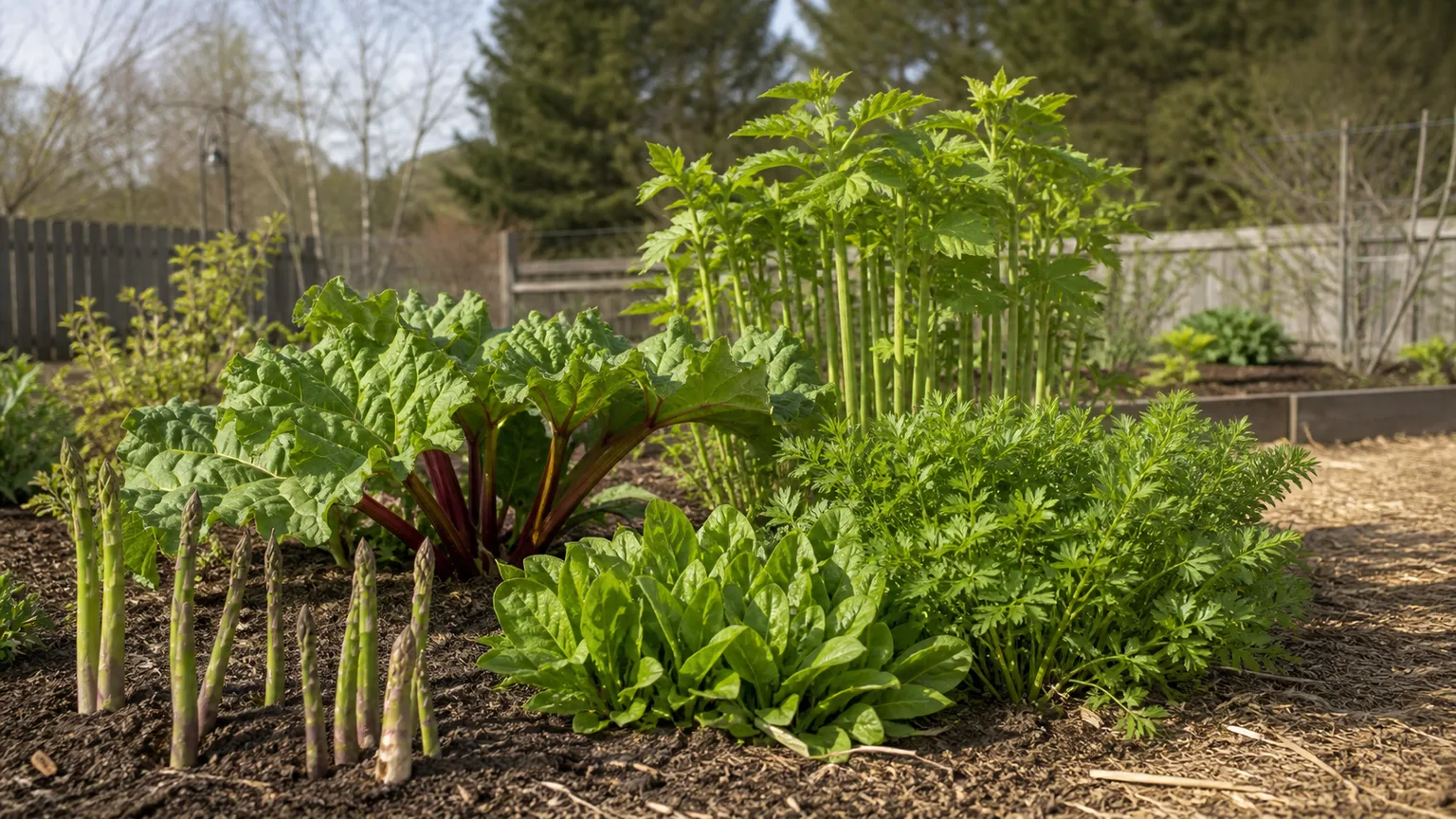
Rhubarb is ready when an established plant has firm, well-developed leaf stalks, usually around 10 to 15 inches long. The best stalk is still young enough to be tender, but the best time to harvest the plant also depends on its age, how many leaves you leave behind, and whether spring growth is slowing in your climate.
That distinction matters: a stalk can look large enough to pick while a newly planted crown is still too young to spare it. Use the cues below to choose the right stalk, harvest lightly, and give the crown the rest of the season to rebuild.
The quick answer: choose a young, full-size stalk
On a mature, healthy rhubarb plant, begin when the leaf stalks are roughly 10 to 15 inches long and firm, with leaves that have just opened. Pull a few of the largest outer stalks from the base with a gentle twist. Leave most of the stalks and their leaves in place, and stop taking a crop as summer heat slows new growth or the remaining stalks become thin.
The calendar is secondary. In many temperate gardens, harvest starts in spring and continues into early summer; a colder spring delays it, while an early warm spell may move the first pick forward. The Royal Horticultural Society describes spring and early summer as the usual picking season and recommends stopping in late June or early July, while Gardening Know How notes that timing shifts by climate. Use those dates as a general season, not a deadline for every garden.
For a quick check, ask three questions: Is the crown old and vigorous enough to spare stalks? Are the stalks full-sized for that cultivar, not merely red? Can you leave plenty of healthy foliage after picking? If any answer is no, wait or take less.
Let the plant establish before taking a crop
Rhubarb is a long-lived perennial, so the first harvest should not come at the expense of the crown that must support many future seasons. A newly planted division or crown needs its leaves to feed root and crown growth. Picking the first spring stalks may give you a small bowl of rhubarb now, but it can leave the young plant with less strength to establish.
For that reason, do not harvest during the first growing season after planting. Guidance differs slightly on the next step: the RHS recommends taking only a few stalks in the second year, while Utah State University Extension recommends waiting two years and beginning a short harvest in the third year. The conservative choice is best for a small, weak, recently divided, or seed-grown plant. If a vigorous crown has clearly established, a very light second-year pick may be reasonable; leave the bulk of its leaves.
Starting from seed takes longer than planting a crown or division, and seed-grown plants may not match the parent cultivar. Give them extra time and judge their vigor rather than assuming that a calendar year alone makes them harvest-ready. A strong mature plant can produce for years, but it needs enough leaf area after every harvest to replenish its underground reserves.
A practical harvest plan by plant age
| Plant stage | What to do |
|---|---|
| First growing season after planting | Do not pick stalks. Let the crown and roots establish. |
| Second growing season | Skip the harvest if the plant is small or weak. From a vigorous, established crown, take only a few outer stalks and leave most foliage. |
| Third year | Begin a short, light harvest if growth is strong. Utah State Extension suggests about three to four weeks in this year. |
| Mature, vigorous plant | Harvest selectively during the spring-to-early-summer window, taking no more than about one-third of the stalks at a time. |
The exact year a plant is ready depends on whether you planted a division, a dormant crown, a container-grown plant, or seed, as well as how well it has grown. When in doubt, protect the plant and wait one more season; an established crown will reward patience with a longer, more dependable picking window.
Judge stalk readiness by more than length
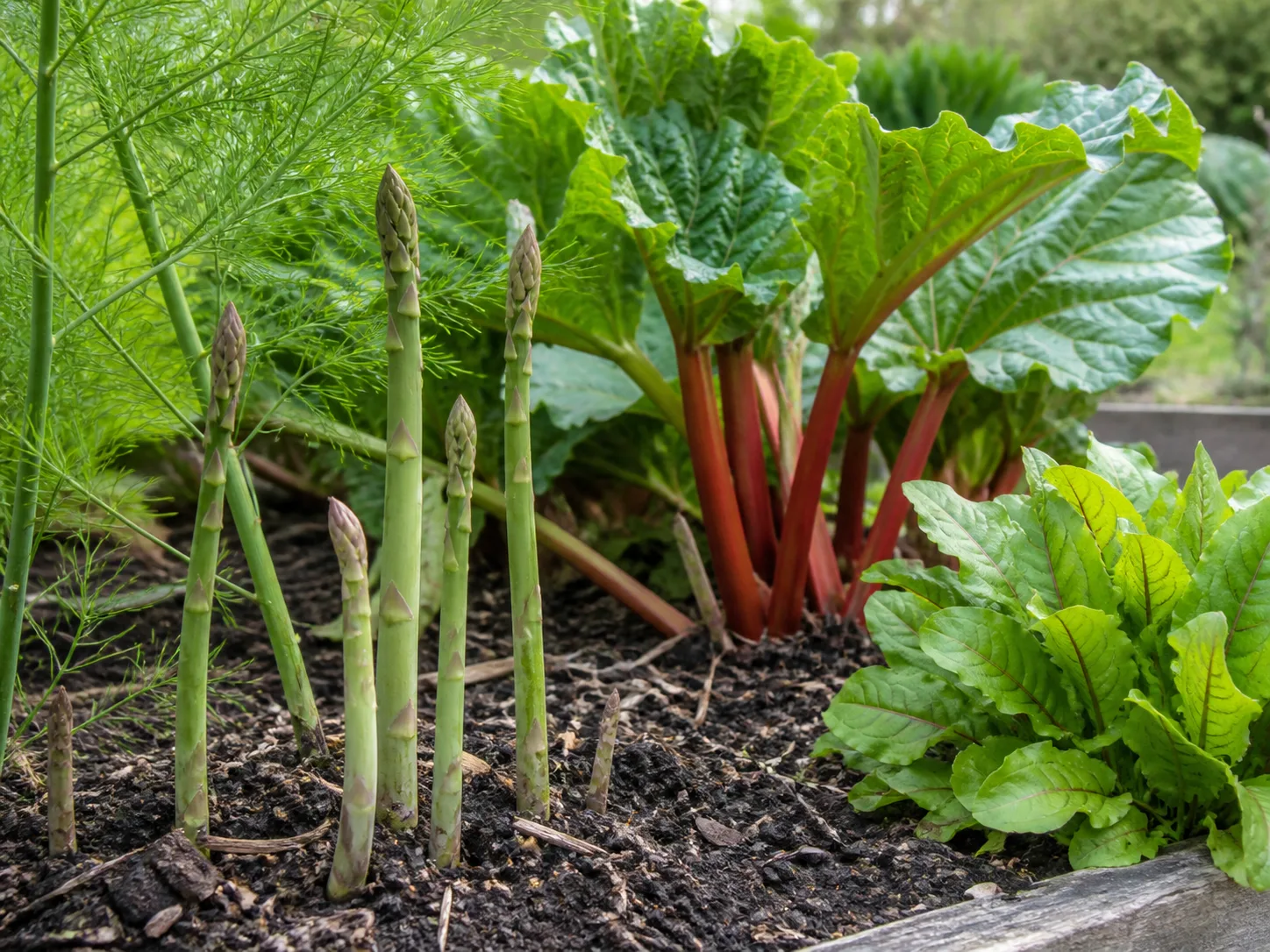
Measure a stalk from where it emerges at the crown to the base of the leaf. Around 10 inches is a useful lower threshold for many varieties; 12 to 15 inches is a common harvest size. Penn State Extension recommends waiting for stalks about 10 to 15 inches long, and Utah State gives a similar 10-to-15-inch range. A stalk that is still short and narrow should stay, even if it has a bright color.
Size is a guide, not a contest. Rhubarb varieties differ in stalk length, thickness, and color, and a plant’s growth depends on its age, water, soil, and weather. Look for a stalk that is firm and upright rather than limp, and whose leaf has recently opened. Stalks that have been left growing for a long time may become more fibrous; you do not need to wait until every stalk reaches the maximum size you have seen in a photograph.
Pick only what you can use or preserve while fresh. If you need a large recipe quantity, collect the harvest in small rounds over several days rather than stripping the whole plant in one visit. That gives the remaining leaves time to keep working and lets you reassess the plant as you go.
Why red color is a poor ripeness test
Rhubarb’s stalk color is mainly a cultivar trait. Some varieties stay green when mature; others turn pink or deep red. The Penn State Extension guide notes that cultivar color varies and does not reliably predict flavor, and Utah State Extension likewise says stalk color ranges by variety. Do not wait for a green cultivar to turn red, or assume a red stalk is ready just because it looks vivid.
Flavor also varies with variety and stalk age. Redder is not automatically sweeter, and green is not automatically sour or immature. If you do not know the cultivar, use the stalk’s length and firmness, the plant’s age, and the state of the rest of the crown. If the stalk is full-sized and crisp and the plant has plenty of foliage, color should not decide the harvest.
A useful first-year observation is to label or photograph the plant when you see its first stalks. Over a season, you will learn the normal size and color of its mature petioles, making next year’s selection easier. That record is more useful than comparing an unfamiliar variety with a red-stalked image online.
Use the season as a guide, not a deadline
Rhubarb emerges as the ground warms in spring, but the local start date varies with winter cold, elevation, latitude, and the variety. In many temperate North American gardens, the first harvest falls in April or May; colder areas may begin later and continue later into early summer. A patch in a mild spring can be ready sooner. The dates are broad patterns, not a reason to force an unready plant.
Watch the plant’s pace. Early in the season, new stalks push up and expand quickly. As warmer weather arrives, growth often slows; high heat and dry soil can make that slowdown happen earlier. When new stalks stop replacing the ones you remove, or the remaining stalks are noticeably thinner, the crown is telling you to leave its leaves in place. Penn State Extension describes rhubarb as a cool-season crop that naturally slows in summer heat, while the RHS harvest guidance gives late June or early July as a common stopping point in its growing context.
In a hot-summer region, stop earlier if the plant slows or wilts despite adequate moisture. In a cool region where stalks remain strong, you may have a longer window, but do not keep picking simply because the calendar says summer harvest is possible. Leave enough healthy leaves for the whole warm season so the crown can store energy for next spring.
Take a sustainable amount from each crown
For an established plant, a conservative rule is to remove no more than about one-third of its stalks at a time. The RHS recommends taking roughly a third, and Utah State Extension says to leave a third of the stalks at any given time. Penn State Extension advises taking no more than half the plant at once. For an unknown or less vigorous plant, use the more cautious one-third limit and leave a broad fan of leaves.
This is not just about how many stalks remain. Every harvested stalk takes its leaf with it, reducing the plant’s working foliage. The leaves capture sunlight that supports the crown and roots; removing too many at once makes it harder for the plant to recover. Take the largest mature outer stalks first, and leave young central growth and plenty of healthy leaves. Avoid a neat, bare center or a harvest that leaves only a few leaves standing.
A single stalk from a small plant may already be a substantial share of its growth. Do not apply a percentage mechanically if the crown has only a handful of stems. If the plant is newly divided, drought-stressed, crowded, or producing thin growth, take nothing or very little and focus on aftercare. A smaller harvest from a vigorous crown is usually a better long-term choice than a heavy one-year yield followed by weak regrowth.
How to pull rhubarb without damaging the crown
Harvest one stalk at a time. Reach low to where the stalk meets the crown, hold it firmly, and pull it outward with a slight downward twist. It should release from the base. Do not jerk upward hard enough to lift the crown, and do not cut the stalk off at soil level. Penn State Extension, Utah State University Extension, and the RHS all describe pulling or gently twisting stalks rather than leaving a cut stump at the crown.
If a stalk resists, stop and reposition your grip lower rather than tearing it loose. A clean, complete pull is easier on the plant than snapping a stalk partway up. Do not dig around the base with a knife or pry against neighboring stalks. The goal is to detach one outer petiole while keeping the crown and its growing points undisturbed.
Keep a clean basket or tub nearby so stalks are not crushed under a heavy pile. Pick during dry weather if convenient; wet stalks are not a problem for the plant, but dry harvests are simpler to sort and store. As you work, pause after a few stalks and check the remaining foliage. That check prevents an enthusiastic first pass from turning into an accidental full harvest.
Remove leaves right away
The edible part is the leaf stalk, not the broad leaf blade. Trim the leaf off as soon as the stalk is harvested, either in the garden or when you bring the basket inside. The leaves contain high levels of oxalic acid and should not be eaten; Utah State University Extension and Penn State Extension both advise discarding them. Keep the leaves out of reach of children and pets, and do not use them as animal feed.
You can compost rhubarb leaves in a managed home compost pile. Utah State Extension notes that leaves can go into compost, and the RHS also recommends composting them. If you prefer not to compost them, bag and discard them according to local yard-waste rules. Wash the stalks under cool running water before cutting or cooking, and remove any damaged or soft sections.
When to stop harvesting for the season
Stop while the plant still looks capable of producing more. Leaving healthy stalks and leaves in place after the spring crop gives the crown time to rebuild reserves for the next year. Rhubarb may continue to send up a few stalks after the main harvest window, especially where summers are mild, but that does not mean every new stalk should be picked. The aim is a sustainable perennial crop, not the largest possible haul in one season.
Late June or early July is a common stopping window in temperate gardens, but respond to your garden’s conditions. Stop earlier if temperatures have risen, growth has slowed, or the stalks are thinning. A plant in a cool, moist site may stay vigorous longer than one in a dry, exposed bed. Even in a mild season, do not keep taking stalks right through summer without checking whether the crown is replacing them.
After the final pick, keep the plant in leaf. Water deeply during prolonged dry spells, remove weeds competing around the crown, and maintain a mulch that conserves moisture without covering the crown itself. Do not keep removing leaves to tidy the plant while it is actively growing; those leaves are the plant’s way to replenish the roots.
Thin stalks and slowed growth are stop signs
The clearest stop signal is a change in the crop: stalks that emerge much thinner than earlier ones, fewer new stalks, or slower expansion. A regional garden column by J.J. Barrett describes slender stalks as a sign that the plant’s reserves are running low; extension guidance similarly ties thin stalks to plant age, stress, or overharvesting. Treat the cue as a reason to stop picking and leave the rest of the season’s foliage intact.
Thin stalks do not always mean the crown is exhausted for good. Plants can produce small stalks because they are young, crowded, short of water, or growing in poor conditions. Do not try to fix a weak patch by harvesting more small stalks. Let it grow, water during dry weather, and evaluate the plant after it has had a full recovery season. If a mature clump remains weak over multiple years, crowding or crown health may need attention.
Flower stalks need removal, not panic
Rhubarb sometimes sends up a thicker, upright flower stalk. Remove it at the base as soon as you notice it, using a clean knife or shears if pulling would disturb the crown. Flowering can draw resources away from leaf-stalk growth, so removing the flower stem helps keep the plant focused on vegetative growth. The RHS recommends removing flower stems promptly.
A flower stalk is not by itself a precise calendar for the last harvest. Check the remaining petioles and the plant’s overall vigor. If the rest of the stalks are still robust and the season is early, a modest harvest may still be reasonable on a mature crown. If flowering coincides with heat, thin stalks, or a slowdown in new growth, stop harvesting and let the plant recover. Older or crowded plants may flower more often, so recurrent flowering can be a cue to review division and general crown health during the dormant season.
Troubleshoot disappointing stalks before next year
Thin, short, or stringy stalks are usually a plant-health signal, not a reason to take more stalks in hopes that the next ones will be better. First consider age: a new crown is not expected to produce a full harvest, and seed-grown plants can take longer to establish. Next check water. Rhubarb needs consistent moisture while it is actively growing; prolonged dryness can slow stalk development, especially in a sunny or container planting. Water the root zone deeply during dry spells rather than giving frequent, shallow sprinkles.
Then consider crowding and drainage. An old clump can become crowded and less productive; the RHS recommends dividing large clumps as they become overcrowded or weaker. Wet, poorly drained soil can also damage the crown. If stalk bases are soft, mushy, or collapsing, do not harvest them for food. Remove damaged material and check whether water is pooling around the plant. Improve drainage or seek local extension advice if rot-like symptoms continue.
Finally, review the amount harvested last year. A plant stripped too heavily may need a season with no picking to rebuild. For a mature, healthy clump with persistent weak growth, plan to divide it during dormancy according to local guidance rather than repeatedly feeding or harvesting it harder. These checks help distinguish a normal end-of-season slowdown from a longer-term problem that deserves attention.
Store rhubarb while it is crisp
Trim away the leaves first; leaving them attached pulls moisture from the stalks and makes them soften more quickly. Store fresh stalks unwashed in a loosely closed or perforated plastic bag in the refrigerator crisper. Penn State Extension gives about two weeks as a refrigerator-storage window, while Utah State University Extension reports two to four weeks. For the best texture, plan to use them within about two weeks and check for soft spots before cooking.
If you are not using the stalks soon, freeze them. Wash, dry, trim, and cut into the size you expect to use; freeze in a labeled container or bag. Freezing is a practical way to keep a modest harvest without taking extra stalks from the plant. Do not pick more just because you have freezer space: the crown still needs foliage through summer.
Can you force rhubarb for an earlier harvest?
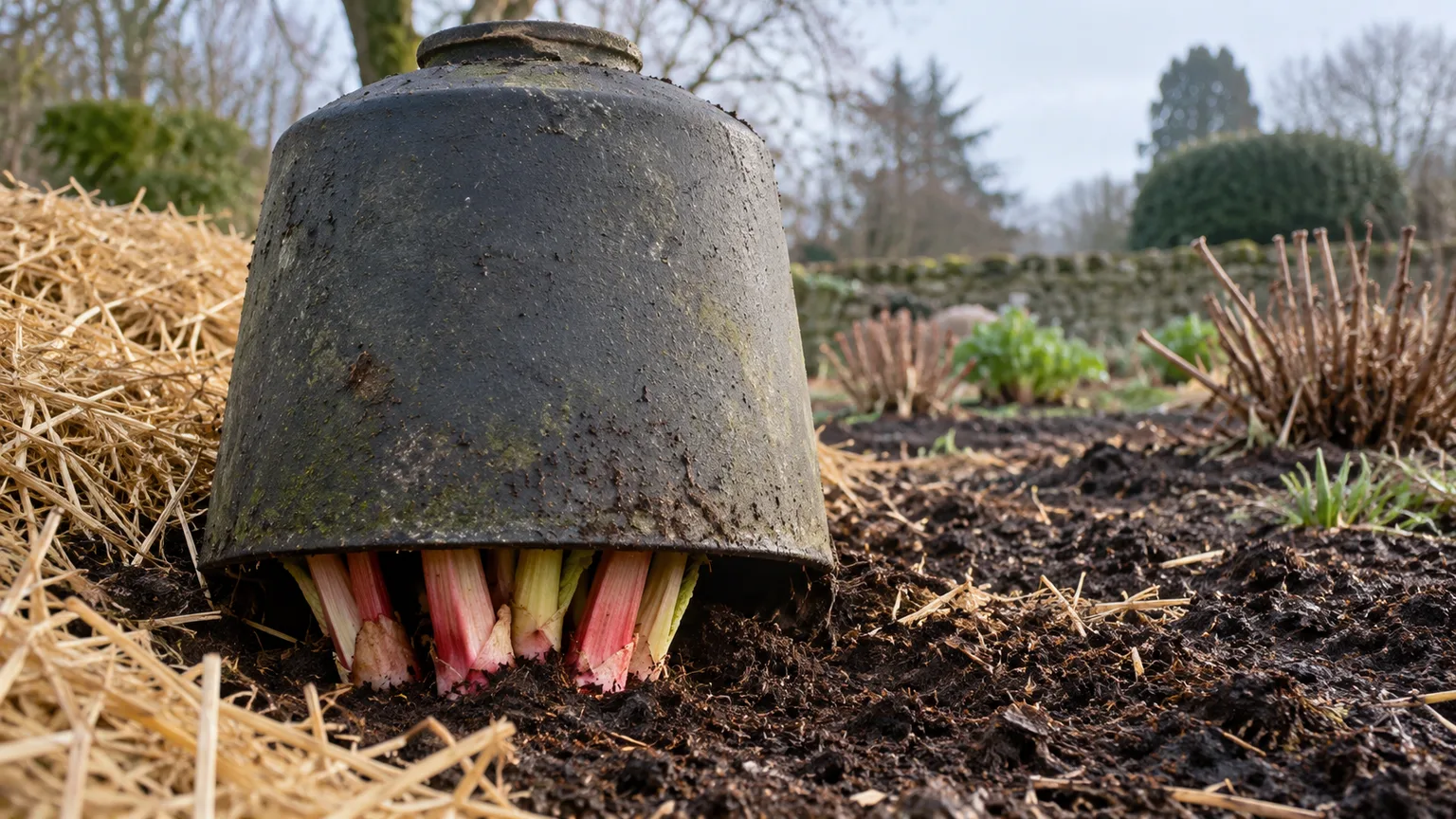
Forcing means covering a strong, established crown in winter so new stalks grow with little or no light. The stems emerge pale and are often more tender and sweet. It can provide an earlier crop, but it is not a shortcut for a young or weak plant. The RHS forcing guidance recommends using a vigorous plant and notes that stalks may be ready about four to eight weeks after covering.
For a home garden, place an opaque forcing jar or a tall, light-blocking container over one mature crown in winter, then check regularly once growth starts. Harvest the forced stalks when they are around a foot long. After that first flush, remove the cover so the crown can resume normal growth. Do not harvest more stalks from that plant that year, and avoid forcing the same plant in consecutive years; forcing draws on stored reserves and needs a recovery season.
You can get a reliable spring crop without forcing. If your priority is a healthy patch and a steady harvest in future years, leave the crown uncovered, wait for naturally grown stalks to reach picking size, and stop as the season slows.
Conclusion
Harvest rhubarb when a mature, healthy plant has firm stalks around 10 to 15 inches long, usually in spring or early summer. Let stalk size and plant vigor guide you; red color alone cannot tell you whether a stalk is ripe. Leave a new plant alone in its first season, pick sparingly in the second only if it is strong, and take no more than about one-third of a vigorous crown at a time.
Pull stalks low with a gentle twist, remove the leaves immediately, and stop when stalks thin or growth slows. That approach gives you tender stalks for the kitchen while preserving the leaves and crown that power next year’s harvest.