Why Ants Have Wings Only at Certain Times of Year
Winged ants are reproductive adults, not a separate species. See why they emerge seasonally, what happens after mating, and how to distinguish them from termites.
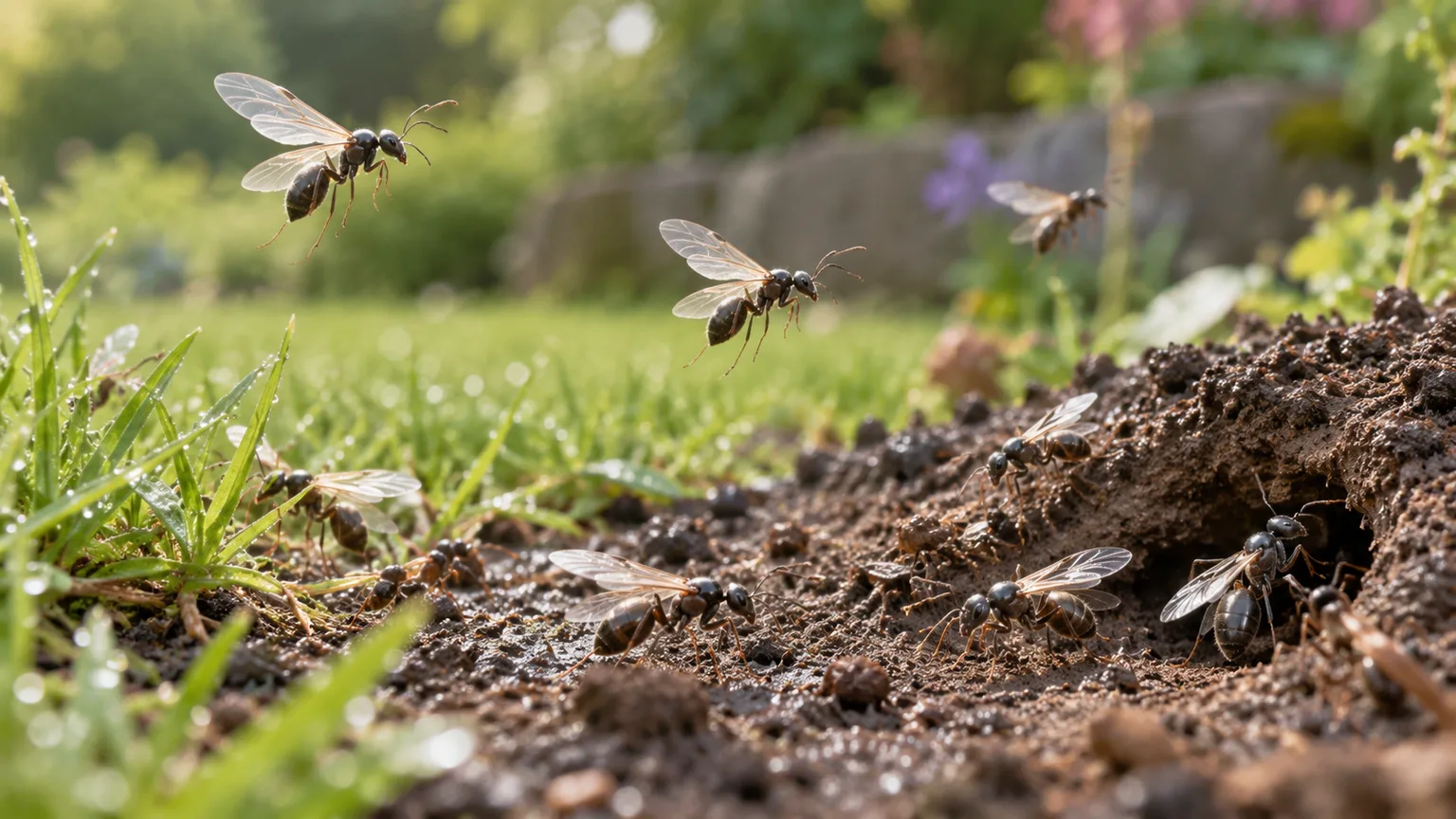
Ants do not grow wings whenever the weather turns warm. In most familiar species, a colony produces winged adults only when it is ready to reproduce: young queens and males leave the nest on a mating flight, then the queens shed their wings and try to start colonies of their own. The workers you see carrying food along a patio or kitchen counter stay wingless.
That is why winged ants arrive in sudden, seasonal bursts instead of flying around all year. The exact window depends on ant species, colony maturity, location, and local weather, so a warm afternoon after rain can be a clue without being a dependable calendar. A swarm outdoors is usually a brief reproductive event; a repeated emergence from inside a wall or window frame deserves a closer look and a species identification.
Short answer: wings belong to the reproductive stage
Winged ants are reproductive adults, often called alates or swarmers. A colony raises these males and future queens as part of its life cycle; when the adults are ready and conditions suit the species, they leave the nest to find mates. The flight moves reproductive ants away from their birth colony and gives new queens a chance to establish nests elsewhere.
Queens and males fly; workers do not
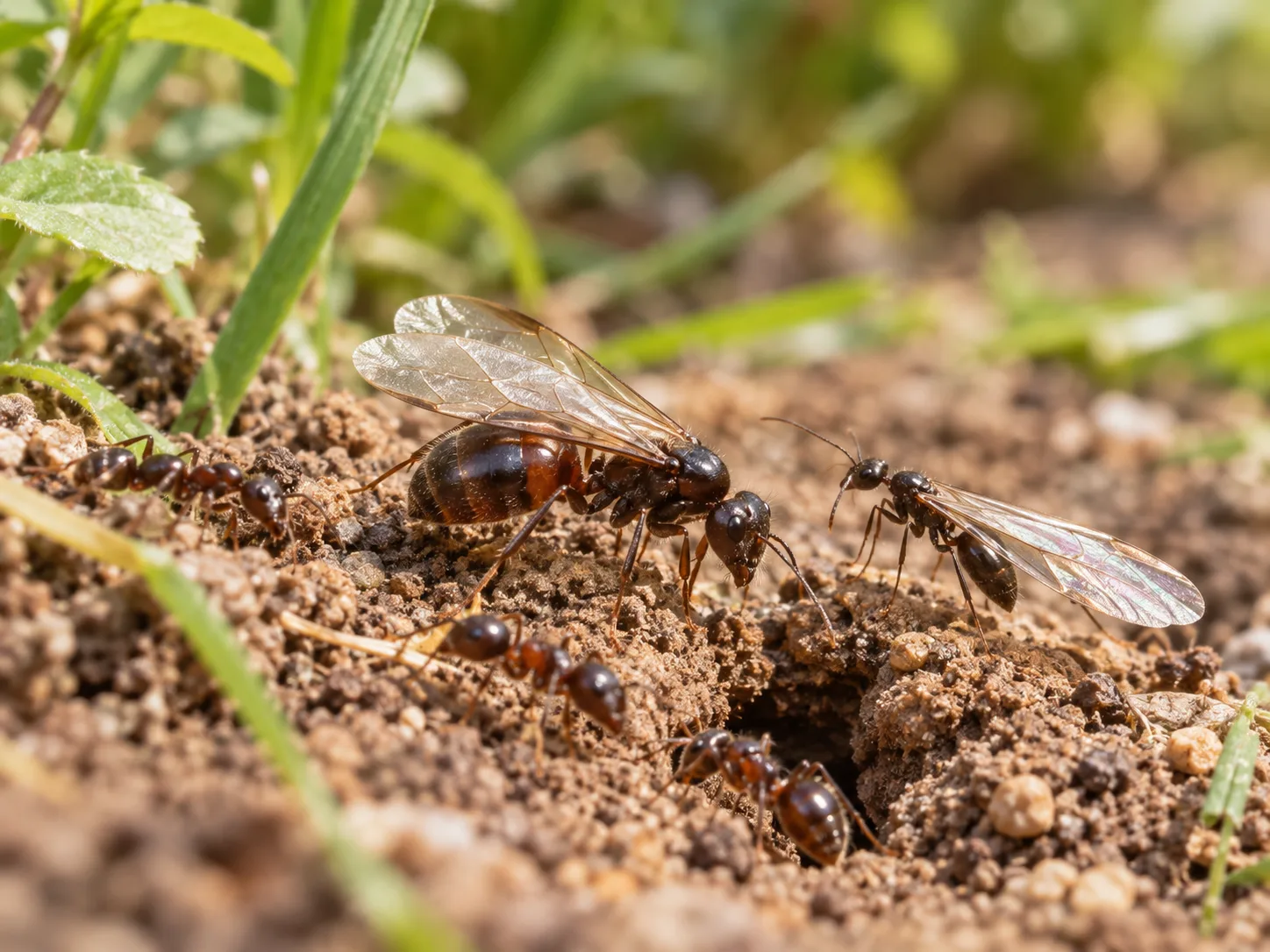
The winged ants in a swarm are not workers that suddenly sprouted wings. They are a distinct reproductive caste: males and virgin queens, sometimes called princesses before they mate. Queens are often larger, with a thicker middle section that anchors flight muscles and a more substantial abdomen; males are usually smaller and more slender, although size varies by species.
Workers are female ants that perform the colony’s everyday jobs, such as foraging and brood care. They do not become winged swarmers just because the colony is old or the weather is warm.
The Natural History Museum explains that, in black garden ants, a queen begins producing virgin queens and males when the colony is ready; most eggs still develop into workers. This distinction is more useful than trying to judge a swarm by its color or by whether it looks unusually large. (Natural History Museum)
A winged ant is a life stage, not a separate species
“Flying ant” describes what the ant is doing and which caste it belongs to, not a single species. Carpenter ants, pavement ants, and many other kinds can produce winged reproductives, so the label alone cannot tell you what is in your yard. The nuptial flight is a common reproductive strategy, but it is not identical in every ant lineage; the museum notes that it is important to most, not all, ant species.
That variation explains why advice tied to one species can fail elsewhere. Some ants release alates in a coordinated flight; others disperse differently, and even related species may prefer different times of day. A winged ant seen in July in one region does not establish that the same species, or the same flight schedule, occurs in another.
Why wings appear only in a seasonal window
Two conditions have to line up: the colony must have invested in reproductive brood, and the adults must have a suitable chance to leave, meet mates, and survive. Ants spend most of their time as workers inside or around a nest. A flying reproductive is a temporary part of the cycle, so there may be no visible swarm until a colony has produced mature alates and its species-specific flight cues arrive.
A colony must raise reproductive ants first
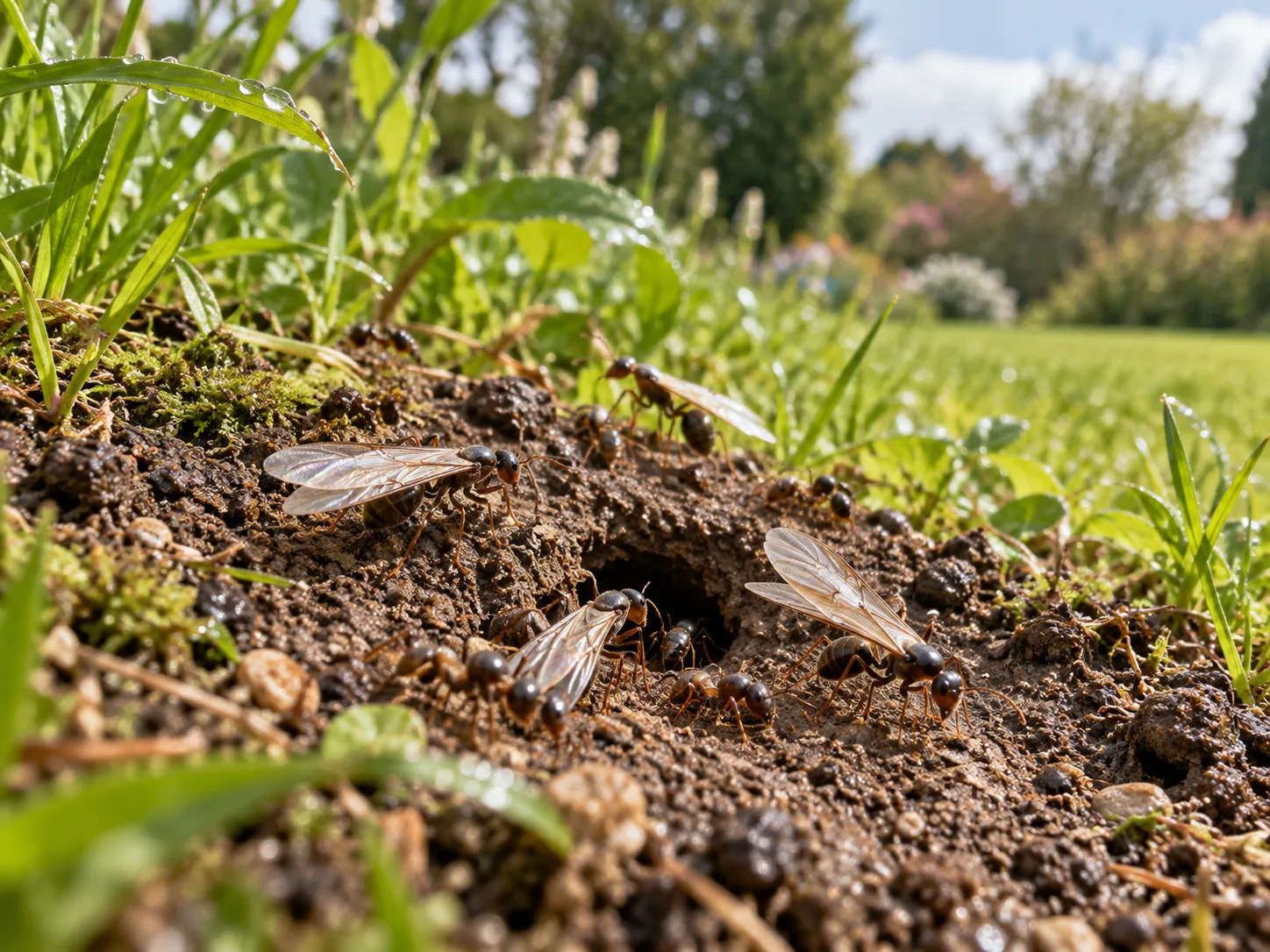
Producing queens and males takes resources. A colony does not release winged ants every time a warm day occurs; it first needs to reach the stage at which it can raise reproductives.
The Natural History Museum describes this as a shift in the queen’s egg production once a black garden ant colony is ready to reproduce. In carpenter ants, the University of California Statewide Integrated Pest Management Program likewise describes winged reproductives leaving on mating flights and notes that a young colony may take several years to mature enough to produce another generation of swarmers.
The alates develop inside the colony before anyone sees them in the air. Weather helps set the departure time, but it does not create wings overnight or turn ordinary workers into queens. This is also why an outdoor swarm is not proof that every nest in the neighborhood is new: the source colony may have been established for years before it produced visible reproductives. (UC Statewide IPM Program)
Weather opens a short flight window
Temperature and wind can make the difference between staying in the nest and taking flight. Warm, humid, relatively calm conditions are often associated with nuptial flights, and showers may come shortly before a visible swarm. But “after rain” is not a rule that applies to every species: rain can coincide with the broader weather change, while strong wind or poor temperatures can still make flying unfavorable.
The University of Gloucestershire’s peer-reviewed study of ant mating flights found that local temperature and wind speed helped predict when people observed winged ants in the United Kingdom. It also found that conditions changing from the previous day mattered, suggesting that the direction of the weather shift can help explain why a flight happens on one day and not the next. The authors’ result is a pattern from a particular species and region, not a temperature-and-rain formula for all ants. (University of Gloucestershire Research Repository, Ecography study)
The species can change the hour as well as the month. UC IPM reports that the western carpenter ant Camponotus modoc may swarm in late afternoon, often after heavy rainfall. That is a useful California example, not a schedule to apply to every carpenter ant or household. (UC Statewide IPM Program)
Why swarms appear on particular days
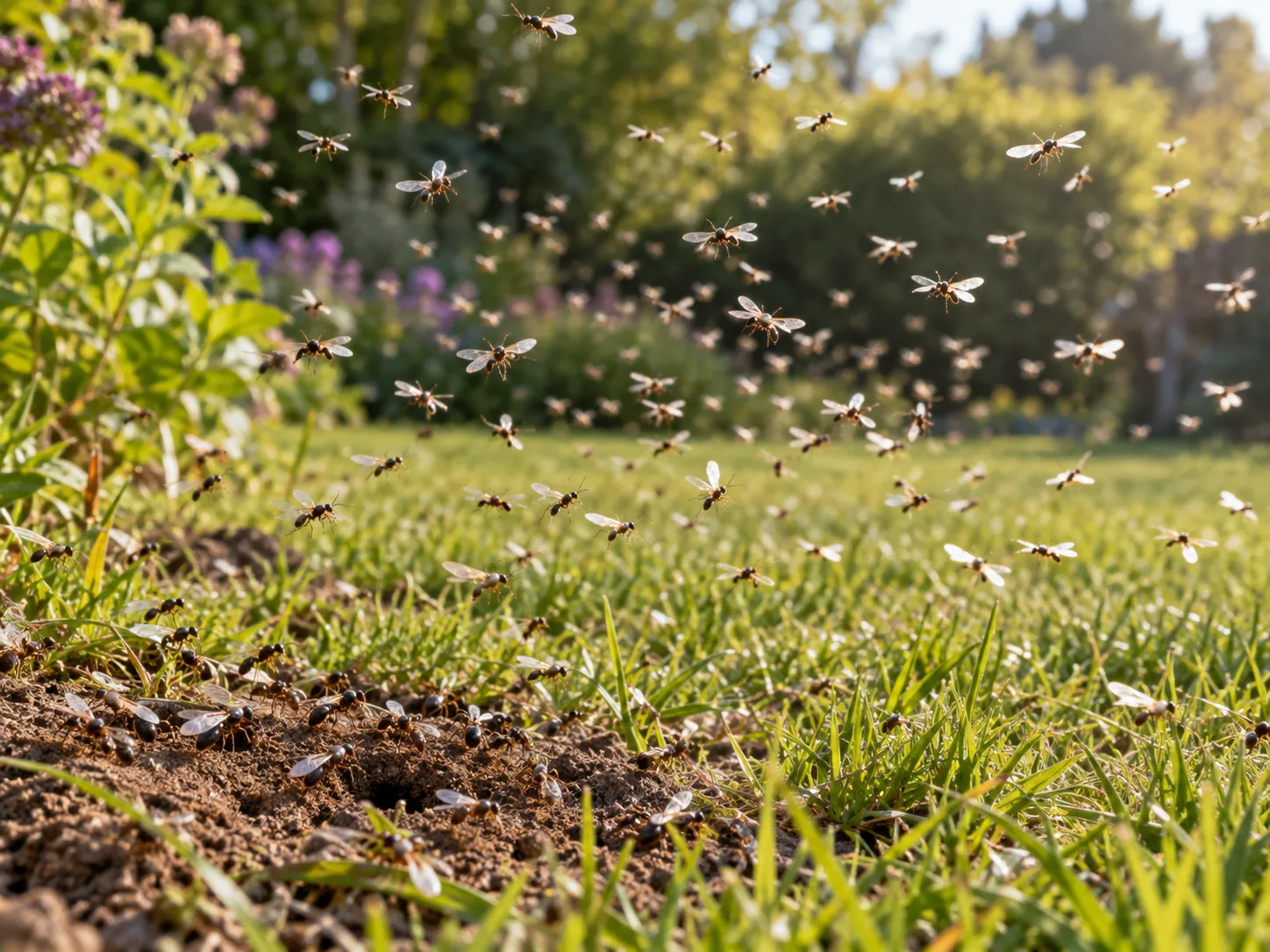
When the timing is right, many alates may emerge from nearby nests within a short period. A cluster is easier to notice than one queen walking along a wall, and a sudden change from no flying ants to hundreds can make the event feel like a one-day invasion. The burst is a visible peak in a longer reproductive season, not evidence that every ant colony in the area synchronized perfectly.
There is a flying-ant season, not one universal day
The familiar idea of a single “flying ant day” is too simple. Natural History Museum coverage explains that UK sightings can run from June into early September, with several short peaks over several weeks and timing that shifts between years. Local weather and the ant species matter more than a date printed on a calendar. (Natural History Museum)
The same limit applies across continents. In colder temperate climates, many noticeable flights occur during warmer months; in warmer regions the season may begin earlier or extend longer, and some species fly at dusk or at other species-specific times. A homeowner who remembers a swarm in late summer should treat that memory as a local observation, not a promise that it will recur on the same weekend.
What a three-year UK study found
Researchers Adam Hart, Thomas Hesselberg, Rebecca Nesbit, and Anne Goodenough analyzed more than 13,000 public observations across the United Kingdom over three years. In that dataset, 88.5 percent of the winged ants sampled were black garden ants, Lasius niger; reports ran from June through September, and 97 percent fell in July and August. Those figures describe that UK survey, not the percentage or timing of flying ants in a North American yard. (University of Gloucestershire Research Repository, Ecography study)
The study’s most useful lesson is not the month range but the variation within it. The researchers found that exact timing differed substantially by year, and observations were less spatially synchronized than people often assume. They also found that nests in urban areas and near heat-retaining structures produced winged ants earlier than rural nests, a reminder that a sunny pavement edge and a shaded field may not share the same schedule.
Smithsonian Magazine’s reporting on a 2019 UK swarm described how a dense flight appeared on weather radar even though meteorologists knew it was not rain. The spectacle made the seasonal event newsworthy, but it did not mean every ant flew at once or that the population had suddenly exploded. The underlying research offers a better expectation: watch for local peaks, not one national alarm bell. (Smithsonian Magazine)
What happens to queens and males after the flight
During a nuptial flight, winged males and virgin queens leave their nests, encounter potential mates, and disperse. Flying helps a future queen get beyond her birth nest to find a separate place to start a colony; mixing reproductives from different nests can reduce close inbreeding. Large numbers also improve the odds that some ants will find mates despite predators and the many other hazards of flight.
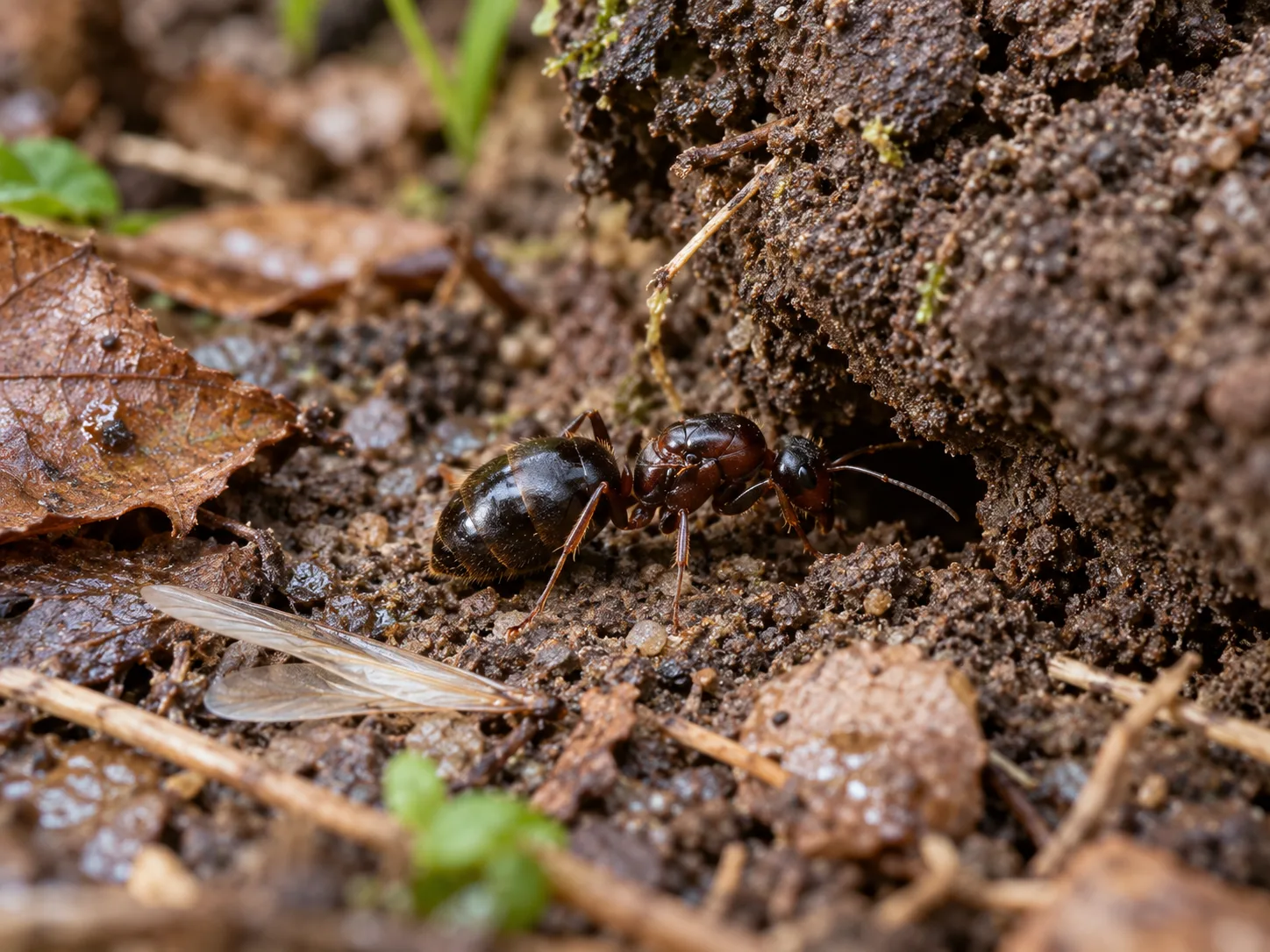
After mating, males have finished their short reproductive role and usually die soon afterward. A mated queen lands, sheds or chews off her wings, and searches for a protected place to begin a nest.
In species whose queens store sperm, sperm from the flight can fertilize eggs over the queen’s later reproductive life; she does not need to keep flying out to mate each season. The Natural History Museum describes a black garden ant queen sealing herself into an underground chamber and raising her first worker brood before those daughters can forage.
That post-flight period explains why you may see wingless, larger ants crawling on pavement after a swarm. Some are new queens searching for a nesting site. A queen without wings can be a clue that mating occurred, but it is not enough to identify her species or prove that a new colony has succeeded; many queens fail to establish a nest.
How to tell winged ants from termites
Winged ants and termite swarmers can emerge in similar seasons and collect near lights, windows, or doors. Their presence calls for identification before you decide what it means, especially indoors, because carpenter ants can nest in wood while termites consume wood as food. UC IPM notes that homeowners often confuse carpenter ant reproductives with termites and recommends using several body features together rather than relying on one impression. (UC Statewide IPM Program)
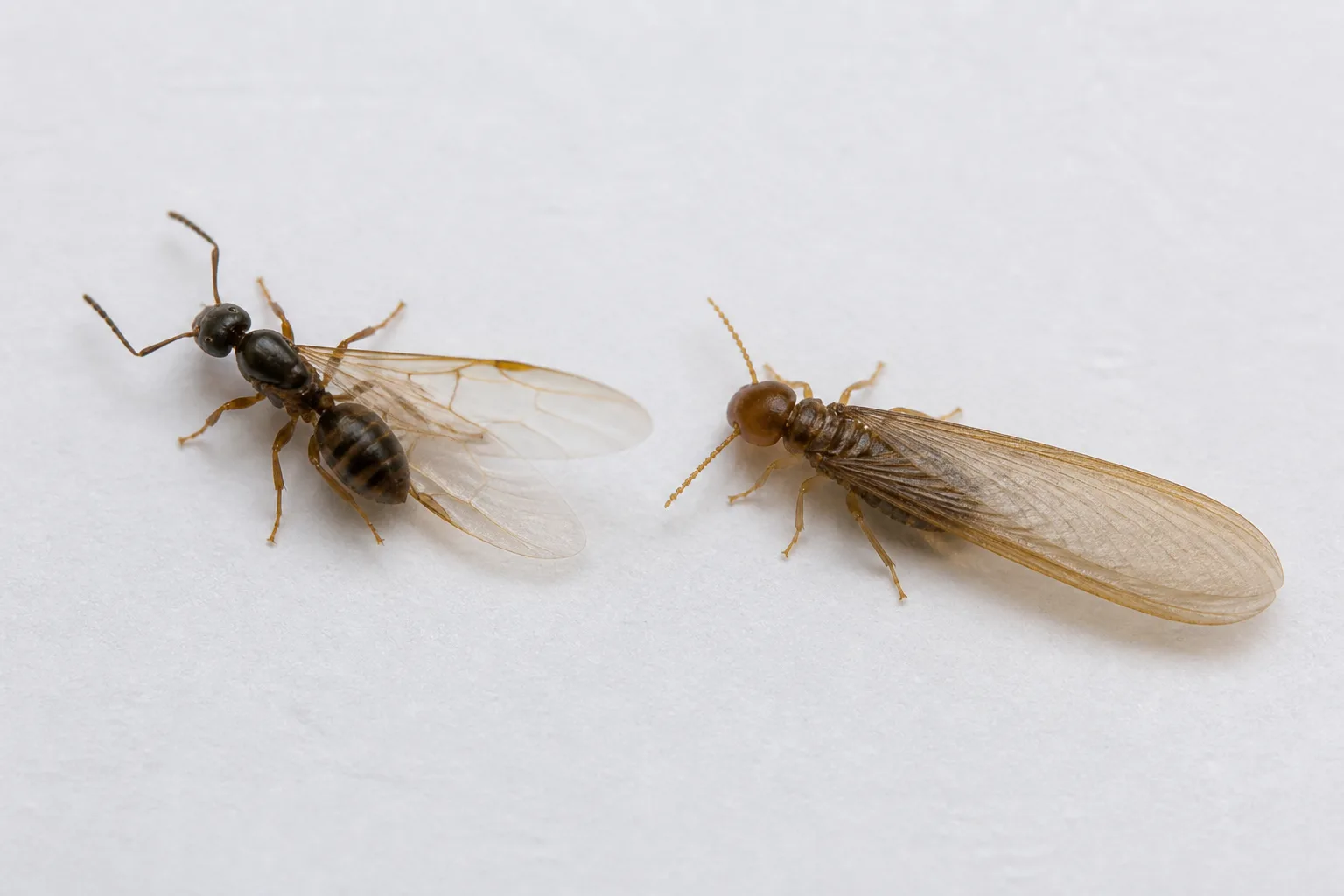
Compare the waist, antennae, and wing pairs
Look at the body outline and antennae if you can do so without handling the insect. Ants have a visibly pinched waist and elbowed antennae; termite swarmers have a thicker, straighter-sided body and straight antennae. Ants’ front wings are longer than their hind wings, while termite wings are more alike in length, a distinction also summarized in Family Handyman’s identification guide. (Family Handyman)
Use the whole pattern: waist, antennae, and wing proportions. A blurry phone photo, a dead insect missing its wings, or a pile of shed wings may not preserve enough detail for a reliable identification. If you find many insects emerging indoors, save an intact specimen or take close photos from the side and above, and record the room and exact point where they first appeared.
What a swarm means for a garden or yard
An outdoor swarm usually means that reproductive ants are dispersing, not that they are attacking people, pets, or plants. The ants are focused on the flight and mating; in most ordinary yard situations, the simplest response is to let the short event pass. If the swarm is over a path or play area, move people around it for a while rather than trying to swat individual fliers.
That does not mean every ant species is harmless. Some ants bite, and fire ants can sting; the species and location matter more than the fact that it has wings.
Avoid walking through an unidentified mass, and use particular caution where stinging ants are established in your region. Family Handyman makes a similar practical point for homeowners: a flying ant’s risk follows the species’ behavior on the ground, so a swarm should not be treated as a uniform “safe” or “dangerous” category. (Family Handyman)
Do not assume a short-lived swarm requires a yard-wide insecticide treatment. Treating visible fliers does not answer where the source colony is or whether there is a problem worth controlling. For carpenter ants, UC IPM advises looking at the larger evidence: their nesting behavior, trails, and possible damage, rather than treating every winged ant as proof that sound structural wood is being excavated.
When winged ants indoors need a closer look
A few winged ants near an open door or window may have flown in from outside. A repeated group emerging from one crack, ceiling, wall, or window frame is different evidence: it raises the possibility that a reproductive colony is inside the building or that insects are entering through a nearby gap. The location where they first appear is more informative than the windowsill where they later collect toward light.
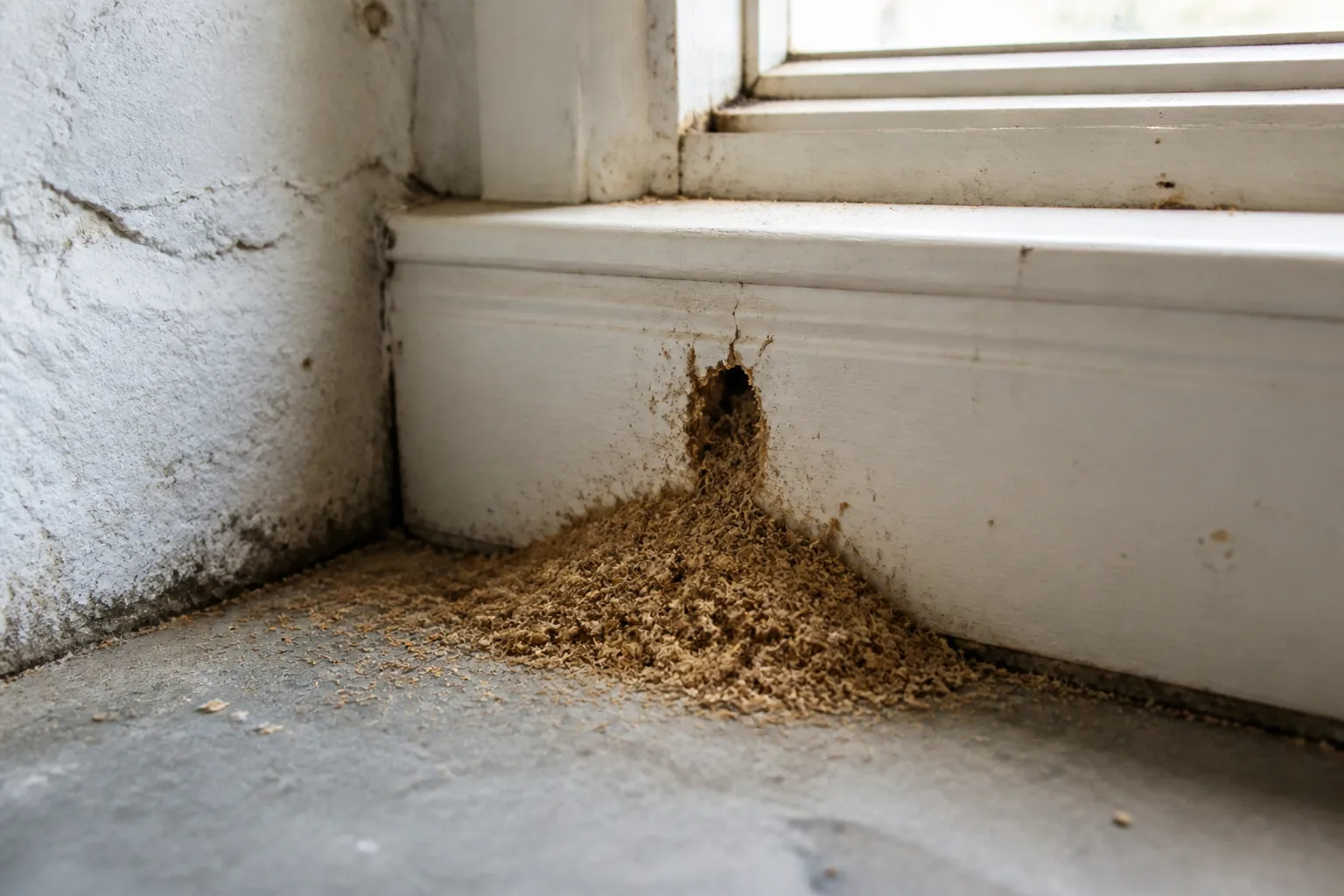
A stray at a window and an indoor emergence are different evidence
Count what you see, note whether they return, and watch the apparent source before cleaning up. One or two insects found by a window do not diagnose an infestation; a concentrated emergence that recurs in the same room, especially alongside worker trails or coarse wood debris, is a reason to identify the ants and inspect further. Carpenter ants excavate galleries rather than eating wood, and UC IPM notes that their nest sites are often associated with wood decay or moisture problems, although ant evidence alone does not prove that a beam is structurally damaged. (UC Statewide IPM Program)
Do not identify an indoor swarm from size or color alone. A clear specimen or photograph can help a local extension service or pest professional compare antennae, waist, and wings; the same description can be shared with a licensed pest-management professional if activity repeats. Correcting a leak or replacing decayed wood may matter if moisture is involved, but first determine what insect is present and where it is emerging.
A practical response by location
If the swarm is outside, note the date, weather, and exact spot, then give it space and let the event finish. If ants are around a doorway, temporarily close or screen the opening and avoid disturbing an active nest. A swarm’s duration varies by species and weather, so a few quiet minutes do not guarantee there will be no further flight that day.
If you find one or two indoors, remove them with a cup or vacuum if needed, check screens and doors, and watch for a repeat. Keep the specimen if you want an identification; include your region, the room, the number of insects, and whether you saw them enter from outside or emerge from a surface. This makes the question easier to answer than “there were ants near a window.”
If many ants repeatedly emerge from one indoor location, photograph and save a specimen, record the point of emergence, and look for other evidence without opening walls or spraying randomly. Ask a local extension office or pest professional to identify the species and assess whether carpenter-ant nesting or another issue is present. A swarm can be a useful clue, but it cannot tell you by itself where a nest is, what damage exists, or which treatment would be appropriate.
Conclusion
Ants have wings only during a reproductive stage because wings help queens and males leave a mature colony, meet mates, and disperse. The colony produces those adults when it is ready, and weather then helps determine the brief window when they fly; species, location, temperature, wind, and seasonal conditions all affect the timing.
So an ant swarm is not a fixed annual appointment and does not automatically mean a home is infested. Let an outdoor flight pass, identify the insect before acting, and investigate repeated indoor emergence or carpenter-ant evidence. That simple sequence turns a startling burst of insects into a much clearer observation of what is happening around your home.