Prune in Late Winter for Stronger Spring Growth
Why prune in winter? Dormant cuts heal fast, pests are low, and you can see branch structure. Get a late-winter pruning plan for your yard.
Late winter pruning is the sweet-spot window when deciduous trees and many shrubs are still dormant but spring is close enough that cuts heal quickly and new growth follows your plan. You are not chasing a calendar date on social media—you are matching plant biology to your local weather. Done well, one dry afternoon in February or March can replace a month of corrective trimming once leaves return and every problem branch hides in green foliage.
The job is not “cut everything because it is winter.” It is direct stored energy into the branches you want, remove what will cause trouble later, and finish before buds swell so the plant wakes up with a cleaner framework. If you can read branch structure without leaves and you expect several days of moderate weather ahead, you are in the right season.
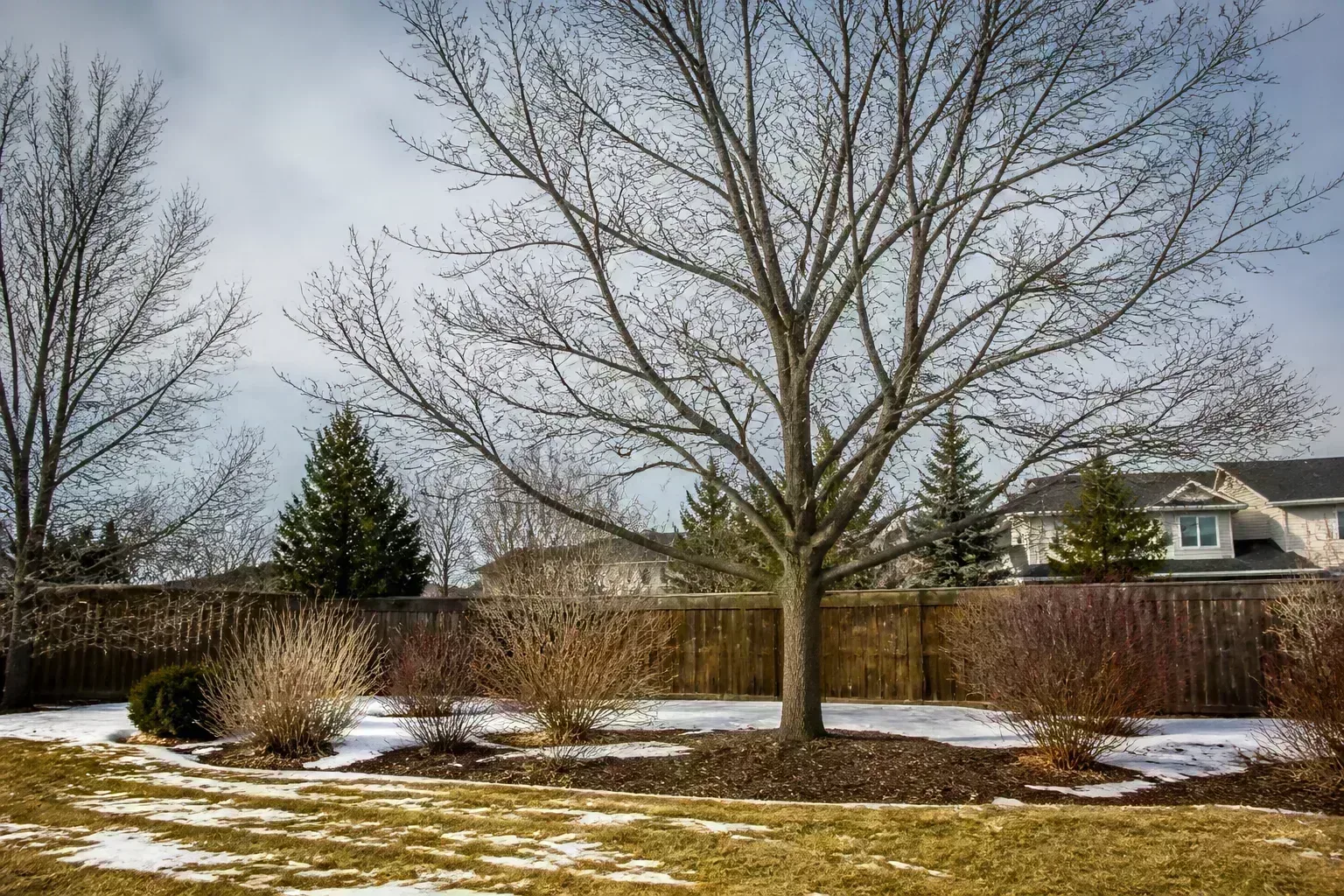
Late winter is when bare branches reveal structure you cannot see once leaves return. Finish structural cuts while the plant is still dormant but hard freezes are easing.
The quick answer: prune dormant plants just before buds swell
Prune most deciduous trees and summer-flowering shrubs after the coldest winter weather has passed but before new leaves or flowers emerge. In many U.S. regions that means roughly late February through early March; in mild coastal zones it may start earlier, and in cold northern zones it may run into mid-March. The plant cue matters more than the month: look for swollen buds or the first hint of green at nodes, and finish structural work before growth takes off.
Start every session with dead, damaged, diseased, and dangerous wood—often that is enough. Cosmetic shaping and renewal cuts come second. Hold major work on spring-blooming shrubs and trees until after they flower, and postpone Prunus species (cherries, plums, almonds) during autumn and winter because they are vulnerable to silver leaf disease when pruned in cool wet periods. The RHS December tree and shrub advice groups those exceptions clearly: many deciduous plants are fair game in dormancy, but tender evergreens, hydrangeas for frost protection, and Prunus timing need a different clock.
What dormant pruning actually does for your plants
Dormancy means the plant has shut down active growth for cold weather. Leaves are off (or mostly off), metabolism is low, and food reserves sit in roots and woody tissue rather than in tender new shoots. A cut made now does not compete with a flush of spring leaves the same way a midsummer haircut would.
Structure you can finally see
Without foliage, crossing branches, double leaders, bark inclusion, and dead stubs show up in plain sight. That visibility is the main practical reason professionals prefer dormant pruning for structural work on young trees. You can trace each limb back to a trunk and decide which fork should become the permanent scaffold.
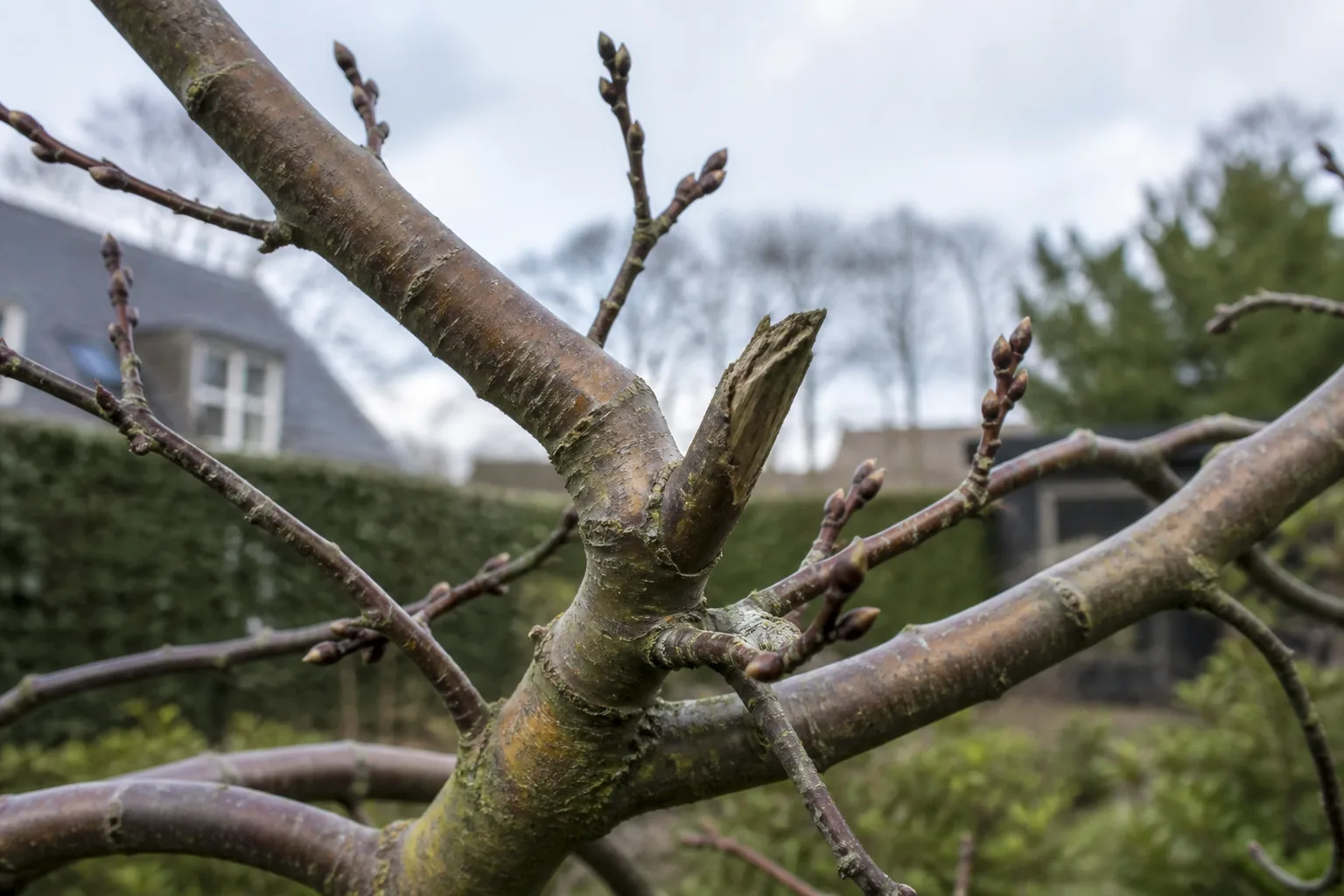
Crossing limbs, dead stubs, and swollen buds are easier to judge when leaves are off. Trace each branch back to the trunk before you commit to a cut.
Winter also exposes suckers and water sprouts—vertical shoots from the base or interior that steal vigor from the canopy you actually want. Spotts Garden Service, which dormant-prunes across the Midwest, notes that removing those shoots in late winter lets you fill bare spots with purposeful new growth instead of random upright clutter once the tree leafs out. The same logic applies to overgrown shrubs: you see the skeleton before you commit.
Spring energy goes where you cut
When warmth and longer days return, the plant breaks dormancy and mobilizes stored reserves. Pruning before that surge channels regrowth toward the buds you left behind. Heading cuts (shortening a branch to a bud or side branch) encourage local branching; thinning cuts (removing a branch entirely at its origin) open space without stimulating a thicket at the tip.
The RHS guide on pruning for colourful stems explains the balance point: roots and shoots stay in equilibrium, and hard pruning in the dormant season lets the plant regrow vigorously because resources are still concentrated below ground. Prune the same shrub hard in summer and you remove photosynthetic leaves the plant depends on right then, so recovery is weaker. Late-winter timing is how you ask for strong spring regrowth without stripping the engine mid-season.
When late winter beats early winter (and when it doesn’t)
“Winter pruning” spans several months, but late winter is safer and more productive than early winter for most backyard plants. The distinction saves you from two opposite mistakes: pruning so early that new growth gets frozen, or waiting so long that you prune into active spring growth and slow the plant down.
The bud-break window explained
Bud break is the shift from dormant buds to active growth—swelling first, then green tissue, then leaves or flowers. Pruning just ahead of that moment gives you maximum visibility with minimum stress. Once leaves expand, every cut diverts energy from flowering, fruit set, and root support toward wound repair.
LawnStarter’s tree-care roundup, citing extension guidance on dormant-season trimming, places the common sweet spot for many trees at late February to early March in typical continental climates—after hard winter cold but before buds open. Spotts Garden Service in central Indiana targets mid-February into March, explicitly waiting until prolonged hard freezes (below about 28°F / −2°C) are less likely because fresh cuts can be damaged by severe freeze right after pruning. That is not superstition; open wood is more vulnerable until the plant re-hardens.
Pruning too early in winter—right after leaf drop—can stimulate weak growth that does not harden off and then gets killed by cold, forcing you to re-cut in spring anyway. Early winter is fine for removing clearly dead or storm-broken limbs, but save structural and renewal pruning for the late-winter window.
Climate and freeze risk by zone
Translate “late winter” with local weather, not a national map:
- Cold zones (roughly USDA 3–5): Often March, sometimes into April for marginally hardy specimens. If the forecast shows a deep arctic plunge within a week, postpone cosmetic cuts.
- Mid zones (6–7): February–March is typical; watch for late hard freezes after warm spells.
- Mild zones (8+): January–February may work for many deciduous plants; evergreens may still need later timing.
If your ground is icy, your ladder footing is bad, or rain is soaking bark, wait for a better day—moisture and slippery tools raise disease and safety risks. Our guide on whether to prune wet tree branches walks through why dry bark and a clear weather window matter, especially on fruit trees.
Plants that belong on your late-winter pruning list
Group plants by how they flower and how they grow, not by whether they are “a tree” or “a shrub.” The same calendar week can be perfect for an apple and wrong for a lilac.
Deciduous shade trees and hedges
Most leaf-losing shade trees are standard late-winter candidates: oak, ash, hickory, sweetgum, hornbeam, beech, hazel, and similar. The RHS lists beech, hazel, and hornbeam among deciduous trees and hedges that can be pruned throughout the dormant season once leaves are gone.
Use late winter to:
- Establish a single dominant leader on young trees
- Remove crossing and inward-growing branches
- Raise low limbs for clearance
- Thin dense hedges before spring flush
Exception: maple and birch can bleed sap heavily if pruned during warm late-winter or early-spring thaws. Gardening Know How’s pruning basics recommends summer or true winter for those genera to reduce sap loss—not a hot afternoon in March when sap rise has started.
Summer-blooming shrubs and vines
Plants that bloom on new wood grown this season are classic late-winter targets. Cutting them now does not remove upcoming flowers; it shapes the framework that will flower later.
Strong candidates include:
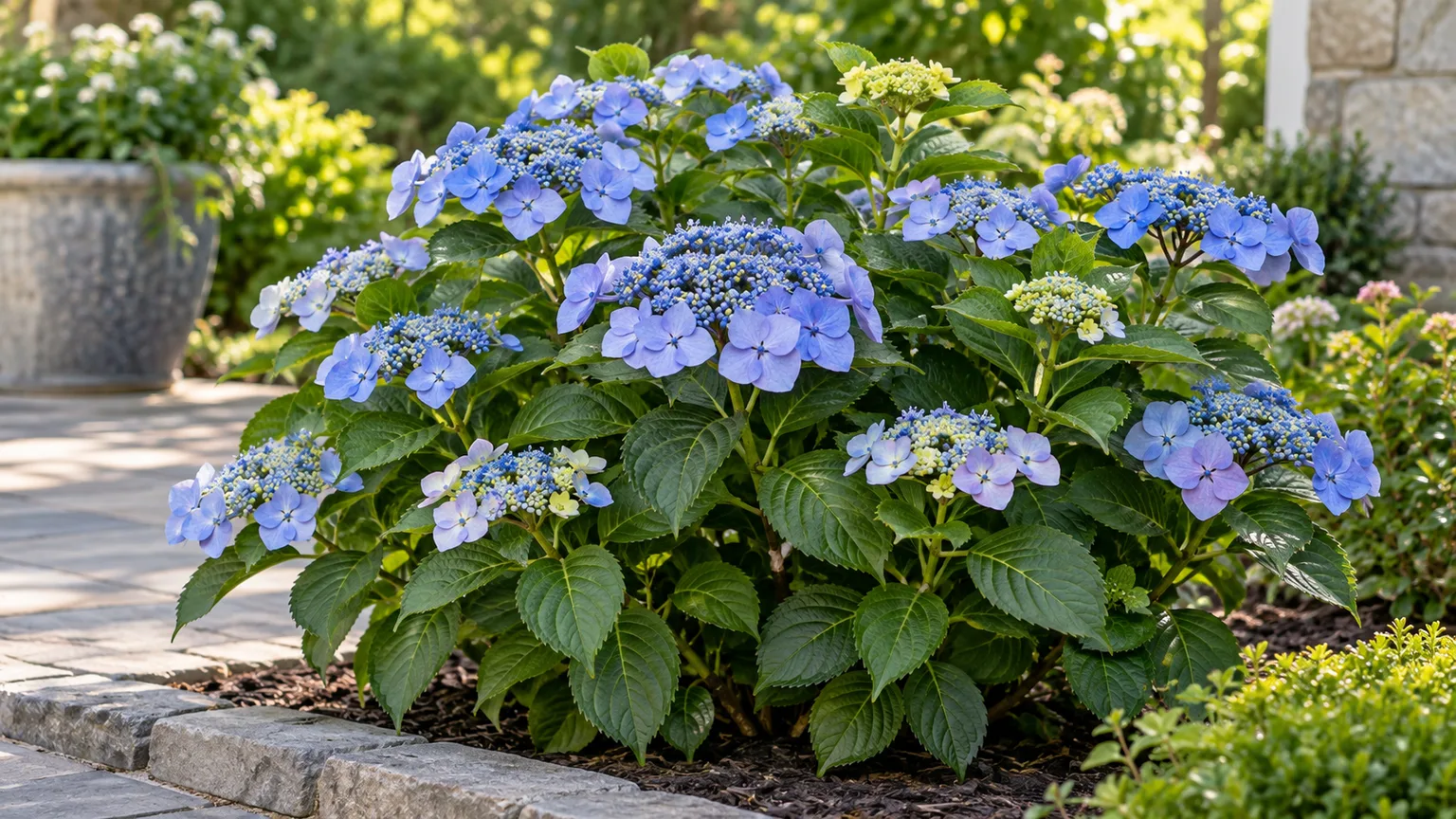
- Panicle and smooth hydrangeas (not bigleaf or oakleaf—see skip list below)
- Summer- and fall-blooming clematis types
- American wisteria (shorten shoots to two or three buds, thin crowded stems)
- Ninebark, smoke bush, and many ornamental brambles grown for winter stem color
- Crape myrtle and other shrubs that flower on current-year growth
For dogwood, willow, and white-stemmed Rubus grown specifically for winter bark color, the RHS colourful-stems guide traditionally recommends late February through mid-spring, before leaves appear—though some gardeners now delay slightly to enjoy the stems longer. Hard cuts in dormancy produce the vivid regrowth those displays depend on.
Roses, fruit trees, and evergreens
Roses: Most bush and shrub roses are pruned in late winter before new growth. Remove remaining leaves if any linger (they can harbor disease), take out dead and crossing canes, and shorten healthy stems by roughly one-third to an outward-facing bud. Climbing roses need a lighter framework trim; know your rose type before you cut hard.
Fruit trees: Apple, pear, and quince are normally dormant-pruned annually for structure and fruit quality. Spotts Garden Service and Lam Tree Service both treat dormant pruning as the default for pome fruits. Stone fruits (cherries, peaches, plums) are more nuanced—some growers prune cherries in dormancy, others prefer early summer after leaf out to reduce disease pressure; follow regional extension advice for your cultivar.
Evergreens: A subset—boxwood, yew, holly, juniper, arborvitae—can be trimmed in late winter for shape. Needled evergreens often benefit from spring touch-ups for compact growth. Do not assume every evergreen wants a February haircut; conifers with a strong central leader may only need deadwood removal in winter.
Grapes and brambles: Wine and table grapes, raspberries, and blackberries often receive their main pruning in dormancy, but techniques are specialized (cane vs spur systems). Learn the system for your variety before you shorten canes at random.
What to skip until after bloom or late spring
Late-winter pruning is powerful because it is selective. The skip list prevents the most common flower-loss mistake.
Spring-flowering trees and shrubs set buds the previous year on old wood. Pruning now removes the display you were hoping for in April and May. Wait until flowering finishes, then shape lightly if needed. Examples: lilac, forsythia, flowering dogwood, azalea, rhododendron, spring-blooming clematis, and many viburnums.
Bigleaf and oakleaf hydrangeas bloom on old wood; the RHS advises holding hydrangea pruning until March and keeping old flowerheads through winter for frost protection on tender shoot tips.
Prunus species (ornamental cherries, plums, almonds): avoid autumn and winter pruning when possible because of silver leaf risk; many authorities prefer summer for these genera.
Tender or newly planted specimens: Anything still establishing, recently transplanted, or marginally hardy in your zone should get minimal wood removal—light deadwood only until roots catch up.
Stressed plants: drought, root damage, heavy pest load, or repeated defoliation last year. They need recovery, not a hard renovation cut.
If you are starting seeds indoors for spring, late-winter pruning pairs naturally with planning work like our seeds to start in February list—outdoor structure first, indoor starts second.
Start with the four D’s before you reshape anything
Every pruning session should open with sanitation and safety, not aesthetics. Gardening Know How teaches the Three D’s—dead, damaged, diseased—and many arborists add a fourth:
- Dead — brittle, no green inside, no buds
- Damaged — split, torn, sunscalded, or storm-twisted wood
- Diseased — cankers, blackened stems, obvious fungal dieback
- Dangerous or disruptive — limbs over roofs, walkways, or power lines; suckers; branches that cross and rub
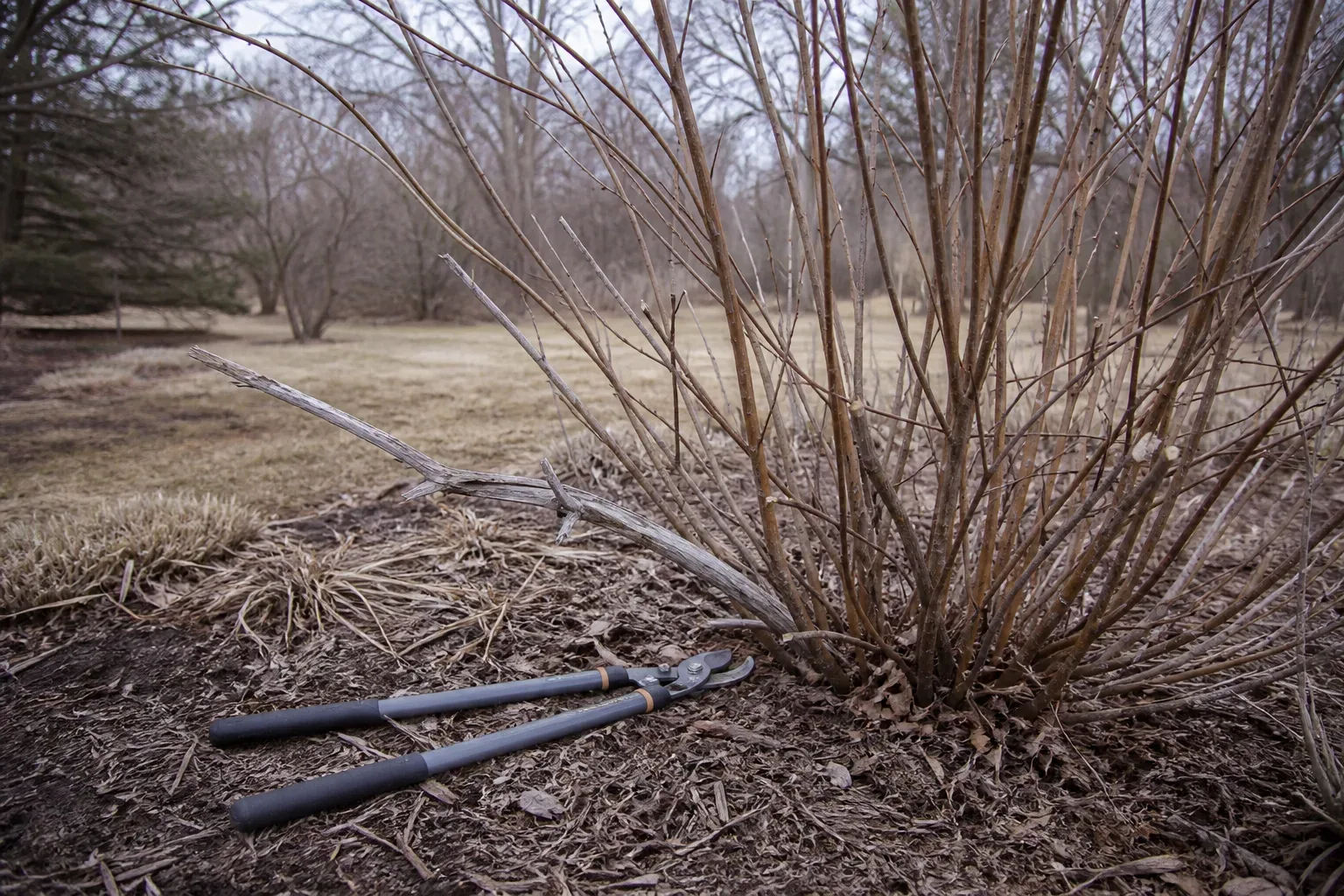
Dead and damaged wood comes first in every session—before you reshape healthy branches for structure or size.
Remove those first, cutting just outside the branch collar—the slightly swollen ring where branch meets trunk—without leaving a stub and without cutting into the trunk tissue. On shrubs, cut back to a lateral branch or bud facing the direction you want new growth to travel.
Disinfect tools between cuts when disease is present (10% bleach solution or rubbing alcohol). Bag and trash diseased material; do not compost it.
How much wood to remove in one session
After the four D’s, ask how much live tissue the plant can replace in one year.
The one-third rule is the safest default for ornamental shrubs and many trees: remove no more than about one-third of live wood per year when you are rejuvenating or resizing. Severely overgrown plants need staged renewal across two to four seasons, not one dramatic chop.
Hard-pruning for stem colour (dogwood, willow) is the exception—those shrubs are meant to be cut nearly to the ground on a cycle. Know which camp your plant belongs to before you apply the one-third cap.
For young trees, prioritize fewer, well-placed cuts over aggressive thinning. Each cut is a permanent architectural decision.
Tools, weather, and cuts that heal cleanly
Tools by branch size:
- Hand pruners — twigs and small stems up to about ¾ inch (2 cm)
- Loppers — branches up to roughly 1½ inches (4 cm)
- Pruning saw — anything larger; use three-cut method on big limbs to avoid bark tearing
Keep blades sharp. Dull tools crush wood and slow healing.
Weather checklist:
- Choose a mild, dry day when bark is not wet from rain or melting snow
- Avoid pruning when temperatures are wildly fluctuating and a hard freeze is imminent
- Skip icy ladders and muddy slopes
Skip pruning sealers on most landscape plants. Wound paints and tar can trap moisture; trees compartmentalize best when cuts are clean and dry. Commercial orchard protectants are a separate, labeled category for specific crops—not default hardware-store sealant.
Common late-winter pruning mistakes
Pruning for flowers at the wrong time. If your lilac did not bloom, late-winter shaping is a likely reason. Match timing to flowering wood vs new wood.
Cutting too early in winter. Stimulates vulnerable shoots that freeze; you redo the work in spring.
Waiting too long. Pruning into full leaf forces the plant to heal and grow at the same time, reducing vigor and fruit set.
Shearing everything into balls. Random outer clipping destroys the natural branch habit and creates dense shells that block light and air. Thin from the inside; shorten with purpose.
Ignoring suckers and root sprouts. They steal vigor and often indicate stress or improper previous cuts.
Topping large trees. Shortening trunks to stubs creates weak, crowded regrowth and long-term hazard wood—not a substitute for proper reduction cuts.
Pruning stressed or wet plants. Combine drought recovery, disease pressure, and wet bark, and you stack odds against clean healing.
Confusing houseplant schedules with yard schedules. Tropical indoor plants follow different cues. For example, Christmas cactus pruning happens after flowering, not in outdoor late winter.
Conclusion
Late winter pruning is less about clearing a chore off a January list and more about catching the dormant window when you can see structure, pests are quiet, and spring energy is about to move. Finish structural work after hard freezes ease but before buds swell, lead with dead and damaged wood, respect the one-third rule for renewal, and keep spring bloomers and vulnerable Prunus off the late-winter schedule.
Walk your yard once with pruners holstered and only a notebook out. Mark the four D’s, note which shrubs flower in spring versus summer, and schedule two or three dry afternoons instead of one rushed marathon. Your spring garden will not look dramatically different the day you finish—but by early summer, air movement, flower placement, and fruiting wood will show you why the timing mattered.