How to Grow and Care for Dutchman’s Pipe Vine Outdoors
Plan Dutchman’s pipe vine around its mature size, shade tolerance, trellis needs, water, pruning, swallowtail value, toxicity, and site fit before planting.
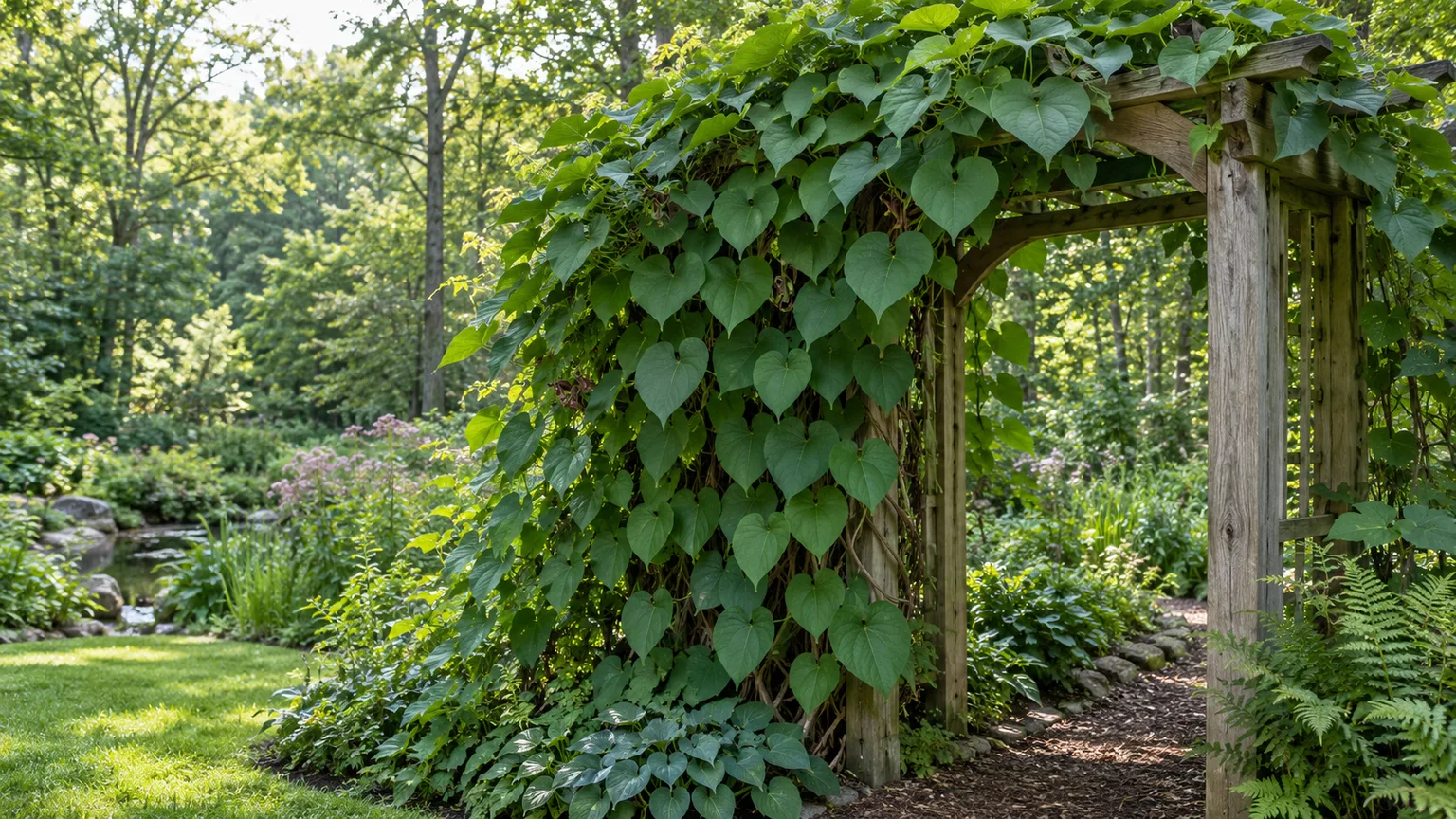
Dutchman’s pipe vine is a deciduous, woody climber for gardeners who want a large leafy screen and can give it permanent support, steady moisture, and enough room to mature. Its flowers are unusual but often hidden; the main show is an overlapping canopy of broad, heart-shaped leaves that also feeds pipevine swallowtail caterpillars.
The botanical name to look for is Aristolochia macrophylla. Before buying, decide whether you can safely fit a vigorous native vine into your landscape: it commonly reaches 20–30 feet, with broader references giving a range of about 15–40 feet, is poisonous if eaten, and has a high flammability rating in North Carolina State Extension’s profile. The plant rewards a deliberate placement much more than a last-minute decision to cover a small fence.
| Growing factor | What to plan for |
|---|---|
| Habit and foliage | Deciduous, woody, twining vine with large heart-shaped leaves |
| Mature reach | Commonly about 20–30 feet; broader references give a range of roughly 15–40 feet |
| Light and soil | Full sun to partial shade; rich, moist, well-drained soil |
| Support | A sturdy arbor, fence, or trellis installed before planting |
| Best known wildlife role | Larval host for the pipevine swallowtail |
| Main cautions | Ingestion toxicity, vigorous growth, and high flammability near structures |
The size estimates differ among plant databases, which is a useful reminder to plan for a large woody vine rather than rely on a tidy nursery-pot label. NC State Extension, Cornell CALS, and the University of Connecticut Plant Database describe a fast, twining vine generally reaching about 20–30 feet, with NC State listing a wider possible range.
Is Dutchman’s pipe the right vine for your yard?
Choose this vine when you have a substantial arbor, sturdy fence, or freestanding framework that can carry a heavy, leafy climber for years. It can make a dense green screen in partial shade and offers a host plant for a native butterfly, but it is not a small, self-supporting decorative vine that can be tucked into a narrow planter and ignored.
Think about where the mature plant will be, not just where the young pot fits. Keep its growth away from gutters, roofs, overhead wires, and fragile fence panels; allow space to prune from the ground or a safe working platform. If you want a smaller plant for a shaded wall, compare options in our guide to perennial vines for shade before committing to a vigorous woody species.
This vine is native to eastern North America, including parts of Canada and the eastern United States, and is best suited to gardens where it is regionally appropriate. Plant databases place it around USDA zones 4–8, with some variation at the cold edge: Cornell lists zone 4b, while NC State includes 4a. Treat that difference as a reason to consider local winter lows, exposure, and plant provenance rather than assuming every specimen will perform the same in every zone-4 garden.
Identify the native vine before you buy
“Dutchman’s pipe” can refer to more than one plant, so check the botanical name on the label. Aristolochia macrophylla is the native, deciduous woody vine covered here; NC State also lists older names such as A. durior and A. sipho. Do not confuse it with other pipe-shaped-flower species or with the unrelated Dutchman’s-pipe cactus, which is a different plant altogether.
The easiest field clues are the smooth, broad, heart-shaped leaves, twining stems, and small curved flowers hidden under the foliage. The leaves can reach about a foot long, and the flowers are usually greenish with brown-purple coloring rather than large, bright blooms; UConn and the University of Michigan describe these flowers as small and partly concealed. The University of Michigan’s species account explains the twining habit and pipe-shaped flowers, while NC State distinguishes this smooth-leaved species from the hairy-leaved A. tomentosa.
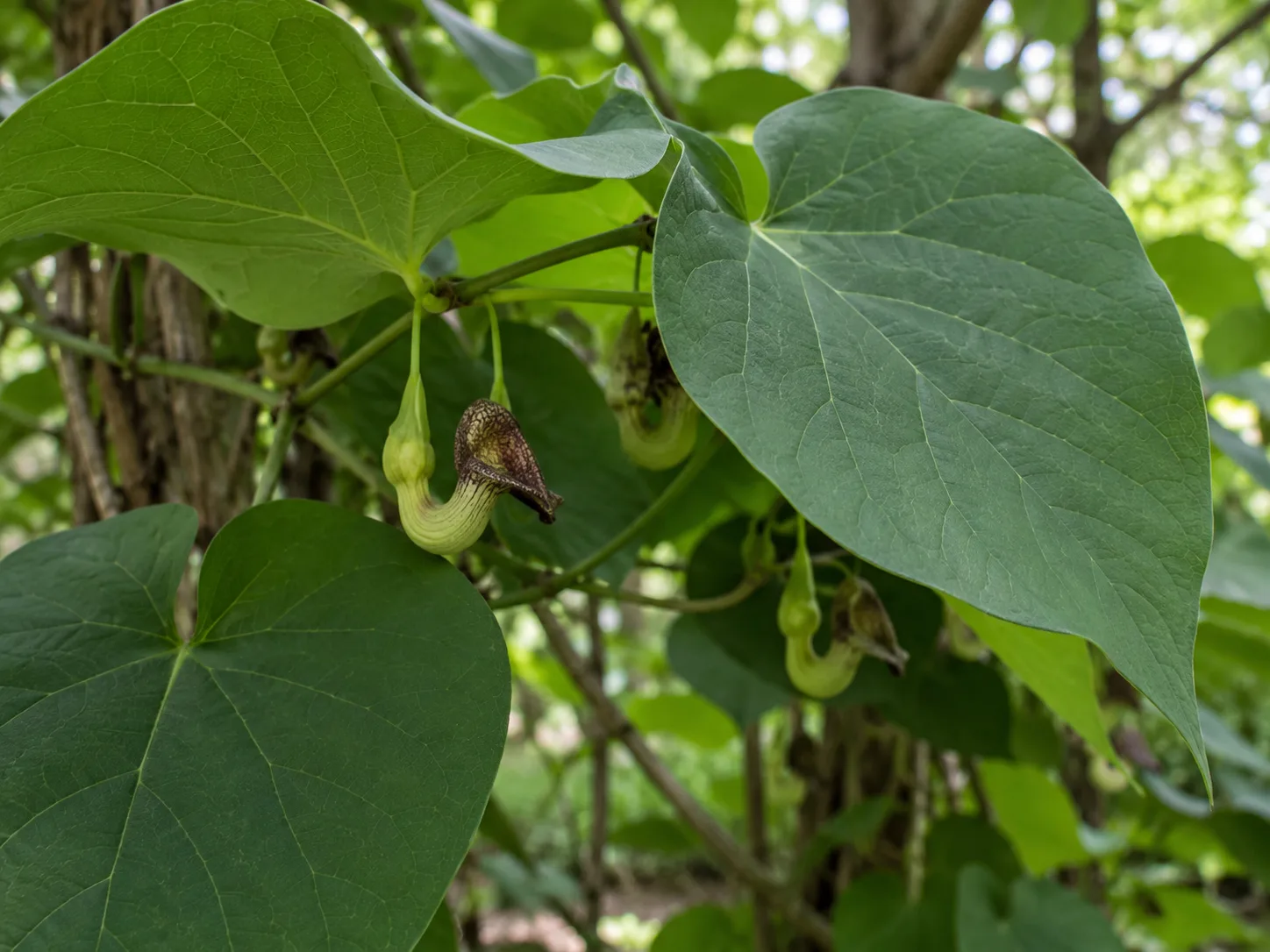
That distinction matters if your goal is a butterfly garden. Pipevine swallowtails use suitable Aristolochia as larval food, but an ornamental species with the same common name is not automatically an appropriate substitute; Gardening Know How’s species comparison cautions that giant Dutchman’s pipe can be harmful to the larvae. Buy by botanical name and ask the nursery to confirm the species if the tag only says “pipevine.”
Choose a site with the right light, soil, and moisture
Dutchman’s pipe tolerates full sun to partial shade, but the plant’s moisture needs should guide how much sun you give it. A site with morning sun and afternoon shade is a practical fit in hot, dry-summer locations; a cooler, evenly moist spot can support fuller growth. In shadier positions, expect foliage to do most of the work and do not judge the plant by a few hard-to-find flowers.
Before digging, observe the site at midday and in late afternoon, then notice where roof overhangs, mature trees, or walls block rain. A shaded bed under tree roots may be much drier than it looks, while a low hollow that stays saturated can suffocate roots. The target is soil that holds moisture between waterings but drains after a heavy rain, not a permanently wet planting hole.
Sunlight: balance leaf growth with summer heat
NC State and Cornell list the species for full sun to partial shade, so full sun is not required, and their guidance does not establish it as a plant for all-day deep shade. A site with several hours of filtered or direct light is a more reliable choice than a dark corner; very low light may produce a thinner, slower screen. In full sun, consistent root-zone moisture matters especially during establishment and in hot climates. If you see midday wilt, first check soil moisture and root-zone heat rather than immediately moving or feeding the vine.
Partial shade is often the safer choice where summer afternoons are intense, provided the soil does not dry out. Avoid choosing a dark site only because the word “shade” appears on a plant list; flowering is already subtle, and very low light can make the foliage thinner and the screen slower to fill. Track the actual hours of sun in the growing season, when nearby trees are leafed out.
Soil: keep roots moist without waterlogging them
Aim for fertile soil with plenty of organic matter and good drainage. NC State describes the plant as preferring rich, moist, well-drained soil and says it is intolerant of dry soil; Cornell’s woody-plant database gives a similar moisture range. If water sits in the planting hole long after rain, improve the site or choose another location instead of trying to solve poor drainage with frequent watering.
Wind is another site factor. NC State recommends protection from strong winds, which can buffet new shoots and broad leaves; a sheltered spot is useful as long as it is not within the defensible space around a home. For a wall or fence planting, keep the root crown away from the dry strip directly beneath the eaves so rain can reach it.
Build support before planting
This is a twining vine: its growing stems wrap around narrow supports as they extend, but it does not attach itself to a wall with adhesive pads or aerial roots. Give it a substantial arbor, pergola, or firmly anchored trellis with rails, wires, or lattice that young stems can reach. The RHS guide to growing climbers recommends sturdy support before planting vigorous climbers and tying stems in as they grow.
Size the structure for the plant you intend to keep, not the one you buy. A lightweight decorative fan trellis may bend or pull loose as a mature vine thickens and its foliage catches wind; attach the support to posts or structural framing rather than trusting a weak fence board. Leave room behind or beside the framework for airflow and maintenance, and keep the vine clear of gutters and rooflines.
If training it beside a wall, plant away from the foundation and rain shadow. The RHS general climber guide recommends roughly 18 inches between a wall and the planting position so rain can reach the root zone and roots are less likely to encounter rubble or restricted soil. Dutchman’s pipe also has a high flammability rating in the NC State profile, so do not use it as a wall-covering plant inside a home’s defensible space; check local fire guidance for the required separation in your area.
Plant with the mature vine in mind
Spring or early autumn, when the ground is workable and temperatures are moderate, are sensible planting windows. Spring gives roots a full growing season to establish before winter; early autumn can work where soil remains warm and the plant has time to settle before hard freezes. Avoid planting into frozen ground, waterlogged soil, or the start of a long heat wave.
Set up the support first, then plant the vine where its roots can spread without hitting a foundation or large tree roots. Dig a hole about twice as wide as the root ball but no deeper; loosen circling roots gently, position the root flare at soil level, backfill with the native soil, and water thoroughly to settle it. Do not bury the stem to compensate for a leaning plant; tie a young stem loosely to a temporary cane that leads toward the permanent structure.
Mulch the root zone after planting, leaving a small gap around the stem. Keep competing weeds and turf away from the base while the vine establishes, because they can take water from a young root system. For a screen, start with one plant only if the framework can support its eventual spread; several plants crowded together can be harder to prune and inspect.
Water during establishment, then follow the soil
Water a new plant deeply enough to wet the root ball and surrounding soil, then check the soil before watering again. For the first growing season, inspect every few days during hot or dry weather and less often after reliable rain; the useful cue is whether soil a few inches below the surface is drying, not a rigid calendar. A new vine’s root system is small even when its top growth looks vigorous.
Once established, Dutchman’s pipe still dislikes prolonged drought, but it does not need to sit in wet soil. During a dry stretch, water slowly at the base so moisture reaches the wider root zone; a short splash against the trunk only wets the surface. If the leaves droop during a hot afternoon and recover by evening, check the soil early the next morning before deciding that the plant needs a major intervention.
The RHS recommends regular watering for newly planted climbers through at least their first growing season, with extra attention to plants growing in the rain shadow of walls or fences. That general rule fits this species’ preference for moist soil. If leaves yellow while the soil stays saturated, improve drainage and reduce watering rather than adding fertilizer.
Mulch and feed lightly
A 2-inch layer of compost or leaf mold helps soil hold moisture and suppresses weeds, especially in a sunny site. Keep mulch a few inches clear of the stem so the bark stays dry and visible, and extend the layer over the root area rather than piling it against the vine. Refresh it when it thins or decomposes instead of adding a thick mound every season.
If the soil is fertile and the vine is growing normally, routine strong fertilizer is usually unnecessary. The RHS notes that climbers in fertile ground often get enough nutrients from annual mulching; this is a good starting point for a vigorous foliage plant that can already grow rapidly. If growth is unusually weak, check light, soil moisture, compaction, and support before assuming the plant needs more nitrogen.
A soil test is more useful than guessing at pH or applying a general lawn fertilizer nearby. Do not fertilize during drought or when roots are waterlogged, and avoid feeding a plant simply because it has been heavily eaten by caterpillars. The vine’s seasonal leaf loss and butterfly feeding are different from a nutrient deficiency.
Train stems and prune for controlled coverage
Guide a few young stems onto the framework and spread them in different directions so the canopy fills the available area rather than bunching at one point. The growing tips twine around slender rails; stems that miss the support can be loosely tied with soft plant ties until they catch. Check ties several times through the growing season and loosen any that begin to pinch as stems thicken.
Pruning is mainly a way to keep this vigorous vine within its assigned footprint and preserve safe access around the structure. Remove dead, broken, crossing, or badly placed stems first, then shorten long shoots that are entering gutters, windows, neighboring shrubs, or paths. For a neglected plant, reduce it over more than one season if a single hard cut would leave the framework bare or destabilize the canopy.
Use late-winter pruning to reset the framework
Late winter, before active spring growth, is the practical time for structural pruning. NC State lists late-winter pruning for growth control, and the vine’s deciduous habit makes its framework easier to see before leaves return. Use clean, sharp bypass pruners for small stems and a pruning saw for larger wood; cut just outside the branch collar rather than leaving long stubs.
Start by removing dead or damaged wood, then thin congested areas and shorten the longest outward-running shoots to a side branch or healthy bud. Keep the main stems that carry the framework unless they are damaged, badly crossing, or have outgrown their support. If you need regular heavy cuts just to keep the plant in bounds, the site or support is too small for the vine and a staged renovation—or removal—may be the better choice.
Do not shear the entire surface into a tight hedge. Shearing leaves a dense outer layer and tangled interior that is harder to inspect, train, and maintain. After flowering, make only small clearance cuts if needed; reserve larger changes for late winter so you can see what you are removing.
Make room for pipevine swallowtail caterpillars
Aristolochia macrophylla is a larval host plant for the pipevine swallowtail (Battus philenor). The caterpillars eat the leaves, and a well-established vine can lose a striking amount of foliage before growing back; NC State says even severe feeding does not cause lasting harm to the vine. A chewed leaf is not automatically a sign that the plant is failing.
If you plant the vine for butterflies, expect to share it. Avoid spraying caterpillars or applying broad-spectrum insecticides to the foliage, and do not remove every leaf that shows feeding. A young plant with very little foliage may need extra protection from drought and wind, but routine caterpillar feeding on an established plant is part of its purpose, not a pest outbreak to eliminate.
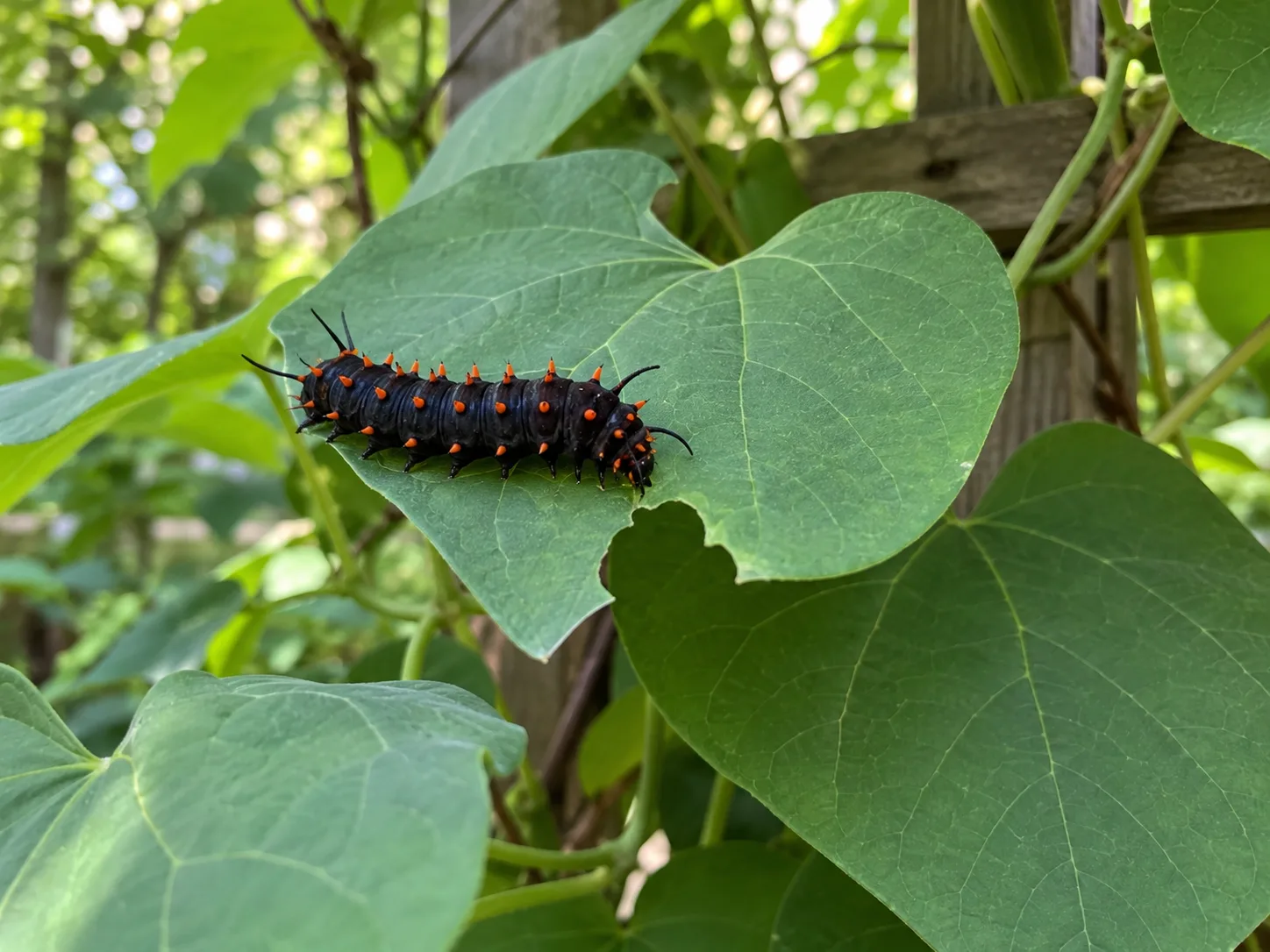
Do not substitute an unfamiliar Aristolochia just because it carries the same common name or has showier flowers. The native species is the plant documented by NC State as a host; Gardening Know How notes that giant Dutchman’s pipe can be toxic to pipevine swallowtail larvae. If butterfly hosting is the goal, verify the species name with the nursery and keep the plant label for future identification.
Prevent and solve common growing problems
The most common preventable problem is planting a vigorous vine in a weak or cramped support. A framework that bows, a fence panel that pulls away, or shoots repeatedly entering gutters are signs that the vine’s eventual size was underestimated. Correct the structure while stems are young, and prune to a defined boundary rather than letting the plant spread until removal becomes difficult.
NC State reports no serious insect or disease problems for this species, so investigate growing conditions before treating leaves. A vine that wilts repeatedly in a sunny bed may need more root-zone moisture; one wilting in wet soil may have poor drainage or damaged roots. Check the soil and inspect the stem base, then make one correction at a time instead of applying fertilizer and pesticide together.
If the canopy is sparse, confirm that the plant is actually A. macrophylla, has a stable support, and receives enough light for its site. Drought, strong wind, root competition, and establishment stress can all limit leaf growth. Since the flowers are small and tucked under foliage, use healthy new growth—not the number of visible flowers—as the main indicator that the vine is settling in.
Propagate from seed, cuttings, or layering
North Carolina State lists both seed and stem cuttings for propagation, while the RHS describes cuttings and layering as common methods for climbers. Seed is useful when you have mature capsules and do not mind waiting; cuttings or layering are more direct ways to produce a plant like the parent. A nursery-grown plant is the fastest route if you need the vine to cover a structure soon.
Propagation success depends on timing and conditions, so keep several seeds or cuttings rather than expecting every one to root. Label the botanical name, date, and source, and do not move a plant into a butterfly habitat unless you have confirmed that it is the appropriate native species. Keep the toxic plant material away from children and pets during propagation as well as after planting.
Start seed from mature capsules
The species forms dry capsules after flowering; allow them to mature on the vine before collecting seed. Sow fresh seed in a clean, free-draining seed mix, cover it lightly, and keep it evenly moist rather than saturated. Because some seeds may remain dormant or germinate unevenly, use more than one seed and give the tray time before discarding it.
Keep seedlings in bright, indirect light while they establish, then pot them on once they can be handled without disturbing the roots. Protect small plants from drying winds and harsh afternoon sun, and harden them off before setting them outdoors. Seed-grown plants may take longer to create a substantial screen than a larger nursery specimen, so plan for gradual growth rather than immediate privacy.
Root cuttings or layer a flexible stem
For a stem cutting, take a healthy, flexible piece during active growth and remove leaves from the portion that will sit below the propagation medium. Use a sterile blade, place the lower node in a moist, airy rooting mix, and cover loosely with a clear bag or propagator to maintain humidity while still allowing ventilation. Check the mix often; soggy conditions can rot a cutting before roots form.
Layering is another low-disturbance option if a flexible stem can reach the soil. Pin a section of stem under the soil surface while leaving the tip exposed, keep that patch evenly moist, and wait until the buried section has rooted before separating it from the parent. The RHS lists layering among common climber-propagation methods, but rooting time varies, so do not cut the connection just because a few weeks have passed.
Protect the vine through winter
Dutchman’s pipe is deciduous, so its leaves naturally drop in cold weather and the woody framework remains. That seasonal change is not a reason to water heavily or wrap the whole vine; focus on the root zone and structural safety. In colder areas, a modest mulch layer can buffer temperature swings without touching the stem.
Before winter, remove broken branches and tie in long stems that could whip in wind or pull at the support. Do not prune heavily in autumn, when it is harder to see the framework and fresh cuts may be exposed to winter stress. In spring, wait until you can distinguish living buds from dead tips before removing more wood.
A newly planted vine benefits more from good drainage, a sheltered position, and moisture through its first growing season than from elaborate wrapping. If your site regularly falls below the plant’s local hardiness range, ask a regional nursery about locally grown stock or choose a more cold-adapted vine. The database ratings give a useful range, but they cannot account for every exposed wall, frost pocket, or winter wind.
Place it with toxicity and fire risk in mind
Every part of Aristolochia macrophylla—including leaves, stems, roots, seeds, and flowers—is listed as toxic if ingested by NC State Extension. The profile identifies aristolochic acid as the toxic principle and warns of potentially irreversible kidney failure after ingestion; it does not list contact dermatitis as the concern. Treat the plant as ornamental only, keep children and animals from chewing it, and seek prompt help from a poison center, medical service, or veterinarian if ingestion is suspected.
The same NC State profile rates the vine as highly flammable and advises against planting it within a home’s defensible space. This is a separate concern from toxicity: even if no one is likely to eat the leaves, a dense woody vine may still be a poor choice near a building in a wildfire-prone area. Check local fire guidance before placing it on a house wall, porch, or attached arbor; consider a lower-flammability plant for the closest zone around the home.
These cautions do not make the vine unsuitable everywhere, but they should be part of the decision before purchase. A detached arbor at the far edge of a moist garden may be a sensible use; a screen pressed against a house where children play or dry leaves collect may not be. If the space cannot accommodate both the mature plant and the safety distance, choose another native climber.
Conclusion
Dutchman’s pipe vine is at its best when a gardener plans for its adult scale, builds a support that will last, and keeps the soil from drying during establishment. Give it a moist, well-drained site in full sun to partial shade, train the twining stems early, and use late-winter pruning to keep the framework within bounds.
Its large leaves can provide privacy and host pipevine swallowtail caterpillars, but it is not an all-purpose fence cover. Confirm the species, leave room for feeding and pruning, and weigh ingestion toxicity and fire placement against the benefits; when those limits fit your yard, Aristolochia macrophylla can become a durable, wildlife-supporting feature rather than a surprise maintenance problem.