13 Perennial Flowering Vines for Shady Areas
Need blooms on a north-facing fence or shaded pergola? Compare 13 shade-tolerant perennial vines by hardiness, flower season, and how aggressively they spread.
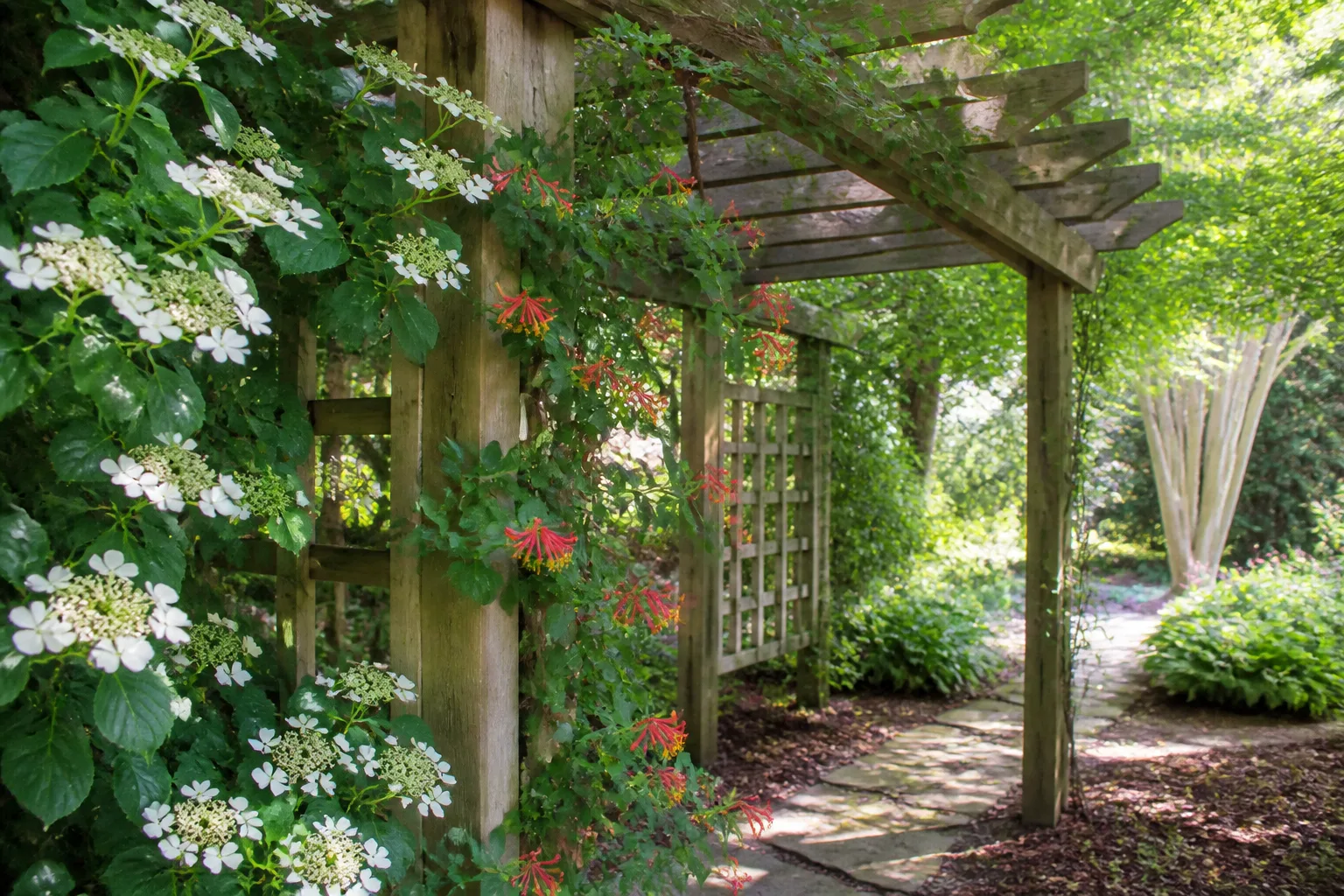
A north-facing fence, a tree-canopied pergola, or the afternoon-shadow side of a patio can feel like dead space for color. Most flowering vines want six or more hours of direct sun, but partial shade — roughly two to six hours of direct light, or bright indirect light filtered through leaves — opens a real list of perennial options that return year after year.
The trick is matching three things at once: how much light the spot actually gets, how the vine climbs, and how much spread you are willing to manage. The profiles below cover thirteen perennial flowering vines that tolerate limited light, with honest notes on hardiness, bloom season, and the mistakes that turn a pretty vine into a maintenance headache.
What shade-tolerant vines need before you buy
Read the light, not just the nursery tag
“Partial shade” on a plant tag is not the same as a dark evergreen canopy or a wall that never sees sun. Dappled shade under deciduous trees often works well because spring-blooming vines get early sun before leaves fill in. Afternoon shade helps vines in hot climates avoid scorched foliage while still giving them morning light for flower buds.
Deep, all-day shade is a different category. Virginia creeper and sausage vine can live there, but flower counts drop sharply. If your site gets less than two hours of direct sun, plan for foliage and structure first — and treat any bloom as a bonus.
Shade soil is often dry soil
Tree roots, eaves, and north walls create shade and steal moisture. Gardening Know How notes that hydrangeas in shade still need consistent moisture, and the same rule applies to most vines on this list. Before planting, dig a test hole after a rain shower. If the soil is dusty six inches down, plan drip irrigation or a soaker hose rather than assuming shade equals low water needs.
Match the vine to your support and climbing method
Vines reach light in different ways, and the wrong pairing leads to a plant that sprawls on the ground or tears a weak trellis off the fence. The RHS guide to climbers and wall shrubs groups the main strategies as twining stems, tendrils, leaf-stem climbers, and adhesive aerial roots.
Twining stems — Carolina jessamine, coral honeysuckle, mandevilla, chocolate vine, star jasmine — need a post, wire, or narrow lattice they can wrap around. Tendril climbers — passionflower and clematis — need a fine mesh or slender horizontal wires. Aerial rootlets — climbing hydrangea and Virginia creeper — cling to rough bark, masonry, or a sturdy trellis; keep them off fragile siding unless you are prepared for long-term attachment.
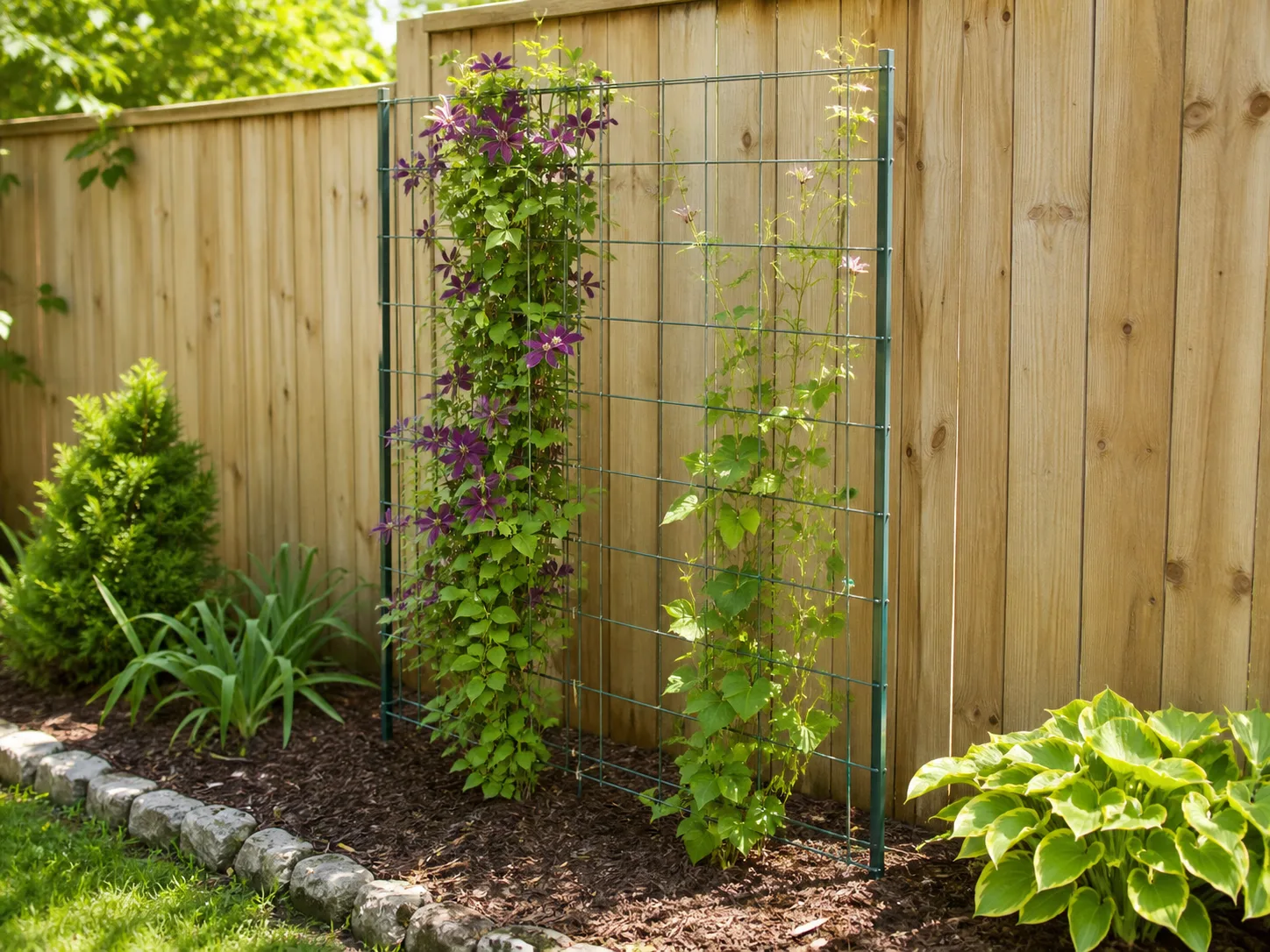
Install the support before planting, anchor it independently of a wobbly fence panel, and leave about 18 inches between the vine and a wall so roots are not trapped in the rain shadow. Match support weight to mature size: a lightweight fan trellis works for clematis; trumpet vine, climbing hydrangea, and mature wisteria need posts and crossbeams sized for decades of growth.
Vines to skip — even when they flower beautifully
Several popular flowering vines tolerate shade but cause problems North American gardeners regret later. Chinese wisteria (Wisteria sinensis) and Japanese wisteria (Wisteria floribunda) seed aggressively and strangle small trees. Japanese honeysuckle (Lonicera japonica) is listed as highly invasive by NC State Extension. Sweet autumn clematis (Clematis terniflora) self-seeds freely and can overwhelm native edges.
If a vine on this list is labeled “vigorous,” read that as a spread warning. Chocolate vine and trumpet vine belong in that category. Choose American wisteria, coral honeysuckle, or a well-chosen clematis instead of their invasive look-alikes, and check your state invasive-plant list before you buy.
Carolina jessamine (Gelsemium sempervirens)
Carolina jessamine is a native southeastern evergreen with fragrant yellow trumpet flowers in late winter and early spring — one of the earliest color signals that the season is turning. Despite the common name, it is not a true jasmine; the scent and flower shape earned the comparison.
NC State Extension recommends moist, organically rich, well-drained soil in full sun for best bloom, though it tolerates light shade. Expect 12 to 20 feet on a trellis after a few seasons of establishment. All parts are poisonous if ingested, and the pollen is toxic to honeybees — a concern for beekeepers. The plant also carries a high fire-risk rating; do not plant it against the house in wildfire-prone regions.
Hardiness: Zones 6–10. Best for: Early spring color on a sturdy arbor in the Southeast. Skip if: You need a pet-safe vine, keep hives, or want a low-maintenance groundcover without yearly training.
Climbing hydrangea (Hydrangea anomala subsp. petiolaris)
If you garden in a cold climate and thought flowering vines were off the table for shade, climbing hydrangea is the answer. This woody vine uses aerial rootlets to cling to tree trunks, north walls, and heavy trellises, producing flat white lacecap blooms in early summer once mature.
Patience is non-negotiable. Climbing hydrangea can take three to five years to settle in before it flowers heavily. It wants moist, humus-rich, slightly acidic soil and tolerates full shade better than most flowering vines on this list. The RHS profile for Hydrangea petiolaris notes it can eventually reach 15 meters (about 50 feet) in ideal conditions — plan a permanent support.
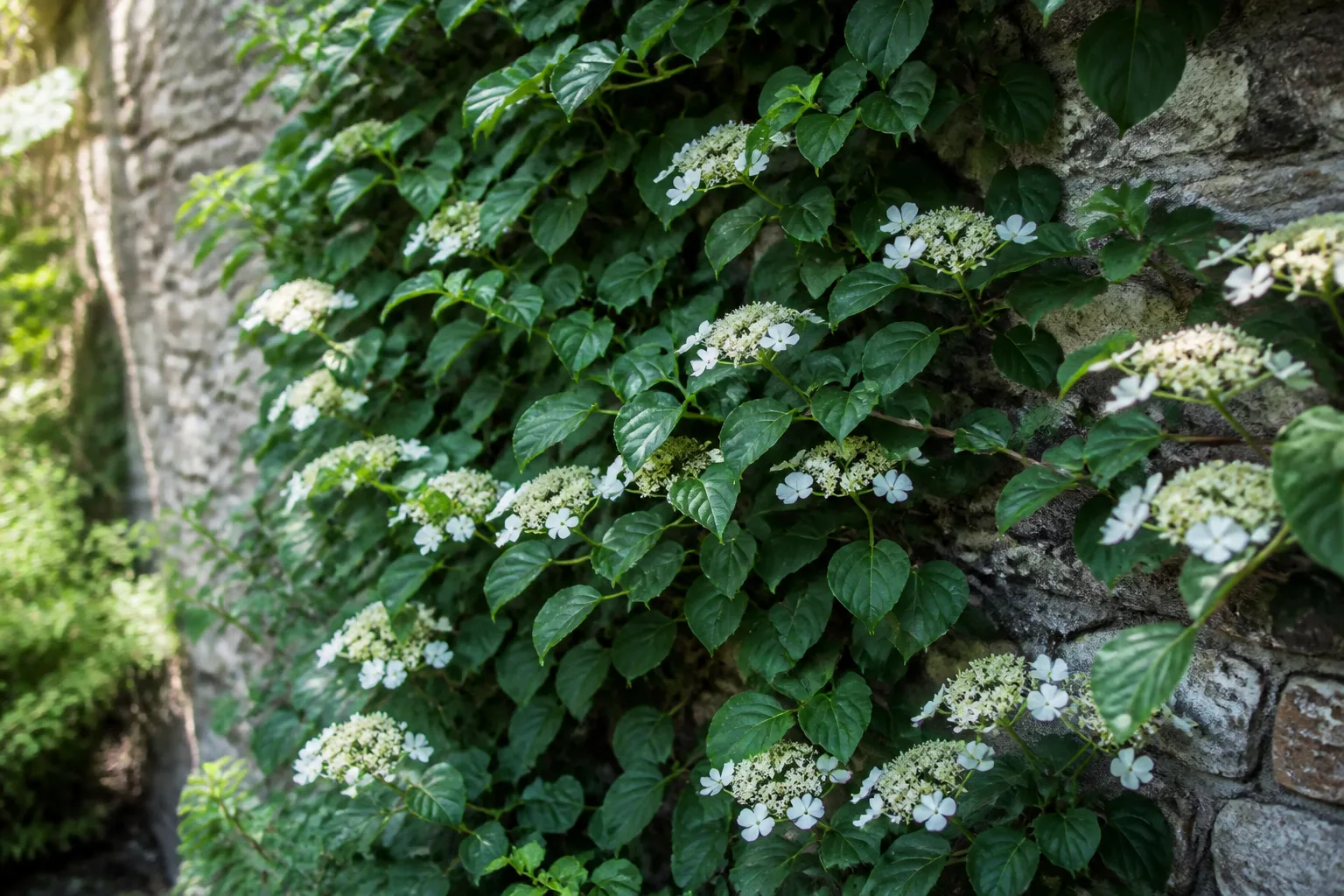
Hardiness: Zones 4–8. Best for: Large shaded walls, mature trees, and long-term structure in northern gardens. Skip if: You need quick coverage or cannot keep soil consistently moist.
Virginia creeper (Parthenocissus quinquefolia)
Virginia creeper is a native deciduous vine with adhesive tendrils and outstanding red fall foliage. The greenish-white summer flowers are inconspicuous; the blue-black berries and autumn color are the main show. It tolerates partial shade and even heavy shade, making it useful where you want vertical green cover more than summer blooms.
Cultivars such as ‘Engelmannii’ and the variegated ‘Star Showers’ stay somewhat tamer than the straight species, but this is still a fast, large vine — plan for 30 to 50 feet. It can attach to masonry and bark; keep it away from gutters and painted surfaces you do not want it to climb. Berries are toxic to humans.
Hardiness: Zones 3–10. Best for: Shade-tolerant fall color on a strong fence or woodland edge. Skip if: You want showy summer flowers or a small trellis.
Mandevilla — warm-climate perennial, northern container vine
Mandevilla (often sold alongside dipladenia) produces trumpet-shaped pink, red, or white flowers from summer into fall. In zones 10–11 it behaves as a woody perennial vine; elsewhere it is typically grown in a container and overwintered indoors or treated as an annual.
Afternoon shade protects the glossy foliage from scorch in hot climates, but flowering still improves with morning sun. Use a pot with drainage, a trellis or obelisk in the container, and bring plants inside before the first frost if you want to keep the same vine next year. Reduce watering indoors and expect some leaf drop while light levels are lower.
Hardiness: Zones 10–11 outdoors. Best for: Shaded patios and container columns in warm climates. Skip if: You want a plant-it-once perennial in zones 8 and colder without overwintering work.
Sausage vine (Holboellia coriacea)
Sausage vine is an evergreen twiner valued for pendulous, fragrant white flowers in late winter and early spring, followed by large pink sausage-shaped fruit. ‘Cathedral Gem’ is a widely sold cultivar. It tolerates partial to full shade and can reach 20 to 25 feet on a pergola.
This is a specialty vine for mild climates (zones 7–9) with moist, acidic, well-drained soil. It is not commonly stocked at big-box nurseries, so source it from a specialty grower and verify hardiness for your microclimate. Fruit is ornamental; do not assume it is edible without confirming the species and cultivar.
Hardiness: Zones 7–9. Best for: Winter fragrance on a shaded arbor in mild coastal or Pacific Northwest gardens. Skip if: You are in a cold interior climate or cannot provide steady moisture.
Trumpet vine (Campsis radicans)
Trumpet vine delivers orange-red trumpet flowers that hummingbirds love. It climbs by aerial rootlets and spreads by underground suckers and seed. NC State Extension warns that the species suckers freely and self-seeds, which is why many gardeners regret planting the straight species in small yards.
Partial shade is tolerated, but bloom is heavier with more sun. If you want the flowers without the lawn invasion, choose a named cultivar such as ‘Apricot’ and remove root suckers promptly — or grow it in a large contained bed with a root barrier. Never plant it against a house foundation; the rootlets and suckers are difficult to remove later.
Hardiness: Zones 4–10. Best for: Hummingbird gardens on a remote fence or pole with room to spread. Skip if: You have a small lot, nearby lawn, or unwillingness to prune suckers yearly.
Purple passionflower (Passiflora incarnata)
Purple passionflower — also called maypop — is the hardiest passion vine for North America. It climbs by tendrils, produces intricate lavender-and-white summer blooms, and develops edible orange fruit (maypops) in warm months. NC State Extension describes it as a rapid grower for full sun to part shade in average, well-drained soil; it spreads by root suckers in ideal conditions.
It is a larval host for Gulf fritillary and other butterflies, so expect caterpillar feeding — that is the trade-off for supporting pollinators. Like Carolina jessamine and coral honeysuckle, it has a high flammability rating near structures. Unripe fruit and other plant parts can cause stomach upset if eaten in quantity.
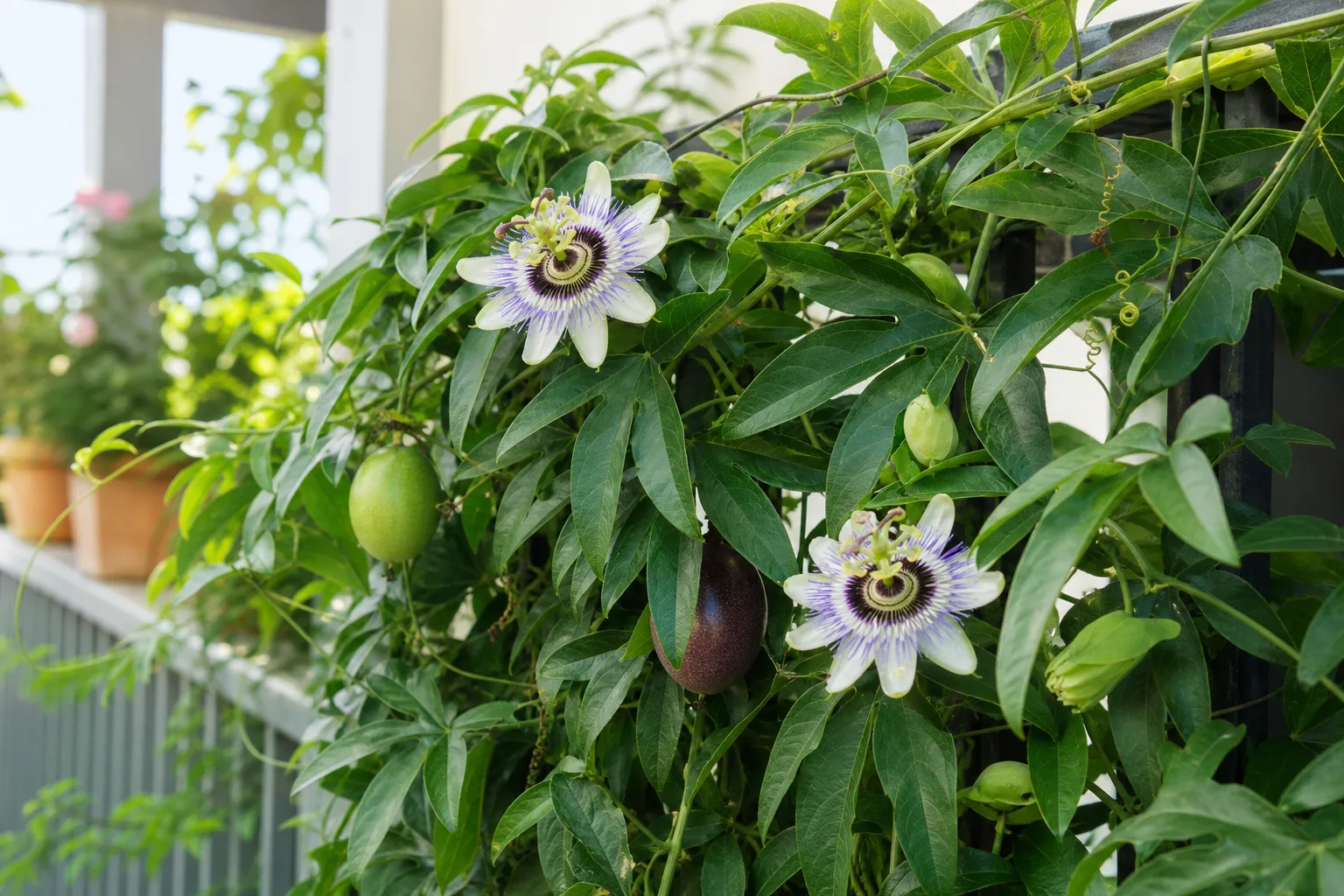
Hardiness: Zones 7–11 (dies to ground in cold winters, resprouts). Best for: Native pollinator gardens and light trellises in part shade. Skip if: You need a perfectly pristine leaf canopy or a fire-safe zone zero planting.
American wisteria (Wisteria frutescens)
American wisteria offers the hanging racemes people want from wisteria without the rampant spread of Asian species. Flowers are shorter, rounder, and less fragrant than Chinese wisteria, but the vine is less aggressive and often blooms sooner on younger plants. Garden Design’s wisteria overview contrasts native American species with invasive Asian wisterias that escape cultivation.
Grow in moist, acidic, well-drained soil with partial shade — especially afternoon shade in hot regions. Twining stems need a heavy arbor or pergola; plan for 15 to 40 feet of spread over time. Prune after flowering to control size and encourage next year’s buds.
Hardiness: Zones 5–9. Best for: Native alternative to Asian wisteria on a large shaded pergola. Skip if: You only have a narrow trellis or expect intense fragrance.
Dutchman’s pipe (Aristolochia macrophylla)
Dutchman’s pipe is a large native vine with heart-shaped leaves and curious pipe-shaped flowers in late spring — easy to miss in the foliage but fascinating up close. It is a vigorous twiner that can cast dense shade over a sitting area, making it useful for privacy on a partial-shade pergola.
It prefers moist, well-drained soil and tolerates partial shade well. Pipevine swallowtail butterflies use Aristolochia species as larval hosts. Because the vine grows heavy, use a robust support and prune to keep pathways clear. Some Aristolochia species are toxic; stick to the native macrophylla for North American gardens and avoid confusing it with invasive exotic pipevines.
Hardiness: Zones 4–8. Best for: Large-leaf texture and butterfly habitat on a shady arbor. Skip if: You want long-lasting showy flowers visible from a distance.
Coral honeysuckle (Lonicera sempervirens)
Coral honeysuckle is the native alternative to invasive Japanese honeysuckle. Tubular red, orange, or yellow flowers attract hummingbirds in mid-spring; blue-green foliage stays semi-evergreen in warm zones. NC State Extension notes it grows 10 to 20 feet, tolerates some shade, but flowers best with more sun — aim for morning light and afternoon shade in hot climates.
Repeat-blooming cultivars such as ‘Major Wheeler’ and yellow-flowered ‘John Clayton’ extend the season. Avoid high-nitrogen fertilizer, which pushes leaves at the expense of flowers. Like Carolina jessamine, it carries a high fire-risk rating near homes.
Hardiness: Zones 4–11. Best for: Hummingbird fences with morning sun and native-garden credibility. Skip if: Deep shade is the only light available — bloom will be sparse.
Chocolate vine (Akebia quinata)
Chocolate vine gets listed on shade-vine roundups because it tolerates heavy shade and produces curious purple-brown spring flowers with a light chocolate scent. The palmate leaves are attractive, and the sausage-shaped fruit is technically edible — though many gardeners find the pulp unappealing.
The more important fact: NC State Extension classifies chocolate vine as an invasive species in North Carolina and recommends native alternatives instead. It spreads by birds eating fruit and can be extremely difficult to remove once established — roots over 20 feet long have been documented. If you still grow it, never let it sprawl on the ground into wooded edges, and consider a contained bed with root barriers.
Hardiness: Zones 4–8. Best for: Experienced gardeners who understand containment risk and want winter interest in partial shade. Skip if: You are near natural areas, prefer low-maintenance plantings, or want a responsible native garden — choose clematis or coral honeysuckle instead.
Clematis cultivars for partial shade
Clematis is the most versatile genus on this list for partial shade, but the “feet in shade, head in sun” rule matters. Large-flowered hybrids such as ‘Nelly Moser’ (striped pink), ‘Prince Charles’ (lilac), and ‘Madame Julia Correvon’ (magenta) bloom on old and new wood with protection from hot afternoon sun. Spring species Clematis montana and Clematis alpina handle brighter dappled shade and are excellent for covering a shaded gate or tree trunk with fine stems.
Match the support to the climbing method: clematis leaf stalks need slender wires or a narrow grid, not a thick post. Keep roots cool with mulch or a low companion planting, and know your pruning group — spring bloomers are pruned right after flowering; many large hybrids need a light early-spring cleanup. NC State Extension’s clematis overview explains the three pruning groups that confuse most first-time growers.
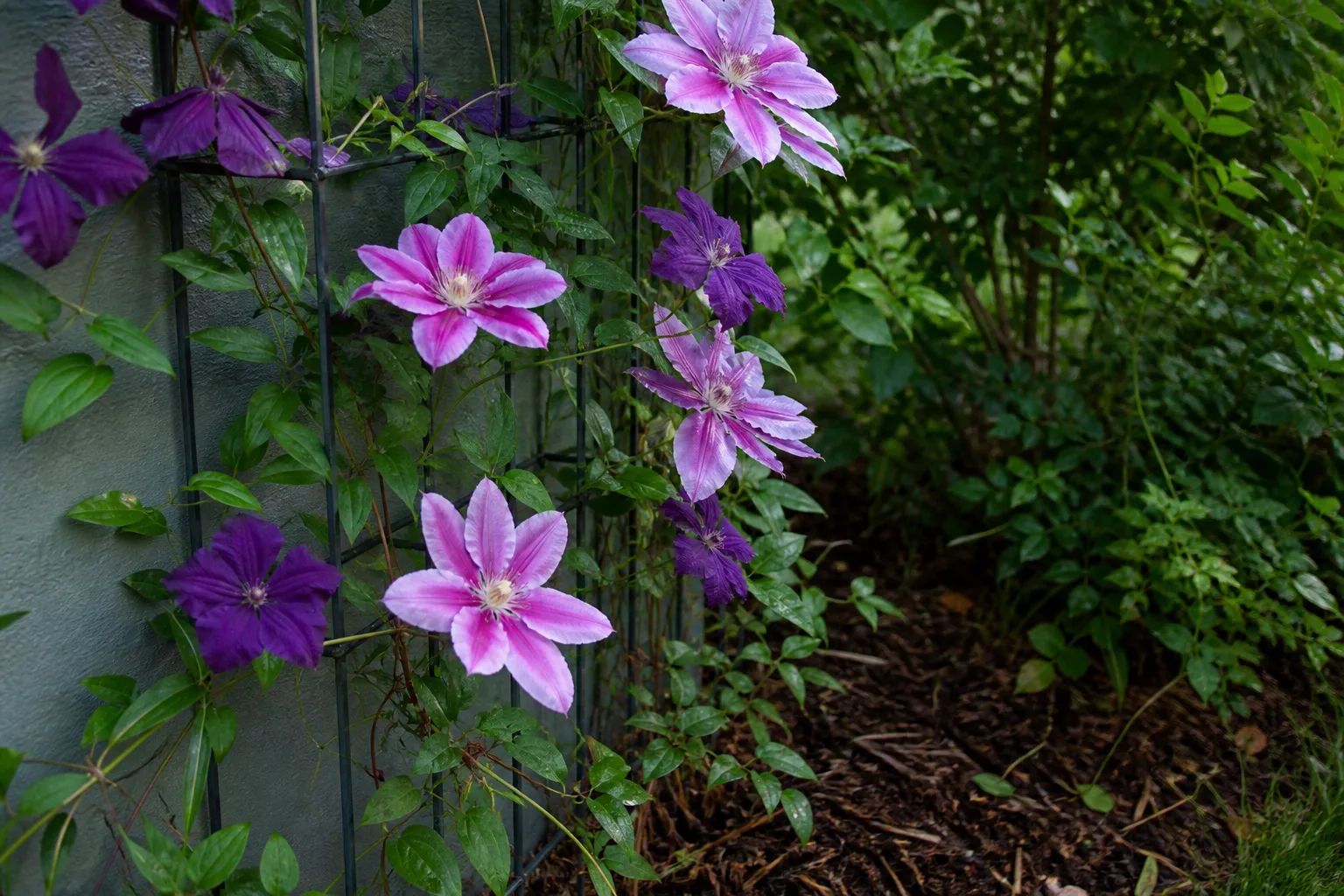
Hardiness: Zones 4–9 depending on species. Best for: Repeat color on a shaded trellis with morning light. Skip if: The site is dry shade with tree-root competition and no irrigation plan.
Star jasmine (Trachelospermum jasminoides)
Star jasmine is an evergreen twiner with intensely fragrant white flowers in late spring and early summer. It is widely grown in California and the South, often adding 3 to 6 feet of growth per year once established. It tolerates partial shade but flowers more heavily when it can climb toward brighter light — typical behavior for vines that “reach for sun” on a trellis.
In zones 8–10 it is a reliable perennial on fences and pergolas. In colder margins, stems may die back in hard freezes and recover from the roots. Plant in moist, well-drained soil and provide a trellis early so stems do not mat on the ground.
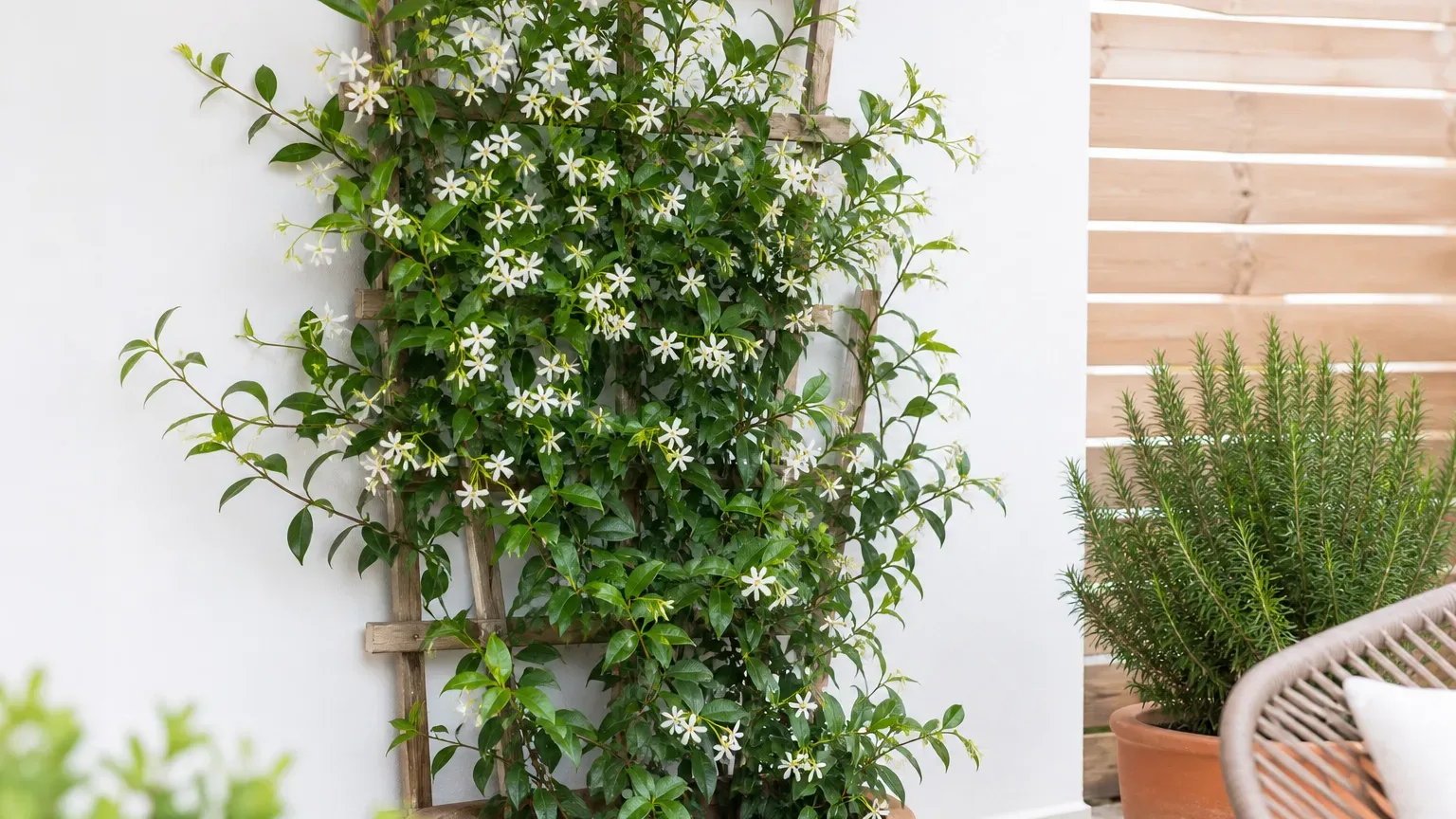
Hardiness: Zones 8–10. Best for: Fragrant evergreen screening on a west- or east-facing trellis with afternoon shade. Skip if: You are below zone 8 and need a fully evergreen vine without winter dieback.
Conclusion
Shade does not limit you to foliage-only vines, but it does change the shortlist. For cold-climate walls and tree trunks, climbing hydrangea is the standout flowering perennial if you can wait for maturity and keep soil moist. For repeat color with manageable size, clematis cultivars and coral honeysuckle are the most flexible picks — as long as they get some direct morning sun. For native southeastern gardens, Carolina jessamine, American wisteria, passionflower, and Dutchman’s pipe add regional character with clear trade-offs on spread, fire risk, or poison concerns.
Before you buy, measure the light at the planting spot in midsummer, install a support sized for the mature vine, and cross-check invasive status in your state. The right shaded vine feels almost effortless once the roots are established; the wrong one becomes a decade of pruning suckers, pulling seedlings, or fighting a trellis that was never strong enough. Start with the plant that matches your zone and your tolerance for vigor — then let the flowers come back on their own schedule.



