Passion Fruit Care Guide: Grow Passiflora edulis
Passiflora edulis
Grow Passion Fruit (Passiflora edulis) in full sun with a sturdy trellis, free-draining soil, and frequent deep watering. Learn watering, soil, training, fruiting, and pet-safety basics.
Passion Fruit Care Guide: Grow Passiflora edulis
Start with wateringThe most common care mistake for Passion FruitWatering guide →Passion Fruit care essentials
Light
Water
Keep the shallow root zone evenly moist with frequent, thorough watering, then let excess drain. Do not allow the mix to stay waterlogged or dry out for long during active growth.
Soil
Fertile, well-drained loam or a free-draining container mix. Slightly acid soils are best; the vine tolerates near-neutral to mildly alkaline conditions but resents poor drainage.
Humidity
Temperature
Fertilizer
Feed lightly during active growth after light, water, and drainage are correct—balanced fertilizers support vine fill in year one, then ease nitrogen so plants favor flowering rather than only leafy growth.
About Passion Fruit
Passion Fruit is native to South America (Brazil, Paraguay, and northern Argentina), typically reaches Tendril vine often exceeding 10 m (35 ft) in a season; total length can surpass 30 m (100 ft) on mature support indoors, with fast in full sun with steady moisture and warm temperatures growth. Passion Fruit has a climbing growth habit and part of the Passifloraceae family. It is also known as Purple Granadilla, Maracuyá, Maracujá, Lilikoi, Krishna Kamal Fruit, and Parcha.
| Detail | Information |
|---|---|
| Also known as | Purple Granadilla, Maracuyá, Maracujá, Lilikoi, Krishna Kamal Fruit, Parcha |
| Native region | South America (Brazil, Paraguay, and northern Argentina) |
| Mature size | Tendril vine often exceeding 10 m (35 ft) in a season; total length can surpass 30 m (100 ft) on mature support |
| Growth rate | Fast in full sun with steady moisture and warm temperatures |
| Growth habit | Climbing |
| Scientific name | Passiflora edulis |
| Family | Passifloraceae |
Passion Fruit Care Guide: Grow Passiflora edulis
Passion fruit is a sun-hungry climbing vine grown for fragrant flowers and aromatic pulp—not a low-light houseplant. Passiflora edulis belongs to the Passifloraceae family, and UF/IFAS describes it as a short-lived evergreen perennial vine native to Brazil, Paraguay, and northern Argentina. In a warm Indian garden or on a bright terrace it can flower within the first year, but only when strong light, free drainage, steady root-zone moisture, and successful pollination work together.
The first priorities are simple: give it outdoor full sun, train it on a sturdy trellis, keep the shallow root zone evenly moist without staying soggy, and confirm whether your vine is a self-fertile purple type or a yellow type that needs a pollen partner. Fertilizer cannot replace six hours of usable sunlight or compensate for chronically wet roots.
Passion fruit care at a glance
Give passion fruit full sun and a climbing structure the tendrils can grip. UF/IFAS notes that vines in shade or partial shade typically drop leaves, and that slightly acid, well-drained soils around pH 6.0–7.5 suit the crop best. Water frequently enough to keep the root zone from drying hard, then stop before the mix or bed stays saturated.
Use fertile, free-draining soil, feed modestly after the vine is established, prune to renew flowering wood, and plan for pollination. Purdue’s Fruits of Warm Climates records that purple flowers are generally self-compatible while yellow flowers are self-incompatible, so fruit set is a biology problem as often as a watering problem.
Know the vine you are growing
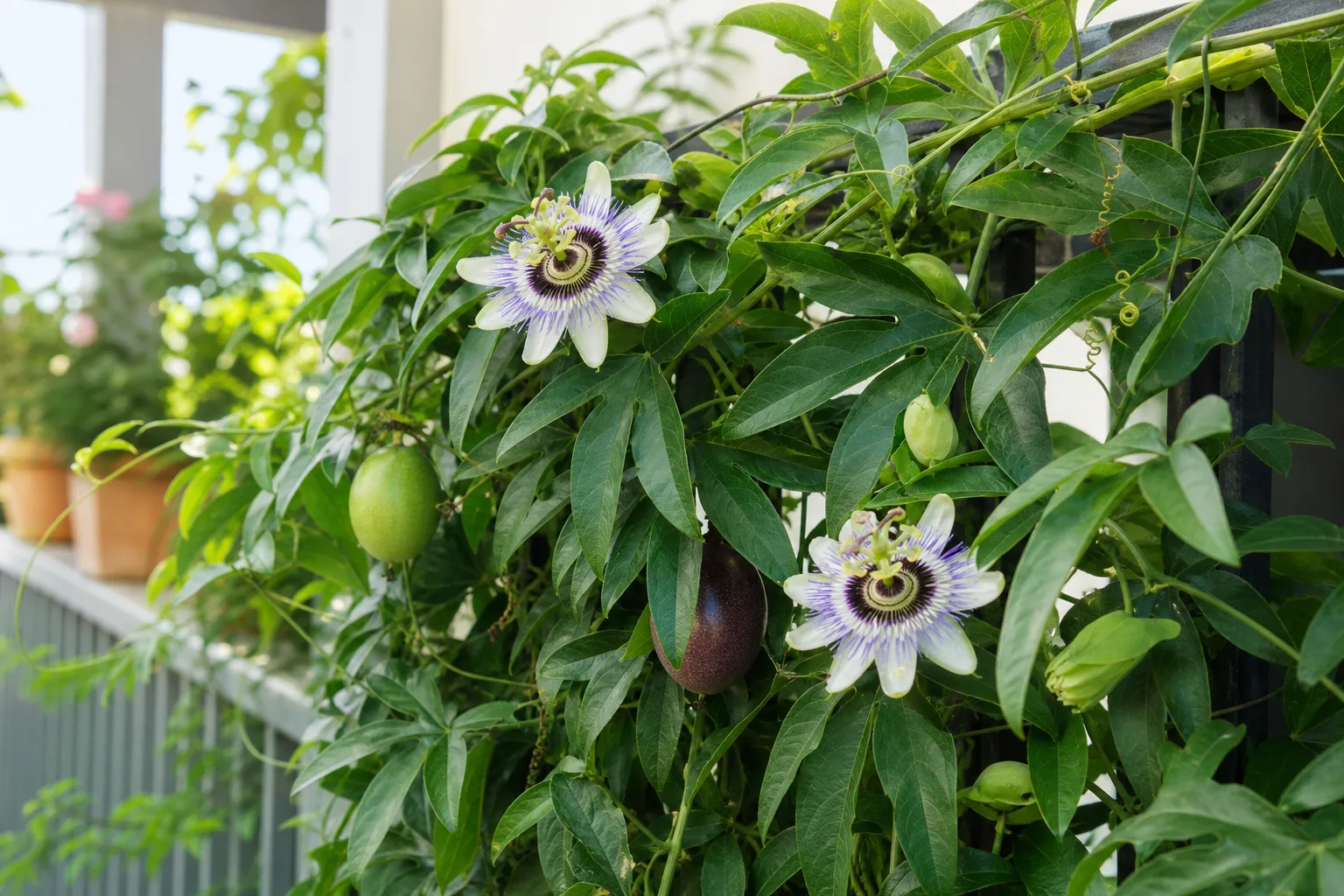
True passion fruit means Passiflora edulis—not every ornamental passion flower sold for blooms alone. RHS growing guidance notes that the well-known edible passion fruit comes from the tropical species P. edulis, while many garden Passiflora types are grown mainly for flowers. Do not assume a blue ornamental vine will behave like a fruiting purple or yellow selection.
Purdue’s passionfruit profile describes a shallow-rooted, woody, perennial climber with tendrils, deeply three-lobed mature leaves, and a single fragrant flower at each node on new growth. The fruit is a tough-skinned berry filled with juice-filled arils and many small seeds. That vine habit explains why support, new-growth pruning, and root-zone drainage dominate care.
Purple vs yellow forms
Within the species, growers usually meet the purple form and the yellow form (P. edulis f. flavicarpa). UF/IFAS treats them as forms of the same species and notes that purple types are often linked to higher tropical elevations, while yellow types and purple–yellow hybrids suit warmer lowland sites. Purdue adds that yellow vines are typically more vigorous with larger fruit, while purple pulp is often less acid and richer in aroma, with a higher juice proportion.
In India, Purdue records longstanding purple harvests in the Nilgiris and northern hill areas, with yellow types later proving productive at lower elevations around Madras and Kerala. Choose the form that matches your climate and pollination plan, not only the fruit color you prefer at market.
Growth habit and realistic size
Passion fruit is a liana: UF/IFAS reports that mature vines can exceed 100 ft (30 m) of total length in the wild and may put on more than 35 ft (10 m) of growth in a single year under good conditions. Home growers manage that vigor with training, annual pruning, and a finite productive life—often about three to four years of strong cropping before decline becomes likely.
Expect fast canopy expansion in warm weather. Flowers form on new growth, so a vine that never pushes fresh shoots will not load fruit. Weak light produces lanky, leafy growth that may never set a useful crop.
Choose full sun and a strong trellis
Place passion fruit on an open terrace, courtyard wall, or garden edge where it receives direct sun for most of the day. RHS advises a sunny, sheltered position for passion flowers and notes that tendrils need a trellis, fence, or wired wall to climb. In Indian heat, a south- or west-facing wall can help ripening, but leave airflow so monsoon humidity does not trap fungal disease in a dense thatch of dead stems.
Build the support before the vine outgrows you. UF/IFAS recommends a strong fence or trellis that can carry a wind-loaded canopy, and describes commercial curtain training where a main stem reaches the top wire and laterals hang down to fill the face of the trellis. Home growers can use the same idea on a balcony frame if the structure is bolted securely.
Can passion fruit grow in a container?
Yes, passion fruit can grow and fruit in a large container, but the pot must behave like a managed root zone. UF/IFAS notes grow-bag or container culture as a way to use custom, disease-free media and to keep roots off contaminated soil, with the container raised for drainage. Start only one pot size wider than the nursery root ball, ensure several clear drainage holes, and step up gradually as roots fill the mix.
A heavy, stable pot matters because a leafy vine becomes top-heavy once it covers a trellis. If the balcony receives less than full-day sun, treat fruiting as uncertain rather than guaranteed. For window-specific targets and sun-stress diagnosis, use the Passion Fruit light guide.
Water for even moisture, not waterlogging
Passion fruit has a shallow root system and limited drought and flood tolerance. UF/IFAS states that vines need small but frequent irrigation to keep soil moisture adequate without saturation, and that drought stress reduces growth, flowering, fruit set, and fruit size. Purdue warns that dry soil as fruit approaches maturity can cause shriveling and premature drop.
Check the upper few centimeters of mix or bed with a finger. If that layer is dry and the pot feels light, soak until water runs from every drainage hole, then empty the saucer. Do not water again on a hot afternoon wilt alone: confirm whether deeper roots are still wet, because wilt above soggy soil can mean oxygen-starved roots rather than thirst.
During monsoon or cool cloudy spells, lengthen the interval and prioritize drainage. For seasonal examples and overwatering diagnosis, use the Passion Fruit watering guide.
Give free-draining, fertile soil
Passion fruit tolerates a range of soils when drainage is good, but containers and compacted beds fail quickly. Purdue recommends light to heavy sandy loams of medium texture with pH about 6.5–7.5, and stresses that good drainage is essential to minimize collar rot. UF/IFAS similarly prefers well-drained soils and notes that slightly acid conditions are best even though near-neutral to mildly alkaline sites can still grow vines.
A practical container mix combines quality potting mix, mature compost, and a generous share of perlite, coarse sand, or bark so water wets evenly and then drains. Do not repeatedly add fertilizer to pale foliage without checking whether the root zone smells sour or stays heavy for days. The Passion Fruit soil guide covers mix adjustments and drainage warning signs in more detail.
Feed for vine growth, then flowering
Feed only a rooted, actively growing vine. UF/IFAS recommends encouraging strong root and canopy growth in year one, then substantially reducing nitrogen after the first year so the plant shifts energy into flowering rather than endless soft shoots. Balanced fruit or general-purpose fertilizers that also supply magnesium and micronutrients are more useful than nitrogen-only pushes.
Purdue notes that potassium and calcium deficiencies are common concerns and that excessive nitrogen can cause premature fruit drop. Stop feeding when growth stalls in cool weather or when a vine is newly stressed from repotting or hard pruning. Use the Passion Fruit fertilizer guide before correcting a suspected deficiency.
Pollination decides whether you get fruit
Flowers alone do not equal a harvest. UF/IFAS explains that flowers emerge on new growth and produce fruit only if pollinated, and that pulp quantity depends largely on pollination quality. Large carpenter bees (Xylocopa spp.) are the most effective natural pollinators; where they are scarce, hand pollination with a clean brush or cotton glove can set fruit.
Match cultivars to the pollination plan. Purdue reports purple flowers as self-compatible and yellow flowers as self-incompatible, opening later in the day and needing genetically different pollen. If you grow a yellow vine, plant at least two compatible seedlings or cultivars that can intertwine, or commit to hand pollination during bloom. Time from flowering to harvest is commonly about 70–80 days.
Harvest when fruit drops or wrinkles
Ripe passion fruit usually abscises and falls while still firm. UF/IFAS advises collecting dropped fruit regularly, noting that picking from the vine makes it harder to confirm full interior ripeness and that nonripe fruit has inferior aroma and flavor. Fruit that wrinkles as the peel loses water can still be edible even when the market prefers a smooth shell.
A young vine may produce only a modest first crop; UF/IFAS estimates roughly 5–15 lb of fruit on a one-year-old plant under Florida conditions, with peak production later. Yield varies widely with cultivar, pollination, and climate, so treat first-year fruit as a success signal rather than a production target.
Adjust care through Indian seasons
During hot pre-monsoon weather, check pots frequently, keep the shallow root zone from baking dry, and protect black plastic pots from extreme sidewall heat if roots overheat. During monsoon, prioritise drainage and airflow, move containers away from roof runoff, and prune dense thatch so wet foliage and dead stems do not sit together. UF/IFAS warns that unmanaged canopies can form a thatch of dead leaves that feeds fungal problems on new leaves and fruit.
During a cooler winter on the plains, growth and flowering may slow with short days; Purdue notes that least flowers develop in winter because of short day length. Lengthen watering intervals and pause heavy feeding until warmth and visible new shoots return. In frost-prone hill stations, protect the base of the vine; UF/IFAS reports that mid-20s °F exposure can kill aboveground growth that may not resprout.
Read common warning signs correctly
Yellow leaves plus slow-drying, sour-smelling soil point first toward excess moisture, poor aeration, or collar-zone disease. Purdue stresses drainage to reduce collar rot, while UF/IFAS lists Fusarium and Phytophthora problems among major soilborne threats, especially where water sits around the stem base.
A vine that flowers but never sets fruit usually needs better pollination, a compatible partner, or less nitrogen-driven vegetative growth—not another dose of bloom booster. Mottled, distorted leaves and woody, misshapen fruit can signal virus disease; UF/IFAS treats woodiness-type viruses as a major limiting factor worldwide and advises starting from clean planting material. Diagnose the whole pattern—soil moisture, light, recent cuts, and which leaves are affected—rather than treating one symptom in isolation.
Handle unripe fruit and pet curiosity carefully
Ripe passion fruit pulp is a common food for people, but that does not make every plant part a snack for pets or children. Purdue records a cyanogenic glycoside in passionfruit pulp at all stages, highest in very young unripe fruit and lowest in fallen, wrinkled ripe fruit where levels are considered of little toxicological significance. Keep green fruit and chewed foliage away from pets, and do not use unripe fruit as a casual treat.
This overview is not medical or veterinary advice. If a pet chews a large amount of vine tissue or unripe fruit, contact a veterinarian. Wear gloves if sap or plant tissue irritates your skin while pruning.
When to use this page vs other Passion Fruit guides
- Use this overview to understand passion fruit as a sun-loving fruiting vine and decide whether your site can support light, support, moisture, and pollination together.
- Use Passion Fruit light to assess a balcony, terrace, or garden position and diagnose shade-related leaf drop.
- Use Passion Fruit watering when leaves wilt, soil stays wet, or seasonal frequency is unclear.
- Use Passion Fruit soil for container recipes, drainage problems, and collar-rot risk.
- Use Passion Fruit fertilizer before choosing a product or correcting a suspected nutrient issue.
- Use Passion Fruit repotting when roots circle, the pot dries within a day, or the mix has collapsed.
- Use Passion Fruit propagation to compare seed, cuttings, and grafting onto yellow rootstocks.
- Use Passion Fruit pruning for timing, curtain training, and renewing flowering wood.
Related Passion Fruit guides
- Passion Fruit plant hub — species profile, key care facts, and the complete care cluster.
- Passion Fruit pruning — renew flowering wood and manage vine thatch.
- Passion Fruit light — full-sun targets and shade stress.
- Passion Fruit watering — shallow-root moisture and monsoon adjustments.
- Passion Fruit soil — drainage, pH, and mix structure.
- Passion Fruit fertilizer — year-one growth vs later flowering balance.
- Passion Fruit propagation — seed, cuttings, and disease-aware starts.
- Passion Fruit repotting — container step-up and root refresh.
Conclusion
Passion fruit rewards growers who treat it as a vigorous, short-lived fruiting climber rather than a decorative indoor vine. Give Passiflora edulis full sun, a strong trellis, free-draining soil, even moisture, moderated feeding after establishment, and a pollination plan that matches purple or yellow biology. When those basics are in place, open the dedicated light, watering, soil, fertilizer, pruning, propagation, and repotting guides for the next precise adjustment.
How to care for Passion Fruit?
When should you water Passion Fruit?
Keep the shallow root zone evenly moist with frequent, thorough watering, then let excess drain. Do not allow the mix to stay waterlogged or dry out for long during active growth.
- Feel the top 2–3 cm - Keep the shallow root zone evenly moist with frequent, thorough watering, then let excess drain.
- water thoroughly when it begins to dry - Do not allow the mix to stay waterlogged or dry out for long during active growth.
- then empty any saucer - Keep the shallow root zone evenly moist with frequent, thorough watering, then let excess drain.
- Drain excess water - Keep the shallow root zone evenly moist with frequent, thorough watering, then let excess drain.
What soil works best for Passion Fruit?
Fertile, well-drained loam or a free-draining container mix. Slightly acid soils are best; the vine tolerates near-neutral to mildly alkaline conditions but resents poor drainage.
- 50% quality potting mix or loam - Fertile, well-drained loam or a free-draining container mix.
- 30% mature compost
- 20% perlite, coarse sand, or fine bark - Fertile, well-drained loam or a free-draining container mix.
Grower notes for Passion Fruit
What matters most with Passion Fruit
Passion Fruit is a tendril-climbing evergreen vine grown for fragrant passion flowers and edible fruit, not a compact houseplant. Give it full sun, a strong trellis or fence, and consistently moist but free-draining soil. Shade or partial shade often causes leaf drop and weak flowering. Fruit forms only on new growth after effective pollination.
Best placement in a real home
Use a sunny balcony, terrace, courtyard, or garden boundary where vines can climb a sturdy support that holds wind load when covered in foliage. Aim for warm conditions near 18–32°C (65–90°F). Protect young plants from frost; prolonged freezes can kill vines to the ground. Container plants need excellent drainage and more frequent watering than in-ground vines.
Before you buy this plant
Choose a plant labeled Passiflora edulis with firm green shoots, clean trilobed adult leaves, and no sour smell from the pot. Confirm you have space and support: vines can grow more than 10 m in a year. Note whether you have purple (often more self-compatible) or yellow types, because yellow forms usually need a genetically different pollen partner for fruit.
First month after bringing it home
Install the trellis before shoots sprawl, then train one or more leaders upward and keep the root zone evenly moist without saturation. Do not combine an immediate hard prune, heavy feed, and large repot. Watch for leaf yellowing in wet soil, drought wilt, and caterpillar chewing. Carpenter bees or careful hand pollination improve fruit set where natural pollinators are scarce.
Safety note for Passion Fruit
Ripe passion fruit pulp is grown as food for people, but leaves and stems of related Passiflora species contain cyanogenic glycosides and are flagged as poisonous for pets and children. Keep pets from chewing vines, unripe fruit, or prunings, and contact a veterinarian after suspected ingestion.
How to tell Passion Fruit is settling in
Look for tendrils wrapping the support, glossy new leaves, and flower buds on fresh shoot tips. Ripened fruit often drop when ready; wrinkled skins still indicate edible pulp for people. Prune congested or dead wood in late winter to reopen the canopy, and restart tired vines rather than nursing chronically diseased plants indefinitely.
Is Passion Fruit safe for pets?
Related Passiflora species are flagged for cyanogenic glycosides in leaves and stems. Treat Passion Fruit vines and unripe fruit as unsafe for pets to chew, even though ripe pulp is a human food crop. Call a veterinarian if ingestion causes concern.
Passiflora edulis has no dedicated ASPCA toxic/non-toxic listing confirming whole-plant safety. NC State Extension documents medium- severity cyanogenic glycoside poisoning risks for related Passiflora species (leaves and stems), with nausea, vomiting, drowsiness, and heart-rhythm concerns. Do not allow pets or children to chew foliage, stems, or unripe fruit; ripe culinary pulp for people is separate from companion-animal safety.
Watering Passion Fruit
For Passion Fruit, feel the top 2–3 cm; water thoroughly when it begins to dry, then empty any saucer and water about every 2–4 days in hot container weather and every 5–7 days in milder conditions; always confirm by checking soil moisture. Water most often through warm flowering and fruiting; reduce in cool weather when vine growth slows, without letting pots parch.
| Detail | Information |
|---|---|
| How often | About every 2–4 days in hot container weather and every 5–7 days in milder conditions; always confirm by checking soil moisture |
| How to check | Feel the top 2–3 cm; water thoroughly when it begins to dry, then empty any saucer |
| Seasonal changes | Water most often through warm flowering and fruiting; reduce in cool weather when vine growth slows, without letting pots parch |
Signs of overwatering
- yellowing leaves while the mix stays wet
- soft or darkened stem base near soil level
- sour-smelling soil
- sudden wilt that does not recover after watering
Signs of underwatering
- leaf drop and limp shoots
- reduced flowering and fruit set
- fruit drop or smaller fruit
- potting mix pulling away from the pot walls
Soil & potting for Passion Fruit
Use a mix of 50% quality potting mix or loam, 30% mature compost, 20% perlite, coarse sand, or fine bark for Passion Fruit. Free-draining with steady moisture; shallow roots dislike both drought and waterlogging. Target soil pH around 6.0–7.5 (slightly acidic preferred). Repot every 1–2 years for vigorous container vines, or sooner when roots crowd the pot, ideally in early spring after frost risk has passed, or at the start of warm-season growth.
| Detail | Information |
|---|---|
| Recommended mix | 50% quality potting mix or loam, 30% mature compost, 20% perlite, coarse sand, or fine bark |
| Drainage | Free-draining with steady moisture; shallow roots dislike both drought and waterlogging |
| Soil pH | 6.0–7.5 (slightly acidic preferred) |
| Repotting frequency | Every 1–2 years for vigorous container vines, or sooner when roots crowd the pot |
| Best season to repot | Early spring after frost risk has passed, or at the start of warm-season growth |
Signs it needs repotting
- roots circling densely or emerging from drainage holes
- soil drying again within a day in warm weather
- stalled vine growth despite sun, warmth, and feeding
Humidity & temperature for Passion Fruit
Fertilizer & pruning for Passion Fruit
Use feed lightly during active growth after light, water, and drainage are correct—balanced fertilizers support vine fill in year one, then ease nitrogen so plants favor flowering rather than only leafy growth. for Passion Fruit.
| Detail | Information |
|---|---|
| Fertilizer type | Feed lightly during active growth after light, water, and drainage are correct—balanced fertilizers support vine fill in year one, then ease nitrogen so plants favor flowering rather than only leafy growth. |
Common problems on Passion Fruit
Yellow Leaves
MediumLikely cause: Common on this plant type; confirm with recent watering, light, and root checks.
Quick fix: Inspect the plant and correct the most likely care stressor before stacking treatments.
Full fix guide →Brown Tips
MediumLikely cause: Common on this plant type; confirm with recent watering, light, and root checks.
Quick fix: Inspect the plant and correct the most likely care stressor before stacking treatments.
Full fix guide →Root Rot
MediumLikely cause: Common on this plant type; confirm with recent watering, light, and root checks.
Quick fix: Inspect the plant and correct the most likely care stressor before stacking treatments.
Full fix guide →Overwatering
MediumLikely cause: Common on this plant type; confirm with recent watering, light, and root checks.
Quick fix: Inspect the plant and correct the most likely care stressor before stacking treatments.
Full fix guide →Underwatering
MediumLikely cause: Common on this plant type; confirm with recent watering, light, and root checks.
Quick fix: Inspect the plant and correct the most likely care stressor before stacking treatments.
Full fix guide →Spider Mites
MediumLikely cause: Common on this plant type; confirm with recent watering, light, and root checks.
Quick fix: Inspect the plant and correct the most likely care stressor before stacking treatments.
Full fix guide →Mealybugs
MediumLikely cause: Common on this plant type; confirm with recent watering, light, and root checks.
Quick fix: Inspect the plant and correct the most likely care stressor before stacking treatments.
Full fix guide →Aphids
MediumLikely cause: Common on this plant type; confirm with recent watering, light, and root checks.
Quick fix: Inspect the plant and correct the most likely care stressor before stacking treatments.
Full fix guide →Leggy Growth
MediumLikely cause: Common on this plant type; confirm with recent watering, light, and root checks.
Quick fix: Inspect the plant and correct the most likely care stressor before stacking treatments.
Full fix guide →Slow Growth
MediumLikely cause: Common on this plant type; confirm with recent watering, light, and root checks.
Quick fix: Inspect the plant and correct the most likely care stressor before stacking treatments.
Full fix guide →Wilting
MediumLikely cause: Common on this plant type; confirm with recent watering, light, and root checks.
Quick fix: Inspect the plant and correct the most likely care stressor before stacking treatments.
Full fix guide →Drooping Leaves
MediumLikely cause: Common on this plant type; confirm with recent watering, light, and root checks.
Quick fix: Inspect the plant and correct the most likely care stressor before stacking treatments.
Full fix guide →Low Humidity
MediumLikely cause: Common on this plant type; confirm with recent watering, light, and root checks.
Quick fix: Inspect the plant and correct the most likely care stressor before stacking treatments.
Full fix guide →Not Enough Light
MediumLikely cause: Common on this plant type; confirm with recent watering, light, and root checks.
Quick fix: Inspect the plant and correct the most likely care stressor before stacking treatments.
Full fix guide →Fungus Gnats
MediumLikely cause: Common on this plant type; confirm with recent watering, light, and root checks.
Quick fix: Inspect the plant and correct the most likely care stressor before stacking treatments.
Full fix guide →Mold on Soil
MediumLikely cause: Common on this plant type; confirm with recent watering, light, and root checks.
Quick fix: Inspect the plant and correct the most likely care stressor before stacking treatments.
Full fix guide →