Passion Fruit Light Needs: Full Sun & Placement
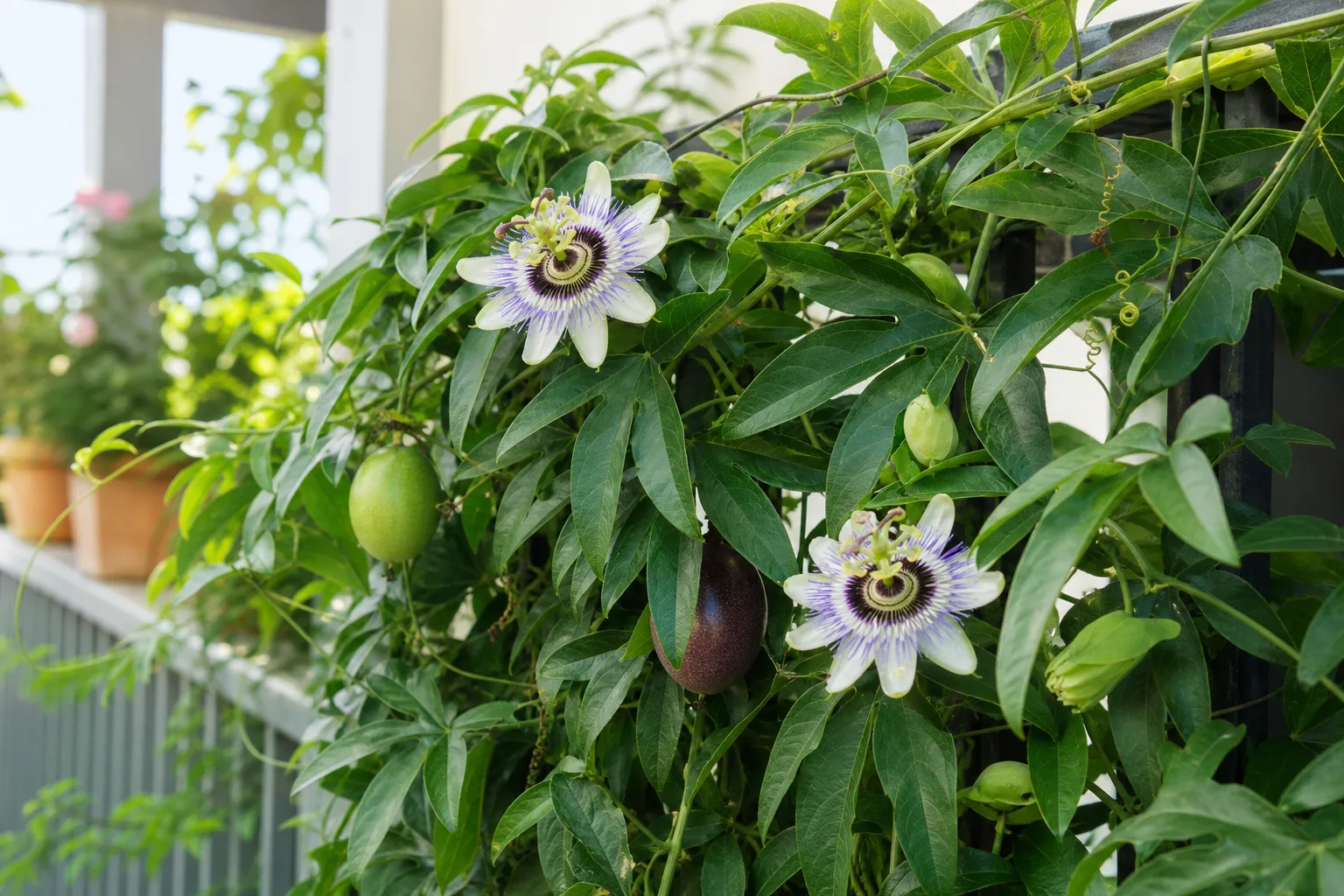
Passion Fruit Light Needs: Full Sun & Placement
Passion Fruit Light Needs: Full Sun & Placement
Passion fruit (Passiflora edulis) is a fast tropical vine grown for fragrant flowers and aromatic fruit, not for dim corners. If your plant keeps pushing soft shoots but rarely blooms, or if a once-leafy curtain suddenly thins under a tree or north wall, light is usually the first constraint to fix. UF/IFAS notes that vines held in shade or partial shade typically drop their leaves, which is the clearest species-specific signal that “bright enough for a houseplant” is not bright enough for passion fruit. (UF/IFAS)
This guide covers how much sun P. edulis needs outdoors, what balcony and trellis placements actually work in warm climates like India, how to harden seedlings without burning them, where indoor light hits its limits, and which warning signs mean move the vine before you change fertilizer or prune hard.
How much light passion fruit actually needs
Treat passion fruit as a full-sun fruit vine. For productive growth, aim for at least six hours of direct sunlight daily, with open-sky brightness around those hours rather than a single sharp beam between buildings. That six-hour full-sun definition matches how extension plant tools describe high-light climbers in the same genus; even the hardier maypop (Passiflora incarnata) is rated for full sun of six or more hours, with only part shade as a secondary option. (NC State Extension)
Commercial and home planting advice points the same direction. UF/IFAS recommends planting rows north–south to maximize sunlight exposure, and it moves young plants from partial shade into full sun only after a short hardening period. (UF/IFAS) The RHS likewise ties reliable fruiting of edible passion flowers to consistent warmth and good light, while noting that P. edulis needs tropical conditions rather than a cool borderline garden. (RHS edible passion flowers)
In practical home terms: choose the brightest warm wall, fence, or balcony you can give a strong trellis. If you must compromise, keep morning-to-midday sun and accept that deep afternoon shade under trees will cut flowering harder than a wind-sheltered full-sun terrace.
Surviving versus flowering and fruiting
A passion fruit vine can stay alive for a while in light that will never fill a kitchen bowl with fruit. Sparse leaves, long internodes, and a green curtain that never opens buds are survival mode, not success. Flowers form on new growth, and fruit only follows if those flowers are pollinated, so weak light steals both bud production and the energy to hold fruit. (UF/IFAS)
Day length also matters at the margins of the season. Classic horticultural summaries note that the fewest flowers often appear in winter when days are short, even when watering stays regular. (Purdue / Morton) In India, that means monsoon cloud cover and short winter days can slow blooming even on a “good” balcony—your job is still to keep the vine in the strongest available sun so recovery is fast when skies clear.
Judge placement by new shoots and flower buds, not by yesterday’s leaves. Old foliage can look acceptable while the growing tip has already entered shade decline.
Why shade fails on Passiflora edulis
Passion fruit is not a forest-floor houseplant. It is a tendril climber that, in nature, races toward open canopy light and can cover long runs of support when conditions favor it. UF/IFAS describes mature vines as vigorous lianas that can grow more than 35 feet in a single year under favorable conditions, with flower buds emerging with young leaves and tendrils on new tips. (UF/IFAS) That growth habit only pays off when the leaf surface sees strong light for most of the day.
Shade failures look dramatic because the plant sheds leaves instead of quietly “tolerating” dimness. Gardeners often misread that leaf drop as watering failure or disease. Check the sky first: if the trellis sits under dense tree canopy, on a north-facing balcony (northern hemisphere), or behind a tall building that steals midday sun, move or retrain the vine before you overhaul the watering routine.
Native range, vine habit, and leaf drop
P. edulis is native to regions of Brazil, Paraguay, and northern Argentina and is grown worldwide wherever climate allows. (UF/IFAS) Purple types are often associated with higher tropical elevations, while yellow types and many purple–yellow hybrids are considered better suited to warmer, lower sites—useful context in India, where hill stations and coastal plains are not interchangeable. (Purdue / Morton)
Do not confuse edible passion fruit with maypop (P. incarnata), the hardier North American relative that can flower even without climbing and tolerates a wider temperate range. Maypop’s “full sun to part shade” flexibility does not transfer to fruiting P. edulis in a warm home garden. (NC State Extension) If your goal is passion fruit pulp, design for sun first, then train the vine.
Best outdoor placement in warm climates
In tropical and warm subtropical homes, the winning placement is a warm, open, wind-sheltered full-sun site with a sturdy trellis, fence, or arbor the tendrils can grip. UF/IFAS recommends USDA hardiness zones 9b and warmer for P. edulis, which maps cleanly to much of India’s frost-free coastal and inland warm regions when winter protection is available farther north. (UF/IFAS)
Keep the root zone in well-drained soil or a large container; passion fruit has a shallow root system and limited flood tolerance, so a bright site that stays waterlogged after monsoon rains will fail even in perfect sun. Pair placement with the soil guide rather than hoping light alone will compensate for soggy mix.
Optimum temperatures for growth and production generally fall around 65–90°F (about 18–32°C); outside that band, growth, flowering, pollen viability, and fruit set can drop even when the sky is clear. (UF/IFAS) In extreme heat, prioritize open morning sun, airflow, and moisture management over moving the vine into permanent deep shade.
Balconies, terraces, and trellis orientation
On apartments and terrace gardens, compass direction and obstruction matter more than “outdoor” as a label. Prefer south- or west-facing exposures in the northern hemisphere when heat is manageable, or east-facing when western masonry reflects punishing late heat. Orient the fruiting curtain so leaves see the open sky; a north–south trellis run still helps maximize daily light on the canopy, matching UF/IFAS orchard orientation logic at home scale. (UF/IFAS)
Avoid planting under dense overhead shade cloth meant for ferns, or training the vine into a cool light well that never receives direct sun. If the only balcony is dim, grow lights can maintain foliage, but fruiting expectations should stay modest until you can summer the pot outdoors. Use a strong support early—once the vine is leafy, wind load rises quickly—and keep pruning decisions tied to light on the fruiting curtain via the pruning guide.
Direct sun, heat, and leaf scorch
Established, acclimated passion fruit vines are meant for full sun outdoors. Scorch appears mainly when soft nursery leaves meet sudden high radiation, when roots are dry in a hot pot, or when vines bake under glass without light shade. The RHS notes that direct sunlight under glass in summer can scorch edible passion flowers, so lightly shade conservatory plants in hot weather while still providing strong overall light. (RHS edible passion flowers)
Outdoors, bleached or crisp patches on the sun-facing side after a sudden move are sun stress, not a reason to permanently hide the plant. Correct the exposure path, check moisture with the watering guide, and wait for new, adapted leaves rather than chasing every damaged blade with fertilizer.
Acclimating seedlings and nursery vines
Young passion fruit plants burn easily in abrupt full sun. UF/IFAS advises keeping newly germinated plants in partial shade rather than direct sunlight, then moving them through partial sun for several days before planting in full sun. (UF/IFAS) Cuttings rooted under humidity covers should start in indirect light until they are ready for the final site.
Use a two-week hardening schedule in practice. Begin with bright open shade and one to two hours of gentle morning sun, then add direct exposure every couple of days while watching the newest leaves. Pause during heatwaves, and do not combine a major light jump with hard pruning, heavy feeding, and repotting in the same week—stage root work with the repotting guide once the vine is stable.
Indoor and conservatory light limits
Indoors, passion fruit is a space-hungry climber that needs the brightest position you can offer: an unobstructed south window in the northern hemisphere, a sunroom, or a heated greenhouse. The RHS separates hardy ornamental passion flowers from tender edible types and states that P. edulis needs tropical conditions with winter temperatures no lower than about 10–16°C (50–61°F) in their growing guide, while the edible guide also flags dislike of winter minima below about 15°C (59°F)—treat cool rooms as unsuitable for fruiting plants. (RHS growing guide) (RHS edible passion flowers)
A bright living-room corner that works for a snake plant will not drive passion fruit flowering. If you grow indoors for flowers and fruit, expect to supplement light and train vines on a large frame, then hand-pollinate when carpenter bees are absent—pollination quality still decides pulp fill even in perfect light. (UF/IFAS)
Grow lights as a supplement, not a shortcut
Use full-spectrum LED grow lights when winter days are short, monsoon weeks are gray, or the only indoor site lacks direct sun. Hang lights close enough that new growth stays compact, run them roughly 12–14 hours in active growth, and keep the canopy from pressing into hot diodes. Grow lights can maintain a vine and support some flowering; they rarely match an open terrace for long fruiting seasons.
If the plant is only decorative indoors, say so honestly and keep expectations on foliage. If fruit is the goal, plan summer outdoor placement or a conservatory with strong light and warmth rather than hoping a north window plus fertilizer will substitute.
Warning signs of too little or too much light
Too little light usually shows as leaf drop in shade, long soft internodes, pale new leaves, few or no flower buds, and soil that stays wet far longer than it did in brighter weather. UF/IFAS’s shade leaf-drop note is the diagnostic anchor—move the vine toward sun before assuming a mystery disease. (UF/IFAS)
Too much light or heat after a sudden move shows as bleached yellow-tan patches, crisp edges on the exposed face, and wilt that recovers poorly until roots catch up with higher demand. Under glass, scorch without outdoor wind cooling is common; add light summer shading while keeping overall intensity high. (RHS edible passion flowers)
First action when unsure: photograph the vine at mid-morning and mid-afternoon on a clear day. If leaves see little or no direct sun in either photo, improve placement. If they are suddenly in harsh unfiltered sun after weeks indoors, pull back to bright shade for a few days, then resume gradual acclimation. Confirm water and drainage next using the overview and watering guides so light fixes are not undone by wet roots.
When to use this page vs other Passion Fruit guides
Use this page to decide sun hours, balcony orientation, seedling hardening, indoor limits, and light-related leaf drop or scorch. Switch to sibling guides when another factor is primary:
- Passion Fruit overview for whole-plant expectations, climate fit, and how light sits beside other care basics.
- Passion Fruit watering when brighter sun suddenly dries pots faster or shade keeps roots wet.
- Passion Fruit soil when drainage or mix quality is limiting growth even in good sun.
- Passion Fruit fertilizer after light is fixed and new growth is active.
- Passion Fruit pruning to renew fruiting wood once the canopy actually receives sun.
- Passion Fruit propagation and repotting when you are multiplying vines or upsizing containers rather than diagnosing light.
Related Passion Fruit guides
- Passion Fruit overview — identity, habit, and care map for Passiflora edulis.
- Passion Fruit watering — moisture checks that change when sun exposure rises.
- Passion Fruit soil — drainage for shallow-rooted vines in full sun.
- Passion Fruit fertilizer — feeding once light and growth are active.
- Passion Fruit pruning — training the fruiting curtain in bright sites.
- Passion Fruit propagation — starting cuttings and seedlings before full-sun planting.
- Passion Fruit repotting — container size and root refresh for terrace vines.
Conclusion
Passion fruit rewards the brightest warm site you can give a strong trellis: full sun for most of the day, open sky on the leaf surface, and a gradual path from nursery shade into that exposure. Shade and partial shade push Passiflora edulis toward leaf drop and sparse flowering, while abrupt full sun on soft young leaves causes avoidable scorch. Fix placement first, then align watering, soil, and pruning with the brighter growth rate—and keep indoor fruiting ambitions honest unless you can match tropical light and warmth.