Overwatering on Passion Fruit: Causes, Checks & Fixes
Quick answer
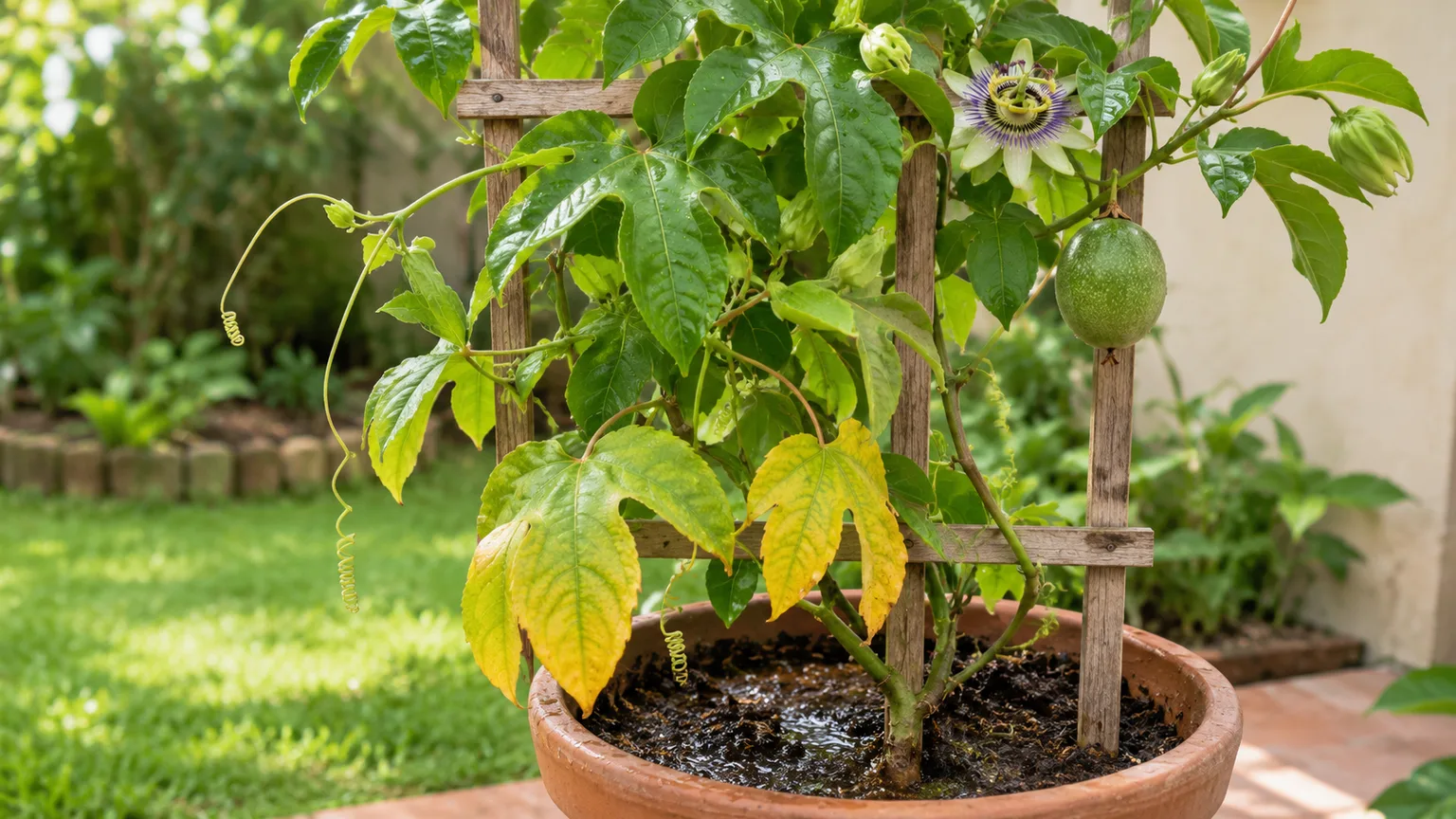
Overwatering on Passion Fruit shows as yellowing leaves while the mix stays wet, a heavy pot, and sometimes a soft stem base or sour-smelling soil. First step: empty any saucer water and stop watering until the top 2-3 cm of mix dries.
Overwatering on Passion Fruit: Causes, Checks & Fixes
This guide covers overwatering on Passion Fruit. See also the general Overwatering guide, watering, and light pages for this plant.
Overwatering on Passion Fruit: Causes, Checks & Fixes
Quick answer
Overwatering on Passion Fruit (Passiflora edulis) means its shallow roots sit in saturated mix long enough to lose oxygen, so the vine yellows and wilts despite standing in moisture. Expect yellow leaves while the soil stays wet, a pot that stays heavy for days, and in worse cases a soft or darkened stem base and sour-smelling mix. For how soggy mix damages roots in general, see our overwatering guide. On Passion Fruit, the pattern usually shows up as stalled shoot tips and drooping tendrils on a vine whose pot still feels full of water.
First step: empty any saucer or cachepot water and stop watering until the top 2–3 cm of mix dries. Do not fertilize, prune hard, or move the vine to a bigger pot on day one. Recheck moisture at depth with a finger before every watering, not on a fixed schedule.
What overwatering looks like on Passion Fruit
On this vine, the earliest signal is yellowing leaves paired with damp soil — the opposite of what most growers expect from a thirsty-looking plant. Lower and older leaves usually yellow first while the newest shoot tips slow down or stop extending. Tendrils may stay limp instead of curling firmly around the trellis on your Passion Fruit overview.
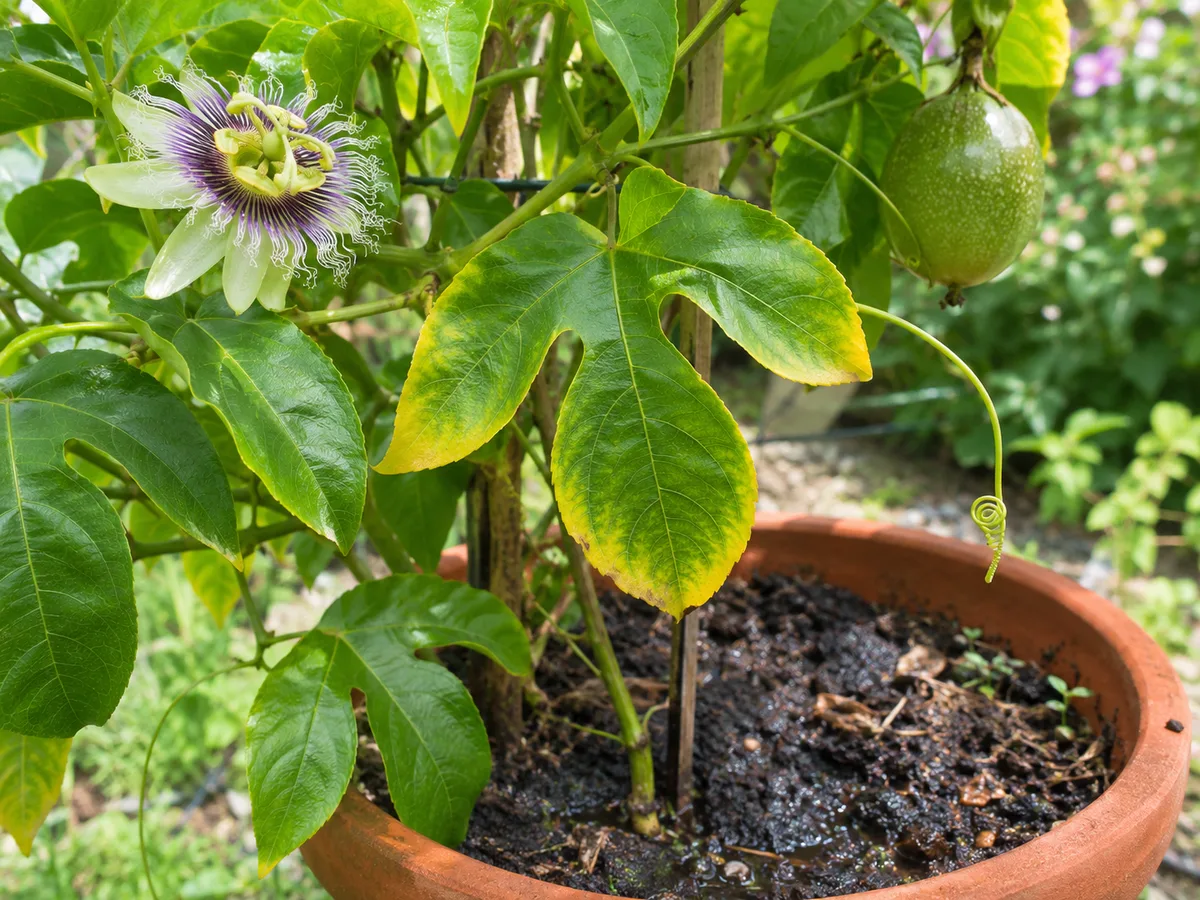
Yellowing older leaves and damp mix are a common overwatering pattern on Passion Fruit.
As the root zone stays saturated, the stem base near soil level can soften or darken, and the mix may develop a sour smell. A vine can wilt suddenly and fail to perk up after watering, because damaged roots cannot move water upward — roots in waterlogged soil die when they cannot absorb the oxygen they need to function (Missouri Botanical Garden). Flower buds forming on new growth may drop, and young fruit can stall, since fruit only forms on fresh shoots after successful pollination.
Why this vine stays too wet
Passion Fruit grows fast in warm weather and drinks heavily, which tricks owners into watering on a calendar. But it carries a shallow root system that dislikes both drought and waterlogging, so frequent shallow top-ups in a slow-draining pot keep the lower root zone permanently wet. Containers are the usual trap: a small black nursery pot heats and dries fast on top while the center stays soggy, and saucers left full after watering re-soak the mix from below. A specialist grower notes that passion fruit wants moisture but also oxygen around its roots, with drainage holes and no standing water under pots (John’s Passion Fruit Express).
Heavy or compacted mixes make the same problem worse. The vine wants fertile soil that holds useful moisture yet drains freely — practical guidance recommends keeping it evenly moist but never waterlogged, in well-draining fertile soil (Get Busy Gardening). Rainy spells count too: after repeated storms, irrigation on top of rain keeps roots saturated for days. And in cool weather the vine slows down and uses far less water, so a summer rhythm continued into the cold season leaves the pot wet — the same wet-soil root rot risk NC State Extension flags for passionflowers in poorly drained ground (NC State Extension).
How to confirm before you act
Work through these checks in order on your Passion Fruit watering routine before changing anything:
- Finger test at depth. Push a finger 2–3 cm into the mix. If it feels damp there, the vine does not need water even if the surface looks dry.
- Lift the pot. A heavy pot days after watering means the root zone is still saturated. Compare against its weight right after a full drain to learn the difference.
- Check the saucer. Standing water under the pot is direct evidence of re-soaking. Empty it and note how fast it refills.
- Inspect the stem base. Firm and greenish-brown is reassuring; soft, dark, or translucent tissue near soil level signals advancing trouble.
- Smell the drainage holes. A sour or stagnant odor means anaerobic breakdown around the roots.
- Read the newest growth. Stalled shoot tips, limp tendrils, and yellowing on wet mix confirm overwatering. Fresh green tips on a drying pot mean the vine is already turning the corner.
The first fix to try
Empty all standing water and let the top 2–3 cm of mix dry before watering again — that single dry-down is the whole first fix. Move the pot out of its saucer puddle, tip out trapped water, and set it where air circulates and sun reaches the foliage. Then leave the watering can alone until the depth check says the upper root zone is actually drying.
This pause works because most mild cases are a timing problem, not a disease yet. Roots that still have firm white tips recover function once air returns to the pore spaces. Only escalate to unpotting if the checks above show a soft stem base, sour mix, or continued collapse after the dry-down.
Step-by-step recovery
If stems are firm and the mix just stays wet too long:
- Stop watering and empty saucers until the top 2–3 cm dries.
- Loosen the surface gently with a chopstick if it has crusted, without stabbing deep into roots.
- Water thoroughly only when the depth check passes, letting excess run fully out the drainage holes.
- Resume the vine’s normal rhythm from the soil and drainage setup — check first, pour second.
If the stem base is soft, the mix smells sour, or the vine collapses on wet soil:
- Slide the vine from its pot and shake off saturated mix; rinse roots gently under clean water so you can see what is firm.
- Trim only the dark, mushy roots with sharp shears cleaned before and after, keeping every firm pale root.
- Repot into fresh free-draining mix at the same depth — never deeper, and never into a much larger pot — then water once lightly and drain fully. Standard rot-rescue practice follows this sequence of rinsing, trimming with clean tools, discarding old soil, and repotting into clean mix (Gardening Channel).
- Hold fertilizer for at least a week while roots re-establish; feeding a root-damaged vine risks shock rather than helping (Gardening Channel).
- If the whole stem base is mushy with no firm tissue left, the original vine is unlikely to recover — restart from a healthy cutting or a new plant instead of nursing dead wood.
Recovery timeline
Mild cases stabilize within one to two watering cycles once the dry-down rhythm starts. Judge progress by new growth, not by old leaves: firm green shoot tips, tendrils wrapping the support again, and clean new leaves mean roots are working. Already-yellowed leaves rarely green up; they may drop as the vine redirects energy.
After a repot rescue, expect two to four weeks of quiet before fresh extension growth resumes in warm weather. Flower buds appear only on new shoots, so blooming pauses until the vine produces healthy fresh wood. If yellowing spreads to new leaves, the stem base keeps softening, or the sour smell persists despite fresh mix, root failure is advancing — see root rot on Passion Fruit for the escalation path.
Lookalikes: what else mimics wet feet
| What you see | More likely | How to tell |
|---|---|---|
| Wilt on a light, dry pot with mix pulling from the walls | Underwatering | Depth check finds dry mix 3+ cm down; vine perks within hours of a thorough drink |
| Afternoon droop that recovers by evening | Heat stress | Soil moisture reads normal and the vine rebounds as temperatures fall |
| Yellow leaves on well-drained mix with green veins or pale new growth | Nutrient or pH issue | Moisture and roots check out fine; see yellow leaves on Passion Fruit |
| Limp vine with soft stems at multiple points plus spreading collapse | Root rot or wilting disease | Sour soil, dark mushy roots, no recovery after dry-down |
| White fuzz or tiny flies on persistently damp mix | Surface mold or fungus gnats | See mold on soil and fungus gnats; both ride along with overwatering rather than causing it |
Drooping leaves alone never settle the question — moisture depth and pot weight separate thirst from saturation. Full scope routing lives in when to use this page vs other Passion Fruit guides below.
Mistakes to avoid
- Watering because leaves droop. On wet mix, droop means roots cannot drink. Check depth first.
- Feeding a stressed vine. Fertilizer does not fix oxygen-starved roots and can burn damaged tissue. Correct water and drainage before any feed.
- Repotting into a bigger pot. Extra unused mix stays wet longer than shallow roots can use. Keep or downsize to fit the actual root mass.
- Daily sips. Light daily watering wets the surface while the lower zone never dries and never fully flushes. Water thoroughly, then wait.
- Piling mulch against the stem. Mulch moderates moisture well, but a collar of wet mulch on the stem base invites softening. Keep it pulled back a few centimeters.
- Chewing-risk blind spot. Vine leaves and stems carry cyanogenic glycoside concerns documented across passionflowers, so keep pets and children from chewing stressed prunings while you work (NC State Extension).
How to prevent it next time
Water the root zone, not the calendar. Pot size, sun, wind, and rainfall all change how fast the mix dries, so the finger check at 2–3 cm plus pot weight beats any fixed-day rule — the same observation-over-schedule approach specialist growers recommend (John’s Passion Fruit Express). Count rainfall as watering and skip irrigation after storms until the depth check passes.
Keep the physical setup honest: a pot with open drainage holes, free-draining fertile mix, and an emptied saucer every time. In the ground, plant slightly proud on loosened soil or a low mound where drainage is doubtful, and keep mulch off the stem. Train vines early onto their support so air moves through the canopy instead of trapping humidity at the base. When cool weather slows growth, stretch the interval and let pots dry a little further between drinks — steady moisture in summer, restraint in winter.
When to use this page vs other Passion Fruit guides
Use this page when moisture checks show wet mix plus heaviness, yellowing, or wilt that ignores watering. Move to root rot when roots are dark and mushy or the stem base is soft. Start from yellow leaves when moisture reads normal and color is the only symptom. Check underwatering when the pot is light and mix is dry at depth. Browse the full Passion Fruit problems hub when several symptoms overlap.
Related Passion Fruit guides
- Passion Fruit overview — sun, trellis, and drainage basics for the whole vine.
- Passion Fruit problems hub — entry point when you are unsure which problem page fits.
- Passion Fruit watering — the normal rhythm this page’s dry-down checks plug into.
- Passion Fruit soil — free-draining mix ratios and pH for shallow roots.
- Yellow Leaves on Passion Fruit — use when yellowing persists on well-drained mix.
- Root Rot on Passion Fruit — escalation path for mushy roots and stem-base decay.
- Underwatering on Passion Fruit — the mirror image: light pots and dry-depth checks.
- Wilting on Passion Fruit — use when wilt crosses with heat or disease signs.