Fungus Gnats on Passion Fruit: Dry-Down Without Fruit Drop
Quick answer
Fungus gnats on Passion Fruit usually mean the top layer of a container mix stays wet while you keep the shallow root zone evenly moist for vine growth—adults are a nuisance; larvae chew fine root hairs. First step: let only the top 2–3 cm dry between thorough waterings, set a yellow sticky trap at the pot rim, and confirm larvae with a potato slice before any Bti drench.
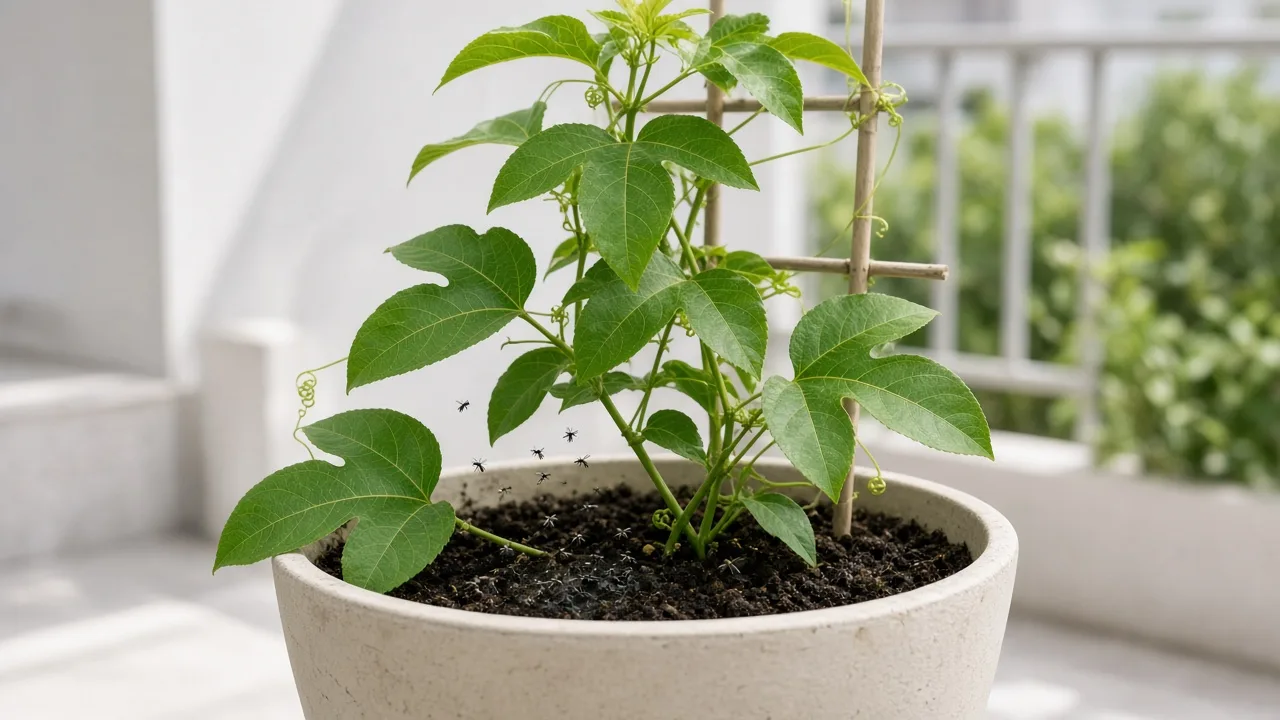
Fungus Gnats on Passion Fruit: Moist Pots, Larvae & Fixes
This guide covers fungus gnats on Passion Fruit. See also the general Fungus Gnats guide, watering, and light pages for this plant.
Fungus Gnats on Passion Fruit: Moist Pots, Larvae & Fixes
Quick answer
Fungus gnats on Passion Fruit (Passiflora edulis) almost always point to a persistently damp top layer of organic potting mix in containers kept evenly moist for vine growth and fruit set. Adults are a nuisance around the pot and trellis; the real risk is larvae chewing fine root hairs on seedlings, cuttings, and shallow-rooted pots. For universal fungus-gnat biology and monitoring methods, see our fungus gnats hub. On Passion Fruit, the useful pattern is flies rising from a heavy grow bag or pot while trilobed leaves still look green and flowers or young fruit are forming—not chewed foliage or honeydew.
Your first fix is a surface dry-down only: wait until the top 2–3 cm of mix feels dry and the pot lightens, then water deeply and empty saucers. Place a yellow sticky trap at the rim the same day. Confirm larvae with a potato slice before you drench anything.
Scope note: This page covers gnats breeding in wet Passion Fruit mix. If the stem softens at the soil line on sour, saturated soil, pair this guide with overwatering on Passion Fruit or root rot. White fuzz on the surface without matching flies belongs on mold on soil.
What fungus gnats look like on Passion Fruit
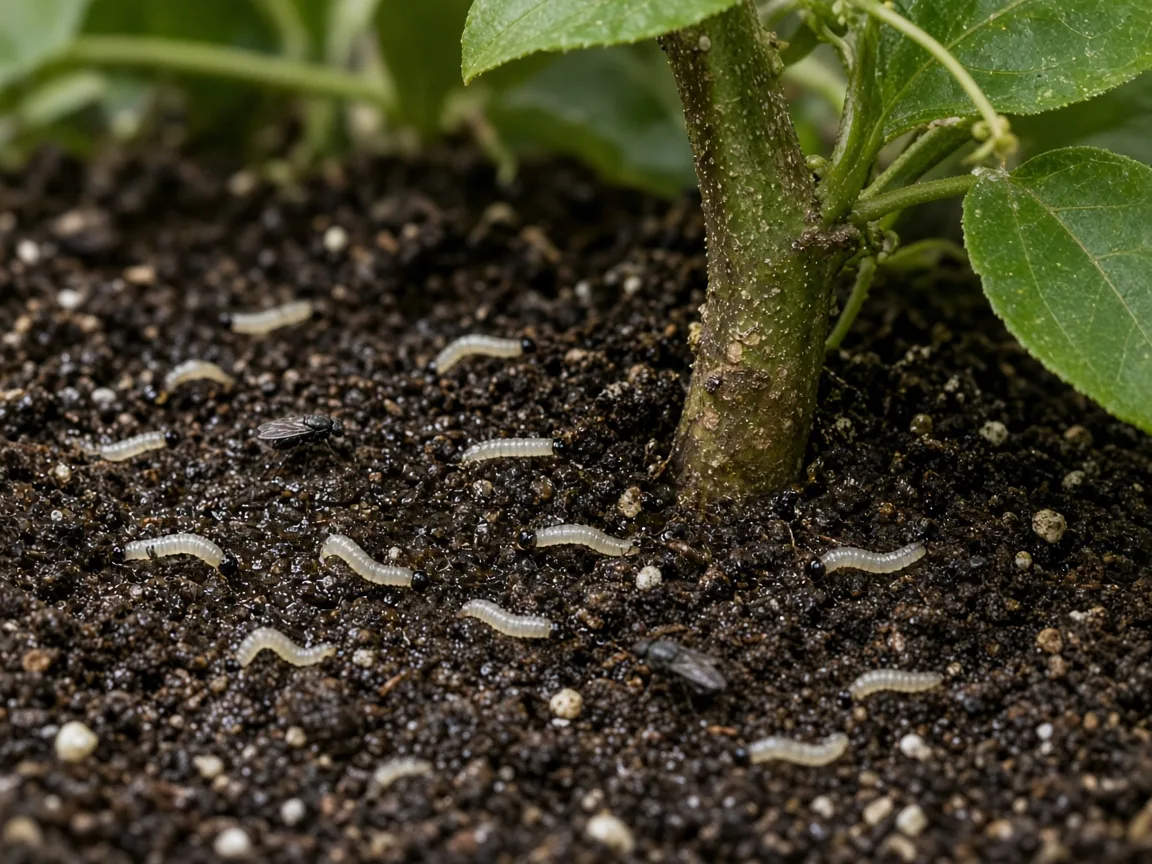
Adult fungus gnats and damp container mix at the Passion Fruit soil line—check the surface of the pot or grow bag, not the trilobed leaves or hanging fruit, for the breeding site.
Adults: Small, dark, mosquito-like flies about 1/16–1/8 inch long with slender legs and relatively long antennae. UC IPM notes adults do not damage plants or bite people; they skim the soil, rest on pot rims, and drift toward windows or bright balcony walls. On Passion Fruit they appear when you water or bump a container—not as leaf-chewing insects on the vine canopy.
Larvae: Whitish-to-clear, legless maggots with shiny black heads living in the top inch of moist media. They feed on fungi, organic debris, and root hairs. RHS links some sciarid larvae to soft seedling roots and cutting bases in damp compost. That matters most for Passion Fruit started from seed or cuttings under humidity domes, where a shallow root system has little reserve.
Plant stress overlap: A young Passion Fruit that wilts while the mix stays wet may have larval root-hair loss, oxygen-starved roots, or both. Do not assume thirst and pour again—probe moisture first using the checks in the Passion Fruit watering guide.
Why Passion Fruit containers breed fungus gnats
Passion Fruit is a fast tropical climber with a shallow root system that wants steady moisture without flooding. UF/IFAS notes limited drought and flood tolerance, prefers well-drained soil, and recommends small but frequent irrigation so moisture stays adequate without saturation. That care profile collides with fungus gnats when growers keep the surface wet “because passion fruit likes water.”
Evenly moist pots that never dry at the surface
Container vines on a balcony or terrace often need water every one to three days in heat—sometimes daily in small pots. Each soak must still leave the top 2–3 cm able to dry between drinks. Calendar misting that only wets the surface, saucers left full, or a cachepot that never empties keeps the larval zone active while deeper roots still need oxygen. Align frequency with the watering guide and structure with the soil guide—moisture-retentive yet free-draining, not a peat sponge.
Grow bags, stands, and organic-rich media
UF/IFAS describes grow-bag culture on stands specifically to improve drainage and avoid soil contact. Bags sitting flat in trays of runoff recreate the same wet surface band larvae love. Epic Gardening flags peat- and coco-heavy mixes as favored breeding sites. Compost-heavy Passion Fruit blends that stay cool and dark for four days after watering invite egg-laying even when the vine looks lush.
Cuttings, humidity domes, and shaded dry-down
UF/IFAS keeps cuttings moist under humidity domes or bags—useful for rooting, and also ideal for sciarids if the media never lightens. A vine moved into afternoon shade after full-sun training uses water more slowly; continuing daily soaks leaves the surface damp for a week. Give containers the bright placement the light guide describes so pots dry on a predictable cycle.
Fruit-set moisture without a swampy crown
Drought stress cuts flowering, fruit set, and fruit size, and increases Fusarium susceptibility. Growers rightly refuse to bone-dry a fruiting vine—but constant saturation at the crown raises Phytophthora-style root and collar risk noted in passionfruit culture summaries. Fungus gnats are often the early warning that the surface stays wetter than the fruit needs.
Confirm larvae before you change Passion Fruit care
- Flight test — Flies rise from this pot’s soil line when disturbed, not only from overripe fallen fruit under the trellis.
- Surface moisture — Top 2–3 cm stay cool and damp many days after a deep watering; the pot still feels heavy.
- Potato slice — UC IPM and Wisconsin Horticulture both recommend raw potato chunks cut-side down for a few days; lift and look for black-headed larvae on the underside, then discard the slice.
- Stem and crown check — Firm green stem and active tendril tips with many flies = early moisture/gnat issue. Soft, darkened tissue at the soil line on sour mix = escalate toward root rot.
- Neighbor pots — Check every peat tray, cutting dome, and tropical pot on the same balcony; adults are weak fliers but move between damp containers.
Lookalikes on Passion Fruit
| What you notice | More likely cause | Next step |
|---|---|---|
| Tiny dark flies rising from damp mix; larvae on potato | Fungus gnats | Dry-down + sticky trap; optional Bti |
| White fuzzy film on wet surface, few or no flies | Surface mold | Mold on soil |
| Soft stem base, sour saturated mix, stalled vine | Overwatering / root decline | Overwatering or root rot |
| Limp leaves on a light, bone-dry pot; fruit drop | Underwatering | Underwatering |
| Flies on overripe fallen fruit, not at the soil line | Fruit flies | Collect dropped fruit; recheck the pot |
| Cottony white clumps on stems or fruit stalks | Mealybugs | Mealybugs |
First fix for Passion Fruit
Let the top 2–3 cm of mix dry, then water deeply and drain. Set one yellow sticky trap at the pot rim.
That single correction hits the breeding window without starving a vine that still needs frequent drinks in heat and during fruit swell. UC IPM’s primary cultural control is allowing the surface of container soil to dry between waterings and improving drainage. Wisconsin Horticulture likewise emphasizes letting the top inch dry before watering. On Passion Fruit, “surface dry” means the depth you already use for a watering check—not a week of total drought that drops flowers or immature fruit.
After dry-down starts:
- Keep saucers empty; elevate grow bags so runoff escapes.
- Use yellow sticky cards near the soil line to catch egg-laying adults. RHS notes sticky traps reduce adults but can catch non-target insects, so place them at the rim rather than broadcasting cards across the whole trellis.
- If adults keep emerging after two weeks of true surface dry-down and potato tests still show larvae, drench with Bacillus thuringiensis subspecies israelensis (Bti) products labeled for fungus gnats (for example Gnatrol or Mosquito Bits watered in). UC IPM advises repeating Bti about every five days because it does not persist indoors and does not kill eggs or adults. Caterpillar Bt (kurstaki) will not work.
Shallow roots, larvae, and fruiting vines
Seedlings and cuttings are the high-stakes case. Fine root hairs sit in the same wet peat band where larvae feed. Wilting, stalled leaf expansion, or sudden collapse in a constantly wet dome can follow heavy larval feeding, especially when oxygen is already low. Start plants per the propagation guide in clean media with drainage holes you actually use.
Fruiting container vines with a firm stem usually suffer gnats as a moisture alarm more than as a lethal root pest. Adults still signal that the surface is too wet too often—the same pattern that invites Phytophthora-style crown problems linked to poor drainage. Fix the cycle before the soft stem base appears, and do not chase gnats by withholding water while flowers or young fruit are sizing up.
Step-by-step recovery
- Days 1–3: Pause shallow sprinkles. Wait for the top 2–3 cm to dry. Install sticky traps. Run a potato test on the worst pot.
- Days 4–10: Resume deep soak-and-drain only when the surface check passes. Empty saucers within minutes. Refresh potato slices and note fewer larvae.
- Days 10–21: If flies still pour off the rim on a drying surface, apply Bti per label two to three times about five to seven days apart. Do not stack foliar fungicides, neem soil soaks, and peroxide on the same day “just in case.”
- Weeks 3–4: Trap counts should fall. New Passion Fruit leaves and tendrils should expand normally; flowers and set fruit should hold if root moisture stayed even below the dry surface. Remixed or newly potted plants should use a free-draining blend from the soil guide.
- Ongoing: Quarantine new nursery Passion Fruits for two weeks with a trap at soil level before they join other pots.
Tissue reality: Leaves that yellowed from wet roots will not re-green. Judge success by falling trap counts, a surface that dries between soaks, firm stem tissue, clean new vine growth, and fruit that stays on the vine when heat arrives.
Mistakes to avoid on this vine
- Bone-drying the entire root ball for weeks—Passion Fruit drops flowers and fruit under drought even while gnats decline.
- Stacking fungicides, oils, and systemic insecticides on a plant whose only confirmed issue is damp mix and gnats.
- Misting the canopy to “raise humidity” while the mix never dries; humidity does not replace free drainage.
- Leaving grow bags in trays of runoff or humidity domes sealed for weeks after roots have formed.
- Treating window-swarming adults with aerosol fogging while larvae keep breeding in the pot.
- Ignoring soft stem bases because “it’s just gnats”—wet-soil disease is the larger Passion Fruit risk.
How to prevent fungus gnats next time
- Match watering to heat and pot weight: frequent in hot sun, less when cool or cloudy, always with free drainage (watering).
- Use fertile, fast-draining container mixes with ample perlite, pumice, or bark—not pure peat cubes (soil).
- Elevate grow bags and empty saucers; start cuttings in clean media (propagation).
- Give vines full sun so pots dry on schedule (light).
- Collect fallen fruit promptly so fruit flies do not confuse the diagnosis, and quarantine new plants with a sticky card at the rim.
Related tool
Use the Pest Identifier to confirm whether the small flies around your Passion Fruit pot are fungus gnats versus other indoor flies before you change watering or apply a drench.
Related Passion Fruit guides
- Passion Fruit overview — growth habit, moisture needs, and climate fit
- Watering — top 2–3 cm dry-down without drought stress on fruit
- Soil — free-draining mixes that still hold even moisture
- Light — full-sun placement that speeds predictable dry cycles
- Propagation — clean cutting and seedling media
- Overwatering — wet-soil triage when the stem softens
- Root rot — mushy roots and sour saturated mix
- Mold on soil — surface fungi without matching gnat flights
- All Passion Fruit problems — full diagnostic directory
When to use this page vs other Passion Fruit guides
- This page — Tiny flies at the soil line, damp container mix, firm stem; dry-down, traps, optional Bti without stressing fruit set.
- Watering guide — Routine moisture checks before you assume a pest outbreak.
- Overwatering / root rot — Soft stem, sour wet mix, or declining roots even if gnats are also present.
- Mold on soil — Fuzzy surface growth is the main symptom.
- Problems hub — Browse every common Passion Fruit issue when the pattern is unclear.