Brown Tips on Passion Fruit: Lobed-Leaf Tip Burn Fixes
Quick answer
Brown tips on Passion Fruit are dry tan necrosis at the lobe tips and outer margins of adult trilobed leaves—not scattered water-soaked spots. First step: check pot weight and the mix surface; if the pot is light and dry, deep-water once and resume even moisture. If the mix is already moist with a white rim crust, flush salts before raising humidity or feeding.
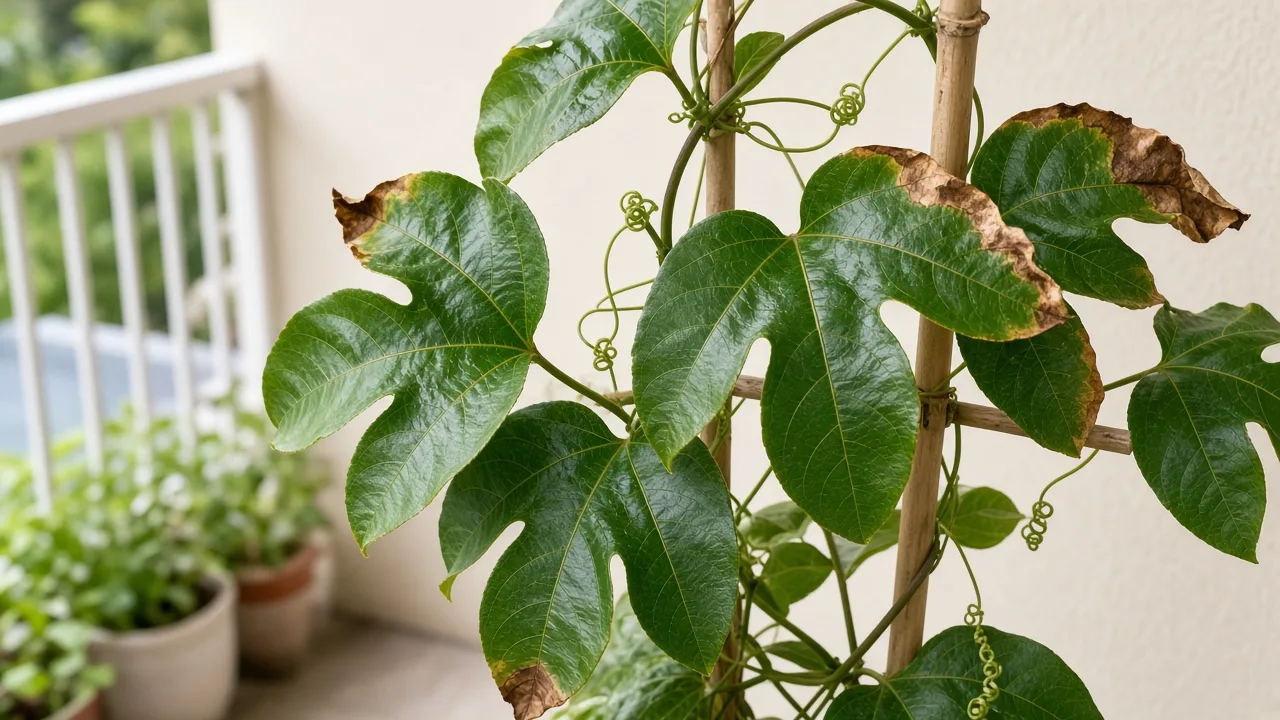
Brown Tips on Passion Fruit: Causes, Checks & Fixes
This guide covers brown tips on Passion Fruit. See also the general Brown Tips guide, watering, and light pages for this plant.
Brown Tips on Passion Fruit: Causes, Checks & Fixes
Quick answer
Brown tips on Passiflora edulis mean dry tan necrosis at the lobe tips and outer margins of adult trilobed leaves while stems and tendrils stay firm—not round water-soaked lesions scattered across the blade. For how leaf-edge burn works in general, see our brown tips hub. On passion fruit, the first fork is pot weight plus the newest shoot-tip leaf: thirst or wind desiccation shows on a light dry pot or exposed trellis, salt burn browns margins on moist mix with a mineral crust, and dry air crisps tips even when the pot still feels correctly moist.
First step: lift the container and finger-test the top 2–3 cm of mix. Light pot + crispy lobe tips only = deep-water once, then follow the watering guide. Moist pot + white rim crust = flush salts before you mist or fertilize. Moist pot + tip-only crisping in heated dry rooms or windy balconies = raise humidity and add wind shelter without keeping foliage constantly wet.
When to use this page vs other Passion Fruit guides
| Pattern | Read next |
|---|---|
| Whole lobes yellowing, not just the tip | Yellow leaves |
| Soft limp leaves, very light pot | Underwatering or drooping leaves |
| Soft stem base, sour wet soil | Overwatering or root rot |
| Tip crisping with dry heated-room air, moist mix | Low humidity |
| Discrete water-soaked or greasy spots on blades/fruit | Bacterial or fungal leaf spot—not this tip-burn page; see problems hub |
| Speckling and fine webbing under leaves | Spider mites |
What brown tips look like on Passion Fruit
Passion fruit is a fast tendril climber with glossy adult leaves that are deeply trilobed and finely toothed—not a compact houseplant rosette. Tip burn shows at the farthest points of those lobes:
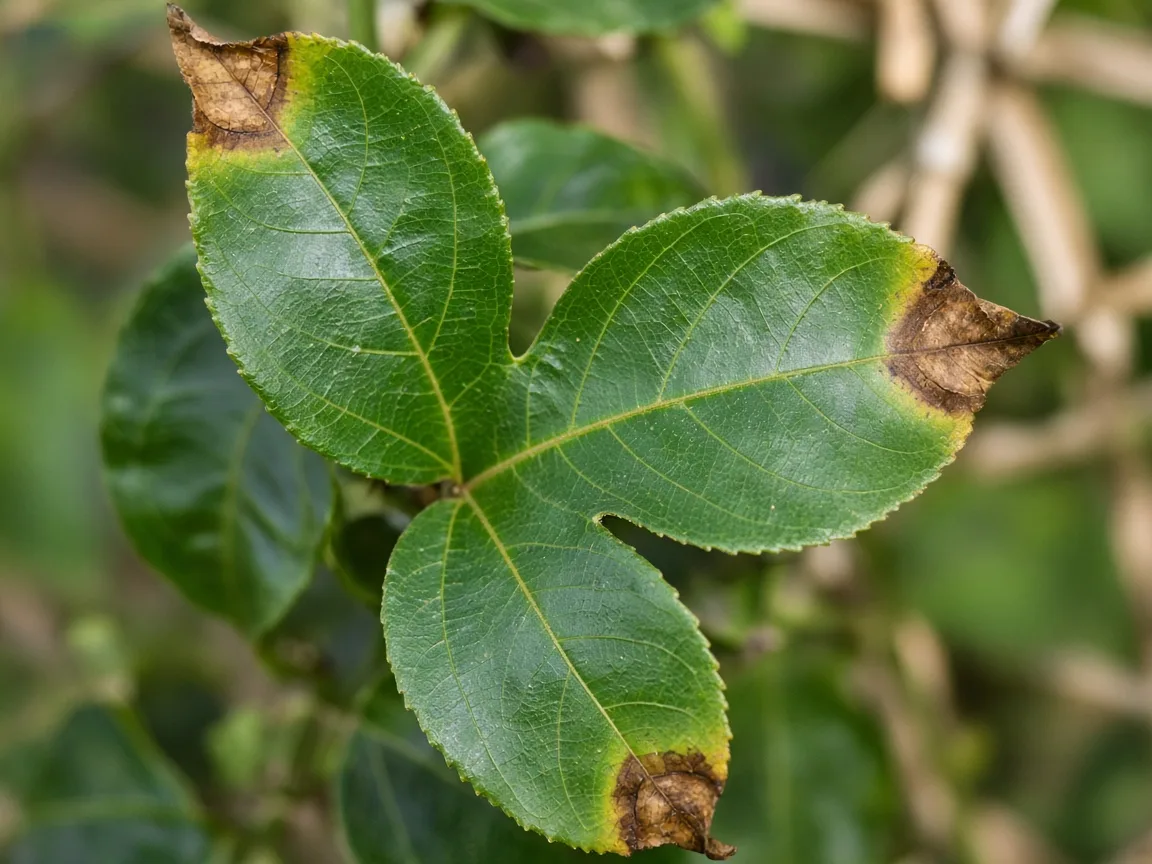
Dry tan necrosis at lobe tips and outer toothed margins—the dead edge will not re-green; watch the next shoot-tip leaf for clean lobe edges.
- Tan crispy tip or lobe margin only, green leaf center, firm stems and wrapping tendrils — Drought, low humidity, salt or fluoride edge burn, wind desiccation, or normal aging on an older curtain leaf.
- White crust on the soil surface or pot rim with tip burn — Fertilizer or irrigation salt buildup.
- Tips crispy while pot is still moist in winter heat or AC rooms — Low humidity; see low humidity.
- Tips brown first on the windward side of a balcony trellis — Wind desiccation; roots cannot keep up with leaf water loss.
- Round water-soaked, greasy, or expanding spots across the blade or on fruit — Bacterial spot or fungal leaf spot, not classic abiotic tip burn.
- Browning plus pale stippling and webbing underneath — Spider mites before blaming dryness alone.
A firm vine with a few tan-tipped older curtain leaves is common on container passion fruit and not automatically a crisis—those large lobes lose edge tissue quickly when moisture, salts, wind, or room air wobble.
Trilobed leaf tip anatomy: why passion fruit edges go first
This section is passion-fruit-specific and does not apply to small-leaved houseplants or undivided foliage.
- Adult P. edulis leaves are deeply lobed with two indentations and finely toothed margins, so the lobe tips are the farthest points from the shallow root mass.
- New growth and flower buds emerge at shoot tips with young leaves and tendrils. Thin expanding lobes show drought, salt, or dry-air damage at the tip before older curtain leaves do.
- Passion fruit needs small but frequent irrigation that keeps soil moist but not saturated—not a soak-and-dry succulent rhythm. Brief edge dryness is common when the large leaf surface loses water faster than roots can supply it.
- On a curtain-trained vine, outer hanging leaves age as the canopy densifies; tan tips on lower curtain leaves while newest shoot-tip leaves open clean often means senescence, not active decline.
Always compare the newest shoot-tip leaf to one older curtain leaf. Tip burn climbing into every new unfurl is more urgent than one fading leaf on an otherwise firm, tendril-active vine.
Tip burn vs bacterial spot lesions
Passion fruit growers often confuse two different leaf problems:
- Abiotic tip or margin burn — Even tan or brown color starting at lobe tips and edges, often paired with a light pot (drought), white soil crust (salts), dry heated-room air, or windward exposure. No discrete circular lesions with greasy or water-soaked centers.
- Bacterial spot — Xanthomonas axonopodis pv. passiflorae causes bacterial spot on purple and yellow passion fruit. Expect scattered lesions on leaf blades and often fruit involvement—not a clean tip-to-edge burn line alone.
- Fungal leaf spots and disease scorch lookalikes — UF/IFAS notes Alternaria may attack leaves and fruit with leaf spots, while Phytophthora crown problems can precede mild chlorosis that looks like leaf burn or scorch plus wilt. Those patterns are disease paths, not classic tip burn from dry air or salts.
If you see scattered dark or water-soaked spots on blades or fruit, do not treat this as a humidity or salt page alone—inspect for disease on the problems hub and avoid keeping foliage constantly wet when you water or raise humidity.
Wind desiccation on climbing vines
Passion fruit foliage sits on a tall, wind-loaded canopy. UF/IFAS recommends a strong fence or trellis that can withstand high winds when covered with vine. The RHS advises planting hardy passion flowers in a sunny, sheltered position away from cold drying winds, and Epic Gardening notes vines should be protected from extreme heat and strong wind.
Leaf scorch is a noninfectious disorder that appears when roots cannot supply water as fast as leaves lose it through transpiration—especially after dry, windy weather. On a balcony passion fruit, that often means:
- Tip and margin browning strongest on the windward face of the trellis
- Mix that dries faster than you expect in the same room where other plants stay moist
- Crispy tips even after you watered, if wind strips moisture from lobes faster than the shallow roots refill them
First shelter fix: move the pot behind a windbreak, against a wall, or deeper into the balcony corner, then resume even moisture. Do not respond to wind scorch by misting the canopy all day—wet foliage in a dense curtain invites foliar disease.
How to confirm the cause
Work through these checks in order:
- Pot weight and top 2–3 cm of mix — Light and dry = drought path. Heavy and wet with soft stem base = watering or root problem (overwatering, root rot), not tip burn alone.
- Soil or pot-rim crust — White or grey crystallized coating points to fertilizer or irrigation salts.
- Newest shoot-tip leaf — Clean new lobes while only older curtain leaves are tan-tipped = often corrected stress or aging. New leaves already tipped = active stress still present.
- Wind and room air — Windward browning or heated-room tip crisping with moist mix = desiccation or low humidity.
- Lesion shape — Continuous tip necrosis vs discrete water-soaked spots. Spots push you off this page toward disease diagnosis.
- Undersides — Stippling and webbing = mites, not salt flush first.
The first fix to try
Correct the moisture–salt fork before stacking humidity gadgets, pruning, and feeding.
- If the pot is light and dry: Water thoroughly until excess drains, empty the saucer, then return to frequent checks as in the watering guide. Passion fruit is sensitive to dry soil—drought reduces growth, flowering, and fruit set, and severe drought causes defoliation.
- If the pot is moist with a white crust: Flush the container with plain non-softened water until a large volume runs through the drainage holes, then pause fertilizer for several weeks. Excess fertilizer is a recognized scorch factor, and fertilizer salts commonly brown leaf tips when they accumulate on the soil surface or pot. Review rates in the fertilizer guide.
- If the mix is correctly moist and tips still crisp: Raise ambient humidity and reduce wind exposure next—without constant foliar wetting.
Do not fertilize a tip-burned vine on day one. Do not repot unless drainage has failed or roots are clearly rotten.
Flush salts and stabilize humidity without wet foliage
Container passion fruit is often fed regularly to support fast vine growth. UF/IFAS schedules small granular applications every 4–6 weeks through the warm season. That cadence helps fruiting vines—and it can also leave a salt rim if pots never get a thorough leach.
Salt flush (containers):
- Take the pot to a sink or outdoors.
- Water slowly with plain water until a large volume exits the drainage holes.
- Let it drain fully; do not leave the nursery pot sitting in the runoff.
- Hold fertilizer until new shoot-tip leaves open with clean margins for a couple of weeks.
- Prefer non-softened water; softened or high-fluorine water can contribute to tip burn.
Humidity without a wet canopy:
Passion fruit prefers higher humidity as a tropical vine, and low indoor humidity commonly shows as brown tips while browning along edges more often tracks underwatering. Raise RH with a pebble tray, room humidifier, or grouping—not all-day misting. UF/IFAS warns that dense unmanaged canopies form a thatch of dead leaves that can harbor fungal disease. Constantly wet foliage on a curtain-trained vine is the wrong humidity strategy.
Use the humidity calculator to set a realistic target for your room, then adjust placement and watering together.
Recovery timeline
- Days 1–3: Pot weight stabilizes after deep watering or flush; no new rapid inward march of brown tissue.
- 1–2 weeks: Newest shoot tips produce leaves with cleaner lobe edges; tendrils keep attaching.
- 2–4 weeks: Tip burn stops spreading on recently expanded leaves. Old necrotic tips stay brown—trim only if the dead edge bothers you or collects dust.
- Ongoing: Resume light feeding only after clean new growth appears; keep the soil mix free-draining so frequent watering does not become waterlogging.
Judge recovery by new shoot-tip leaves, not by old brown tips turning green again.
Mistakes to avoid
- Misting the canopy all day “for humidity” while leaves stay wet in dense curtain growth
- Stacking fertilizer, hard prune, and repot on the same day a tip burn shows up
- Assuming every brown tip is underwatering when the pot is still heavy and crusted with salts
- Ignoring wind on a balcony trellis while only changing the watering calendar
- Treating discrete leaf-spot lesions as tip burn and delaying disease inspection
- Using softened water for every flush and feed cycle
How to prevent it next time
- Keep the shallow root zone evenly moist with free drainage—follow watering and soil guidance.
- Feed on a measured schedule from the fertilizer guide, then flush containers periodically.
- Shelter the trellis from cold drying winds; use a sturdy support that can hold a leafy canopy.
- Raise room humidity for indoor or enclosed vines without leaving foliage wet for hours.
- Prune congested thatch in the dormant season so air moves through the curtain without chronic leaf wetness.
- Recheck the overview when placement, light, or pot size changes.
Related Passion Fruit guides
- Passion Fruit overview — placement, trellis, and species basics when you are resetting the whole setup
- Watering — even moisture without saturation after drought tip burn
- Fertilizer — feeding cadence after a salt flush
- Low humidity — dry-air tip crisping with moist mix
- Underwatering — light-pot wilt and leaf drop vs tip-only burn
- Problems hub — disease and pest lookalikes beyond abiotic tip burn
Related tool
Use the Humidity Calculator to set a realistic RH target for Passion Fruit before you change misting habits or move the vine.