Passion Fruit Repotting: Pot Size, Roots & Timing
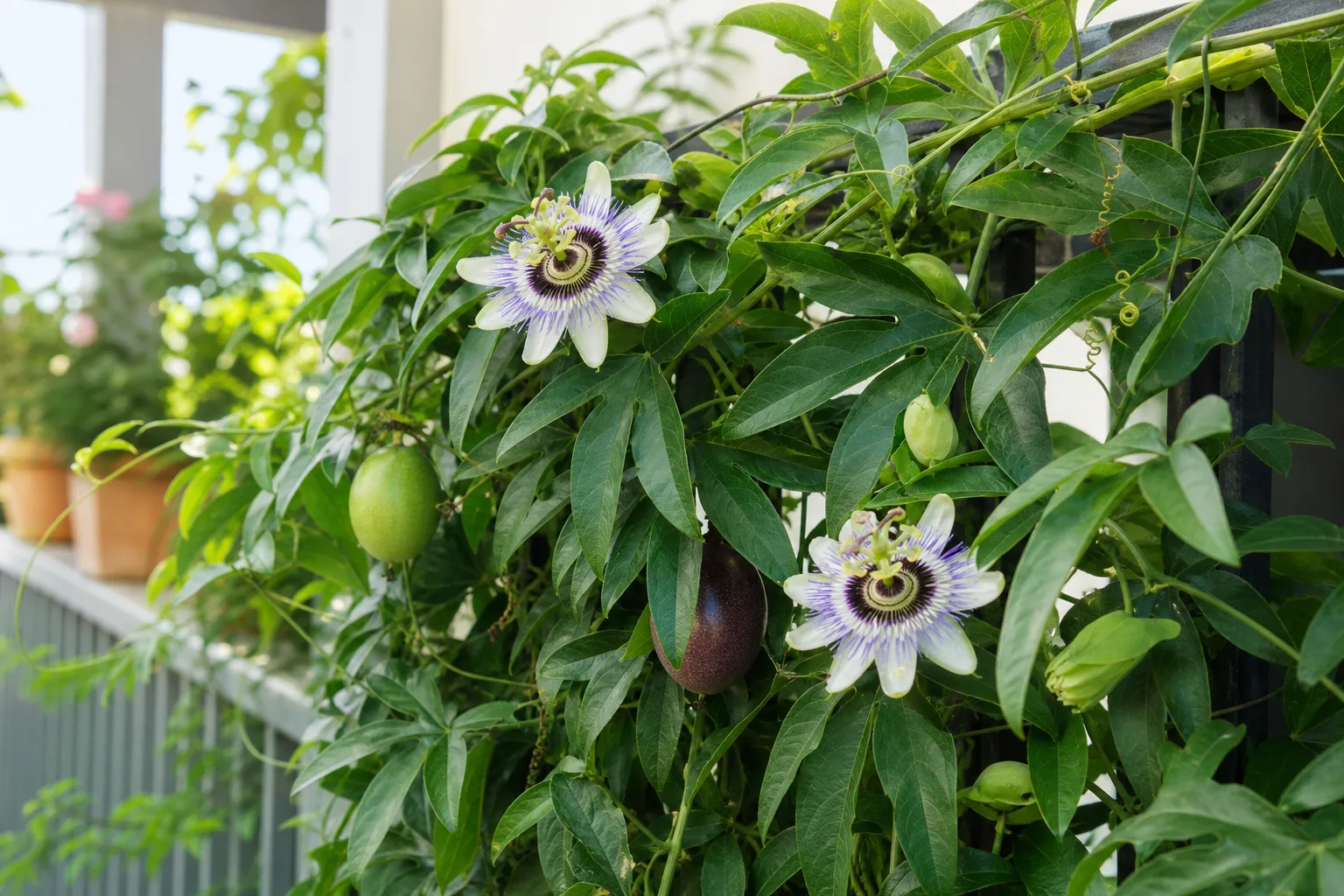
Passion Fruit Repotting: Pot Size, Roots & Timing
Passion Fruit Repotting: Pot Size, Roots & Timing
Passion fruit repotting is less about chasing a bigger decorative pot and more about protecting a shallow, oxygen-hungry root system on a fast vine. Passiflora edulis climbs by tendrils, spreads roots near the surface, and collapses quickly when the crown sits in soggy mix. In a balcony tub or terrace grow bag, that biology shows up as stalled flowering, rapid drying one week and sour wet soil the next, or sudden wilt after monsoon rains.
This guide covers when to move the vine, how large to step up, how to handle grafted plants, what mix to use, and how to nurse the plant through the first month. Start from the Passion Fruit care hub if you still need to confirm whether the symptom is light, water, or a true root-container mismatch.
Why passion fruit roots force careful container choices
Passion fruit is a woody perennial climber, not a compact foliage houseplant. UF/IFAS notes that passion fruit prefers well-drained soil and has shallow root systems, with limited drought and flood tolerance under those conditions (UF/IFAS passion fruit guide). Julia Morton likewise describes the vine as shallow-rooted and stresses that good drainage is essential to reduce collar rot (Morton passionfruit profile).
In open ground, roots can explore a wide, aerated surface layer. In a pot, they meet plastic walls, circle, and occupy the air spaces that once buffered moisture. Old peat-heavy mix then settles into a dense core that stays wet after watering while the outer edge crusts dry. That mismatch is exactly when Phytophthora crown and root problems and Fusarium-related collar decline become more likely, especially if water pools around the stem base (UF/IFAS passion fruit guide).
Shallow roots, collar rot, and drainage
Treat the root collar—the transition where stem meets soil—as sacred. Morton warns that good drainage minimizes collar rot, and that grafted vines must be planted with the union well above ground, not buried under soil or mulch, or disease resistance is lost (Morton passionfruit profile). Container growers make the same mistake by filling mix up the stem after a move or by letting a saucer keep the crown wet for days.
If your vine is grafted onto yellow passion fruit or another resistant stock, keep that union visible after every repot. If it is a seedling or cutting, still keep the original soil line; do not “plant deeper for stability.” Stability comes from a wider base, a trellis, and temporary soft ties—not from burying the collar.
Signs your passion fruit needs repotting
Check young container vines at least once a year during active growth. Expect to pot up every 1–2 years while the plant is filling nursery pots quickly. For established container passion flowers, the RHS recommends repotting every 2–3 years as ongoing care (RHS passion flower growing guide). Use evidence, not only the calendar.
Strong signals include roots circling the wall or emerging from drainage holes, a root ball that barely holds loose mix, a pot that becomes light again within a day in warm weather, slowed vine extension despite good sun, and a top-heavy canopy that rocks the container. Penn State lists rapid drying, roots through drainage holes, and crowded root balls among practical repotting cues (Penn State repotting guidance).
Root-bound vs wet-root problems
A healthy root-bound passion fruit usually shows firm, light-coloured feeder roots and an earthy smell. Dark, mushy roots, a sour odour, collar swelling, yellowing while the mix stays wet, or sudden canopy wilt point to oxygen loss or soilborne disease rather than a need for a giant pot. UF/IFAS links poorly drained soils with harder control of soilborne pathogens and notes Phytophthora attack on roots and basal stems (UF/IFAS passion fruit guide).
Before upsizing a wet, yellowing vine, review the Passion Fruit watering guide and confirm that drainage holes are open. Illinois Extension treats a functioning bottom outlet as essential for root aeration; gravel layers are not a substitute for holes (Illinois Extension drainage).
Best season to repot in India and similar climates
Choose the start of warm active growth—typically late winter into spring in much of India—once nights are mild and the vine is beginning to push new shoots. Warm roots colonise fresh mix faster, and you can see recovery in new tendrils within weeks. RHS identifies spring planting after frost risk for hardy types and treats container passion flowers as plants that need active-season care with reduced winter watering (RHS passion flower growing guide).
In humid tropical and coastal India, an early post-monsoon window can also work if the vine is growing and the site will not stay waterlogged. Avoid elective moves during peak midday heat above about 38°C, while the vine is carrying a heavy fruit load, during weeks of continuous monsoon rain, or in a cool dormancy lull. UF/IFAS advises planting young plants in early spring where frost is possible, and anytime temperatures stay under about 90°F with irrigation available in warm regions (UF/IFAS passion fruit guide).
Emergency moves are justified for a cracked pot, collapsing wet roots, or a plant tipping over. Keep those moves as gentle as possible and restore drainage first.
Choosing pot size and container type
RHS suggests starting tender passion flowers in a container about 30 cm (12 in) wide under greenhouse or conservatory culture (RHS passion flower growing guide). For a fruiting P. edulis on a terrace, treat that as a juvenile size, not a permanent home. Step up by roughly 5–8 cm in diameter (about one practical nursery size) at each move so the vine can fill the new collar of mix without sitting in unused wet soil.
A fruiting balcony vine usually ends in a large, stable planter or fabric grow bag—often in the 40–60 L range for serious home crops—paired with a sturdy trellis. UF/IFAS notes that grow bags with custom media, placed on stands such as cinderblocks, improve drainage and keep roots off contaminated ground (UF/IFAS passion fruit guide). Plastic holds moisture in hot dry weather but can overheat on bare concrete; terracotta breathes and stays cooler but dries fast; fabric bags drain well yet need more frequent watering in summer.
Why overpotting hurts a fruiting vine
Jumping from a 20 cm nursery pot into a 60 cm tub leaves a wide ring of unused mix. That outer soil stays wet while the old root ball may still be dry in the centre, making watering guesses unreliable and raising root-disease risk. RHS explains this mismatch as the core problem of overpotting.
Do not solve a tippy vine by burying the stem deeper. Use a broader base, weight the pot safely, or tie growth to the trellis. Keep the original soil line visible.
Fresh mix for passion fruit after a move
Morton recommends light to heavy sandy loams of medium texture, with pH about 6.5–7.5, and lime only if the soil is too acid (Morton passionfruit profile). UF/IFAS similarly prefers well-drained soils and notes slightly acid conditions are best within a roughly pH 6–7.5 tolerance (UF/IFAS passion fruit guide).
For containers, aim for a mix that stays evenly moist yet drains within minutes after a soak. A practical starting blend is 40–50% quality potting mix or sandy loam, 25–30% mature compost, and 25–30% coarse perlite, pumice, or composted bark. Moisten ingredients before use so dry peat does not pull water from the old root ball. Full mix recipes belong in the Passion Fruit soil guide; this page’s job is to force a full refresh when the old mix has collapsed.
Discard mix that smells sour or has turned to sludge. Do not reuse soil from a vine that died of suspected soilborne disease in the same container without thorough cleaning, and avoid replanting in the same ground spot if UF/IFAS-style pathogen death has already occurred there (UF/IFAS passion fruit guide).
How to repot passion fruit step by step
Water the vine the day before if the root ball is bone dry; a lightly moist ball holds together and tears fewer fine roots. Prepare the new pot, mix, clean blade, trellis ties, and a shaded workspace before you lift anything.
- Confirm drainage. Open every hole. Cover large outlets with mesh if needed, not with a solid gravel plug that blocks flow.
- Free the vine. Lay the pot on its side, support the root ball, and ease it out. Cut disposable nursery plastic rather than pulling on stems.
- Inspect roots. Tease outer roots outward. Cut only dead, mushy, or sharply circling roots with a clean blade.
- Set height. Add mix so the old soil line sits about 2–3 cm below the rim and the graft union (if present) stays above the finished surface.
- Backfill. Work fresh mix around the sides with fingers or a blunt stick. Firm lightly; do not ram the crown hard.
- Water once, deeply. Soak until water exits the holes, then empty the saucer. RHS container practice is to water until moisture emerges from drainage holes after potting work (RHS container watering).
- Re-train. Soft-tie main stems to the trellis immediately so wind does not lever the fresh root ball.
Handling grafted vines and the root collar
Keep the graft union above the mix for the life of the plant. Morton’s field rule—union well above ground, never covered by soil or mulch—transfers directly to pots (Morton passionfruit profile). After watering, check that settling did not bury the union; add a thin collar of mix only around the root ball edge if needed, not up the stem.
If you are moving a rooted cutting that has just left a propagation tray, UF/IFAS propagation guidance is to transfer into a new pot with fresh substrate once roots resist a gentle tug and new leaves appear (UF/IFAS passion fruit propagation). That is a smaller, gentler move than upsizing a mature fruiting vine, but the same drainage rules apply.
Same-pot root renewal for large vines
Once the vine is in the largest planter you can manage, endless upsizing stops making sense. At the start of warm growth, slide the root ball out, shave or slice a thin congested outer layer and base, loosen the remaining edge, clean the pot, and return the vine with fresh mix. RHS allows light root trimming for established container plants kept in the same pot (RHS how to repot); stay conservative—remove only the outer congested band on a healthy passion fruit, not a large fraction of the root mass.
Pair same-pot renewal with canopy editing only if growth is tangled. Structural thinning belongs in the Passion Fruit pruning guide, not as an afterthought during a messy root job.
Moving from pot to ground or grow bags
Open ground is ideal where frost is rare, drainage is reliable, and you can build a strong trellis. UF/IFAS recommends well-drained sites, full sun exposure for climbing vines, and notes grow bags as an alternative when native soil is compromised or pathogen pressure is high (UF/IFAS passion fruit guide). Plant on a slight mound in heavy monsoon soils rather than in a basin that collects water at the collar.
Correct circling roots before planting out. Set the original soil line level with or slightly above surrounding grade, water to settle, and mulch away from the stem—never piled against the collar. Keep irrigation frequent but not saturating while roots leave the old pot shape and enter new soil.
Post-repot care for the first month
Return the vine to bright light. After heavy root disturbance, give brief afternoon shade for a few days in extreme heat, then restore full sun so flowering does not stall. Keep the mix evenly moist: passion fruit is sensitive to drought stress, which reduces growth and fruiting and can increase susceptibility to soilborne Fusarium problems (UF/IFAS passion fruit guide). At the same time, never leave the pot sitting in runoff.
Skip strong fertilizer on day one. Fresh mix and torn roots already change the root environment. Resume light feeding only after firm new leaves or active tendril growth, following the Passion Fruit fertilizer guide. Temporary stillness or a few older yellow leaves can be normal; repeated wilt in wet soil, sour smell, or a loose stem at the collar is not—inspect drainage before watering again.
When not to repot passion fruit
Leave the vine alone when roots still have room, drainage works, and growth matches the container. Do not repot because one leaf yellowed, a few flower buds dropped after a dry day, or the nursery pot looks plain. A decorative cachepot is fine if you empty runoff promptly.
Delay elective work during peak flowering and fruit fill if the pot still functions. Disturbance plus uneven moisture can drop buds and fruit. If the vine looks pale but roots have space, check light and feeding via the Passion Fruit light guide and fertilizer page rather than forcing a move. If you simply want another plant, use the Passion Fruit propagation guide instead of hacking apart a woody root ball.
When to use this page vs other Passion Fruit guides
Use this page for pot size, root inspection, graft-collar depth, grow-bag moves, and first-month recovery. Use Passion Fruit soil to dial the mix, Passion Fruit watering for the moisture rhythm after the move, and Passion Fruit pruning to keep the canopy trainable on a trellis. The Passion Fruit overview is the better entry point when several care factors are wrong at once.
Related Passion Fruit guides
- Passion Fruit care hub — species profile and all care routes.
- Passion Fruit soil guide — drainage, pH, and container mixes.
- Passion Fruit watering guide — moisture after a root disturbance.
- Passion Fruit fertilizer guide — when to resume feeding.
- Passion Fruit propagation guide — cuttings and seedlings for new pots.
- Passion Fruit pruning guide — training the vine after a move.
Conclusion
Repot passion fruit when the root ball proves it has outgrown or outlived the container—not because a calendar alone says so. Work at the start of warm growth, step pot size up modestly, keep the collar and any graft union high and dry, refresh free-draining mix, and water through once. For a mature terrace vine, same-pot root renewal or a well-drained grow bag on a stand usually beats an impractically huge, constantly wet planter.