8 Heat-Tolerant Climbing Plants for Fence Privacy
Turn a hot, bare fence into a living screen with eight climbing plants matched to sun, winter cold, fence strength, and the amount of pruning you can handle.
A bare fence can become a useful privacy screen, but the right plant depends on more than how quickly it grows. A vigorous vine on a weak fence can pull at panels, hide rot, or escape into nearby trees; a tender tropical vine may look perfect in July and disappear after one freeze.
The eight heat-tolerant climbing plants below cover different jobs: evergreen structure, hummingbird flowers, a compact climber for a small yard, a fast screen for a large boundary, and a container option you can move before winter. The best choice is the one whose mature size, climbing method, and maintenance needs match your fence and your climate.
How to choose a fence vine that will last
Start with the site rather than the plant tag. Measure the fence height, note how many hours of direct sun hit the planting strip, and look for reflected heat from paving, walls, or a dark fence surface. Also check whether the soil stays dry under the fence overhang; a vine can tolerate hot air and still fail because its young root ball repeatedly dries out.
USDA hardiness zones are useful for judging winter survival, but they are not a summer-heat score. A plant that is hardy in your zone can still need irrigation during establishment, protection from reflected afternoon heat, or a cooler root zone on a south-facing fence.
Check the fence before you plant
The fence should be able to carry the plant at its mature weight, not just the weight of a small nursery pot. Inspect posts for movement and rot, and leave a service gap so you can paint, repair, or replace boards without cutting through a wall of stems.
For a wood, vinyl, or chain-link fence, a separate trellis or wire panel is usually the more forgiving setup. Mount it slightly in front of the fence so air can move behind the foliage, and anchor it to posts or the ground rather than relying on thin fence boards. This also lets you remove a spreading vine without tearing apart the fence.
Match the vine’s climbing method to its support
Twining plants wrap their stems around a narrow support, while tendril climbers need a grid, wire, or lattice they can catch. A rose does not climb by itself in the same way; its long canes need to be tied to the fence or trellis. Matching support to habit is one of the simplest ways to reduce training and pruning later, a point also emphasized in Gardenia’s practical guide to vines for fences, arbors, and pergolas. (Gardenia)
Eight heat-tolerant fence vines at a glance
| Plant | Approximate hardiness range | Best use | Main caution |
|---|---|---|---|
| Carolina jessamine | Zones 6–10 | Evergreen-leaning screen in sun | Toxic; high flammability rating |
| Coral honeysuckle | Zones 4–9 | Hummingbird border and moderate coverage | Needs support; can get mildew in humid heat |
| Maypop passionflower | Zones 5–9 | Fast summer foliage and edible fruit | Root suckers, winter dieback, high flammability |
| Texas leatherflower clematis | Zones 4–8 | Smaller fence or cooler-rooted site | Needs a grid or fine support; toxic if eaten |
| Trumpet vine | Zones 4–10 | Large, sunny boundary needing a fast screen | Heavy and aggressively spreading |
| Lady Banks rose | Zones 6–10 | Thornless spring cascade or privacy arch | Needs sturdy support and space |
| Mandevilla | Zones 10–11 | Movable container screen in warm climates | Freezes; regular water and feeding help flowering |
| Crossvine | Zones 5–9 | Broad coverage on a strong fence or arbor | Root suckers and seeds can spread it |
These ranges are a starting point, not a promise of performance. The plant profiles explain which vines prefer full sun, which appreciate some afternoon protection, and which should be kept away from the home’s defensible space because of high flammability ratings.
Carolina jessamine: evergreen gold for sunny fences
Carolina jessamine (Gelsemium sempervirens) is a strong choice when you want glossy foliage and fragrant yellow flowers instead of a summer-only screen. It is native to the southern United States and can grow about 12 to 20 feet when trained to a trellis or arbor; in warm areas, the foliage is evergreen to semi-evergreen, with some winter bronzing.
Give it full sun for the best growth and flowering, plus moist, organically rich soil that drains well. It tolerates short dry periods once established, but a young plant beside a hot fence still needs consistent watering while its roots spread. NC State’s Plant Toolbox also notes that it is easiest to shape soon after flowering, which lets you redirect long stems before the season’s new growth hardens. (NC State Plant Toolbox: Carolina jessamine)
This is a beautiful screen near a patio or garden gate, but it is not a casual choice for every home. All parts are poisonous if ingested, and NC State gives it a high flammability rating; keep it away from the defensible space nearest a house and wear gloves when handling unfamiliar sap. Choose it when evergreen structure and a sunny, well-maintained planting strip matter more than a completely carefree vine.
Coral honeysuckle: hummingbird-friendly, well-behaved coverage
Coral honeysuckle (Lonicera sempervirens) brings red, coral, orange, or yellow tubular flowers to a fence without the invasive reputation of Japanese honeysuckle. It is a vigorous native twiner that can reach roughly 10 to 20 feet, and its flowers attract hummingbirds; in warm winter climates it can hold foliage longer than it does in colder parts of its range.
Plant it in full sun for the heaviest bloom, in medium-moisture soil with good drainage. It flowers on new growth, so let the main spring display finish before pruning. Avoid high-nitrogen fertilizer if flowers are the goal, because lush leaves can come at the expense of the bloom show. (NC State Plant Toolbox: coral honeysuckle)
Coral honeysuckle is a good middle-ground plant for a homeowner who wants wildlife value but does not want the extreme size of trumpet vine. Give it a trellis, wire panel, or narrow arbor to wrap around, and check it during hot, humid weather for aphids, powdery mildew, and leaf spots. It also carries a high flammability rating, so place it farther from the home than you might expect from a soft-looking flowering vine.
Passionflower: tropical-looking foliage from a native vine
Maypop passionflower (Passiflora incarnata) supplies the most tropical look on this list: three-lobed foliage, curling tendrils, intricate flowers, and round fruit that can ripen yellow. It grows rapidly in full sun to part shade and is native to the southeastern and south-central United States, making it a useful option when you want dramatic summer coverage without buying a strictly tropical plant.
The trade-off is movement. Passionflower can spread by root suckers, and in cold climates the top dies back before returning from the roots. Keep the root zone well drained, use a loose mulch to buffer heat, and decide where new shoots are allowed to emerge before planting. NC State describes it as drought tolerant but warns that wet winter soil can encourage root rot; it also lists a high flammability rating. (NC State Plant Toolbox: maypop passionflower)
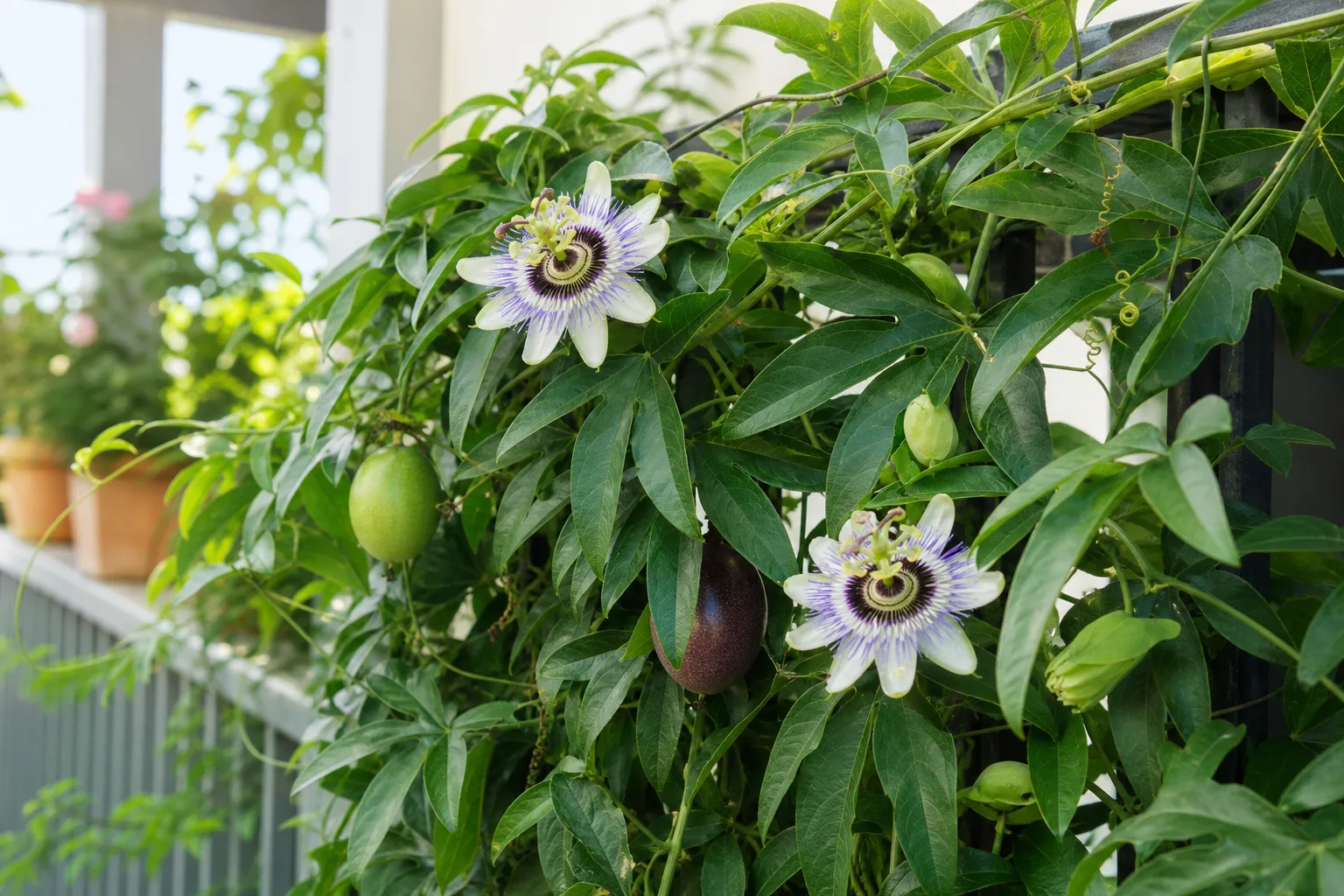
Use a sturdy lattice or wire panel rather than expecting tendrils to cover a solid board fence on their own. If you want fruit, leave enough room to inspect flowers and developing maypops; if you only want foliage, pinch or cut back wandering stems before they root into neighboring beds. The flowers and larval-host value for butterflies are reasons to keep some leaf damage in perspective instead of treating every caterpillar as a problem.
Texas leatherflower clematis: compact heat-tolerant color
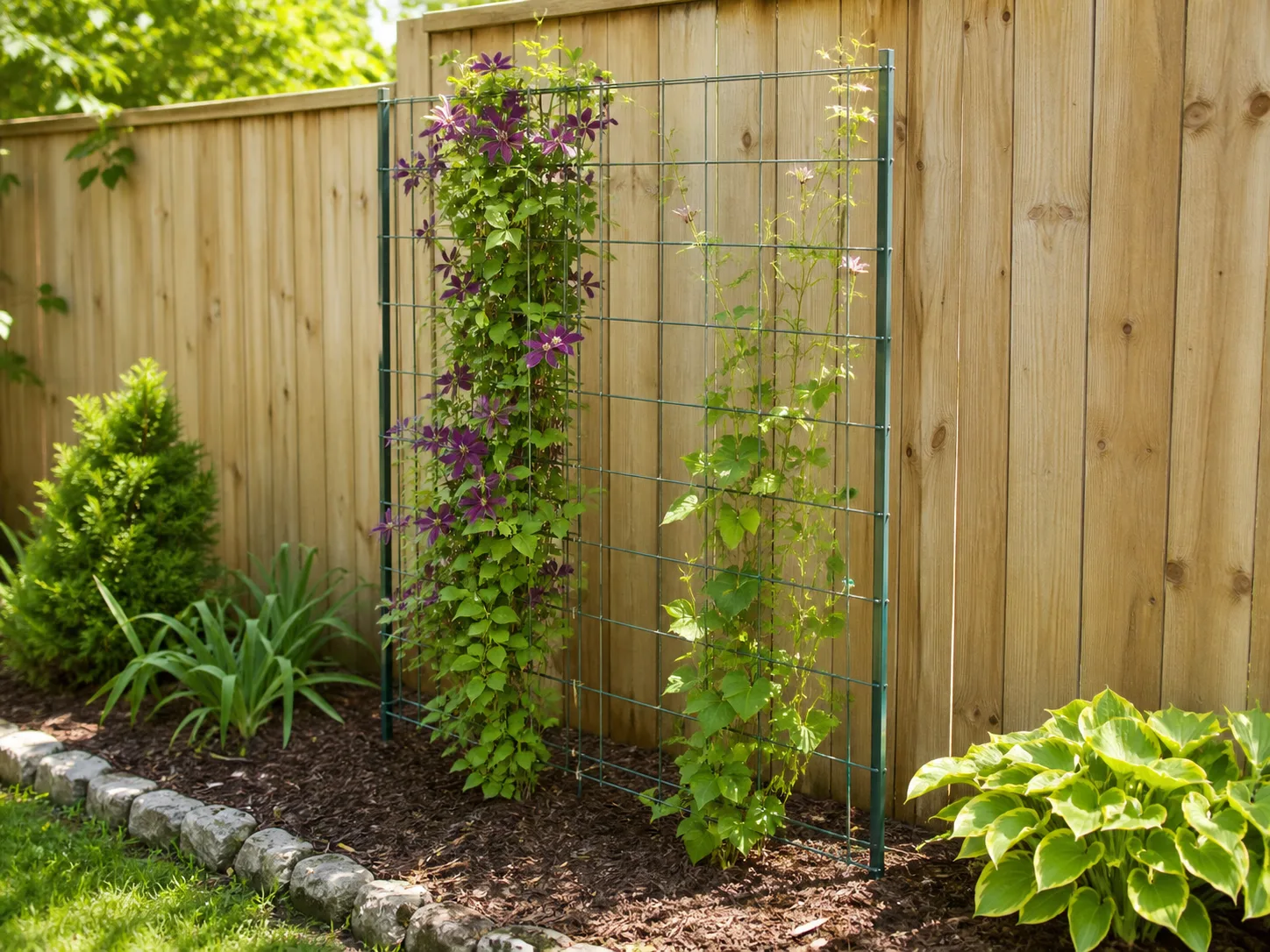
Texas leatherflower (Clematis texensis) is a better fit for a small fence than the sprawling vines that can swallow an entire boundary. NC State lists a mature size of about 6 to 9 feet tall and 2 to 3 feet wide, with scarlet, bell-shaped flowers from summer into fall and a drought-tolerant nature once established.
Unlike a twining honeysuckle, clematis uses its leaf stems to catch a fine support. Give it a grid, netting, or narrow lattice with openings small enough for the petioles to wrap around. Its flowers form on new growth, so prune it in late spring after the plant has begun its season; avoid cutting blindly in late winter before you know which clematis pruning group you are growing. (NC State Plant Toolbox: Texas clematis)
This is also the plant here most likely to appreciate a cooler base than its leaves. On a hot, west-facing fence, shade the root zone with mulch or a low companion plant while allowing the upper foliage to receive filtered light. Texas leatherflower has poisonous characteristics, so place it where pets and children are unlikely to chew stems or leaves, and do not mistake compact size for low importance of support.
Trumpet vine: the fast screen that needs a boundary
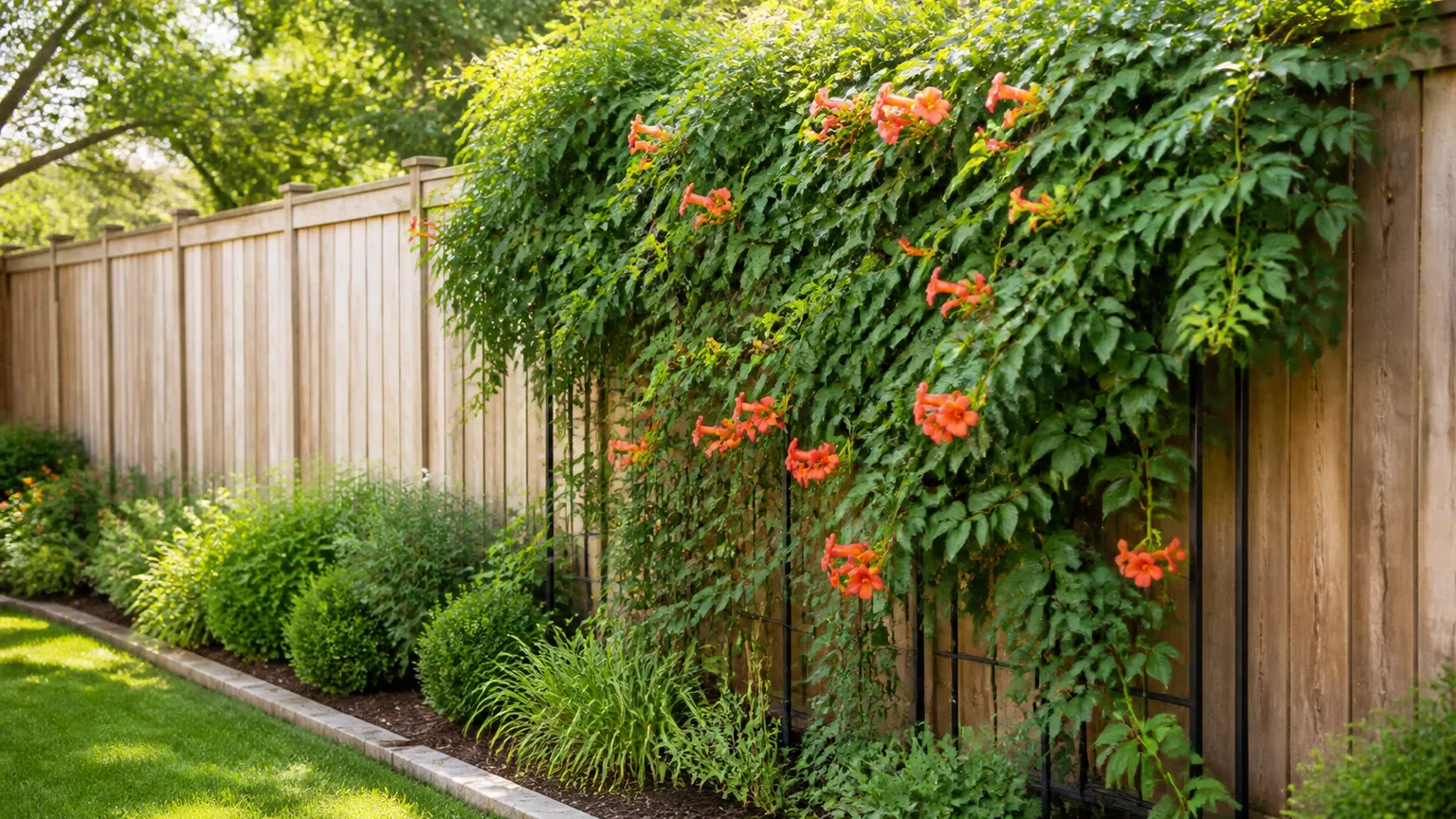
Trumpet vine (Campsis radicans) is the choice for a large, sunny fence when fast, heavy coverage matters more than restraint. Its orange-red trumpet flowers draw hummingbirds, it flowers on new growth, and established plants can handle a range of soils and periods of heat and drought. The plant is also capable of becoming a thicket through underground runners and self-seeding.
Support is not optional. Mature vines produce considerable weight, so use a strong arbor or a well-anchored trellis rather than attaching a heavy plant to a flimsy panel. NC State recommends planting it where suckers can be mowed or otherwise monitored; that boundary is part of the planting plan, not a maintenance detail to solve later. (NC State Plant Toolbox: trumpet vine)
Prune in late winter or early spring if you need to control size; because it blooms on new wood, that timing does not remove the coming season’s flowers. Expect to remove suckers at ground level and cut seed pods before they mature if you do not want volunteers. Trumpet vine can cause skin irritation in some people and has a high flammability rating, so it belongs on a large property boundary—not tight against the house just because it grows quickly.
Lady Banks rose: thornless spring cascades
Lady Banks rose (Rosa banksiae) is not a true twining vine, but its long, flexible canes can be trained across a fence or arch to create a soft spring screen. The nearly thornless stems are a major advantage beside a walkway, and the plant is covered in small white or yellow flowers in mid-spring to early summer. In warmer zones it can stay evergreen, while colder gardens may treat it as a deciduous rambling rose.
Give it sun or part shade, moist but well-drained soil, and plenty of air circulation. NC State notes that it can reach upward of 40 feet, so the absence of thorns should not be confused with a small footprint. Provide sturdy support, remove dead wood, and do the meaningful size reduction soon after flowering so you do not remove next year’s flower-bearing growth. (NC State Plant Toolbox: Lady Banks rose)
This is a good choice when you want a seasonal cascade over a fence rather than a solid year-round wall. Tie canes loosely with soft, wide ties and spread them horizontally; more canes trained sideways usually create a fuller flowering layer than one upright bundle. Choose it for a fence with room to carry a broad rambling plant, and skip it if your priority is fast coverage at ground level or a compact container.
Mandevilla: the movable container screen
Mandevilla is the solution for a hot patio, rental yard, balcony edge, or fence where digging is risky. It is a tropical, twining vine with glossy leaves and trumpet flowers that performs strongly in warm weather; UF/IFAS notes that larger cultivars can produce stems up to 20 feet in one season, while compact types are better for containers and smaller supports.
Plant it in full sun and well-drained soil, water it regularly, and feed it during active growth if you want abundant flowers. In tropical areas it can stay evergreen, but freezing temperatures cause dieback. In climates with winter freezes, grow it in a container that can be cut back and moved indoors, or treat it as a seasonal screen rather than expecting an in-ground plant to return. (UF/IFAS Gardening Solutions: mandevilla)
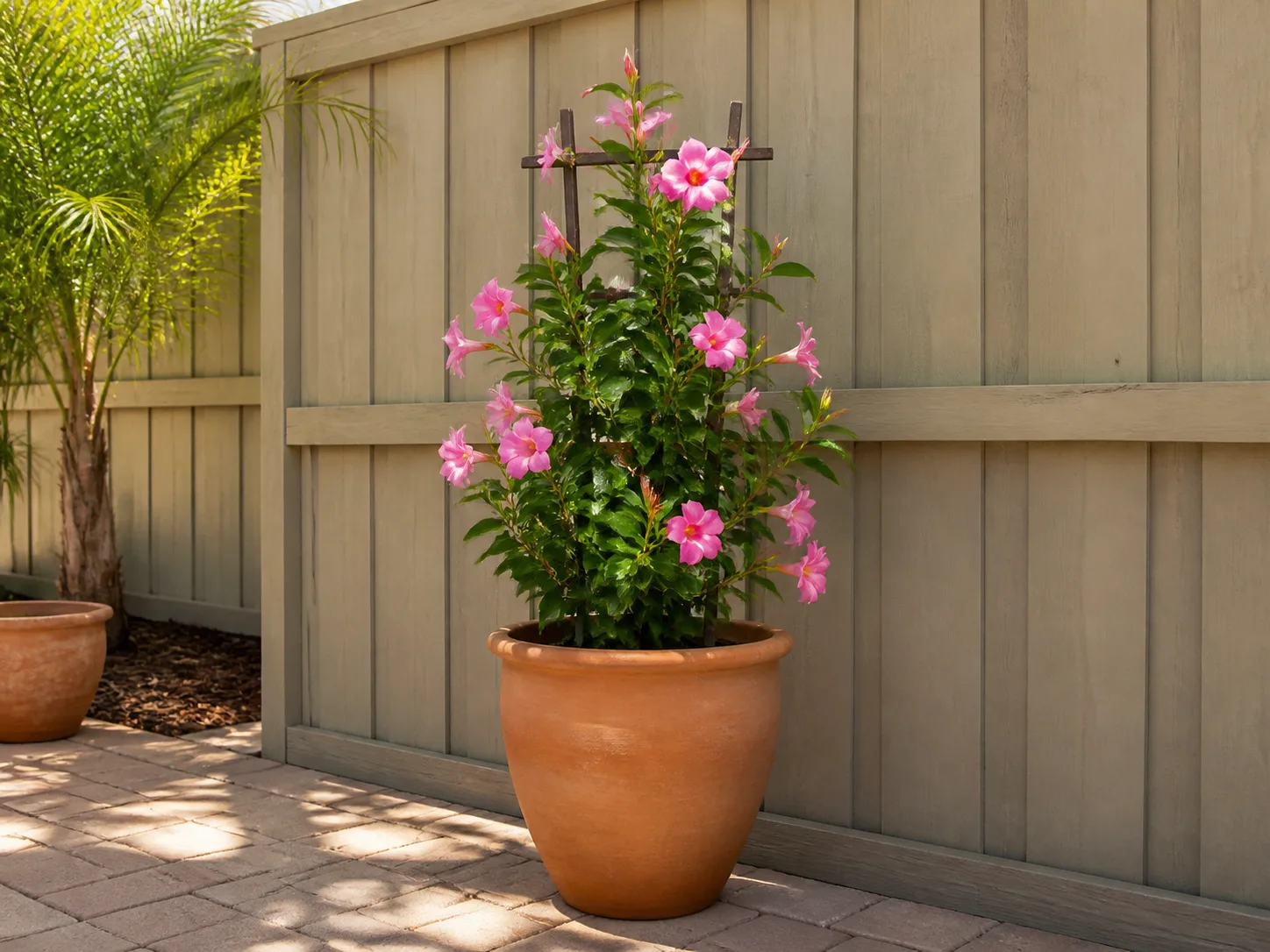
The movable pot is more than a convenience: it lets you change the plant’s exposure, inspect the fence behind it, and bring it away from freezing weather. Larger mandevillas need a substantial container and trellis so the top-heavy plant does not tip, while bushier cultivars may need only a short support. The milky sap can irritate skin and may be toxic if ingested, so prune with care and keep fallen leaves away from pets and children.
Crossvine: a broad, evergreen-leaning privacy layer
Crossvine (Bignonia capreolata) is a vigorous native vine for a large fence, arbor, or wall where you want early-season flowers and substantial foliage. It climbs with branched tendrils, blooms in late winter or early spring, and can keep dark glossy leaves in warm climates; colder weather may turn the foliage reddish-purple or cause dieback before regrowth.
It tolerates shade through full sun, although more light generally means more flowers. Give it organically rich, well-drained soil and a support that can handle a plant that may eventually occupy a wide vertical span. NC State reports that it spreads by both seed and root suckers, so pull unwanted shoots as soon as they appear instead of waiting for a mature tangle. (NC State Plant Toolbox: crossvine)
Crossvine is especially useful when the fence receives morning sun but not the relentless heat of a west-facing wall. Its early flowers provide nectar for hummingbirds before many summer vines begin blooming, and its foliage can soften a broad boundary for much of the year. Like several native vines on this list, it has a high flammability rating, so do not place it in the defensible space nearest a home.
How to plant a vine beside a fence in hot weather
Plant in the cooler part of the day, preferably when the soil is workable and the plant can settle before the next heat spike. Dig a hole about as deep as the root ball and wider than it, loosen circling roots, and set the crown at the same level it occupied in the container; burying a stem does not make a vine establish faster.
Keep the planting strip a few inches away from the fence if possible. That offset gives you room to water at the root zone, inspect the lower stems, and keep the vine from growing into a hot, airless seam between boards and trellis. Southern Living’s fence-vine guidance likewise separates climber choice from fence style and warns that fast growth still comes with different levels of vigor and maintenance. (Southern Living)
Build the root zone for heat
Water deeply after planting, then check the soil with a finger or hand trowel rather than following a rigid calendar. A shallow root ball beside a fence can dry faster than the rest of the garden, especially where the fence blocks rainfall or a paved surface reflects heat. Mulch the root zone with a thin, even layer, leaving a gap around the stem so it does not stay wet.
Do not solve heat stress with constant saturation. Well-drained soil is part of the heat strategy for passionflower, clematis, and mandevilla; soggy winter soil can damage roots even when the air is warm. Once the vine is established, lengthen the interval between thorough waterings when possible so roots explore outward, but continue to monitor during drought, high wind, and periods of extreme reflected heat.
Train the first season without strangling stems
Install the support before planting if you can. Guide young stems toward the trellis with loose ties, then check them every few weeks during the growing season; a tie that is gentle in May can girdle a rapidly thickening stem by August.
Spread stems across the support instead of stacking them in one vertical bundle. Horizontal or fan-shaped training fills gaps sooner, improves air movement, and makes the plant easier to prune. For tendril climbers such as clematis and crossvine, use a fine grid or wire; for twiners such as coral honeysuckle, jessamine, and mandevilla, offer poles, wires, or lattice narrow enough for stems to wrap around. A separate support also keeps the fence repairable and prevents the plant from claiming the boards as its only structure.
Prune, water, and troubleshoot without losing the screen
Pruning is easier when you know what the plant is supposed to do next. Cut spring-flowering vines such as Carolina jessamine, coral honeysuckle, and Lady Banks rose after their main display; prune new-wood bloomers such as trumpet vine and Texas leatherflower according to their growth pattern and after the plant has started its new season. Remove dead, damaged, crossing, or escaped stems first, then reduce length gradually rather than shearing a living wall into bare wood.
If a vine looks wilted in the afternoon, check the soil before watering. Dry soil with limp leaves points toward heat or water stress; moist soil with yellowing lower leaves suggests a root-zone or drainage problem instead. Brown, powdery, or spotted foliage in a dense screen improves first with better spacing and airflow, while aphids, scale, or mealybugs should be confirmed on the plant before treatment.
Watch the base of vigorous vines, not just the top of the fence. Trumpet vine, passionflower, and crossvine can send shoots outside the intended bed, and a new shoot is much easier to pull or mow while young. If a vine reaches into a roofline, utility area, neighboring tree, or the home’s defensible space, redirect or remove it early; privacy is not worth creating a fire, repair, or access problem.
The most reliable fence screen is usually layered rather than forced. Use an evergreen-leaning vine where winter structure matters, add a seasonal flowering climber where you have room, or use a container mandevilla when the fence cannot safely carry permanent growth. That approach gives you coverage without asking one plant to be fast, evergreen, compact, perfectly behaved, frost-proof, and maintenance-free at the same time.
Conclusion: choose the vine your fence can handle
For a sunny, evergreen-leaning screen, start with Carolina jessamine; for hummingbirds and moderate growth, coral honeysuckle is a more balanced choice. Choose maypop passionflower or crossvine when you can monitor spread, trumpet vine when you have a large boundary and a very strong support, Texas leatherflower for a smaller clematis-shaped space, Lady Banks rose for thornless spring flowers, and mandevilla when a movable container solves the winter problem.
The best heat-tolerant climbing plant is not the one with the biggest growth claim. It is the one that fits your fence’s strength, your soil’s drainage, your winter temperature, your distance from the house, and the amount of pruning you will actually do. Build the support first, water the root ball through establishment, and keep the vine within a boundary you can inspect.



