Not Enough Light on Passion Fruit: Causes, Checks & Fixes
Quick answer
Not enough light on Passion Fruit (Passiflora edulis) shows as pale small leaves, leaf drop, stretched shoots, and few or no flowers, because this full-sun liana only blooms on sunlit new tip growth. First step: move or retrain the vine so the leafy canopy sits in true full sun, then acclimate shade-soft leaves gradually before making any other change.
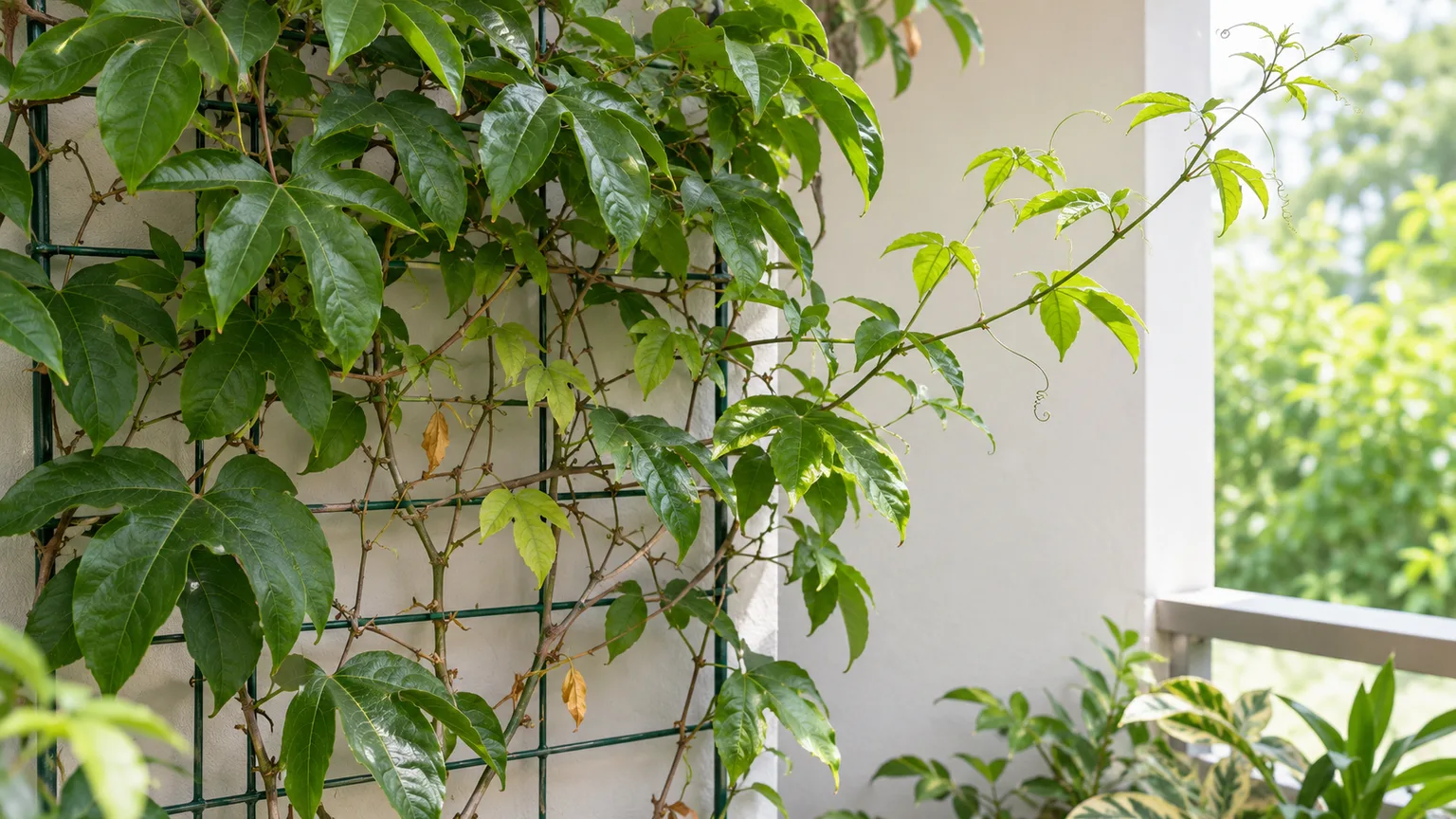
Not Enough Light on Passion Fruit: Causes, Checks & Fixes
This guide covers not enough light on Passion Fruit. See also the general Not Enough Light guide, watering, and light pages for this plant.
Not Enough Light on Passion Fruit: Causes, Checks & Fixes
Quick answer
Not enough light on Passion Fruit (Passiflora edulis) looks like pale undersized leaves, leaf drop, thin shoots leaning toward the brightest gap, and a vine that keeps extending but never sets buds. That combination makes sense for a perennial liana that grows best in full sun or a location where it can reach full sun after climbing — and whose vines in shade or partial shade typically drop their leaves.
First fix: move the container, clear the overhead shade, or retrain the leaders so the leafy canopy itself sits in true full sun. Make that one change before fertilizing, hard-pruning, or repotting.
For how dim light weakens plants in general, see our not enough light guide. On Passion Fruit, the story is always about a sun-hungry fruiting vine whose flowers only form on sunlit new tip growth — not a foliage houseplant that tolerates a bright room.
When to use this page vs other Passion Fruit guides
Use this page when pale leaves, leaf drop, stretch toward light, and missing buds arrive together. Browse the Passion Fruit problems hub and Passion Fruit overview if another pattern fits better.
| What you see | Likely issue | Go to |
|---|---|---|
| Pale small leaves, lean toward light, no buds, firm wood | Light shortage | Stay here |
| Long bare internodes with sparse leaves, focus on stretch mechanics | Shade-driven etiolation | Leggy growth |
| Everything stalled with short internodes, little tip extension | Low vigor or cool check | Slow growth |
| Yellowing without stretch or lean | Water, nutrient, or age patterns | Yellow leaves |
| Limp leaves that perk after watering | Moisture deficit | Underwatering or drooping leaves |
| Soft, dark, or foul stem base; wilt in wet mix | Collar / root decline | Root rot or overwatering |
What not enough light looks like on Passion Fruit
Adult Passion Fruit leaves are deeply trilobed, glossy deep green above, and carried on tendril-climbing shoots — Purdue describes a fragrant flower borne at each node on the new growth. When photons run short, that whole system downshifts:
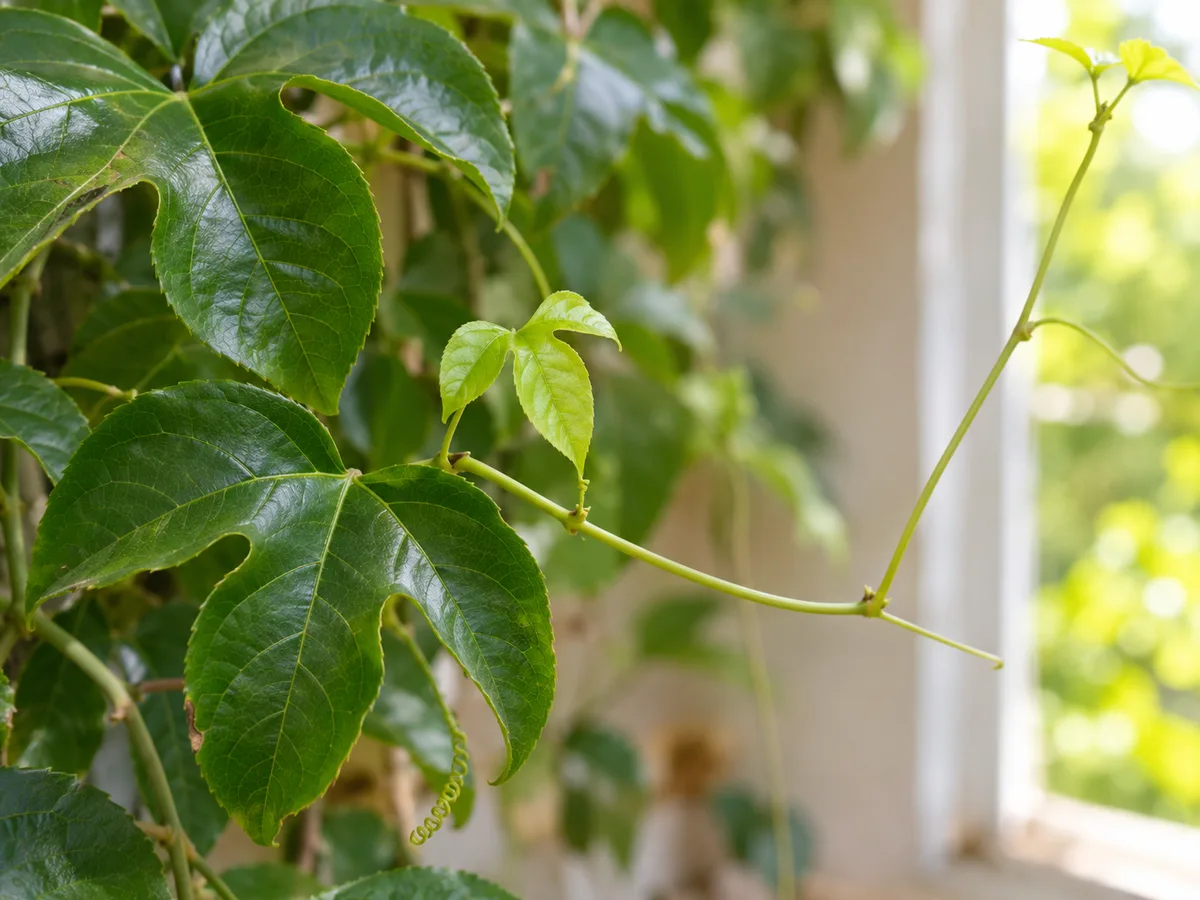
Pale new leaves and long spaces between nodes can show that a passion fruit vine is stretching toward more direct light.
- Pale, undersized new leaves: Fresh trilobed leaves stay smaller and lighter green than older sun-grown foliage, sometimes with a washed-out yellow cast.
- Leaf drop from shaded wood: Inner laterals and lower curtain sections shed leaves first — the documented shade response for this vine.
- Phototropic lean and stretch: Soft tips dive toward a window, door gap, or the bright edge of the trellis while the pot stays put. When gaps between nodes lengthen markedly, read the stretch-focused leggy growth guide alongside this one.
- Missing buds on extending tips: The vine keeps growing but flower buds never appear with the young leaves and tendrils, because flower buds emerge along with young leaves and tendrils only when the tip has energy to spare. UF/IFAS notes that once mature, vines produce flowers on new growth with adequate access to sunlight, nutrients, and water.
- Slow dry-down: The mix stays heavy for days because a dim canopy transpires little — easy to misread as a watering problem. Cross-check Passion Fruit watering before changing the schedule.
Why a full-sun liana goes short on light
Shade on a vine built for open sun
UF/IFAS is blunt: passion fruit grows best in full sun or where vines climb into it, and shaded vines drop leaves. RHS guidance agrees — plant passion flowers in a sunny, sheltered position, ideally against a south- or west-facing support. Gardening Know How states that tropical passion flowers need full sun and well-drained soil, and that indoor vines need a bright window to have any chance.
Common shortfalls on real balconies and patios:
- A north-facing balcony or a trellis under a tree canopy that reads “bright” to eyes but delivers a fraction of outdoor sun.
- A south wall where the pot sits in sun but the curtain climbs into the shadow of an overhang.
- An indoor hold through winter near a small window, far below the vine’s outdoor photon budget.
- A neighboring building or new-season leaf canopy that stole last year’s sun.
Flowers live on sunlit new tips
This is the plant-specific trap. Buds form at nodes on extending new growth, so a vine can look green and vigorous while producing nothing. Dim tips spend their budget on longer, thinner extension instead of buds — and excess nitrogen pushes that leafy growth further at the expense of flowering. Fixing light restores the bud supply; no feed or spray substitutes for it.
Curtain thatch self-shades productive wood
UF/IFAS trains Passion Fruit as an open curtain: one leader up, laterals spreading and drooping into light. When laterals tangle into a dense mat, outer shoots hog the sun while inner wood goes leafless — and the thatch also becomes a fungal disease source. UF/IFAS recommends pruning and spacing to increase ventilation and light conditions against brown spot and anthracnose, which is a second reason to keep the curtain open. Detail lives in the Passion Fruit pruning guide.
Seedlings want shade; mature vines want sun
Young Passion Fruit breaks the full-sun rule briefly. UF/IFAS propagation guidance keeps fresh seedlings in partial shade because direct sun burns them, then moves them from partial shade to partial sun for several days before planting out in full sun. So a scorched seedling and a starved mature vine can sit side by side in the same household:
- Seedlings and fresh cuttings: hold in bright partial shade with steady warmth and humidity until established.
- Established vines: graduate to full sun once hardened — a mature curtain held in seedling conditions will pale, drop leaves, and stop flowering.
- After any dim hold: step exposure up over 7–14 days rather than jumping straight to all-day sun, since shade-soft leaves bleach easily.
If your plant is under a year old and has never flowered in good light, patience may be the answer — vines can take up to a year to reach flowering maturity even with adequate sun.
How to confirm the cause
Work through these checks on a clear day before stacking treatments:
- Count direct sun on the canopy. Stand at the trellis at midday and count hours of sun striking the leaves — not brightness on the floor or wall. Fewer than about six hours of direct sun on the leaf curtain is the lead suspect for this crop.
- Compare new leaves to old. Smaller, paler new trilobed leaves with longer gaps between nodes confirm shortage; uniformly yellow older leaves with normal spacing point elsewhere.
- Check the lean direction. Tips racing toward one bright gap while the rest of the curtain sits dim is classic phototropism — Gardening Know How describes vines stretching with long spaces between nodes when light is the limiter.
- Peel the curtain. Gently part the outer mat. Leafless brittle inner laterals under healthy outer tips mean self-shade is compounding site shade.
- Feel stem bases and weigh the pot. Firm green wood with a lean toward light supports a light diagnosis; soft, darkened, or foul tissue at soil level sends you to root checks instead. Placement nuance lives in the Passion Fruit light guide.
The first fix to try
Restore full sun to the Passion Fruit canopy — move the container, clear the overhead shade, or retrain leaders onto the brightest trellis face — before you prune hard, feed, or repot.
That single change stops new growth from racing and re-arms bud formation. Everything below is sequencing after the light source is corrected.
Use the Light Requirement Calculator to sanity-check window direction and distance, then verify with your own midday sun count on the leaves.
Step-by-step recovery
- Relocate or retrain first. Aim for open sun most of the day on the hanging curtain. If the pot cannot move, lead the strongest shoots along ties to the sunniest trellis section.
- Acclimate over 7–14 days. Start shade-soft vines in morning sun, then lengthen midday exposure. RHS reserves light shade only to prevent scorch under glass — use it as a transition step, not a permanent home.
- Open the thatch. Remove dead, leafless hangers and thin tangled mats so light and air reach the laterals; keep firm green wood that still carries leaves.
- Retune watering as metabolism rises. A sun-restored canopy drinks faster. Keep the shallow root zone evenly moist but free-draining per Passion Fruit watering and Passion Fruit soil — never soggy.
- Hold fertilizer until tips respond. Resume a light balanced feed only once new growth looks denser; excess nitrogen before that pushes soft foliage over buds.
Recovery timeline
Judge progress by new tip growth, not by old leaves re-greening.
- Days 1–7: The lean toward light slows; the mix begins drying on a faster, healthier rhythm.
- Weeks 2–4: New trilobed leaves emerge larger and deeper green with shorter gaps between fresh nodes in warm weather.
- Weeks 4–8: Flower buds may return on fresh extension if warmth, sustained sun, and pollination align — buds still need bees or hand pollination to become fruit.
- Beyond: Old pale leaves stay as they are until naturally replaced. If weeks of true full sun in warm weather bring no denser tips or buds, suspect root decline, virus, or chronic exhaustion — and consider restarting from a healthy cutting in a brighter site.
Mistakes to avoid
- Feeding a dim vine first. Fertilizer cannot replace photons, and excess nitrogen favors leaves over flowers.
- Throwing shade-soft leaves into all-day sun. Bleached, papery patches after a sudden move are scorch on top of shortage — step exposure up instead.
- Hard-renovating before fixing light. Cutting a shaded vine to stubs forces weak regrowth in the same dimness and delays flowering.
- Treating a bright room as full sun. For this crop, a luminous interior is still deep shade.
- Watering on a calendar while the mix stays heavy. Dim vines use less water; soggy mix invites collar decline on shallow roots.
How to prevent it next time
- Site the trellis in open full sun from the start — the brightest warm fence or balcony face, with room for leaders to climb into light.
- Train an open curtain early so laterals hang in sun instead of stacking into thatch.
- Do a late-winter cleanup yearly: dead wood out, strong framework kept, excess soft tips shortened.
- After the first year, keep nitrogen modest so growth favors flowering over endless soft vines.
- Track sun seasonally — new buildings, growing trees, and shorter winter days can quietly demote a once-sunny site.
When to worry
Escalate or restart when:
- Stem bases turn dark, soft, or foul — treat as disease or wet-collar decline, not simple shortage.
- After 4–6 weeks of true full sun in warm weather, no denser tip growth appears and pale racing continues.
- Leaves show mottling, ring spots, or distortion rather than simple pallor — possible virus, which needs rogueing, not more sun.
- The trellis is collapsing under wet foliage or the curtain is mostly leafless thatch you cannot open without removing the canopy.
A firm but pale vine usually rebounds at the tips. A rotting-based, leafless curtain rarely earns months of life support — restart it in a brighter site.
Related Passion Fruit guides
- Passion Fruit overview — habit, trellis needs, and what healthy fast growth looks like on P. edulis.
- Passion Fruit light — full-sun placement, balcony realities, and acclimation detail.
- Passion Fruit pruning — late-winter timing, curtain training, and safe cut limits.
- Leggy growth on Passion Fruit — when stretch mechanics and tip-pruning are the main story.
- Slow growth on Passion Fruit — when the whole vine stalls rather than leaning and paling.
- Passion Fruit problems hub — pests, wet-mix issues, and other lookalikes.
Conclusion
Short light on Passion Fruit is a sun-hungry tendril vine asking for outdoor-grade sun on its fruiting curtain. Restore full sun to the canopy, step shade-soft leaves up gradually, thin the thatch so laterals see light and air, and measure recovery by denser new tips and returning buds. Keep nitrogen modest after year one and treat this plant as the tropical fruit climber it is — not a shade-tolerant houseplant.
Related tool
Use the Light Requirement Calculator to check whether your window direction and distance can support a high-light vine like Passion Fruit, and the Plant Problem Diagnosis Tool to separate light shortage from watering or root lookalikes before changing multiple variables at once.