Low Humidity on Passion Fruit: Causes, Checks & Fixes
Quick answer
Low humidity on passion fruit shows as crisp brown edges on trilobed leaves, stalled tendril tips, and dropped flower buds while the top 2–3 cm of mix feels normally moist. Dry heated air or hot balcony wind is the usual trigger. First step: place a hygrometer at canopy height and raise local humidity with a room humidifier or sheltered grouping before changing watering.
Low Humidity on Passion Fruit: Causes, Checks & Fixes
This guide covers low humidity on Passion Fruit. See also the general Low Humidity guide, watering, and light pages for this plant.
Low Humidity on Passion Fruit: Causes, Checks & Fixes
Quick answer
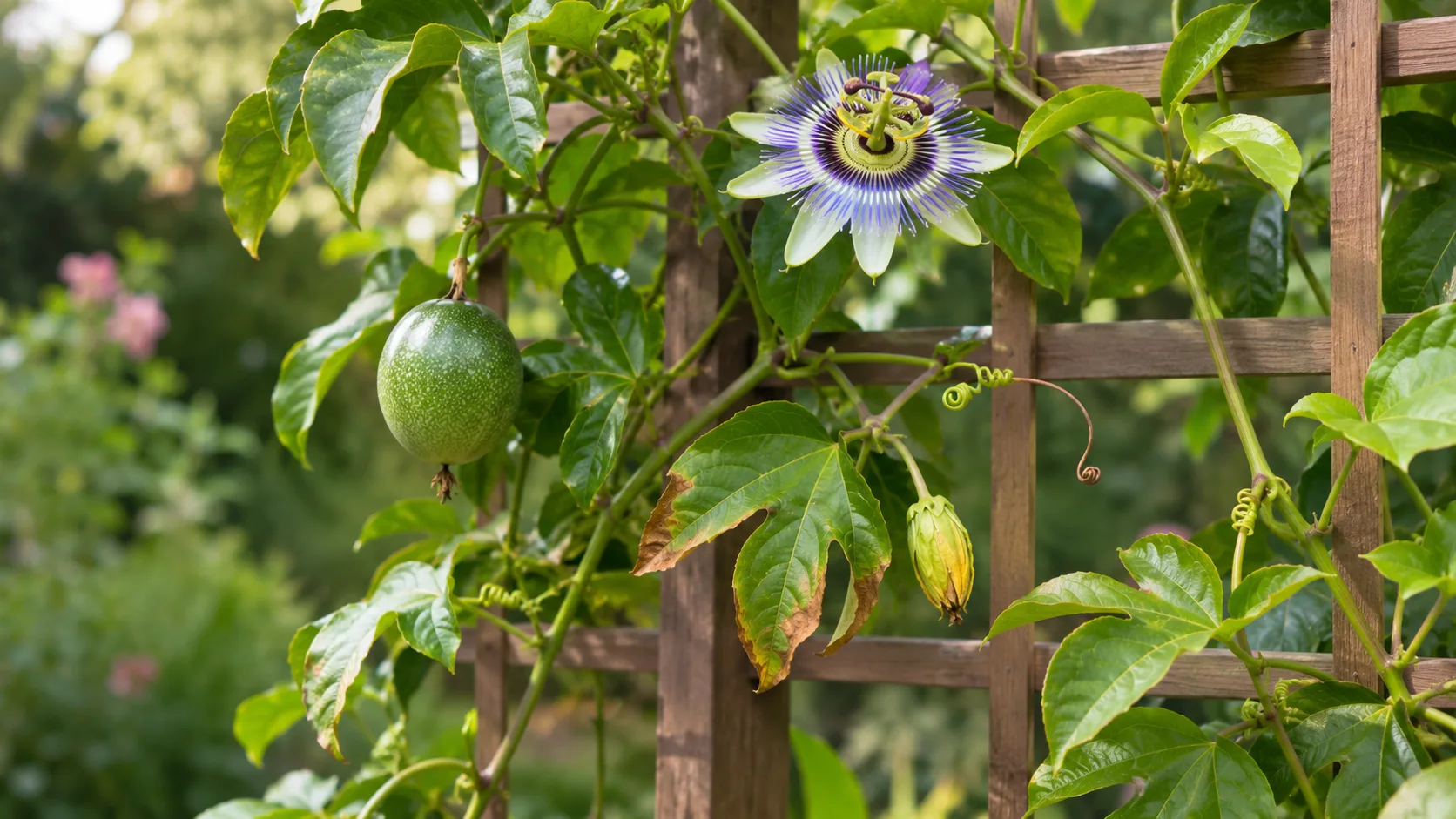
Passion fruit (Passiflora edulis) is a fast tendril-climbing vine, not a compact foliage plant, so dry air reads differently here: crisp brown edges on the deeply cut trilobed leaves, tendril tips that stall instead of wrapping the trellis, and flower buds that yellow and drop while the mix still feels correctly moist at the top 2–3 cm.
For how dry air damages houseplants in general, see our low humidity hub. On passion fruit, dry air most often shows as marginal leaf crisping plus bud drop on new shoot tips — easy to confuse with underwatering, fertilizer tip burn, or normal shedding of older shaded leaves deep inside a dense canopy.
First step: place a hygrometer at canopy height and raise local humidity — a room humidifier indoors, or wind shelter plus grouping and mulch outdoors — before changing how often you water.
When to use this page vs other passion fruit guides
| Pattern | Read next |
|---|---|
| Crisp edges on several leaves plus dropped buds, soil moisture normal | This page — dry air |
| Light pot, mix pulling from walls, limp shoots | Underwatering |
| Tan bands at leaf tips only after feeding | Brown tips |
| Whole vine wilts suddenly, soft stem base, sour mix | Overwatering or root rot |
| Fine stippling and webbing on leaf undersides | Spider mites |
| Pale stretched shoots, few flowers in shade | Not enough light |
| General flop with moist soil but no crisping | Wilting or drooping leaves |
This page covers dry-air crisping, stalled tendrils, and bud drop when the root zone is otherwise stable.
What low humidity looks like on passion fruit
Passion fruit rarely collapses from dry air alone. Because the vine carries many thin trilobed leaves over metres of growth, symptoms concentrate at the most exposed tissue: outer canopy margins, fast-extending shoot tips, and developing buds.
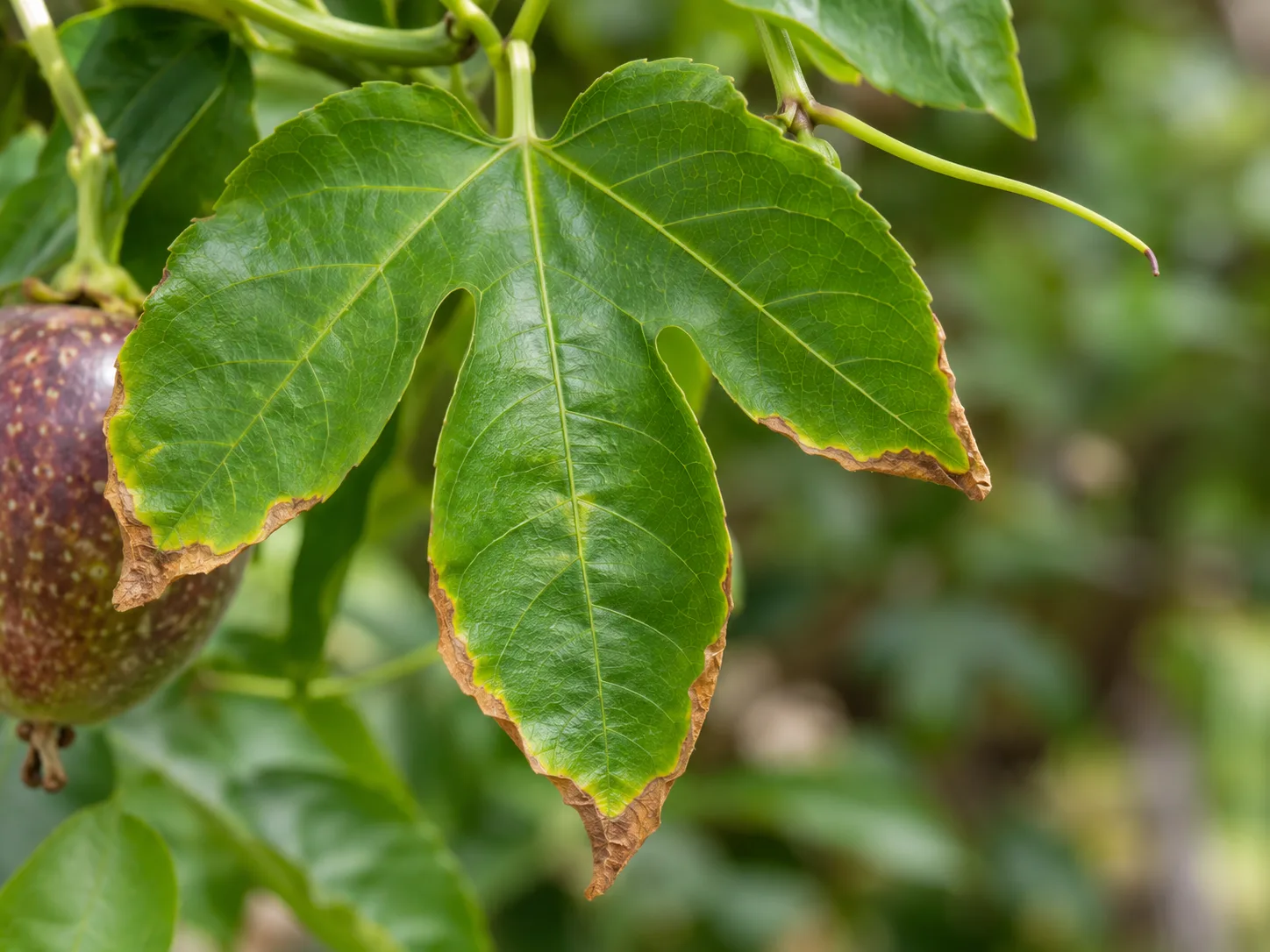
Dry-air stress appears first on exposed leaf margins and tender tendril tips while the rest of the vine can remain green.
Typical signs when dry air is actually involved:
- Papery brown edges on outer trilobed leaves while inner shaded leaves stay green
- Tendril tips that brown and stall instead of curling around wires or trellis
- Flower buds yellowing and dropping before opening, or young fruitlets aborting in a hot dry spell
- New shoot tips pausing even though the vine was extending fast a week earlier
- Damage worst near heat sources, radiators, or windy balcony rails rather than evenly through the plant
Usually not low humidity:
- Uniform wilt with a light pot and shrunken mix — underwatering
- Yellowing lower leaves in soggy mix — overwatering
- Stippled dull leaves with fine webbing underneath — spider mites
- Crisping limited to leaf tips after repeated feeding or hard-water use, sometimes with pale mineral crust on the mix — suspect salt tip burn; pause fertilizer and compare brown tips. Dry-air injury is more likely when exposed margins and tendrils near an AC or draft are affected without a feeding pattern.
- Sparse flowering on a shaded indoor vine — not enough light
- Old shaded leaves yellowing deep inside a dense canopy — normal turnover; thin with pruning in late winter
Judge the newest three shoot tips separately from older canopy leaves. On a healthy vine those tips extend daily in warm weather, tendrils grip within days, and buds hold until the one-day flowers open.
Tendril tips and trellis growth: the vine-only tell
This section applies to climbing passion fruit, not to bushy or rosette houseplants.
Each passion fruit shoot climbs by coiling tendrils, and those tendrils are the most humidity-sensitive tissue on the plant. In dry air, tendril tips brown at the very end and stop coiling, so shoots flop away from the support instead of gripping it. Shoots may still look green overall, which misleads owners into waiting for the vine to “catch up” on its own.
Check tendrils every few days during hot or heated spells. Firm green tendrils that wrap wire within a few days mean the microclimate is acceptable. Brown stalled tips on several shoots at once, while the watering routine has not changed, mean the air around the canopy is too dry or too windy. Training stalled shoots by hand will not hold until the air improves — new tendrils need steadier local humidity to coil and lignify.
Container vines on exposed balconies suffer first because wind strips the boundary layer off thin leaves and tendrils alike. Moving the pot one metre back from the rail, behind a screen or companion pots, often helps more than any spray.
Bud drop and fruit set in dry air
This section would be nonsense on a foliage-only plant: passion fruit flowers and fruits only on new growth, so anything that checks new shoot tips directly cuts flowering.
Each flower lasts about a day, and buds are costly for the vine to build. When transpiration outruns what the shallow roots deliver — exactly what the RHS describes when low air humidity drives rapid water loss from leaf pores — the vine sheds buds and young fruitlets first to protect established foliage. Expect buds to yellow at the stalk and fall untouched, or open flowers to wilt unusually fast in a dry heatwave.
Do not confuse this with pollination failure. Poor pollination leaves open flowers that simply never swell into fruit, common on lone yellow types needing a different pollen partner. Dry-air bud drop happens before flowers open. If buds fall while still closed during a hot dry spell with crisp leaf edges, treat the air and root moisture first; hand-pollination only matters once buds actually stay on to open.
Steady root moisture matters as much as air here because passion fruit roots run shallow. A mulched, evenly moist root zone buffers buds against a dry afternoon far better than alternating soak and drought.
The shallow-root, full-sun container trap
This failure mode is specific to sun-hungry vines with shallow roots grown in pots.
UF/IFAS describes passion fruit as an evergreen flowering vine from Brazil that needs full sun for best flowering and fruit production yet is only moderately drought tolerant. That combination is the trap: owners give the vine the blazing balcony it wants, in a free-draining container mix, and the shallow roots cycle between moist and parched while dry wind works the canopy all day. Leaves crisp at the margins, buds drop, and the instinct is to flood the pot — which then invites root rot in a plant that resents waterlogging.
Passion fruit vines grow best in warm, humid climates with well-draining slightly acidic soils around pH 6 to 7.5. Match that underground: keep the top 2–3 cm check from the watering guide steady, hold 5–8 cm of coarse organic mulch on outdoor pots, and fix the air with shelter rather than extra floods. Seed and early growth need high humidity and warmth, and young vines never outgrow that preference — they just hide it better behind fast extension until a dry spell stalls them.
Indoors, the same trap appears beside south glass plus a radiator: excellent light, dry heated air, and a pot that swings between wet and dry. Move the plant back from the heat source and stabilize both air and watering instead of chasing one lever.
Why passion fruit gets low-humidity symptoms
Tropical vine in dry heated or windy air
Passion fruit evolved in warm humid parts of South America, so long spells of dry indoor heating or hot balcony wind sit outside what its thin leaves handle gracefully. Penn State Extension notes heated winter homes commonly fall below 30% relative humidity while most indoor plants want more. A vine parked beside a radiator or on a windy high-rise balcony lives in exactly that deficit for weeks.
Transpiration outrunning shallow roots
Dry air pulls water from leaf pores faster than roots replace it, and the RHS notes this is precisely when plants wilt even where soil water exists. Passion fruit’s shallow root system has limited buffer, so exposed canopy margins crisp while deeper shaded leaves look fine — a pattern that looks like a watering fault but persists even when the watering routine is correct.
Spider mites riding the same dry spell
Dry air rarely travels alone. Spider mite damage concentrates in warm, dry conditions on thin tender leaves, which describes passion fruit foliage on a hot balcony exactly. Mites add fine stippling and webbing on undersides alongside the crisping — always scan undersides with a lens before concluding humidity alone explains the damage, and treat confirmed mites per the spider mites guide.
How to confirm the cause
Work through these checks in order, changing one thing at a time.
- Hygrometer at canopy height — Hang or set a digital hygrometer among the outer leaves, not across the room. Sustained readings well below 40% with crisp margins and stalled tendrils support dry air. Aim for roughly 40–60% around the canopy.
- Soil moisture cross-check — Feel the top 2–3 cm and lift the pot. Dust-dry mix with a light pot means fix underwatering first. Steady moisture with crisp outer margins points to the air.
- Wind and heat map — Feel for radiator blast, air-conditioner outflow, or steady balcony wind on the worst-affected shoots. Relocate once — back from the rail or register — before buying equipment.
- Bud-stage check — Buds dropping while still closed during a dry spell implicate air and root moisture. Open flowers failing to set fruit without any crisping implicate pollination instead.
- Underside scan — Inspect outer-leaf undersides for stippling and fine webbing. Mite signs send you to spider mites alongside humidity work, not instead of it.
You have likely confirmed dry air when canopy readings hold near 40–60% after your fix, new tendrils coil within days, and fresh buds hold to opening.
First fix for passion fruit
Raise local humidity around the canopy and hold it for a week — run a room humidifier near (not blowing on) indoor vines, or group and shelter outdoor pots behind a screen with fresh mulch — without changing watering frequency yet.
Keep foliage from staying wet: aim a humidifier into the surrounding air rather than onto leaves, allow air to move through the vine, and do not rely on repeated misting. This raises ambient humidity without keeping Passiflora foliage constantly wet.
Indoors, a small humidifier several hours daily in the same room beats every other lever. Penn State Extension finds misting raises humidity only until droplets evaporate within minutes, and pebble trays diffuse into the whole room with almost no local effect. Outdoors, wind shelter plus a 5–8 cm mulch ring and steady watering per the watering guide does the equivalent work.
After one week, re-check the hygrometer and the newest tendrils. If tendrils coil and buds hold, keep the setup through the dry spell. If crisping continues with steady 40–60% readings and moist roots, route to pests or feeding via the overview.
Recovery timeline
Damaged tissue is permanent. Brown leaf edges will not re-green and dropped buds will not reattach. Judge success by stopped spread and clean new growth.
- One to two weeks: no new crisping on outer leaves; tendril tips stay green and start coiling
- Two to three weeks: fresh buds hold to opening; shoot tips resume steady extension
- A month: one or two fully clean new leaves per shoot with working tendrils confirms control
If three consecutive shoot tips extend with gripping tendrils and held buds, the dry-air episode is over. Keep monitoring through heating season or heatwaves.
What not to do
- Do not flood the pot because margins look dry when the top 2–3 cm is already moist — soggy mix invites root rot on shallow roots.
- Do not rely on misting as the fix; it wets foliage for minutes without holding room humidity.
- Do not fertilize a stressed vine before tendrils and buds stabilize — see the fertilizer guide after new growth looks healthy.
- Do not hard-prune or repot on day one unless roots are mushy — see pruning and repotting after recovery.
- Do not stack sprays, feeds, and repotting in one day trying to force buds to hold.
How to prevent it next time
- Keep a hygrometer at the canopy through heating season and heatwaves; act when readings sit well below 40%.
- Site pots out of direct heater blast and prevailing wind while keeping the full sun the vine needs per the light guide.
- Mulch outdoor containers and water to steady moisture in free-draining soil rather than soak-drought cycles.
- Inspect tendril tips weekly in dry spells — they warn days before leaf margins crisp.
- Scan undersides for mites whenever air stays dry for weeks, since both arrive together.
When to worry
Treat as urgent if most shoot tips blacken within days, stems soften at the base, the mix smells sour, or webbing spreads across undersides — those patterns point past cosmetic dry-air burn toward root rot, severe underwatering, or spider mites. See wilting, root rot, or spider mites accordingly.
Lower urgency: papery edges on outer leaves with firm stems, steady soil moisture, and tendrils still attempting to coil. Fix air and shelter before escalating.
Conclusion
Low humidity on passion fruit is a canopy-microclimate problem on a fast tropical climber, not a mysterious disease. Thin trilobed leaves and delicate tendrils telegraph dry heated or windy air at the margins and shoot tips first, and buds drop before flowers ever open. Measure the air at the canopy, humidify or shelter the vine, keep shallow roots steadily moist and mulched — and let new tendrils and held buds deliver the verdict. Old edges stay tan, but gripping tendrils mean you found the right lever.
Related Passion Fruit guides
- Passion Fruit overview — start here for sun, trellis, and watering basics behind every problem page
- Passion Fruit problems — hub routing every symptom to the right diagnosis
- Underwatering on Passion Fruit — use when pots run light and shoots wilt, not just crisp
- Brown tips on Passion Fruit — use for isolated tip burn, often feed or salt related
- Spider mites on Passion Fruit — use when stippling and webbing ride the same dry spell
- Not enough light on Passion Fruit — use for pale stretched shoots with few buds in shade
- Wilting on Passion Fruit — use for sudden whole-vine flop rather than marginal crisping
- Root rot on Passion Fruit — use when extra watering for crisp edges turned the mix sour