How to Use Diatomaceous Earth for Pest Control Safely
Diatomaceous earth can help with crawling pests when it stays dry. Get label-first application steps, safety limits, reapplication advice, and next moves.
Diatomaceous earth can earn a place in a home pest-control kit, but only if you treat it as a targeted pesticide—not as harmless white flour to scatter everywhere. The powder works best against crawling pests that cross a dry, barely visible layer in a crack, along a route, or on a carefully selected plant surface.
The catch is important: food grade is not the same thing as pesticide-labeled, and natural does not mean risk-free. The National Pesticide Information Center (NPIC) says some food-grade products have not been evaluated for pest-control risks or effectiveness, while products registered for pest control carry directions, precautions, and an EPA registration number where applicable. Check the label first, then use the smallest effective placement.
What DE Is—and Why It Kills Some Pests
Diatomaceous earth, or DE, is a powder made from the fossilized silica skeletons of diatoms, microscopic organisms that lived in water. Most DE is made largely of amorphous silicon dioxide. It is not a poison that an insect has to swallow; it is a physical, desiccating material.
When a susceptible insect walks through dry DE, particles abrade the waxy outer layer of its exoskeleton and absorb oils and moisture. That increases water loss until the insect dies. UC Integrated Pest Management describes DE as a contact insecticide that works by drying insects and scratching the exoskeleton, while a 2024 PubMed-indexed study found dose-dependent mortality and increased water loss in red flour beetles after DE exposure. That study helps explain the mechanism, but it does not guarantee the same speed or result for every pest in every home.
This mechanism gives DE two practical strengths. It does not depend on an insect’s nervous system, so it is useful where a physical treatment makes sense, and a dry deposit can keep working until moisture or disturbance removes it. It also gives DE two hard limits: the pest must contact the powder, and the powder must remain dry enough to work.
The Label Check That Matters More Than “Food Grade”
Start with the package, not the marketing claim on the front. A product described as food grade may be purified for a food or feed use, but that does not automatically mean its pest-control performance, directions, exposure limits, or indoor uses have been evaluated. NPIC specifically advises choosing a product with a pesticide label when using DE for pest control and following that label.
Avoid pool-grade DE and anything identified as crystalline silica or intended for pool filtration. Pool-filter material is processed differently, and crystalline silica is the form that raises much greater inhalation concern. The fact that a bag of powder is sold near garden supplies—or that a social post calls it “natural”—does not override its actual label.
Look for a product that names the pest and application site you intend to treat. If you want to use DE in a vegetable garden, the label should address that use; if you want to treat a home for cockroaches or bed bugs, the label should say so. Do not improvise a rate, mix a product for spraying, apply it to a pet, or put it on food unless the product label specifically permits that use.
The label also tells you what protective equipment and re-entry precautions apply. NPIC notes that pesticide labels specify where and how much to use, precautions, required protective equipment, signal words, and—in certain public-health pest uses—evidence of effectiveness under ideal conditions. Those details are more useful than a general “safe” or “non-toxic” promise.
Decide Whether DE Fits Your Pest Problem
Before opening the bag, identify the pest and its route. A white powder is not a substitute for knowing whether you have ants, roaches, carpet beetles, fleas, bed bugs, slugs, or something else. If you only see damage and no pest, use a sticky monitor, trap, photo, or local extension service to narrow the diagnosis before treating.
DE is a reasonable candidate when three conditions line up:
- The pest crawls across a surface you can treat precisely.
- The treatment can stay dry and relatively undisturbed.
- The product label allows the pest, site, and application you have in mind.
Pests DE Can Contact-Kill
NPIC’s DE overview lists registered DE products for pests including bed bugs, cockroaches, crickets, fleas, ticks, spiders, and other insects. UC IPM also lists bed bugs, carpenter ants, carpenter bees, carpet beetles, cockroaches, silverfish, and snails and slugs among pest notes that mention this active ingredient. Those listings mean DE can have a role; they do not mean every DE product is labeled for every pest.
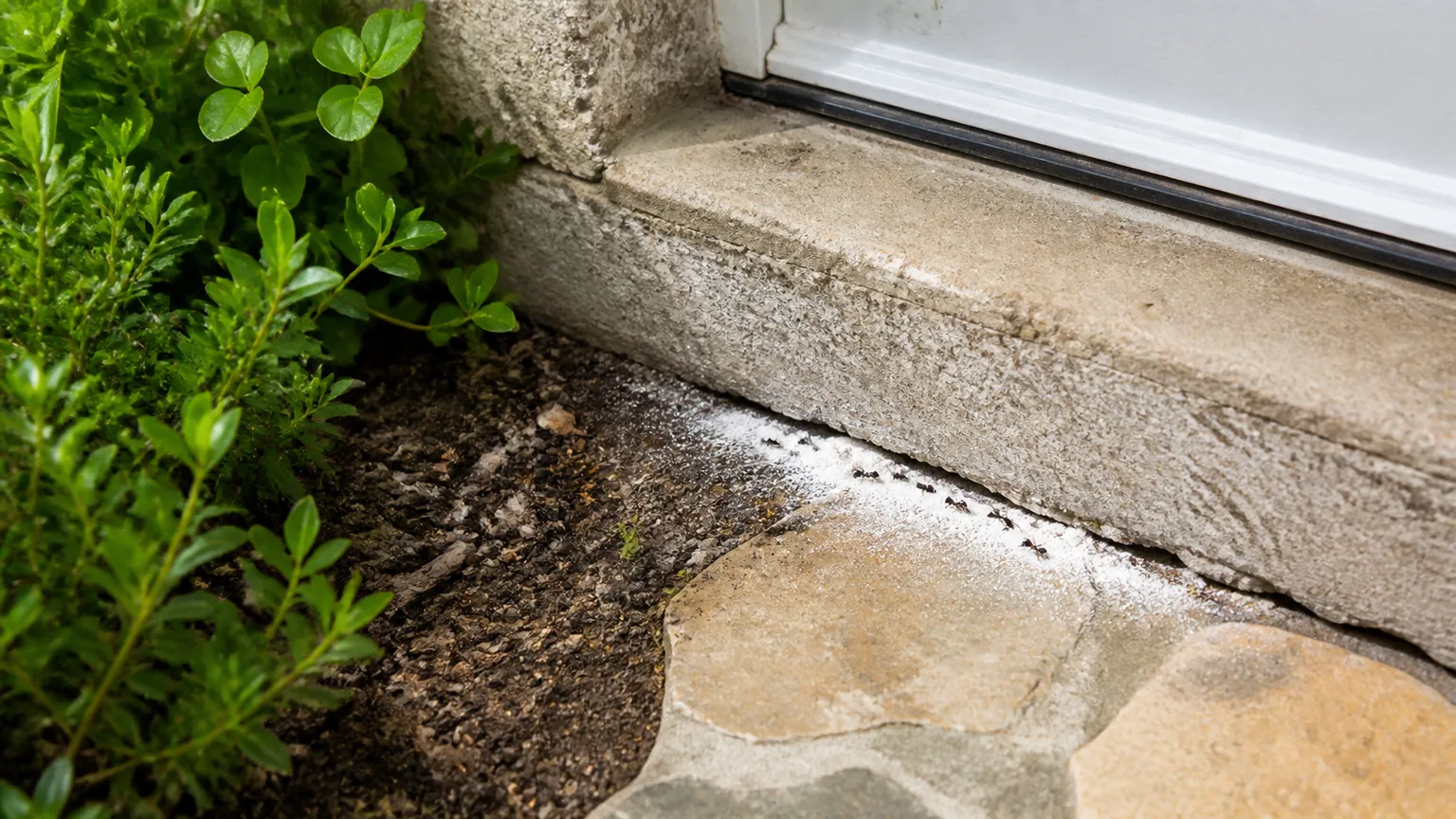
In a home, DE is most useful as a route treatment for crawling insects. Roaches may cross a dry deposit behind an appliance or inside a protected crack. Ants may cross a narrow treatment line along a known entry route. Fleas and carpet beetles may contact a properly labeled treatment in protected floor edges, although their life cycles and hiding places make a whole-infestation plan more complicated.
In a garden, it can make sense around a dry perimeter or on a specific plant part when the target insect is actually present. It is less compelling as a routine blanket dusting of every leaf, because it can contact beneficial insects too and will lose its usefulness after rain, irrigation, or heavy dew.
Problems DE Will Not Solve Alone
DE does not repel rodents, and it is not a reliable answer to mosquitoes or other pests that do not regularly crawl through the treated area. It will not reach a nest, wall void, or deep harbor simply because you sprinkle powder nearby. A visible line beside an ant trail may kill some workers without solving the colony or the food and moisture condition attracting them.
DE is also a poor “preventive” around a bed when no bed bugs have been identified. NPIC’s bed-bug guidance says bed bugs are difficult to control even for trained professionals, recommends correct identification, and describes a broader integrated approach that can include monitoring, heat, steam, vacuuming, encasements, and professional help. Do not let a dusting delay identification when bites, shed skins, fecal marks, or live insects suggest bed bugs.
Finally, DE does not remove eggs simply because adult insects cross it. Breaking a life cycle may require repeated monitoring and other controls. If activity persists after a correctly labeled, dry, targeted application, the answer is usually better identification and a broader plan—not a thicker layer of powder.
Before You Apply: A Five-Minute Setup
The quality of the setup determines more than the quantity of DE. Walk the treatment area and answer these questions before you dust:
- What insect am I treating, and where does it travel?
- Does my exact product label allow this pest and surface?
- Can I keep children, pets, and other people away while the dust settles?
- Are fans, HVAC vents, open windows, doors, or foot traffic likely to move the powder?
- Is the outdoor surface dry, with no immediate rain, irrigation, or heavy dew expected?
Gather a labeled product, the duster or applicator recommended on its package, eye protection, long sleeves, and the respiratory protection the label calls for. A bellows-style powder duster generally gives better control than shaking a bag, but do not assume a tool makes an off-label use acceptable.
Clean up food crumbs, standing water, and clutter first. Seal obvious entry gaps where appropriate, repair screens, fix leaks, and move stored food into closed containers. DE can intercept a route, but sanitation and exclusion reduce the reason pests are using that route in the first place.
Plan the exit route before you apply. You should be able to finish, close or leave the area, and let the dust settle without walking back through it. If the plan requires blowing powder under a door, toward a vent, or across a child’s play area, choose a different control or ask a professional for a safer placement.
Use DE Indoors Without Making a Dust Problem
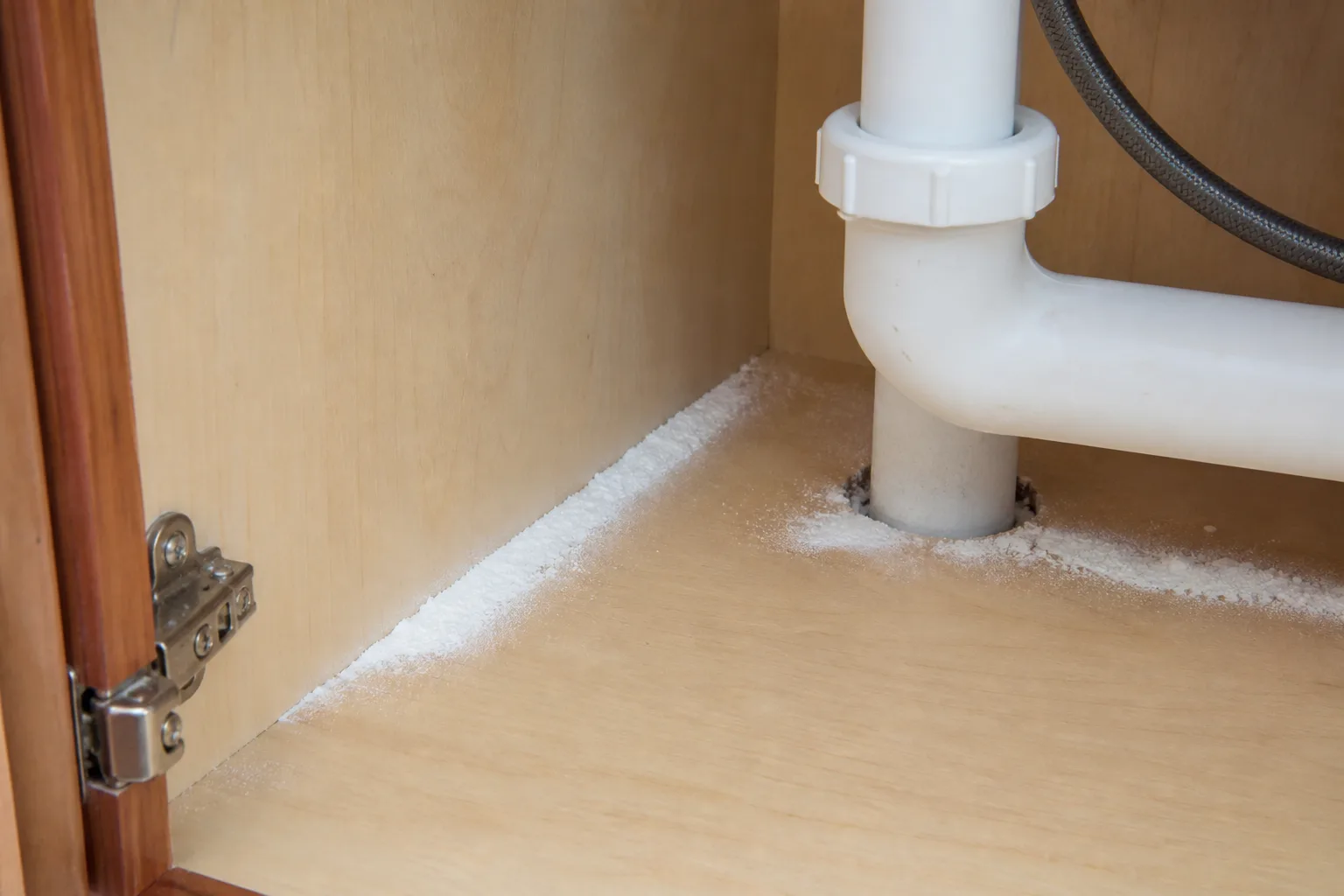
Indoors, the goal is not to make the room look powdered. The goal is to leave a very thin deposit in a protected place where the target pest is likely to cross it and people, pets, and air movement are unlikely to disturb it.
Martha Stewart’s current expert guidance similarly emphasizes strategic placement behind appliances, under sinks and furniture, along baseboards, and in cracks and crevices, with sparing use in areas that will not create an inhalation risk. That is a useful practical translation of the label-first rule: treat the pest’s path, not the visible center of the room.
Where to Place a Thin Indoor Dusting
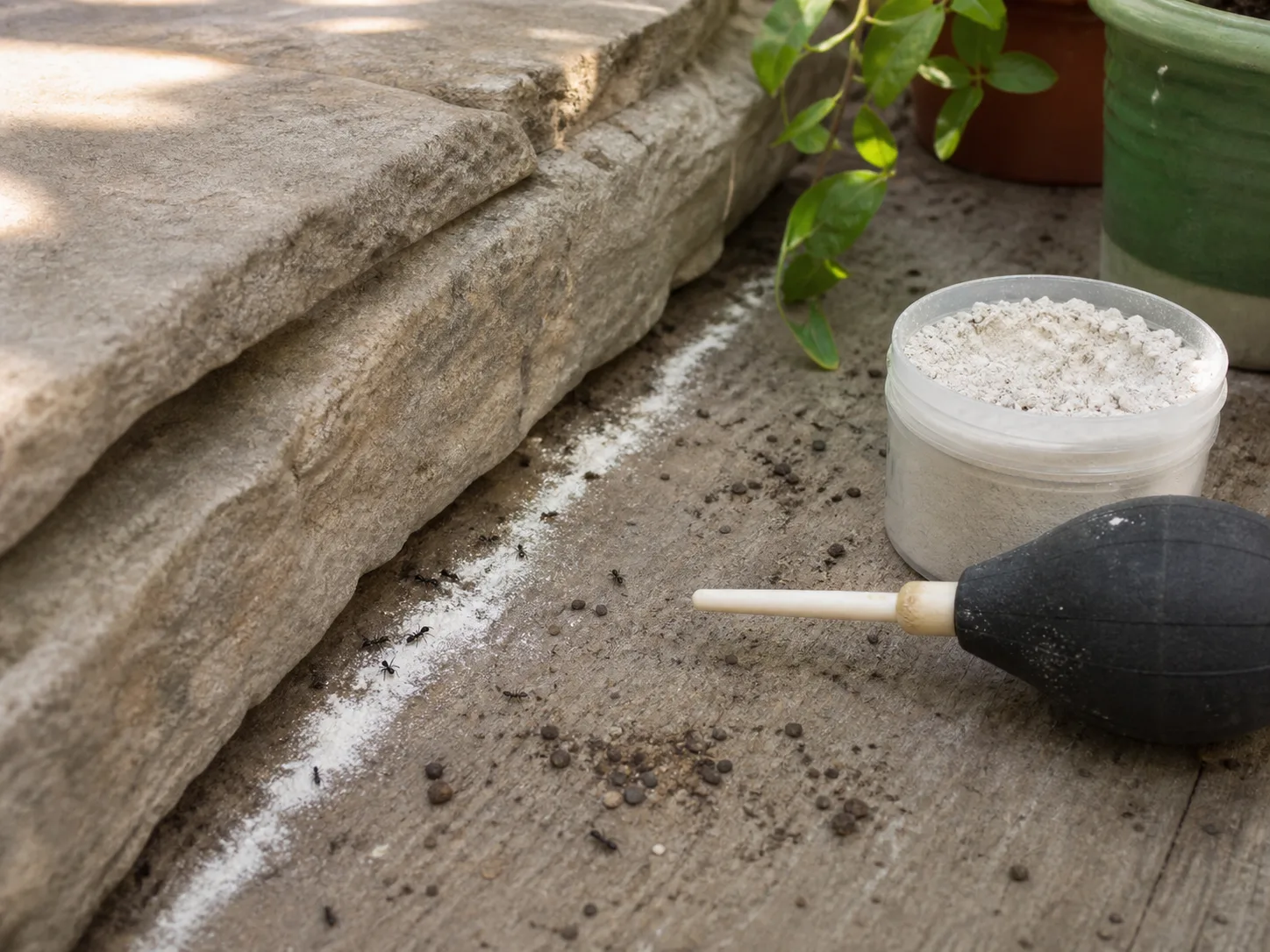
Apply the thinnest layer that the label allows. A heavy white ridge is not proof of a stronger treatment; it can be easier for people to disturb, can increase airborne dust, and may cause insects to route around it. A fine duster can place a light film along a protected baseboard edge, behind an appliance, beneath a cabinet toe-kick, or in an accessible crack when the label permits that site.
Avoid exposed countertops, food-contact surfaces, children’s low play areas, pet bowls, bedding that is in use, air returns, supply vents, heaters, fans, and high-traffic floor centers. Do not puff DE into an electrical outlet or switch box unless the product label explicitly directs that use and you understand the electrical safety risk; a wrong tool or excessive dust can create a different household hazard.
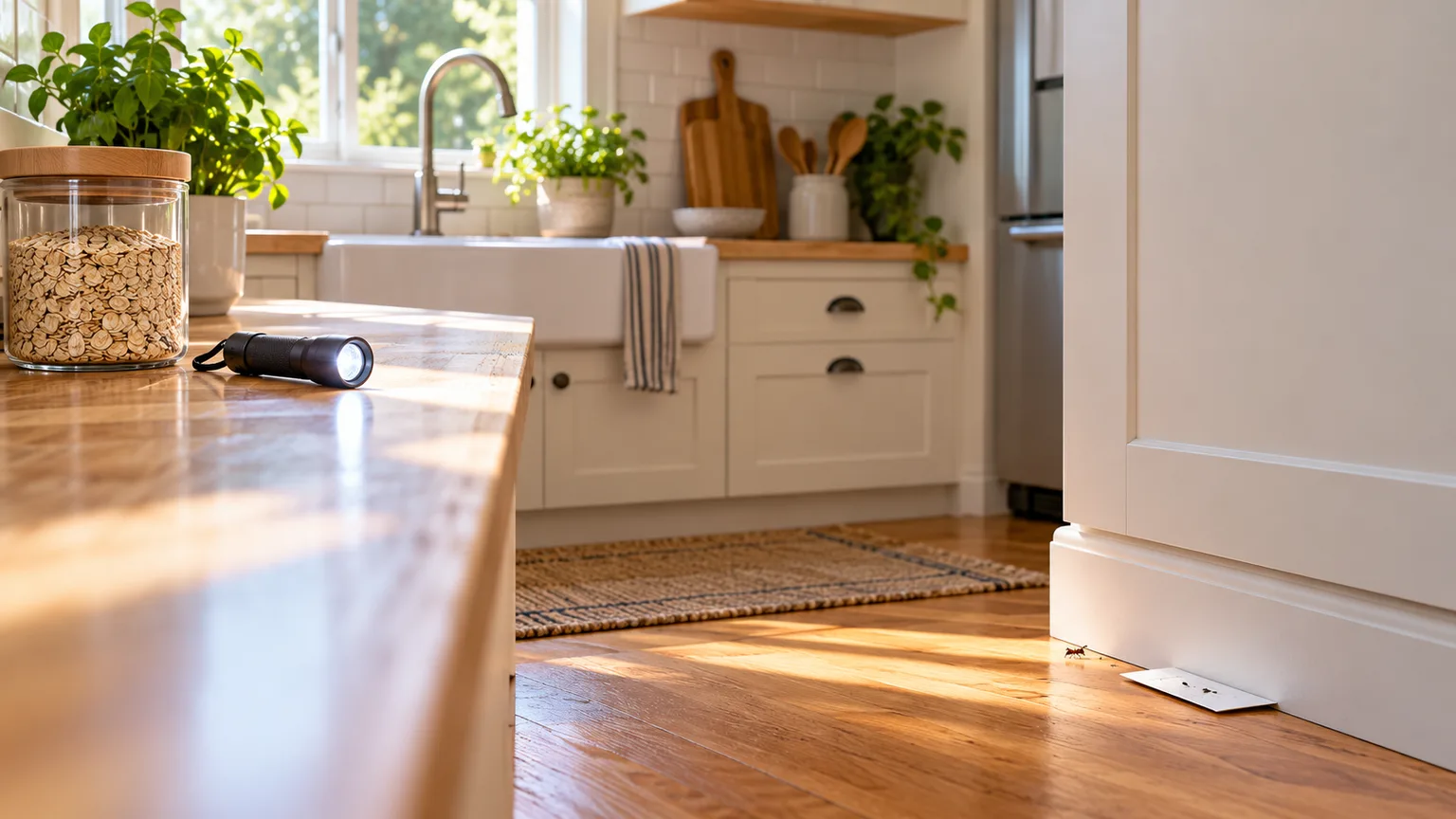
Use a flashlight and look for the route: grease marks, droppings, shed skins, live insects, gaps below doors, or the protected edge behind an appliance. If you cannot identify a route, a monitor is often more informative than coating a larger area.
How to Treat Carpets, Bedding, and Pet Areas
Soft furnishings deserve more caution than a hard crack. Powder can settle into fibers, become airborne during walking or vacuuming, and remain where a child or pet lies. Only treat carpet, rugs, pet bedding, mattresses, or upholstered items when the product label specifically allows that surface and you can follow its dwell-time and cleanup directions.
Keep people and animals out during application and until the label says the area can be reoccupied. Never apply DE directly to a pet unless the product is specifically labeled for that animal and use; “food grade” alone is not a substitute for veterinary or pesticide directions. For a suspected bed-bug problem, do not rely on a mattress dusting as the complete plan. NPIC recommends identification, monitoring, laundering or high-heat drying where appropriate, vacuuming, encasements, and professional coordination for difficult infestations.
Before vacuuming, check the vacuum manufacturer’s instructions. Fine powders can pass through some machines or be blown back into the room; Martha Stewart’s experts recommend checking whether the vacuum is suitable for powders and using a damp cloth for surfaces when it is not. Seal or empty the contents promptly according to your local disposal rules, and wash treated fabrics as directed.
Use DE in the Garden With Precision
Outdoor DE should be a spot treatment, perimeter treatment, or label-approved plant application—not a fog of powder over the whole garden. Start at the damaged plant or the edge where the pest is actually traveling, then work outward only if monitoring shows the pressure is coming from elsewhere.
Choose a calm, dry period. Moisture clumps the material and reduces contact with the insect; even when the deposit later dries, coverage may have shifted or washed away. UF/IFAS Extension notes that DE is used against several common household and garden pests and stresses following label directions for rate and safety, while UC IPM warns that application hazards vary with location, formulation, environmental conditions, and rate.
Dry Dusting vs. Labeled Wet Application
For a dry application, use the product’s applicator to place a barely visible coating on the intended surface. Focus on a pest pathway, the undersides of leaves only when the label allows it, or a dry soil or mulch surface where contact is plausible. Do not dust open flowers, wet foliage, puddles, or places where runoff can carry the product into water.
Some products allow a wettable-powder or slurry application. That does not mean every DE product can be mixed into a spray, and it does not mean the wet mixture kills on contact while wet. The deposit must dry before its desiccating action can work. Follow the package’s mixing, equipment, protective, and re-entry directions exactly; if the label does not describe a wet method, do not invent a kitchen measurement.
Wet application can help a labeled product adhere to hard-to-reach foliage, but it introduces its own tradeoff. It takes longer to dry, can put DE on plant surfaces where beneficial insects may land, and may need to be repeated after rain or overhead irrigation. Epic Gardening also notes that wet DE becomes effective again only after drying and that some products can clog a sprayer, which is another reason the label and equipment instructions matter.
Protect Bees and Beneficial Insects
DE is not selective. The same abrasive, drying action that affects a pest can affect a ladybug, bee, butterfly, lacewing, or other insect that crosses the deposit. UC IPM’s DE entry says not to apply or allow drift to flowering plants, including weeds, and not to contaminate water accessible to bees.
Before treatment, watch the bed long enough to see where pollinators land and when they are active. Keep DE off flowers and away from plants that are being visited, such as flowering herbs and milkweed. Use a targeted barrier or a different control method when the pest is confined to a stem, lower leaf, soil edge, or non-flowering crop section.
The safest application is the smallest one that addresses a confirmed pest. Hand-picking, exclusion mesh, pruning a heavily infested leaf, a water spray, sanitation, or a crop-specific biological control may be better first moves depending on the pest. “Organic” does not turn a non-selective product into a pollinator-safe blanket treatment.
What Results to Expect—and When to Reapply
DE is a contact treatment, not a magic signal that makes pests leave an area. A pest must cross the deposit, and the material must remain available and dry. Expect individual insects to die over hours to days rather than assuming the entire problem will disappear overnight; the exact timing depends on species, humidity, dose, temperature, and whether the pest can avoid the treated route.
Watch for the right result. Fewer live pests crossing the monitored route is more meaningful than a white line remaining visible. If the powder is gone, wet, clumped, covered with dust, or repeatedly walked through by people and pets, it may no longer be functioning as intended.
Reapply only when the label permits and a new application is justified by monitoring. Outdoors, rain, irrigation, and heavy dew are common reset points. Indoors, do not automatically refresh a treatment just because you can no longer see it; first ask whether the area is still appropriate, whether the pest is still active, and whether cleanup or a different control is safer.
For an ant trail, look for new activity after the first dry period and inspect the entry point. For a leaf pest, check new growth and the undersides of leaves, but do not turn repeated dusting into a whole-plant coating. For bed bugs or roaches, continuing sightings after a careful treatment should trigger a reassessment of hiding places and the broader control plan.
Common DE Mistakes That Waste the Treatment
Using the wrong grade. Pool-grade or crystalline-silica products are not interchangeable with a labeled pest-control product. A food-grade label does not automatically supply tested pest directions.
Applying a visible pile. More powder can mean more dust and a route the pest avoids. The useful deposit is generally a light film, placed where contact is likely and disturbance is low.
Dusting wet plants or soil. Moisture reduces the treatment’s performance and may move it into places where it does not belong. Wait for an appropriate dry window and plan around watering.
Spraying an invented recipe. Particle size, formulation, site, and equipment vary. Use a wet method only if your exact label permits it and provides directions.
Treating every insect as a pest. A garden is not an empty room. DE can injure beneficial insects, especially when applied to blooms or drifting across active foraging areas.
Skipping the cause. Ants may be following food or water; roaches may have shelter and leaks; fleas may be tied to an animal or wildlife host; bed bugs may be hitchhiking or moving between units. DE can intercept contact, but it does not repair the condition creating pest pressure.
Using it as a bed-bug guarantee. NPIC warns that bed bugs are hard to control and that many pesticide treatments do not kill eggs. Identification, persistent monitoring, heat or steam where appropriate, vacuuming, encasements, and professional coordination matter more than scattering extra dust.
When to Switch to Integrated Pest Management
Integrated pest management (IPM) means combining identification, prevention, monitoring, physical controls, and the least-risk effective pesticide option rather than reaching for one product repeatedly. DE fits as one tool in that sequence when it matches the pest, surface, and label.
Move beyond DE alone when you see one of these patterns:
- The pest is flying, a rodent, or otherwise unlikely to contact the treatment.
- Activity continues because the colony, nest, host, leak, food source, or entry gap remains.
- You suspect bed bugs, especially in an apartment or shared-wall building.
- Cockroach activity is frequent, daytime, or spread across rooms.
- A child, pet, sensitive adult, or respiratory condition makes airborne dust unacceptable.
- The application would reach flowers, water, food-contact areas, HVAC equipment, or high-traffic surfaces.
- The product is not labeled for the pest or site you want to treat.
At that point, keep monitoring and bring in the right help: a local extension service for identification and garden options, a veterinarian for a pet issue, or a licensed pest professional for a persistent indoor infestation. Tell them what you applied, where, when, and how much, and keep the product label available.
Store, Clean Up, and Dispose of DE Carefully
Close the container tightly and store it in its original labeled package, away from children, pets, food, moisture, and heat. A sealed container prevents clumping and makes it less likely that someone will mistake the powder for flour or another household material. Do not transfer it into an unlabeled jar.
When the treatment is no longer needed, remove exposed residue according to the label. For a hard surface, a damp cloth can keep dust from becoming airborne. For carpet or fabric, use only a vacuum approved for fine powders and follow the product directions; do not sweep vigorously or use a fan to clear the area.
Wash hands after handling the product and launder dusty clothing separately if the label directs it. If DE gets in your eyes, on your skin, or into your lungs, follow the product first-aid directions. NPIC’s fact sheet notes that inhaled DE can irritate the nose and airways, while dust can irritate eyes and dry the skin; seek medical or poison-control advice for concerning exposure.
Conclusion
Diatomaceous earth is worth keeping only when you know what job it is doing. Choose a product whose label covers the pest and location, avoid pool-grade material, wear the protection the label calls for, and apply a thin, targeted layer where a crawling pest will cross it.
Indoors, keep dust away from air movement, food-contact areas, children, pets, and bedding in use. Outdoors, wait for a dry window, expect to reapply after moisture only when the label permits, and keep the powder off blooms and pollinator routes. If the pest cannot contact the treatment—or the activity continues after a careful application—shift to identification, exclusion, monitoring, and a broader IPM plan. That is how a simple mineral becomes a useful household tool without becoming a household dust problem.