Mold on Soil on African Violet: Causes, Checks & Fixes
Quick answer
Surface mold on African violet soil is usually harmless saprophytic fungus—but on this plant it signals the peat top layer stayed wet too long, often from bottom-watering too long or a full wick reservoir. First step: stop watering, feel the crown for firmness, and let the top inch of mix dry before the next drink.
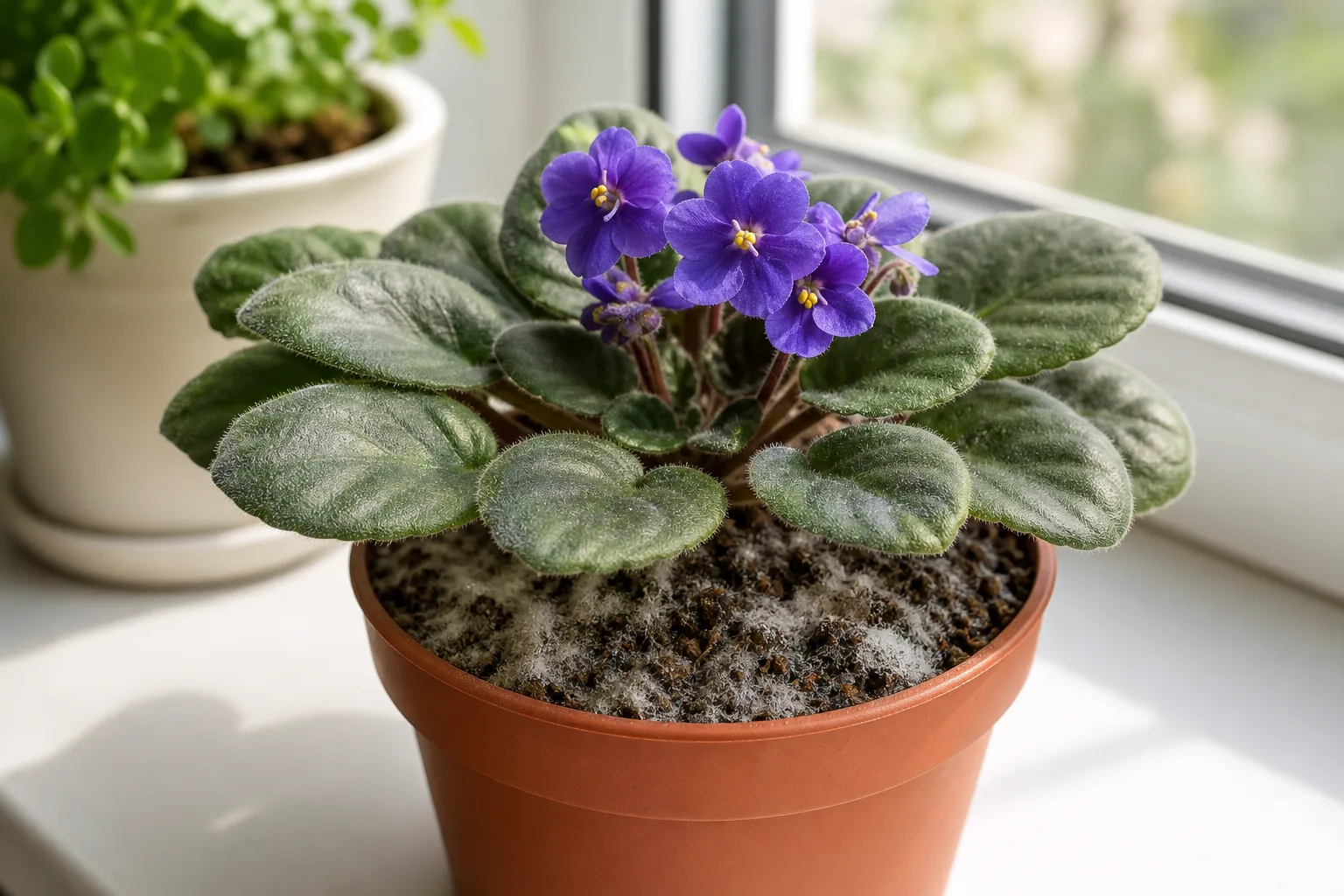
Mold on Soil on African Violet: Causes, Checks & Fixes
This guide covers mold on soil on African Violet. See also the general Mold on Soil guide, watering, and light pages for this plant.
Mold on Soil on African Violet: Causes, Checks & Fixes
Quick answer
White or gray fuzz on the soil surface of your African violet almost always means the top layer of peat-rich mix stayed wet too long. The mold itself is usually harmless saprophytic fungus breaking down organic particles—but on a plant with shallow, fine roots and a moisture-sensitive crown, that same damp surface is an early warning for root rot from overwatering, fungus gnats, and crown rot.
For how saprophytic fungi colonize wet organic potting mix in general, see our mold on soil hub. On African violets, the pattern almost always traces to bottom-watering or wick setups that keep the peat surface damp between drinks.
First fix: stop watering immediately. Feel the crown where new leaves emerge—firm tissue is reassuring; soft or mushy center means escalate beyond scraping. Do not resume until the top inch of mix feels dry and the pot feels lighter. Only after that dry-down should you scrape off remaining fuzz if it bothers you.
African violets are normally bottom-watered or wick-fed to keep velvety leaves dry. Mold appears when that routine keeps the surface damp between drinks—often from calendar watering, saucers holding runoff, wick reservoirs that never empty, or dense peat mix on a crowded grow shelf.
Bottom-watering and wick traps that grow mold
This is the section most houseplant mold guides skip—and the one that matters on African violets.
Saucer soak too long. Place the pot in about one inch of water; when the soil surface becomes moist, remove the pot, allow it to drain, and pour out excess water. Many growers leave the violet submerged for an hour or overnight. The velvety leaves stay dry, but the top centimeter of peat never dries—exactly where mold spores germinate.
Wick reservoir always full. The potting mix should be porous enough for wick watering; dense mix can rot plants because soil stays too wet. A capillary mat or wick jar kept topped up while the surface is already dark and damp is a common mold factory on grow shelves, especially in cool rooms when the plant uses less water.
Crowded violet collections. Multiple pots under lights trap humidity between rosettes. Without an inch of space for air movement, the top layer dries slowly even when roots below would tolerate moderate moisture.
Calendar watering in winter. Water African violets whenever the soil surface feels dry to the touch, but before it becomes hard or the plant wilts—not every Sunday regardless of pot weight. A routine that worked in bright summer light can leave winter soil soggy when growth slows.
What mold on soil looks like on African Violet
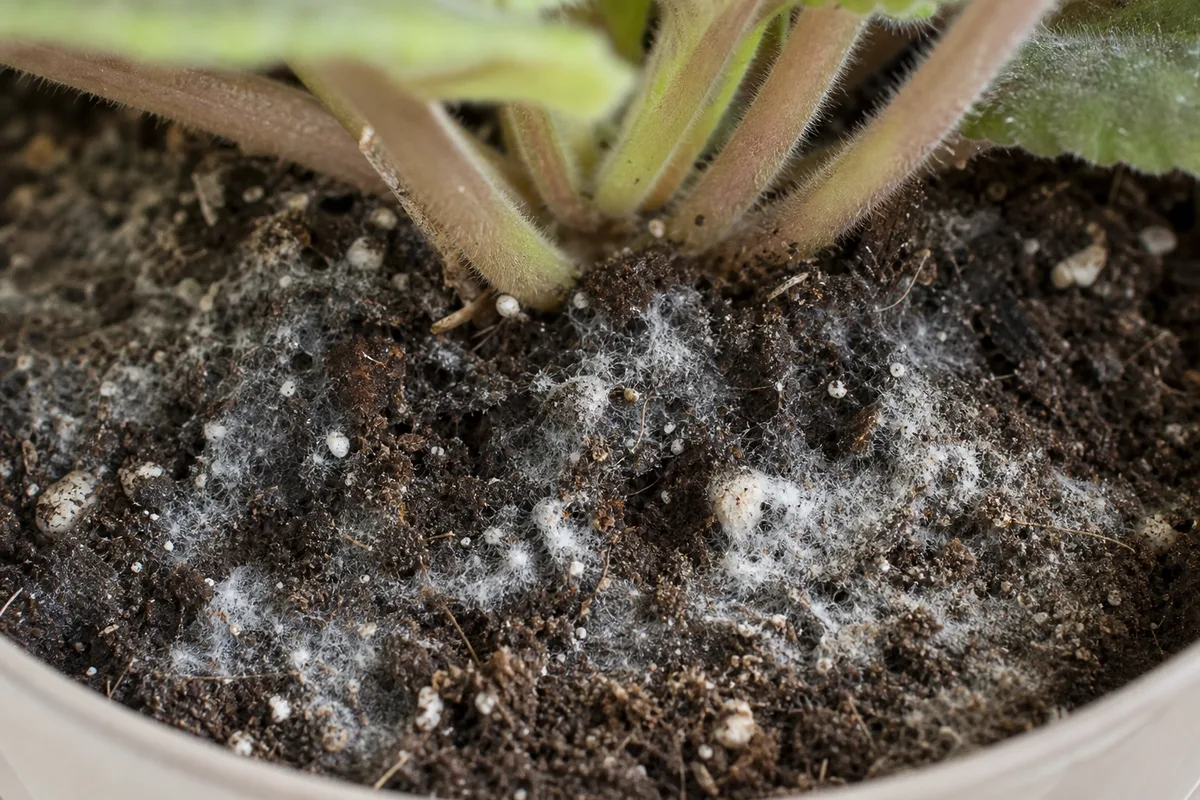
Thin white or gray fuzzy saprophytic mold on the top inch of peat-based mix—harmless fuzz that signals the surface stayed wet too long.
On African violet pots, mold most often appears as a thin white, gray, or occasionally yellowish fuzzy film across the top of the peat-vermiculite mix. It may show up in patches near the pot rim or cover the entire surface. Sometimes you notice it alongside a musty smell, dark wet-looking soil, or small flies hovering when you lift the pot from its watering tray.
Healthy African violets in active growth should have a lightly moist—not soggy—surface that dries slightly between waterings. If the top stays dark, cool, and soft to the touch for many days after one bottom soak, mold is a predictable follow-up. Leaves may still look fine at this stage—that is why surface mold catches growers off guard. The risk is not the fuzz itself but the wet conditions feeding it on a plant highly subject to root and crown rot if overwatered.
During cool winter months on a dim windowsill, a small violet pot may stay wet for weeks when growth slows. A plant left in a bottom-watering tray overnight—or on a capillary mat with a constantly full reservoir—is a common indoor mold scenario.
White and gray fuzzy surface growth
Saprophytic molds on peat-based African violet mix look like cottony threads or a fine powder across the surface. Molds on peat moss growing media are saprophytic—they feed on dead plant material and are not pathogenic to plants. They break down old peat particles and fallen leaf bits. On African violets, that decomposition happens in the same top inch where fungus gnat larvae breed when moisture lingers.
Musty smell, gnats, and wet peat signs
A musty odor from the drain hole, fungus gnats running across the soil when you water, and white fuzz together point to chronic surface wetness, not a random indoor fly. Gnats and mold share the same habitat; drying the top inch treats both better than spraying leaves. If the smell is sour rather than earthy, inspect roots—anaerobic conditions may already be stressing fine violet roots.
Why African Violet gets mold on soil
African violets evolved in cloud-forest conditions with loose, fast-draining debris around shallow roots. Indoors they live in small peat-perlite pots that hold moisture at the surface when drainage and timing slip. Spores are everywhere; they germinate when humidity and moisture stay high on organic mix.
Several care patterns trigger mold on African violets more than on drought-tolerant succulents:
Peat-heavy mix without enough perlite. Commercial African violet blends high in peat retain moisture at the surface. That same mix supports healthy roots when drainage and timing are right; mold means the balance tipped toward too wet for too long—the pattern behind overwatering on this species.
Low airflow on grow shelves. Crowded violet collections under lights trap humidity between pots. Without space for air movement, the top centimeter dries slowly even when roots below would tolerate moderate moisture.
How to confirm the cause
Work through these checks before repotting, spraying fungicide, or discarding the plant:
- Crown firmness. Gently feel the center rosette where new leaves emerge. Firm and tight is reassuring. Soft, spongy, or giving under pressure suggests crown rot—not just surface mold.
- Surface moisture at depth. Press a finger into the top inch. If it stays damp many days after watering, the problem is chronic wet surface soil—not a one-time splash.
- Pot weight and drainage. Lift the pot. Heavy days after you thought you watered lightly means water is not exiting. Confirm drainage holes are open, cachepots are empty, and the plant is not sitting in a full wick reservoir.
- Watering setup. Review whether you bottom-water past 30 minutes, leave saucer water standing, or run wicks with reservoirs always full. Pour off any water remaining in the saucer after a few hours when bottom-watering.
- Companion signs. Fungus gnats at the rim, yellow lower leaves on an otherwise firm plant, or green algae on the pot edge point to the same root-zone moisture issue.
If the crown is firm, leaves are healthy, and only the top centimeter is fuzzy after one overwatering episode, you likely caught it early. Soft crown plus sour smell plus wet deep soil means escalate to rot protocol, not just scraping.
The first fix to try
Stop watering and let the top inch of mix dry completely.
Do not scrape, repot, or spray on day one. Pausing irrigation gives you a clear read on whether the plant was simply overwatered. In warm active growth with good light, a small African violet pot often dries in five to ten days. During cool winter months, it may take longer—and that is acceptable.
Once the top inch feels dry and the pot feels lighter:
- Scrape off the top 1–2 cm of fuzzy soil with a spoon and discard it in the trash (not the compost pile indoors).
- Move the pot to a brighter spot with space around it for airflow—see the light guide for targets.
- Resume bottom-watering only when the dry-down test passes: set the pot in shallow room-temperature water until the surface feels moist, then remove and discard excess.
That single correction resolves most first-time mold cases on African violets with firm crowns.
If mold comes back within a week
Recurring fuzz means the environment still favors fungus. After the dry-down cycle:
- Top-dress with a thin layer of dry, perlite-rich mix to replace the removed surface layer.
- Shorten bottom-water soaks—many violets need only 15–30 minutes, not hours in a full tray.
- Repot in spring if the mix is peat-heavy, smells sour, or takes more than ten days to dry in a bright room. Use a lighter blend with extra perlite—especially for wick setups per the soil guide.
- Top-water once to flush accumulated fertilizer salts if you bottom-water exclusively; salts can crust the surface and hold moisture.
Repotting is a second-step fix, not an emergency response to a single mold patch on an otherwise healthy plant.
Recovery timeline
With a firm crown and corrected watering, new center leaves staying tight is the best sign you are clear. Surface mold should not return once the top dries between drinks.
Improvement usually shows within one dry-down cycle (roughly one to two weeks depending on pot size, light, and season). Watch for:
- Good: Firm crown, top inch dry before each watering, no new fuzz, healthy new leaf tips.
- Bad: Crown softening, center leaves water-soaked, sour smell from drainage holes, mold returning within days of scraping, limp leaves on wet mix.
Root and crown rot can occur when roots stay too wet—even when no specific disease organism is present. Mushy crown tissue does not firm up again. You can sometimes restart from healthy outer leaves as cuttings, but prevention at the mold stage is far easier.
Lookalike symptoms
Green algae on the pot rim or soil surface also signals constant surface moisture and low light—not a different disease. Brighten indirect light slightly and dry the top layer.
Fungus gnats share the same wet-soil habitat. Adults are mostly a nuisance; larvae in the top inch can stress fine roots. Drying the surface treats both—see fungus gnats for confirmation steps.
Salt or mineral crust can look white but feels hard and gritty, not fuzzy. Flush from the top monthly if you bottom-water exclusively; crust holds moisture differently from organic mold.
Powdery mildew on leaves is a separate issue tied to humid stagnant air on foliage. Mold confined to soil with dry, firm leaves points to watering and mix, not leaf fungus.
Normal peat darkening after watering is not mold—look for actual fuzzy threads or a musty smell before treating.
| What you see | Likely cause | First check |
|---|---|---|
| White/gray fuzz on wet peat | Saprophytic mold on overwatered surface | Crown firmness + top-inch dryness |
| Green film on rim | Algae from constant moisture + low light | Light level + watering duration |
| Hard white crust | Fertilizer or hard-water salts | Flush test; review feeding |
| Tiny flies on damp surface | Fungus gnats breeding in top inch | Dry surface + sticky traps |
| Mushy center on wet mix | Crown rot escalation | Stop water; see crown rot guide |
What not to do
Do not drench with fungicide or hydrogen peroxide as a substitute for drying the soil—African violet roots need oxygen, not another wet treatment.
Do not increase watering because leaves look slightly wilted while the soil is still damp. Wilting with wet mix means root stress, not thirst—watering again deepens rot.
Do not mist fuzzy leaves while soil is moldy and wet; moisture on velvety foliage invites leaf spots and crown problems.
Do not leave the pot in a bottom-watering tray overnight or keep a wick reservoir full while the surface stays soggy.
Do not assume mold is harmless and ignore a softening crown. Surface saprophytes and root rot share the same cause: too much moisture for too long in fine roots.
How to prevent mold on African Violet soil
Match watering to the plant’s rhythm: moist but not soggy, with the top inch drying slightly between drinks. Pair that with a light peat-perlite mix, open drainage, and enough space between pots on a grow shelf for air movement.
Practical habits for African violet culture:
- Bottom-water on dryness, not calendar—when the top half inch of soil is somewhat dry.
- Empty saucers within 30 minutes of bottom-watering; never let the pot sit in standing water after the mix is moist.
- Use extra perlite in wick systems so capillary moisture does not suffocate roots.
- Top-water occasionally to flush salts that crust the surface and alter moisture behavior.
- Keep crowns dry—water the mix, not the rosette center; see the watering guide for technique.
- Review pot size—oversized pots hold extra wet mix around small root systems, raising poor drainage risk.
Treat the first patch of white fuzz as a moisture alarm, not a cosmetic annoyance. Fixing wet surface soil early is what keeps African violet crowns firm, blooms coming, and rot out of the picture.
When to worry
Treat mold as urgent when:
- The crown feels soft or center leaves turn water-soaked and pull away easily.
- The plant wilts on wet mix with a sour smell from the drain hole.
- Mold returns within days of scraping despite dry-down corrections.
- Multiple lower leaves yellow and collapse while the center fails—not normal one-at-a-time aging.
At that point, inspect roots gently. If roots are mushy, brown, and slimy, the plant may not survive due to root loss. Take healthy outer leaves for propagation before discarding a collapsed plant so you keep the variety without risking nearby violets on the same shelf or shared wick reservoir.
For firm crowns with only surface fuzz, mold is a correctable watering habit problem—not a death sentence. For soft crowns, see crown rot and stop all watering until you know how much tissue is still firm.
When to use this page vs other African Violet guides
- African Violet watering guide — Use for routine moisture checks before assuming mold on soil is the main issue.
- African Violet problems hub — Browse all common issues on this species.
- Fungus gnats on African Violet — Different entry point when flies appear alongside surface fuzz.
- Overwatering on African Violet — Go here when the whole pot stays heavy, not just the surface.
- Root rot on African Violet — Go here when roots are mushy or the crown collapses.