Black Spots on Aglaonema Lady Valentine: Disease Checks
Quick answer
Black spots on Aglaonema Lady Valentine are dark lesions on rose-pink and green variegated leaves—usually leaf spot after wet foliage, cold drafts on damp blades, or scale on veins. First step: stop misting and overhead watering; dry leaves and check for water-soaked spreading spots vs dry bumps.
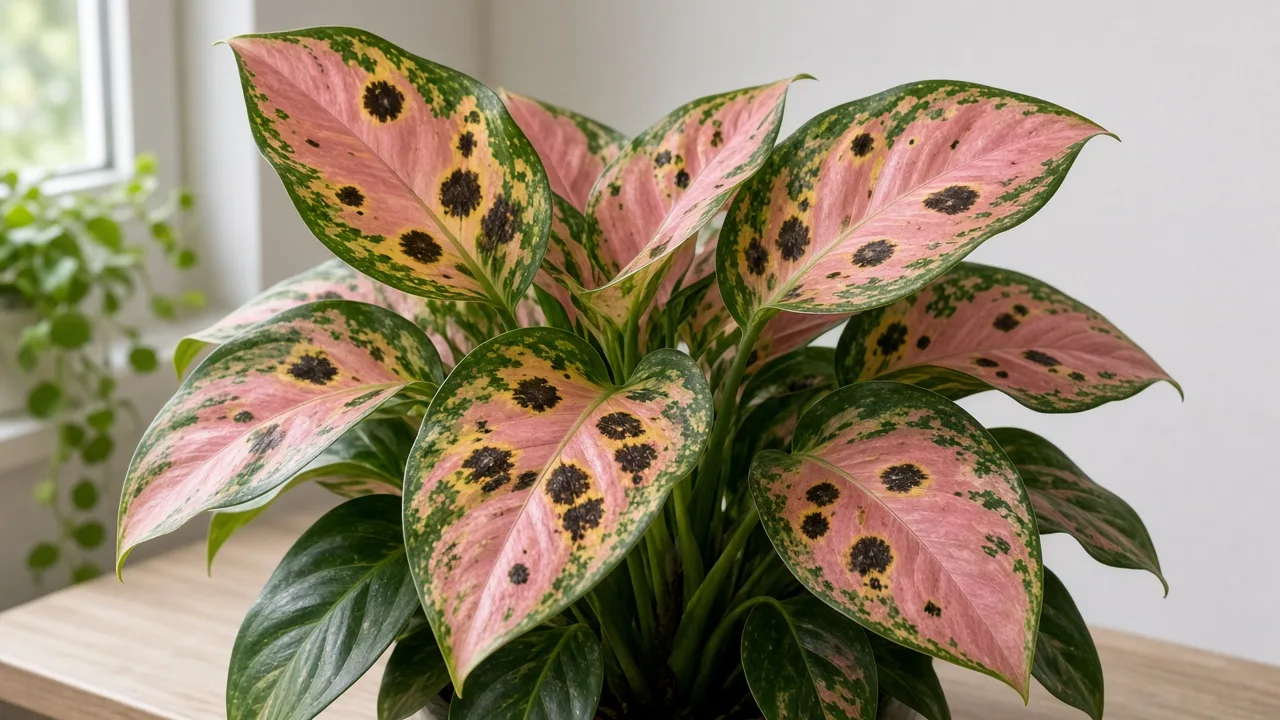
Black Spots on Aglaonema Lady Valentine: Causes, Checks & Fixes
This guide covers black spots on Aglaonema Lady Valentine. See also the general Black Spots guide, watering, and light pages for this plant.
Black Spots on Aglaonema Lady Valentine: Causes, Checks & Fixes
Quick answer
Black or dark brown spots on Aglaonema commutatum ‘Lady Valentine’ are localized tissue death on rose-pink, cherry-red, and green variegated blades—not the same problem as brown tips from fluoride or whole-leaf yellowing from wet roots. The most common indoor cause is fungal or bacterial leaf spot when broad glossy leaves stay wet overnight with poor airflow. Scale insects and cold injury on damp foliage leave different patterns.
First step: Stop misting and overhead watering onto leaves. Wipe blades dry, improve spacing for airflow, and note whether spots are water-soaked with yellow halos and spread after wet nights—or dry with raised bumps underneath.
For general spot disease mechanics, see our black spots guide. On Lady Valentine, pale pink and cream zones lack chlorophyll and hold surface moisture longer than green tissue—making variegated streaks the first place spot appears after misting in a dim room.
Route to overwatering if spots coincide with soggy mix and yellow lower leaves—root stress weakens foliage and keeps ambient humidity high around crowded blades.
When to use this page vs other Lady Valentine guides
| Pattern | Start here | Or route to… |
|---|---|---|
| Discrete dark spots with halos on pink zones | This page | — |
| Dry bumps on veins, sticky residue | Scale insects | — |
| Pink fading to all-green new growth | Not enough light | Light guide |
| Only tip/margin brown, no round spots | Brown tips | — |
| Wet soil, mushy crown | Root rot | Overwatering |
| Yellow before spots | Yellow leaves | Watering |
What black spots look like on Aglaonema Lady Valentine
Lady Valentine leaves are broad, glossy, and splashed with rose-pink anthocyanin variegation on green ground color. Spots show up differently depending on cause.
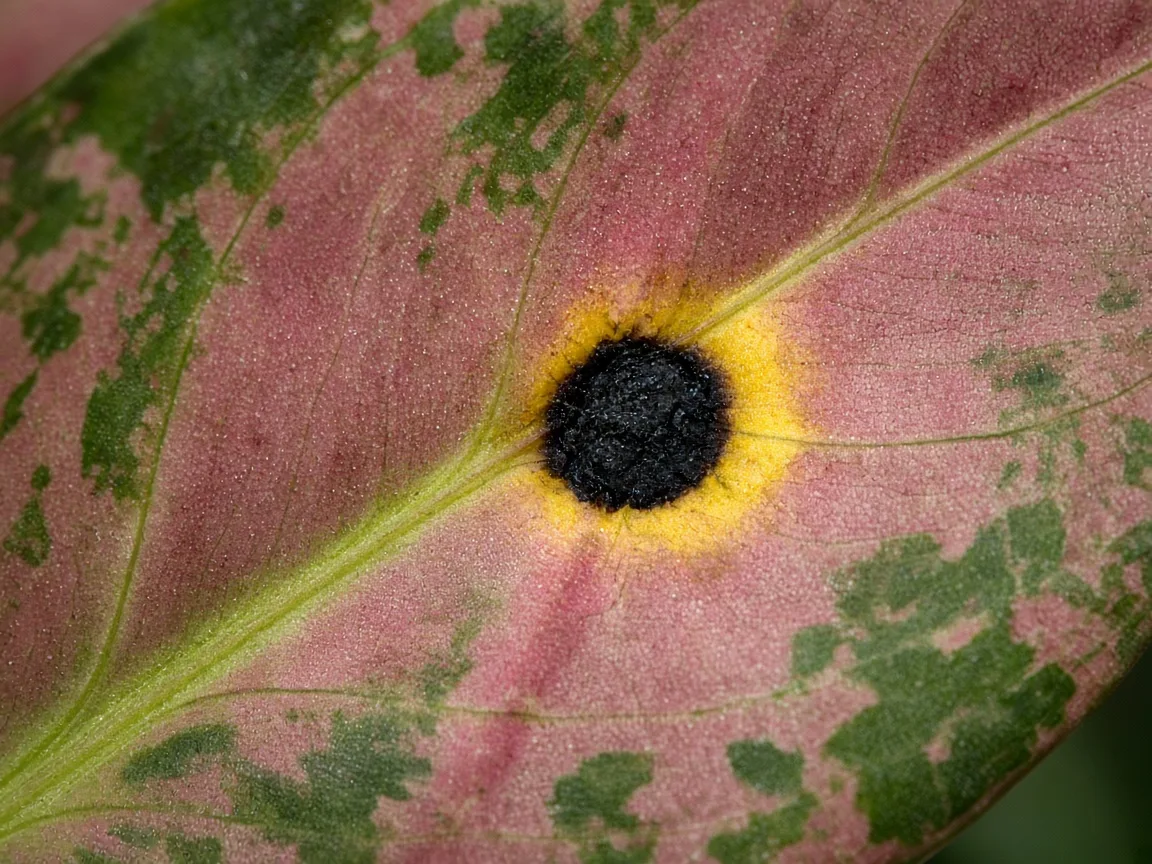
Black spot on rose-pink variegation—pink zones dry slowly after misting and show lesions first.
Fungal or bacterial leaf spot — Round to irregular dark brown or black patches, often with a yellow halo, enlarging slowly across the blade. Spots frequently start where pink meets green along a vein because that junction stays wet longest. Worse on lower leaves in crowded groupings after misting or splash from watering.
Scale insect specks — Dry black or brown dots with raised waxy bumps on midribs and petioles—not water-soaked. Honeydew may feel sticky on nearby surfaces. See scale insects if bumps scrape off.
Cold injury — Darkened, water-soaked patches after a cold draft near winter glass or AC on recently watered plants. May not have halos; often one-sided on the leaf that faced the cold source.
Fluoride or salt necrosis — Usually starts at tips and margins (brown tips), not isolated round spots—unless advanced marginal death has darkened centrally.
The pink-zone wet-leaf trap (Lady Valentine only)
Unlike solid-green cultivars such as ‘Maria’ or ‘Silver Bay’, Lady Valentine’s pink and cream sectors have less chlorophyll and thinner functional tissue. After misting or overhead watering, water beads on the glossy surface and pink zones dry more slowly than green in low light. In a north-facing bedroom or dim office, that film stays wet for hours—ideal for leaf-spot pathogens. Variegated Aglaonema cultivars need brighter indirect light than green types to hold color and to help leaves dry between waterings. Humidity goals are better met with spacing and a pebble tray than wetting the blade surface—see low humidity without foliar soaking.
Why Aglaonema Lady Valentine gets black spots
Wet foliage + poor airflow is the primary fungal pathway. Chinese evergreens prefer even soil moisture but suffer when leaves stay wet. Lady Valentine’s broad blades hold more surface water than narrow ribbon types like Cutlass.
Low light slow dry-down stacks risk on pink cultivars. Deep shade fades anthocyanin pink to green and keeps leaves damp longer after watering—see not enough light if mix stays wet for weeks.
Overhead watering and misting — Water on leaves encourages leaf spot fungi; avoid misting foliage prone to spot.
Scale, cold, and root stress — Scale insects on indoor plants attach along veins; cold drafts on damp blades darken tissue without halos. Root rot follows overwatered Aglaonema in heavy pots with poor light—spots may be secondary to a failing root zone.
Confirm the cause in five checks
- Watering method: Do you mist leaves, use a foliar spray, or splash water on blades when watering? Evening wetting?
- Halo test: Yellow ring around a dark center → fungal or bacterial leaf spot likely.
- Texture test: Water-soaked enlarging patch vs dry speck with a raised bump underneath → disease vs scale.
- Pink-zone pattern: Spots clustered on rose-pink streaks after misting → cultural fix first, not fungicide.
- Undersides and midribs: Sticky residue, insects, or waxy bumps → scale insects route.
- Soil moisture: Pot heavy and wet 7+ days at 2–3 cm depth → also correct overwatering and improve light.
First fix by confirmed cause
| Confirmed cause | First fix | After 10–14 days if stable |
|---|---|---|
| Fungal or bacterial leaf spot | Stop foliar wetting; water soil only when top 2–3 cm dries; improve airflow | Remove worst leaves with sterile shears; fungicide only if spread continues |
| Scale | Isolate; inspect midribs | Scale insects guide |
| Cold injury | Move off drafty glass to stable warmth | Trim only fully dead tissue |
| Root-zone weakness | Dry-down per watering guide | Overwatering |
One action first: dry the leaf routine—stop misting and wipe blades dry—before any spray.
Recovery timeline
| Phase | Timing | Improvement | Worsening |
|---|---|---|---|
| Cultural fix | Days 3–10 | No new spots on existing leaves | Halos spread after wet nights |
| New pink flush | Weeks 2–5 | Clean emerging leaves with stable variegation | Spots on new blades = escalate |
| After prune | Weeks 4–6 | Fuller crown from center | Crown softens or smells sour → root rot |
Spotted tissue does not heal back to pink or green. Spot-free new leaves with strong rose-pink splashing are the recovery marker—not cosmetic repair of old blades.
How to prevent black spots on Lady Valentine
- Water at soil level per watering guide—never mist pink leaves for humidity.
- Give bright indirect light so pink color holds and blades dry—see light guide.
- Use filtered or rested tap water if tips brown; space plants for airflow.
- Fix culture before fungicide; route tip-only damage to brown tips, not this page.
Related Aglaonema Lady Valentine guides
- Brown tips — margin and tip burn, not round blotches
- Scale insects — dry bumps on veins
- Not enough light — fading pink plus slow dry-down
- Overwatering — wet mix weakens leaves
- Watering — soil-level moisture hub
Conclusion
Black spots on Lady Valentine usually mean wet leaf surfaces met poor airflow on pink variegation—not mysterious blight. Stop foliar wetting first, brighten filtered light so pink zones dry, and watch whether new center leaves stay clean with strong rose-pink color for two to three weeks. Scale and cold leave different patterns—match history before spraying. Route to root guides if soggy mix stacks with crown softness.
Related tool
Use the Plant Problem Diagnosis Tool to narrow causes for black spots on this plant before changing multiple variables at once.