Fungus Gnats on Anacharis / Elodea: Causes, Checks & Fixes
Quick answer
Fungus gnats near Anacharis setups come from damp houseplant soil on the tank stand or emersed propagation cups-not submerged aquarium water. First step: Let the top 1–2 inches of adjacent potting soil dry completely before the next watering.
Fungus Gnats on Anacharis / Elodea: Causes, Checks & Fixes
This guide covers fungus gnats on Anacharis / Elodea. See also the general Fungus Gnats guide, watering, and light pages for this plant.
Fungus Gnats on Anacharis / Elodea: Causes, Checks & Fixes
Quick answer
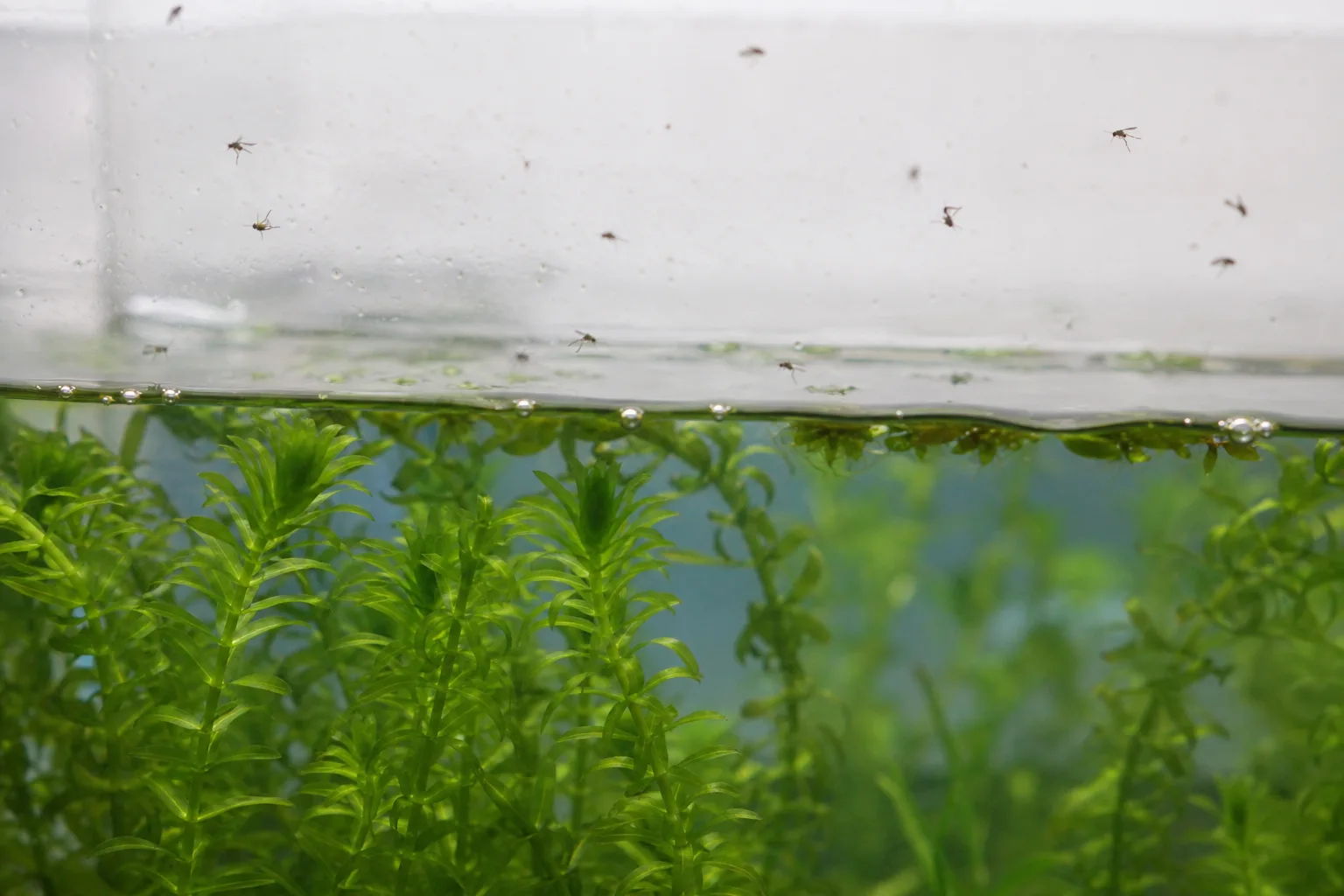
Tiny dark flies hovering over your open-top aquarium or turtle tub? On Anacharis (Egeria densa), fungus gnats almost always come from damp houseplant soil on the tank stand, emersed propagation cups, or wet bench surfaces nearby-not from submerged stems in the water column. Adults look like slender, dark, mosquito-like fliers about 1/16 to 1/8 inch long with long legs-they hover over open water but breed only in adjacent moist soil.
First step: let the top 1–2 inches of adjacent potting soil dry completely before the next watering. Submerged Anacharis whorls do not host gnat larvae; you are eliminating the terrestrial breeding site, not treating the aquatic plant.
For how fungus gnats breed in damp potting mix in general, see our fungus gnats pest guide. On Anacharis, the pattern is almost always a damp houseplant pot, emersed propagation cup, or wet bench surface beside an open aquarium—not submerged whorls in the water column.
This guide covers submerged aquarium, turtle tub, and pond-edge culture-not terrestrial houseplant pots. For soft-bodied insects on emersed tips above the waterline, see aphids on Anacharis. For white cottony wax on emersed nodes, see mealybugs on Anacharis. For mushy translucent submerged melt-not flying pests-see transparent leaves. For culture and quarantine tubs, see the Anacharis overview and propagation guide.
Why gnats appear near Anacharis tanks - nearby soil, not submerged water
Fungus gnats are not caused by poor nitrates, dim aquarium light, or underwater water quality crashes. They breed in moist organic potting soil where females lay eggs and larvae feed on fungi, decaying matter, and root hairs in the top layers of a container.
Because Egeria densa grows fully submerged in aquarium culture, open-tank hobbyists often keep houseplants, propagation cups, or emersed cutting tubs on the same stand as the tank. That proximity-not the Anacharis itself-supplies the habitat gnats need:
- Overwatered pothos, peace lily, or fern on the aquarium stand
- Emersed propagation cups where Anacharis stems grow above the water surface beside the display tank
- Nursery quarantine tubs with wet potting mix holding emersed stems before submerging
- Damp cork, driftwood, or sphagnum on the stand that stays wet from misting or splash
- Greenhouse benches where multiple wet pots share airspace with open-top turtle tubs
Why submerged Anacharis does not host larvae: Fungus gnat larvae require moist potting media or organic debris in containers-not open aquarium water. Fully submerged whorls in dechlorinated tank water lack the moist soil layer where eggs hatch. Adult flies hover over open tanks because they are attracted to light and humidity near windows and plant displays, which makes an open-top aquarium look like the problem even when the breeding site is a pot six inches away.
Turtle setups with basking platforms and intentionally emersed growth create visible fly traffic above the water without meaning the submerged portion of Egeria densa is infested.
Where gnats breed vs. where they only fly
Use this map before dosing the tank-larvae live only in the left column:
| Zone | Can host fungus gnat larvae? | Common Anacharis setup examples |
|---|---|---|
| Terrestrial soil on tank stand | Yes - primary source | Pothos, fern, or peace lily beside open aquarium |
| Emersed propagation cups / wet bench mix | Yes - frequent secondary source | Cutting tubs with algae and damp top dressing |
| Damp cork, sphagnum, or wood on stand | Sometimes - organic debris | Misted hardscape above turtle tub |
| Submerged Anacharis whorls | No | Firm green stems below waterline |
| Open aquarium water column | No | Display tank, turtle swimming area |
| Floor drain or sink in humid fish room | No - drain flies, not fungus gnats | Fuzzy moth-like flies on bathroom wall near tank room |
What fungus gnats look like - adults over the tank, larvae in adjacent soil
Near Anacharis aquariums and turtle tubs, expect this pattern:
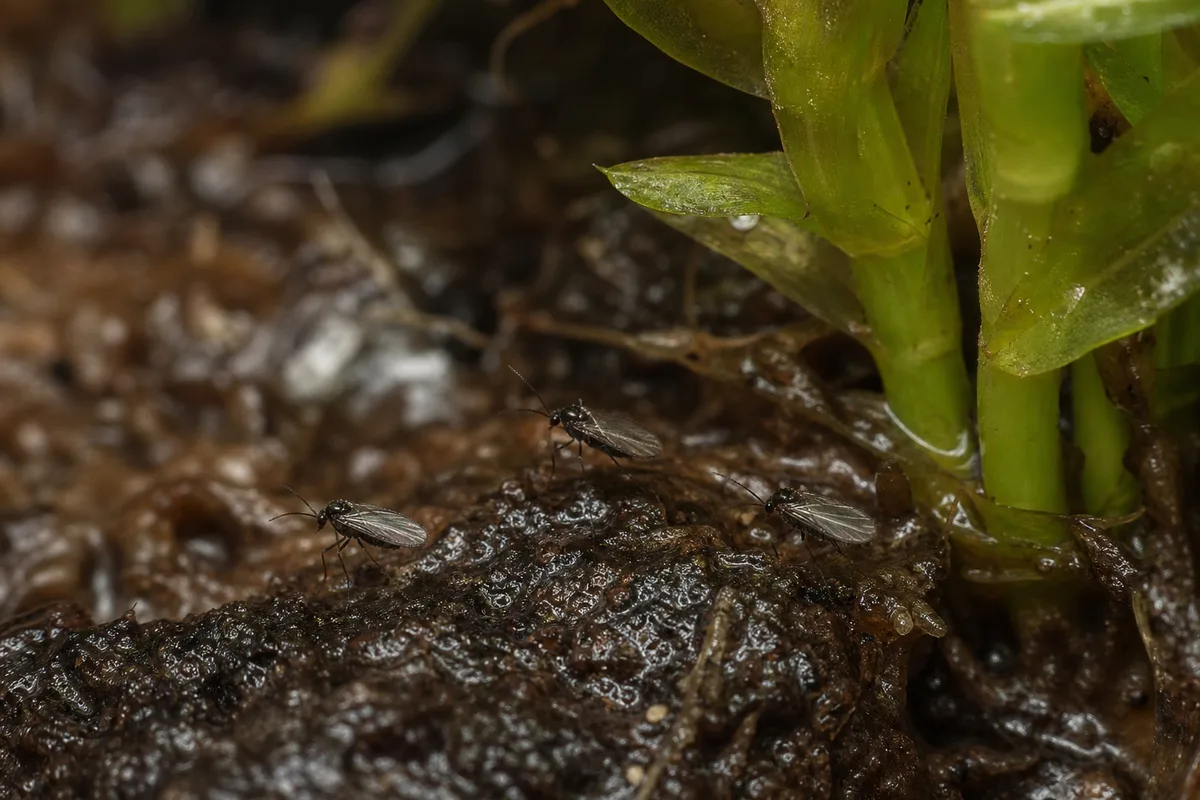
Fungus Gnats symptoms on Anacharis / Elodea - compare with healthy tissue on the same plant.
Adult flies (what you see over the tank)
- Small, dark, delicate flies about 1/16 to 1/8 inch long-mosquito-like but weak fliers that do not bite
- Long legs and segmented antennae longer than the head; Bradysia species show a Y-shaped wing vein
- Hover near open tank surfaces, windows, and damp pots-especially when you water a houseplant on the stand
- Run across moist potting soil on adjacent containers rather than landing on submerged Anacharis whorls
- Take flight when you tap or water an adjacent pot-a reliable field test for fungus gnats
Larvae (in soil-not in your tank)
- Whitish-to-clear, legless worms with shiny black heads in the top 1–2 inches of potting mix
- Slime trails on soil surface in heavily infested pots-resembling tiny snail tracks
- Never found inside submerged Anacharis whorls or floating freely in aquarium water
Compare adult flies in the air above the tank to submerged stem condition: clean firm whorls below the waterline with no insects attached confirm the aquatic plant is not the host-only the nuisance fly cloud is tank-adjacent.
Confirm gnats vs. fruit flies, aphids, and unrelated tank melt
Work through this checklist in order:
- Soil-source test - Tap the nearest houseplant pot on the stand. Flies rise from the soil? Strong fungus gnat signal. No soil pots nearby? Check emersed propagation cups and damp bench surfaces.
- Submerged stem check - Inspect underwater whorls with a hand lens. No insects, no slime, firm nodes? Submerged Anacharis is not infested.
- Larval probe - Scrape the top inch of the suspect pot’s soil. Whitish larvae with black heads? Confirms breeding site.
- Fruit fly rule-out - Fruit flies are rounder and attracted to ripening produce or compost-not damp potting mix alone.
- Drain fly rule-out - Drain flies are fuzzy, moth-like, and breed in gelatinous biofilm inside sink or floor drains-not in submerged stems. If flies rest on bathroom walls near a humid fish room but tap-tests on stand pots release nothing, inspect plumbing before treating soil.
- Aphid rule-out - Soft-bodied clusters on emersed stems above the waterline with honeydew point to aphids-not flying gnats over open water.
- Melt rule-out - Translucent mushy submerged whorls with foul odor indicate water stress or rot-not fungus gnats.
Five-step aquarium-adjacent inspection
- Map every soil source within arm’s reach of the open tank-stand plants, propagation cups, quarantine tubs, and wet decor.
- Tap-test each pot and note which containers release flying adults.
- Inspect submerged Anacharis whorls at mid-stem and tip-confirm no larval damage or attached insects underwater.
- Check emersed propagation setups for algae, fallen leaf debris, and constantly wet potting mix on the bench.
- Place one yellow sticky trap in the worst pot and count catches after three days-declining numbers after soil dries confirm you found the right source.
Symptom lookalike comparison
| Pattern | Location | Key sign | Typical trigger |
|---|---|---|---|
| Fungus gnats | Air above tank; larvae in adjacent soil | Dark weak fliers; larvae in top inch of potting mix | Wet houseplant on stand, emersed cups |
| Fruit flies | Kitchen or compost area | Round tan flies on produce, not soil | Ripening fruit, compost bin near tank room |
| Drain flies | Bathroom walls, sink, floor drain | Fuzzy moth-like body; short flights near plumbing | Slow drain biofilm in humid fish-room bathroom |
| Aphids | Emersed stem tips | Soft pear-shaped bodies, honeydew on stems | Pond edge, nursery bundles, emersed growth |
| Mealybugs | Emersed nodes | White cottony wax clusters | Propagation bench, greenhouse transfer |
| Melt / rot | Submerged whorls | Translucent mush, foul tank odor | Ammonia spike, copper, shipping shock |
First fix: dry nearby soil before adding traps or BTI
Make one focused correction first: stop watering adjacent houseplants until the top 1–2 inches of potting mix are dry throughout. Allowing the soil surface to dry between waterings disrupts egg hatch and larval survival-this alone often breaks mild infestations within one to two weeks.
Wait three to five days and count adult activity at the tank rim before stacking treatments. If flies persist after the soil dries, add traps and BTI in the order below.
Sticky trap placement for open-top and turtle tanks
- Cut yellow sticky cards into small squares on wooden skewers-available at garden centers-and set them inside affected pots at soil level, not floating on aquarium water.
- Angle traps away from the tank opening so adhesive cannot drip or fall into the water-especially on turtle tubs where basking heat softens glue faster.
- One trap per infested pot on the stand; replace when covered or every seven to ten days.
- Track catch counts every three to five days-declining numbers on traps confirm the dry-down is working even if a few adults still hover over the open tank.
Yellow sticky traps capture adult females and reduce the next generation of larvae in adjacent soil-they do not treat submerged Anacharis.
BTI drench on adjacent houseplant pots (fish-safety notes)
If trap counts stay high two weeks after soil dries:
- Use a labeled BTI product (Bacillus thuringiensis subspecies israelensis-Mosquito Bits, Gnatrol, or equivalent) mixed with water as a soil drench on terrestrial pots only.
- Apply to the potting mix surface of stand plants-not to aquarium water. Bti is toxic only to fly larvae such as fungus gnats and mosquitoes; it does not persist indoors and requires repeat applications at about five-day intervals for several weeks.
- Prevent drips into the tank - stabilize pots, use a saucer to catch runoff, and wipe any splash from the stand before it reaches the water surface. Shrimp and sensitive invertebrate tanks need extra care: treat pots on a separate surface temporarily if runoff risk is high.
- Do not combine hydrogen peroxide soil drenches with BTI in the same week-oxidizers can neutralize biological activity.
Do not pour pyrethrin sprays, neem, or houseplant insecticides into aquarium water to kill flying gnats-pyrethrins are labeled for potting soil surfaces on houseplants, and tank chemicals harm fish without reaching larvae in adjacent soil.
When submerged Anacharis needs no treatment
If underwater whorls are firm, green, and free of attached insects, do not dose the display tank for fungus gnats. No submerged pesticide, algaecide, or copper treatment targets flies breeding in a pothos pot on the stand-and Anacharis is sensitive to copper herbicides without addressing the actual pest source. See chemical damage on Anacharis if copper or algaecide was already applied.
Focus every treatment on terrestrial soil and emersed propagation debris beside the tank.
Emersed propagation cup cleanup
When gnats persist despite drying stand plants:
- Empty and scrub emersed propagation cups-remove algae, fallen leaf bits, and old potting mix from tubs beside the tank.
- Move propagation benches away from open tank openings or add a dry tray barrier under wet cups.
- Use raw potato chunks buried cut-side-down in suspect pots for three days-larvae congregate on potato and away from roots-then discard infested chunks sealed in a bag.
- Hold new cuttings in a quarantine tub with no houseplant soil on the same shelf-see the Anacharis propagation guide for submerged acclimation after the bench is clean.
Recovery timeline - gnat elimination vs. plant health
Judge success by declining trap counts and fewer flies when watering adjacent pots-not by changes in submerged Anacharis appearance, because the plant was never infested.
| Phase | Timing | Gnat signs (good) | Gnat signs (bad) |
|---|---|---|---|
| Soil dry-down | Days 1–7 | Fewer adults when tapping pots; soil surface dry | Soil stays wet; flies increase when watering |
| Trap monitoring | Days 7–14 | Sticky catches drop every three to five days | Traps fill as fast as you replace them |
| BTI escalation | Weeks 2–4 | Larvae absent in soil probe; occasional single fly only | Multiple pots still release clouds after three BTI cycles |
Field example (June 2026): A 20-gallon open-top planted tank with submerged Anacharis had dark flies hovering at the rim daily. Tap-test on an overwatered pothos on the stand released a small cloud; submerged whorls were firm with no attached insects. After stopping pothos water until the top 2 inches dried and placing one yellow trap at soil level angled away from the tank, catches fell from 18 flies on day 3 to 4 on day 7 to zero on day 12. Submerged Anacharis growth was unchanged throughout-confirming the flies were a stand-soil problem, not an aquatic infestation.
Submerged Anacharis during gnat treatment: Firm whorls and active tip growth mean the aquarium plant is unaffected. New purchases may melt emersed tips during acclimation-that is a culture transition, not gnat damage, if submerged nodes stay solid.
Adult fungus gnats live about one week and lay eggs in moist soil-expect at least two to three weeks to break the full life cycle after soil dries, longer if multiple wet pots surround the tank.
What not to do in aquariums and ponds
Do not dose terrestrial pesticides, fungicides, or pyrethrin fogs into aquarium water to kill flying adults-larvae are in adjacent soil, not submerged stems.
Do not assume poor water quality caused the gnats and chase ammonia or nitrate fixes while wet potting mix on the stand keeps breeding new flies.
Do not place sticky traps on the water surface where fish, turtles, or shrimp contact adhesive.
Do not overwater stand plants immediately after a dry-down cycle-excess moisture restarts egg laying within days.
Do not move infested pots to other rooms without treating soil first-moving infested plants spreads flies to new pots.
Do not release Anacharis trimmings into streams or storm drains when cleaning propagation benches-Brazilian egeria is invasive when fragments escape.
Prevent gnats near Anacharis setups next time
Bottom-water stand plants: Set pots in a saucer of water for 15–30 minutes so roots absorb moisture while the soil surface stays dry-discouraging egg laying where gnats prefer to breed.
Quarantine new houseplants two weeks before placing them beside open aquariums or turtle tubs. Inspect soil and set a sticky trap in the quarantine pot on day one.
Separate propagation from display: Keep emersed Anacharis propagation tubs on a dry tray away from tank openings; trim emersed tips regularly per the pruning guide.
Use pasteurized potting mix for any terrestrial cups holding emersed stems-incompletely composted organic matter often arrives infested with fungus gnats.
Clean the stand weekly: Wipe algae, fallen leaves, and damp sphagnum from bench surfaces before organic debris becomes a secondary breeding spot.
Inspect purchases on arrival: New houseplants and wet-wrapped pond bundles are common entry points for fungus gnats in homes.
When to worry - persistent clouds and multiple soil sources
Lower urgency: A few flies after bringing home one overwatered stand plant; submerged Anacharis firm; single pot identified as source. Dry-down alone usually clears this within two weeks.
Moderate urgency: Flies persist two weeks after drying one pot; trap counts plateau; emersed propagation cup still holds wet algae and debris. Add traps, then BTI on terrestrial pots only.
Higher urgency: Multiple pots on the stand and bench all release adults when watered; trap counts rise despite BTI drenches; gnats appear in every room after moving infested plants without treatment. Isolate infested stand plants from the aquarium room until soil is dry and trap counts fall-shared HVAC can keep reinfestation cycling between wet pots in different rooms.
Escalate to your local cooperative extension office when three BTI cycles at five-day intervals plus dry-down fail to reduce trap catches across all identified pots-persistent infestations may need professional assessment of greenhouse benches, building plantscapes, or hidden drain-fly plumbing in humid tank rooms.
Fungus gnats are marked medium severity for Anacharis in the symptom matrix-a triage clue, not a guarantee. Submerged-only culture with dry adjacent soil often downgrades real-world severity to a short nuisance phase.
Escalation summary - which path fits your setup
| Your situation | First action | Next step if flies persist | When to call extension |
|---|---|---|---|
| One wet stand pot; firm submerged Anacharis | Dry top 1–2 inches; wait 7–14 days | Yellow trap at soil level; count catches every 3–5 days | Trap counts still high after 3 weeks of dry soil |
| Multiple wet pots on stand or bench | Dry all pots; trap in each source | BTI drench on terrestrial soil every 5–7 days × 3 cycles | BTI + dry-down fails on every identified pot |
| Flies only near bathroom drain in fish room | Scrub drain biofilm; rule out stand soil | Extension or plumber if drain flies persist after cleaning | Chronic drain flies with slow plumbing |
| Firm submerged whorls; flies over open tank only | Map terrestrial sources-do not dose tank | Treat adjacent soil only | N/A unless misidentified melt or chemical damage |
Dry-down alone resolves most single-pot cases. BTI belongs in the escalation column-not day one. Extension referral is the right move when three BTI cycles plus moisture correction still leave rising trap counts across multiple soil sources.
When to use this page vs other Anacharis / Elodea guides
- Anacharis / Elodea watering guide - Use for routine moisture checks before assuming fungus gnats is the main issue.
- Anacharis / Elodea problems hub - Browse all 34 common issues on this species.
- Overwatering on Anacharis / Elodea - Different entry point when symptoms overlap with fungus gnats.
- Root Rot on Anacharis / Elodea - Different entry point when symptoms overlap with fungus gnats.
- Slow Growth on Anacharis / Elodea - Different entry point when symptoms overlap with fungus gnats.
Related Anacharis / Elodea guides
- Anacharis / Elodea overview
- Anacharis / Elodea watering
- Anacharis / Elodea light
- Anacharis / Elodea soil
- Overwatering on Anacharis / Elodea
- Root Rot on Anacharis / Elodea
- Slow Growth on Anacharis / Elodea
- Anacharis / Elodea problems
Related tool
Use the Plant Problem Diagnosis Tool to narrow causes for fungus gnats on this plant before changing multiple variables at once.