Betel Leaf Fertilizer Guide: When & How Much
Betel Leaf Fertilizer Guide: When & How Much
Betel Leaf Fertilizer Guide: When & How Much
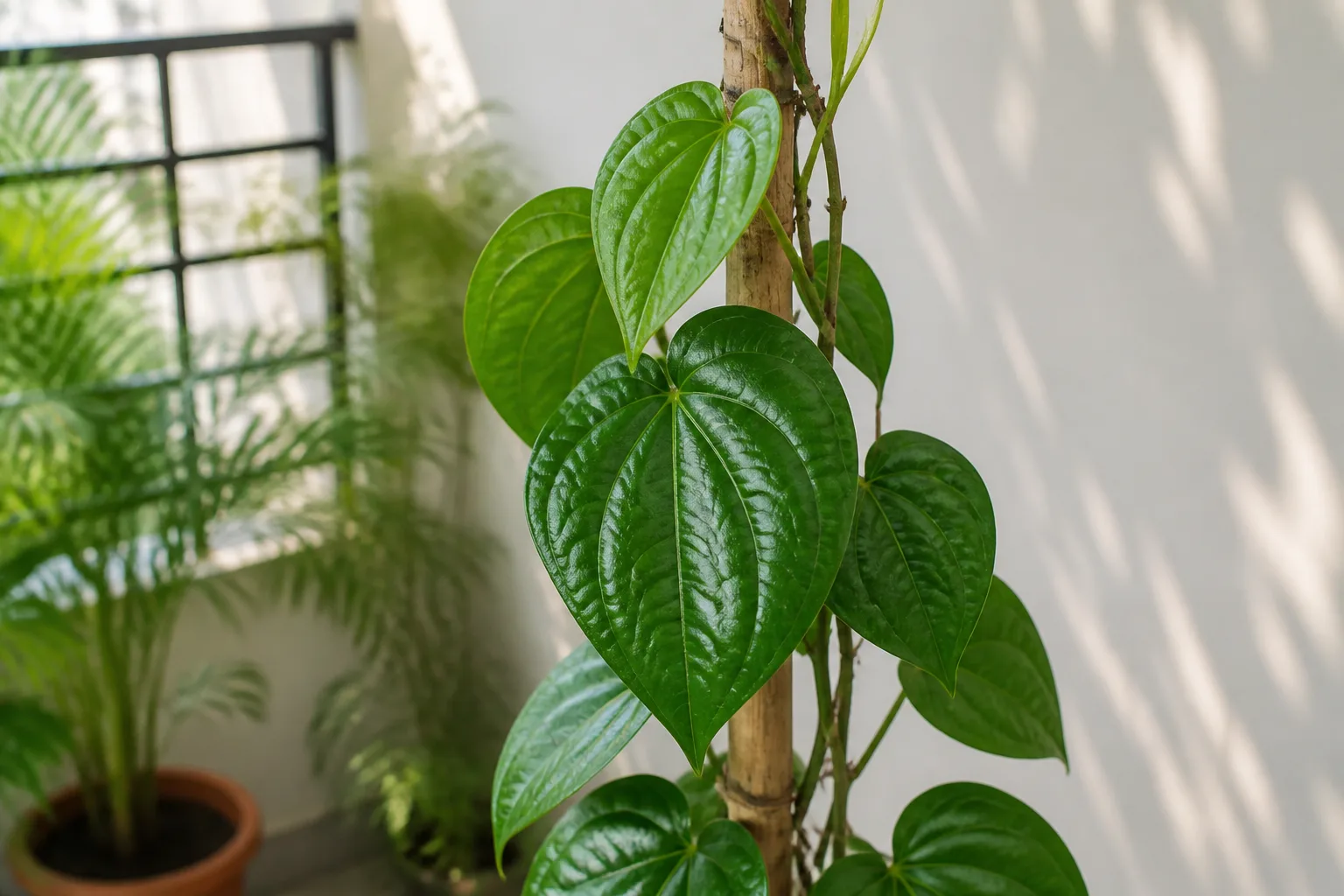
Betel Leaf (Piper betle) is a shade-loving Piperaceae climber grown for glossy heart-shaped leaves—not for fruit or flowers—so feeding should support steady leafy flush without pushing soft, salt-stressed growth. For most home growers in India and similar warm climates, the practical default is a balanced liquid fertilizer diluted to half label strength every 2–4 weeks during active warm growth, paired with modest compost or vermicompost top-dressing. Hold fertilizer in cool months, after repotting, and whenever roots are wet, wilted, or recovering from stress.
Commercial betelvine beds are fed more aggressively than a balcony pot can safely handle. Tamil Nadu Agricultural University (TNAU) publishes a field manuring schedule built around nitrogen, phosphate, potash, and neem cake in split doses. This page translates that biology into container-safe practice. For the filtered light that drives nutrient use, see Betel Leaf light needs. For moisture rhythm that must stay even without waterlogging, see Betel Leaf watering. For the fertile, free-draining mix that holds nutrients without trapping salts, see Betel Leaf soil. The Betel Leaf care hub covers the full cluster.
Why Betel Leaf Needs Steady, Leafy Feeding
Betel Leaf is a continuous leaf crop in humid shade. Vines climb supports, produce many nodes, and keep harvesting pressure on nitrogen and organic matter when growth is strong. TNAU notes that betelvine needs cool humid conditions with regular soil moisture and does not tolerate saline or alkaline soils—conditions that also make fertilizer salts more damaging in pots.
Fertilizer is support, not a fix. Clemson Extension’s tree-and-shrub guidance is clear that fertilizer should serve a defined objective—not a routine pour—and that poor growth often comes from damaged roots, drought, excess water, or unsuitable pH rather than a missing bottle of NPK. On Betel Leaf, pale thin leaves in deep shade or soft wilt in soggy mix are usually light or watering problems first.
Field rates vs balcony pots
TNAU’s commercial schedule calls for about 150 kg N per hectare per year split between neem cake and urea, plus 100 kg P₂O₅ as super phosphate and 30 kg muriate of potash in three splits after vines are lifted, with shade-dried neem or Calotropis leaves worked into beds. That is useful context: the crop is nitrogen-responsive and traditionally paired with organic cake and green leaf manures.
Do not scale hectare rates into a 25 cm pot. A small container has a tiny root volume, frequent leach from watering, and almost no buffering. Home practice uses dilute liquids and light organics so salts do not concentrate against feeder roots. Academic work on NPK and betelvine growth and leaf quality (for example the Shodhganga thesis record on Piper betle NPK response) reinforces that nutrition matters for yield and quality in field systems—while home pots still need restraint.
When to Fertilize Betel Leaf in Indian Climates
Feed when the vine is actively extending nodes and opening new glossy leaves in warm, humid weather. Pause when nights cool, growth stalls, or the plant is stressed. Clemson’s fertilizer environmental guidance stresses applying nutrients at the right time when plants can absorb them, and delaying applications when conditions waste nutrients or injure roots.
Active warm-season window
Across much of India, the reliable window is roughly March through October, with strongest response from late spring through monsoon and early post-monsoon flush when humidity and temperatures stay in the plant’s comfort zone. Start only after you see consistent new leaves—not on a calendar day alone. Young balcony vines in bright filtered light that dry within a few days may use half-strength liquid every 2–3 weeks; larger tubs with compost-rich mix may stretch to every 3–4 weeks.
If you keep Betel Leaf indoors under grow lights year-round and new leaves keep forming, you can continue dilute feeds, but still drop strength and frequency whenever growth slows. Heat without adequate light does not create a feeding season.
Cool-season pause and stress holds
From about November through February in most Indian regions, taper to a stop. Give a final light feed in early autumn only if soft new growth is still forming, then pause. Resume after consistent spring flush returns.
Also pause during acute stress: soft collar wilt, sour soil, yellowing after overwatering, mite or scale outbreaks you are still treating, or recent transplant shock. Clemson warns against fertilizing drought-stressed plants because moisture is required for uptake—and the same logic applies to waterlogged Betel Leaf, where damaged roots cannot use nutrients safely. Restore watering rhythm and drainage first; feed days later only on moist, not soggy, mix.
Best Fertilizer Types and NPK for Betel Leaf
The best everyday Betel Leaf fertilizer for home growers is a complete, water-soluble, balanced formula (for example 10-10-10 or 20-20-20) used at half label strength, optionally with a mild nitrogen bias for leafy growth. You do not need a specialty “betel vine” bottle. You do need accurate dilution and moist soil when you apply.
Penn State Extension explains that a complete fertilizer supplies nitrogen, phosphorus, and potassium, that concentrated nutrients can damage plants, and that over-fertilization is more serious than under-fertilization. Clemson’s choosing-fertilizer factsheet adds that fertilizers are salts and that excess fast-release product can cause fertilizer burn—leaf margins that look scorched while roots lose water to a salty soil solution.
Balanced liquids with a mild nitrogen bias
Balanced NPK supports foliage, roots, and overall vigor. Because Betel Leaf is harvested for leaves, a slight nitrogen lean (or simply consistent nitrogen from compost plus balanced liquid) helps maintain flush without forcing weak, overly soft stems. Measure dilutions with a spoon or syringe. If the label lists a houseplant rate, start at half of that and watch the next two leaf flushes before increasing frequency.
Organic liquids such as diluted compost tea, seaweed extract, or fish emulsion can substitute at half strength or weaker during warm months. Use fish emulsion outdoors or with ventilation; skip it when pots stay damp and fungus gnats are already present.
Compost, FYM, vermicompost, and neem cake
For pots and bed edges, well-rotted compost, farmyard manure, or vermicompost worked lightly into the top few centimeters once or twice in the warm season builds a slower nutrient base that matches TNAU’s organic emphasis better than weekly full-strength synthetics. Penn State notes that organic matter improves water-holding and nutrient-holding capacity but is rarely a perfectly balanced nutrient source alone—so pair organics with occasional dilute liquid rather than stacking both at full strength.
Neem cake is central to TNAU’s betelvine program: half of the recommended nitrogen may come through neem cake, and cake or dried neem leaf also appears in nematode and wilt management notes on the same crop page. On a home vine, treat cake as a thin surface top-dress once or twice in the warm season—roughly a small handful worked into the top of a 25–30 cm pot, kept off the stem collar, then watered in. Do not pile cake weekly on top of strong liquid NPK.
Skip high-phosphorus bloom boosters, fertilizer–pesticide combos, and undiluted spikes. They add salt without fixing shade, humidity, or drainage limits that usually stall Betel Leaf.
How Much and How Often: Containers vs Ground Beds
Use this as a starting schedule, then adjust to flush quality and salt signs.
| Setup | Warm-season schedule | Strength / amount | Notes |
|---|---|---|---|
| Container 20–30 cm, filtered light | Every 2–3 weeks, March–October | Half-strength balanced liquid | Pause if tips brown or white crust appears |
| Large tub / grow bag | Every 3–4 weeks | Half-strength liquid + light compost midseason | Bigger volume buffers salts |
| Shade-house bed / raised bed | 2–3 organic top-dressings + optional dilute liquid | Compost/FYM/cake; follow local extension if scaling | Inspired by TNAU split-dose logic, not hectare math |
| Cool months / stalled growth | None | Hold | Resume after consistent new leaves |
Always apply liquid feed to moist soil, then water lightly so nutrients move into the root zone without dumping concentrate on dry roots. After any strong feed—or if you suspect salt buildup—flush the pot thoroughly until water runs freely from drainage holes, then wait for the next normal dry-down before feeding again.
Underfeeding vs Overfeeding Warning Signs
Underfeeding on an otherwise healthy Betel Leaf in good light usually looks like slow node extension, uniformly pale older leaves without soft stems, and smaller leaves than the previous flush—especially in containers watered heavily for months. Confirm light and root health before reaching for a stronger bottle; pale growth in deep shade is often light hunger, not nitrogen hunger.
Overfeeding is the more common pot mistake. Watch for white crust on the soil surface or pot rim, brown or scorched leaf tips and margins after a feed, overly soft lush shoots that flop, sudden leaf yellowing after fertilizing, or a plant that looks thirsty even when the mix is moist. Clemson describes how excess soluble fertilizer can injure or kill plants through fertilizer burn. If those signs appear, stop feeding, flush, and correct watering before you resume at a weaker dilution.
Do not confuse Phytophthora-style collar wilt, cold damage, or pest damage with a nutrient story. Soft roots and sour soil need a soil and watering reset, not more NPK—TNAU links wet beds and wilt pressure with careful cultural management on betelvine, not heavier urea.
Flushing salts after burn
If tip burn or crust appears, water thoroughly several times so excess salts leach from drainage holes, empty the saucer, and hold fertilizer for 3–6 weeks. Restart only after new growth looks clean, using half strength or less on already-moist mix. If the pot stays salty or the mix smells sour, refresh the upper few centimeters or repot into a fertile, free-draining blend rather than adding more feed.
How Light, Water, and Soil Change Nutrient Use
Nutrient demand rises when Betel Leaf sits in bright filtered light or partial shade with warm temperatures and steady humidity—conditions that push continuous leaf production. In deep gloom, fertilizer cannot create thick glossy leaves; the vine stays thin even if you feed. Match feeding to the light you actually provide.
Watering controls whether nutrients move or burn. Keep soil evenly moist but never waterlogged. Feeding a dry root ball concentrates salts at root surfaces; feeding a soggy root ball wastes product and stresses oxygen-starved roots. Align fertilizer days with your watering checks: moist at 2–5 cm depth, then feed if it is a scheduled week.
Soil chemistry sets the stage. Betel Leaf prefers fertile organic loam that drains well and stays near slightly acidic to near-neutral—roughly the range noted on the plant hub. Alkaline or saline mixes make salt injury more likely. Penn State links nutrient availability to soil pH; if leaves stay pale despite dilute feeding, check the mix and drainage before doubling dose. Build fertility into the soil mix with compost rather than relying only on liquid NPK.
What Not to Do When Feeding Betel Leaf
Do not pour full-strength outdoor vegetable rates into small pots. Do not fertilize every watering “just in case.” Do not stack urea, neem cake, fish emulsion, and bloom booster in the same week. Do not feed a vine sitting in a saucer of stagnant water. Do not use fertilizer to force recovery from scorch, mites, or wilt. Do not assume yellow leaves always mean “needs nitrogen”—rule out wet roots, cold nights, and low light first.
USDA and related nutrient-management framing for farms emphasizes matching rate and timing to plant need so nutrients are used rather than lost; home growers can borrow the same idea: apply the right amount at the right time, then stop. More product is not better care.
After Repotting and New Cuttings
Hold soluble fertilizer for several weeks after repotting or after setting propagation cuttings until new nodes confirm roots are working. Fresh compost-amended mix already carries a nutrient bank. Early full-strength liquid is a common way to burn tender feeder roots on setts. When you restart, begin at quarter to half strength once, then return to the warm-season cadence only if leaves stay firm and glossy.
When to use this page vs other Betel Leaf guides
Use this page for feeding schedules, fertilizer types, dilution, burn signs, and seasonal pauses. Use the overview for identity and whole-plant context. Use light when leaves scorch or stretch. Use watering when wilt, yellowing, or soggy mix is the main issue. Use soil when drainage, pH, or mix structure is wrong. Use repotting when roots fill the pot. Use propagation when you are rooting setts rather than feeding a mature vine.
Related Betel Leaf guides
- Betel Leaf care hub — placement, toxicity caution, and cluster entry
- Betel Leaf watering — moisture checks that must align with feeding
- Betel Leaf light — filtered light that drives nutrient use
- Betel Leaf soil — fertile drainage that buffers salts
- Betel Leaf repotting — when to refresh mix instead of feeding harder
- Betel Leaf propagation — aftercare before the first fertilizer dose
Conclusion
Betel Leaf fertilizer success is quiet and seasonal: half-strength balanced liquid every 2–4 weeks while the vine flushes in warm months, light compost or neem-cake top-dress, and a firm winter pause. Field TNAU rates explain why the crop loves nitrogen and organic cake; container practice must stay dilute so salts never outrun roots. Fix light, water, and drainage before you raise the dose—and when tips burn, flush and wait rather than feed again.