Betel Leaf Light Needs: Shade, Windows & Scorch
Betel Leaf Light Needs: Shade, Windows & Scorch
Betel Leaf Light Needs: Shade, Windows & Scorch
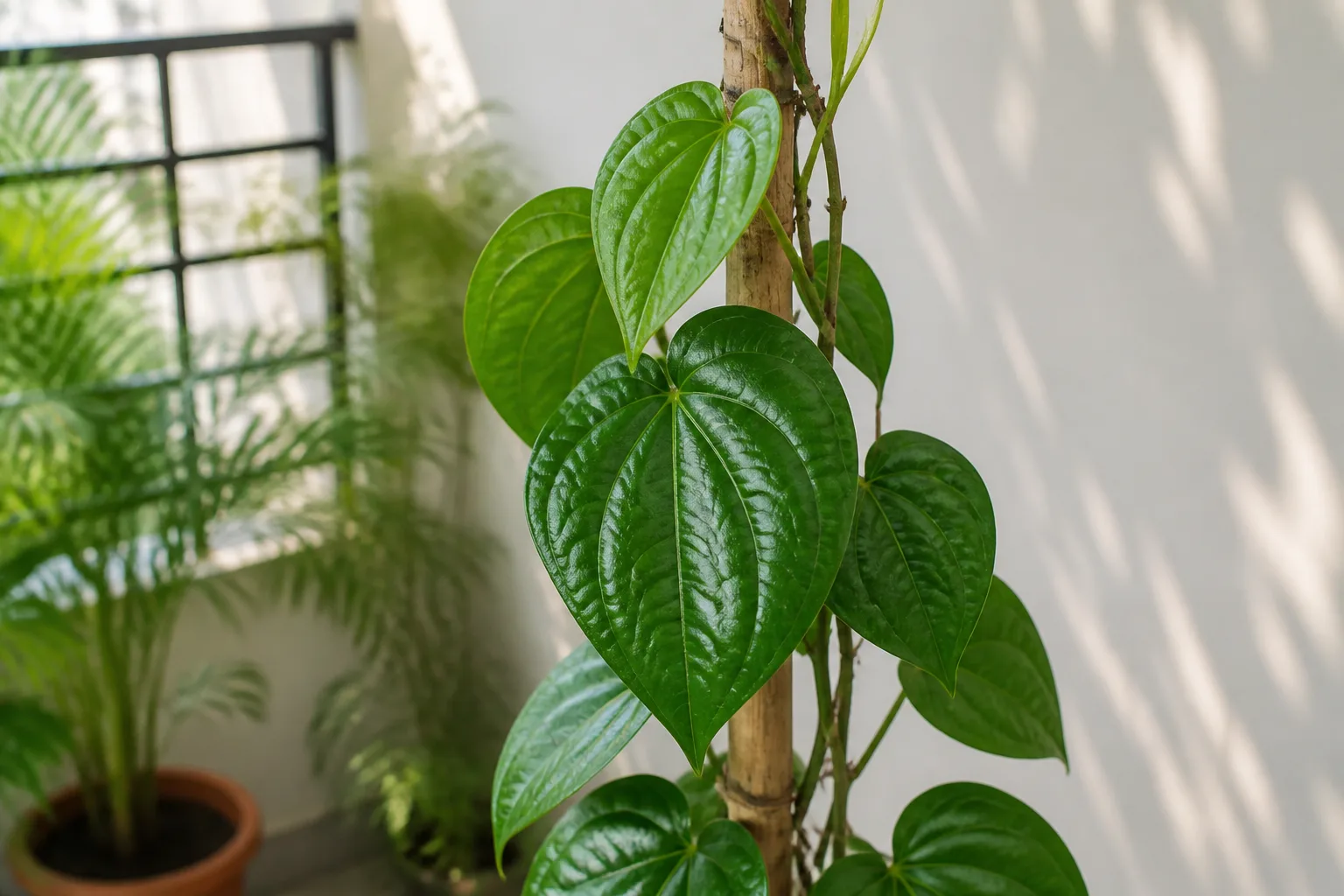
Betel Leaf (Piper betle) is grown for glossy, heart-shaped leaves on a climbing vine—not for a sun-soaked patio showpiece. Get the light right and new nodes stay short, leaves stay deep green, and the vine climbs a pole or trellis with steady flush. Get it wrong and you see two opposite failures: bleached or crisp patches from harsh midday sun, or thin, stretched stems from deep gloom. This guide is about placement for Betel Leaf light—windows, balconies, shade cloth, and the warning signs that tell you to move the pot before damage piles up.
Kew records Piper betle as a climbing shrub or liana of the wet tropical biome, native from Indo-China to Malesia and long cultivated across South Asia. (Plants of the World Online) That biology sets the light brief: bright but filtered exposure that mimics canopy shade, paired with warmth and humidity—not all-day open sun.
How Much Light Betel Leaf Actually Needs
Aim for bright filtered light or partial shade for most of the day. In practice that means strong ambient brightness at the leaf surface with little or no harsh midday beam. Many home growers succeed with 2–4 hours of gentle morning sun and shade for the rest of the day, or with all-day dappled light under a tree, shade net, or sheer curtain. [Flagged: no authoritative source found for this claim]
Plants For A Future lists Piper betle as able to grow in full shade or semi-shade, and cultivation notes stress a position in the shade with wind protection in humid, moisture-rich tropical conditions. (Plants For A Future) Commercial and traditional growers treat shade as a crop requirement, not a preference: proper shade (often via live supports or a covered garden) is essential alongside moisture management. (Wikipedia: Piper betle)
Translate that to a container vine: give Betel Leaf the brightest filtered spot you have, then pull back only when leaves heat-bleach or crisp. Do not park it in a dark hallway and expect thick, aromatic leaves.
Bright Filtered Light vs Deep Shade
Bright filtered light is the thrive zone. Leaves look polished, internodes stay reasonably short, and the vine extends along its support. You can read a book by the plant without a lamp, and a hand held above the foliage casts a soft, readable shadow.
Deep shade is survival mode. The plant may stay green for weeks while stems elongate, new leaves shrink, and pungency and leaf size decline. Clemson Extension notes that plants kept in light levels below their preference grow slower and look less attractive—useful framing when a “still alive” Betel Leaf is quietly declining. (Clemson HGIC) [Flagged: Clemson discusses indoor light classes and foot-candle ranges but does not use the slower/less-attractive wording]
Betel Leaf is more shade-tolerant than a full-sun herb like basil, but it is not a cave plant. Use deep shade only as a temporary holding spot after purchase or while you set up a better window or shade net.
The Soft-Shadow Field Test
On a clear morning, hold your hand between the sun path and the vine. A soft shadow with defined edges usually means bright indirect or dappled light—the range Betel Leaf likes. A sharp, hard shadow at midday on the leaf surface means direct intensity that often scorches unacclimated vines. A faint or missing shadow means the spot is too dim for steady growth.
Check the leaf surface with the back of your hand after 20–30 minutes of exposure. If the lamina feels hot, intensity or heat load is too high even if the room “looks fine.” Re-test in midsummer and again in December—the same balcony corner can flip from ideal to punishing as sun angle and day length change.
Why Betel Leaf Is a Shade Crop, Not a Sun Vine
Marketing sometimes groups “tropical vines” with plants that love a west railing. Piper betle does not. It belongs with understory Piperaceae climbers that evolved to capture dappled canopy light, not desert or rooftop radiation. When you treat it like a sun vegetable, leaf quality collapses first; when you treat it like a true shade crop with steady brightness, leaf flush improves.
TNAU’s betelvine guidance stresses a cool, humid microclimate with regular soil moisture—conditions growers create with live standards, bed structure, and dense planting systems rather than open full-sun beds. (TNAU Agritech) Shade and humidity travel together on this plant: harsh sun dries leaf margins faster, and dry AC rooms next to a hot window compound tip burn that people mislabel as a watering problem. Fix light and placement before you rewrite the entire watering routine.
Tropical Understory Origins
As a wet-tropical climber, Betel Leaf expects high sky brightness filtered by leaves and supports above it. (Plants of the World Online) PFAF’s cultivation summary—shade preference, wind shelter, and per-humid forest moisture—maps cleanly to home care: east exposure, shade cloth, or a bright room set a few feet back from glass, not an unshielded south railing at noon. (Plants For A Future)
That origin story also explains support. Adventitious roots cling better when the vine climbs; climbing lifts leaves into a more even light field than a tangled pot on the floor. Give every plant a bamboo stake, trellis, or moist moss pole so light and growth direction work together.
Best Placement Indoors and on Indian Balconies
Start with an east balcony or east window. Morning sun is bright but cooler, then the rest of the day stays luminous without the thermal punch of western rays. Indoors, set the pot within a few feet of unobstructed east glass, or slightly farther back if summer mornings still crisp the newest leaves.
Outdoors in India and similar climates, use 40–50% shade cloth, the dappled shade of a larger tree, or the partial cover of a shade house. [Flagged: no authoritative source found for this claim] Traditional systems often grow betel with companion live supports that both train the vine and soften light; TNAU describes planting on Agathi (Sesbania grandiflora) standards and managing canopy height so vines can climb. (TNAU Agritech) Indigenous practice in coastal Tamil Nadu similarly pairs betel with supporting trees and border bananas that raise crop intensity while structuring the plot. (TNAU ITK)
Indoors in dry AC rooms, prioritize bright filtered light plus humidity. A perfect east window still fails if leaf tips fry in 30% relative humidity. Group plants, use a pebble tray or humidifier, and avoid cold drafts on night glass.
East Windows, Shade Cloth, and Live Supports
East is the default safe bet for apartments and houses. Place the vine where morning rays hit for a short period, then leave bright ambient light. Rotate the pot a quarter turn every couple of weeks so one face does not stretch toward the glass.
Shade cloth (about 40–50%) is the outdoor dimmer switch when you only have a south or west balcony. Mount the cloth so it blocks midday beams but still admits strong daylight—opaque tarp shade that creates deep gloom will push leggy growth. Live supports and overhead canopy play the same role in field culture: they filter intensity while keeping the vine in useful brightness. (Wikipedia: Piper betle)
If you grow on a moss pole indoors, keep the pole in the bright zone. A support in a dim corner simply trains a skinny vine upward into more darkness.
South and West Exposures Without Scorch
South windows and balconies can work with distance or diffusion. Set the pot several feet back from the glass, hang a sheer curtain, or use shade net during April–June heat. Winter south light is often excellent; summer south light is where most scorch stories begin.
West exposures need the most caution. Late-day sun carries heat through glass and onto leaf surfaces already stressed by afternoon temperatures. If west is your only option, use shade cloth, move the pot inward during peak summer weeks, and watch the sun-facing leaves daily after any placement change.
North windows usually provide gentle all-day light that is too weak for vigorous Betel Leaf growth unless the room is unusually bright or you add a grow light. North is acceptable for short-term holding, not for a productive leaf vine.
Can Betel Leaf Take Direct Sun?
A little yes; all-day no. Gentle morning direct sun is often beneficial. Unfiltered midday and afternoon sun commonly scorches the thin, aromatic leaf tissue, leaving yellow-white or brown patches that do not green up again.
Intense sunlight and associated heat can damage foliage when demand for water at the leaf exceeds what roots can supply—Missouri Botanical Garden describes this pattern in environmental scorch and sun-related injury. (Missouri Botanical Garden — Scorch) On Betel Leaf, that shows up as crisped margins, bleached zones facing the glass, and sudden damage after a move from nursery shade to a hot railing.
Never assume a store plant “wants more sun” because it looks pale. Pale leaves after purchase are often shipping stress or prior low light; blasting them with noon sun is the fastest way to permanent scars.
Morning Sun vs Midday Heat
Morning sun (east) gives photons with lower heat load—use it. Midday and afternoon sun (south/west, especially in dry heat) combine intensity and temperature—filter it. Acclimate gradually: move the pot toward brighter filtered light over 10–14 days rather than overnight. After any move, judge success by new leaves, not by old damage that will never heal.
If only the newest leaves burn while older leaves look fine, intensity is still too high for the current season. Pull back or add shade cloth before you change fertilizer or soil mix.
Low-Light Limits and Leggy Growth
Betel Leaf can survive dim rooms longer than many tropical foliage plants, but survival is not the goal. Insufficient light produces longer internodes, smaller leaves, weaker climbing, and slower flush. Soil also stays wet longer in low light, which raises overwatering risk even if you “follow the same schedule.”
Treat persistent leggy growth as a light problem first. Move closer to an east window, improve reflection with a light wall, or add a grow light. Pruning stretched tips helps appearance only after the light budget improves—otherwise the vine simply stretches again. See the overview hub for how light interacts with humidity and support, and use pruning guidance once placement is stable.
Grow Lights for Indoor Betel Leaf
If your home lacks a suitable window, a full-spectrum LED grow light for about 10–12 hours daily can keep a Betel Leaf vine productive. [Flagged: no authoritative species-specific source found for this claim] Hang the fixture so leaves receive bright light without feeling hot to the touch—often roughly 30–45 cm (12–18 inches) away, then adjust. A diffuser or slightly greater distance helps mimic canopy-filtered light rather than a harsh spotlight.
Keep the photoperiod consistent. Sudden 16-hour blasts after weeks of gloom can stress soft tissue. Combine grow lights with the same moisture and humidity habits you would use near a bright window: the lamp increases water use, so check the top few centimeters of mix more often rather than watering on a fixed calendar.
Warning Signs of Too Much or Too Little Light
Too much light / heat: bleached yellow-white patches on sun-facing leaves, crisp brown margins, leaf surfaces that feel hot by midday, sudden damage after a move to a brighter spot. Environmental scorch literature links bright sunshine and heat load to margin browning and brittle tissue when water supply cannot keep up. (Missouri Botanical Garden — Scorch) First action: move to filtered light or add shade cloth the same day; do not strip every marked leaf at once.
Too little light: stretched internodes, smaller or thinner new leaves, weak climbing, soil that stays wet for many days, and a vine that “looks fine” while producing almost no usable flush. First action: increase brightness (east window, sheer-filtered south, or grow light) and slow watering until the pot dries on a normal rhythm.
Do not confuse dry-air tip burn with sunscorch. Brown tips with otherwise green centers in a dry AC room often mean humidity and airflow issues, especially when the plant never sees direct midday sun. Scorch from light usually tracks the sun-facing side and appears after a placement change. When unsure, fix the harshest sun first, then raise humidity, then revisit watering.
When to use this page vs other Betel Leaf guides
Use this page when the question is placement, window direction, shade cloth, grow lights, or leaf bleaching versus stretch. Switch to the watering guide when the mix stays soggy or bone-dry regardless of light. Use soil when drainage or mix structure is the suspect. Use fertilizer only after light and moisture are stable. Use repotting when roots fill the pot and dry-down becomes extreme. Use propagation when you are rooting cuttings in bright filtered light. The overview ties these pieces together for new owners.
Related Betel Leaf guides
- Betel Leaf overview — full care map and placement context
- Betel Leaf watering — moisture rhythm once light is correct
- Betel Leaf soil — mix that stays moist without waterlogging
- Betel Leaf fertilizer — feeding for leafy growth after light is fixed
- Betel Leaf repotting — when roots outpace the pot
- Betel Leaf propagation — cuttings in warm, filtered light
- Betel Leaf hub — species profile and cluster entry
Conclusion
Betel Leaf thrives in bright filtered light or partial shade—east windows, dappled balcony shade, or roughly 40–50% shade cloth—not in harsh midday sun and not in deep interior gloom. Match placement to its wet-tropical climbing habit, watch new leaves for scorch or stretch, and move the pot before you overhaul water and fertilizer. When light is stable, the rest of the Betel Leaf care cluster becomes much easier to get right.