Betel Leaf Pruning Guide: When, Where, and How Much to Cut
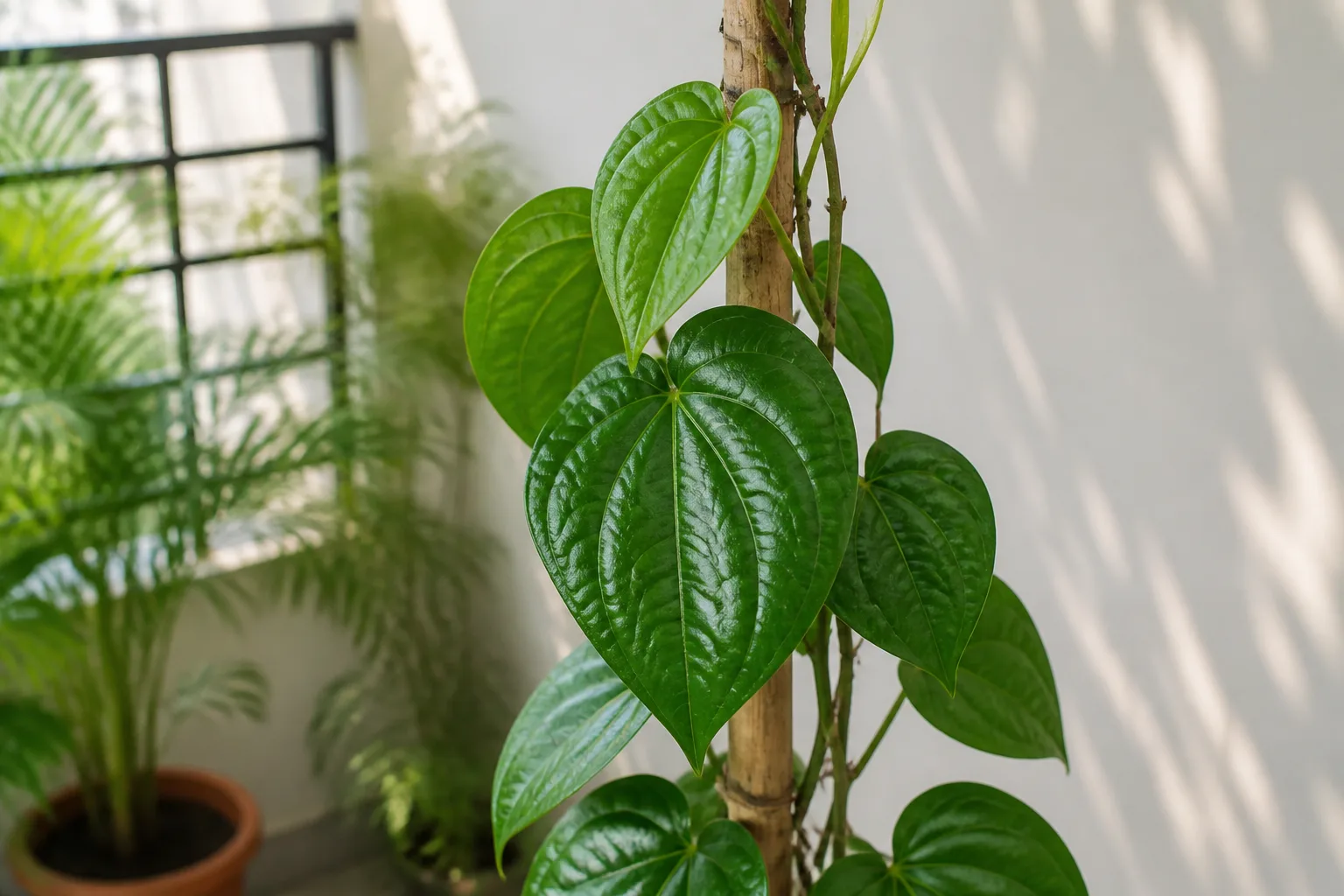
Betel Leaf Pruning Guide: When, Where, and How Much to Cut
Betel Leaf Pruning Guide: When, Where, and How Much to Cut
First action: Walk the vine and remove only fully yellow, brown, soft-rotted, or clearly diseased leaves and stem tips with clean sharp scissors or bypass pruners—finish that cleanup before you tip healthy leaders or shorten long vines for shape. Betel Leaf grows from nodes, so you want a clear map of live, glossy joints before you decide how much length to take.
For whole-plant context—filtered light, humidity, and watering rhythm—see the Betel Leaf overview.
Reviewed by LeafyPixels Review Board · Author: sai-ananth
Quick answer
Prune Betel Leaf (Piper betle), also sold as paan plant or betel vine, to keep glossy heart-shaped leaves within reach, train stems onto a support, and rejuvenate vines that have grown long and small-leaved—not to “fix” harsh sun, dry air, or waterlogged soil. TNAU advises training vines onto standards every 15–20 days during growth, and rejuvenating tall vines by lowering them in March–April once they lose leaf size and vigor. (TNAU Agritech)
Make tip and size-control cuts just above a node—the swollen joint where leaves and aerial roots form—limit live foliage removal to about one-third per session on pots, and schedule major cutbacks for warm, humid active growth. Pruning improves shape and branching, but it cannot replace filtered light or a steady watering rhythm on fertile, well-draining mix.
What pruning does for Betel Leaf
Betel Leaf is a shade-loving Piperaceae climber. Stems enlarge at the nodes and cling with adventitious rootlets; under good conditions vines can run many metres if left free. (Monaco Nature Encyclopedia) Useful Tropical Plants records evergreen climbing stems about 5–20 metres long with adventitious roots that adhere for support. On a balcony or indoors, that habit becomes a sparse rope of stretched internodes unless you train and tip regularly.
Four jobs show up repeatedly:
- Cleanup removes yellow, scorched, pest-coated, or rotting leaves and soft stem tips whenever you spot them.
- Training loosely ties new growth to a bamboo stake, trellis, or moss pole so nodes can root against the support.
- Tip pinching / tip cuts shorten soft leaders just above a node to encourage side shoots and denser leaf production.
- Rejuvenation shortens or coils overlong vines when leaf size drops and the plant looks leggy—field growers lower vines; pot growers usually cut back to healthy nodes and retrain.
Pruning cannot fix chronic midday scorch, low humidity that browns tips, or Phytophthora-style wilt from soggy soil. Correct those conditions first, then cut.
Cleanup vs training vs rejuvenation
Cleanup is safe anytime and should always come first. Training is ongoing maintenance during active growth—TNAU describes fixing vines at 15–20 cm intervals along standards every couple of weeks. (TNAU Agritech) Rejuvenation is the heavier job: when vines get tall and leaf quality declines, growers cut back or lower the vine so new shoots break from nodes. On a pot, that usually means shortening to a framework of sturdy stems with several live nodes left on the support—not stripping the plant bare.
What to check before you cut
Before any shaping session, inspect in good light:
- Live nodes — slightly swollen joints with a leaf scar or aerial root nub; new growth emerges here, not from smooth internode skin.
- Soft vs firm stems — soft, dark, or sour-smelling sections near the soil line may signal wilt; remove those and reassess watering before heavy tip work.
- Support contact — stems hanging free stretch; stems touching a moist moss pole root better at nodes.
- Leaf quality — large glossy leaves on upper laterals are keepers; small, pale, or scorched leaves on shaded or sunburned sections mark where light needs fixing.
- Stress signs — recent repotting, cold nights near 10°C (50°F), or constantly wet mix. Delay hard cutbacks until the vine is stable.
- Tools — sharp scissors or bypass pruners for herbaceous stems; wipe and sterilize blades between plants if disease is present. (Clemson HGIC)
Decide the goal before the first cut: cleanup only, tip for bushiness, train onto a support, or intentional rejuvenation of an overgrown vine.
When to prune Betel Leaf
Best window for tip cuts and rejuvenation
Time major tip cuts and rejuvenation for warm, humid active growth. In most Indian climates that means spring into the monsoon—TNAU schedules field lowering for March–April when vines have reached about 3 m and leaf vigor drops. (TNAU Agritech) Soft tip pinching can continue whenever the plant is pushing new nodes.
Avoid hard canopy removal during cold snaps or dry AC winters. Betel Leaf prefers cool shade with steady moisture, not frost; a hard prune followed by chill and dry air leaves fewer leaves to buffer stress.
Cleanup anytime
Fully yellow, brown, soft-rotted, or diseased leaves can come off whenever you find them. Do not wait for a “pruning day” if soft stem rot or leaf blight is spreading—remove affected tissue, bag it, and keep tools clean. TNAU advises removing severely wilt-affected vines from gardens and destroying them rather than composting nearby. (TNAU Agritech)
Young-plant timing
Start training as soon as the vine has a few nodes and a support in place. Early tip work keeps internodes shorter. Do not wait until the leader is draped across the floor.
The first cut to make
Remove only dead, damaged, yellow, or diseased growth first. Cut each failed leaf at the petiole base near the node, and cut soft rotten stem tips back to firm tissue just above a healthy node. Work from the tip downward so debris does not hide nodes you still need to evaluate.
After cleanup, step back. If the vine is already trained and leaf size looks normal, stop. If leaders race past the support with long bare internodes, move to tip cuts and retraining next—not fertilizer, not repotting, and not a second aggressive pass the same afternoon.
How to prune Betel Leaf step by step
- Sanitize and stage tools. Sharp scissors or bypass pruners; a clean cloth and alcohol wipe if you have moved between a sick plant and a healthy one. (Clemson HGIC)
- Cleanup pass. Yellow, brown, soft, and diseased tissue only.
- Train loose stems. Loosely tie or weave stems to the stake or trellis at roughly 15–20 cm intervals so nodes touch the support—TNAU’s field rhythm for home vines. (TNAU Agritech)
- Tip soft leaders. Cut just above a node that faces the direction you want new growth. Leave at least two to three healthy nodes on each stem you shorten.
- Rejuvenate overlong vines if needed. When the vine exceeds a convenient height and new leaves shrink, shorten to a sturdy framework or coil a healthy lower section gently toward the pot surface so nodes can root—field growers bury lowered vine sections to trigger new primary shoots. (Monaco Nature Encyclopedia)
- Stop and leave recovery foliage. On pots, do not strip every leaf. Bag debris; keep aromatic leaf trimmings out of pet reach.
Healthy tip cuttings with several nodes can go into propagation if the parent vine is pest-free—TNAU prefers terminal setts about 30–45 cm long from vigorous tops. (TNAU Agritech)
Where to cut (and what not to cut)
Cut just above a node, angling slightly so water does not sit on the stub. New shoots and aerial roots form at those joints. (iPlantz)
Do not:
- Cut mid-internode and leave a long leafless stub that dies back.
- Strip all leaves from a stem you want to keep—nodes need some foliage nearby to feed recovery.
- Saw into old, woody basal stubs expecting a flush of leaves if no live nodes remain.
- Remove more than about one-third of live foliage at once on a container plant.
- Prune hard on the same day you repot, fertilize heavily, or move the plant into harsh sun.
Do not confuse leaf harvest for chewing with structural pruning: plucking individual leaves with the petiole is fine on a vigorous vine, but wholesale defoliation is not a shape strategy.
How much you can safely remove
On balcony and indoor pots, treat about one-third of live leafy growth as a practical single-session ceiling. Betel Leaf recovers from hard rejuvenation in field systems, but a pot has less root volume and humidity buffer. If the vine is badly overgrown, take a cleanup pass, wait one to two weeks for remaining leaves to stay firm, then shorten another section.
Field notes that vines around 2–3 m often need rejuvenation because leaf size declines—that is a cue to cut or lower, not a reason to remove every stem at once. Useful Tropical Plants notes that vines about 2 metres long produce smaller, poorer leaves and should be cut back; TNAU schedules field lowering near the 3 m mark in March–April. (Monaco Nature Encyclopedia)
Aftercare and recovery
After pruning:
- Return the plant to bright filtered light or partial shade—not harsh midday sun. See the light guide.
- Keep soil evenly moist but never waterlogged; water when the top 2–5 cm feels dry. See the watering guide.
- Maintain high humidity if indoor air is dry; brown tips after pruning usually mean dry air, not a need for more fertilizer.
- Pause strong fertilizer for one to two weeks after a hard cut; resume mild feeding only when new nodes flush.
- Check that ties are loose so stems are not girdled as they thicken.
Recovery timeline
In warm, humid weather, expect new shoots from remaining nodes within about one to three weeks. Full canopy fill-in takes longer—often several weeks of steady growth. Cool rooms, dim corners, and wet soil stretch that timeline. Signs pruning worked: firm remaining leaves, new glossy nodes, and shorter internodes on tip-trained stems. Signs it went wrong: progressive soft wilt, leaf drop from wet cold soil, or no bud break after several warm weeks—recheck roots and moisture before cutting again.
Mistakes to avoid
- Skipping the support. Untied vines stretch; pruning alone will not make a free-hanging stem look bushy.
- Cutting without fixing light. Leggy growth from deep shade returns after tip cuts unless you improve placement.
- Hard pruning a waterlogged plant. Soft collar rot and Phytophthora-style wilt need drainage fixes and cleanup—not a full haircut. (TNAU Agritech)
- Leaving long internode stubs. Always finish at a node.
- Stacking stress. Do not combine hard rejuvenation, repotting, and heavy fertilizer on the same day.
- Composting diseased material nearby. Bag and dispose of wilted or blighted tissue away from healthy vines.
When not to prune
Skip structural tip cuts and rejuvenation when:
- Nights are cold or the plant is near its frost limit.
- The vine was just repotted or moved and is still shedding leaves.
- Soft stem rot or sour, waterlogged mix is active—stabilize the root zone first.
- You cannot provide filtered light and humidity for recovery.
Cleanup of dead tissue is still allowed in those windows; hard shaping is not.
Related Betel Leaf guides
- Betel Leaf overview — growth habit, humidity, and pet caution context
- Betel Leaf light — filtered shade vs scorch that drives leggy or burned growth
- Betel Leaf watering — even moisture without waterlogging after cuts
- Betel Leaf soil — fertile, free-draining mix that supports recovery
- Betel Leaf propagation — rooting tip cuttings and setts from pruning
- Betel Leaf fertilizer — when to resume mild feeding after new flush
- Betel Leaf repotting — when root stress means delay hard pruning