Betel Leaf Repotting: When, Pot Size & Soil
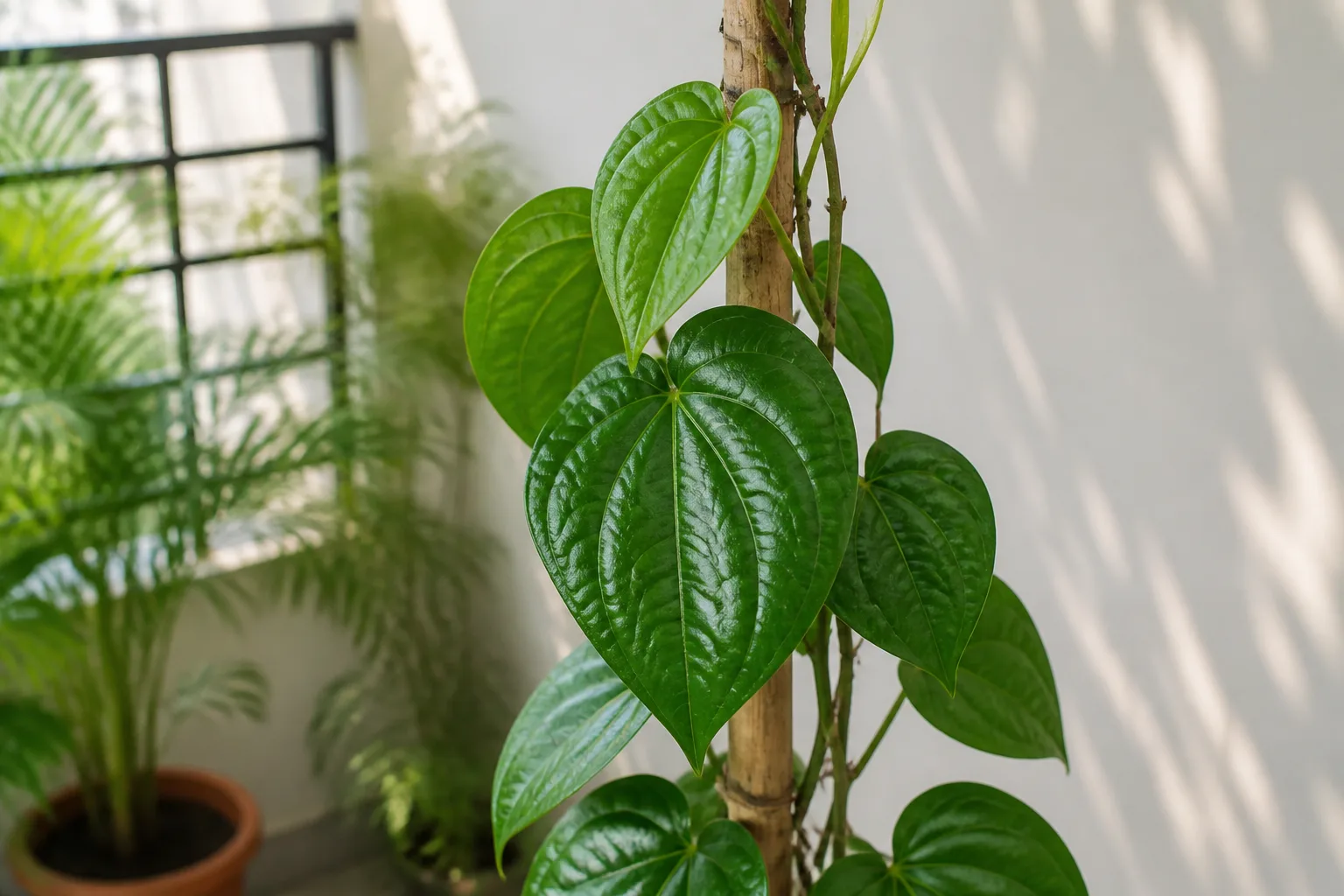
Betel Leaf Repotting: When, Pot Size & Soil
Betel Leaf Repotting: When, Pot Size & Soil
A Betel Leaf vine that dries within a day of watering, stalls despite warm humid placement, or softens at the collar after the mix stays wet is not asking for more fertilizer first. It is asking for a reset of the root zone. Repotting fixes crowded roots and failed soil — but only if you treat Piper betle as a shade-loving, moisture-dependent climber that still dies quickly in waterlogged pots, not as a plant that thrives in oversized, constantly soggy containers.
Betel Leaf — also called Paan, Paan Plant, Betel Vine, or Nagavalli — is an evergreen Piperaceae climber grown for glossy heart-shaped leaves. Useful Tropical Plants describes it as a climbing shrub with woody stems and adventitious roots that cling to supports, often reaching several metres when trained (Useful Tropical Plants — Piper betle). Plants For A Future places it in humid tropics with a preference for moist, well-drained, organic-rich soil in shade or semi-shade, and notes that waterlogged, saline, and alkali soils are unsuitable (Plants For A Future — Piper betle). That biology drives every pot decision: modest upsizing, fertile mix that drains, spring-to-early-monsoon timing in India, and a support ready the moment the vine leaves the old pot. For the full care picture, start from the Betel Leaf overview.
Why Betel Leaf Repotting Is Different From Slow Houseplants
Most slow foliage plants forgive a random spring upgrade. Betel Leaf does not, because two needs collide in one pot: steady moisture and free drainage. TNAU Agritech recommends well-drained fertile clay loams for betelvine and stresses that the crop does not tolerate saline or alkaline conditions, while needing cool humidity and a regular moisture supply (TNAU Agritech — Betelvine). In a balcony pot, that means the danger after a careless move is often too much unused wet volume, not too little leaf room.
The vine also grows fast in warm, humid, shaded conditions and trains onto a stake, trellis, or moss pole. When you lift the root ball, you disturb both soil roots and the climbing habit. Replanting without a support ready, or burying the stem deeper while leaving nodes in wet airless mix, invites the soft collar decline growers associate with overwatering and Phytophthora-style wilt. Missouri Botanical Garden notes that waterlogged roots lose oxygen, decay, and become abnormally susceptible to pathogens such as Phytophthora (Missouri Botanical Garden — Overwatering). Pair this page with Betel Leaf soil and Betel Leaf watering — the new pot only works if the mix and moisture rhythm match the species.
How Often to Repot Betel Leaf
For most home growers, every 1–2 years is a practical rhythm, or sooner when roots fill the pot and dry-down becomes very fast. Vigorous vines on humid balconies may need a move earlier if roots jam the holes and the mix dries within a day. Once the plant sits in a stable final container with a firm support — often a 25–35 cm (10–14 inch) pot for a managed indoor or balcony vine — a same-size soil refresh can beat endless upsizing.
Do not repot on a calendar alone. If drainage is still sharp, new nodes keep forming, and roots are not circling, leave the plant alone. A newly purchased Betel Leaf usually needs two to three weeks of quarantine and observation before any pot change unless the mix is already sour or waterlogged. Cuttings and young setts go up in small steps as they outgrow starter cups; mature vines you want to keep compact may stay in the same pot with a light root tease and fresh organic mix.
Clear Signs Your Betel Leaf Needs a New Pot
Penn State Extension’s pot-bound checklist maps cleanly onto container Betel Leaf: mix that dries unusually fast, roots through drainage holes, and stalled top growth despite decent light and season (Penn State Extension — Repotting Houseplants). Watch for these vine-specific signals.
- Roots circling the pot wall or poking from drainage holes. A few tips are a warning; a solid mat with little soil left means usable volume is gone.
- Soil dry within a day of a thorough soak in weather that used to take several days — classic “more root than soil.”
- Vine extension stalls through warm humid weeks while Betel Leaf light is still correct — exhausted or compacted mix is a prime suspect.
- Water racing down the sides without wetting the core after the root ball shrinks from the pot wall.
- Sour, swampy smell or soft stems near the soil line with yellowing leaves — failed drainage, not a fertilizer deficit.
- Salt crust or algae on the surface with slowed leaf flush — old, compacted mix that no longer holds air and moisture evenly.
Any one sign can justify a refresh. Two or more usually mean you are overdue. Act before the collar softens; a stressed Piper recovers slower once roots have spent weeks in anaerobic mix.
Best Season to Repot Betel Leaf
Timing decides how fast new roots colonize fresh mix. Repot when the vine can push growth into warm, humid air; avoid routine moves when cool weather keeps soil wet for days.
Spring to early monsoon in India
Spring to early monsoon — roughly February to June in most of India — is the default window. Roots wake as days lengthen and humidity rises, so the plant can occupy new mix before peak summer demand. Extension guidance for houseplants likewise favors spring, when roots actively grow into fresh media (Penn State Extension — Repotting Houseplants). Work in the morning or late afternoon on a mild day, not under harsh midday terrace heat. Keep the plant in bright filtered light or partial shade after settling; Betel Leaf is shade-preferring, and harsh sun after a move only adds leaf scorch on top of root stress (Plants For A Future — Piper betle).
When emergency repotting overrides the calendar
Two situations override the season. The first is active root rot or Phytophthora-style wilt — soft, foul-smelling roots, collapsing stems, and saturated soil that will not dry. TNAU lists Phytophthora wilt among major betelvine problems and ties management to drainage and soil hygiene (TNAU Agritech — Betelvine). UF/IFAS similarly notes that Phytophthora root diseases are favored by periodically waterlogged soils (UF/IFAS — Phytophthora Root Rot). Repot immediately into fresh, lightly moist mix, trim compromised tissue, and accept slower recovery if weather is cool. The second is a catastrophically failing root zone — a pot that will not drain, soil turned to mud, or a cracked container exposing roots.
Routine winter or deep-monsoon repotting for convenience alone is a mistake. Disturbed roots sitting in wet fresh mix without active colonization invite the exact oxygen loss Missouri Botanical Garden describes for waterlogged plants (Missouri Botanical Garden — Overwatering). If you must move off-season, prefer a same-size refresh, skip fertilizer for at least a month, and keep warmth and humidity steady without trapping stagnant water in the saucer.
Choosing the Right Pot — Size, Material, and Drainage
The new pot does not need to be decorative. It needs to be one size larger, equipped with a real drainage hole, and deep enough for a stake or moss pole without tipping.
The one-size-up rule for moisture-loving climbers
Move up about 2–5 cm (1–2 inches) in diameter — one pot size — not a jump into a huge tub “so you never repot again.” Penn State advises choosing a container only slightly larger so the plant stays balanced and unused mix does not dominate the root zone (Penn State Extension — Repotting Houseplants). Oversized pots are the most common reason Betel Leaf softens after a move: a large volume of moist organic mix surrounds a still-small root system, the center stays wet, and oxygen drops.
Terracotta dries more evenly and suits growers who tend to keep saucers full; plastic holds moisture longer and suits hot, windy balconies where pots dry in hours. Glazed ceramic works if it has a drainage hole and you empty the saucer after watering. Whatever material you choose, a drainage hole is non-negotiable — Betel Leaf wants consistent moisture, not a sealed bowl of stagnant water. Install the bamboo stake, trellis, or moist moss pole before you backfill so you are not stabbing through new roots later.
Soil Mix to Use When Repotting Betel Leaf
Field references converge on fertile, organic, well-drained loam with steady moisture. TNAU calls for well-drained fertile clay loams; Useful Tropical Plants and PFAF describe deep, friable loamy or clayey soils rich in organic matter, with preferred pH near mildly acid to near-neutral depending on the source range cited (TNAU Agritech — Betelvine; Useful Tropical Plants — Piper betle). In containers, translate that into a mix that feels crumbly, drains from the holes within minutes, and still holds moisture in the top few centimetres between waterings.
A practical home blend matches the plant hub profile: roughly 40% quality potting mix or coco coir, 30% compost or well-rotted manure, 20% perlite or coarse sand, and 10% orchid bark or fine coco chips. Aim for about pH 5.5–7.0. Do not use heavy garden clay alone, moisture-control peat that stays wet for days, or alkaline sandy fills with no organic matter. Moisten the mix before potting so water wets evenly rather than channeling (Penn State Extension — Repotting Houseplants). Full ingredient logic lives on the Betel Leaf soil page — use this guide for the move itself.
Step-by-Step: How to Repot Betel Leaf
Water the plant in its old pot about an hour before you work so the root ball slides out intact. Clean and sanitize a previously used pot; soak new unglazed terracotta so it does not pull moisture from the fresh mix on day one (Penn State Extension — Repotting Houseplants). Cover the drainage hole with a scrap of mesh if needed, add a base of pre-moistened mix, and set the support in place.
Root check, clean cuts, and reattaching the support
Slide the vine out and inspect roots. Healthy tissue is firm and pale; soft, black, or foul-smelling roots should be cut away with clean shears. Gently tease circling roots so they can grow outward into fresh mix. Set the root ball so the original soil line sits about 2–3 cm below the rim, then backfill without packing the mix into concrete. Leave watering space at the top. Thoroughly water until excess runs from the holes, empty the saucer, and immediately train stems onto the support so adventitious roots can cling again (Useful Tropical Plants — Piper betle).
If you are doing a same-size refresh, remove as much old mix as you can without shredding healthy roots, trim only damaged tissue, and return the plant to the cleaned pot with fresh blend. Do not bury leafy stems deeper hoping for more roots — wet buried nodes in dense mix are a soft-rot risk on this crop.
Aftercare — Water, Light, and Feeding for the First Month
For the first one to two weeks, keep the plant in bright filtered light or partial shade, out of harsh midday sun and cold drafts. Water when the top 2–5 cm feels dry — thoroughly, then drain — matching the Betel Leaf watering rhythm rather than keeping the pot permanently swampy. Mild leaf dullness or a short pause in new nodes for a week or two can be normal while roots reestablish; progressive collapse, sour soil, or a mushy collar is not.
Hold fertilizer for at least three to four weeks, or until you see steady new growth. Fresh compost already supplies a mild nutrient base, and salts on damaged roots only add burn. Resume a diluted, balanced feed only after the vine is clearly pushing again — details on the Betel Leaf fertilizer guide. Keep humidity high if indoor air is dry, but prioritize airflow so foliage does not sit wet overnight.
When Not to Repot Betel Leaf
Skip routine moves when the vine is already stressed by pests, cold nights below about 10°C (50°F), or a recent hard prune. Do not repot on the day you bring a nursery plant home unless the mix is failing — quarantine first and learn how fast the pot dries. Avoid upsizing into a decorative pot with no drainage hole; use a nursery pot inside a cachepot and empty water after each soak (Penn State Extension — Repotting Houseplants).
Also skip “repotting as a cure” for problems that are really light or humidity failures. A vine in harsh sun or dry AC air will not recover because you gave it a prettier container. Fix placement first, then disturb roots only when the root zone itself is the limiting factor.
When to use this page vs other Betel Leaf guides
Use this page when you need timing, pot size, mix at the move, step-by-step technique, and post-repot recovery. Use Betel Leaf soil when you are designing or diagnosing the mix itself without changing pots. Use Betel Leaf watering when dry-down timing or overwatering signs are the question. Use Betel Leaf light when scorched or leggy leaves are the issue. Use Betel Leaf propagation when you are rooting setts rather than moving an established vine, and Betel Leaf pruning when you need to shorten or train stems after the plant stabilizes.
Related Betel Leaf guides
- Betel Leaf overview — identity, placement, and full care summary
- Betel Leaf soil — mix ratios, drainage, and pH for containers
- Betel Leaf watering — moisture checks and seasonal rhythm
- Betel Leaf light — filtered shade vs harsh sun
- Betel Leaf fertilizer — when to resume feeding after a move
- Betel Leaf propagation — terminal setts and aftercare for new vines
- Betel Leaf pruning — training and cutting back woody growth
Conclusion
Repot Betel Leaf when roots, dry-down speed, or failing mix say the current pot is the limit — typically every 1–2 years, with February–June as the safest window in much of India. Step up one pot size, use a fertile organic mix that drains, reinstall a support immediately, and keep moisture even without a waterlogged saucer. Treat oversized wet pots and day-one nursery moves as the main ways growers create transplant stress on this climber. Get the root zone right, and glossy new leaves follow without stacking fertilizer, harsh sun, and another pot change on top of recovery.