Calcium Deficiency on Bird of Paradise: Causes, Checks &
Quick answer
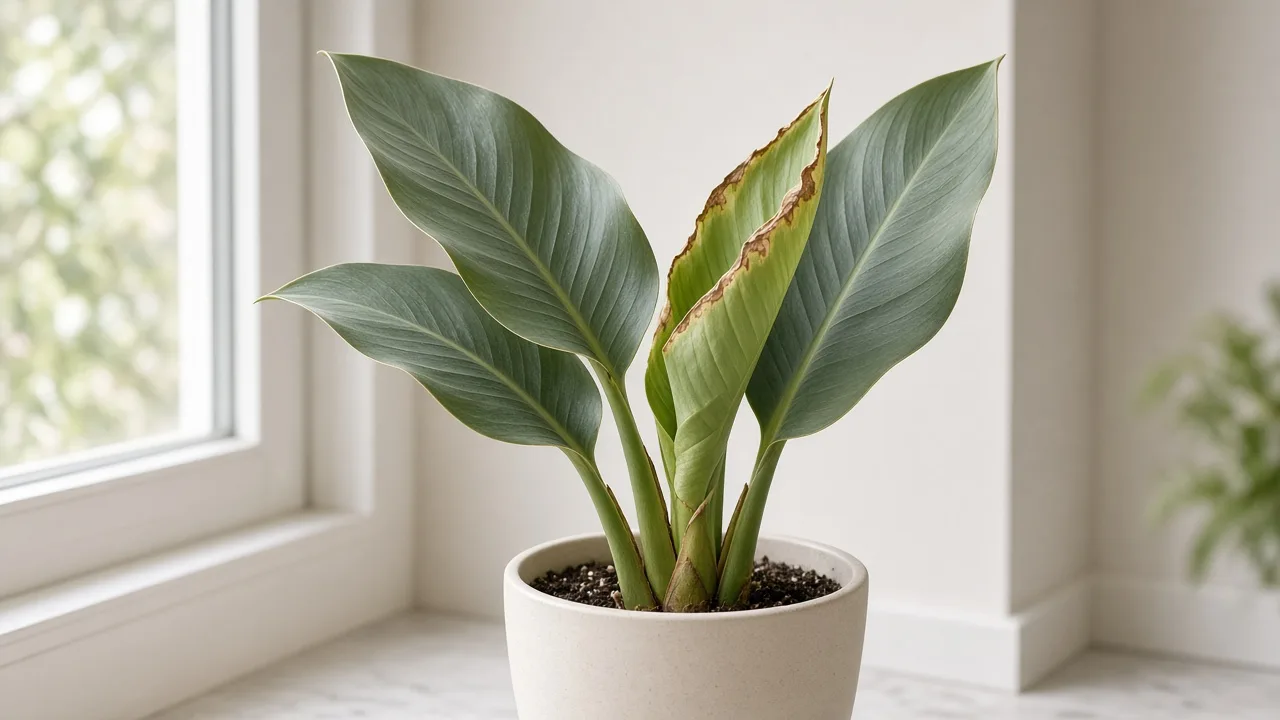
Calcium deficiency on Bird of Paradise shows as cupped, torn, or margin-burned new paddle leaves emerging from the central fan while older stiff gray-green blades often look normal. First step: confirm damage on the newest unfurling spear—not natural splits on mature paddles or thrips scarring—then water thoroughly once the top 5 cm is dry so transpiration can move calcium to expanding tissue.
Calcium Deficiency on Bird of Paradise: Causes, Checks & Fixes
This guide covers calcium deficiency on Bird of Paradise. See also the general Calcium Deficiency guide, watering, and light pages for this plant.
Calcium Deficiency on Bird of Paradise: Causes, Checks & Fixes
Quick answer
Calcium deficiency on Strelitzia reginae (Bird of Paradise) shows as cupped, torn, or margin-burned new paddle leaves emerging from the central fan while older stiff gray-green paddles on thick petioles often look normal. Calcium is bound in cell walls and is plant-immobile, so deficiency appears on young expanding tissue first—not on the lowest mature leaves the way nitrogen deficiency does.
See our calcium deficiency guide for general new-tissue distortion mechanics. On Bird of Paradise, inspect the softest central spear still unfurling above the rhizome—mature paddles with clean lengthwise splits can look dramatic while the real calcium signal hides on the newest blade.
First step: confirm cupping or tan margin necrosis on the newest unfurling paddle—not natural splits on hardened leaves, thrips streaks, or dry brown tips from salt—then water thoroughly once the top 5 cm is dry so roots can resume moving calcium with transpiration.
When to use this page vs other Bird of Paradise guides
| Pattern | Read next |
|---|---|
| Cupped or margin-burned newest central paddle | Calcium deficiency (this page) |
| Puckered or silver-streaked new growth | Distorted leaves or thrips |
| Yellow between veins on older paddles | Magnesium deficiency |
| Yellow new spear with dark green veins | Iron deficiency |
| Pale lower paddles, uniform wash | Nitrogen deficiency or pale leaves |
| Brown scorched edges on many open leaves | Potassium deficiency or fertilizer burn from the fertilizer guide |
| Lengthwise splits only on mature paddles | Normal Strelitzia habit—not this page |
| Yellowing with soft petioles on wet mix | Overwatering or root rot |
| Rolled or curled paddles in dry winter air | Low humidity or curling leaves |
What calcium deficiency looks like on Bird of Paradise
Bird of Paradise is a clumping rhizomatous tropical with large gray-green paddle leaves on stiff upright petioles. Healthy new growth pushes from the center as a tight spear that unfolds into a broad blade. Calcium supports rigid cell walls in that expanding paddle; when uptake or distribution fails, the newest spear shows damage while older paddles on the same plant may still look full.
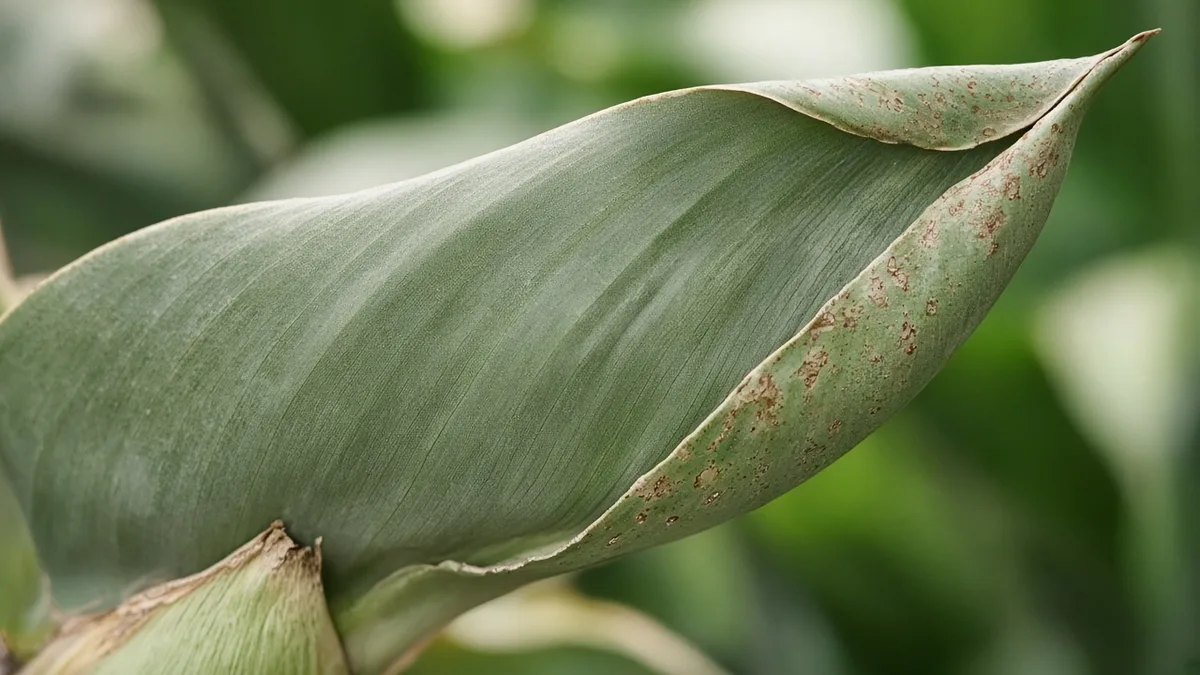
Newest unfurling paddle with inward-curled margin and small tan necrotic edge spots—older stiff paddles below may look normal.
Typical signs:
- Inward cupping or hood-like curling on the margin of the newest paddle before it fully hardens
- Small tan or brown necrotic spots along the expanding edge or near the petiole base of that young leaf
- A new paddle that opens smaller, narrower, or more torn than the prior spear from the same fan
- Center of the blade expands while margins stay tight, leaving a rippled or crinkled profile
- Older mature paddles on stiff petioles often stay green and upright
- Firm rhizome at the soil line and white healthy root tips when the mix drains well; mushy bases on sour wet soil suggest rot instead
Not calcium deficiency:
- Clean lengthwise splits on fully hardened paddles in bright dry rooms—normal Strelitzia leaf behavior, not nutrient hunger
- Silver streaks, black specks, or sticky residue on soft new tissue—thrips or distorted leaves from pest scarring
- Uniform dry crispy tips on many leaves without cupping on the central spear—brown tips from salts or low humidity
- Interveinal yellowing on older lower paddles—magnesium deficiency (magnesium deficiency initially develops on lower foliage with interveinal chlorosis)
- New spear yellow with dark green veins—iron deficiency
- Pale lower paddles without tip distortion—nitrogen deficiency
- Soft drooping petioles on constantly wet mix—overwatering or root rot
Penn State notes calcium deficiency symptoms appear first on younger leaves, with brown chlorotic spots along margins that can unite as tissue expands. On an indoor Bird of Paradise, that pattern is easiest to read on the central spear during spring and summer when the plant should be pushing new paddles in bright light.
Why Bird of Paradise gets calcium deficiency
Bird of Paradise is a heavy summer grower in good light: NC State recommends watering freely and fertilizing regularly in spring and summer while keeping the mix drier in winter. Each new paddle demands calcium for cell walls as it unfurls from the rhizome fan. Indoor culture often creates uptake gaps even when older leaves look fine.
Bird of Paradise–specific causes:
- Letting the root ball go bone-dry between waterings — RHS notes calcium deficiencies in containers are often caused by poor distribution within the plant after the compost dries out, not because the mix truly lacks calcium. A large floor pot near a sunny window can dry unevenly while you still see green mature paddles.
- Very soft or reverse-osmosis water without complete feed — Owners chasing fluoride-sensitive brown tips sometimes remove the small calcium contribution tap water normally supplies unless fertilizer replaces it.
- Incomplete or long-skipped fertilizer during active flush — See the Bird of Paradise fertilizer guide: hungry plants in bright light leach nutrients through frequent summer soaks per the watering guide.
- Potassium-heavy feeding without balance — RHS cautions that overfeeding with potassium-rich fertilizers can contribute to calcium distribution problems on fruiting crops; on foliage plants, bloom-boost formulas used every week on a non-flowering indoor specimen can skew uptake.
- Blocked uptake from waterlogged roots — Chronic saturation in a cachepot prevents absorption even when calcium is present; fix overwatering before feeding.
- Depleted acidic mix in an old root ball — Penn State notes calcium deficiency can be a problem in acid soils when roots cannot explore deeper horizons. In a root-bound container, the entire root zone is that top layer.
Do not diagnose calcium deficiency on sour wet soil with a soft rhizome—that is root failure until you confirm mostly firm roots and appropriate dry-down.
Natural paddle splits vs new-spear cupping
The diagnostic fork on Strelitzia is which leaf is damaged, not merely that a paddle looks torn.
Mature Bird of Paradise paddles split lengthwise along the midrib in dry indoor air or after mechanical flexing—that is a normal architectural release, not calcium starvation. Those splits appear on fully hardened blades with stiff petioles and often follow years of good growth.
Calcium deficiency hits the soft central spear while it is still expanding: margins cup inward, tan necrotic specks appear on the young edge, or the paddle opens smaller than the previous one. If only old paddles show clean splits and the newest spear opens flat and full, look at low humidity or mechanical damage instead of nutrients.
Run your eyes from the oldest outer paddles inward: split mature blades + distorted central spear points here; split mature blades + healthy new spear does not.
The central fan and rhizome growing point
Bird of Paradise grows from an underground rhizome that sends up a fan of petioles from one soil-level crown. All new paddles emerge from that tight center—not from random nodes along a vine.
When calcium transport fails, the youngest spear in the heart of the fan stalls or cups while petioles one ring outward still hold firm gray-green blades. That new-vs-old contrast is the hallmark of immobile calcium deficiency and is meaningless on a single-rosette succulent.
During active growth, you should see a visible central spear every few weeks in bright light. If successive spears emerge increasingly cupped, the rhizome growing point is under stress even when the plant still looks like a bold floor specimen from across the room.
Summer leaching in heavy floor pots
The trap on Bird of Paradise is a large container in a sunny bay window that drinks heavily in July but still dries to dust between your weekend waterings.
Each thorough summer soak per the watering guide flushes soluble nutrients through drainage holes. Years of flushing without measured feeding—or with micronutrient-only drenches—can leave distorted central spears while outer paddles stay green on firm petioles. That pattern often means depleted uptake or dry spells, not that the whole plant lacks light—compare with not enough light, which washes out the entire fan and stretches petioles.
Cachepot risk: Outer decorative pots hide a saturated inner root ball. Roots stop drawing water—and calcium—while you still see upright mature leaves. Lift the nursery pot and check weight before assuming hunger.
Lookalike symptoms
| Pattern | Check | Likely cause |
|---|---|---|
| Cupped newest central paddle | Dry-down history, water type | Calcium deficiency (this page) |
| Splits on mature paddles only | Spear shape | Normal habit or humidity |
| Silver streaks on new tissue | Leaf undersides | Thrips |
| Interveinal yellow on old paddles | Vein pattern | Magnesium deficiency |
| Yellow new spear, green veins | Wet mix, pH | Iron deficiency |
| Pale lowest paddles | Feed history | Nitrogen deficiency |
| All paddles dull, long petioles | Window hours | Pale leaves or leggy growth |
| Soft petioles, wet sour mix | Root smell | Overwatering |
How to confirm
Work in this order during active spring or summer growth:
- Locate the softest central spear — Cupping, margin necrosis, or stunted unfurling on that leaf supports calcium deficiency; splits only on hardened outer paddles do not.
- Compare to the previous spear — A clearly smaller or more torn new paddle than the last one, with older paddles still stiff, strengthens the diagnosis.
- Check dry-down — If the top 5 cm has been dust-dry for days while the plant pushed new growth, dry-spell distribution failure is likely per RHS calcium guidance.
- Review water and fertilizer — Soft water, skipped feeds, or bloom-only formulas on a non-flowering indoor plant raise suspicion; cross-check the fertilizer guide.
- Feel the rhizome and petiole bases — Firm crowns and stiff petioles fit nutrient uptake stress; mushy bases on wet mix redirect to root rot.
- Rule out pests on new tissue — Magnify the unfurling spear for thrips before feeding.
Confirmed calcium deficiency means new-tissue margin damage with firm roots and a plausible dry-down or soft-water story—not every torn paddle in the pot.
The first fix to try
Water thoroughly once the top 5 cm of mix is dry, letting excess drain fully, and do not let the root ball bake completely dry again while the central spear is expanding.
That single soak restores transpiration-driven calcium movement to the growing paddle—RHS lists preventing compost dry-out as the primary remedy when calcium fails to reach new tissue. Wait seven to ten days and inspect the next spear, not the paddle that already hardened with cupped margins.
Step-by-step recovery
After the first thorough watering on appropriate dry-down:
- Stabilize the rhythm — Match summer and winter dry-down to the watering guide; avoid alternating flood and drought on a heavy root ball.
- Apply one measured dose of complete liquid fertilizer at half label strength on moist—not waterlogged—soil during active growth, using a product that lists calcium or micronutrients on the label. Use the Fertilizer Dilution Calculator if you are unsure of dilution.
- Pause bloom-boost-only formulas until two clean spears open; balance matters when potassium-heavy feeding can skew calcium distribution.
- Empty standing water from cachepots after each soak so roots re-aerate.
- Trim only fully brown necrotic margin tissue on the worst hardened paddle if it tears further; leave green cupped tissue attached so the plant is not shocked mid-recovery.
If two successive spears stay cupped after stable watering and one complete feed, refresh depleted soil at the next appropriate repot window—not as an emergency stack with heavy fertilizer on the same day.
Recovery timeline
- 7–14 days: Transpiration normalizes after consistent moisture; the current distorted spear may still harden cupped.
- 4–8 weeks: The next central spear often opens with cleaner margins if roots stayed firm and feeding was measured.
- 8–12 weeks: A second clean paddle confirms the fan is back on track; older split mature leaves are unchanged.
Judge success by new spear shape and petiole stiffness, not by old paddles re-smoothing or splits closing.
Mistakes to avoid
- Do not feed heavily on bone-dry soil or immediately after a long drought—soak first, then fertilize on moist mix.
- Do not treat natural mature paddle splits as calcium deficiency and dump fertilizer on a healthy fan.
- Do not use distilled or RO water without ensuring complete feed supplies calcium.
- Do not repot, divide, and heavy-feed a recently moved floor specimen in the same week.
- Do not expect the currently cupped paddle to flatten—watch the next spear.
- Do not ignore wet cachepots while chasing nutrients—uptake fails when roots stay saturated.
Prevention
- Keep the seasonal dry-down from the watering guide—Bird of Paradise tolerates drought better than chronic wet feet, but repeated complete dry-outs during spear flush invite calcium distribution failure indoors.
- Feed lightly with complete fertilizer during active growth per the fertilizer guide; pause in winter unless strong grow lights keep new spears coming.
- Place the plant where it receives enough light to justify summer feed and water use without baking the root ball in a dark cachepot.
- Refresh depleted perlite-rich soil when roots circle a heavy pot every two to three years.
- Inspect the central fan weekly in growing season—early margin cupping is easier to correct than a stunted rhizome tip.
Related Bird of Paradise guides
- Bird of Paradise overview — species baseline and care hub
- Bird of Paradise problems — full symptom index
- Bird of Paradise fertilizer — seasonal feeding and over-feeding recovery
- Bird of Paradise watering — dry-down that pairs with nutrient transport
- Bird of Paradise soil — drainage and pH for container culture
- Bird of Paradise light — brightness that drives summer feed demand
- Distorted leaves — pest and unfurling damage on new paddles
- Magnesium deficiency — older-paddle interveinal patterns
- Iron deficiency — new-spear chlorosis with green veins
- Overwatering — when uptake failure mimics hunger
Conclusion
Cupped or margin-burned new central paddles on a Bird of Paradise fan point to calcium distribution failure on expanding tissue—separate natural splits on mature blades, confirm the new-vs-old pattern, restore thorough watering on appropriate dry-down, then apply one complete measured feed on firm roots during active growth.
Related tool
Use the Fertilizer Dilution Calculator to narrow causes for calcium deficiency on this plant before changing multiple variables at once.