Bitter Gourd Care Guide: Grow Momordica charantia (Karela)
Momordica charantia
Grow bitter gourd or karela on a trellis in full sun with rich well-drained soil, even moisture, and harvest while fruit is still green and firm.
Bitter Gourd Care Guide: Grow Momordica charantia (Karela)
Start with wateringThe most common care mistake for Bitter GourdWatering guide → →Bitter Gourd care essentials
Light
Water
Keep the root zone evenly moist while vines are climbing and setting fruit, but never waterlogged. Water deeply when the upper 2–3 cm of mix begins to dry, directing water at the soil rather than routinely wetting foliage.
Soil
Rich, organic, well-drained loam or container mix. Slightly acidic to near-neutral pH around 6.0–7.0 suits most cultivars.
Humidity
Temperature
Fertilizer
About Bitter Gourd
Bitter Gourd is native to Tropical Africa and tropical Asia, typically reaches Vine commonly 3.6–6 m long in one season; immature fruits often 10–20 cm long indoors, with fast - harvest commonly 55–80 days from sowing in warm weather growth. Bitter Gourd has a vine growth habit and part of the Cucurbitaceae family. It is also known as Karela, Bitter Melon, Balsam Pear, and Ampalaya.
| Detail | Information |
|---|---|
| Also known as | Karela, Bitter Melon, Balsam Pear, Ampalaya |
| Native region | Tropical Africa and tropical Asia |
| Mature size | Vine commonly 3.6–6 m long in one season; immature fruits often 10–20 cm long |
| Growth rate | Fast - harvest commonly 55–80 days from sowing in warm weather |
| Growth habit | Vine |
| Scientific name | Momordica charantia |
| Family | Cucurbitaceae |
Bitter Gourd Care Guide: Grow Momordica charantia (Karela)
Bitter gourd (Momordica charantia), sold as karela in much of India and as bitter melon or ampalaya elsewhere, is a frost-tender annual climbing vegetable in the cucumber family—not a compact houseplant you can park in dim indoor light. Growers prize the immature green, warty fruits for cooking; the same vine becomes ornamental but hazardous once fruit ripens yellow-orange and splits to show scarlet-coated seeds NC State Extension. This overview covers identity, season, light and water summaries, soil and trellis basics, pollination, harvest timing, container limits, and when to open a deeper guide in the Bitter gourd plant hub.
What Bitter Gourd Is and How It Grows
Scientific identity, karela, and cucurbit relatives
The Latin name Momordica charantia sits in Cucurbitaceae alongside cucumber, bottle gourd, ridge gourd, pumpkin, and melon. Packet labels may say bitter melon, balsam pear, or karela, but the cultural pattern is the same: a monoecious vine with separate yellow male and female flowers, tendril climbing, and fast summer growth when heat and sun are strong UF/IFAS Extension. Because it shares pests and soil diseases with other cucurbits, avoid planting year after year in the same tired container mix or bed row without refreshing organic matter and rotation when problems stack up.
Growth habit, vine length, and annual life cycle
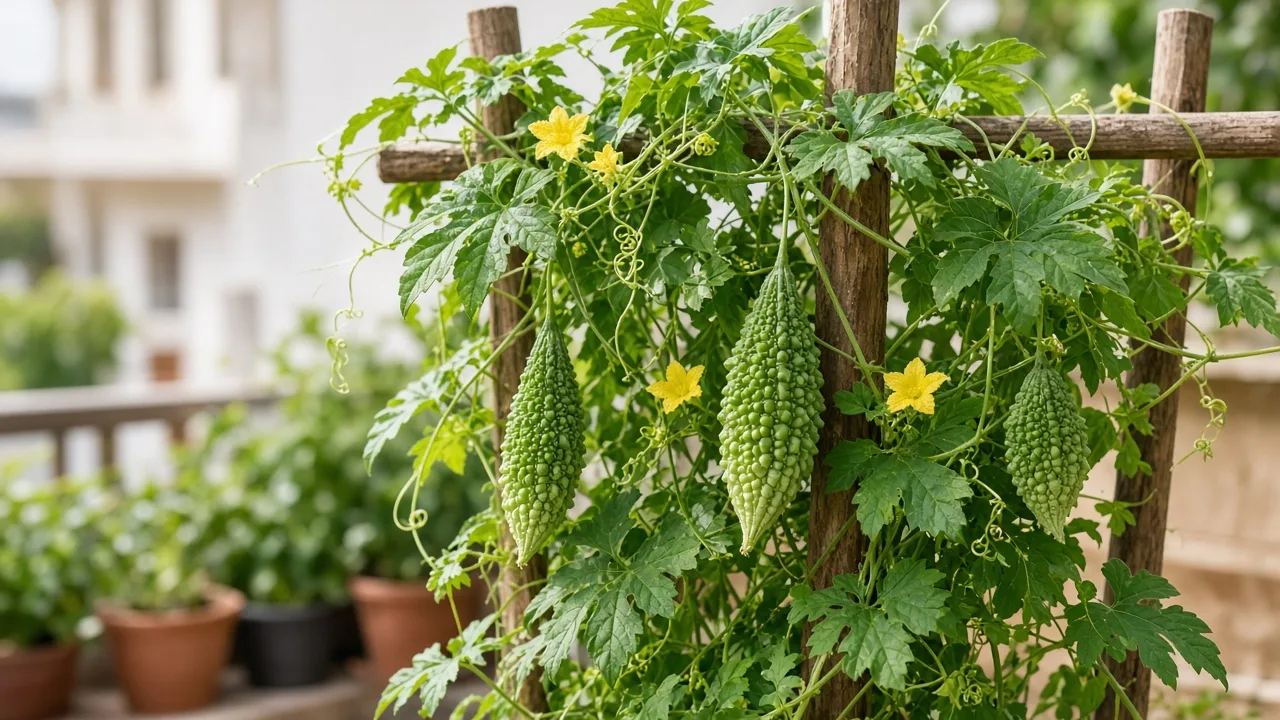
Bitter gourd grows as a vigorous tendril-bearing vine with deeply lobed leaves. NC State Extension describes stems running 12–20 feet (roughly 3.6–6 m) in one warm season, with warty fruits commonly 4–8 inches long while still green. The plant completes its life in a single frost-free window: germinate in warm soil, climb, flower, set fruit, then senesce when nights turn cold or the crop is finished. There is no dormant indoor phase—if your space cannot offer sun, root room, and a trellis for several months, choose a smaller crop instead.
Native range and where it thrives today
Bitter gourd is native to tropical and subtropical Africa and Asia and is now grown across South and Southeast Asia, the Caribbean, and warm parts of the Americas NC State Extension. It favors hot, humid weather with steady moisture access, which is why terrace and kitchen-garden culture in India, Bangladesh, and the Philippines often succeeds when temperate “last frost” calendars are adapted to local monsoon and dry-season patterns rather than copied blindly from another climate zone.
Why Bitter Gourd Needs a Warm Season
Frost tenderness and warm seed germination
Bitter gourd is frost tender and dies at first frost NC State Extension. Seeds carry stiff coats and germinate best when soil stays warm and moist—UF/IFAS notes roughly 60–95 °F (about 15–35 °C) for reliable emergence; cold, dry sowings stall or fail UF/IFAS Extension. In temperate regions growers start seed indoors a few weeks before tomato-planting weather; on an Indian balcony the equivalent rule is warm nights and a heated root zone, not a calendar date imported from another country.
Sowing windows for Indian plains, hills, and terraces
On hot plains, many households sow after winter chill fades—often February–March for a spring crop or June–July where monsoon cloudiness still leaves enough heat for vine growth—while hill districts may shift earlier or later based on frost-free weeks. Read the days-to-harvest on your seed packet: Indian market types may produce usable fruit in roughly 55–80 days in warm weather, though long-season cultivars exist. Starting too late on a short balcony season means fewer pickings before heat or rain ends the run.
Light Needs in Brief
Bitter gourd wants full sun—at least six hours of direct light daily for strong vines and good fruit set NC State Extension. A south- or west-facing terrace rail outperforms a shaded courtyard where the vine stretches toward light and sets fewer female flowers. Harsh midday heat on small containers may stress leaves even when soil is moist; afternoon shade can help foliage without replacing the need for bright morning sun. Window orientation, reflectors, and scorch signs are covered in the dedicated Bitter gourd light guide—here the rule is simple: open sun, not houseplant shade.
Water and Root-Zone Basics
A fruiting vine punishes both drought and saturation. Keep the root zone evenly moist while stems climb and young fruits swell, watering deeply when the upper 2–3 cm of mix begins to dry rather than on a fixed clock. Containers in pre-monsoon heat may need daily checks; during humid monsoon spells the same pot stays wet longer and needs far less. Direct water at the soil line to keep lobed leaves drier and cut common cucurbit leaf diseases. Drought during bloom often drops flowers or young fruit; constant sogginess invites rot and sour-smelling mix. Finger-test depth, wilt recovery, and seasonal schedules live in the Bitter gourd watering guide.
Soil, pH, and Fertility Summary
Grow bitter gourd in rich, organic, well-drained loam or container mix, similar to cucumber culture NC State Extension. Most cultivars tolerate slightly acidic to near-neutral pH around 6.0–7.0; dense, compacted potting soil sheds water unevenly and stresses roots. A workable container blend combines quality potting mix, mature compost, and perlite or coarse sand for free drainage with steady moisture between waterings. Heavy nitrogen alone pushes leaves at the expense of fruit; balanced feeding timing is covered in the Bitter gourd fertilizer guide and mix recipes in the Bitter gourd soil guide.
Trellis Support, Spacing, and Airflow
Why vertical training beats ground sprawl
UF/IFAS production guidance stresses a trellis support system for yield and quality, with field systems often about 6 feet tall so vines climb off damp ground UF/IFAS Extension. Install netting, stakes, or a sturdy frame at planting so you do not disturb roots later. Supported vines keep warty fruit clean, improve airflow through lobed leaves, and make it easier to spot overripe or split gourds before pets or children reach them. Left to sprawl, the same plant risks fruit rot where gourds touch soil and powdery mildew in still, humid air—acceptable for ornamental ground cover, poor for kitchen harvests.
Give each vine real horizontal space: commercial spacing often runs 3–5 feet between plants and 5–6 feet between rows UF/IFAS Extension. On a balcony, one well-fed vine per large container plus trellis usually beats crowding three seedlings in a small pot.
Pollination and Fruit Set on the Vine
Male-first flowering and hand pollination on balconies
Bitter melon bears separate male and female yellow flowers on the same plant and is cross-pollinated, with bees carrying pollen between blooms UF/IFAS Extension. Male flowers often dominate early in the bloom cycle, which can look like “no fruit yet” when the vine is actually healthy. Female flowers show a baby fruit between the blossom and the stem; if pollinators are scarce above ground level, transfer pollen from a fresh male flower to females in the morning when flowers are open. Persistent failure to set fruit after good sun and moisture usually points to shade, drought, or missing pollination—not the wrong seed packet.
Harvest Timing: Green Culinary Stage vs Ripe Fruit
Pick bitter gourd while fruits are firm, warty, and green to pale green—the normal culinary stage NC State Extension. Check every few days once production starts; regular picking encourages more young fruit. Left on the vine, gourds turn yellow-orange, soften, and may split to expose seeds in scarlet pulp—a striking display but the wrong harvest stage for the kitchen. UF/IFAS notes fruit is typically harvested green or slightly yellow for market, and that maturity shifts toward orange flesh unsuitable for the same uses UF/IFAS Extension. In warm Florida trials, first harvest may arrive roughly 50 days after seeding in the north of the state, sooner farther south—use that as a benchmark, not a guarantee for every Indian cultivar.
Ripe Fruit, Seeds, and Pet Safety
Mature fruit and seeds are toxic and should not be eaten NC State Extension. NC State lists medium-severity poison characteristics for humans when large quantities of ripe fruit coats or seeds are consumed, with symptoms that can include gastrointestinal and neurologic effects. Immature green karela is a familiar cooked vegetable; ripe, split, or fallen gourds are not pet-safe forage. Remove overripe fruit from the vine and ground, and contact a veterinarian if an animal eats mature fruit or shows vomiting, weakness, or unusual behavior. Do not rely on this page for medical advice—treat ripe seeds like hazardous garden waste.
Growing Bitter Gourd in Containers and Grow Bags
Bitter gourd can grow in pots, grow bags, or raised beds on terraces, but only with generous volume—often on the order of 19–26 L (5–7 gallons) or larger for a full-season vine—and a trellis anchored to a wall or railing. Shallow decorative pots dry out between waterings, stall growth, and drop flowers. Use drainage holes, rich mix as above, and expect daily moisture checks in dry heat. Transplanting timing, final pot upsizing, and seed-start cells are detailed in the Bitter gourd repotting guide and Bitter gourd propagation guide.
Common First-Season Mistakes
Sowing in cold, wet mix wastes the short warm window and invites seed rot. Skipping the trellis invites soil-contact rot and hides overripe fruit. Letting pots swing between bone-dry and flooded causes flower and fruit drop during the very weeks that matter. Harvesting too late turns food into toxic ornament and slows new fruit. Assuming male-only blooms mean crop failure leads to unnecessary replanting when pollination or patience would fix set. Crowding multiple vines in one small container competes for water and light. Pruning excess laterals and managing vine length are covered in the Bitter gourd pruning guide.
When to Use This Page vs Other Bitter Gourd Guides
This overview explains what the plant is and how the warm-season pieces fit together. Open a sibling guide when one variable needs a deep dive:
- Light: Window placement, scorch relief, grow lights → /plants/bitter-gourd/light/
- Watering: Soil-check depth, monsoon vs dry-season frequency, wilt clues → /plants/bitter-gourd/watering/
- Soil: Mix recipes, pH, drainage, wrong-soil signs → /plants/bitter-gourd/soil/
- Fertilizer: NPK timing, compost, overfeeding risks → /plants/bitter-gourd/fertilizer/
- Repotting & transplant: Cells, final containers, disturbing roots → /plants/bitter-gourd/repotting/
- Propagation: Seed scarification, sowing dates, hand pollination detail → /plants/bitter-gourd/propagation/
- Pruning: Lateral shoots, vine length, airflow → /plants/bitter-gourd/pruning/
Related Bitter Gourd Guides
- Bitter gourd light requirements — sun hours, terrace orientation, heat stress
- Bitter gourd watering — when to water, container vs bed, monsoon caution
- Bitter gourd soil — mixes, pH, drainage, fertility baseline
- Bitter gourd propagation — seeds, transplants, pollinator-limited balconies
- Bitter gourd fertilizer — feeding through fruit set without leaf overload
Conclusion
Bitter gourd rewards growers who treat it like a sun-loving cucurbit vine, not a shade houseplant: warm soil at sowing, a sturdy trellis, even root-zone moisture through bloom and fruit swell, and frequent harvest of firm green karela before fruits ripen. Match container volume and cultivar days-to-harvest to your terrace season, hand-pollinate when bees are scarce, and remove ripe or split fruit from the garden before it becomes toxic waste or a pet hazard. When one factor—light, water, soil, feed, propagation, or pruning—needs troubleshooting, use the focused guides linked above rather than guessing from generic cucumber advice.
How to care for Bitter Gourd?
When should you water Bitter Gourd?
Keep the root zone evenly moist while vines are climbing and setting fruit, but never waterlogged. Water deeply when the upper 2–3 cm of mix begins to dry, directing water at the soil rather than routinely wetting foliage.
- Test the soil below the surface and lift containers - Water deeply when the upper 2–3 cm of mix begins to dry, directing water at the soil rather than routinely wetting foliage.
- water deeply when the mix feels dry and the pot is lighter - Water deeply when the upper 2–3 cm of mix begins to dry, directing water at the soil rather than routinely wetting foliage.
- Drain excess water - Keep the root zone evenly moist while vines are climbing and setting fruit, but never waterlogged.
What soil works best for Bitter Gourd?
Rich, organic, well-drained loam or container mix. Slightly acidic to near-neutral pH around 6.0–7.0 suits most cultivars.
- 50% quality potting mix or loam - Rich, organic, well-drained loam or container mix.
- 30% mature compost
- 20% perlite, coarse sand, or pumice - Rich, organic, well-drained loam or container mix.
Grower notes for Bitter Gourd
Plan for a climbing vine
Bitter gourd is a frost-tender annual cucurbit that can extend 3.6–6 m in one warm season. Install a trellis, netting, or sturdy frame at planting so roots are not disturbed later. A supported vine dries faster after rain, keeps warty fruit off damp soil, and is far easier to inspect than a sprawling mat on the ground.
Heat and sun drive the crop
Choose the sunniest practical position with at least 6 hours of direct sun. Growth is strongest once soil and nights are warm; cold sowings and chilly transplant weather waste part of a short season. In very hot Indian summers, keep moisture steady and give the pot afternoon relief if leaves repeatedly scorch despite a moist root ball.
Keep moisture even through fruit set
A fruiting vine punishes both drought and saturation. Check the upper 2–3 cm instead of watering by habit alone. Containers in heat may need water daily, while the same pot can stay wet much longer during monsoon humidity. Water at the base to limit leaf diseases and use mulch in beds to buffer swings without burying the stem.
Harvest while fruit is still green
Pick immature fruits while they are firm, warty, and pale to medium green. Over-mature fruit softens, turns yellow-orange, and signals the plant to slow new production. NC State Extension notes that ripe fruit and seeds are toxic to people and should not be eaten, so remove split or overripe gourds from the vine and from pet reach.
Expect male flowers first
Separate yellow male and female flowers open on the same vine, with males often appearing in greater numbers early on. That pattern is normal, not a failed crop. On balconies with few pollinators, hand-pollinate fresh female flowers in the morning by transferring pollen from a male bloom.
Keep ripe fruit away from pets
Immature green bitter gourd is a familiar cooked vegetable, but mature fruit and seeds contain resin, saponic glycosides, and alkaloids that NC State lists as poisonous to humans in quantity. Do not let pets chew ripe, split, or fallen fruit, and contact a veterinarian if ingestion causes vomiting, weakness, or unusual behavior.
Is bitter gourd safe for pets?
Immature green fruit is a human food crop, but NC State Extension identifies ripe fruit and seeds as poisonous to humans. Keep pets away from ripe, split, or fallen gourds and seeds.
Momordica charantia has medium-severity poison characteristics. NC State Extension reports that ripe fruits, fruit coats, and seeds can cause gastrointestinal and neurologic symptoms in humans if eaten in quantity. The immature green fruit is the usual culinary stage; do not treat ripe or split fruit as pet-safe forage.
Watering Bitter Gourd
For Bitter Gourd, test the soil below the surface and lift containers; water deeply when the mix feels dry and the pot is lighter and water check daily in hot weather; water when the upper 2–3 cm dries. Increase during peak heat and active fruiting; reduce during cool or rainy spells when the pot stays wet longer.
| Detail | Information |
|---|---|
| How often | Check daily in hot weather; water when the upper 2–3 cm dries |
| How to check | Test the soil below the surface and lift containers; water deeply when the mix feels dry and the pot is lighter |
| Seasonal changes | Increase during peak heat and active fruiting; reduce during cool or rainy spells when the pot stays wet longer |
Signs of overwatering
- persistently wet soil and sour smell
- yellowing lower leaves
- soft stems or fruit rot at soil contact
Signs of underwatering
- midday wilt that does not recover
- flower or young fruit drop
- dry soil pulling from the container edge
Soil & potting for Bitter Gourd
Use a mix of 50% quality potting mix or loam, 30% mature compost, 20% perlite, coarse sand, or pumice for Bitter Gourd. Free drainage with steady moisture; avoid standing water and heavy, compacted mixes in pots. Target soil pH around 6.0–7.0. Repot sow or transplant once into a final bed or large container; bitter gourd is normally replaced after the crop, ideally in warm season, after frost risk has passed and nights are mild.
| Detail | Information |
|---|---|
| Recommended mix | 50% quality potting mix or loam, 30% mature compost, 20% perlite, coarse sand, or pumice |
| Drainage | Free drainage with steady moisture; avoid standing water and heavy, compacted mixes in pots |
| Soil pH | 6.0–7.0 |
| Repotting frequency | Sow or transplant once into a final bed or large container; bitter gourd is normally replaced after the crop |
| Best season to repot | Warm season, after frost risk has passed and nights are mild |
Signs it needs repotting
- seedling roots circle a small cell
- growth stalls in an undersized pot
- the vine dries out severely between waterings